5-1
Chapter 05 Reporting and Analyzing Inventories Answer Key
True / False Questions
1.
Goods in transit are automatically included in a company’s inventory account.
2.
If damaged and obsolete goods cannot be sold, they are not included in inventory.
5-2
3.
Goods on consignment are goods passed by their owner, called the consignee, to another
party called the consignor that holds the goods for sale on behalf of the owner.
4.
If obsolete or damaged goods can be sold, they will be included in inventory at their net
realizable value.
5.
If the seller ships goods FOB destination, then ownership of inventory passes when the
goods are received by the buyer.
5-3
6.
Net realizable value for damaged or obsolete goods is equal to the sales price plus the
cost of making the sale.
7.
The cost of an inventory item includes the costs of expenditures, directly or indirectly,
necessary to bring an item to a salable condition and location.
5-4
8.
When taking a physical count of inventory, the use of prenumbered inventory tickets
assists in the control process.
9.
Incidental costs added to the costs of inventory can include import tariffs, freight, storage,
and insurance.
10.
The Inventory account is a controlling account for the inventory subsidiary ledger that
contains a separate record for each separate product.

5-5
11.
Few companies take a physical count of inventory each year as they rely primarily on
inventory records alone to determine the inventory value.
12.
All incidental costs of inventory acquisition must be assigned to the inventory account.
13.
The matching principle is used by some companies to justify allocating incidental
inventory costs to cost of goods sold.
5-6
14.
The consistency concept prescribes that a company use the same accounting methods
period after period, so that financial statements are comparable across periods.
15.
A company can change its inventory costing method without mentioning this change in its
financial statements since it is a decision made by internal management.
5-7
16.
Whether prices are rising or falling, FIFO always will yield the highest gross profit and net
income.
17.
An advantage of the weighted average inventory method is that it tends to smooth out
erratic changes in costs.
18.
In a period of rising prices, FIFO usually gives a lower taxable income, which leads to an
advantage when it comes to paying income tax.
5-8
19.
LIFO is the preferred inventory costing method when costs are rising and managers have
incentives to report higher income for reasons such as bonus plans, job security, and
reputation.
20.
LIFO inventory value is often less than the inventory’s replacement cost because LIFO
inventory is valued using the oldest purchase cost.
5-9
21.
The full disclosure principle prescribes that the notes to the financial statements report a
change in accounting method for inventory costing.
22.
An advantage of LIFO is that it assigns the most recent costs to cost of goods sold and
does a better job of matching current costs with revenues on the income statement.
23.
According to IRS requirements, companies are allowed to use FIFO for financial reporting
and LIFO for tax reporting.
5-10
24.
GAAP allows the use of LIFO to assign costs to inventory but IFRS does not.
25.
Inventory errors cause misstatements on the current period’s records and financial
statements but do not affect future periods.
26.
An inventory error is sometimes said to be self-correcting because it causes an offsetting
error in the next period.
5-11
27.
Managers are still able to make important decisions when there are erroneous inventory
balances because inventory errors are self–correcting and, as a result, are less serious.
28.
An understatement of the ending inventory balance will understate cost of goods sold and
overstate net income.
5-12
29.
Neither GAAP nor IFRS allow inventory to be adjusted upward beyond the original cost.
30.
An understatement of ending inventory will cause an understatement of assets and equity
on the balance sheet.
31.
An overstatement of ending inventory will cause an overstatement of assets and an
understatement of equity on the balance sheet.
5-13
32.
A company’s ability to pay its short-term obligations depends on many factors including
how quickly it is able to sell its merchandise inventory.
33.
The inventory turnover ratio is computed by dividing average inventory by cost of goods
sold.
34.
The days’ sales in inventory ratio is computed by dividing ending inventory by cost of
goods sold and multiplying the result by 365.
5-14
35.
There is no simple rule for inventory turnover, except that a high ratio is preferable
provided inventory is adequate to meet demand.
36.
It can be expected that companies that sell perishable goods have higher inventory
turnover than companies that sell nonperishable goods.
5-15
37.
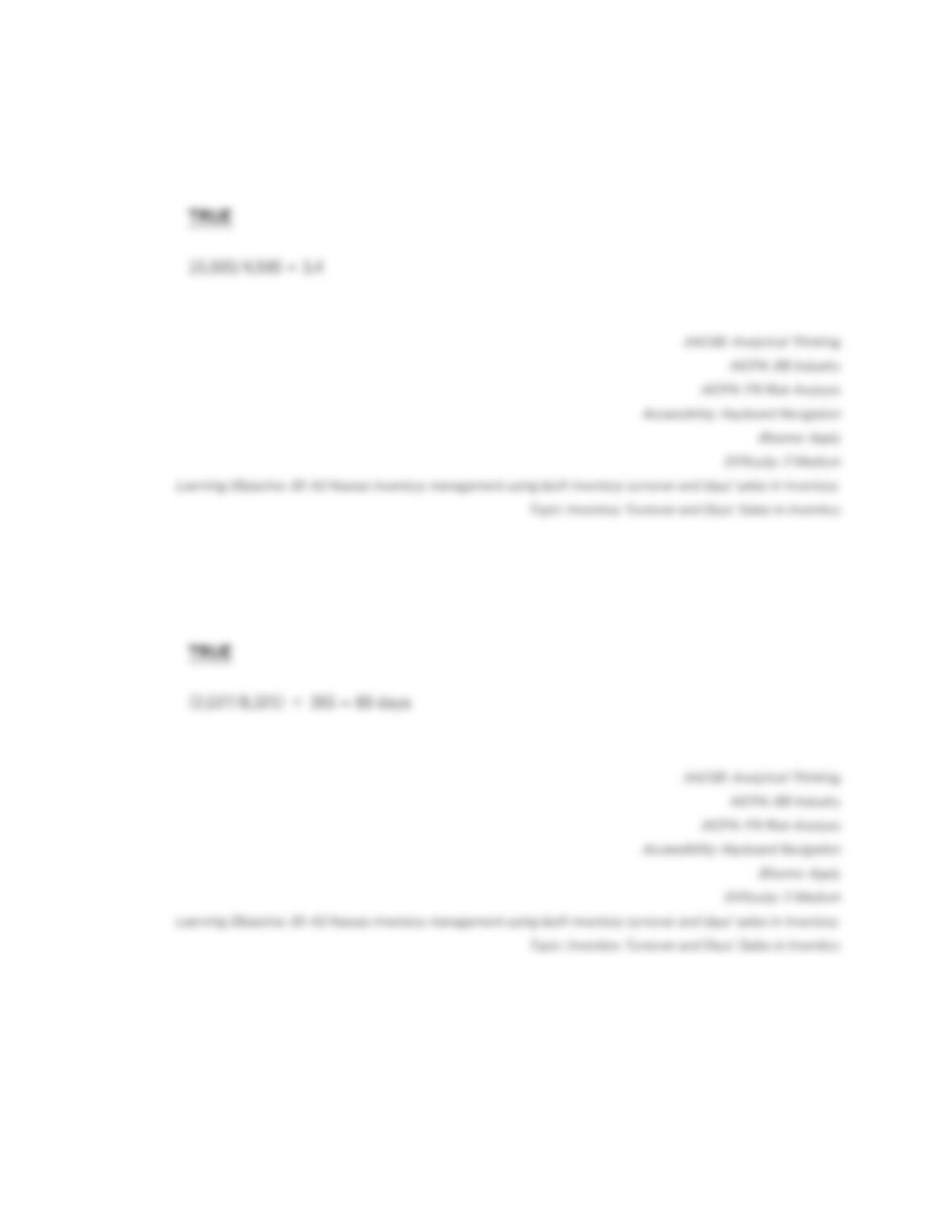
A company’s cost of goods sold was $15,500 and its average merchandise inventory was
$4,500. Its inventory turnover equals 3.4.
38.
Toys “R” Us had cost of goods sold of $8,321 million and ending inventory of $2,027
million. Based on this, its days’ sales in inventory is equal to 89 days.
39.
One of the most important decisions in accounting for inventory is determining the per unit
costs assigned to inventory items.
40.
The four methods of inventory valuation are SIFO, FIFO, LIFO, and average cost.
41.
When units are purchased at different costs over time, it is simple to determine the cost
per unit assigned to inventory.
5-17
42.
LIFO assumes that inventory costs flow in the order they were incurred.
43.
The assignment of costs to cost of goods sold and inventory using weighted average yields
the same results depending on whether a perpetual or periodic system is used.
5-18
44.
The FIFO inventory method assumes that costs for the most recently purchased items are
the first to be charged to the cost of goods sold.
45.
Three key variables determine the dollar value of inventory: (1) inventory quantity, (2)
costs of inventory, and (3) cost flow assumption.
46.
The assignment of costs to cost of goods sold and ending inventory using specific
identification is the same for both the perpetual and periodic systems.
5-19
47.
The cost of goods purchased will differ under the four inventory valuation methods of
specific identification, FIFO, LIFO, and weighted average.
48.
The assignment of costs to the cost of goods sold and to inventory under FIFO is the same
for both the perpetual and periodic inventory systems.
5-20
49.
Under LIFO, the most recent costs are assigned to ending inventory.
50.
The matching principle requires that the inventory valuation method used match the
physical flow of inventory.
51.
The choice of an inventory valuation method can have a major impact on gross profit and
cost of sales.