____
1.
Merchandise inventory (beginning)
____
2.
Cash dividends declared on common stock
____
3.
Flood loss (infrequent and unusual)
____
4.
Expenses incurred as a result of a strike
____
5.
Discount on bonds payable
____
6.
Correction of erroneous overstatement of last year’s ending inventory
____
7.
Loss from write-off of a significant accounts receivable (frequent, not unusual)
____
8.
Additional depreciation on office equipment resulting from decrease in estimated useful life
____
9.
Interest expense
____
10.
Transportation-in
Required:
Indicate where each component would be reported in the financial statements by inserting the corresponding code letters in the space provided.
102. The Samba Company, during 2010, reported net income on its income statement of $90,000. There were
8,000 shares of common stock outstanding during the entire year, and a $5 per-share dividend was declared on
November 21, 2010. During the year, it was discovered that depreciation of $50,000 was overstated in 2008 on
some production equipment. The retained earnings balance on January 1, 2010 was $300,000, and the income
tax rate on all items of income is 40%.
Required:
Prepare a retained earnings statement for the year ended December 31, 2010.
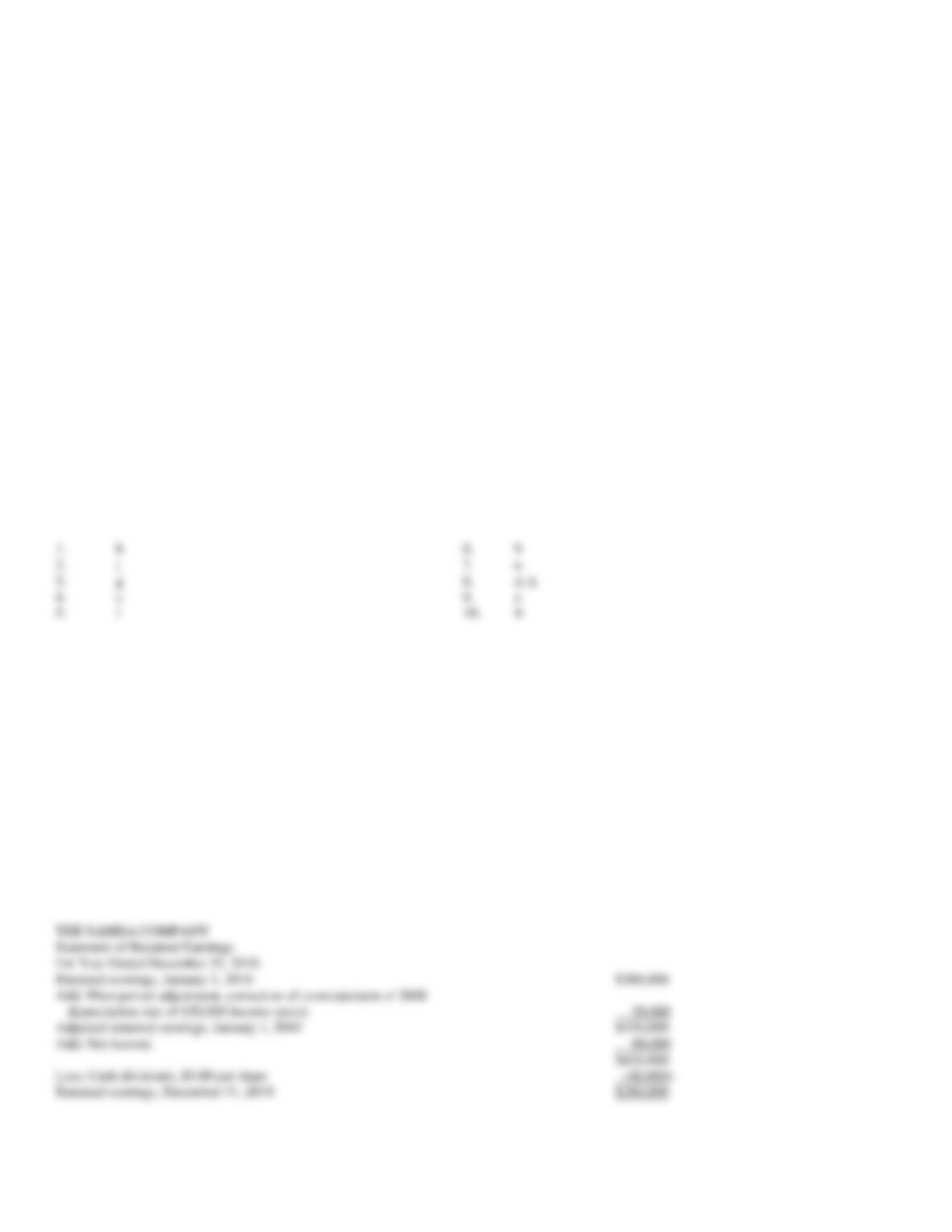
Retained earnings, January 1, 2010
$300,000
Add: Prior period adjustment, correction of overstatement of 2008
depreciation (net of $20,000 income taxes)
30,000
Adjusted retained earnings, January 1, 2010
$330,000
Add: Net income
90,000
$420,000
b
h
2.
j
7.
e
3.
g
8.
d, k
4.
e
9.
e
l
b
103. Retained earnings for Smith Corporation as reported on January 1, 2010, was $40,000. During 2010, net
income of $15,400 was earned and $12,000 of dividends were distributed. In addition, the following two
material errors were found in 2010:
·
At the end of 2009, ending inventory was overstated by $5,000.
·
In 2009, equipment depreciation was recorded at $5,000 instead of the correct $4,000.
The tax rate is 30%.
Required:
Prepare a statement of retained earnings for the year ended December 31, 2010.
104. On December 31, 2010, Mela Company’s adjusted trial balance contained the following account balances:
Sales
$175,000
Operating expenses
18,000
Unrealized decrease in value of available for sale securities
10,000
Cost of goods sold
100,000
The income tax rate is 30%, and the company had 2,000 shares of common stock outstanding during the year.
Required:
a.
Prepare the income statement for the year 2010 that includes comprehensive income.
b.
Prepare the income statement for the year 2010 and a separate statement of comprehensive income.
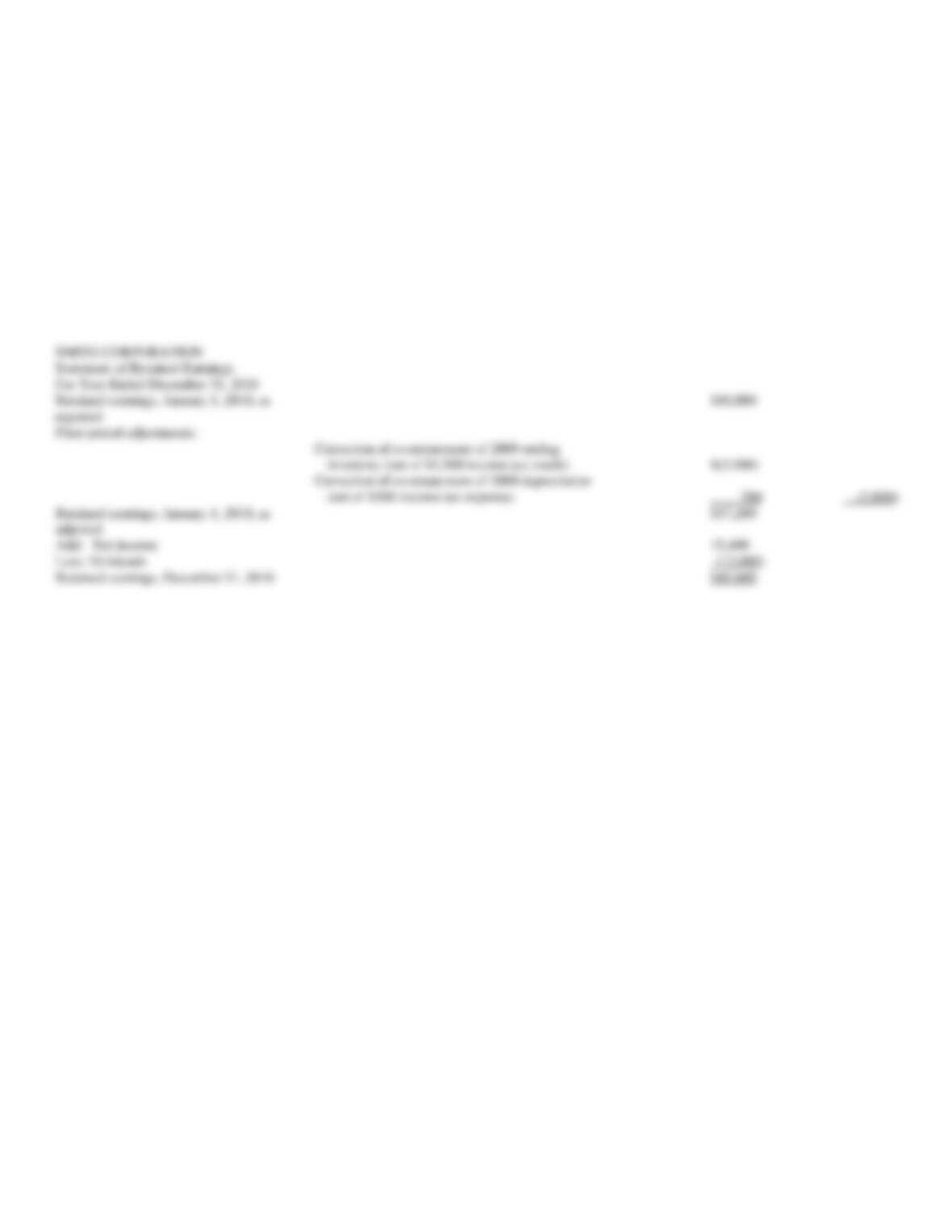
Prior period adjustments:
Correction of overstatement of 2009 ending
inventory (net of $1,500 income tax credit)
$(3,500)
Correction of overstatement of 2009 depreciation
(net of $300 income tax expense)
700
Add: Net income
15,400
Less: Dividends
(12,000)
Retained earnings, December 31, 2010
$40,600
105. Brady, Inc.’s adjusted trial balance contains the following account balances at December 31, 2010:
Cost of goods sold
$250,000
Depreciation expense
7,000
Loss on sale of equipment
5,000
Rent expense
12,000
Sales
410,000
Sales commissions
34,000
Sales discounts
22,000
Unrealized decrease in value of available for sale securities
12,000
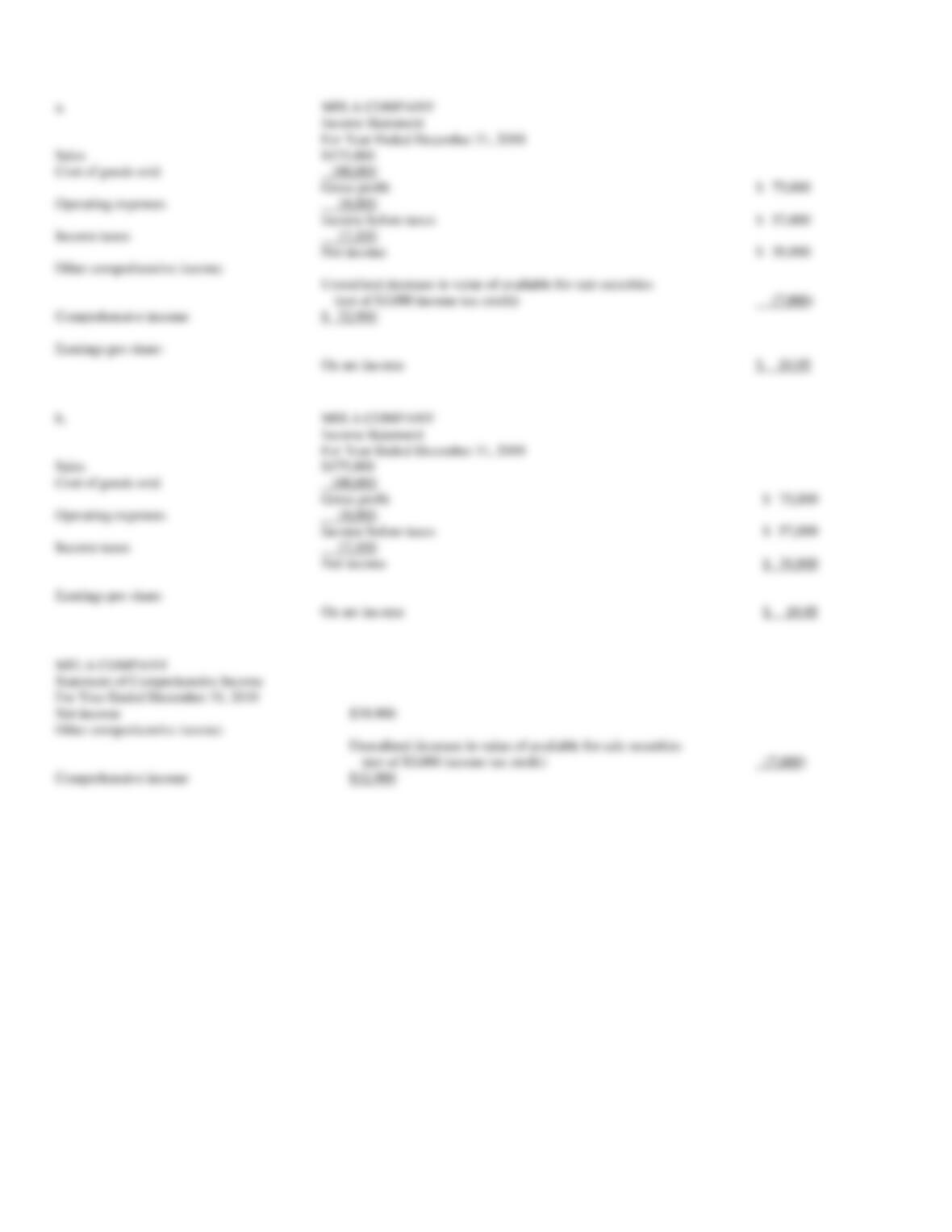
Sales
$175,000
Cost of goods sold
100,000
Gross profit
$ 75,000
Operating expenses
18,000
Income before taxes
$ 57,000
Income taxes
17,100
Net income
$ 39,900
Other comprehensive income:
Unrealized decrease in value of available for sale securities
(net of $3,000 income tax credit)
(7,000)
Comprehensive income
$ 32,900
Earnings per share:
On net income
$ 19.95
Sales
$175,000
Cost of goods sold
100,000
Gross profit
$ 75,000
Operating expenses
18,000
Income before taxes
$ 57,000
Income taxes
17,100
Net income
$ 39,900
Earnings per share:
On net income
$ 19.95
Net income
$39,900
Other comprehensive income:
Unrealized decrease in value of available for sale securities
(net of $3,000 income tax credit)
(7,000)
Comprehensive income
$32,900
Income taxes are 30% on all items, and there were 2,000 shares of common stock outstanding during the year.
Required:
Prepare a statement of comprehensive income.
106. For income reporting purposes, items can appear in any of the following components of the income
statement, retained earnings statement, and related schedules and footnotes:
a.
income from continuing operations or supporting schedules
b.
extraordinary gains or losses
c.
results from discontinued operations
d.
statement of comprehensive income
e.
statement of retained earnings
f.
footnote disclosure
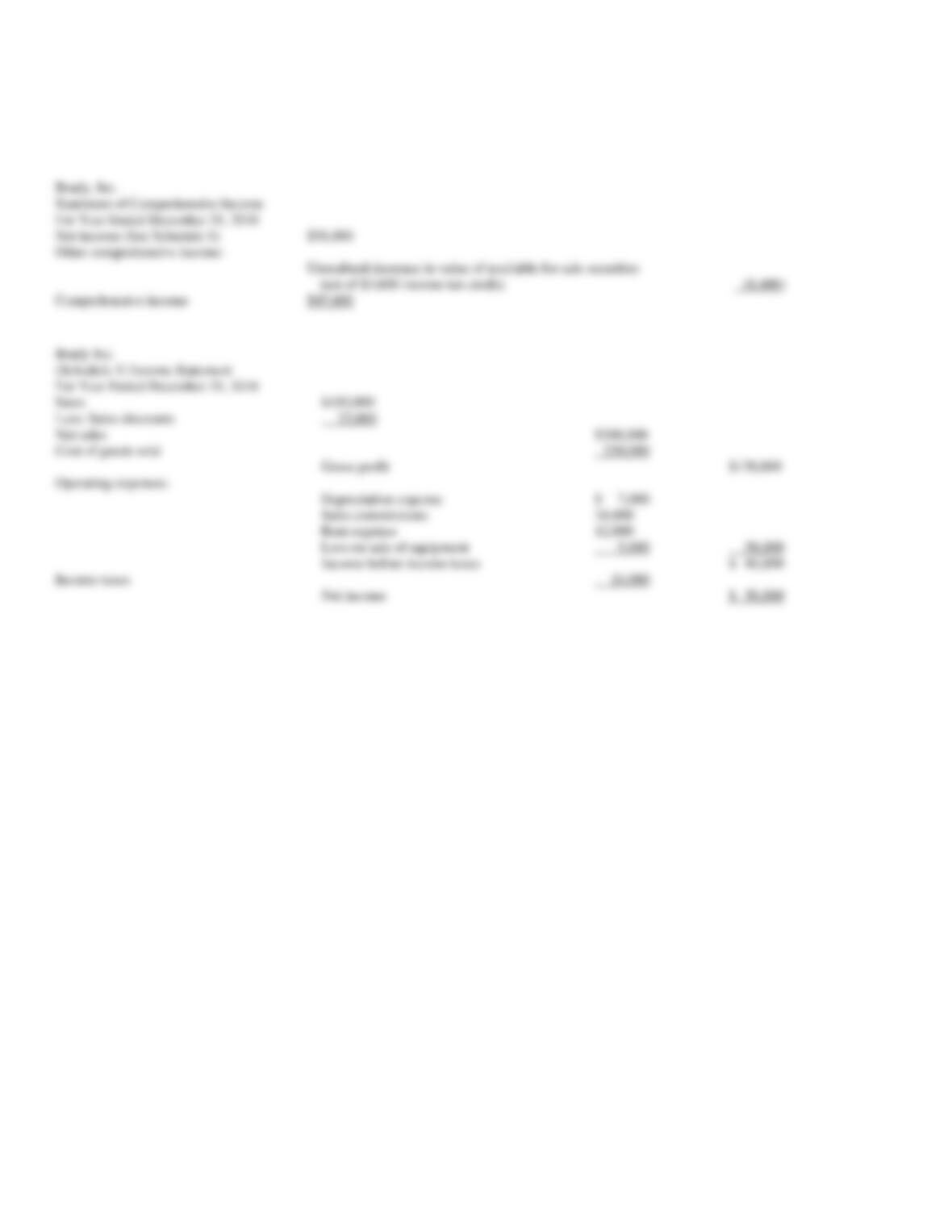
Net income (See Schedule 1)
$56,000
Other comprehensive income:
Unrealized decrease in value of available for sale securities
(net of $3,600 income tax credit)
(8,400)
Comprehensive income
$47,600
Sales
$410,000
Less: Sales discounts
22,000
Net sales
$388,000
Cost of goods sold
250,000
Gross profit
$138,000
Operating expenses:
Depreciation expense
$ 7,000
Sales commissions
34,000
Rent expense
12,000
Loss on sale of equipment
5,000
58,000
Income before income taxes
$ 80,000
Income taxes
24,000
Net income
$ 56,000

Several items of accounting information are listed below:
____
1.
Loss resulting from earthquake damage
____
2.
Selling expenses
____
3.
Loss on sale of plant assets
____
4.
Unrealized losses due to market value changes in available for sale equity security investments
____
5.
Correction of a miscount in last year’s ending goods-in-process inventory
____
6.
Cash dividends declared on common stock
____
7.
Unrealized gains due to foreign currency translation adjustments
____
8.
Interest revenue
____
9.
Loss on sale of a major component of the business
____
10.
How a company defines cash and cash equivalents
Required:
By placing the letters (a-f) in the spaces provided above, identify where the information would be most appropriately reported. If the information
would not appear in any of the above components, place an (X) in the space.
107. The following are several items involving the cash flow activities of the Pretzel Company for 2010:
Net income
$62,000
Payment of dividends
$15,000
1,000 shares of stock were issued at $20 par
$20,000
Amortization expense on patents
$ 4,000
Plant assets were acquired at a cost of
$60,000
Accounts receivable increased by
$ 8,000
Accounts payable decreased by
$12,000
Salaries payable increased by
$ 5,000
Beginning cash balance
$18,000
1.
b
6.
e
a
d
3.
a
8.
a
5.
e
10.
f
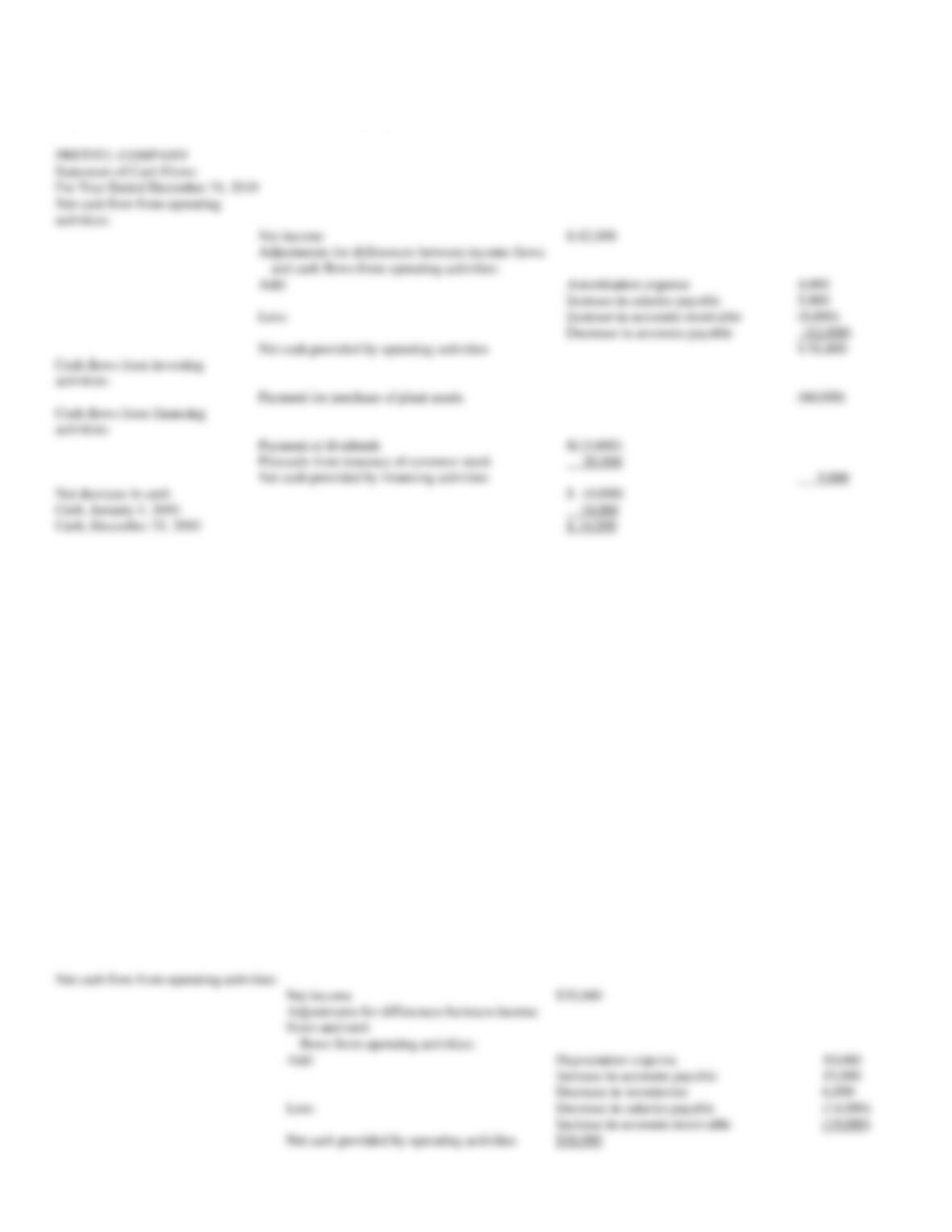
Required:
Prepare the statement of cash flows of the Pretzel Company for 2010.
108. The following are accounting items taken from the records of the Palin Company for 2010:
Payment of dividends
$ 4,000
Increase in accounts payable
$15,000
Increase in accounts receivable
$19,000
Decrease in inventories
$ 6,000
Decrease in salaries payable
$14,000
Net income
$42,000
Payment for purchase of land and buildings
$60,000
Issuance of ten-year bonds payable at par
$50,000
Depreciation expense
$10,000
Required:
Prepare the net cash flow from operating activities section of the Palin Company’s 2010 statement of cash flows.
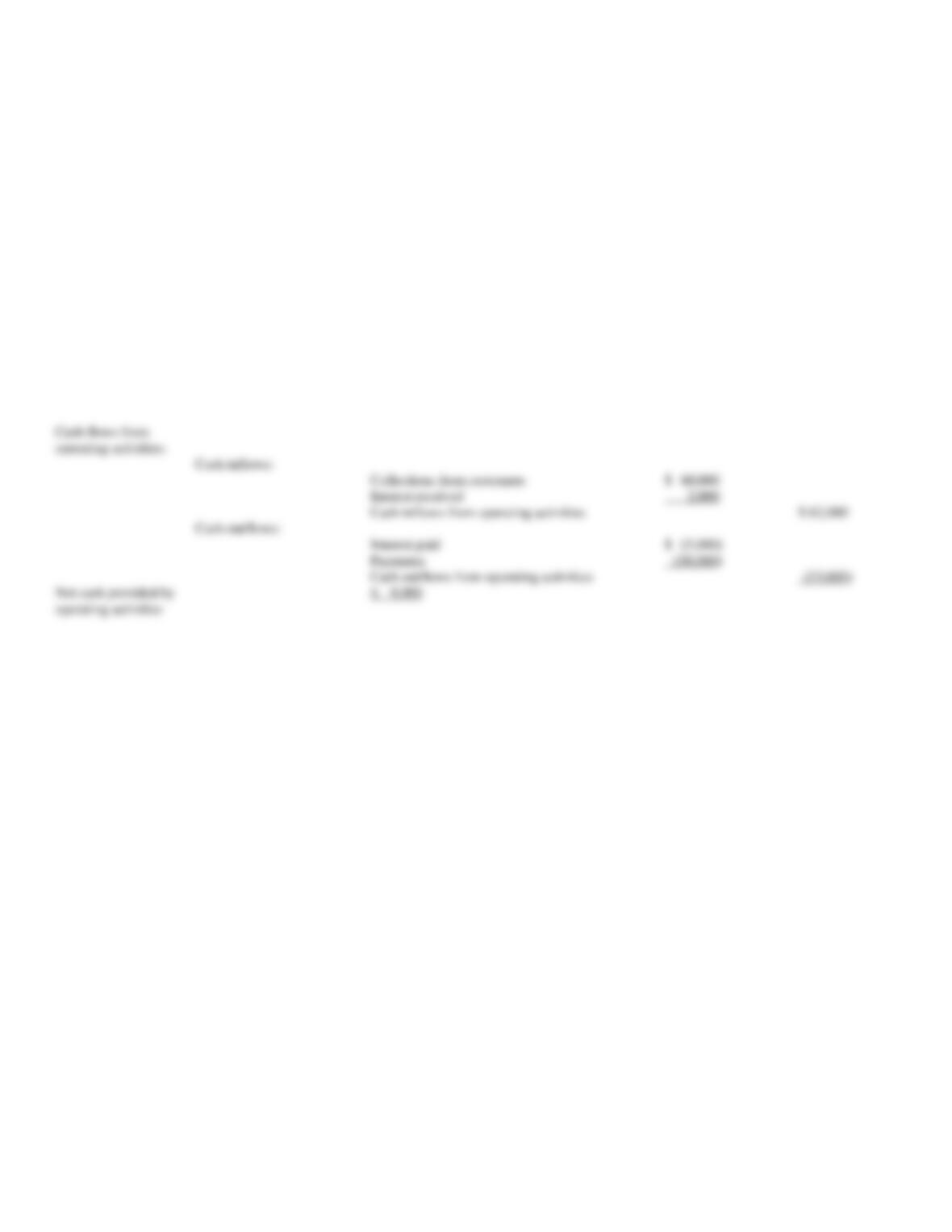
Net cash flow from operating activities:
Net income
$20,000
flows from operating activities:
Add:
Depreciation expense
Net income
$ 62,000
Adjustments for differences between income flows
and cash flows from operating activities:
Add:
Amortization expense
4,000
Increase in salaries payable
5,000
Less:
Increase in accounts receivable
(8,000)
Decrease in accounts payable
(12,000)
Net cash provided by operating activities
$ 51,000
Payment for purchase of plant assets
(60,000)
Payment of dividends
$(15,000)
Proceeds from issuance of common stock
20,000
Net cash provided by financing activities
5,000
Net decrease in cash
$ (4,000)
Cash, January 1, 2010
18,000
Cash, December 31, 2010
$ 14,000
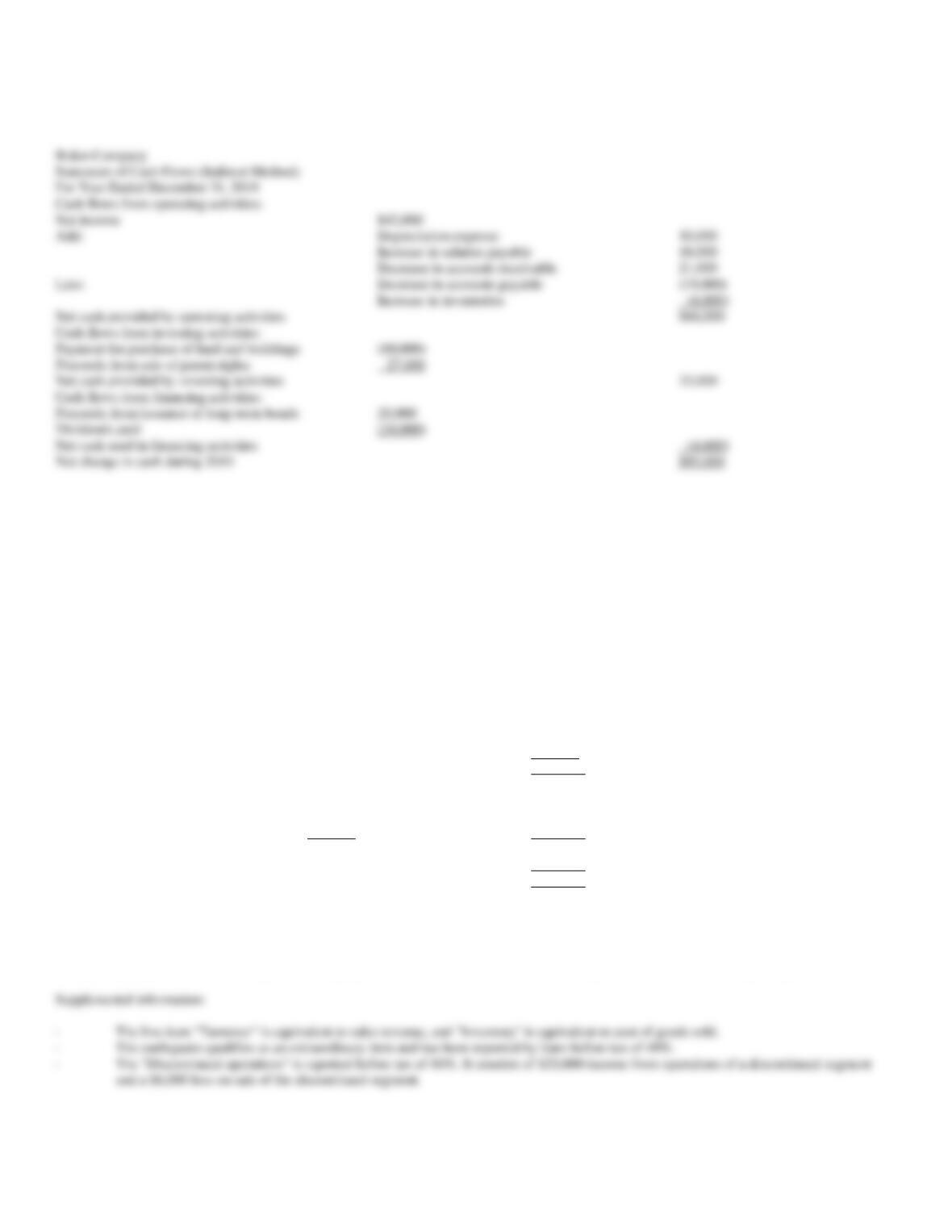
109. The following cash flows and other information pertain to the El Cajon Company for 2010:
Proceeds from sale of stock
$25,000
Interest received
$ 2,000
Dividends received
1,000
Payments to suppliers
12,000
Depreciation expense
1,500
Net income
12,000
Proceeds from sale of equipment
15,000
Decrease in inventory
8,000
Collections from customers
60,000
Cost of goods sold
46,000
Interest paid
3,000
Required:
Prepare the operating activities section of the statement of cash flows for 2010, using the direct method.
110. The following are accounting items taken from the records of the Biden Company for 2010:
Payment of dividends
$24,000
Decrease in accounts payable
$19,000
Decrease in accounts receivable
$21,000
Increase in inventories
$ 6,000
Increase in salaries payable
$18,000
Net income
$42,000
Payment for purchase of land and buildings
$60,000
Issuance of ten-year bonds payable at par
$20,000
Depreciation expense
$10,000
Proceeds from sale of patent rights
$27,000
Cash inflows:
Collections from customers
$ 60,000
Interest received
2,000
Cash inflows from operating activities
$ 62,000
Cash outflows:
Interest paid
$ (3,000)
Payments
(50,000)
Cash outflows from operating activities
(53,000)
Required:
Prepare the statement of cash flows for Biden Company for 2010 using the indirect method.
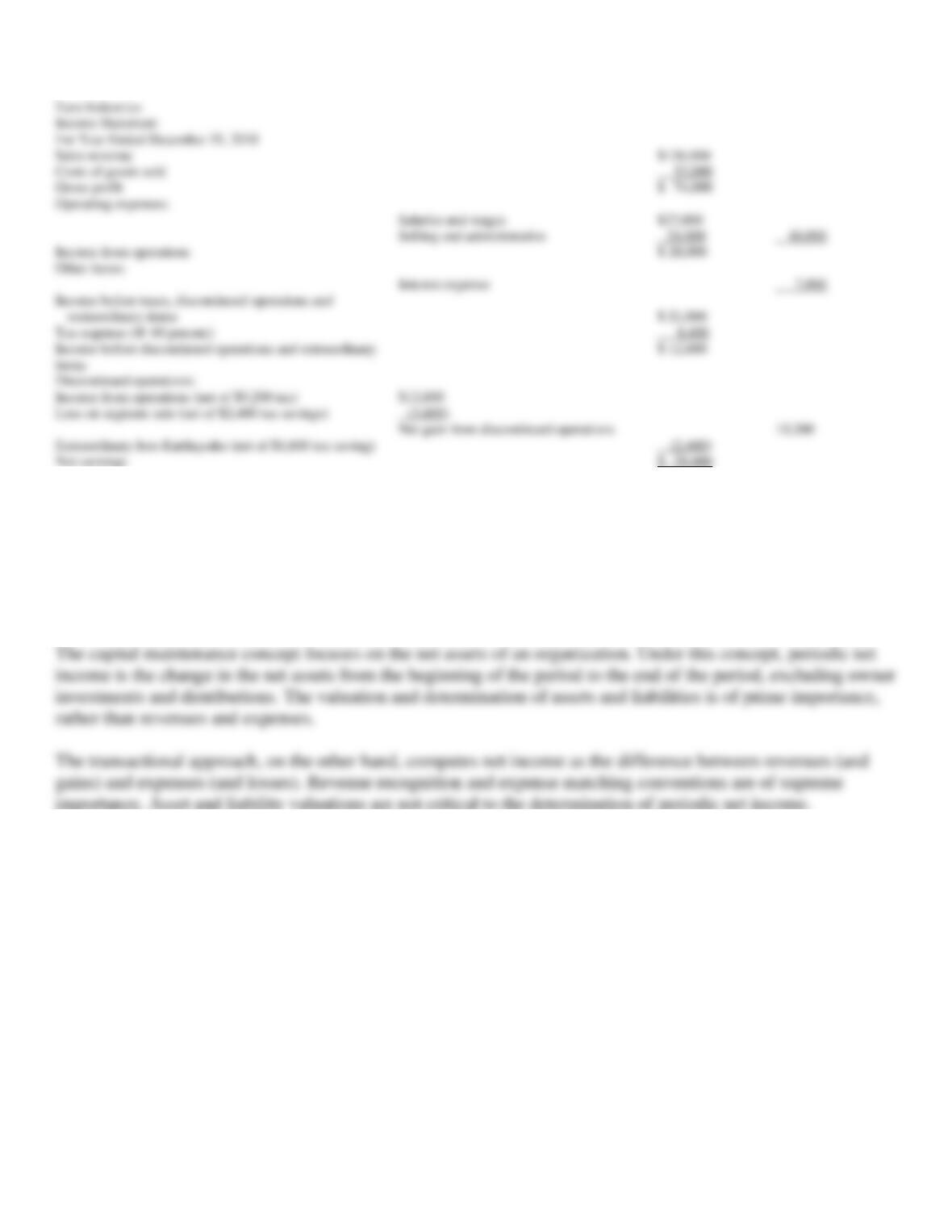
111. Euro Industries has prepared the following statement of earnings for 2010:
Euro Industries
Statement of Earnings
For Year Ended December 31, 2010
Turnover
$126,000
Costs:
Inventory
$52,000
Labor
22,000
Selling
14,000
Interest
7,000
Administrative
10,000
Total operating costs
105,000
Operating profit
$ 21,000
Other income and costs
Earthquake losses
$ (4,000)
Discontinued operations
17,000
13,000
Income before tax
$ 34,000
Taxes (@ 40 percent)
13,600
Net earnings
$ 20,400
Required
Using the supplemental information given below, prepare Euro’s Income Statement in conformity with U.S. GAAP in multiple-step format.
·
The line item “Turnover” is equivalent to sales revenue, and “Inventory” is equivalent to cost of goods sold.
·
The earthquake qualifies as an extraordinary item and has been reported by Euro before tax of 40%.
Cash flows from operating activities:
Net income
$42,000
Add:
Depreciation expense
10,000
Increase in salaries payable
18,000
Decrease in accounts receivable
21,000
Less:
Decrease in accounts payable
(19,000)
Increase in inventories
(6,000)
Net cash provided by operating activities
$66,000
Cash flows from investing activities:
Payment for purchase of land and buildings
(60,000)
Proceeds from sale of patent rights
27,000
Net cash provided by investing activities
33,000
Cash flows from financing activities:
Proceeds from issuance of long-term bonds
20,000
Dividends paid
(24,000)
Net cash used in financing activities
(4,000)
Net change in cash during 2010
$95,000
112. Income measurement is a fundamental accounting concept, and yet the computation of periodic income has
caused the accounting profession some difficulty. Economists and accountants have long debated what
constitutes income and how it should be measured. The capital maintenance and transactional methods have
been advocated as means of determining and measuring periodic income. Discuss these two income concepts.
113. The accounting profession has developed three alternatives for matching expenses: association of cause
and effect, systematic and rational allocation, and immediate recognition. Discuss the conceptual merits of each
alternative and give two examples for each expense matching alternative.
114. A beginning accounting student has just learned how to prepare an income statement and has been told
how valuable it is in the measurement of a company’s profitability. However, he asks you, as an upper division
accounting student, if there are any limitations to the information contained on the statement.
Required:
Discuss four limitations of the income statement.
115. Why did FASB decide it was necessary to require the reporting of both net income and comprehensive
income?
FASB wants companies to report under the all-inclusive concept of net income. To improve full disclosures of
items that were reported as a change to stockholders’ equity and in footnote disclosures, FASB has companies
report comprehensive income. Comprehensive income consists of net income and other comprehensive income.
Examples of items reported as part of other comprehensive income include:
116. Describe the major differences that still exist between the income statement information presentation
requirements under IFRS and GAAP.