101) A company had the following purchases and sales during its first year of operations:
Purchases
Sales
January:
10 units at $120
6 units
February:
20 units at $125
5 units
May:
15 units at $130
9 units
September:
12 units at $135
8 units
November:
10 units at $140
13 units
On December 31, there were 26 units remaining in ending inventory. Using the periodic LIFO
inventory costing method, what is the cost of the ending inventory? (Assume all sales were made
on the last day of the month.)
A) $3,405.
B) $3,270.
C) $3,200.
D) $3,364.
E) $5,400.
10
@
$120
16
@
$125
26 units
102) A company had the following purchases and sales during its first year of operations:
Purchases
Sales
January:
10 units at $120
6 units
February:
20 units at $125
5 units
May:
15 units at $130
9 units
September:
12 units at $135
8 units
November:
10 units at $140
13 units
On December 31, there were 26 units remaining in ending inventory. Using the perpetual FIFO
inventory costing method, what is the value of cost of goods sold? (Assume all sales were made
on the last day of the month.)
A) $8,670.
B) $3,540.
C) $5,400.
D) $5,130.
E) $3,270.
10
@
$120
20
@
$125
11
@
$130
41 units
103) A company had the following purchases and sales during its first year of operations:
Purchases
Sales
January:
10 units at $120
6 units
February:
20 units at $125
5 units
May:
15 units at $130
9 units
September:
12 units at $135
8 units
November:
10 units at $140
13 units
On December 31, there were 26 units remaining in ending inventory. Using the periodic FIFO
inventory costing method, what is the value of cost of goods sold? (Assume all sales were made
on the last day of the month.)
A) $8,670.
B) $3,540.
C) $5,400.
D) $5,130.
E) $3,270.
10
@
$120
20
@
$125
11
@
$130
41 units
104) A company had the following purchases and sales during its first year of operations:
Purchases
Sales
January:
10 units at $120
6 units
February:
20 units at $125
5 units
May:
15 units at $130
9 units
September:
12 units at $135
8 units
November:
10 units at $140
13 units
On December 31, there were 26 units remaining in ending inventory. Using the perpetual LIFO
inventory costing method, what is the value of cost of goods sold? (Assume all sales were made
on the last day of the month.)
A) $8,670.
B) $5,400.
C) $5,470.
D) $5,130.
E) $5,305.
6
@
$120
5
@
$125
9
@
$130
11
@
$135
10
@
$140
41 units
105) A company had the following purchases and sales during its first month of operations:
January 1
Purchased 10 units at $4.00 per unit
January 9
Sold 6 units at $12.00 per unit
January 17
Purchased 8 units at $5.50 per unit
January 27
Sold 7 units at $12.00 per unit
Using the perpetual weighted average method, what is the value of cost of goods sold? (Round
weighted average costs per unit to 2 decimal places.)
A) $40.00.
B) $59.00.
C) $25.00.
D) $24.00.
E) $23.35.
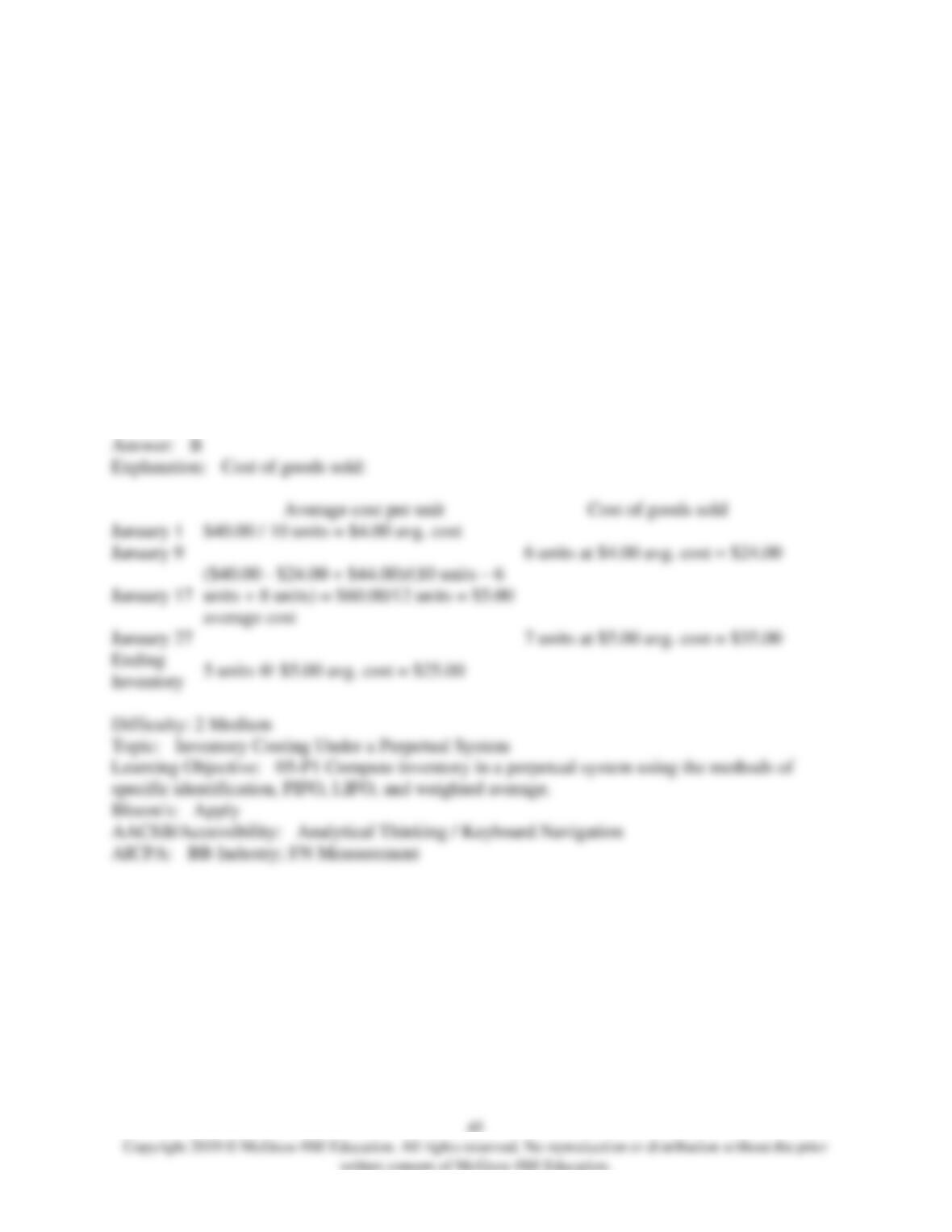
January 1
$40.00 / 10 units = $4.00 avg. cost
January 9
6 units at $4.00 avg. cost = $24.00
average cost
January 27
7 units at $5.00 avg. cost = $35.00
Inventory
106) A company had the following purchases and sales during its first year of operations:
Purchases
Sales
January:
10 units at $120
6 units
February:
20 units at $125
5 units
May:
15 units at $130
9 units
September:
12 units at $135
8 units
November:
10 units at $140
13 units
On December 31, there were 26 units remaining in ending inventory. Using the periodic LIFO
inventory costing method, what is the value of cost of goods sold? (Assume all sales were made
on the last day of the month.)
A) $8,670.
B) $5,400.
C) $5,470.
D) $3,200.
E) $5,130.
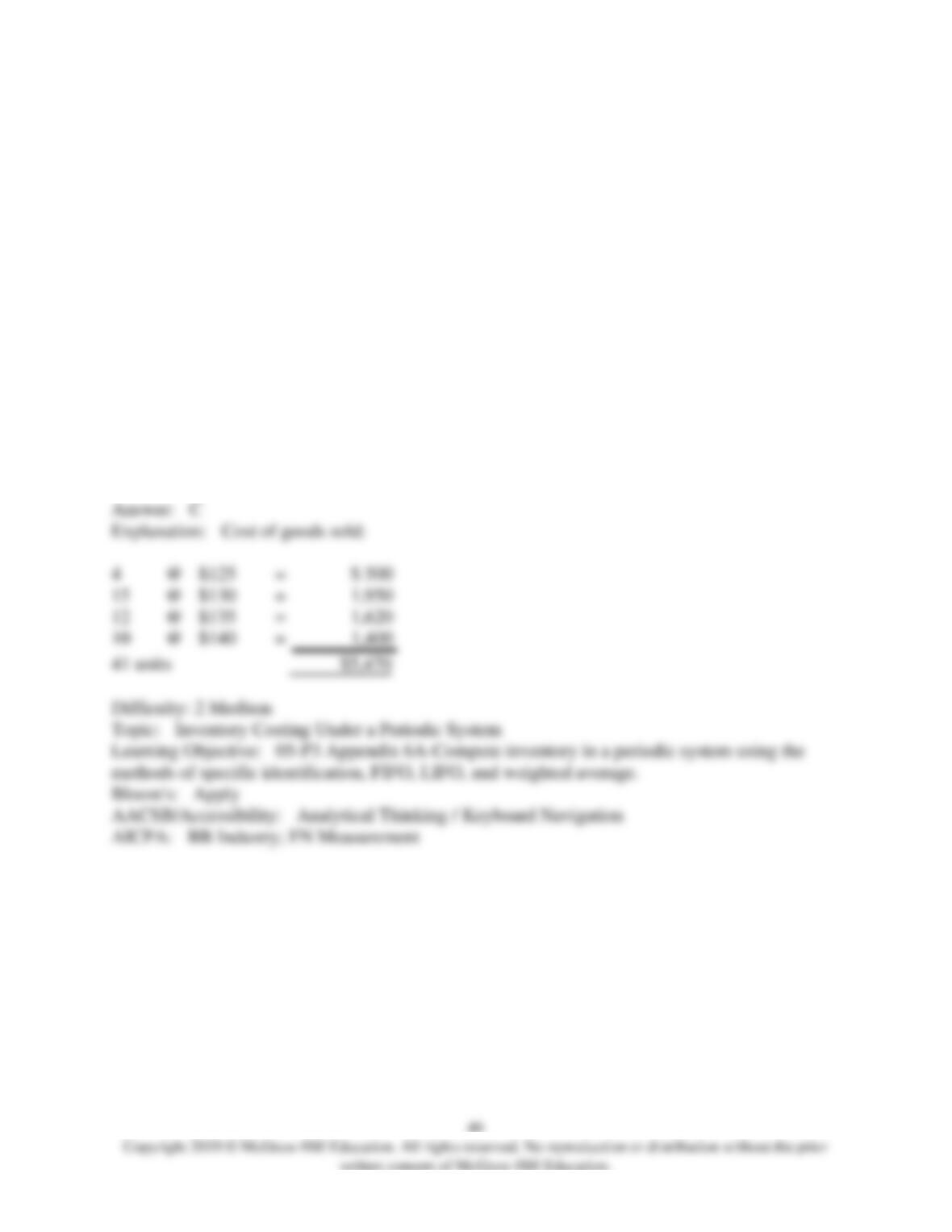
4
@
$125
15
@
$130
12
@
$135
10
@
$140
41 units
107) A company had the following purchases and sales during its first month of operations:
January 1
Purchased 10 units at $4.00 per unit
January 9
Sold 6 units at $12.00 per unit
January 17
Purchased 8 units at $5.50 per unit
January 27
Sold 7 units at $12.00 per unit
Using the Periodic weighted average method, what is the value of cost of goods sold? (Round
weighted average cost per unit to 2 decimal places, and final answer to the nearest whole
dollar.)
A) $84.
B) $61.
C) $23.
D) $27.
E) $5.
108) A company had inventory on November 1 of 5 units at a cost of $20 each. On November 2,
they purchased 10 units at $22 each. On November 6 they purchased 6 units at $25 each. On
November 8, 8 units were sold for $55 each. Using the LIFO perpetual inventory method, what
was the value of the inventory on November 8 after the sale?
A) $304
B) $296
C) $288
D) $280
E) $276
109) Marquis Company uses a weighted-average perpetual inventory system and has the
following purchases and sales:
August 2
10 units were purchased at $12 per unit.
August 18
15 units were purchased at $14 per unit.
August 29
12 units were sold.
What is the amount of the cost of goods sold for this sale? (Round average cost per unit to 2
decimal places.)
A) $148.00
B) $150.50
C) $158.40
D) $210.00
E) $330.00
110) Monarch Company uses a weighted-average perpetual inventory system, and has the
following purchases and sales:
January 1
20 units were purchased at $10 per unit.
January 12
12 units were sold.
January 20
18 units were purchased at $11 per unit.
What is the value of ending inventory? (Round average cost per unit to 2 decimal places and
final answer to the nearest dollar.)
A) $278.
B) $272.
C) $126.
D) $398.
E) $120.
111) Monarch Company uses a weighted-average perpetual inventory system and has the
following purchases and sales:
January 1
20 units were purchased at $10 per unit.
January 12
12 units were sold.
January 20
18 units were purchased at $11 per unit.
What is the value of cost of goods sold?
A) $278.
B) $272.
C) $126.
D) $398.
E) $120.
112) Eastview Company uses a perpetual LIFO inventory system, and has the following
purchases and sales:
January 1
150 units were purchased at $9 per unit.
January 17
120 units were sold.
January 20
160 units were purchased at $11 per unit.
January 29
150 units were sold.
What is the value of cost of goods sold?
A) $2,730.
B) $2,750.
C) $2,670.
D) $440.
E) $380.
113) Eastview Company uses a perpetual LIFO inventory system, and has the following
purchases and sales:
January 1
150 units were purchased at $9 per unit.
January 17
120 units were sold.
January 20
160 units were purchased at $11 per unit.
January 29
150 units were sold.
What is the value of ending inventory?
A) $2,730.
B) $2,750.
C) $2,670.
D) $440.
E) $380.
114) Eastview Company uses a periodic LIFO inventory system, and has the following
purchases and sales:
January 1
150 units were purchased at $9 per unit.
January 17
120 units were sold.
January 20
160 units were purchased at $11 per unit.
January 29
150 units were sold.
What is the value of cost of goods sold?
A) $2,730.
B) $2,750.
C) $2,670.
D) $440.
E) $380.
115) Eastview Company uses a periodic LIFO inventory system, and has the following
purchases and sales:
January 1
150 units were purchased at $9 per unit.
January 17
120 units were sold.
January 20
160 units were purchased at $11 per unit.
January 29
150 units were sold.
What is the value of ending inventory?
A) $2,730.
B) $2,750.
C) $2,670.
D) $440.
E) $360.
116) Grays Company has inventory of 10 units at a cost of $10 each on August 1. On August 3,
it purchased 20 units at $12 each. 12 units are sold on August 6. Using the FIFO perpetual
inventory method, what amount will be reported as cost of goods sold for the 12 units that were
sold?
A) $120.
B) $124.
C) $128.
D) $130.
E) $140.
117) McCarthy Company has inventory of 8 units at a cost of $200 each on October 1. On
October 2, it purchased 20 units at $205 each. 11 units are sold on October 4. Using the FIFO
perpetual inventory method, what amount will be reported as cost of goods sold for the 11 units
that were sold?
A) $2,239.
B) $2,255.
C) $2,200.
D) $2,228.
E) $2,215.
118) McCarthy Company has inventory of 8 units at a cost of $200 each on October 1. On
October 2, it purchased 20 units at $205 each. 11 units are sold on October 4. Using the FIFO
perpetual inventory method, what is the value of inventory after the October 4 sale?
A) $3,485.
B) $3,445.
C) $3,500.
D) $3,472.
E) $3,461.
119) Starlight Company has inventory of 8 units at a cost of $200 each on October 1. On October
2, it purchased 20 units at $205 each. 11 units are sold on October 4. Using the LIFO perpetual
inventory method, what amount will be reported in cost of goods sold for the 11 units that were
sold?
A) $2,239.
B) $2,255.
C) $2,200.
D) $2,228.
E) $2,215.
120) Starlight Company has inventory of 8 units at a cost of $200 each on October 1. On October
2, it purchased 20 units at $205 each. 11 units are sold on October 4. Using the LIFO perpetual
inventory method, what is the value of inventory after the October 4 sale?
A) $3,485.
B) $3,445.
C) $3,500.
D) $3,472.
E) $3,461.
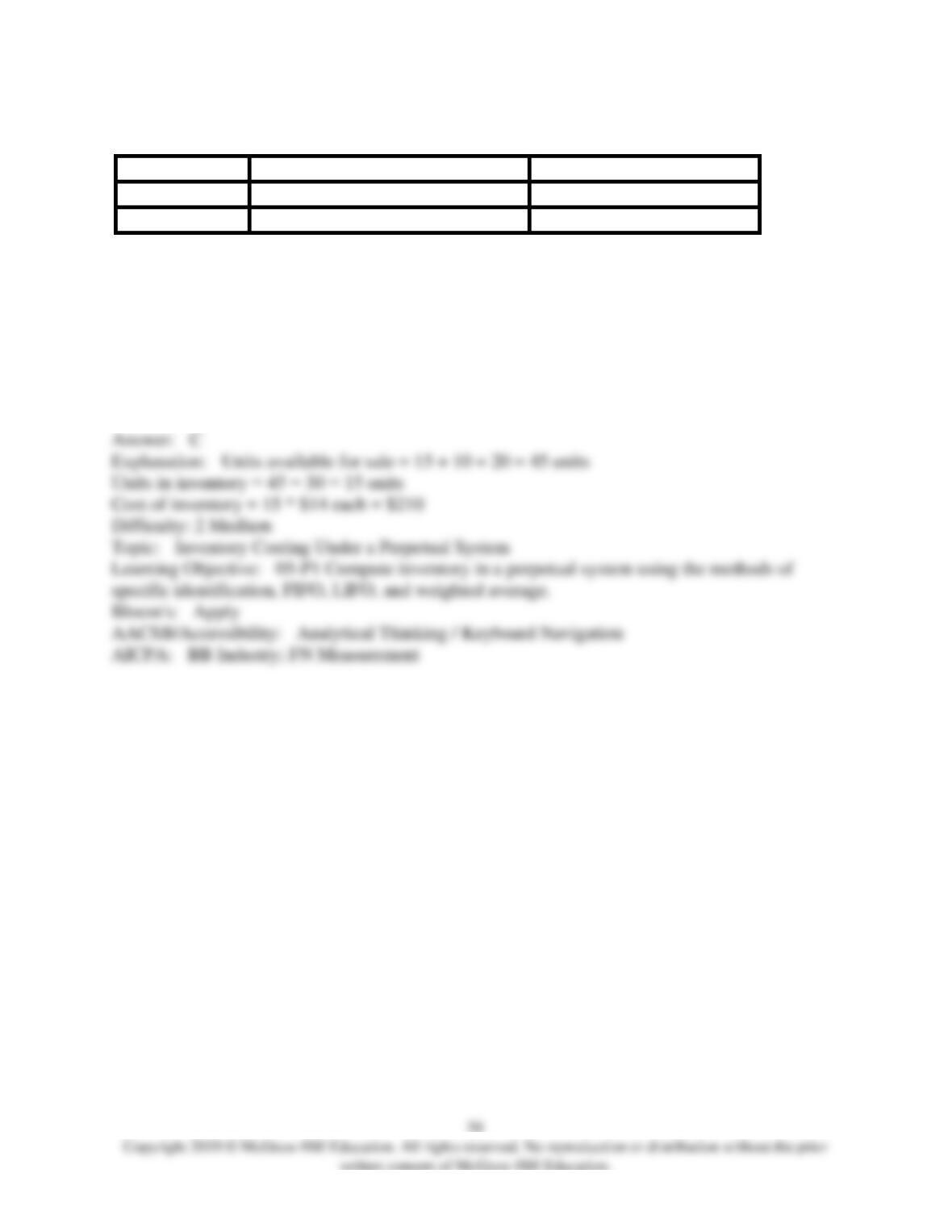
121) A company’s inventory records report the following:
August 1
Beginning balance
15 units @ $12
August 5
Purchase
10 units @ $13
August 12
Purchase
20 units @ $14
On August 15, it sold 30 units. Using the FIFO perpetual inventory method, what is the value of
the inventory at August 15 after the sale?
A) $140
B) $160
C) $210
D) $380
E) $590
122) A company’s inventory records report the following in November of the current year:
Beginning
November 1
5 units @ $20
Purchase
November 2
10 units @ $22
Purchase
November 12
6 units @ $25
On November 8, it sold 12 units for $54 each. Using the LIFO perpetual inventory method, what
was the amount recorded in the cost of goods sold account for the 12 units sold?
A) $254
B) $260
C) $282
D) $188
E) $210
123) A company’s inventory records report the following in November of the current year:
Beginning
November 1
5 units @ $20
Purchase
November 2
10 units @ $22
Purchase
November 12
6 units @ $25
On November 8, it sold 12 units for $54 each. Using the LIFO perpetual inventory method, what
amount of gross profit was earned from the 12 units sold?
A) $577
B) $260
C) $366
D) $438
E) $388