52.
In applying the lower of cost or market method to inventory valuation, market is defined as
the current replacement cost of the same inventory items in the usual manner.
53.
In applying the lower of cost or market method to inventory valuation, market is defined as
the current selling price.
54.
A company has inventory with a market value of $217,000 and a cost of $241,000.
According to the lower of cost or market, the inventory should be written down to
$217,000.
55.
The lower of cost or market rule for inventory valuation must be applied to only individual
items of inventory, not to major categories of inventory or to the entire inventory.
56.
The conservatism constraint prescribes that the most optimistic amount is used when
more than one estimate of the amount to be received or paid in the future exists and these
estimates are about equally likely.
57.
A company’s cost of inventory was $317,500. Due to phenomenal demand for this product,
the market value of its inventory increased to $323,000. According to the consistency
principle, this company should write up the value of its inventory.
58.
When LIFO is used with the periodic inventory system, cost of goods sold is assigned
costs from the most recent purchases.
59.
Monthly or quarterly statements are called interim statements because they are prepared
for periods of less than one year.
60.
The retail inventory method estimates the cost of ending inventory by applying the gross
profit ratio to net sales.
61.
The reasoning behind the retail inventory method is that if an accurate estimate of the
cost-to-retail ratio is made, ending inventory at retail can be multiplied by the ratio to
estimate ending inventory at cost.
62.
The reliability of the gross profit method depends on an accurate and stable estimate of
the gross profit ratio.
63.
In the retail inventory method of inventory valuation, the retail amount of inventory refers
to the dollar amount measured using selling prices of inventory items.
5-26
64.
To avoid the time-consuming process of taking an inventory each year, the majority of
companies use the gross profit method to estimate ending inventory.
65.
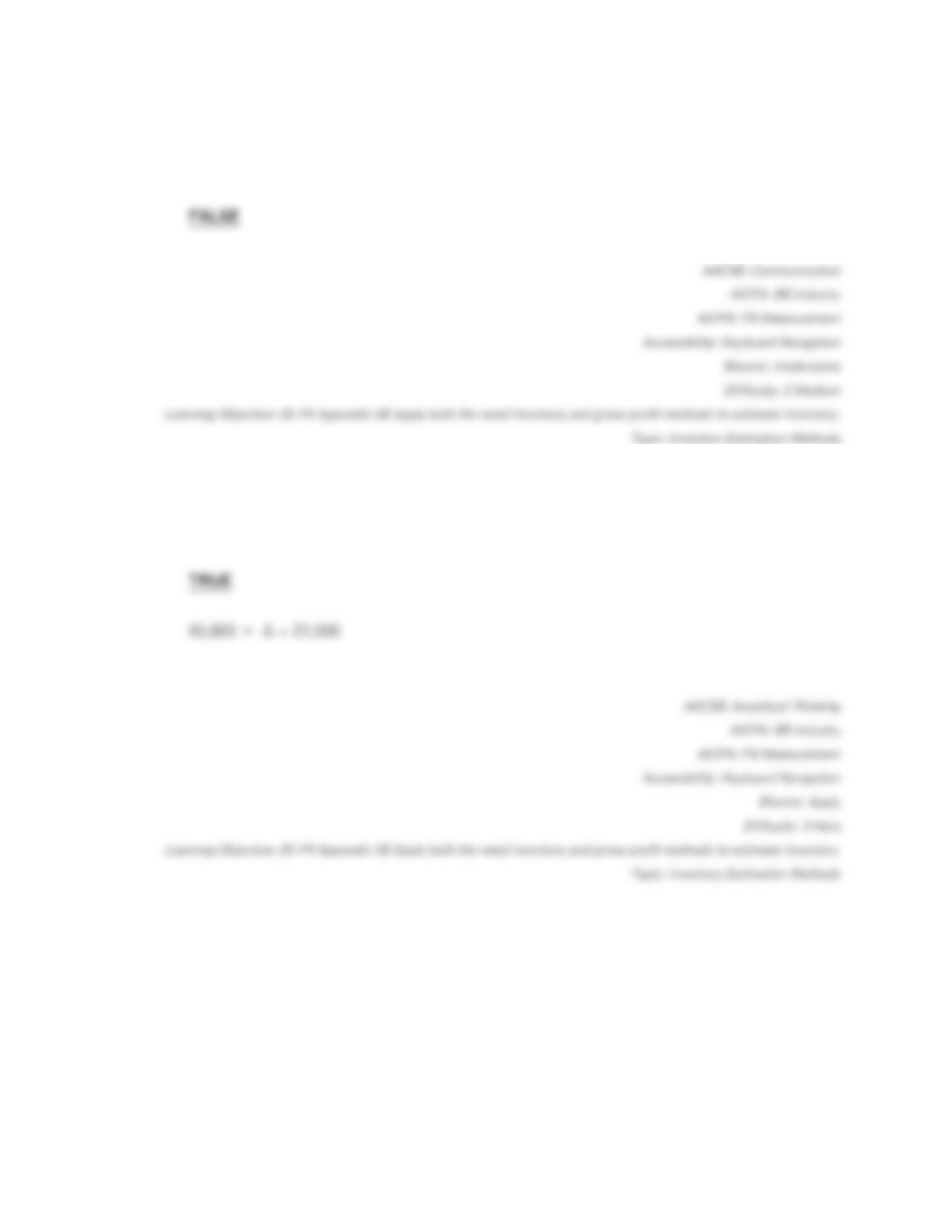
Using the retail inventory method, if the cost to retail ratio is 60% and ending inventory at
retail is $45,000, then estimated ending inventory at cost is $27,000.
Multiple Choice Questions
66.
Damaged and obsolete goods:
67.
Merchandise inventory includes:
68.
Goods in transit are included in a purchaser’s inventory:
69.
Goods on consignment:
70.
Given the following items and costs as of the balance sheet date, determine the value of
Faltron Company’s merchandise inventory.
• $1,000 of goods sold by Faltron to another
company are in transit and shipping terms are
FOB destination.
• $2,000 of goods sold by another company to
Faltron are in transit and shipping terms are FOB
destination.
• $3,000 of goods owned by Faltron are in the
possession of a consignee.
• Damaged goods owned by Faltron that
originally cost $4,000 now have a $500 net
realizable value.
71.
Physical inventory counts:
72.
Given the following items and costs as of the balance sheet date, determine the value of
Light Company’s merchandise inventory.
• $2,000 of goods sold by Light to another
company are in transit and shipping terms are
FOB shipping point.
• $3,000 of goods sold by another company to
Light are in transit and shipping terms are FOB
shipping point.
• $4,000 of goods owned by Light are in the
possession of a consignee.
• Damaged goods owned by Light that originally
cost $5,000 now have an $800 net realizable
value.
73.
During a period of steadily rising costs, the inventory valuation method that yields the
lowest reported net income is:
74.
Upon taking a physical count of its inventory, Damber Corp. determines that $5,500 of
goods have become damaged due to a water leak in the warehouse. It is decided that
$2,300 of the goods are not sellable and the remainder can be sold at a reduced price of
$2,750. The cost incurred to sell the goods will be $800. The damaged goods should be
included in inventory at a value of:
75.
The inventory valuation method that tends to smooth out erratic changes in costs is:
76.
Which inventory valuation method assigns a value to the inventory on the balance sheet
that approximates current cost and also mimics the actual flow of goods for most
businesses?
77.
The inventory valuation method that results in the lowest taxable income in a period of
rising costs is:
78.
The consistency concept:
79.
The full disclosure principle:
80.
An error in the period-end inventory causes an offsetting error in the next period and
therefore:
81.
The understatement of the ending inventory balance causes:
82.
The understatement of the beginning inventory balance causes:
83.
An overstatement of ending inventory will cause:
84.
The inventory turnover ratio:
85.
Days’ sales in inventory:
86.
The inventory turnover ratio is calculated as:
87.
Days’ sales in inventory is calculated as:
88.
Toys “R” Us had cost of goods sold of $9,421 million, ending inventory of $2,089 million,
and average inventory of $1,965 million. The inventory turnover equals: