7. Given the following information, prepare in good form the cost of goods sold section of an income
statement for 2013.
Freight-In
$ 16,000
Merchandise Inventory, December 31, 2012
60,000
Merchandise Inventory, December 31, 2013
64,000
Purchases
152,000
Purchases Returns and Allowances
7,200
Merchandise inventory, December 31, 2012
Purchases
$152,000
Less purchases returns and allowances
Net purchases
$144,800
Freight-in
Net cost of purchases
Goods available for sale
Cost of goods sold
8. Given the following information, prepare in good form the cost of goods sold section of an income
statement for 2013.
Freight-In
$ 24,000
Merchandise Inventory, December 31, 2012
90,000
Merchandise Inventory, December 31, 2013
102,000
Purchases
228,000
Purchases Returns and Allowances
8,400
Purchases
$228,000
Date
Mar 13
Merchandise Inventory
Accounts Payable
13,000
9. Assuming the use of the periodic inventory system, use the data below to calculate the net cost of
purchases and the goods available for sale for the year ended December 31, 2013.
Merchandise Inventory, December 31, 2012
$2,307
Merchandise Inventory, December 31, 2013
2,041
Cost of Goods Sold
7,604
10. Assuming the use of the periodic inventory system, use the data below to calculate the net cost of
purchases and the goods available for sale for the year ended December 31, 2013.
Merchandise Inventory, December 31, 2012
$ 5,660
Merchandise Inventory, December 31, 2013
6,964
Cost of Goods Sold
36,096
Net purchases
Net cost of purchases
Goods available for sale
Cost of goods sold
11. On August 1, Phillips Industries purchased $12,000 of merchandise on credit. Terms of 1/10, n/30 are
extended, and Phillips makes payment on August 9.
a. In the journal provided, make Phillips’s entries, assuming use of the periodic inventory system.
b. Make the entry that would have been made had payment been made on August 17.
General Journal
Page 1
Date
Description
Post.
Ref.
Debit
Credit
12. Compute the dollar amount of the items indicated by letters a through f in the table below.
Case 1
Case 2
Sales
$5,500
$13,000
Beginning Merchandise Inventory
75
d
Net Cost of Purchases
4,975
4,600
Ending Merchandise Inventory
a
600
Cost of Goods Sold
b
e
Gross Margin
c
4,800
Operating Expenses
450
f
Income Before Income Taxes
150
1,200
13. From the following data, calculate the amount of gross margin and gross purchases.
Ending Merchandise Inventory
$ 256
Purchases Returns and Allowances
64
Beginning Merchandise Inventory
320
Sales
2,560
Freight-In
192
Cost of Goods Sold
1,556
Purchases Discounts
32
14. Why is the separation of duties an important control activity in a good system of internal control?
15. Indicate whether each business practice listed below strengthens (S) or weakens (W) a company’s
system of internal control.
_____ a. Bonding of employees
_____ b. Limiting the number of people who have access to cash
_____ c. Combining the recordkeeping and custodianship functions
_____ d. Making all payments with cash
_____ e. Keeping rotation of key employees to a minimum
_____ f. Using prenumbered sales tickets
a. S
d. W
b. S
e. W
c. W
f. S
16. Indicate whether each business practice listed below strengthens (S) or weakens (W) a company’s
system of internal control.
_____ a. Discouraging employees from taking paid vacations
_____ b. Using banking facilities as much as possible
_____ c. Having employees bonded
_____ d. Conducting surprise audits of cash on hand
_____ e. Having one person open the mail
_____ f. Having the receiving department compare goods received with goods ordered
17. For each description below, state which document is being described.
a. Document issued to permit the treasurer to make a payment
b. Bill sent by the vendor to the purchaser
c. Written request prepared by a department asking the purchasing department to make a purchase
d. Document that gives authorization for the bank to pay the vendor a specified amount.
e. Document describing items in a shipment of goods delivered
f. Document sent to a vendor requesting shipment of goods
a. Check authorization
d. Check
b. Invoice
e. Receiving report
c. Purchase requisition
f. Purchase order
18. In the following table, indicate the letter of where each of the following documents would be prepared
and the letter of where it would be sent.
a. Requesting department
d. Accounting department
b. Purchasing department
e. Treasurer
c. Receiving department
f. Vendor
Document
Where Prepared
Where Sent
Purchase requisition
Receiving report
Invoice
Check authorization
Check
Document
Where Prepared
Where Sent
Purchase requisition
a
Receiving report
c
Invoice
f
Check authorization
Check
a. W
d. S
b. S
e. W
c. S
f. W
MATCHING
Match each definition with the correct term below.
a.
An inventory system in which the inventory not yet sold or on hand is counted
periodically.
b.
Management’s regular assessment of the quality of internal control.
c.
An account that accumulates the total cost of merchandise purchased for resale during an
accounting period.
d.
The policies and procedures that management puts into place to see that its directives are
carried out.
e.
The seller bears the transportation costs to the place where merchandise is delivered and
title passes at the time it is delivered.
f.
An inventory system in which continuous records are kept of the quantity and cost of
individual items as they are bought and sold.
g.
The total cost of merchandise that could be sold in an accounting period.
h.
The buyer bears the shipping costs of merchandise and title passes at the time it is shipped.
i.
An account that gives management a readily available measure of unsatisfactory products
and dissatisfied customers.
j.
Controls that limit access to assets.
1. Perpetual inventory system
2. Periodic inventory system
3. FOB shipping point
4. FOB destination
5. Sales returns and allowances account
6. Cost of goods available for sale
7. Purchases account
8. Control activities
9. Monitoring
10. Physical controls
PROBLEM
1. Use the following information to calculate the ratios listed below.
Average stockholders’ equity
$ 9,250
Net income
$ 1,500
Average total assets
18,000
Net sales
15,625
Current assets
11,250
Total liabilities
8,750
Current liabilities
7,500
Cash flow from operating activities
$2,900
a. Working capital
b. Current ratio
2. From the simplified balance sheet and income statement of the business below, compute the following
financial measures.
a. Working capital
b. Current ratio
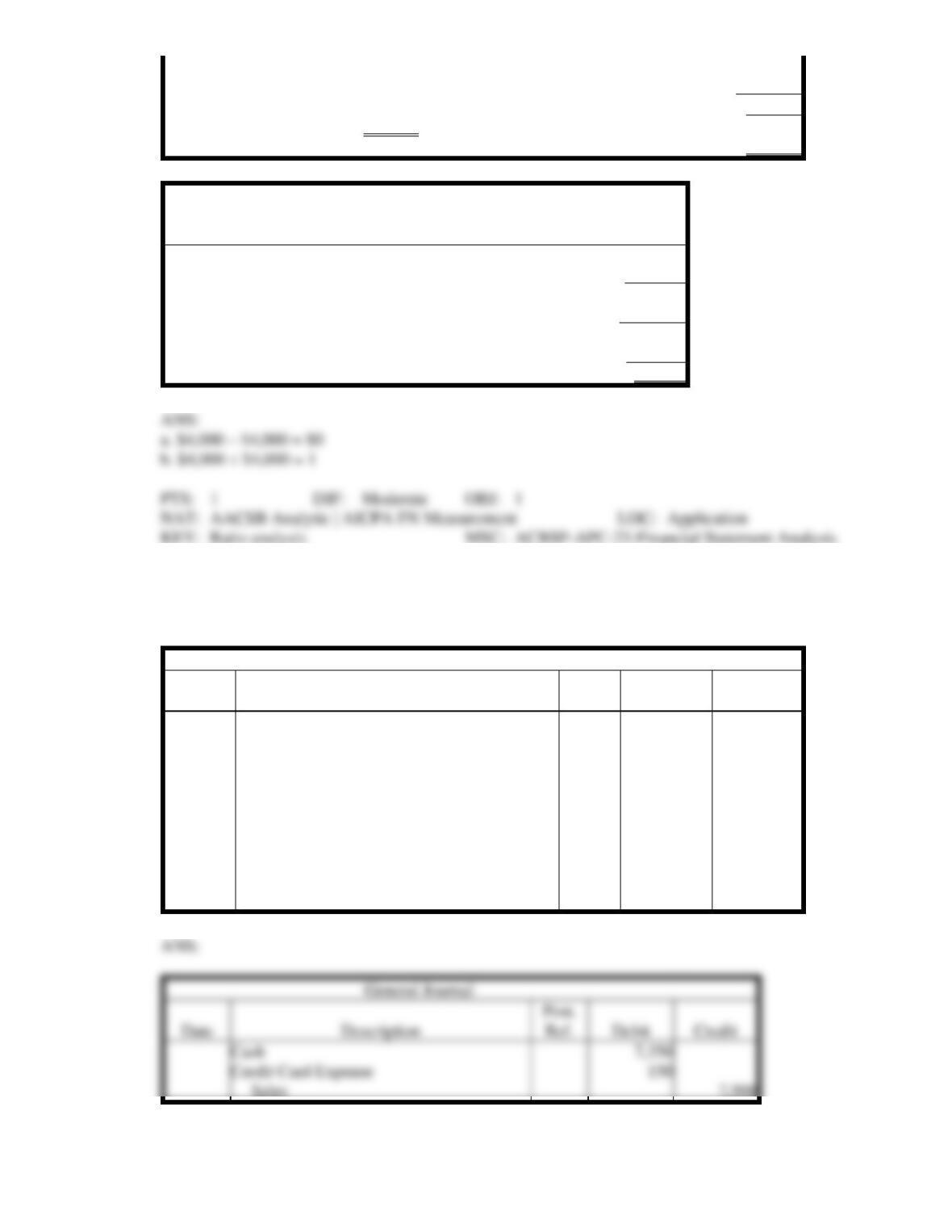
Sci-Tech Enterprises, Inc.
Balance Sheet
June 30, 2013
Assets
Liabilities
Current assets
$ 4,000
Current liabilities
$ 4,000
Investments
2,000
Long-term liabilities
6,000
Property, plant, and
Total liabilities
$10,000
equipment
12,000
Intangible assets
2,000
Stockholders’ Equity
Common stock
$ 8,000
Retained earnings
2,000
Total stockholders’ equity
$10,000
Total assets
$20,000
Total liabilities and stockholders’
equity
$20,000
Sci-Tech Enterprises, Inc.
Income Statement
For the Year Ended June 30, 2013
Net sales
$24,000
Cost of goods sold
12,000
Gross margin
$12,000
Operating expenses
8,000
Income before income taxes
$ 4,000
Income taxes
1,600
Net income
$ 2,400
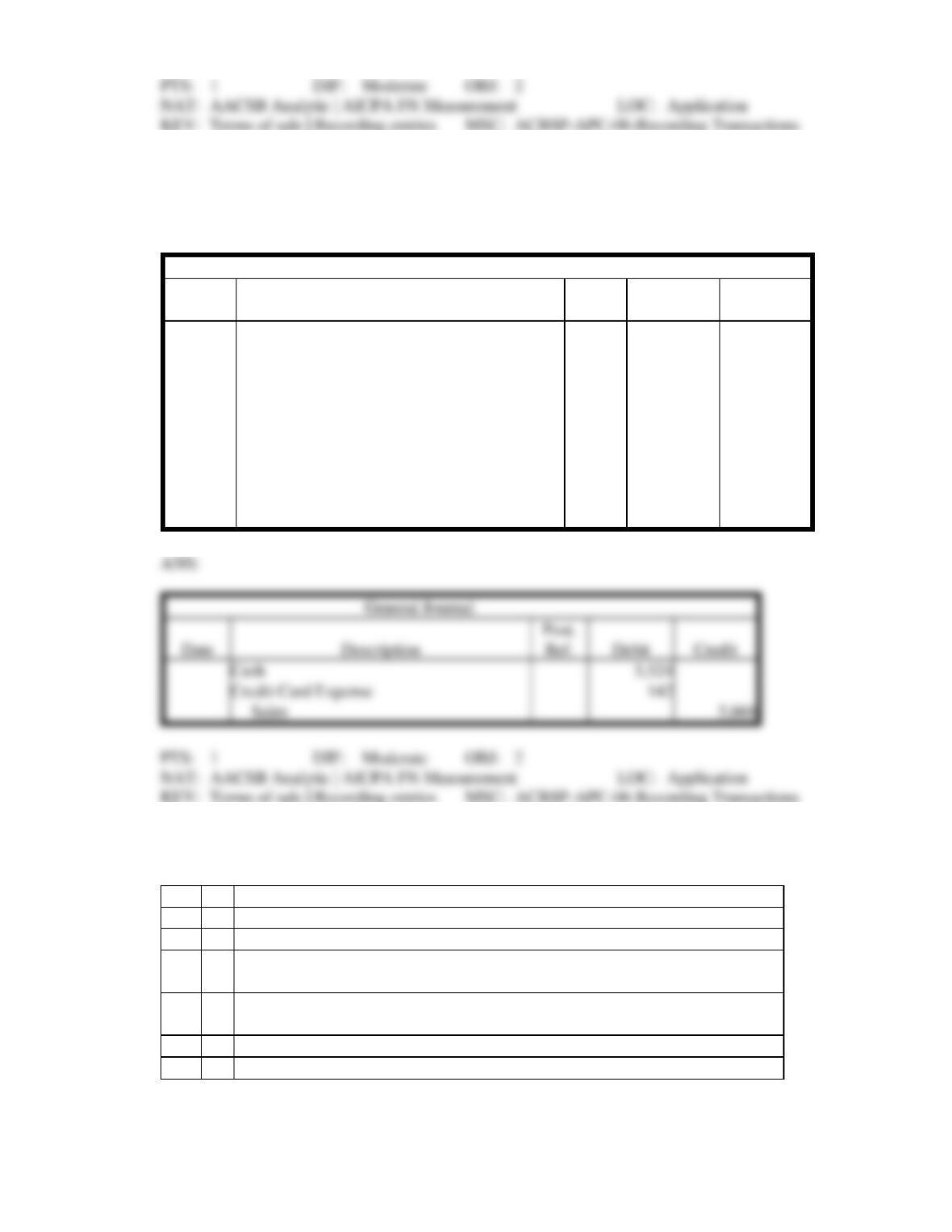
3. Assume that Beckham Corporation had credit card sales of $7,500 for the month ended December 31.
Prepare one journal entry to record these sales assuming that all of the credit card companies charge
Beckham a 2 percent discount fee. (Omit date.) Round to the nearest whole dollar.
General Journal
Date
Description
Post.
Ref.
Debit
Credit
Debit
Cash
Credit Card Expense
Sales
4. Assume that the sales made by Wessling Corporation for the month ended February 28, were made to
customers using credit cards and totaled $5,666. Prepare one journal entry to record these sales
assuming that all of the credit card companies charge Wessling Corporation a 2.5 percent discount fee.
(Omit date.) Round to the nearest whole dollar.
General Journal
Date
Description
Post.
Ref.
Debit
Credit
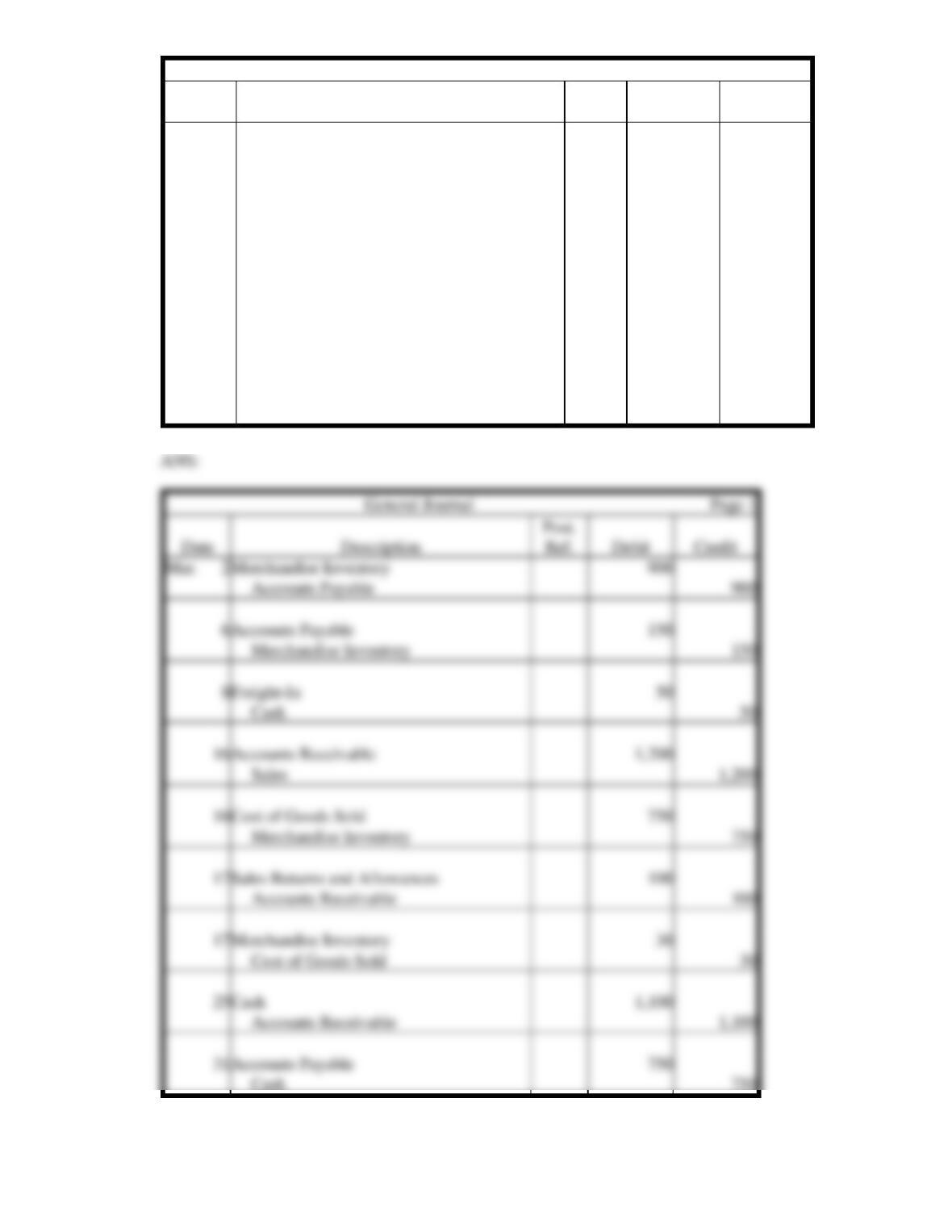
5. Sandy’s Supply Store, Inc., entered into the transactions listed below. In the journal provided, prepare
Sandy’s entries, assuming use of the perpetual inventory system. Omit explanations.
Mar.
2
Purchased $900 of merchandise on credit, terms n/30.
6
Returned $150 of the items purchased on March 2.
8
Paid freight charges of $50 on the items purchased March 2.
16
Sold merchandise on credit for $1,200, terms n/15. The merchandise had a cost
in inventory of $750.
17
Of the merchandise sold on March 16, $100 of it was returned. The items had
cost Sandy’s $30.
25
Received payment in full from the customer of March 16.
31
Paid for the merchandise purchased on March 2.
General Journal
Page 1
Date
Description
Post.
Ref.
Debit
Credit