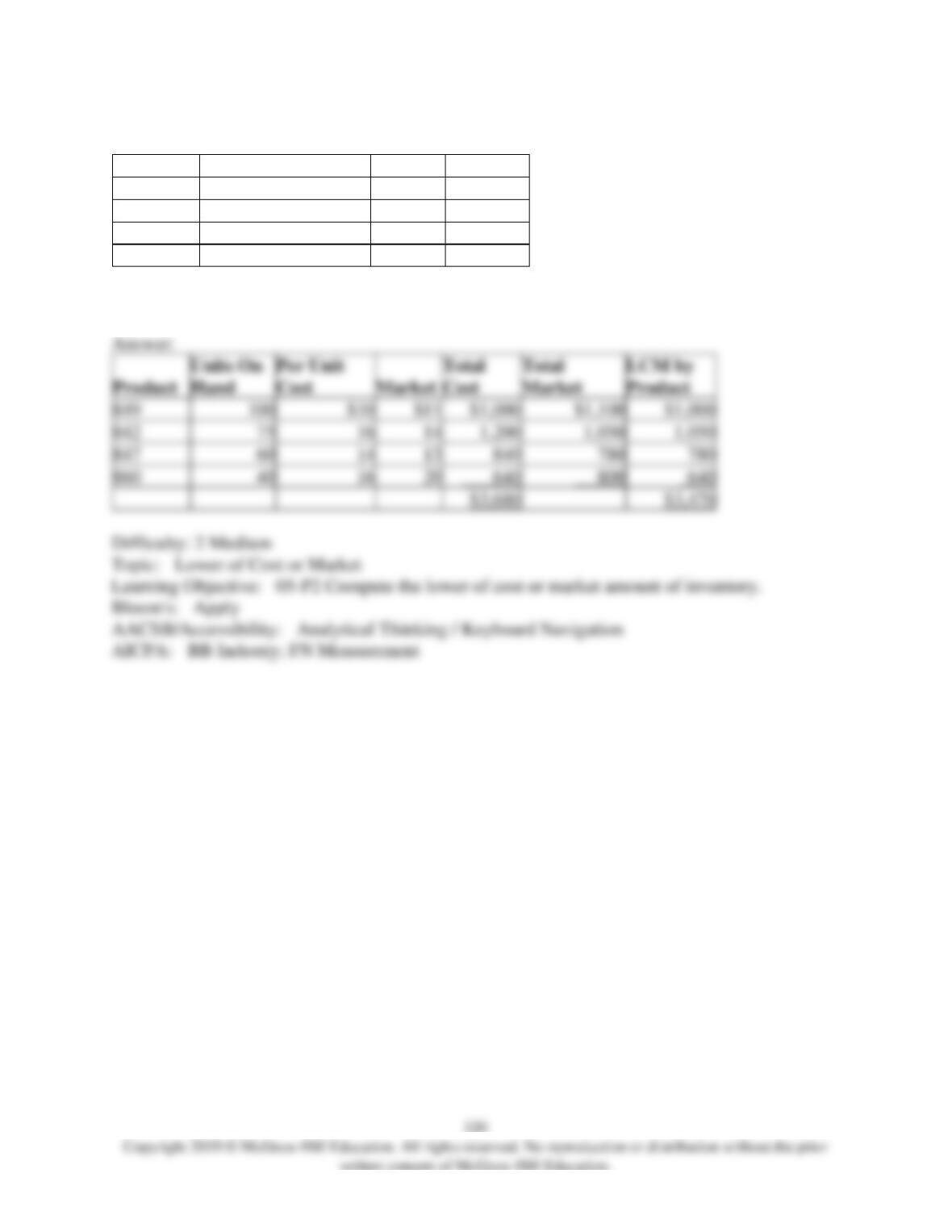
207) A company reported the following data related to its ending inventory:
Product
Units Available
Cost
Market
849
100
$10
$11
842
75
16
14
847
60
14
13
860
40
16
20
Calculate the lower-of-cost-or-market on the inventory applied separately to each product.
Product
Hand
Cost
Market
Cost
Market
Product
849
842
847
860
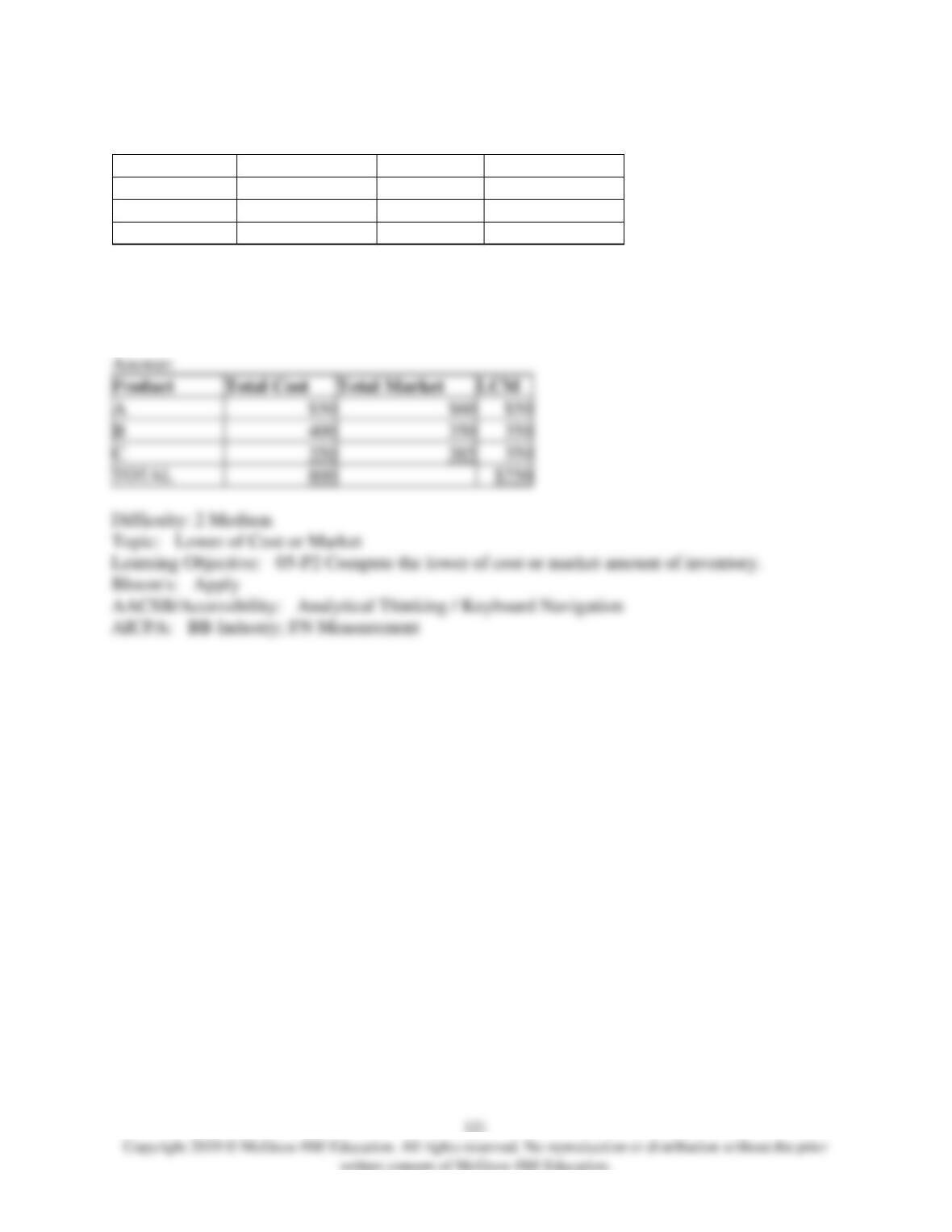
208) A company had the following ending inventory costs:
Product
Units of Hand
Unit Cost
Market Value
A
10
$5
$6
B
50
8
7
C
35
10
11
Required:
Calculate the lower of cost or market (LCM) value for each individual item.
Total Cost
Total Market
A
B
C
TOTAL
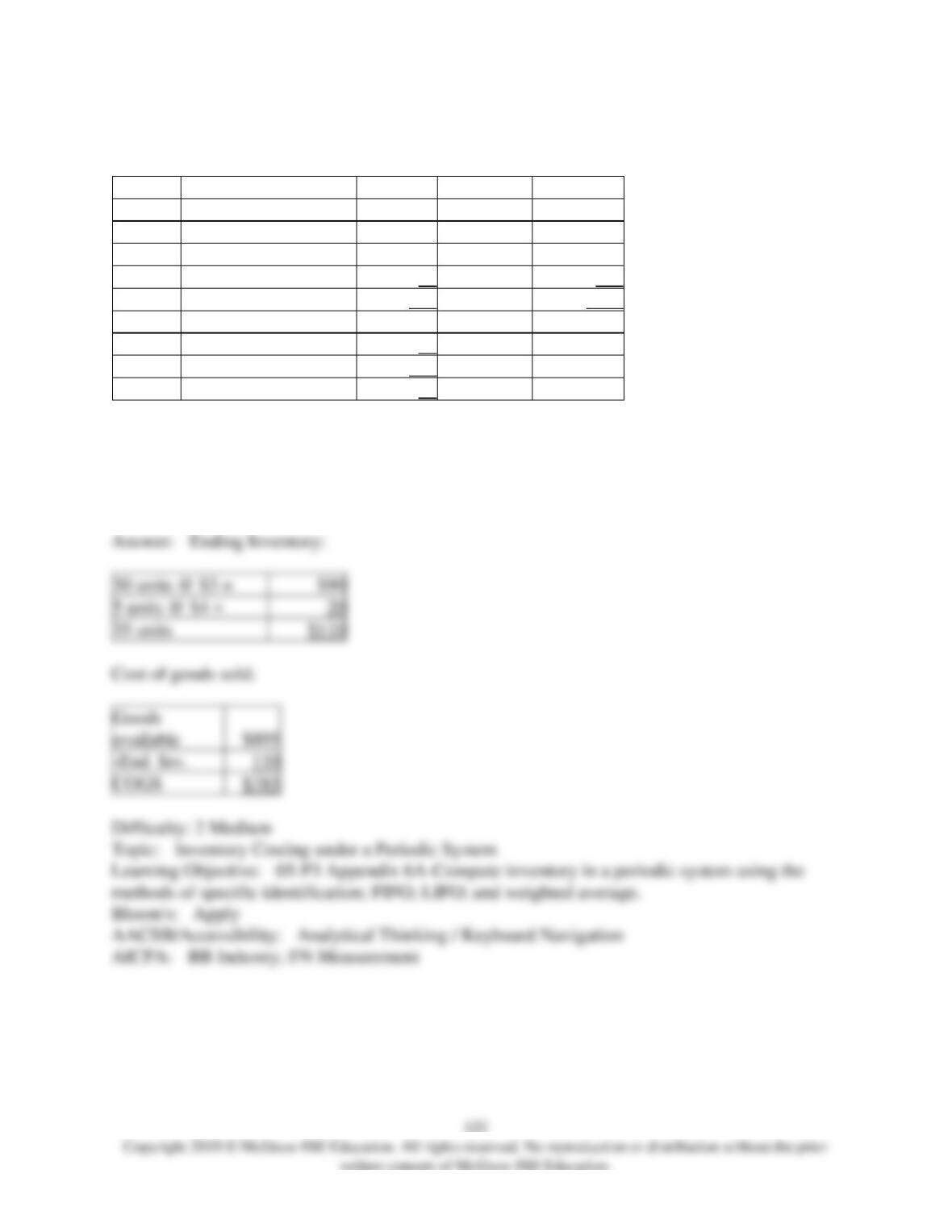
209) A company uses the periodic inventory system, and the following information is available.
All purchases and sales are on credit. The selling price for the merchandise is $11 per unit.
Units
Unit Cost
Total Cost
6/01
Inventory Balance
30
$3
$90
6/06
Purchase
70
4
280
6/11
Purchase
45
5
225
6/16
Purchase
50
6
300
Goods available
195
$895
6/12
Sale
100
6/20
Sale
60
Goods sold
160
6/31
Inventory Balance
35
Required:
Determine the cost of the ending inventory and the cost of goods sold for June using the LIFO
method.
30 units @ $3 =
5 units @ $4 =
35 units
available
-End. Inv.
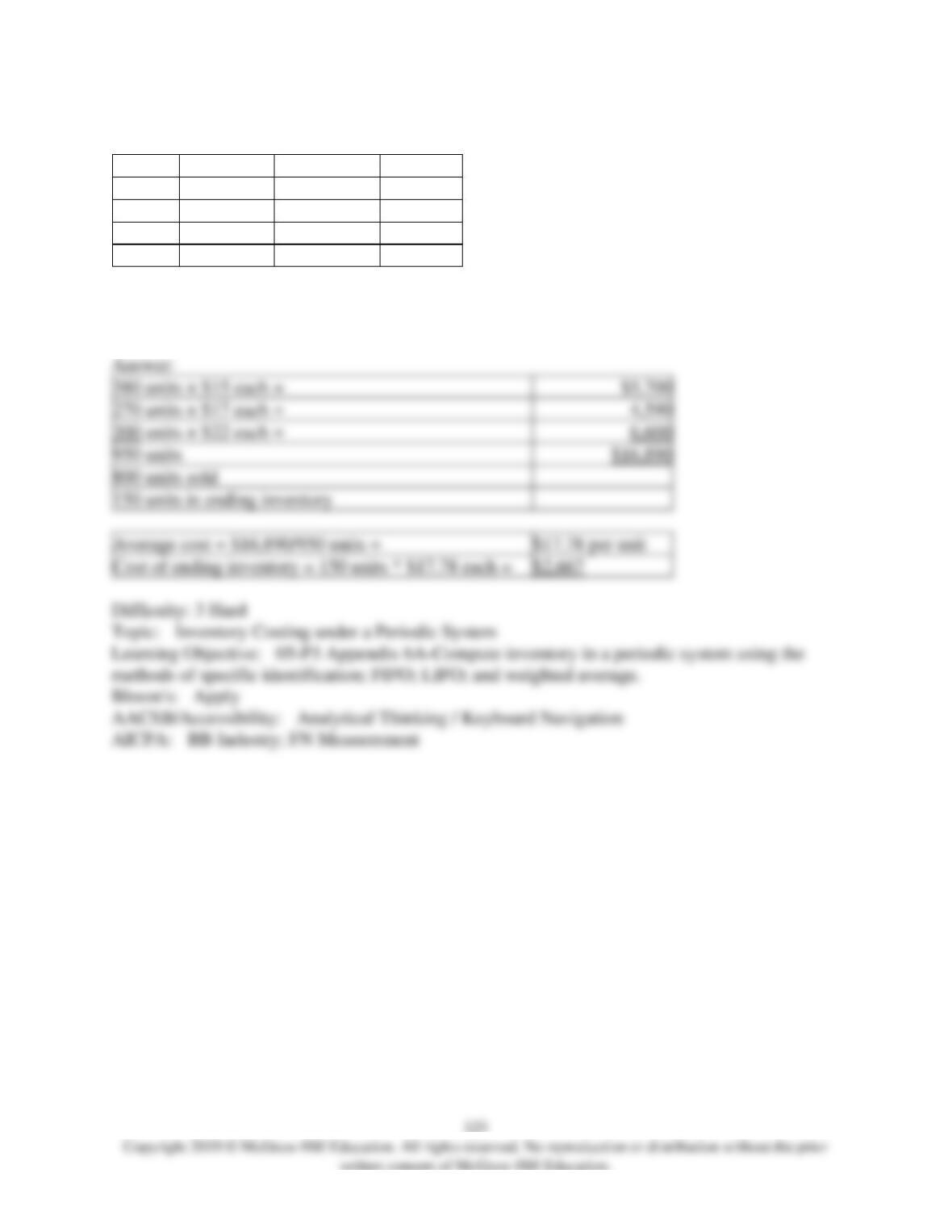
210) A company made the following merchandise purchases and sales during the month of May:
May 1
Purchased
380 units at
$15 each
May 5
Purchased
270 units at
$17 each
May 10
Sold
400 units at
$50 each
May 20
Purchased
300 units at
$22 each
May 25
Sold
400 units at
$50 each
There was no beginning inventory. If the company uses the weighted average periodic method,
what would be the cost of the ending inventory?
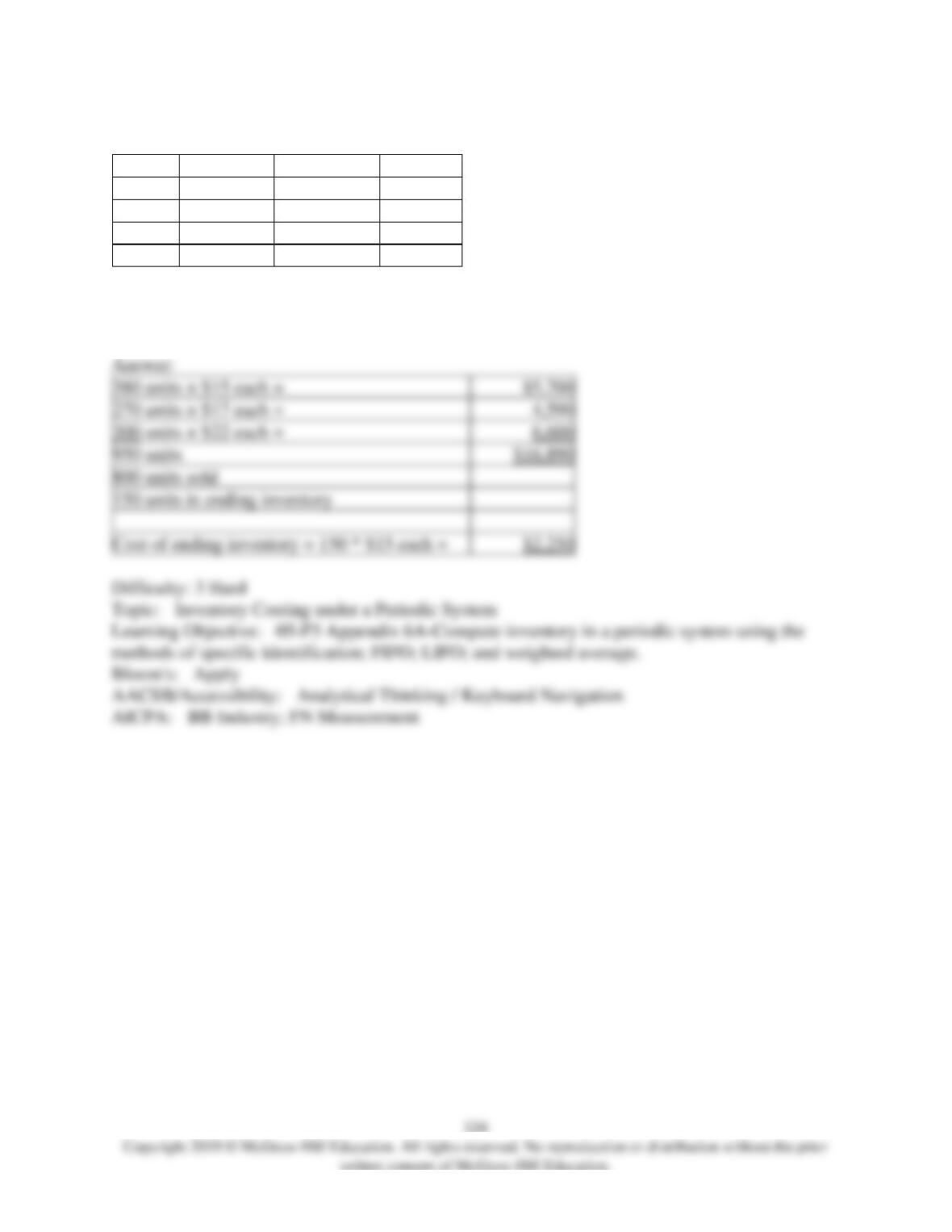
380 units × $15 each =
270 units × $17 each =
300 units × $22 each =
950 units
800 units sold
150 units in ending inventory
Average cost = $16,890/950 units =
$17.78 per unit
Cost of ending inventory = 150 units * $17.78 each =
$2,667
211) A company made the following merchandise purchases and sales during the month of May:
May 1
Purchased
380 units at
$15 each
May 5
Purchased
270 units at
$17 each
May 10
Sold
400 units at
$50 each
May 20
Purchased
300 units at
$22 each
May 25
Sold
400 units at
$50 each
There was no beginning inventory. If the company uses the LIFO periodic inventory method,
what would be the cost of the ending inventory?
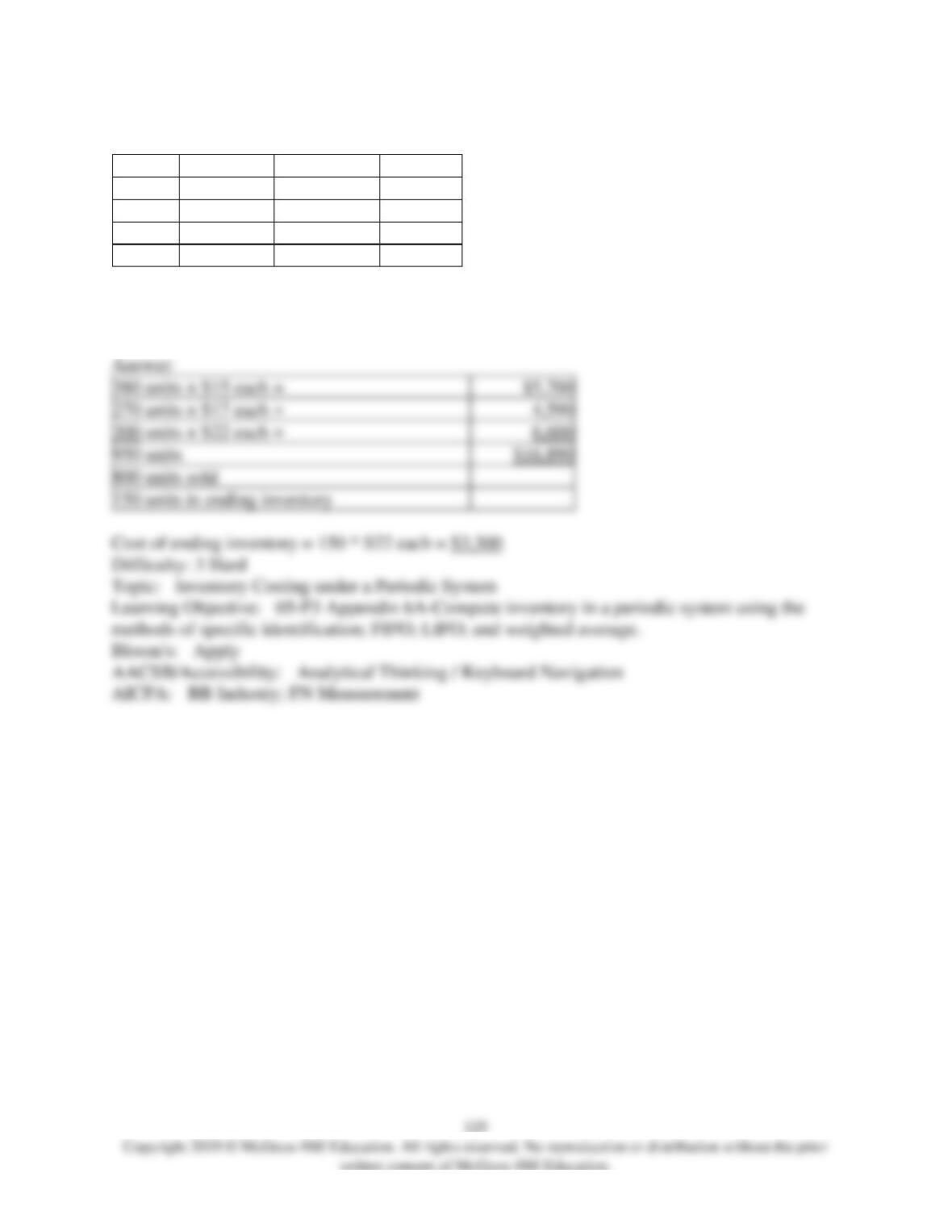
380 units × $15 each =
270 units × $17 each =
300 units × $22 each =
950 units
800 units sold
150 units in ending inventory
Cost of ending inventory = 150 * $15 each =
212) A company made the following merchandise purchases and sales during the month of May:
May 1
Purchased
380 units at
$15 each
May 5
Purchased
270 units at
$17 each
May 10
Sold
400 units at
$50 each
May 20
Purchased
300 units at
$22 each
May 25
Sold
400 units at
$50 each
There was no beginning inventory. If the company uses the FIFO periodic inventory method,
what would be the cost of the ending inventory?
380 units × $15 each =
270 units × $17 each =
300 units × $22 each =
950 units
800 units sold
150 units in ending inventory
213) A company’s store was destroyed by an earthquake on February 10 of the current year. The
only information for the current period that could be salvaged included the following:
Beginning inventory,
January 1:
$44,000
Purchases to date:
$198,000
Sales to date:
$310,000
Historically, the company’s gross profit ratio has been 30%. Estimate the value of the destroyed
inventory using the gross profit method.
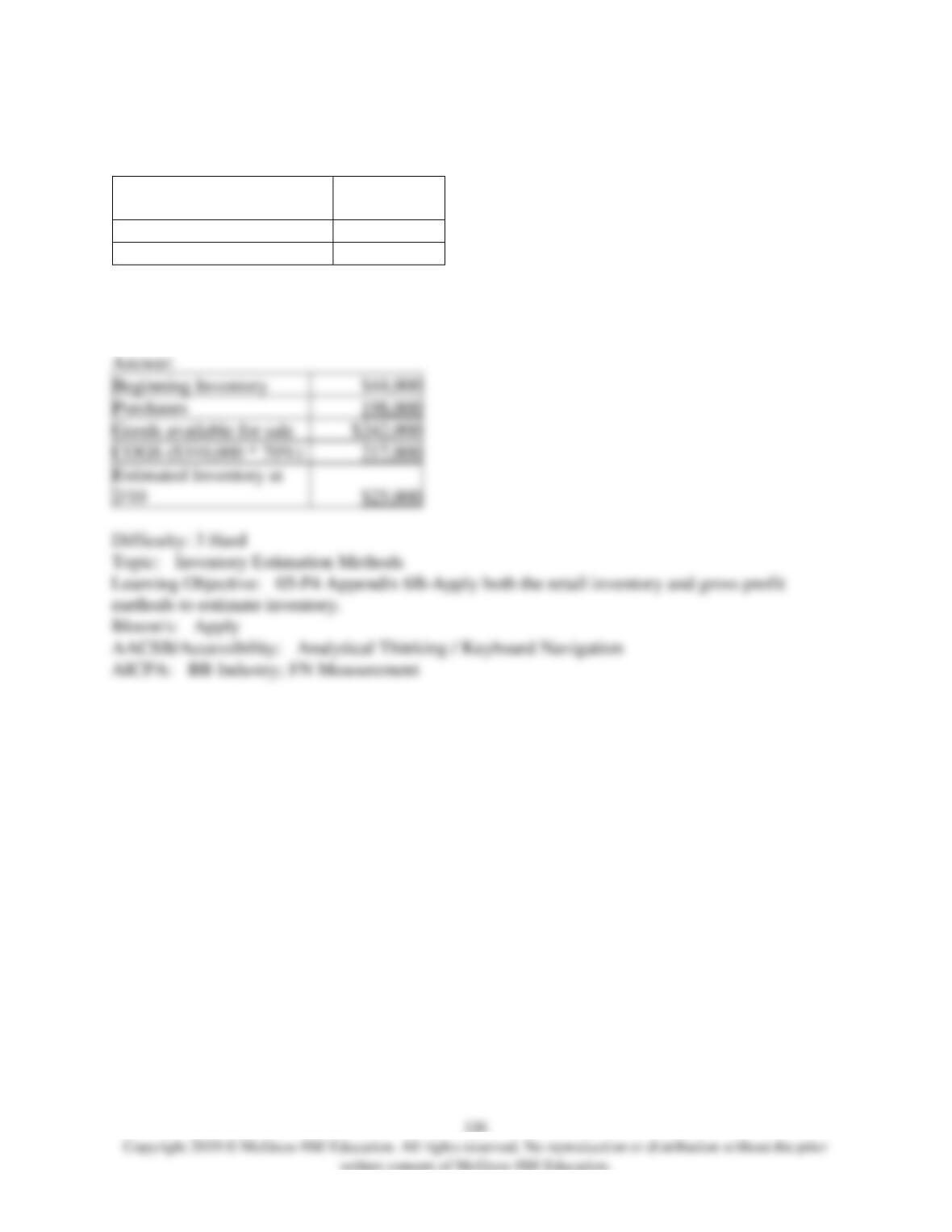
Beginning Inventory
Purchases
Goods available for sale
$242,000
COGS ($310,000 * 70%)
2/10
214) Apply the retail method to the following company information to estimate the cost of the
ending inventory for the current period.
Cost
Retail
Beginning inventory
$20,224
$31,600
Net purchases
59,508
97,000
Sales
89,000
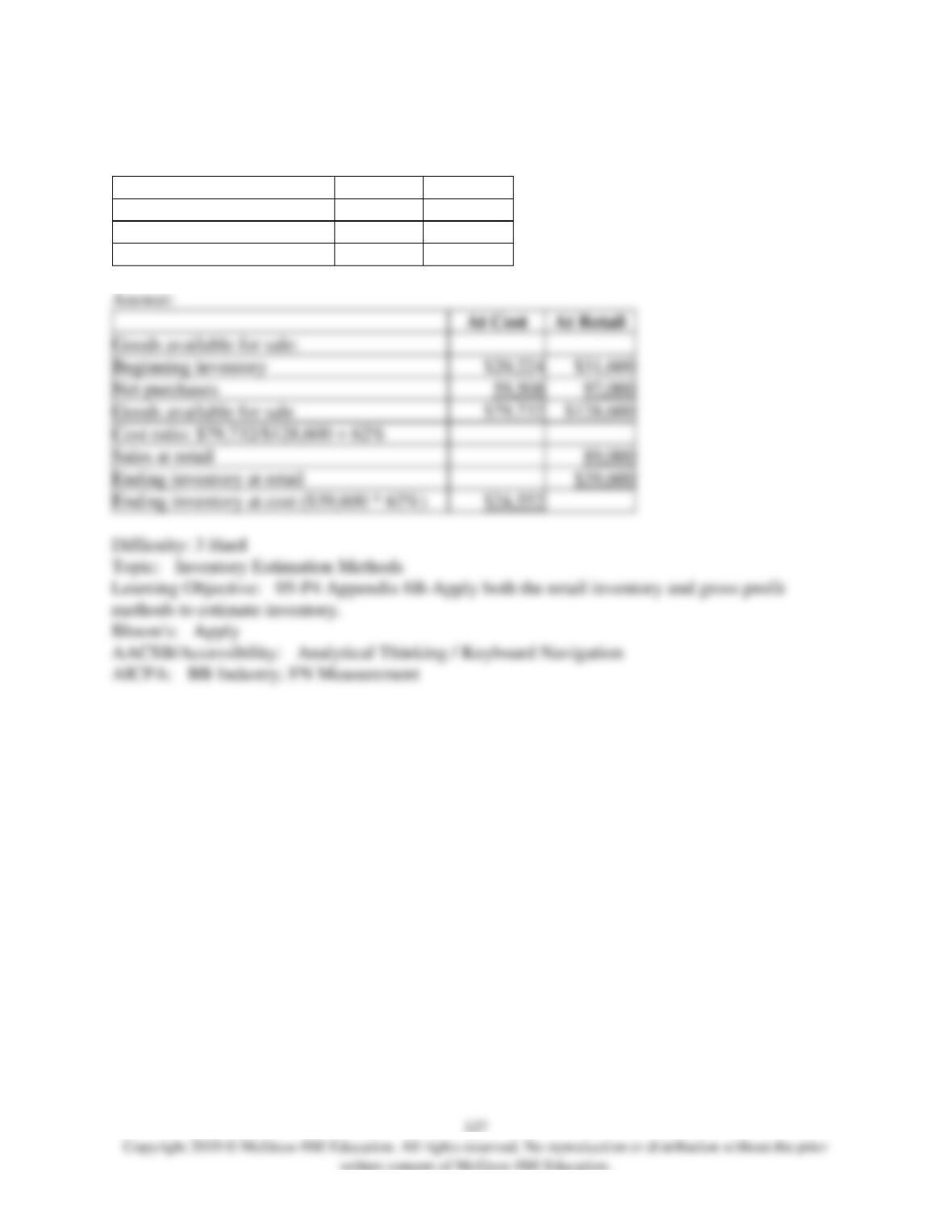
Goods available for sale:
Beginning inventory
$31,600
Net purchases
97,000
Goods available for sale
Cost ratio: $79,732/$128,600 = 62%
Sales at retail
89,000
Ending inventory at retail
$39,600
Ending inventory at cost ($39,600 * 62%)
215) A company uses the retail inventory method and has the following information available
concerning its most recent accounting period:
At Cost
At Retail
Beginning-of-period inventory
$148,600
$245,200
Net purchases
677,400
1,229,800
Sales
1,200,000
1. What is the cost-to-retail ratio using the retail method?
2. What is the estimated cost of the ending inventory?
Cost-to-retail ratio:
Beginning inventory
Net purchases
Cost of goods available for sale
Cost to-retail ratio is 56%.
Estimated cost of the ending inventory:
Sales
Ending inventory at retail
Estimated cost of ending inventory (56% * $275,000)
216) Forever Young Game Stores (FYG) has taken a physical count of its inventory at March 31,
its fiscal year-end. After reviewing the accounting records and documentation, the following
items have been discovered:
(a) An invoice from Shreck Co. indicates that $30,000 of games were shipped to FYG on March
27, terms FOB shipping point. The games and invoice did not arrive at FYG until April 2 and
were not included in the physical count.
(b) An invoice from Gamers, Inc. indicates that $8,000 of games were shipped to FYG on March
29, terms FOB destination. The games and invoice did not arrive at FYG until April 2 and were
not included in the physical count.
The physical count and cost assignment on March 31 prior to these two items is $440,000. The
cost of goods sold for FYG is $2,100,000.
1. Calculate the amount that should be reported as ending inventory for FYG.
2. Calculate the days’ sales in inventory before and after the appropriate adjustments for
inventory.
217) A company reported the current month purchase and sales data for its only product and uses
the perpetual inventory system. Determine the cost assigned to ending inventory and cost of
goods sold using FIFO.
Date
Activities
Units Acquired at Cost
Units Sold at Retail
April 1
Beginning Inventory
175 units @ $15.00
4
Purchase
150 units @ $16.00
7
Sales
160 units @ $30.00
10
Purchase
200 units @ $17.00
16
Sales
250 units @ $30.00
25
Purchase
160 units @ $18.00
28
Sales
150 units @ $32.00
218) A company reported the current month purchase and sales data for its only product and uses
the perpetual inventory system. Determine the cost assigned to ending inventory and cost of
goods sold using LIFO.
Date
Activities
Units Acquired at Cost
Units Sold at Retail
April 1
Beginning
Inventory
175 units @ $15.00
4
Purchase
150 units @ $16.00
7
Sales
160 units @ $30.00
10
Purchase
200 units @ $17.00
16
Sales
250 units @ $30.00
25
Purchase
160 units @ $18.00
28
Sales
150 units @ $32.00
219) A company uses the retail inventory method and has the following information available
concerning its most recent accounting period:
At Cost
At Retail
January 1 beginning inventory
$167,340
$304,240
Cost of goods purchased
561,850
1,021,560
Sales
940,400
Sales returns
40,200
1. Use the retail inventory method to estimate the company’s year-end inventory at cost.
2. A year-end physical count at retail prices yields a total inventory of $404,800. Prepare a
calculation showing the company’s loss from shrinkage at cost and at retail.
$729,190/1,325,800 =
.55
$1,325,800 – $900,200 =
$425,600
$425,600 * .55 =
$234,080
$425,600 – $404,800 =
$20,800 inventory shrinkage at retail
$20,800 * .55 =
$11,440 inventory shrinkage at cost
220) Goods that are in transit and were shipped FOB shipping point should be included in the
inventory records of the ________.
221) Goods that are in transit and were shipped FOB destination should be included in the
inventory records of the ________.
222) Goods on consignment are goods that are shipped by the owner, called the ________, to
another party called the ________ that will sell the goods for the owner.
223) ________ is the estimated sales price of damaged goods minus the cost of making the sale.
224) A ________ is recorded when inventory damage or obsolescence occurs.
225) The cost of an inventory item includes the ________, plus ________ costs necessary to put
it in a place and condition for sale.
226) When purchase costs regularly rise, the ________ method of inventory valuation yields the
highest gross profit and net income.
227) When purchase costs regularly rise, the ________ method of inventory valuation yields the
lowest gross profit and net income, providing a tax advantage.
228) An advantage of the ________ method of inventory valuation is that it tends to smooth out
the effect of erratic changes in costs.
229) An overstated beginning inventory will ________ cost of goods sold and ________ net
income.
230) The ________ ratio reflects how much inventory is available in terms of days’ sales.
231) The ________ is a measure of how many times a company sells its inventory in a period.
232) The ________ method of assigning costs to inventory and cost of goods sold exactly
matches the costs of particular items with the revenues they generate and would be used when
items can be easily traced to the purchase invoice cost.
233) The ________ method of assigning costs to inventory and cost of goods sold assumes that
the inventory items are sold in the order acquired.
234) The ________ method of assigning costs to inventory and cost of goods sold assumes that
the most recent purchases are sold first.
235) The ________ method of assigning costs to inventory and cost of goods sold requires that
we divide the cost of goods available for sale by the units of inventory available at the time of
each sale.
236) Regardless of what inventory method or system is used, cost of goods available for sale
must be allocated between ________ and ________.
237) When applying the lower of cost or market method of inventory valuation for LIFO, market
is defined as the ________.
238) The ________ method is commonly used to estimate the value of inventory that has been
destroyed, lost, or stolen.