148.
A company had 260 units of inventory at a cost of $152 each on January 1. On June 5, the
company purchased 460 units for $172 each. On November 10, the company purchased
160 units for $212 each. On December 15, the company sold 520 units. Given this
information, determine the cost of the 520 units sold using the weighted average periodic
inventory method. (Do not round your intermediate calculations; round the final answer to
nearest dollar amount.)
149.
A company had 260 units of inventory at a cost of $152 each on January 1. On June 5, the
company purchased 460 units for $172 each. On November 10, the company purchased
160 units for $212 each. On December 15, the company sold 520 units. Given this
information, use the weighted average periodic inventory method to find the ending
inventory balance. (Do not round your intermediate calculations; round the final answer to
nearest dollar amount.)
150.
A company had 270 units of inventory at a cost of $154 each on March 1. On March 5, the
company purchased 470 units of inventory for $174 each. On March 10, the company
purchased 170 units for $214 each. On March 20, 540 units were sold. Given this
information, determine the cost of the 540 units sold using the weighted average periodic
inventory method. (Do not round your intermediate calculations; round the final answer to
nearest dollar amount.)
5-104
151.
A company had 240 units of inventory at a cost of $148 each on April 1. On April 5, the
company purchased 440 units of inventory for $168 each. On April 12, the company
purchased 140 units for $208 each. On April 20, 480 units were sold. Given this
information, determine the cost of the 480 units sold using the weighted average periodic
inventory method. (Do not round your intermediate calculations; round the final answer to
nearest dollar amount.)
Matching Questions
152.
Match the following
1. Specific
identification
The accounting principle that aims to
select the less optimistic estimate when
two or more estimates are about equally
2. Retail inventory
The expected sales price of an item
3. Interim
A method for estimating ending
inventory based on the ratio of the
amount of goods for sale at cost to the
4. Days’ sales in
An estimate of days needed to convert
the inventory at the end of the period into
5. Net realizable
An inventory valuation method that
assumes costs flow at an average of the
Financial statements prepared for
An inventory valuation method that
assumes costs of the most recent items
purchased are sold and charged to cost of
8. Conservatism
An inventory valuation method that
assumes that inventory items are sold
and charged to cost of goods sold in the
9. Weighted average
An inventory valuation method that
identifies exactly which items of inventory
are sold and charges those costs to cost
10. Inventory
The number of times a company’s
153.
Match each of the following terms with the appropriate definitions.
1. Materiality
The shipping terms that indicate
ownership of goods pass to the buyer when
2. Periodic
Inventory
The shipping terms that indicate
ownership of goods pass to the buyer when
3. Net Realizable
Inventory items that are in the process of
4. Inventory
The owner of consigned goods that
continues to report the goods in its
5. FOB Shipping
The holder of consigned goods who sells
6. FOB
The conservative value at which damaged
or obsolete goods are included in inventory if
The accounting principle that allows
incidental costs of acquiring merchandise to
be expensed directly to cost of goods sold
The inventory method where updates for
purchases and sales of merchandise are
made in the Merchandise Inventory account
9. Perpetual
Inventory
The inventory method where updates for
purchases and sales of merchandise are
made in the Merchandise Inventory account
10. Goods in
Processes and procedures to minimize
5-108
Essay Questions
154.
Enter the identifier for the correct inventory valuation method for each situation described
below. In all cases, assume a period of rising prices.
FIFO
First in, first out
LIFO
Last in, first out
SI
Specific identification
WA
Weighted average
a.
The method that can only be used if each
inventory item can be matched with a specific
purchase and its invoice.
b.
The method that will cause the company to
have the lowest income taxes.
c.
The method that will cause the company to
have the lowest cost of goods sold.
d.
The method that will assign a value to
inventory that approximates its current cost.
e.
The method that will tend to smooth out
erratic changes in costs.
155.
Identify the types of goods that a company must include when determining its
merchandise inventory balance. (In your answer address the special situations of goods in
transit, consigned goods, and damaged goods.)
156.
What types of costs are assigned to the merchandise inventory account?
157.
Describe the internal controls that are applied when taking a physical count of inventory.
158.
Explain the effects of the four inventory valuation methods of specific identification, FIFO,
LIFO and weighted-average on ending inventory, net income, and income taxes.
159.
How do the consistency concept and the full disclosure principle affect inventory
valuation?
160.
An error that overstates the ending inventory balance will have what effect on the income
statement for that year?
161.
Explain how the inventory turnover ratio and the days’ sales in inventory ratio are used to
evaluate inventory management.
162.
Identify and describe the four inventory valuation methods.
163.
Explain why the lower of cost or market rule is used to report inventory on the balance
sheet.
5-115
164.
Explain the difference between the retail inventory method and gross profit inventory
method for valuing inventory.
Short Answer Questions
5-116
165.
Monitor Company uses the LIFO method for valuing its ending inventory. The following
financial statement information is available for their first year of operation:
MONITOR COMPANY
Income Statement
For the year ended December 31
Sales
$50,000
Cost of goods sold
23,000
Gross profit
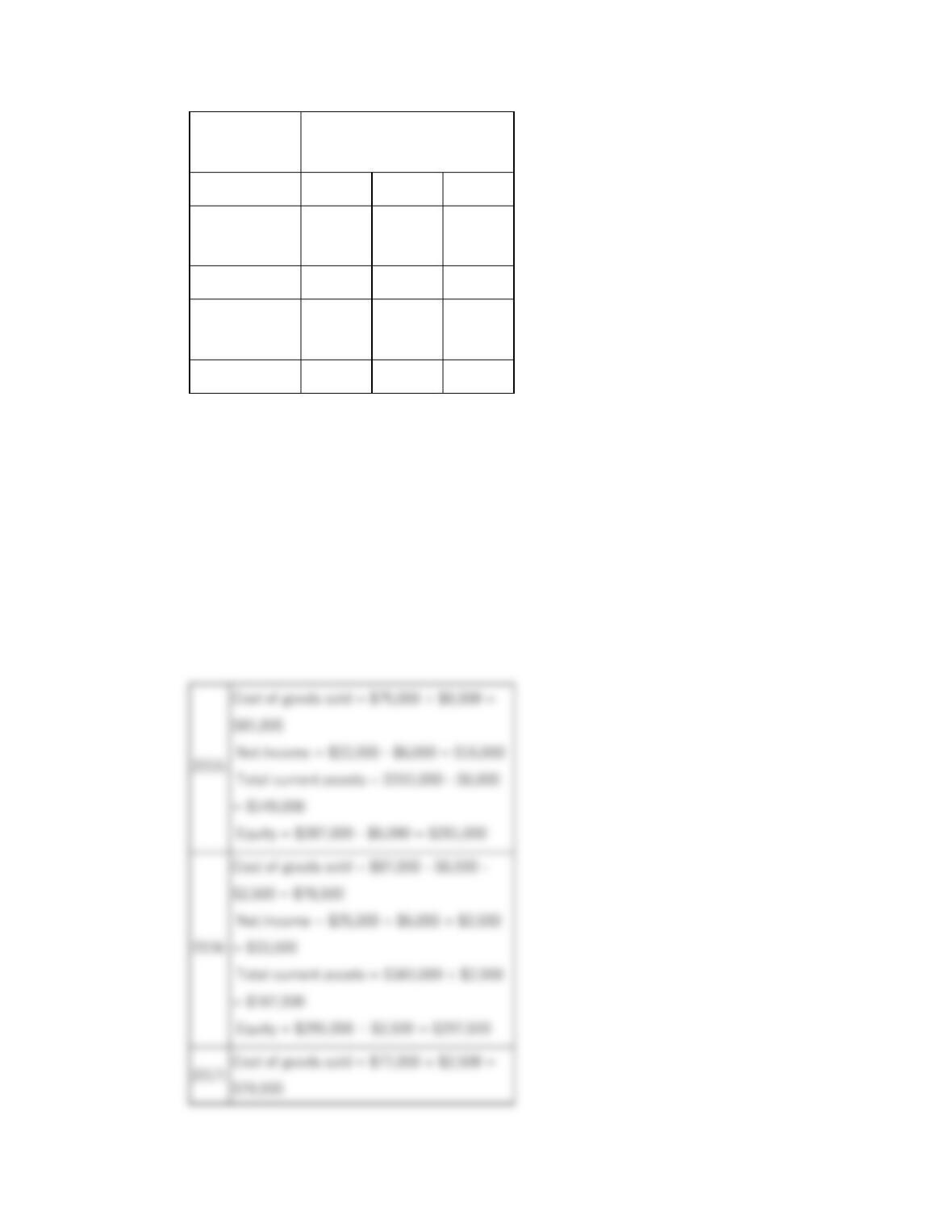
$27,000
Expenses
13,000
Income before taxes
$14,000
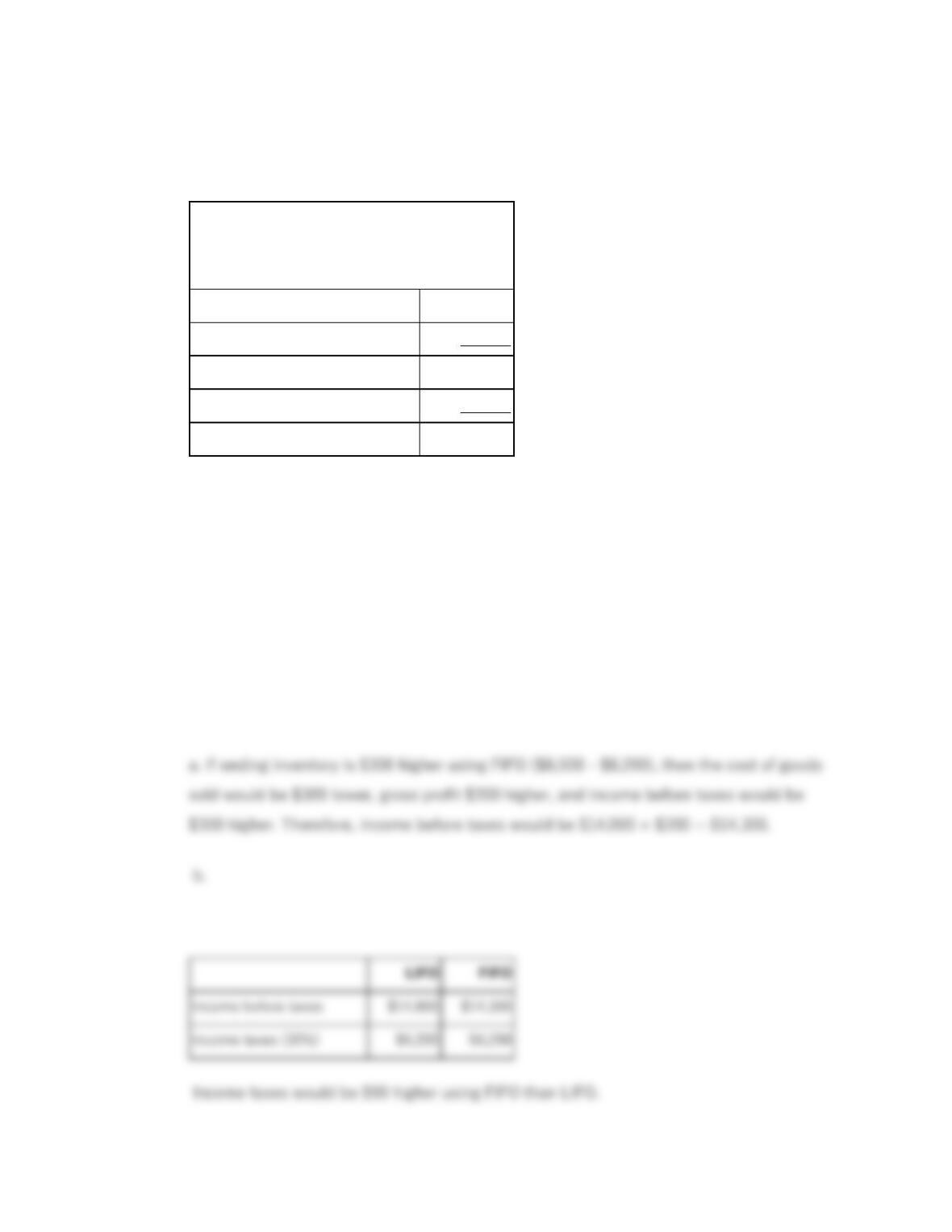
Monitor’s ending inventory using the LIFO method was $8,200. Monitor’s accountant
determined that had they used FIFO, the ending inventory would have been $8,500.
a. Determine what the income before taxes would have been had Monitor used the FIFO
method of inventory valuation instead of LIFO.
b. What would be the difference in income taxes between LIFO and FIFO, assuming a 30%
tax rate?
Income before taxes
Income taxes (30%)
5-117
166.
Evaluate each inventory error separately and determine whether it overstates or
understates cost of goods sold and net income.
Inventory Error
Cost of
Goods Sold
Net
Income
Understatement of
beginning inventory
Understatement of
ending inventory
Overstatement of
beginning inventory
Overstatement of ending
inventory
167.
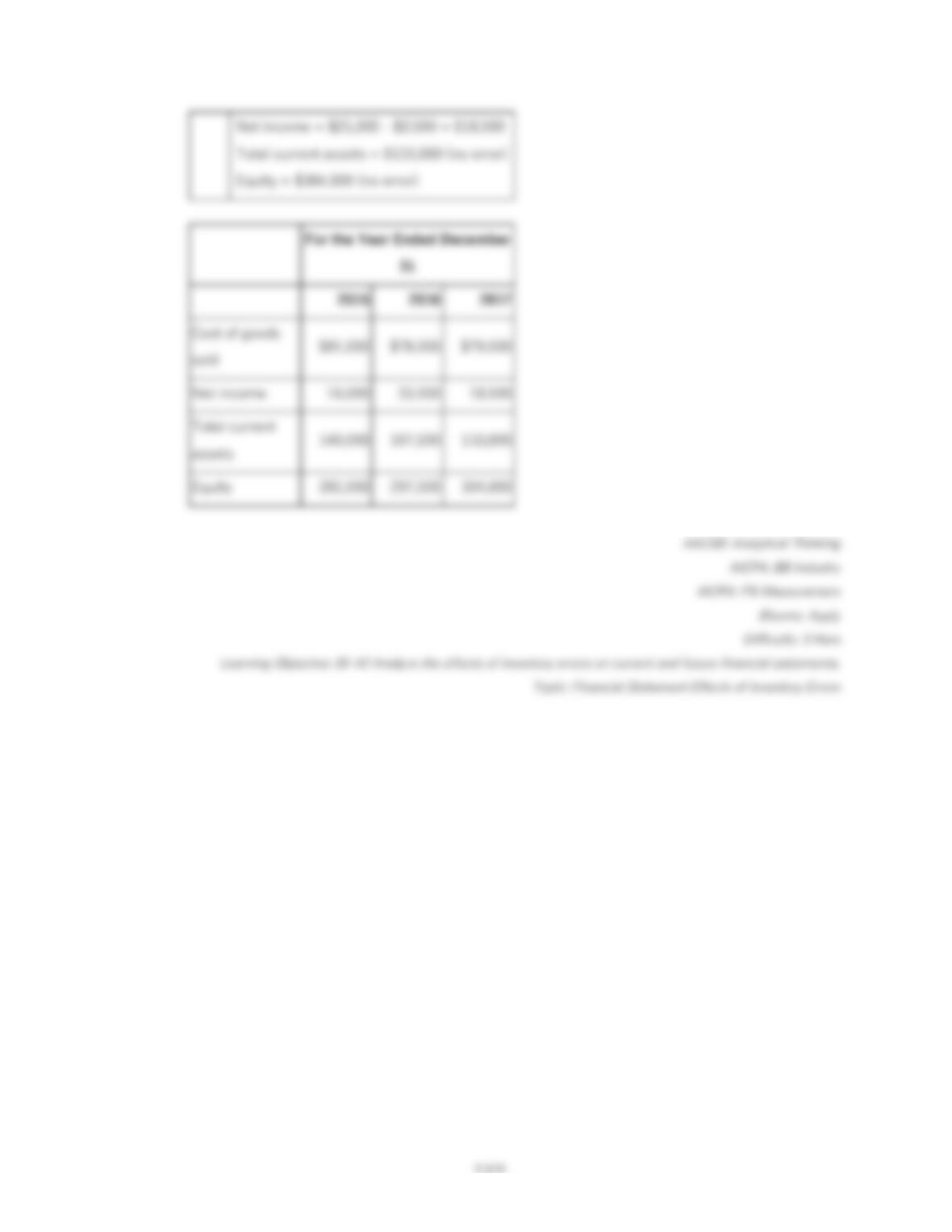
The City Store reported the following amounts on their financial statements for 2015,
2016, and 2017:
Inventory Error
Net Income
Understatement of
Understatement of
ending inventory
Overstatement of
ending inventory
5-118
For the Year Ended December
31
2015
2016
2017
Cost of goods
sold
$75,000
$87,000
$77,000
Net income
22,000
25,000
21,000
Total current
assets
155,000
165,000
110,000
Equity
287,000
295,000
304,000
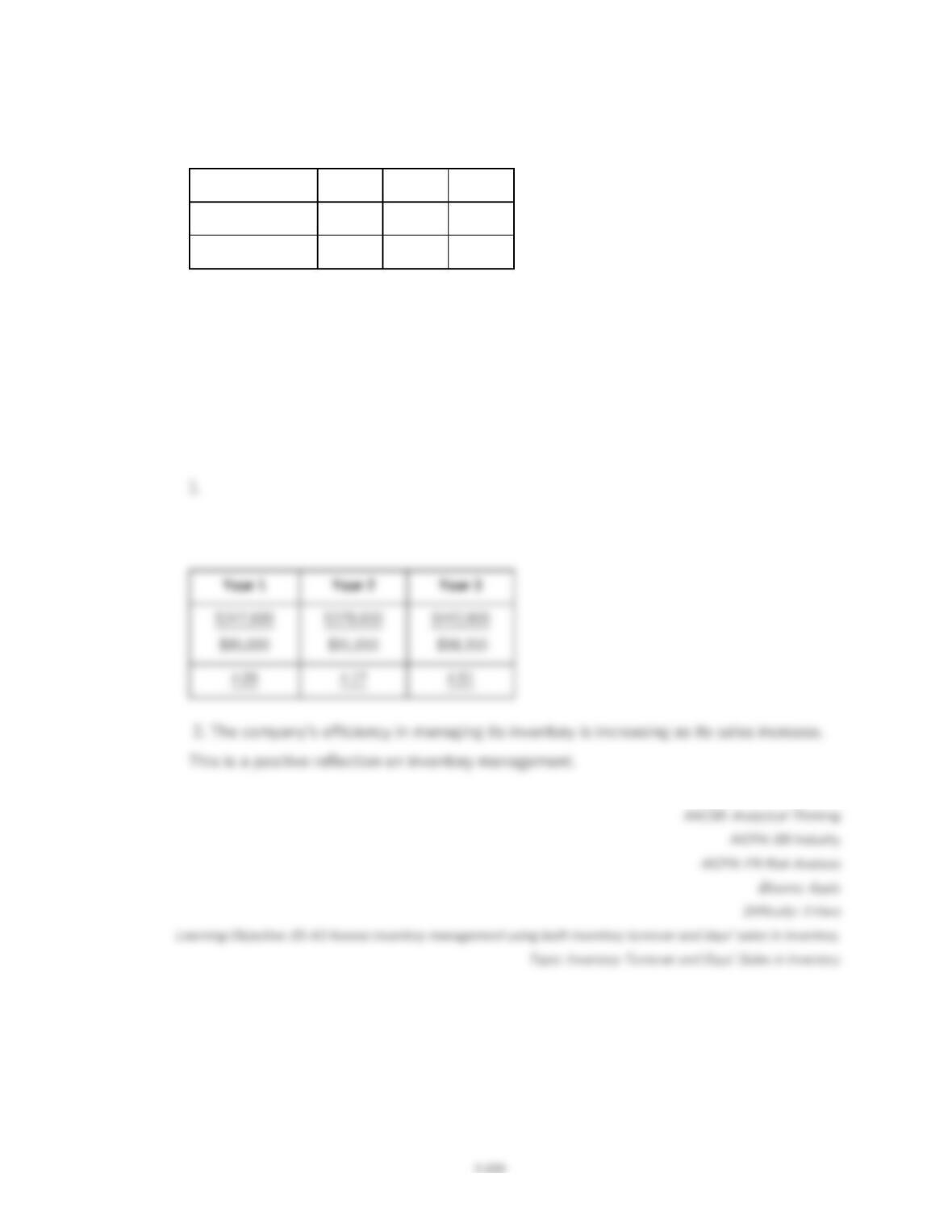
It was discovered early in 2015 that the ending inventory on December 31, 2015, was
overstated by $6,000 and the ending inventory on December 31, 2016, was understated by
$2,500. The ending inventory on December 31, 2017, was correct. Ignoring income taxes,
determine the correct amounts of cost of goods sold, net income, total current assets, and
equity for each of the years 2015, 2016, and 2017.
168.
A company reported the following data:
Year 1
Year 2
Year 3
Cost of goods sold
$347,600
$379,650
$443,900
Average inventory
85,000
91,050
98,350
Required:
1. Calculate the company’s merchandise inventory turnover for each year.
2. Comment on the company’s efficiency in managing its inventory.