86) Which of the following is not one of the five steps for recognizing revenue?
A) Recognize revenue when (or as) each performance obligation is satisfied.
B) Determine the transaction price.
C) Allocate the transaction price to each performance obligation.
D) Estimate variable consideration.
87) Which one of the following is not one of the five steps for recognizing revenue?
A) Identify the contract with a customer
B) Recognize revenue when all the performance obligations have been satisfied
C) Identify the separate performance obligation(s) in the contract
D) Allocate the transaction price to the separate performance obligations
88) For a typical manufacturing company, the most common critical point for recognizing
revenue is the date:
A) An order is received.
B) Production is completed.
C) The product is delivered.
D) Payment is received.
89) Stayman Associates has sold a good to a buyer and wants to recognize revenue. Which of the
following is an indicator that control of a good has passed from Stayman to the buyer?
A) Buyer has scheduled delivery.
B) Buyer has a strong credit history, such that bad debts are reasonably estimable.
C) Buyer has not scheduled delivery.
D) Buyer has assumed the risk and rewards of ownership.
90) Which of the following is not an indicator that the customer is likely to have control over a
good?
A) Asset warehoused by seller-affiliated third party
B) Accepted the asset
C) Legal title to the asset
D) Physical possession of the asset
91) On June 1st, Lucy & Bros received an order for 500 cupcakes. Lucy delivered the cupcakes
to the client on June 25th. A $50 deposit was received on June 5th and the remaining $450 was
paid on June 30th. Lucy likely would recognize revenue on:
A) June 1st
B) June 5th
C) June 25th
D) June 30th
92) The core revenue principle states that:
A) Companies recognize revenue when the earnings process is virtually complete and it is
probable that payments will be received.
B) Companies recognize revenue when goods or services are transferred to customers for the
amount the company expects to be entitled to receive in exchange for those goods or services.
C) Companies recognize revenue when goods or services are transferred to the customer and
payments are received.
D) Companies recognize revenue when the goods or services are transferred to the customer in
an arm’s length transaction.
93) Consider the following three scenarios:
I. ABC Lawncare performed lawn maintenance services for Drake Inc.
on June 1st, and received payment of $500 for those services.
II. On June 1st, Melly Corp received payment for 100 pounds of raw material
to be delivered to Drake Inc. in 6 months.
III. Lodo, LLC collected cash on June 1st for services rendered on May 1st.
Given these scenarios, revenue cannot be recognized on June 1st for:
A) I, II
B) I only
C) II, III only
D) III only
94) Which of the following is not an indicator that revenue can be recognized over time?
A) The seller is enhancing an asset that the buyer controls as the service is performed.
B) The customer consumes the benefit of the seller’s work as the seller performs the service.
C) The seller is creating an asset that has an alternative use to the seller, and the seller can
receive payment for its progress even if the customer cancels the contract.
D) None of these answer choices are correct.
95) Revenue likely is recognized over time for all the following arrangements except for
A) Bank earning interest on a long term loan.
B) Construction of a building.
C) Providing a two-year gym membership.
D) Manufacturing generally stocked items ordered by a favored customer.
96) On November 1, 2018, Taylor signed a one-year contract to provide handyman services on
an as-needed basis to King Associates, with the contract to start immediately. King agreed to pay
Taylor $4,800 for the one-year period. Taylor is confident that King will pay that amount, but
payment is not scheduled to occur until 2019. Taylor should recognize revenue in 2018 in the
amount of
A) $0.
B) $800.
C) $2,400.
D) $4,800.
97) Mary signed up and paid $1200 for a 6 month ceramics course on June 1st with Choplet
Ceramics. As of August 1st, Choplet’s accounting records would indicate:
A) $400 of revenue, $800 of accounts receivable
B) $400 of revenue, $800 of deferred revenue
C) $1,200 of revenue, $1,200 of cash
D) $800 of revenue, $400 of accounts receivable
98) On February 1st, H&B Bank originated a loan for $50,000 at an interest rate of 7.2%. On
March 15th, an interest payment of $300 was received. Which of the following best describes
when interest revenue should be recognized?
A) At a point in time (February 1st)
B) At a point in time (March 15th)
C) At a point in time (March 31st)
D) Over time
99) Rothbart Manufacturing agrees to manufacture bumper cars for 12 Banners Amusement
Parks. Under the terms of the contract, 12 Banners will pay Rothbart a total of $60,000, and 12
Banners can cancel the contract if it so chooses but must pay Rothbart for work completed.
Rothbart believes that, if 12 Banners cancelled the contract, Rothbart could sell the bumper cars
to another amusement park and still make a profit. The manufacturing contract is expected to last
six months, and as of December 31, 2018, the job is 80% complete. How much revenue should
Rothbart recognize in 2018 for this contract?
A) $0
B) $12,000
C) $48,000
D) $60,000
100) Which of the following is not a characteristic of a distinct good or service?
A) It can be used on its own or in combination with other goods or services the seller could
obtain elsewhere
B) It is not highly dependent on other goods or services in the contract
C) It has a stand-alone selling price
D) It is not interrelated with other goods or services in the contract
101) For contracts that include more than one separate performance obligation:
A) Revenue is recorded over time at the fair value of each performance obligation.
B) Revenue is recognized in the amount of the contract price on the date the last separate
performance obligation is satisfied.
C) The contract price is allocated to each performance obligation in proportion to the obligations’
stand-alone selling prices.
D) Revenue is recognized in the amount of the contract price on the date the contract is signed.
102) Binz Company provides cleaning services and sells garbage bins to office clients. On June
1st, Binz delivered 100 garbage bins to a client, and also entered into a 5-year contract for Binz
to provide cleaning services to that client. Which of the following is most likely to be true?
A) Revenue for the garbage bins and the cleaning services must be recognized on June 1st.
B) Revenue for the garbage bins is recognized on June 1st and no revenue will be recognized for
the cleaning services until the end of the 5th year.
C) Revenue for the garbage bins is recognized on June 1st and revenue for the cleaning service is
recognized over the 5 years as those services are performed.
D) Binz Company should not recognize any revenue until the end of the 5th year.
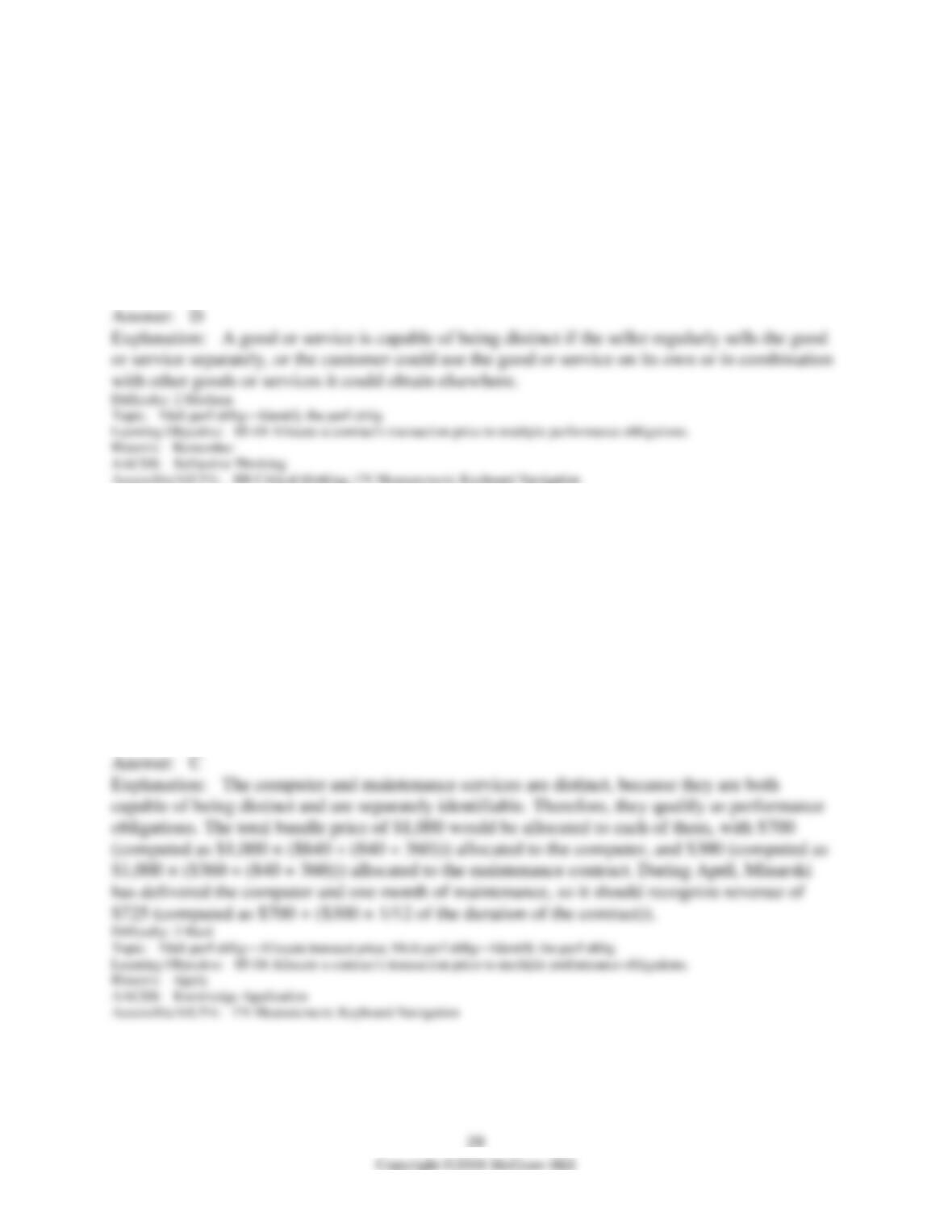
103) Goods or services are capable of being distinct if:
A) The seller regularly sells the good or service separately.
B) A buyer could use the good or service on its own.
C) A buyer could use the good or service in combination with goods or services the buyer could
obtain elsewhere.
D) The seller regularly sells the good or service separately, or the buyer could use the good or
service on its own, or the buyer could use the good or service in combination with goods or
services the buyer could obtain elsewhere.
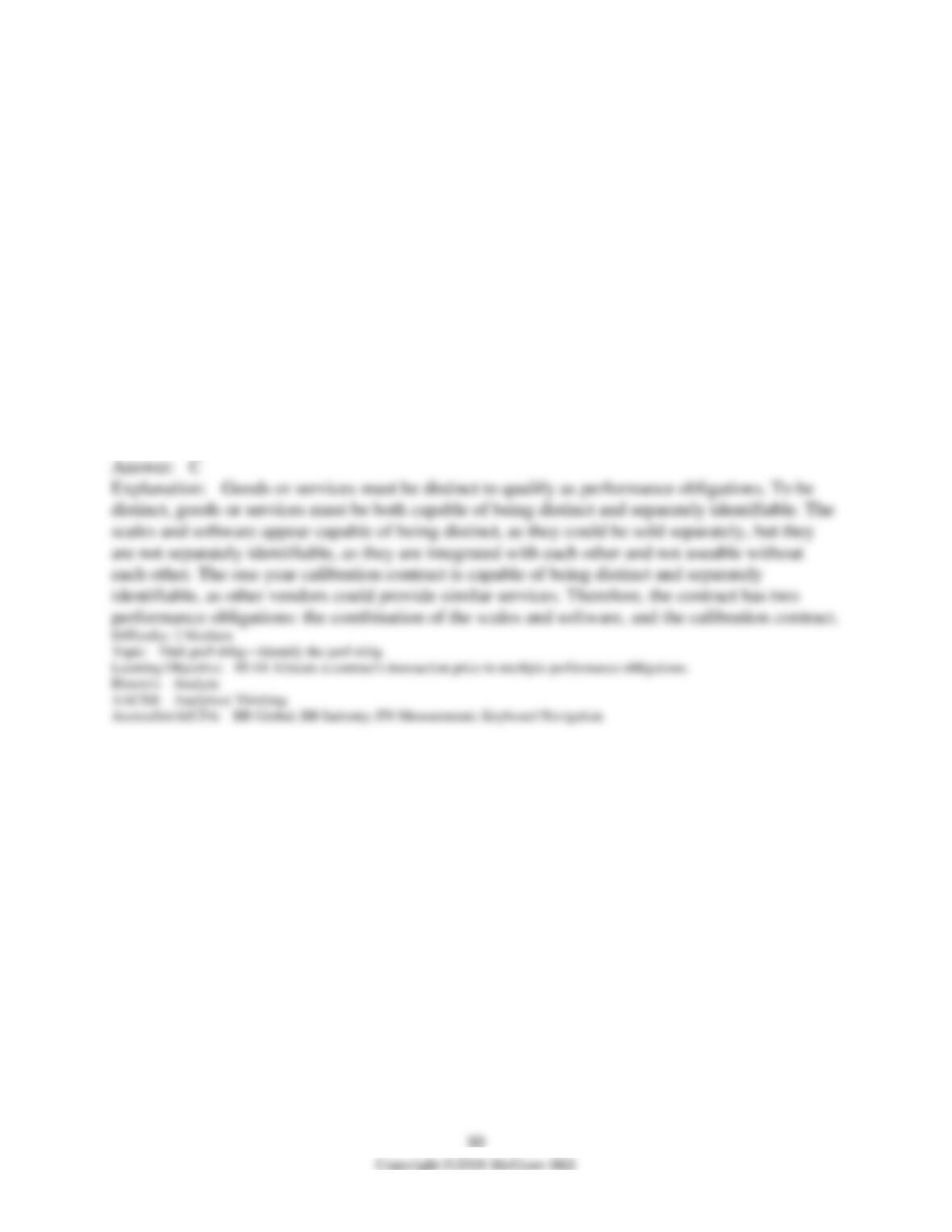
104) Minarski Electronics sells computers and provides hardware maintenance services. On
April 1st, Minarski sold a package deal containing a computer and a one-year unlimited
maintenance/repair service for the computer at a bundle price of $1,000. If sold separately, the
computer costs $840 and the one-year unlimited maintenance/repair service costs $360. How
much revenue does Minarski Electronics recognize for the month ended April 30th, assuming
that revenue is accrued monthly?
A) $1,000
B) $870
C) $725
D) $30
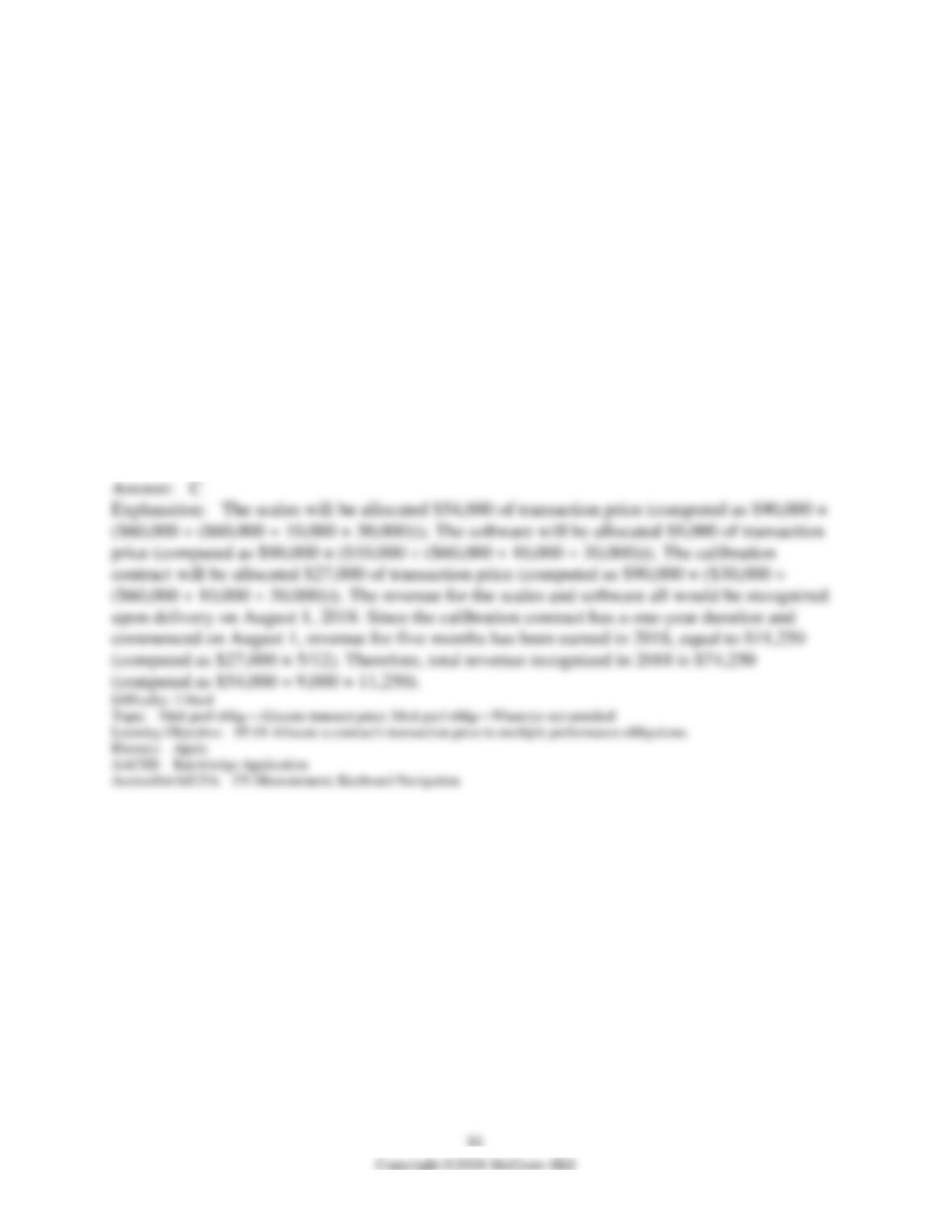
105) On July 15, 2018, Ortiz & Co. signed a contract to provide EverFresh Bakery with an
ingredient-weighing system for a price of $90,000. The system included finely tuned scales that
fit into EverFresh’s automated assembly line, Ortiz’s proprietary software modified to allow the
weighing system to function in EverFresh’s automated system, and a one-year contract to
calibrate the equipment and software on an as-needed basis. (Ortiz competes with other vendors
who offer ongoing calibration contracts for Ortiz’s systems.) If Ortiz was to provide these goods
or services separately, it would charge $60,000 for the scales, $10,000 for the software, and
$30,000 for the calibration contract. Ortiz delivered and installed the equipment and software on
August 1, 2018, and the calibration service commenced on that date.
How many performance obligations exist in this contract?
A) 0
B) 1
C) 2
D) 3
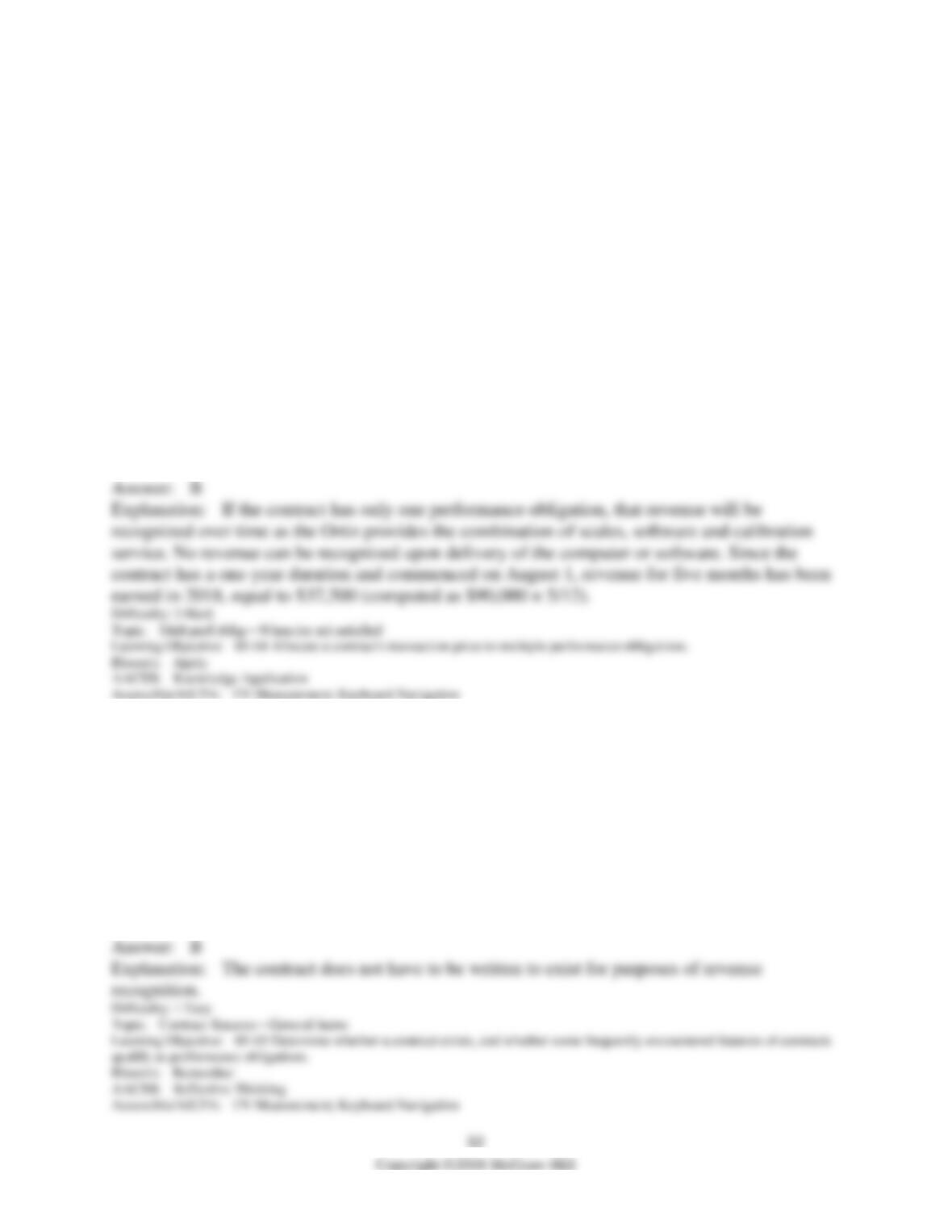
106) On July 15, 2018, Ortiz & Co. signed a contract to provide EverFresh Bakery with an
ingredient-weighing system for a price of $90,000. The system included finely tuned scales that
fit into EverFresh’s automated assembly line, Ortiz’s proprietary software modified to allow the
weighing system to function in EverFresh’s automated system, and a one-year contract to
calibrate the equipment and software on an as-needed basis. (Ortiz competes with other vendors
who offer ongoing calibration contracts for Ortiz’s systems.) If Ortiz was to provide these goods
or services separately, it would charge $60,000 for the scales, $10,000 for the software, and
$30,000 for the calibration contract. Ortiz delivered and installed the equipment and software on
August 1, 2018, and the calibration service commenced on that date.
Assume that the scales, software and calibration service are all separate performance obligations.
How much revenue will Ortiz recognize in 2018 for this contract?
A) $0
B) $63,000
C) $74,250
D) $90,000
107) On July 15, 2018, Ortiz & Co. signed a contract to provide EverFresh Bakery with an
ingredient-weighing system for a price of $90,000. The system included finely tuned scales that
fit into EverFresh’s automated assembly line, Ortiz’s proprietary software modified to allow the
weighing system to function in EverFresh’s automated system, and a one-year contract to
calibrate the equipment and software on an as-needed basis. (Ortiz competes with other vendors
who offer ongoing calibration contracts for Ortiz’s systems.) If Ortiz was to provide these goods
or services separately, it would charge $60,000 for the scales, $10,000 for the software, and
$30,000 for the calibration contract. Ortiz delivered and installed the equipment and software on
August 1, 2018, and the calibration service commenced on that date.
Assume that the scales, software and calibration service are viewed as one performance
obligation. How much revenue will Ortiz recognize in 2018 for this contract?
A) $0
B) $37,500
C) $63,000
D) $90,000
108) A contract does not exist for purposes of applying the revenue recognition principle in all
of the following cases except for when:
A) The seller believes it is not probable that it will collect the amount it’s entitled to receive
under the contract.
B) The seller and buyer did not sign a formalized written contract.
C) The seller and buyer can terminate the contract without penalty and neither has performed any
obligations under the contract.
D) The seller believes it is highly likely but not certain that the buyer will agree to the terms of
the contract.
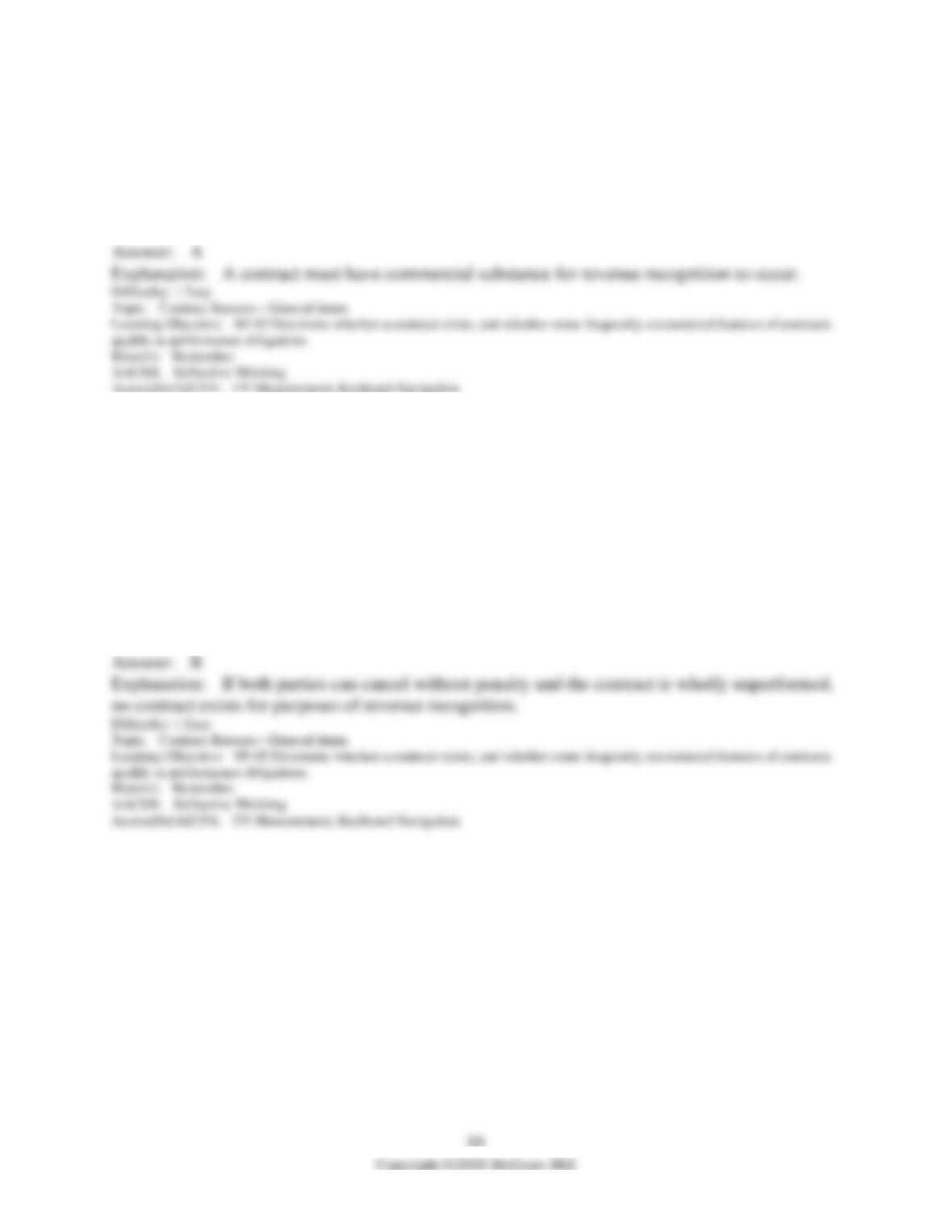
109) Which of the following is a characteristic of a contract for purposes of revenue recognition?
A) Commercial substance.
B) Nonverbal.
C) Reasonable profit margin.
D) Notarized within the company’s state of incorporation.
110) Waldman Associates received a written, approved contract to deliver economic consulting
services, with service and payment commencing in one month. The contract specifies the
services that Waldman is to perform, and the payment terms. Waldman and the customer both
can cancel the contract without penalty prior to commencing service. Does Waldman have a
contract for purposes of revenue recognition on the day the contract is received?
A) Yes, because Waldman has a written approved contract.
B) No, because Waldman and the customer can cancel without penalty, and neither has
performed an obligation under the contract.
C) Maybe, depending on whether Waldman can estimate collectability of the receivable.
D) There is insufficient data on which to base an answer.
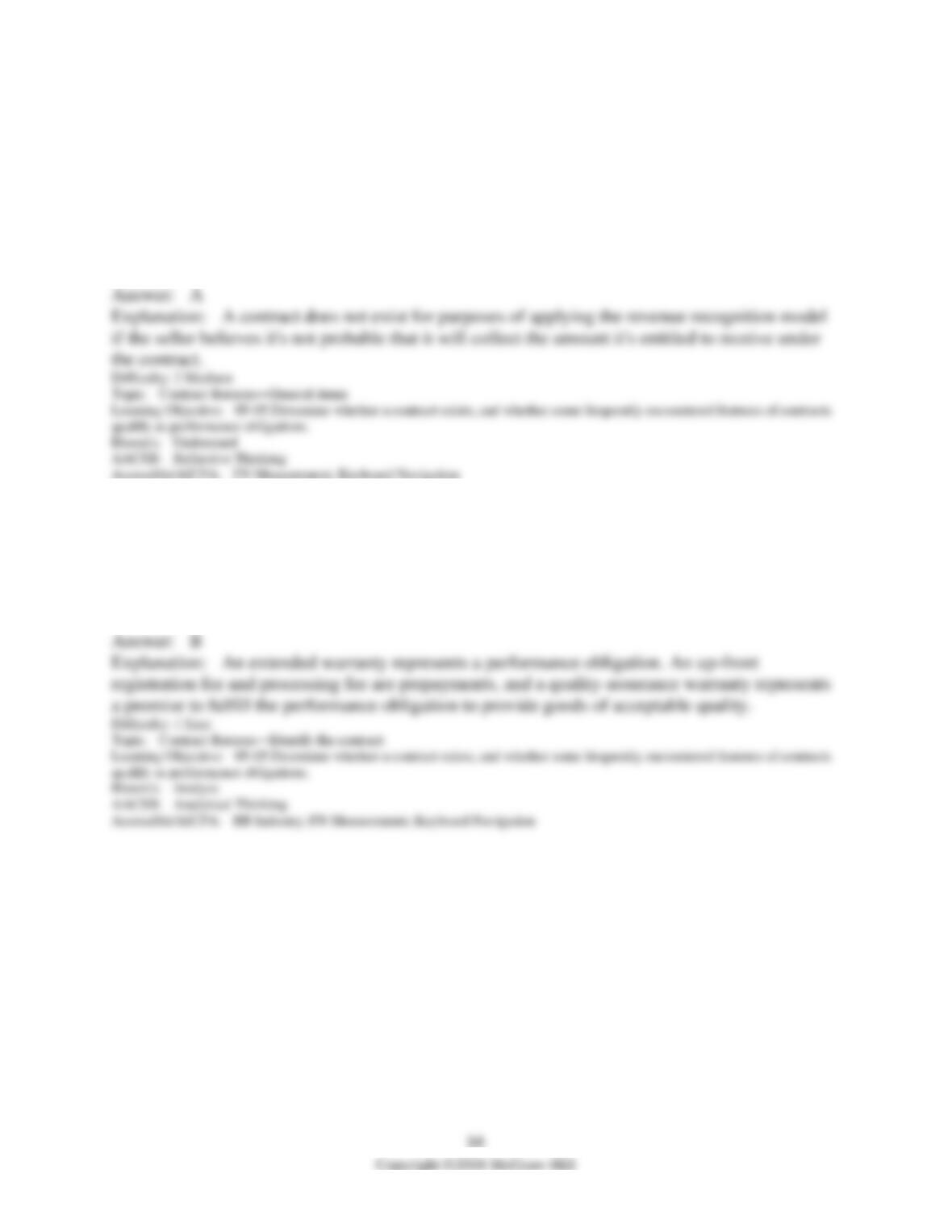
111) What is the effect of bad debts on revenue recognition?
A) The seller must believe it is probable it will collect the amounts it is entitled to collect.
B) Bad debts must be of a remote likelihood in order to recognize revenue.
C) Bad debts are deducted from revenue to calculate net revenue on the income statement,
similar to sales returns.
D) Bad debts are ignored when determining whether to recognize revenue, but recognized as an
expense on the income statement.
112) Which of the following is considered a performance obligation?
A) Up-front registration fees for a gym membership
B) Extended warranties on electronic products
C) Quality-assurance warranties on electronic products
D) A processing fee to obtain a bank loan
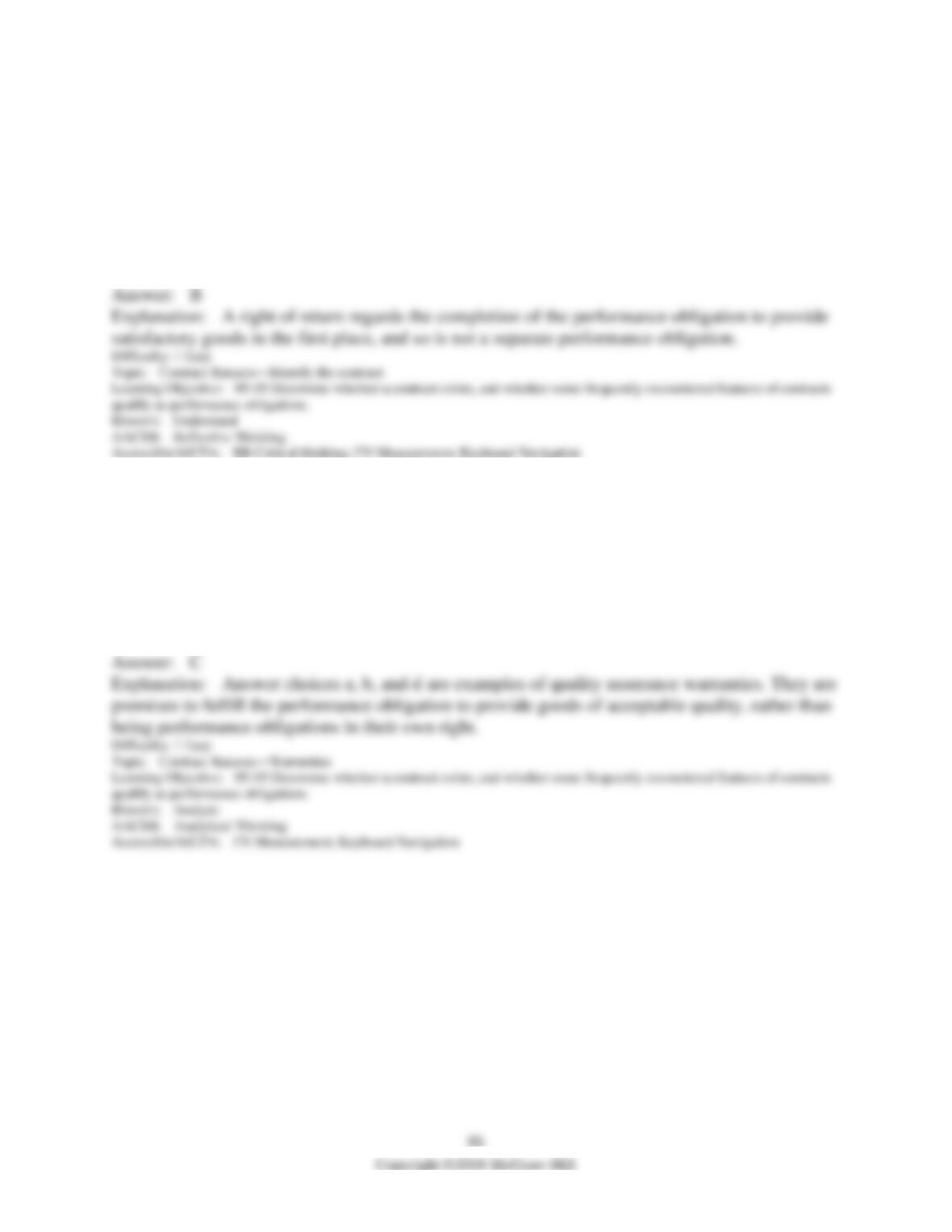
113) Which of the following is not a performance obligation?
A) A good that the seller could sell separately and that is separately identifiable from other goods
or services in the contract.
B) A right of return.
C) An option for a customer to purchase goods under terms that are more advantageous than
those enjoyed by other customers.
D) An extended warranty.
114) Which of the following is an example of an extended warranty?
A) Fancy Headphones, Inc. provides assurance that its headphones are defect-free after purchase.
B) Azalea’s Flowers assures clients that its flowers will stay fresh for at least a week.
C) Mark Electronics offers a warranty at an affordable price that provides additional protection
after the customer takes possession of the product.
D) Erickson Electronics promises to make repairs or replace any product found to be defective
within a week of purchase.
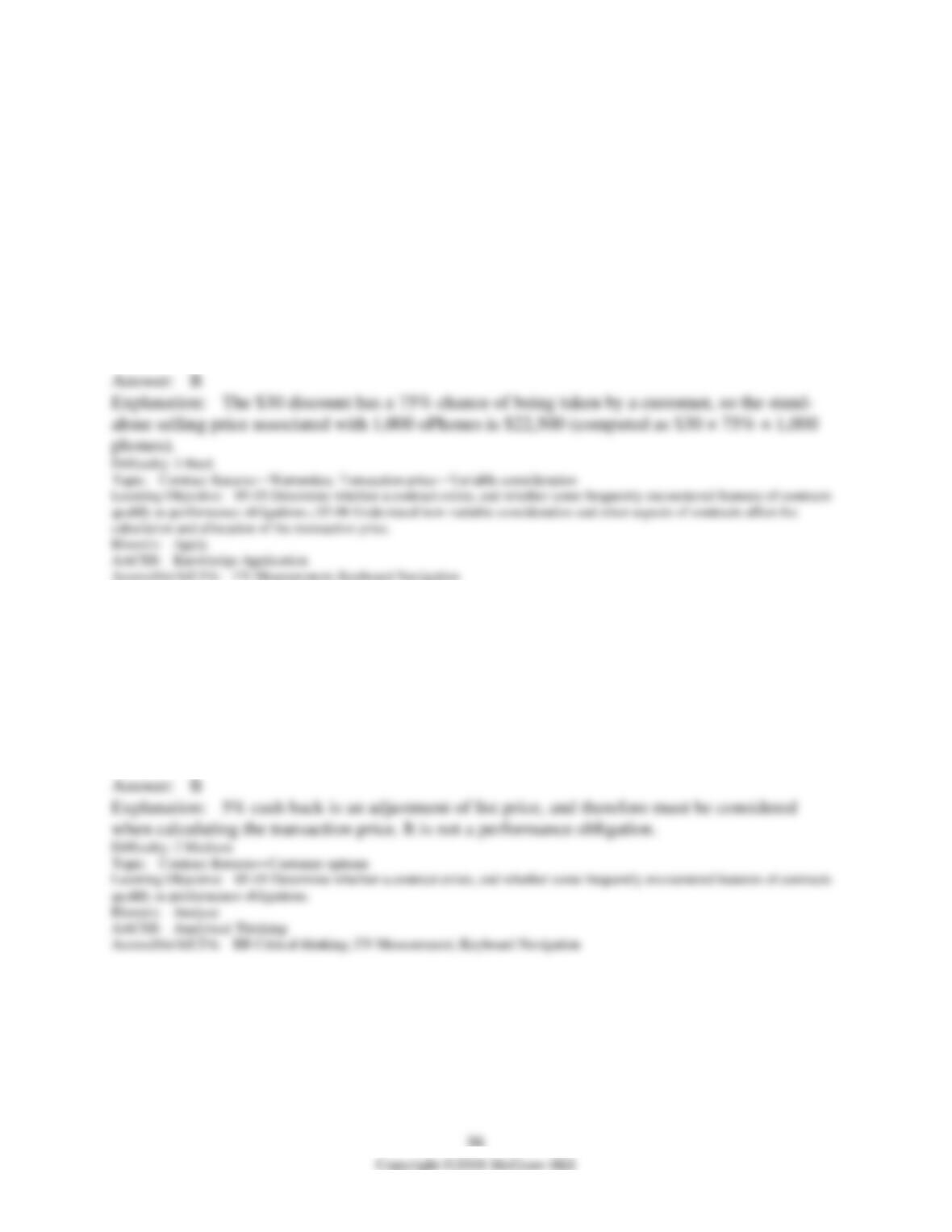
115) Orange Inc. offers a discount on an extended warranty on its oPhone when the warranty is
purchased at the time the oPhone is purchased. The warranty normally has a price of $150, but
Orange offers it for $120 when purchased along with an oPhone. Orange anticipates a 75%
chance that a customer will purchase the extended warranty along with the oPhone. Assume
Orange sells to 1,000 oPhones with the extended warranty discount offer. What is the total stand-
alone selling price that Orange would use for the extended warranty discount option for purposes
of allocating revenue among the performance obligations in those 1,000 oPhone contracts?
A) $0
B) $22,500
C) $30,000
D) $120,000
116) In which of the following is the option described not a performance obligation?
A) Customers accumulate points for every dollar spent at Madeline‘s Book Store. The points can
be redeemed for books once certain levels are met.
B) Customers can get 5% cash back for every $100 spent on eco-friendly products.
C) Customers can “buy two, get one free” at a menswear store.
D) Upon purchase of any name-brand TV, customers can purchase a 5-year extended warranty at
a 25% discount.
117) Which of the following statement is most true?
A) Variable consideration means that the transaction price is uncertain.
B) Basing an estimate on the most likely amount is always superior to basing an estimate on the
expected value.
C) The most likely estimated amount is estimated by multiplying the possible amounts with their
respective probability of occurrence.
D) When the transaction price is uncertain, revenue should not be recognized.
118) Which of the following is an example of a variable consideration?
A) John is expected to receive $100 for his tutoring services provided that he keeps track of his
hours.
B) Melody’s Piano will get paid for the 50 pianos sold provided that the pianos are non-defective
after the customer takes control.
C) Cantankerous Computers gets paid a base amount for every repair plus an additional hourly
fee of $10.
D) Excellent Electronics has a 10% mail-in rebate program for the Model X-001 speaker system.
The company sold $10,000 worth of systems and believes there is a 50% chance that rebates will
be redeemed.
119) Which of the following is correct about changes in estimated variable consideration?
A) Changes in estimated variable consideration should be recognized as an adjustment to
revenue in the period the change in estimate is made.
B) Changes in estimated variable consideration should be applied retroactively to all periods
affected.
C) Changes in estimated variable consideration should be allocated retrospectively to all prior
periods.
D) Changes in estimated variable consideration are not recognized in periods after transaction
price is first estimated.
120) On April 1st, Bob the Builder entered into a contract of one-month duration to build a barn
for Nolan. Bob is guaranteed to receive a base fee of $5,000 for his services in addition to a
bonus depending on when the project is completed. Nolan created incentives for Bob to finish
the barn as soon as he can without jeopardizing the structural integrity of the barn. Nolan offered
to pay an additional 30% of the base fee if the project finished 2 weeks early and 10% if the
project finished a week early. The probability of finishing 2 weeks early is 30% and the
probability of finishing a week early is 60%.
What is the expected transaction price with variable consideration estimated as the expected
value?
A) $4,750
B) $5,000
C) $5,500
D) $5,750
121) On April 1st, Bob the Builder entered into a contract of one-month duration to build a barn
for Nolan. Bob is guaranteed to receive a base fee of $5,000 for his services in addition to a
bonus depending on when the project is completed. Nolan created incentives for Bob to finish
the barn as soon as he can without jeopardizing the structural integrity of the barn. Nolan offered
to pay an additional 30% of the base fee if the project finished 2 weeks early and 10% if the
project finished a week early. The probability of finishing 2 weeks early is 30% and the
probability of finishing a week early is 60%.
What is the expected transaction price with variable consideration estimated as the most likely
amount?
A) $4,750
B) $5,000
C) $5,500
D) $5,750
122) Sanjeev enters into a contract offering variable consideration. The contract pays him
$1,000/month for six months of continuous consulting services. In addition, there is a 60%
chance the contract will pay an additional $2,000 and a 40% chance the contract will pay an
additional $3,000, depending on the outcome of the consulting contract. Sanjeev concludes that
this contract qualifies for revenue recognition over time.
Assume Sanjeev estimates variable consideration as the most likely amount. What is the amount
of revenue Sanjeev would recognize for the first month of the contract?
A) $1,000
B) $1,333
C) $1,400
D) $1,200
123) Sanjeev enters into a contract offering variable consideration. The contract pays him
$1,000/month for six months of continuous consulting services. In addition, there is a 60%
chance the contract will pay an additional $2,000 and a 40% chance the contract will pay an
additional $3,000, depending on the outcome of the consulting contract. Sanjeev concludes that
this contract qualifies for revenue recognition over time.
Assume Sanjeev estimates variable consideration as the expected value. What is the amount of
revenue Sanjeev would recognize for the first month of the contract?
A) $1,000
B) $1,333
C) $1,400
D) $1,200