CHAPTER 5
BALANCE SHEET AND STATEMENT OF CASH FLOWS
IFRS questions are available at the end of this chapter.
TRUE-FALSE—Conceptual
Answer No. Description
MULTIPLE CHOICE—Conceptual
Test Bank for Intermediate Accounting, Fifteenth Edition
5 – 2
MULTIPLE CHOICE—Conceptual (cont.)
Answer No. Description
Balance Sheet and Statement of Cash Flows
5 – 3
MULTIPLE CHOICE—Computational
Answer No. Description
MULTIPLE CHOICE—CPA Adapted
Answer No. Description
BRIEF EXERCISES
Item Description
BE5–107 Definitions.
BE5–108 Terminology.
BE5–109 Current assets.
EXERCISES
E5–110 Account classification.
E5–111 Valuation of balance sheet items.
E5–112 Balance sheet classifications.
E5–113 Balance sheet classifications.

Test Bank for Intermediate Accounting, Fifteenth Edition
5 – 4
E5–114 Balance sheet classifications.
E5–115 Statement of cash flows.
E5–116 Statement of cash flows ratios.
PROBLEMS
Item Description
P5–117 Balance sheet format.
P5–118 Balance sheet preparation.
P5–119 Balance sheet presentation.
P5–120 Statement of cash flows preparation.
P5–121 Statement of cash flows preparation.
CHAPTER LEARNING OBJECTIVES
1. Explain the uses and limitations of a balance sheet.
2. Identify the major classifications of the balance sheet.
3. Prepare a classified balance sheet using the report and account formats.
4. Indicate the purpose of the statement of cash flows.
5. Identify the content of the statement of cash flows.
6. Prepare a basic statement of cash flows.
7. Understand the usefulness of the statement of cash flows.
8. Determine which balance sheet information requires supplemental disclosure.
9. Describe the major disclosure techniques for the balance sheet.
*10.Identify the major types of financial ratios and what they measure.
11. Compare the accounting procedures related to the balance sheet under GAAP and IFRS.
Balance Sheet and Statement of Cash Flows
5 – 5
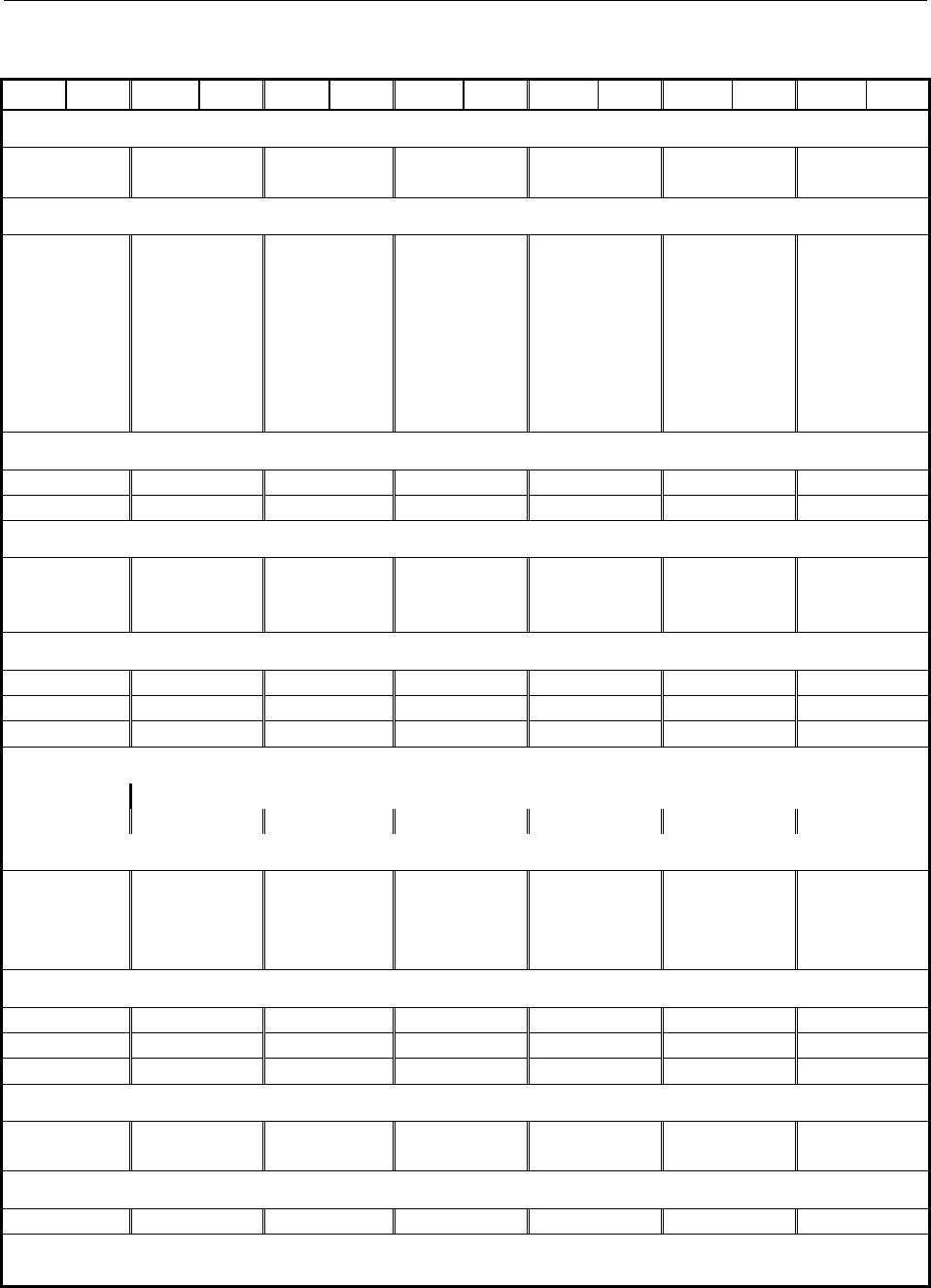
SUMMARY OF LEARNING OBJECTIVES BY QUESTIONS
Item
Type
Item
Type
Item
Type
Item
Type
Item
Type
Item
Type
Item
Type
Learning Objective 1
1.
TF
3.
TF
22.
MC
24.
MC
S26.
MC
P28.
MC
2.
TF
21.
MC
23.
MC
25.
MC
S27.
MC
Learning Objective 2
4.
TF
33.
MC
40.
MC
47.
MC
83.
MC
107.
BE-
CT
114.
E
5.
TF
34.
MC
41.
MC
48.
MC
84.
MC
108.
BE
117.
P
6.
TF
35.
MC
42.
MC
49.
MC
97.
MC
109.
BE
118.
P
29.
MC
36.
MC
43.
MC
79.
MC
98.
MC
110.
E
119.
P
30.
MC
37.
MC
44.
MC
80.
MC
99.
MC
111.
E
31.
MC
38.
MC
45.
MC
81.
MC
100.
MC
112.
E
32.
MC
39.
MC
46.
MC
82.
MC
101.
MC
113.
E
Learning Objective 3
7.
TF
P50.
MC
85.
MC
86.
MC
87.
MC
118.
P
119.
P
Learning Objective 4
8.
TF
9.
TF
51.
MC
S52.
MC
53.
MC
54.
MC
Learning Objective 5
10.
TF
56.
MC
59.
MC
89.
MC
103.
MC
115.
E
11.
TF
57.
MC
60.
MC
90.
MC
104.
MC
55.
MC
58.
MC
88.
MC
102.
MC
105.
MC
Learning Objective 6
12.
TF
61.
MC
92.
MC
121.
P
13.
TF
91.
MC
120.
P
Learning Objective 7
14.
TF
63.
MC
S66.
MC
116.
E-
CT
15.
TF
64.
MC
93.
MC
62.
MC
65.
MC
94.
MC
Learning Objective 8
16.
TF
S68.
MC
71.
MC
106.
MC
110.
E
117.
P
17.
TF
69.
MC
72.
MC
107.
BE
112.
E
S67.
MC
70.
MC
73.
MC
108.
BE
114.
E
Learning Objective 9
18.
TF
74.
MC
76.
MC
19.
TF
75.
MC
77.
MC
Learning Objective 10
20.
TF
78.
MC
95.
MC
96.
MC
Learning Objective 11- IFRS Questions

Test Bank for Intermediate Accounting, Fifteenth Edition
5 – 6
1
TF
3
TF
5
MC
7
MC
9
MC
11
SA
2
TF
4
TF
6
MC
8
MC
10
MC
12
SA
Note: TF = True-False E = Exercise CT = Critical Thinking
MC = Multiple Choice BE = Brief Exercise P = Problem
SA = Short Answer

Balance Sheet and Statement of Cash Flows
5 – 7
TRUE FALSE—Conceptual
1. Liquidity refers to the ability of an enterprise to pay its debts as they mature.
2. The balance sheet omits many items that are of financial value to the business but cannot
be recorded objectively.
3. Financial flexibility measures the ability of an enterprise to take effective actions to alter the
amounts and timing of cash flows.
4. Companies frequently describe the terms of all long-term liability agreements in notes to the
financial statements.
5. A company excludes from the current assets section, the amount of cash restricted for
purposes other than payment of current obligations or for use in current operations.
6. Land held for speculation is reported in the property, plant, and equipment section of the
balance sheet.
7. The account form and the report form of the balance sheet are both acceptable under
GAAP.
8. The primary purpose of a statement of cash flows is to report the cash effects of operations
during a period.
9. The statement of cash flows reports only the cash effects of operations during a period and
financing transactions.
10. Financial flexibility is a company’s ability to respond and adapt to financial adversity and
unexpected needs and opportunities.
11. Collection of a loan is reported as an investing activity in the statement of cash flows.
12. Companies determine cash provided by operating activities by converting net income on an
accrual basis to a cash basis.
13. Significant financing and investing activities that do not affect cash are not reported in the
statement of cash flows or any other place.
14. Financial statement readers often assess liquidity by using the current cash debt coverage.
15. Free cash flow is net income less capital expenditures and dividends.
16. Because of the historical cost principle, fair values may not be disclosed in the balance
sheet.
17. Companies have the option of disclosing information about the nature of their operations
and the use of estimates in preparing financial statements.
18. Companies may use parenthetical explanations, notes, cross references, and supporting
schedules to disclose pertinent information.
Test Bank for Intermediate Accounting, Fifteenth Edition
5 – 8
19. On the balance sheet, an adjunct account reduces either an asset, a liability, or an owners’
equity account.
20. Activity ratios measure the degree of protection for long-term creditors and investors.
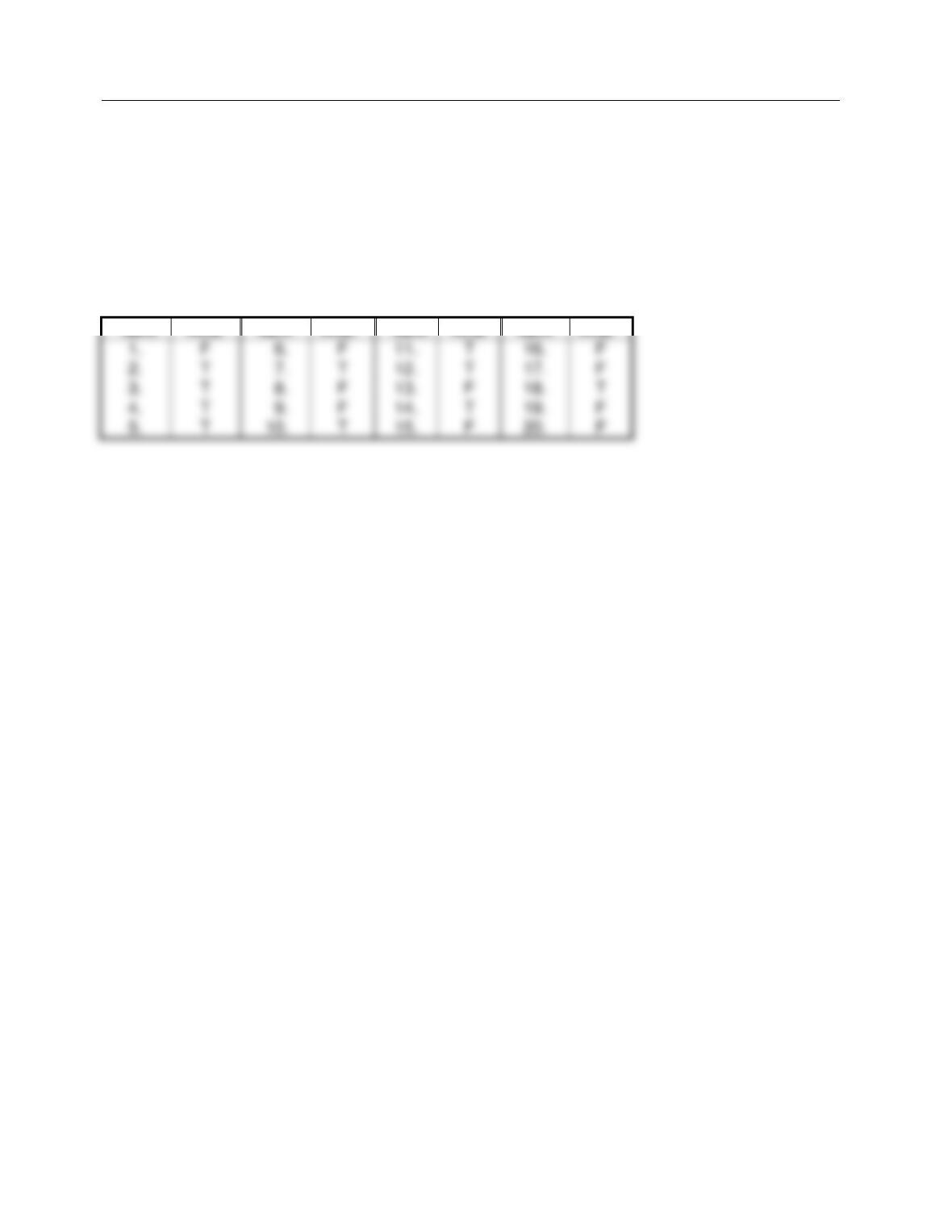
True False Answers—Conceptual
Item
Ans.
Item
Ans.
Item
Ans.
Item
Ans.
MULTIPLE CHOICE—Conceptual
21. Which of the following is a limitation of the balance sheet?
a. Many items that are of financial value are omitted.
b. Judgments and estimates are used.
c. Current fair value is not reported.
d. All of these answer choices are correct.
22. The balance sheet is useful for analyzing all of the following except
a. liquidity.
b. solvency.
c. profitability.
d. financial flexibility.
23. Balance sheet information is useful for all of the following except to
a. compute rates of return
b. analyze cash inflows and outflows for the period
c. evaluate capital structure
d. assess future cash flows
24. Balance sheet information is useful for all of the following except
a. assessing a company’s risk
b. evaluating a company’s liquidity
c. evaluating a company’s financial flexibility
d. determining free cash flows.

Balance Sheet and Statement of Cash Flows
5 – 9
25. A limitation of the balance sheet that is not also a limitation of the income statement is
a. the use of judgments and estimates
b. omitted items
c. the numbers are affected by the accounting methods employed
d. valuation of items at historical cost
S26. The balance sheet contributes to financial reporting by providing a basis for all of the
following except
a. computing rates of return.
b. evaluating the capital structure of the enterprise.
c. determining the increase in cash due to operations.
d. assessing the liquidity and financial flexibility of the enterprise.
S27. One criticism not normally aimed at a balance sheet prepared using current accounting
and reporting standards is
a. failure to reflect current value information.
b. the extensive use of separate classifications.
c. an extensive use of estimates.
d. failure to include items of financial value that cannot be recorded objectively.
P28. The amount of time that is expected to elapse until an asset is realized or otherwise
converted into cash is referred to as
a. solvency.
b. financial flexibility.
c. liquidity.
d. exchangeability.
29. The net assets of a business are equal to
a. current assets minus current liabilities.
b. total assets plus total liabilities.
c. total assets minus total stockholders’ equity.
d. none of these answer choices are correct.
30. The correct order to present current assets is
a. cash, accounts receivable, prepaid items, inventories.
b. cash, accounts receivable, inventories, prepaid items.
c. cash, inventories, accounts receivable, prepaid items.
d. cash, inventories, prepaid items, accounts receivable.
31. The basis for classifying assets as current or noncurrent is conversion to cash within
a. the accounting cycle or one year, whichever is shorter.
b. the operating cycle or one year, whichever is longer.
c. the accounting cycle or one year, whichever is longer.
d. the operating cycle or one year, whichever is shorter.
32. The basis for classifying assets as current or noncurrent is the period of time normally
required by the accounting entity to convert cash invested in
a. inventory back into cash, or 12 months, whichever is shorter.
b. receivables back into cash, or 12 months, whichever is longer.
c. tangible fixed assets back into cash, or 12 months, whichever is longer.
d. inventory back into cash, or 12 months, whichever is longer.

Test Bank for Intermediate Accounting, Fifteenth Edition
5 – 10
33. The current assets section of the balance sheet should include
a. machinery.
b. patents.
c. goodwill.
d. inventory.
34. Which of the following is a current asset?
a. Cash surrender value of a life insurance policy of which the company is the
beneficiary.
b. Investment in equity securities for the purpose of controlling the issuing company.
c. Cash designated for the purchase of tangible fixed assets.
d. Trade installment receivables normally collectible in 18 months.
35. Current assets are presented in the balance sheet in
a. ascending order of their balances.
b. descending order of their balances.
c. order of their liquidity.
d. reverse order of their liquidity.
36. Receivables are valued based on their ________.
a. fair value
b. estimated amount collectible
c. lower-of-cost-or-market value
d. historical cost
37. When a portion of inventories has been pledged as security on a loan,
a. the value of the portion pledged should be subtracted from the debt.
b. an equal amount of retained earnings should be appropriated.
c. the fact should be disclosed but the amount of current assets should not be affected.
d. the cost of the pledged inventories should be transferred from current assets to
noncurrent assets.
38. Which of the following is not a long-term investment?
a. Cash surrender value of life insurance
b. Franchise
c. Land held for speculation
d. A sinking fund
39. A generally accepted method of valuation is
1. trading securities at market value.
2. accounts receivable at net realizable value.
3. inventories at current cost.
a. 1
b. 2
c. 3
d. 1 and 2

Balance Sheet and Statement of Cash Flows
5 – 11
40. Which item below is not a current liability?
a. Unearned revenue
b. Stock dividends distributable
c. The currently maturing portion of long-term debt
d. Trade accounts payable
41. Working capital is
a. capital which has been reinvested in the business.
b. unappropriated retained earnings.
c. cash and receivables less current liabilities.
d. none of these answer choices are correct.
42. An example of an item which is not an element of working capital is
a. accrued interest on notes receivable.
b. goodwill.
c. goods in process.
d. temporary investments.
43. Long-term liabilities include
a. obligations not expected to be liquidated within the operating cycle.
b. obligations payable at some date beyond the operating cycle.
c. deferred income taxes and most lease obligations.
d. all of these answer choices are correct.
44. Which of the following should be excluded from long-term liabilities?
a. Obligations payable at some date beyond the operating cycle
b. Most pension obligations
c. Long-term liabilities that mature within the operating cycle and will be paid from a
sinking fund
d. None of these answer choices are correct.
45. Treasury stock should be reported as a(n)
a. current asset.
b. investment.
c. other asset.
d. reduction of stockholders’ equity.
46. Which of the following should be reported for capital stock?
a. The shares authorized
b. The shares issued
c. The shares outstanding
d. All of these answer choices are correct.
47. Which of the following would be classified in a different major section of a balance sheet
from the others?
a. Capital stock
b. Common stock subscribed
c. Stock dividend distributable
d. Stock investment in affiliate

Test Bank for Intermediate Accounting, Fifteenth Edition
5 – 12
48. The stockholders’ equity section is usually divided into what three parts?
a. Preferred stock, common stock, treasury stock
b. Preferred stock, common stock, retained earnings
c. Capital stock, additional paid-in capital, retained earnings
d. Capital stock, appropriated retained earnings, unappropriated retained earnings
49. Which of the following is not an acceptable major asset classification?
a. Current assets
b. Long-term investments
c. Property, plant, and equipment
d. Deferred charges
50. The financial statement which summarizes operating, investing, and financing activities of
an entity for a period of time is the
a. retained earnings statement.
b. income statement.
c. statement of cash flows.
d. statement of financial position.
S51. The statement of cash flows provides answers to all of the following questions except
a. where did the cash come from during the period?
b. what was the cash used for during the period?
c. what is the impact of inflation on the cash balance at the end of the year?
d. what was the change in the cash balance during the period?
52. The statement of cash flows reports all of the following except
a. the net change in cash for the period.
b. the cash effects of operations during the period.
c. the free cash flows generated during the period.
d. investing transactions.
53. The statement of cash flows helps meet the objective of financial reporting, which is to
assess all of the following except the
a. amount of future cash flows.
b. source of future cash flows.
c. timing of future cash flows.
d. uncertainty of future cash flows.
54. If common stock was issued to acquire an $8,000 machine, how would the transaction
appear on the statement of cash flows?
a. It would depend on whether you are using the direct or the indirect method.
b. It would be a positive $8,000 in the financing section and a negative $8,000 in the
investing section.
c. It would be a negative $8,000 in the financing section and a positive $8,000 in the
investing section.
d. It would not appear on the statement of cash flows but rather on a schedule of
noncash investing and financing activities.
55. Which of the following events will appear in the cash flows from financing activities section
of the statement of cash flows?
a. Cash purchases of equipment.
b. Cash purchases of bonds issued by another company.

Balance Sheet and Statement of Cash Flows
5 – 13
c. Cash received as repayment for funds loaned.
d. Cash purchase of treasury stock.
56. Making and collecting loans and disposing of property, plant, and equipment are
a. operating activities.
b. investing activities.
c. financing activities.
d. liquidity activities.
57. In preparing a statement of cash flows, sale of treasury stock at an amount greater than
cost would be classified as a(n)
a. operating activity.
b. financing activity.
c. extraordinary activity.
d. investing activity.
58. In preparing a statement of cash flows, cash flows from operating activities
a. are always equal to accrual accounting income.
b. are calculated as the difference between revenues and expenses.
c. can be calculated by appropriately adding to or deducting from net income those items
in the income statement that do not affect cash.
d. can be calculated by appropriately adding to or deducting from net income those items
in the income statement that do affect cash.
59. In preparing a statement of cash flows, which of the following transactions would be
considered an investing activity?
a. Sale of equipment at book value
b. Sale of merchandise on credit
c. Declaration of a cash dividend
d. Issuance of bonds payable at a discount
60. Preparing the statement of cash flows involves all of the following except determining the
a. cash provided by operations.
b. cash provided by or used in investing and financing activities.
c. change in cash during the period.
d. cash collections from customers during the period.
61. The cash debt coverage is computed by dividing net cash provided by operating activities
by
a. average long-term liabilities.
b. average total liabilities.
c. ending long-term liabilities.
d. ending total liabilities.
62. The current cash debt coverage is often used to assess
a. financial flexibility.
b. liquidity.
c. profitability.
d. solvency.
63. A measure of a company’s financial flexibility is the
a. cash debt coverage.

Test Bank for Intermediate Accounting, Fifteenth Edition
5 – 14
b. current cash debt coverage.
c. free cash flow.
d. cash debt coverage and free cash flow.
64. Free cash flow is calculated as net cash provided by operating activities less
a. capital expenditures.
b. dividends.
c. capital expenditures and dividends.
d. capital expenditures and depreciation.
S65. One of the benefits of the statement of cash flows is that it helps users evaluate financial
flexibility. Which of the following explanations is a description of financial flexibility?
a. The nearness to cash of assets and liabilities.
b. The firm’s ability to respond and adapt to financial adversity and unexpected needs
and opportunities.
c. The firm’s ability to pay its debts as they mature.
d. The firm’s ability to invest in a number of projects with different objectives and costs.
P66. Net cash provided by operating activities divided by average total liabilities equals the
a. current cash debt coverage.
b. cash debt coverage.
c. free cash flow.
d. current ratio.
S67. Which of the following balance sheet classifications would normally require the greatest
amount of supplementary disclosure?
a. Current assets
b. Current liabilities
c. Plant assets
d. Long-term liabilities
68. Level 1 of fair value hierarchy measures are based on:
a. market prices for identical assets.
b. market prices for similar assets.
c. unobservable inputs.
d. historical cost of similar assets.
69. Which of the following is not a required supplemental disclosure for the balance sheet?
a. Contingencies
b. Financial forecasts
c. Accounting policies
d. Contractual situations
70. Typical contractual situations that are disclosed in the notes to the balance sheet include
all of the following except
a. debt covenants
b. lease obligations
c. advertising contracts
d. pension obligations
71. Accounting policies disclosed in the notes to the financial statements typically include all
of the following except

Balance Sheet and Statement of Cash Flows
5 – 15
a. the cost flow assumption used
b. the depreciation methods used
c. significant estimates made
d. significant inventory purchasing policies
72. Which of the following best exemplifies a contingency that is reported in the notes to the
financial statements?
a. Losses from potential future lawsuits
b. Loss from a lawsuit settled out of court prior to the end of the fiscal year
c. Warranty claims on future sales
d. Estimated loss from an ongoing lawsuit
73. Which of the following is not a method of disclosing pertinent information?
a. Supporting schedules
b. Parenthetical explanations
c. Cross reference and contra items
d. All of these are methods of disclosing pertinent information.
74. Significant accounting policies may not be
a. selected on the basis of judgment.
b. selected from existing acceptable alternatives.
c. unusual or innovative in application.
d. omitted from financial-statement disclosure.
75. A general description of the depreciation methods applicable to major classes of depreci–
able assets
a. is not a current practice in financial reporting.
b. is not essential to a fair presentation of financial position.
c. is needed in financial reporting when company policy differs from income tax policy.
d. should be included in corporate financial statements or notes thereto.
76. It is mandatory that the essential provisions of which of the following be clearly stated in
the notes to the financial statements?
a. Stock option plans
b. Pension obligations
c. Lease contracts
d. All of these answer choices are correct
P77. Which of the following is a contra account?
a. Premium on bonds payable
b. Unearned revenue
c. Patents
d. Accumulated depreciation
78. __________ ratios measure how effectively a company uses its assets.
a. Liquidity
b. Activity
c Profitability
d. Coverage
Test Bank for Intermediate Accounting, Fifteenth Edition
5 – 16
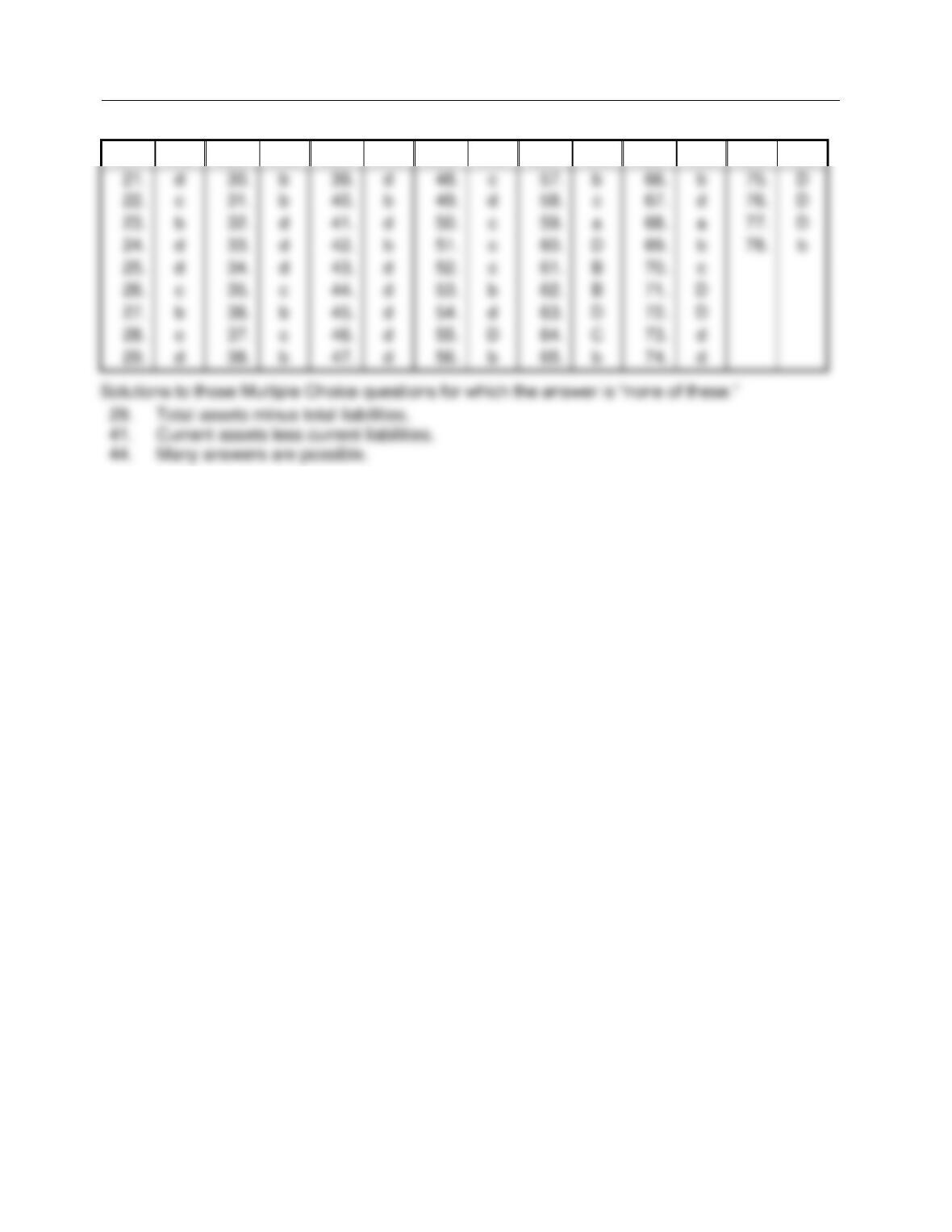
Multiple Choice Answers—Conceptual
Item
Ans.
Item
Ans.
Item
Ans.
Item
Ans.
Item
Ans.
Item
Ans.
Item
Ans.
MULTIPLE CHOICE—Computational
79. Fulton Company owns the following investments:
Trading securities (fair value) $140,000
Available-for-sale securities (fair value) 70,000
Held-to-maturity securities (amortized cost) 94,000
Fulton will report investments in its current assets section of
a. $0.
b. exactly $140,000.
c. $140,000 or an amount greater than $140,000, depending on the circumstances.
d. exactly $210,000.
80. For Grimmett Company, the following information is available:
Capitalized leases $600,000
Trademarks 245,000
Long-term receivables 225,000
In Grimmett’s balance sheet, intangible assets should be reported at
a. $245,000.
b. $275,000.
c. $845,000.
d. $875,000.
81. Houghton Company has the following items: common stock, $800,000; treasury stock,
$105,000; deferred income taxes, $125,000 and retained earnings, $390,000. What total
amount should Houghton Company report as stockholders’ equity?
a. $960,000.
b. $1,085,000.
c. $1,210,000.
d. $1,295,000.

Balance Sheet and Statement of Cash Flows
5 – 17
82. Kohler Company owns the following investments:
Trading securities (fair value) $120,000
Available-for-sale securities (fair value) 80,000
Held-to-maturity securities (amortized cost) 94,000
Kohler will report securities in its long-term investments section of
a. exactly $200,000.
b. exactly $214,000.
c. exactly $294,000.
d. $174,000 or an amount less than $174,000, depending on the circumstances.
83. For Randolph Company, the following information is available:
Capitalized leases $560,000
Copyrights 190,000
Long-term receivables 210,000
In Randolph’s balance sheet, intangible assets should be reported at
a. $190,000.
b. $220,000.
c. $750,000.
d. $780,000.
84. Olmsted Company has the following items: common stock, $750,000; treasury stock,
$105,000; deferred income taxes, $125,000 and retained earnings, $454,000. What total
amount should Olmsted Company report as stockholders’ equity?
a. $974,000.
b. $1,099,000.
c. $1,224,000.
d. $1,349,000.
85. Presented below are data for Antwerp Corp.
2014 2015
Assets, January 1 $2,800 $3,360
Liabilities, January 1 1,680 ?
Stockholders’ Equity, Jan. 1 ? ?
Dividends 560 420
Common Stock 504 448
Stockholders’ Equity, Dec. 31 ? ?
Net Income 560 448
Stockholders’ Equity at January 1, 2014 is
a. $ 704.
b. $ 760.
c. $1,120.
d. $1,624.

Test Bank for Intermediate Accounting, Fifteenth Edition
5 – 18
86. Presented below are data for Bandkok Corp.
2014 2015
Assets, January 1 $5,900 $6,480
Liabilities, January 1 3,240 ?
Stockholders’ Equity, Jan. 1 ? ?
Dividends 1,080 810
Common Stock 972 864
Stockholders’ Equity, Dec. 31 ? ?
Net Income 1,280 864
Stockholders’ Equity at January 1, 2015 is
a. $3,832.
b. $2,660.
c. $2,860.
d. $3,940.
87. Presented below are data for Caracas Corp.
2014 2015
Assets, January 1 $4,560 ?
Liabilities, January 1 ? $2,736
Stockholders’ Equity, Jan. 1 ? 2,750
Dividends 570 646
Common Stock 608 650
Stockholders’ Equity, Dec. 31 ? 2,266
Net Income 684 ?
Net income for 2015 is
a. $484 income.
b. $484 loss.
c. $162 loss.
d. $162 income.
88. Lohmeyer Corporation reports:
Cash provided by operating activities $320,000
Cash used by investing activities 110,000
Cash provided by financing activities 140,000
Beginning cash balance 70,000
What is Lohmeyer’s ending cash balance?
a. $350,000.
b. $420,000.
c. $570,000.
d. $640,000.

Balance Sheet and Statement of Cash Flows
5 – 19
89. Keisler Corporation reports:
Cash provided by operating activities $280,000
Cash used by investing activities 110,000
Cash provided by financing activities 140,000
Beginning cash balance 70,000
What is Keisler’s ending cash balance?
a. $310,000.
b. $380,000.
c. $530,000.
d. $600,000.
90. During 2014 the DLD Company had a net income of $75,000. In addition, selected
accounts showed the following changes:
Accounts Receivable $3,000 increase
Accounts Payable 1,000 increase
Buildings 4,000 decrease
Depreciation Expense 1,500 increase
Bonds Payable 8,000 increase
What was the amount of cash provided by operating activities?
a. $74,500
b. $75,000
c. $76,500
d. $84,500
91. Harding Corporation reports the following information:
Net income $480,000
Depreciation expense 140,000
Increase in accounts receivable 60,000
Harding should report cash provided by operating activities of
a. $280,000.
b. $400,000.
c. $560,000.
d. $680,000.
92. Sauder Corporation reports the following information:
Net income $320,000
Depreciation expense 70,000
Increase in accounts receivable 30,000
Sauder should report cash provided by operating activities of
a. $220,000.
b. $280,000.
c. $360,000.
d. $420,000.

Test Bank for Intermediate Accounting, Fifteenth Edition
5 – 20
93. Packard Corporation reports the following information:
Net cash provided by operating activities $285,000
Average current liabilities 150,000
Average long-term liabilities 100,000
Dividends declared 60,000
Capital expenditures 110,000
Payments of debt 35,000
Packard’s cash debt coverage is
a. 1.14.
b. 1.90.
c. 2.85.
d. 4.75.
94. Packard Corporation reports the following information:
Net cash provided by operating activities $285,000
Average current liabilities 150,000
Average long-term liabilities 100,000
Dividends paid 60,000
Capital expenditures 110,000
Payments of debt 35,000
Packard’s free cash flow is
a. $100,000.
b. $115,000.
c. $175,000.
d. $225,000.
95. Huge Cart Inc. gives you the following information pertaining to the year 2014.
Net sales $800,000
Cost of goods sold 500,000
Current assets 500,000
Current liabilities 250,000
Average total assets 900,000
Total liabilities 550,000
Net income 150,000
The asset turnover ratio of Huge Cart Inc. is
a. 0.56
b. 0.17
c. 0.89
d. 1.13
Balance Sheet and Statement of Cash Flows
5 – 21
96. Huge Cart Inc. gives you the following information pertaining to the year 2014.
Net sales $850,000
Cost of goods sold 500,000
Current assets 500,000
Current liabilities 250,000
Average total assets 900,000
Total liabilities 550,000
Net income 150,000
The rate of return on assets Huge Cart Inc. is:
a. 55.5%.
b. 30.0%.
c. 18.7%.
d. 16.6%.
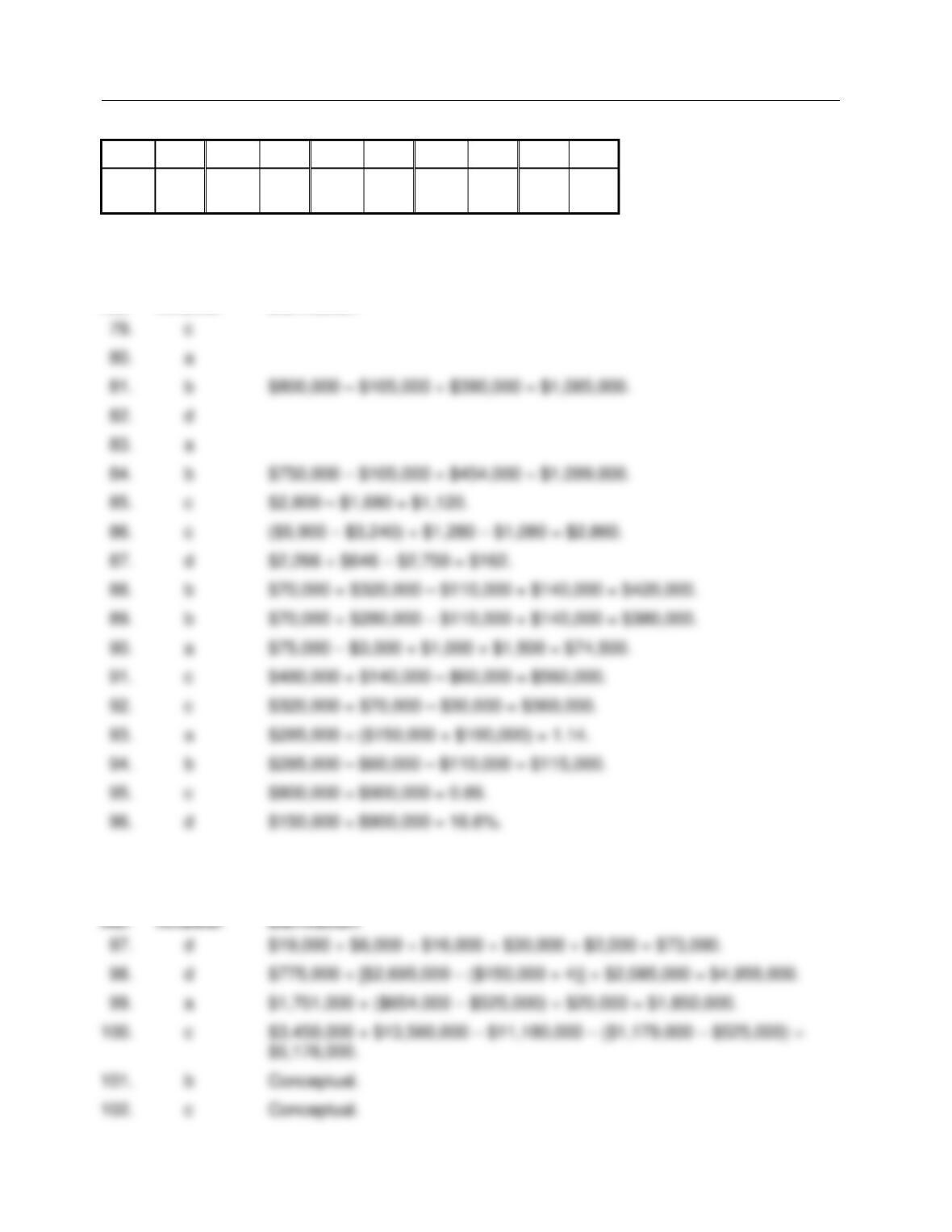
Multiple Choice Answers—Computational
Item
Ans.
Item
Ans.
Item
Ans.
Item
Ans.
Item
Ans.
MULTIPLE CHOICE—CPA Adapted
97. Stine Corp.’s trial balance reflected the following account balances at December 31, 2014:
Accounts receivable (net) $19,000
Trading securities 6,000
Accumulated depreciation on equipment and furniture 15,000
Cash 16,000
Inventory 30,000
Equipment 25,000
Patent 4,000
Prepaid expenses 2,000
Land held for future business site 18,000
In Stine’s December 31, 2014 balance sheet, the current assets total is
a. $90,000.
b. $82,000.
c. $77,000.
d. $73,000.

Test Bank for Intermediate Accounting, Fifteenth Edition
5 – 22
Use the following information for questions 98 through 100.
The following trial balance of Reese Corp. at December 31, 2014 has been properly adjusted
except for the income tax expense adjustment.
Reese Corp.
Trial Balance
December 31, 2014
Dr. Cr.
Cash $ 775,000
Accounts receivable (net) 2,695,000
Inventory 2,085,000
Property, plant, and equipment (net) 7,566,000
Accounts payable and accrued liabilities $ 1,701,000
Income taxes payable 654,000
Deferred income tax liability 85,000
Common stock 2,350,000
Additional paid-in capital 3,680,000
Retained earnings, 1/1/14 3,450,000
Net sales and other revenues 13,560,000
Costs and expenses 11,180,000
Income tax expenses 1,179,000
$25,480,000 $25,480,000
Other financial data for the year ended December 31, 2014:
• Included in accounts receivable is $1,200,000 due from a customer and payable in quarterly
installments of $150,000. The last payment is due December 29, 2016.
• The balance in the Deferred Income Tax Liability account pertains to a temporary difference
that arose in a prior year, of which $20,000 is classified as a current liability.
• During the year, estimated tax payments of $525,000 were charged to income tax expense.
The current and future tax rate on all types of income is 30%.
In Reese’s December 31, 2014 balance sheet,
98. The current assets total is
a. $6,080,000.
b. $5,555,000.
c. $5,405,000.
d. $4,955,000.
99. The current liabilities total is
a. $1,850,000.
b. $1,915,000.
c. $2,375,000.
d. $2,440,000.
100. The final retained earnings balance is
a. $4,651,000.
b. $4,736,000.
c. $5,176,000.
d. $5,105,000.

Balance Sheet and Statement of Cash Flows
5 – 23
101. On January 4, 2014, Kiley Co. leased a building to Dodd Corp. for a ten-year term at an
annual rental of $150,000. At inception of the lease, Kiley received $600,000 covering the
first two years’ rent of $300,000 and a security deposit of $300,000. This deposit will not
be returned to Dodd upon expiration of the lease but will be applied to payment of rent for
the last two years of the lease. What portion of the $600,000 should be shown as a
current and long-term liability in Kiley’s December 31, 2014 balance sheet?
Current Liability Long-term Liability
a. $0 $600,000
b. $150,000 $300,000
c. $300,000 $300,000
d. $300,000 $150,000
102. In a statement of cash flows, receipts from sales of property, plant, and equipment and
other productive assets should generally be classified as cash inflows from
a. operating activities.
b. financing activities.
c. investing activities.
d. selling activities.
103. In a statement of cash flows, interest payments to lenders and other creditors should be
classified as cash outflows for
a. operating activities.
b. borrowing activities.
c. lending activities.
d. financing activities.
104. In a statement of cash flows, proceeds from issuing equity instruments should be
classified as cash inflows from
a. lending activities.
b. operating activities.
c. investing activities.
d. financing activities.
105. In a statement of cash flows, payments to acquire debt instruments of other entities (other
than cash equivalents) should be classified as cash outflows for
a. operating activities.
b. investing activities.
c. financing activities.
d. lending activities.
106. Which of the following facts concerning fixed assets should be included in the summary of
significant accounting policies?
Depreciation Method Composition
a. No Yes
b. Yes Yes
c. Yes No
d. No No
Test Bank for Intermediate Accounting, Fifteenth Edition
5 – 24
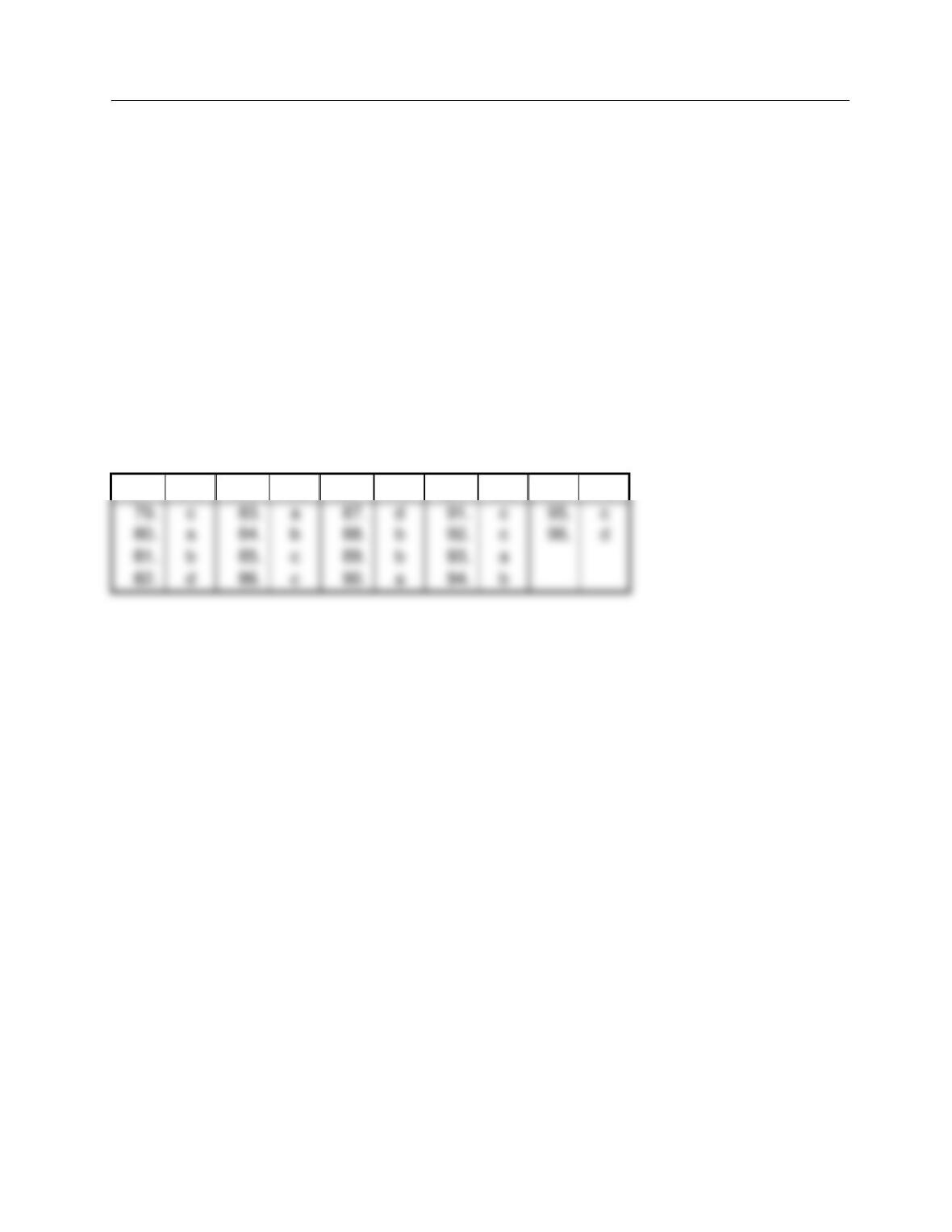
Multiple Choice Answers—CPA Adapted
Item
Ans.
Item
Ans.
Item
Ans.
Item
Ans.
Item
Ans.
97.
d
99.
a
101.
b
103.
a
105.
b
98.
d
100.
c
102.
c
104.
d
106.
c
DERIVATIONS — Computational
No. Answer Derivation
DERIVATIONS — CPA Adapted

Balance Sheet and Statement of Cash Flows
5 – 25
No. Answer Derivation
BRIEF EXERCISES
BE. 5–107—Definitions.
Provide clear, concise answers for the following.
1. What are assets?
2. What are liabilities?
3. What is equity?
4. What are current liabilities?
5. Explain what working capital is and how it is computed.
6. What are intangible assets?
7. What are current assets?
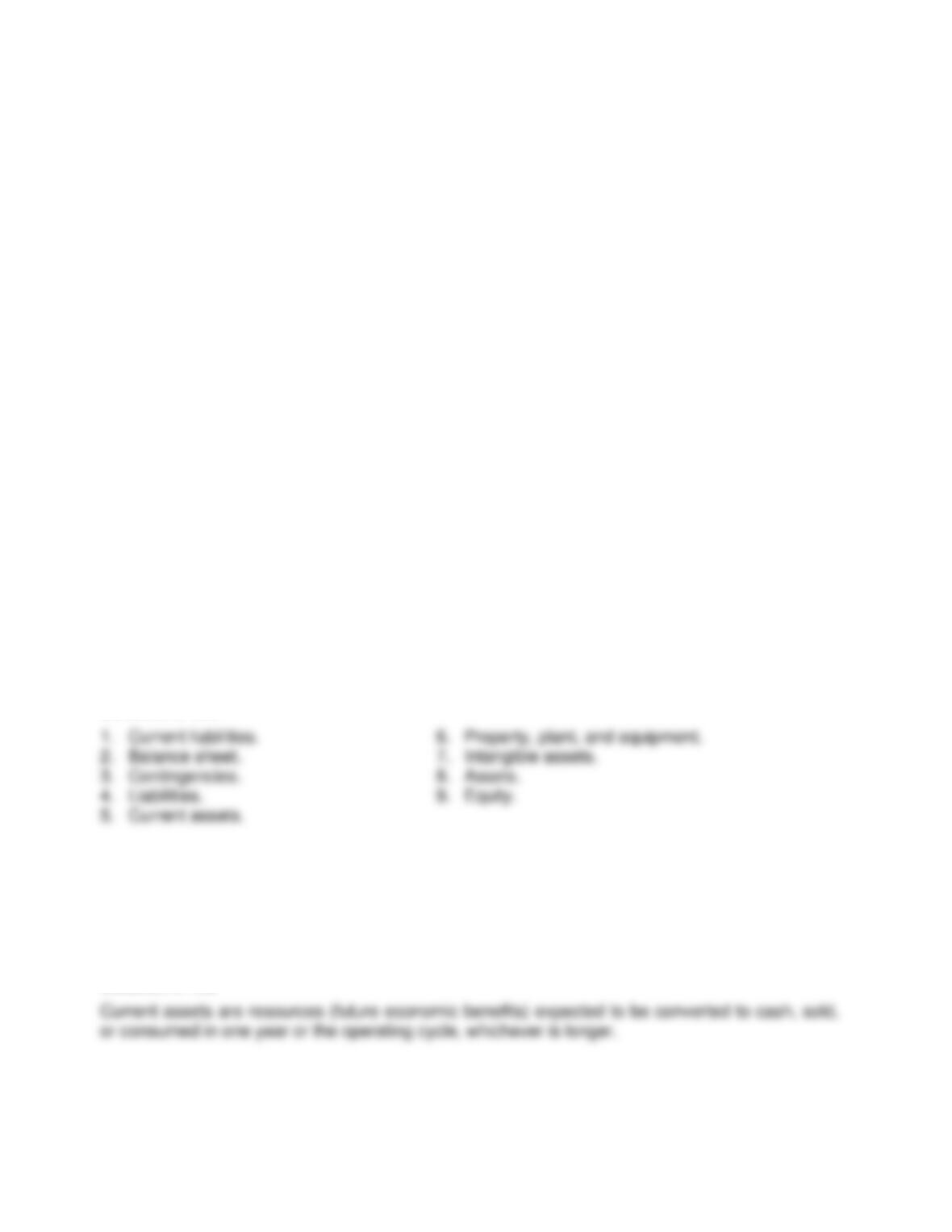
Solution 5-107
1. Assets are probable future economic benefits obtained or controlled by an entity as a result of
past transactions or events.
2. Liabilities are probable future sacrifices of economic benefits arising from present obligations
of an entity as a result of past transactions or events.
3. Equity is the residual interest in the net assets of an entity.
4. Current liabilities are obligations that are expected to be liquidated through the use of current
assets or the creation of other current liabilities.
5. Working capital is the net amount of a company’s relatively liquid resources. It is the excess
of total current assets over total current liabilities.
6. Intangible assets are economic resources or competitive advantages. They lack physical
substance and have a high degree of uncertainty about the future benefits to be received.
7. Current assets are resources (future economic benefits) expected to be converted to cash,
sold, or consumed in one year or the operating cycle, whichever is longer.
Test Bank for Intermediate Accounting, Fifteenth Edition
5 – 26
BE. 5–108—Terminology.
In the space provided at right, write the word or phrase that is defined or indicated.
1. Obligations expected to be liquidated 1. __________________________________
through use of current assets.
2. Statement showing financial condition at a 2. __________________________________
point in time.
3. Events that depend upon future outcomes. 3. __________________________________
4. Probable future sacrifices of economic 4. __________________________________
benefits.
5. Resources expected to be converted to 5. __________________________________
cash in one year or the operating cycle,
whichever is longer.
6. Resources of a durable nature used in 6. __________________________________
operations.
7. Economic rights or competitive advantages 7. __________________________________
which lack physical substance.
8. Probable future economic benefits. 8. __________________________________
9. Residual interest in the net assets of an 9. __________________________________
entity.
Solution 5-108
BE. 5–109—Current assets.
Define current assets without using the word “asset.”
Solution 5-109

Balance Sheet and Statement of Cash Flows
5 – 27
EXERCISES
Ex. 5-110—Account classification.
ASSETS LIABILITIES AND CAPITAL
a. Current assets f. Current liabilities
b. Investments g. Long-term liabilities
c. Plant and equipment h. Preferred stock
d. Intangibles i. Common stock
e. Other assets j. Additional paid-in capital
k. Retained earnings
l. Items excluded from balance sheet
Using the letters above, classify the following accounts according to the preferred and ordinary
balance sheet presentation.
____ 1. Bond sinking fund
____ 2. Common stock dividend distributable
____ 3. Appropriation for plant expansion
____ 4. Bank overdraft
____ 5. Bonds payable (due 2017)
____ 6. Premium on common stock
____ 7. Securities owned by another company which are collateral for that company’s note
____ 8. Equity investments (trading)
____ 9. Inventory
____ 10. Discount on bonds payable
____ 11. Patents
____ 12. Unearned rent revenue
Solution 5-110

Test Bank for Intermediate Accounting, Fifteenth Edition
5 – 28
Ex. 5-111—Valuation of Balance Sheet Items.
Use the code letters listed below (a – l) to indicate, for each balance sheet item (1 – 13) listed
below the usual valuation reported on the balance sheet.
____ 1. Common stock ____ 8. Long-term bonds payable
____ 2. Prepaid insurance ____ 9. Land (in use)
____ 3. Natural resources ____ 10. Land (future plant site)
____ 4. Property, plant, and equipment ____ 11. Patents
____ 5. Accounts receivable ____ 12. Equity investments (trading)
____ 6. Copyrights ____ 13. Accounts payable
____ 7. Inventory
a. Par value
b. Current cost of replacement
c. Amount payable when due, less unamortized discount or plus unamortized premium
d. Amount payable when due
e. Market value at balance sheet date
f. Net realizable value
g. Lower of cost or market
h. Original cost less accumulated amortization
i. Original cost less accumulated depletion
j. Original cost less accumulated depreciation
k. Historical cost
l. Unexpired or unconsumed cost
Solution 5-111

Balance Sheet and Statement of Cash Flows
5 – 29
Ex. 5-112—Balance sheet classifications.
Typical balance sheet classifications are as follows.
a. Current Assets g. Long-Term Liabilities
b. Investments h. Capital Stock
c. Plant Assets i. Additional Paid-In Capital
d. Intangible Assets j. Retained Earnings
e. Other Assets k. Notes to Financial Statements
f. Current Liabilities l. Not Reported on Balance Sheet
Indicate by use of the above letters how each of the following items would be classified on a
balance sheet prepared at December 31, 2014. If a contra account, or any amount that is
negative or opposite the normal balance, put parentheses around the letter selected. A letter may
be used more than once or not at all.
____ 1. Accrued salaries and wages
____ 2. Rent revenues for 3 months
collected in advance
____ 3. Land used as plant site
____ 4. Equity securities classified as
trading
____ 5. Cash
____ 6. Accrued interest payable due in
30 days
____ 7. Premium on preferred stock issued
____ 8. Dividends in arrears on preferred
stock
____ 9. Petty cash fund
____ 10. Unamortized discount on bonds
payable due 2017
____ 11. Common stock at par value
____ 12. Bond indenture covenants
____ 13. Unamortized premium on bonds
payable due in 2018
____ 14. Allowance for doubtful accounts
____ 15. Accumulated depreciation—
equipment
____ 16. Natural resource—timberlands
____ 17. Deficit (no net income earned since
beginning of company)
____ 18. Goodwill
____ 19. 90 day notes payable
____ 20. Investment in bonds of another
company; will be held to 2017
maturity
____ 21. Land held for speculation
____ 22. Death of company president
____ 23. Current maturity of bonds payable
____ 24. Investment in subsidiary; no plans
to sell in near future
____ 25. Accounts payable
____ 26. Preferred stock ($10 par)
____ 27. Prepaid rent
____ 28. Copyright
____ 29. Accumulated amortization, patents
____ 30. Earnings not distributed to
stockholders

Test Bank for Intermediate Accounting, Fifteenth Edition
5 – 30
Ex. 5-113—Balance sheet classifications.
The various classifications listed below have been used in the past by Maris Company on its
balance sheet. It asks your professional opinion concerning the appropriate classification of each
of the items 1–14 below.
a. Current Assets f. Current Liabilities
b. Investments g. Long-Term Liabilities
c. Plant and Equipment h. Common Stock and Paid-in Capital in Excess of Par
d. Intangible Assets i. Retained Earnings
e. Other Assets
Indicate by letter how each of the following items should be classified. If an item need not be
reported on the balance sheet, use the letter “X.” A letter may be used more than once or not at
all. If an item can be classified in more than one category, choose the category most favored by
the authors of your textbook.
____ 1. Employees’ payroll deductions.
____ 2. Cash in sinking fund.
____ 3. Rent revenue collected in advance.
____ 4. Equipment retired from use and held for sale.
____ 5. Patents.
____ 6. Payroll cash fund.
____ 7. Goods held on consignment.
____ 8. Accrued revenue on short-term investments.
____ 9. Advances to salespersons.
____ 10. Premium on bonds payable due two years from date.
____ 11. Bank overdraft.
____ 12. Salaries which company budget shows will be paid to employees within the next year.
____ 13. Work in process.
____ 14. Appropriation for bonded indebtedness.

Balance Sheet and Statement of Cash Flows
5 – 31
Solution 5-113
Ex. 5-114—Balance sheet classifications.
The various classifications listed below have been used in the past by Hale Company on its
balance sheet.
a. Current Assets e. Current Liabilities
b. Investments f. Long-term Liabilities
c. Plant and Equipment g. Common Stock and Paid-in Capital in Excess of Par
d. Intangible Assets h. Retained Earnings
Instructions
Indicate by letter how each of the items below should be classified at December 31, 2014. If an
item is not reported on the December 31, 2014 balance sheet, use the letter “X” for your answer.
If the item is a contra account within the particular classification, place parentheses around the
letter. A letter may be used more than once or not at all.
Sample question and answer:
(a) Allowance for doubtful accounts.
____ 1. Customers’ accounts with credit balances.
____ 2. Bond sinking fund.
____ 3. Salaries which the company’s cash budget shows will be paid to employees in 2015.
____ 4. Accumulated depreciation—equipment.
____ 5. Appropriation for plant expansion.
____ 6. Amortization of patents for 2014.
____ 7. On December 31, 2014, Hale signed a purchase commitment to buy all of its raw
materials from Delta Company for the next 2 years.
____ 8. Discount on bonds payable due March 31, 2017.
____ 9. Launching of Hale’s Internet retailing division in February, 2015.
____ 10. Cash dividends declared on December 15, 2014 payable to stockholders on January
15, 2015.

Test Bank for Intermediate Accounting, Fifteenth Edition
5 – 32
Solution 5-114
Ex. 5-115—Statement of cash flows.
For each event listed below, select the appropriate category which describes the effect of the
event on a statement of cash flows:
a. Cash provided/used by operating activities.
b. Cash provided/used by investing activities.
c. Cash provided/used by financing activities.
d. Not a cash flow.
____ 1. Payment on long-term debt
____ 2. Issuance of bonds at a premium
____ 3. Collection of accounts receivable
____ 4. Cash dividends declared
____ 5. Issuance of stock to acquire land
____ 6. Sale of available-for-sale securities (long-term)
____ 7. Payment of employees’ wages
____ 8. Issuance of common stock for cash
____ 9. Payment of income taxes payable
____ 10. Purchase of equipment
____ 11. Purchase of treasury stock (common)
____ 12. Sale of real estate held as a long-term investment
Solution 5-115

Balance Sheet and Statement of Cash Flows
5 – 33
Ex. 5-116—Statement of cash flows ratios.
Financial statements for Hilton Company are presented below:
Hilton Company
Balance Sheet
December 31, 2014
Assets Liabilities & Stockholders’ Equity
Cash $ 40,000 Accounts payable $ 20,000
Accounts receivable 35,000 Bonds payable 50,000
Buildings and equipment 150,000 Common stock 65,000
Accumulated depreciation— Retained earnings 60,000
buildings and equipment (50,000) $195,000
Patents 20,000
$195,000
Hilton Company
Statement of Cash Flows
For the Year Ended December 31, 2014
Cash flows from operating activities
Net income $55,000
Adjustments to reconcile net income to net cash
provided by operating activities:
Increase in accounts receivable $(16,000)
Increase in accounts payable 8,000
Depreciation—buildings and equipment 15,000
Gain on sale of equipment (6,000)
Amortization of patents 2,000 3,000
Net cash provided by operating activities 58,000
Cash flows from investing activities
Sale of equipment 12,000
Purchase of land (25,000)
Purchase of buildings and equipment (48,000)
Net cash used by investing activities (61,000)
Cash flows from financing activities
Payment of cash dividend (15,000)
Sale of bonds 30,000
Net cash provided by financing activities 15,000
Net increase in cash 12,000
Cash, January 1, 2014 28,000
Cash, December 31, 2014 $40,000
At the beginning of 2014, Accounts Payable amounted to $12,000 and Bonds Payable was
$20,000.
Instructions
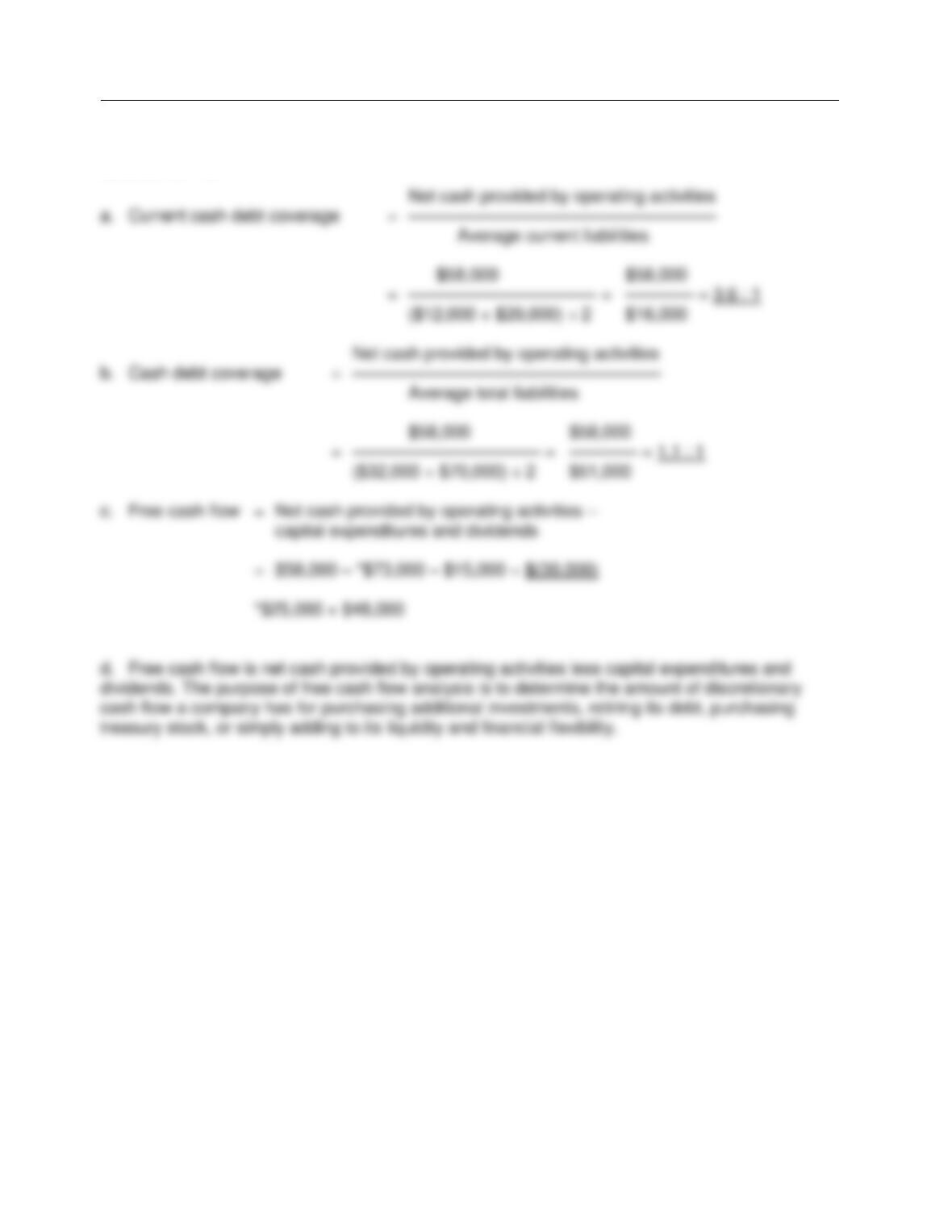
Calculate the following for Hilton Company:
a. Current cash debt coverage
b. Cash debt coverage
c. Free cash flow
Test Bank for Intermediate Accounting, Fifteenth Edition
5 – 34
d. Explain the purpose of free cash flow analysis.
Solution 5-116

Balance Sheet and Statement of Cash Flows
5 – 35
PROBLEMS
Pr. 5-117—Balance sheet format.
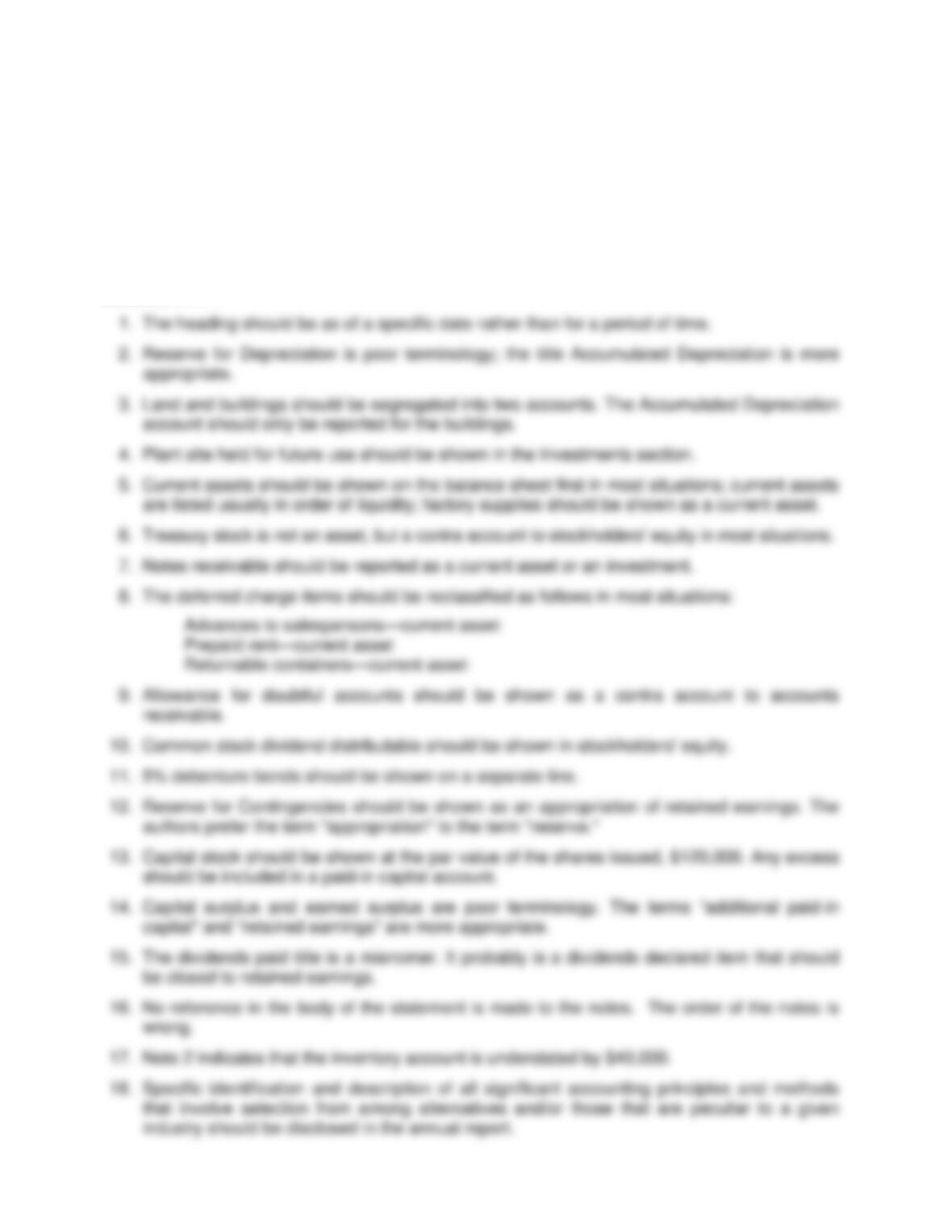
The following balance sheet has been submitted to you by an inexperienced bookkeeper. List
your suggestions for improvements in the format of the balance sheet. Consider both terminology
deficiencies as well as classification inaccuracies.
Jasper Industries, Inc.
Balance Sheet
For the Period Ended 12/31/14
Assets
Fixed Assets—Tangible
Equipment $110,000
Less: reserve for depreciation (40,000) $ 70,000
Factory supplies 22,000
Land and buildings 400,000
Less: reserve for depreciation (150,000) 250,000
Plant site held for future use 90,000 $ 432,000
Current Assets
Accounts receivable 175,000
Cash 80,000
Inventory 220,000
Treasury stock (at cost) 20,000 495,000
Fixed Assets—Intangible
Goodwill 80,000
Notes receivable 40,000
Patents 26,000 146,000
Deferred Charges
Advances to salespersons 60,000
Prepaid rent 27,000
Returnable containers 75,000 162,000
TOTAL ASSETS $1,235,000
Liabilities
Current Liabilities
Accounts payable $140,000
Allowance for doubtful accounts 8,000
Common stock dividend distributable 35,000
Income tax payable 42,000
Sales tax payable 17,000 $ 242,000
Long-Term Liabilities, 5% debenture bonds, due 2017 500,000
Reserve for contingencies 150,000 650,000
TOTAL LIABILITIES 892,000
Equity
Capital stock, $10 par value, issued 12,000 shares with
60 shares held as treasury stock $150,000
Capital surplus 90,000
Dividends paid (20,000)
Earned surplus 123,000
TOTAL EQUITY 343,000
TOTAL LIABILITIES AND EQUITY $1,235,000
Test Bank for Intermediate Accounting, Fifteenth Edition
5 – 36
Note 1. The reserve for contingencies has been created by charges to earned surplus and has
been established to provide a cushion for future uncertainties.
Note 2. The inventory account includes only items physically present at the main plant and
warehouse. Items located at the company’s branch sales office amounting to $40,000
are excluded since the company has consistently followed this procedure for many
years.
Solution 5-117

Balance Sheet and Statement of Cash Flows
5 – 37
Pr. 5-118—Balance sheet presentation.
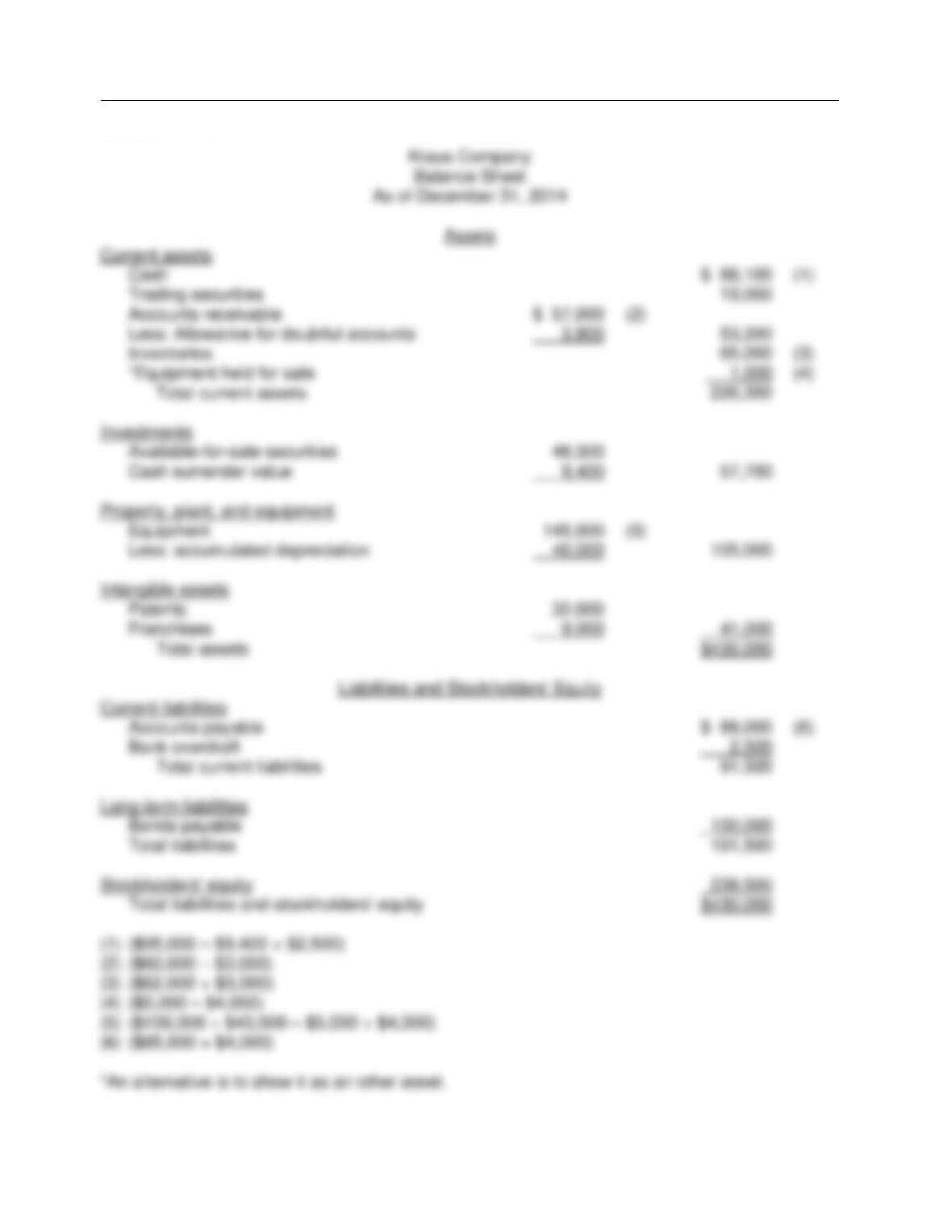
The following balance sheet was prepared by the bookkeeper for Kraus Company as of
December 31, 2014. Kraus Company
Balance Sheet
as of December 31, 2014
Cash $ 95,000 Accounts payable $ 85,000
Accounts receivable (net) 52,200 Bonds payable 100,000
Inventory 62,000 Stockholders’ equity 238,500
Investments 76,300
Equipment (net) 106,000
Patents 32,000
$423,500 $423,500
The following additional information is provided:
1. Cash includes the cash surrender value of a life insurance policy $9,400, and a bank
overdraft of $2,500 has been deducted.
2. The net accounts receivable balance includes:
(a) accounts receivable—debit balances $60,000;
(b) accounts receivable—credit balances $4,000;
(c) allowance for doubtful accounts $3,800.
3. Inventory does not include goods costing $3,000 shipped out on consignment. Receivables of
$3,000 were recorded on these goods.
4. Investments include investments in common stock, trading $19,000 and available–for-sale
$48,300, and franchises $9,000.
5. Equipment costing $5,000 with accumulated depreciation $4,000 is no longer used and is
held for sale. Accumulated depreciation on the other equipment is $40,000.
Instructions
Prepare a balance sheet in good form (stockholders’ equity details can be omitted.)
Test Bank for Intermediate Accounting, Fifteenth Edition
5 – 38
Solution 5-118

Balance Sheet and Statement of Cash Flows
5 – 39
Pr. 5-119—Balance sheet presentation.
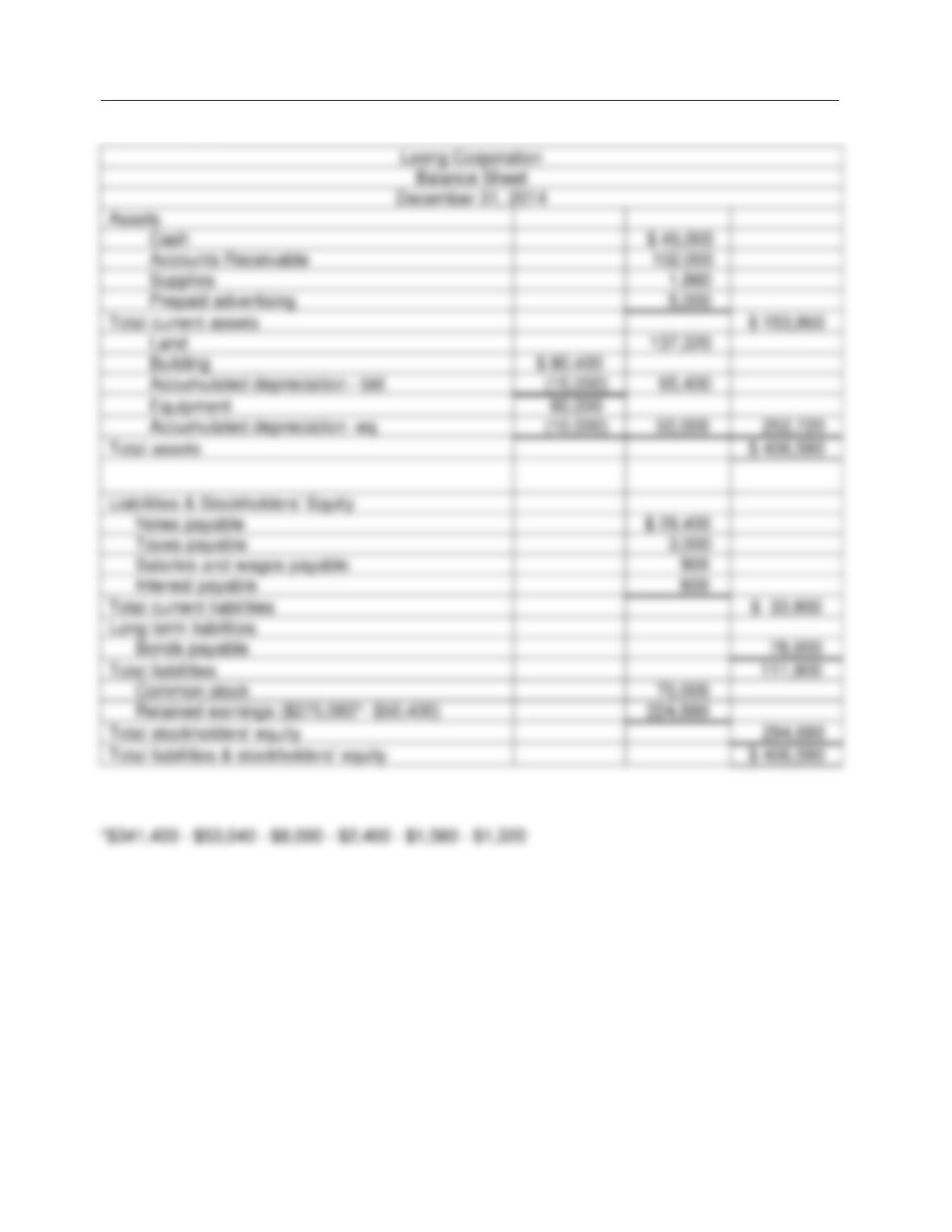
Given the following account information for Leong Corporation, prepare a balance sheet in report
form for the company as of December 31, 2014. All accounts have normal balances.
Equipment 60,000
Interest Expense 2,400
Interest Payable 600
Retained Earnings ?
Dividends 50,400
Land 137,320
Accounts Receivable 102,000
Bonds Payable 78,000
Notes Payable (due in 6 months) 29,400
Common Stock 70,000
Accumulated Depreciation – Equip. 10,000
Prepaid Advertising 5,000
Service Revenue 341,400
Buildings 80,400
Supplies 1,860
Income Taxes Payable 3,000
Utilities Expense 1,320
Advertising Expense 1,560
Salaries and Wages Expense 53,040
Salaries and Wages Payable 900
Accumulated Depr. – Bld. 15,000
Cash 45,000
Depreciation Expense 8,000
Test Bank for Intermediate Accounting, Fifteenth Edition
5 – 40
Solution 5-119

Balance Sheet and Statement of Cash Flows
5 – 41
Pr. 5-120—Statement of cash flows preparation.
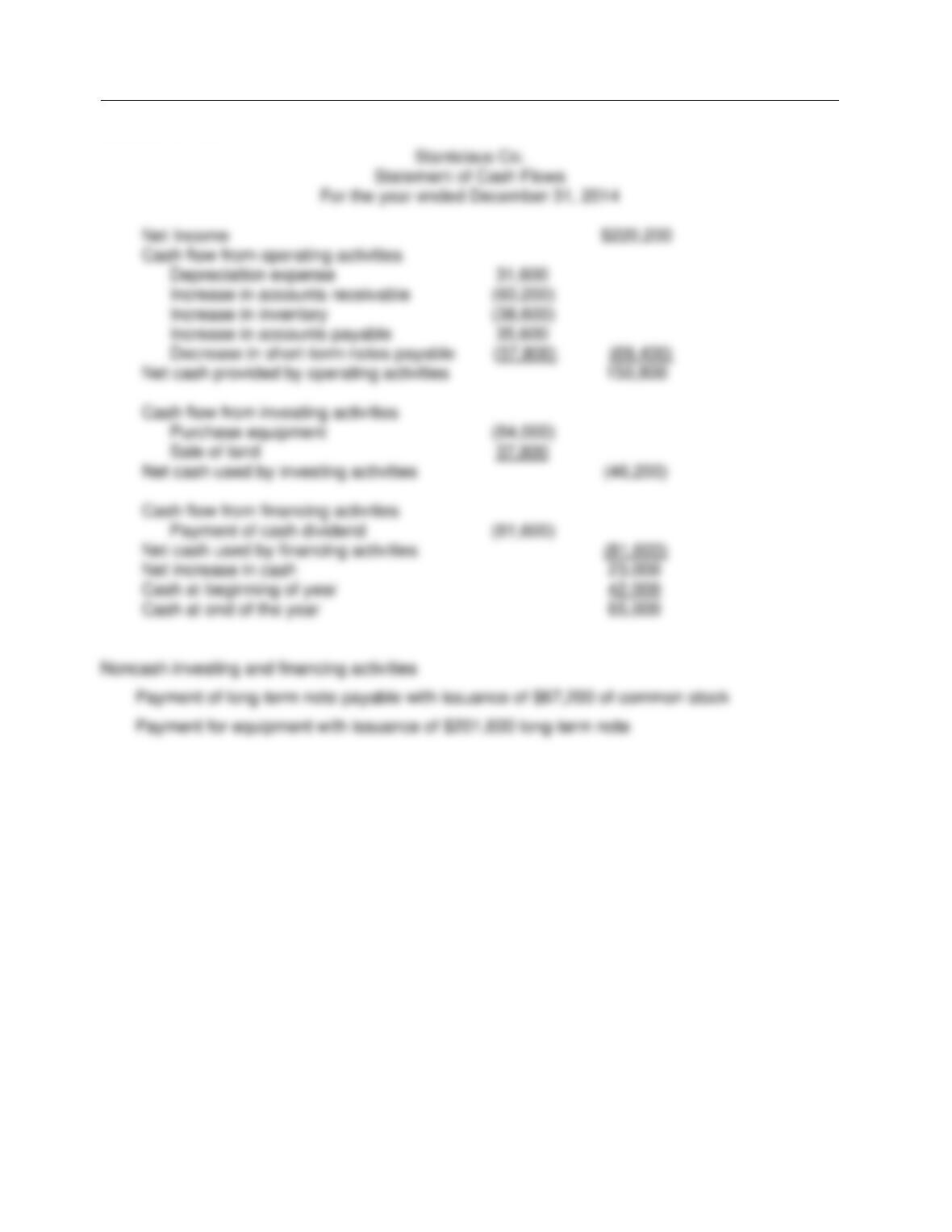
Selected financial statement information and additional data for Stanislaus Co. is presented
below. Prepare a statement of cash flows for the year ending December 31, 2014
December 31
2013 2014
Cash ……………………………………………….. $42,000 $65,000
Accounts receivable (net) …………………… 84,000 144,200
Inventory …………………………………………. 168,000 206,600
Land ……………………………………………….. 58,800 21,000
Equipment ……………………………………….. 504,000 789,600
TOTAL …………………………………..$856,800 $1,226,400
Accumulated depreciation ………………….. $84,000 $115,600
Accounts payable ……………………………… 50,400 86,000
Notes payable – short-term …………………. 67,200 29,400
Notes payable – long-term ………………….. 168,000 302,400
Common stock …………………………………. 420,000 487,200
Retained earnings …………………………….. 67,200 205,800
TOTAL …………………………………..$856,800 $1,226,400
Additional data for 2014:
1. Net income was $220,200.
2. Depreciation was $31,600.
3. Land was sold at its original cost.
4. Dividends of $81,600 were paid.
5. Equipment was purchased for $84,000 cash.
6. A long-term note for $201,600 was used to pay for an equipment purchase.
7. Common stock was issued to pay a $67,200 long-term note payable.
Test Bank for Intermediate Accounting, Fifteenth Edition
5 – 42
Solution 5-120

Balance Sheet and Statement of Cash Flows
5 – 43
Pr. 5-121—Statement of cash flows preparation.
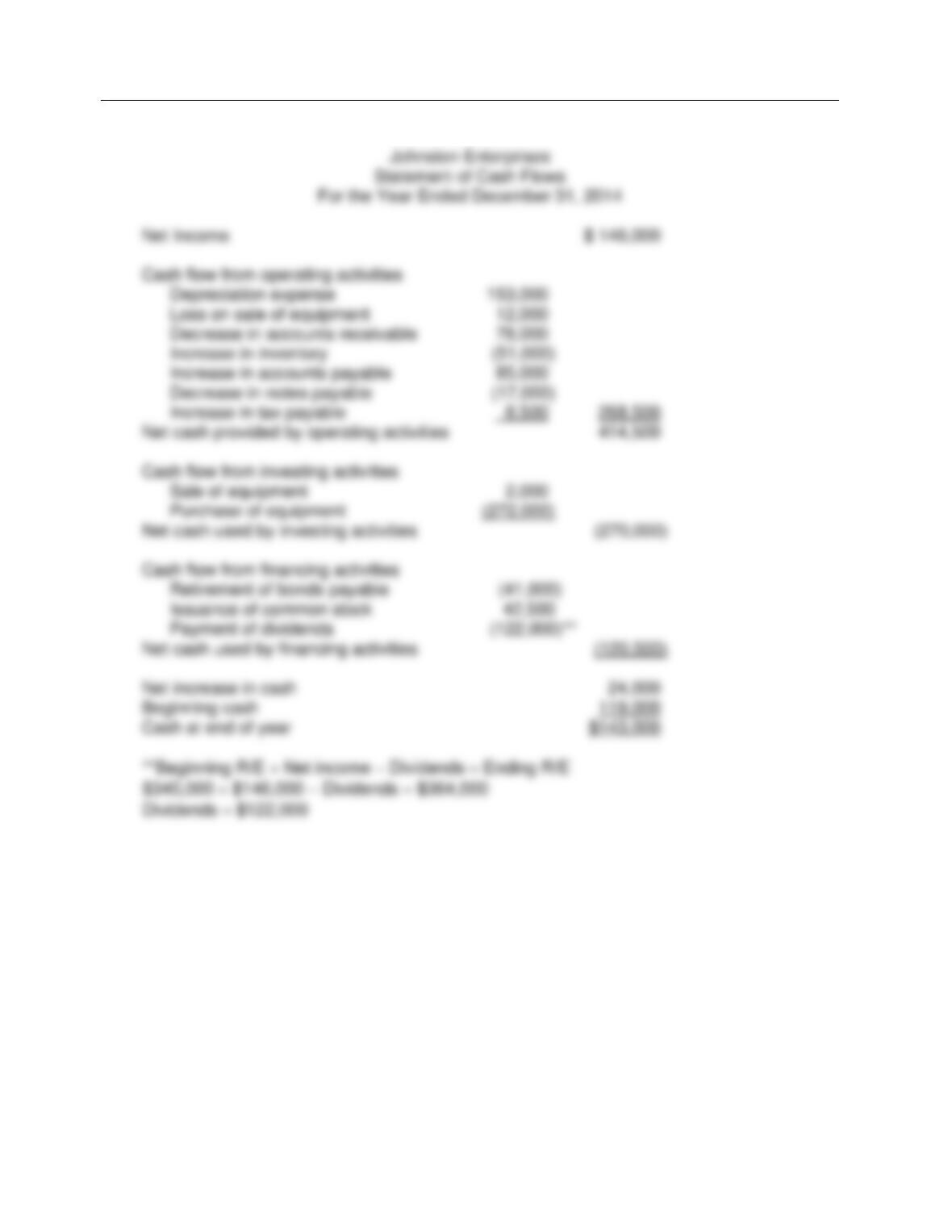
Selected financial statement information and additional data for Johnston Enterprises is
presented below. Prepare a statement of cash flows for the year ending December 31, 2014
Johnston Enterprises
Balance Sheet and Income Statement Data
December 31, December 31,
2014 2013___
Current Assets:
Cash $143,000 $119,000
Accounts Receivable 228,000 306,000
Inventory 391,000 340,000
Total Current Assets 762,000 765,000
Property, Plant, and Equipment 1,261,000 1,122,000
Less: Accumulated Depreciation (476,000) (442,000)
Total Assets $1,547,000 $1,445,000
Current Liabilities:
Accounts Payable $187,000 $102,000
Notes Payable 51,000 68,000
Income Taxes Payable 85,000 76,500
Total Current Liabilities 323,000 246,500
Bonds Payable 350,000 391,000
Total Liabilities 673,000 637,500
Stockholders’ Equity:
Common Stock 510,000 467,500
Retained Earnings 364,000 340,000
Total Stockholders’ Equity 874,000 807,500
Total Liabilities & Stockholders’ Equity $1,547,000 $1,445,000
Sales Revenue 1,615,000 $1,513,000
Less Cost of Goods Sold 781,000 731,000
Gross Profit 834,000 782,000
Expenses:
Depreciation Expense 153,000 136,000
Salaries and Wages Expense 391,000 357,000
Interest Expense 34,000 34,000
Loss on Sale of Equipment 12,000 0
Income Before Taxes 244,000 255,000
Less Income Tax Expense 98,000 102,000
Net Income $146,000 $153,000
Additional Information:
During the year, Johnston sold equipment with an original cost of $133,000 and accumulated
depreciation of $119,000 and purchased new equipment for $272,000.
Test Bank for Intermediate Accounting, Fifteenth Edition
5 – 44
Solution 5-121
Balance Sheet and Statement of Cash Flows
5 – 45
IFRS QUESTIONS
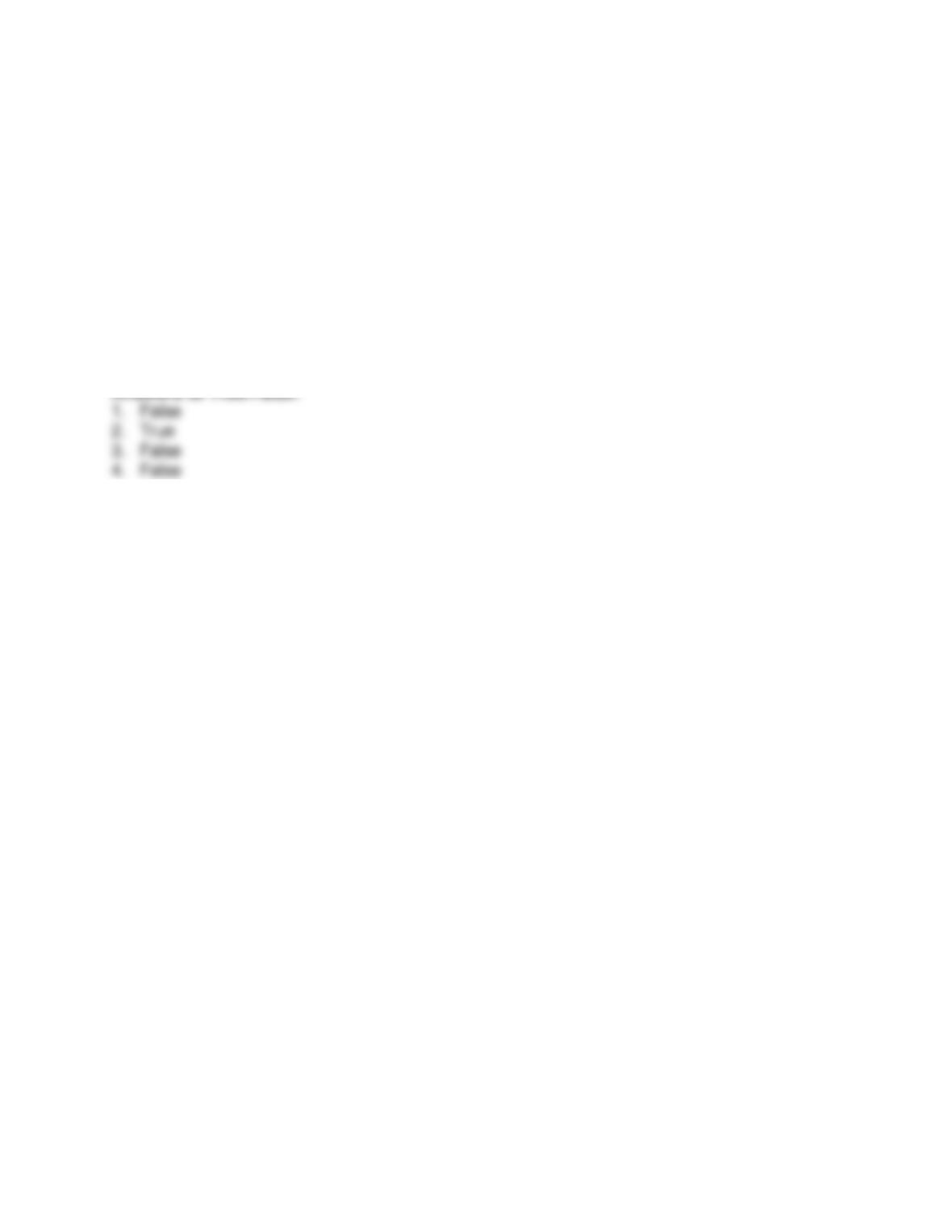
True/False:
1. Although the presentation formats for the balance sheet and statement of cash flows are
similar under IFRS and U.S. GAAP, IFRS requires far more extensive disclosure.
2. One significant difference between a balance sheet prepared using IFRS rather than U.S.
GAAP is that long-term tangible assets may be reported at fair value rather than historical
cost.
3. Both IFRS and U.S. GAAP require that specific items be reported on the balance sheet.
4. Both IFRS and U.S. GAAP require current assets to be listed first on the balance sheet.
Answers to True/False:
Multiple Choice Questions:
5. Which of the following statements about IFRS and U.S. GAAP accounting and reporting
requirements for the balance sheet is not correct?
a. The presentation formats required by IFRS and U.S. GAAP for the balance sheet are
similar.
b. One difference between the reporting requirements under IFRS and those of
U.S. GAAP balance sheet is that an IFRS balance sheet may list long-term assets first.
c. Both IFRS and U.S. GAAP require that property, plant and equipment be reported at
historical cost on the balance sheet.
d. Both IFRS and U.S. GAAP require that comparative information be reported.
Use the following information to answer the next two questions.
Franco Company uses IFRS and owns property, plant and equipment with a historical cost of
5,000,000 euros. At December 31, 2013, the company reported a valuation reserve of
8,565,000 euros. At December 31, 2014, the property, plant and equipment was appraised at
5,525,000 euros.
6. The property, plant and equipment will be reported on the December 31, 2014 statement of
financial position at
a. 5,000,000 euros.
b. 5,525,000 euros.
c. 8,565,000 euros.
d. 9,090,000 euros.
7. The valuation reserve at December 31, 2014 will be reported at
a. 8,040,000 euros on the Statement of Stockholders’ Equity.
b. 8,565,000 euros in the Assets section of the Statement of Financial Position
c. 9,090,000 euros in the equity section of the Statement of Financial Position.
d. 525,000 euros on the Income Statement.
Test Bank for Intermediate Accounting, Fifteenth Edition
5 – 46
8. Similarities between IFRS and U.S. GAAP requirements for balance sheet presentation
include all of the following except:
a. Both require that changes to the valuation reserve be disclosed in the notes to the
financial statements.
b. Both require disclosure of significant accounting policies.
c. Both require the preparation of financial statements annually.
d. Both generally require the use of the current/ non-current classification for both assets and
liabilities.
9. Under IFRS, current assets are listed in:
a. the order of liquidity.
b. the reverse order of liquidity.
c. the ascending order of their balances.
d. the descending order of their balances.
10. Under IFRS, which of the following current assets will be listed last in a statement of financial
position?
a. Inventory
b. Accounts Receivable
c. Short-term Investments Cash
d. Cash
IFRS Short Answer:
11. Briefly describe some of the similarities and differences between U.S. GAAP and IFRS with
respect to balance sheet reporting.
1. Among the similarities between U.S. and IFRS related to balance sheet presentation are as
follows:
Balance Sheet and Statement of Cash Flows
5 – 47
12. Briefly describe the convergence efforts related to financial statement presentation.