Chapter 5
103. Consider the following two activities: (1) performing warranty work, cost: $60,000. The warranty cost of the most
efficient competitor is $10,000. (2) Purchasing components, cost: $100,000 (5,000 purchase orders). A study reveals that
the most efficient level would use 2,500 purchase orders and entail a cost of $55,000.
What is the total nonvalue-added cost?
a. $55,000
b. $60,000
c. $105,000
d. $100,000
Chapter 5
Copyright Cengage Learning. Powered by Cognero.
Page 62
104. Assume that a company spends $15,000 a year for inspecting, $45,000 for purchasing, and $26,000 for reworking
products. A good estimate of nonvalue-added costs would be:
a. $60,000.
b. $41,000.
c. $71,000.
d. $45,000.
e. $26,000.
105. A manual process takes 20 minutes of direct labor time and 8 pounds of material to produce a product. Automating
the process requires 16 minutes of machine time and 6 pounds of material. The cost per labor hour is $10, the cost per
machine hour is $8, and the cost per pound of materials is $12.
Find the nonvalue-added cost for the given situation. (Note: Round all calculations and the answer to two decimal places.)
a. $22.40 per unit
b. $9.00 per unit
c. $25.20 per unit
d. $1.70 per unit
Chapter 5
106. With its original design, a machine requires 14 hours of setup time. By redesigning the machine, the setup time is
reduced by 30%. The cost per setup hour is $325. Calculate the reduction in the nonvalue-added cost per setup.
a. $1,365 per setup
b. $1,225 per setup
c. $450 per setup
d. $800 per setup
e. $2,025 per setup
Chapter 5
107. A product currently requires 6 moves. By changing the plant layout, the number of moves can be reduced to 2. The
cost per move is $40. Calculate the reduction in the nonvalue-added cost of the moving activity.
a. $7
b. $30
c. $0
d. $160
e. $150
108. Inspection time for a plant is 12,000 hours per year. The cost of inspection consists of salaries of four inspectors,
totaling $65,000. Inspection also uses supplies costing $4 per inspection hour. The company has a close to zero-defect
state and has eliminated the need for any inspection activity. Calculate the nonvalue-added cost of inspection per year.
a. $30,000
b. $60,000
c. $113,000
d. $120,000
Chapter 5
109. Each unit of a product requires 5 components. The average number of components is 5.50 due to component failure.
Purchasing higher quality components can reduce the average number of components to 5 per unit. The cost per
component is $450. Calculate the reduction in failure costs per unit due to purchasing higher quality components.
a. $43
b. $350
c. $175
d. $225
e. $372
110. A plant produces 85 different electronic products. Each product requires an average of seven components that are
purchased externally. By redesigning the products, it is possible to produce the 85 products so that they all have four
components in common. This will reduce the demand for purchasing, receiving, and paying bills. Estimated savings from
Chapter 5
the reduced demand are $1,400,000 per year. Calculate the nonvalue-added cost of purchasing, receiving, and paying
bills.
a. $1,400,000
b. $1,000,000
c. $900,000
d. $600,000
111. A factory produces 130,000 televisions per quarter. A total of 9,000 production hours are used by the factory per
quarter. Calculate the cycle time in minutes. (Note: Round answer to two decimal places.)
a. 3.92 minutes
b. 4.15 minutes
c. 3.75 minutes
d. 3.83 minutes
Chapter 5
112. A factory produces 130,000 televisions per quarter. A total of 9,000 production hours are used by the factory per
quarter. Compute the velocity in units per hour. (Note: Round answer to two decimal places.)
a. 16.50 units per hour
b. 15.50 units per hour
c. 14.44 units per hour
d. 18.45 units per hour
113. Which of the following is true of nonvalue-added activities?
a. Nonvalue-added activities are all activities other than those that are absolutely essential to remain in business.
b. Nonvalue-added activities are necessary to comply with legal mandates.
c. Nonvalue-added activities enable other activities to be performed.
d. Nonvalue-added activities help meet the organization’s needs, not the product needs.
Chapter 5
114. Which of the following is a value-added activity?
a. Reordering parts
b. Rework
c. Processing sales orders
d. Handling customer complaints
115. The time required to produce one unit of a product is the
a. efficiency.
b. velocity.
c. speed.
d. cycle time.
Chapter 5
116. Randy Company produces candy sticks (hooked and straight). Both products pass through two producing
departments. The hooked stick’s production is much more labor-intensive than the straight stick. The straight stick is also
more popular. The following data have been gathered for the two products:
Product Data
Hooked Straight
Units produced per year 200,000 2,000,000
Direct labor hours 10,000 40,000
Machine hours 10,000 70,000
Total overhead costs equal $400,000. Randy applies overhead based on direct labor hours.
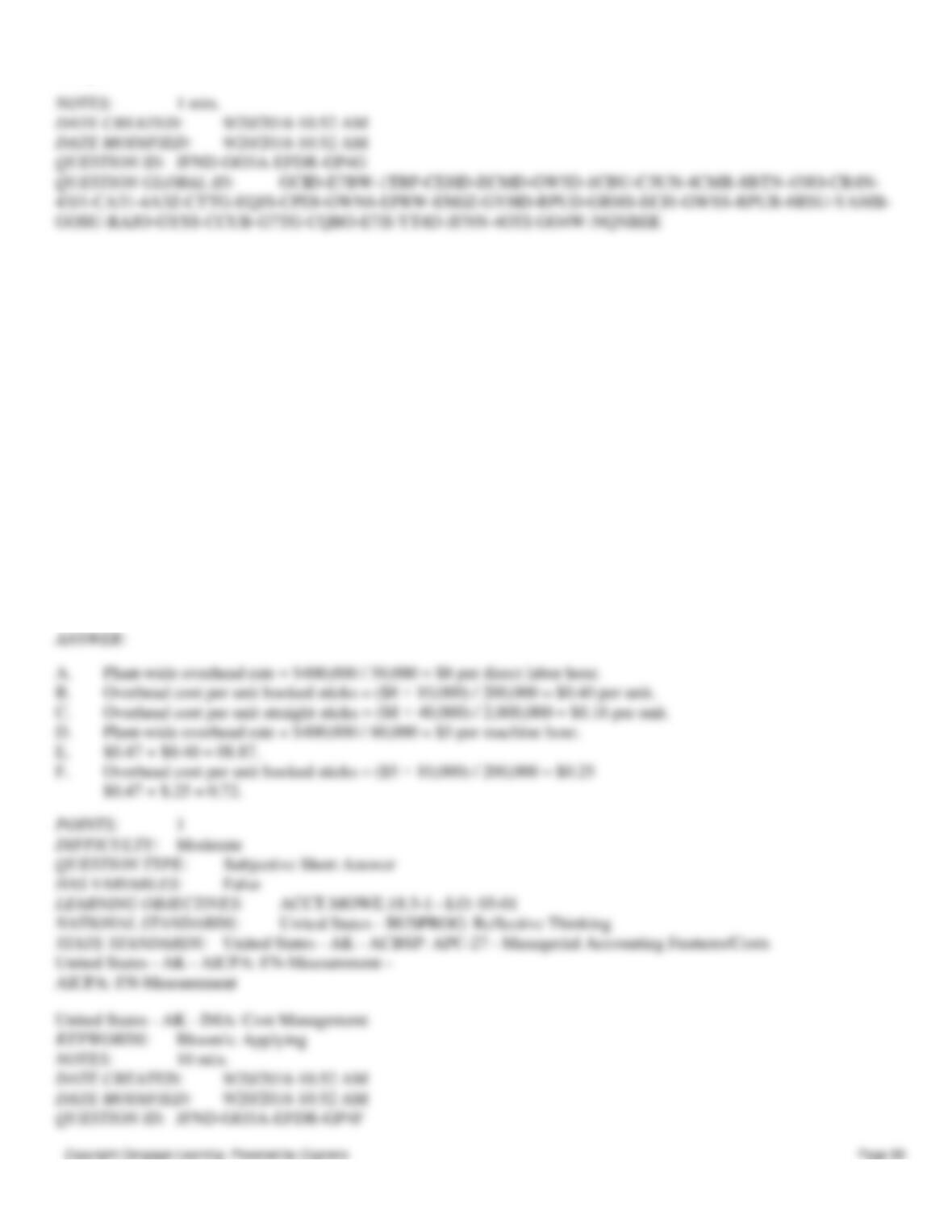
A. Calculate the plantwide overhead rate based on direct labor hours.
B. Using the plantwide overhead rate, calculate the overhead cost per unit for hooked sticks.
C. Using the plantwide overhead rate, calculate the overhead cost per unit for straight sticks.
D. Recalculate the plantwide overhead rate assuming Randy Company applies overhead based on machine hours.
E. Assuming the prime costs for hooked sticks $0.47, what is the total cost using the overhead rate developed in part
A?
F. Assuming the prime costs for hooked sticks $0.47, what is the total cost using the overhead rate developed in part
D?
Chapter 5
117. Xander Company produces televisions. One of its plants produces two versions of televisions: a basic model and a
premium model. At the beginning of the year, the following data were prepared for the plant:
Basic Premium
Model Model
Expected Quantity 20,000 10,000
Selling Cost $90 $200
Prime Costs $40 $ 80
Machine Hours 2,500 2,500
Number of requisitions 500 1,500
Maintenance hours 2,000 6,000
Number of setups 8 32
Additionally, the following overhead activity costs are reported:
Maintaining equipment $220,000
Setting up equipment $112,000
Purchasing materials $ 87,000
Total $419,000
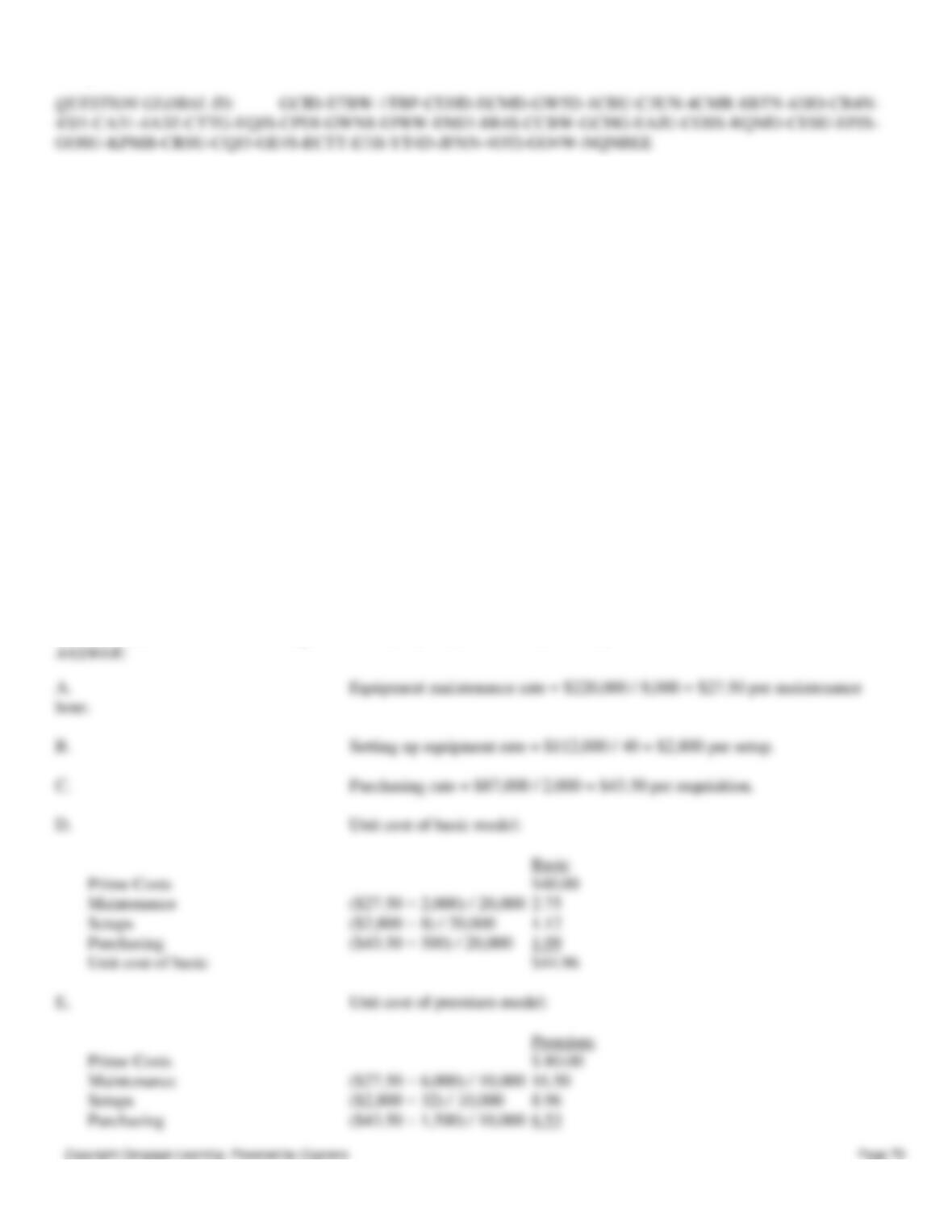
A. What is the activity rate for maintaining equipment based on maintenance hours?
B. What is the activity rate for setting up equipment based on number of setups?
C. What is the activity rate for purchasing materials based on number of requisitions?
D. What is the unit cost of the basic model (rounded to the nearest cent)?
E. What is the unit cost of the premium model (rounded to the nearest cent)?
Chapter 5
118. Xander Company produces televisions. One of its plants produces two versions of televisions: a basic model and a
premium model. At the beginning of the year, the following data were prepared for the plant:
Basic Premium
Model Model
Expected Quantity 20,000 10,000
Selling Cost $90 $200
Prime Costs $40 $ 80
Machine Hours 2,500 2,500
Number of requisitions 500 1,500
Maintenance hours 2,000 6,000
Number of setups 8 32
Additionally, the following overhead activity costs are reported:
Maintaining equipment $220,000
Setting up equipment $112,000
Purchasing materials $ 87,000
Total $419,000
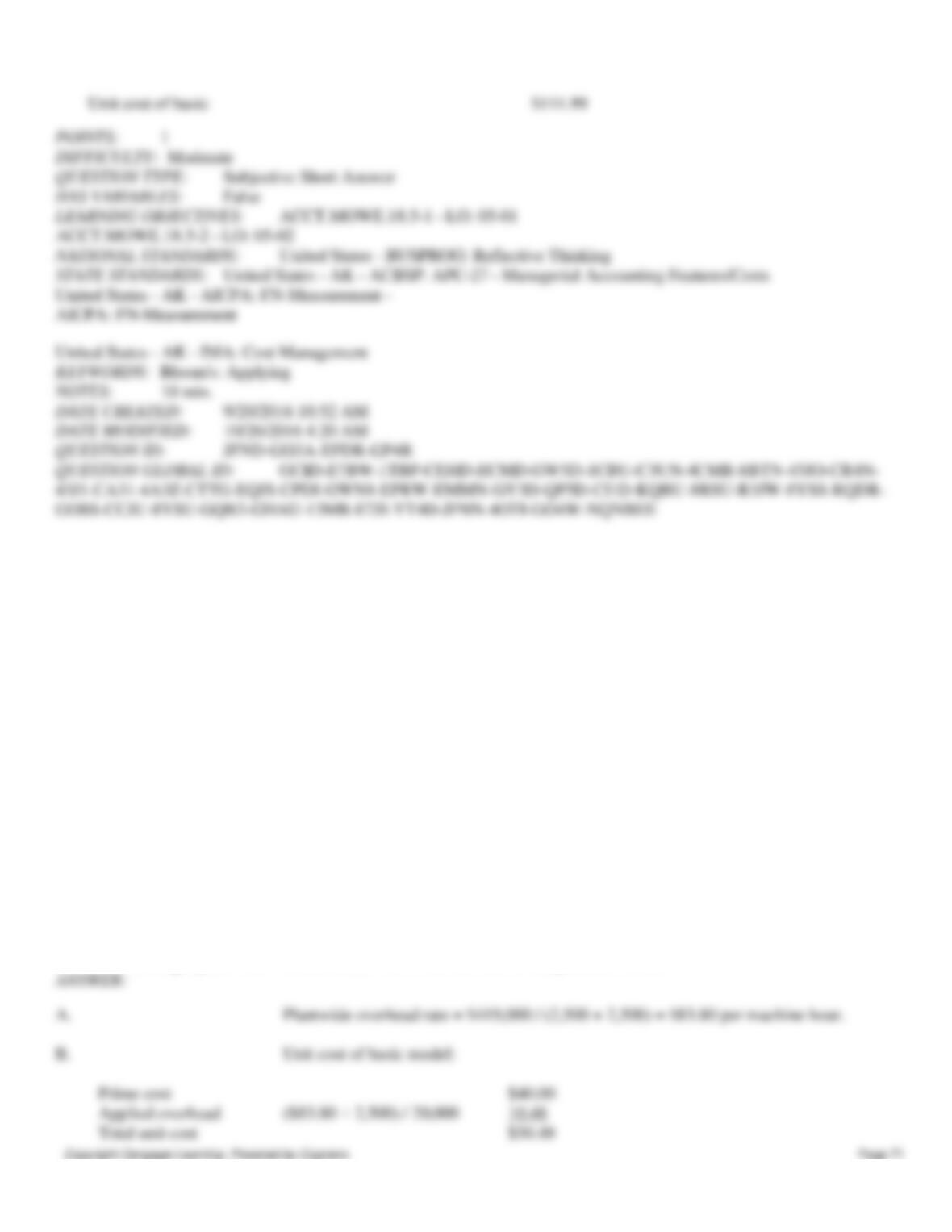
A. What is the plantwide overhead rate based on machine hours?
B. Assuming a plantwide overhead rate, what is the unit cost of the basic model?
C. Assuming a plantwide overhead rate, what is the unit cost of the premium model?
Chapter 5
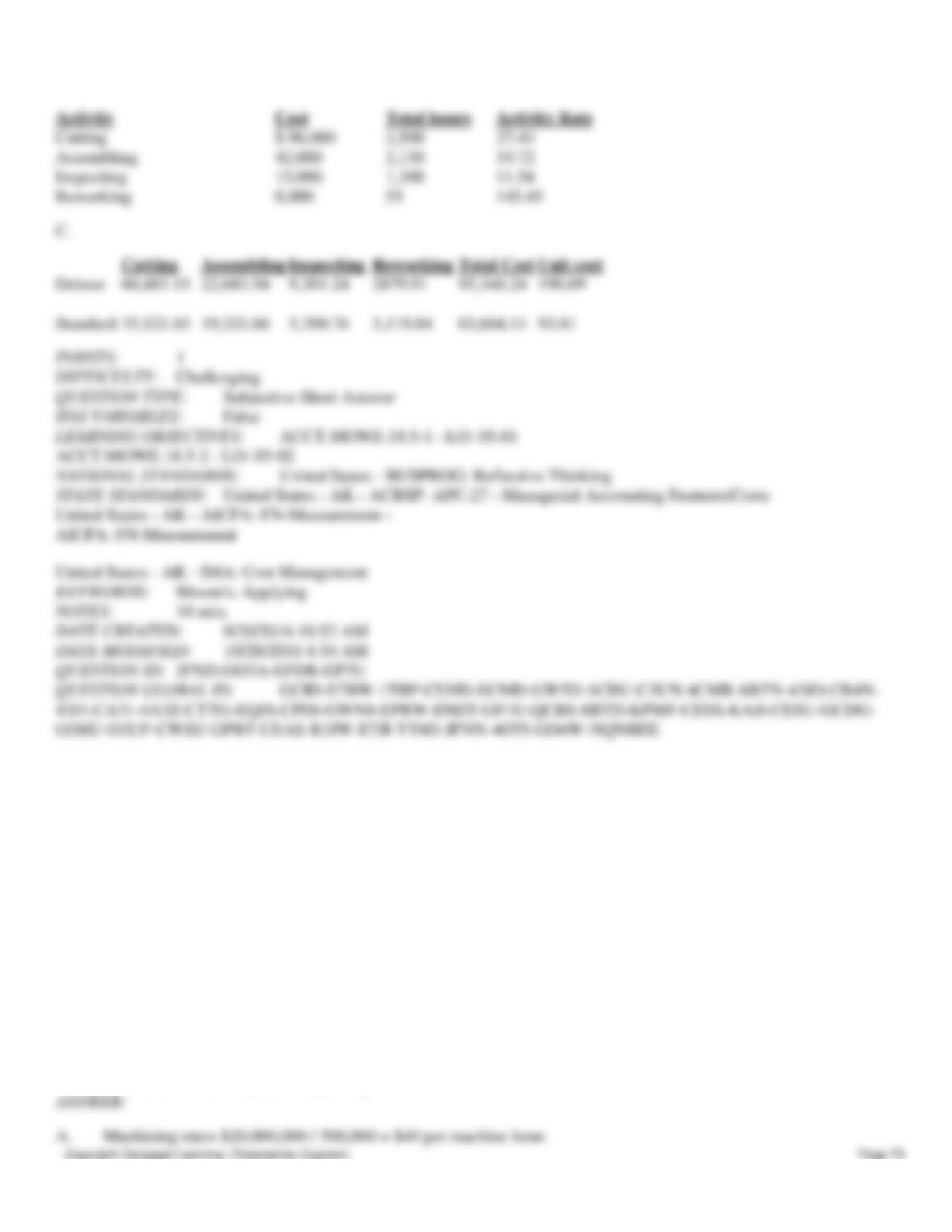
119. Taylor Corporation produces two models of their leather brief cases: deluxe and standard. The four activities and
four drivers are as follows:
Hours
Activities: Cost Driver Deluxe Standard Total
Cutting $ 96,000 Cutting hours 2,200 1,300 3,500
Assembling 42,000 Assembly hours 1,150 980 2,130
Inspecting 15,000 Inspection hours 800 500 1,300
Reworking 8,000 Rework hours 20 35 55
Required:
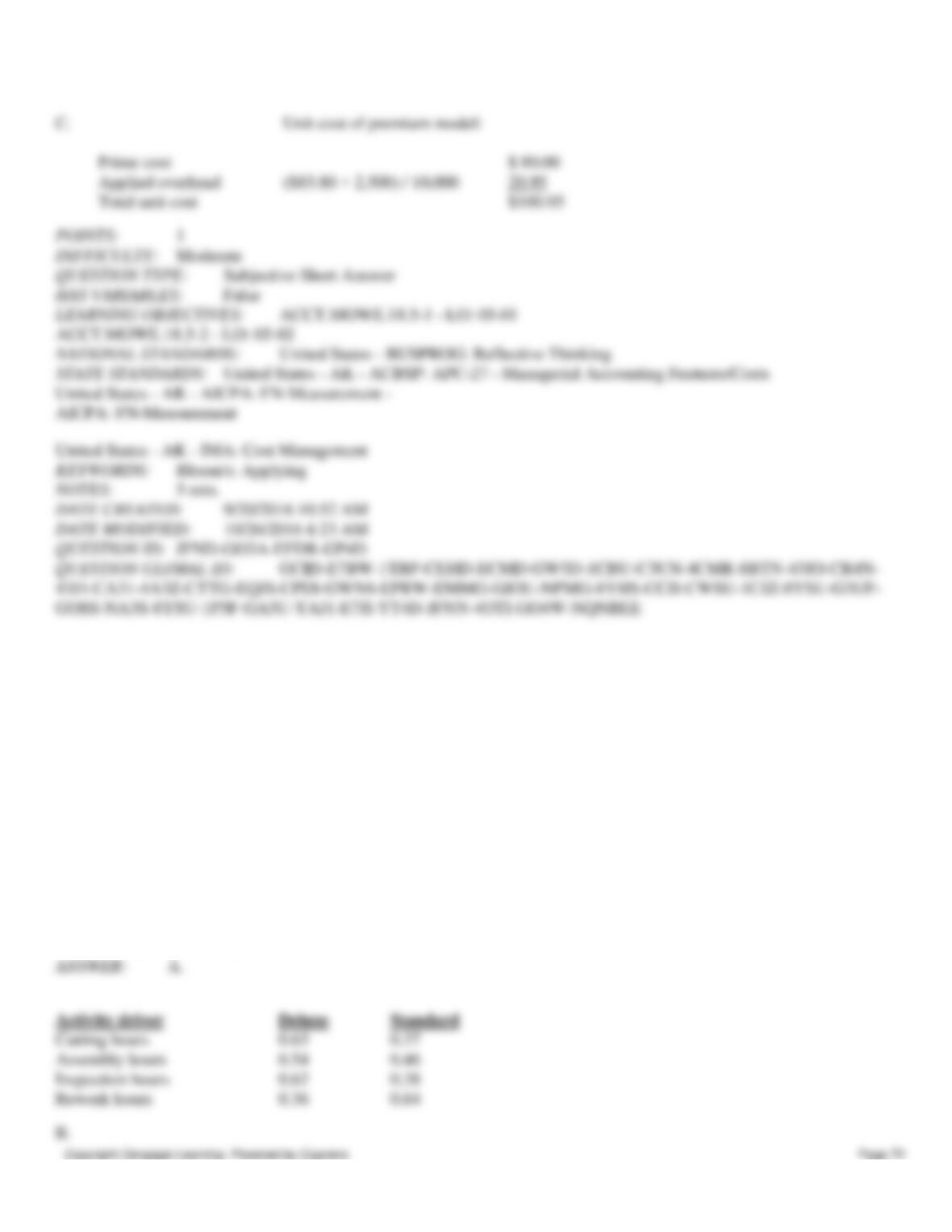
A. Calculate the consumption ratios for the four drivers, rounding to 2 decimal places.
B. Calculate the activity rates that would be used to assign costs to each product. Round your answer to two decimal
places.
C. Calculate the unit cost assuming that 500 deluxe models were produced and 700 standard models were produced,
rounded to the nearest cent.
Chapter 5
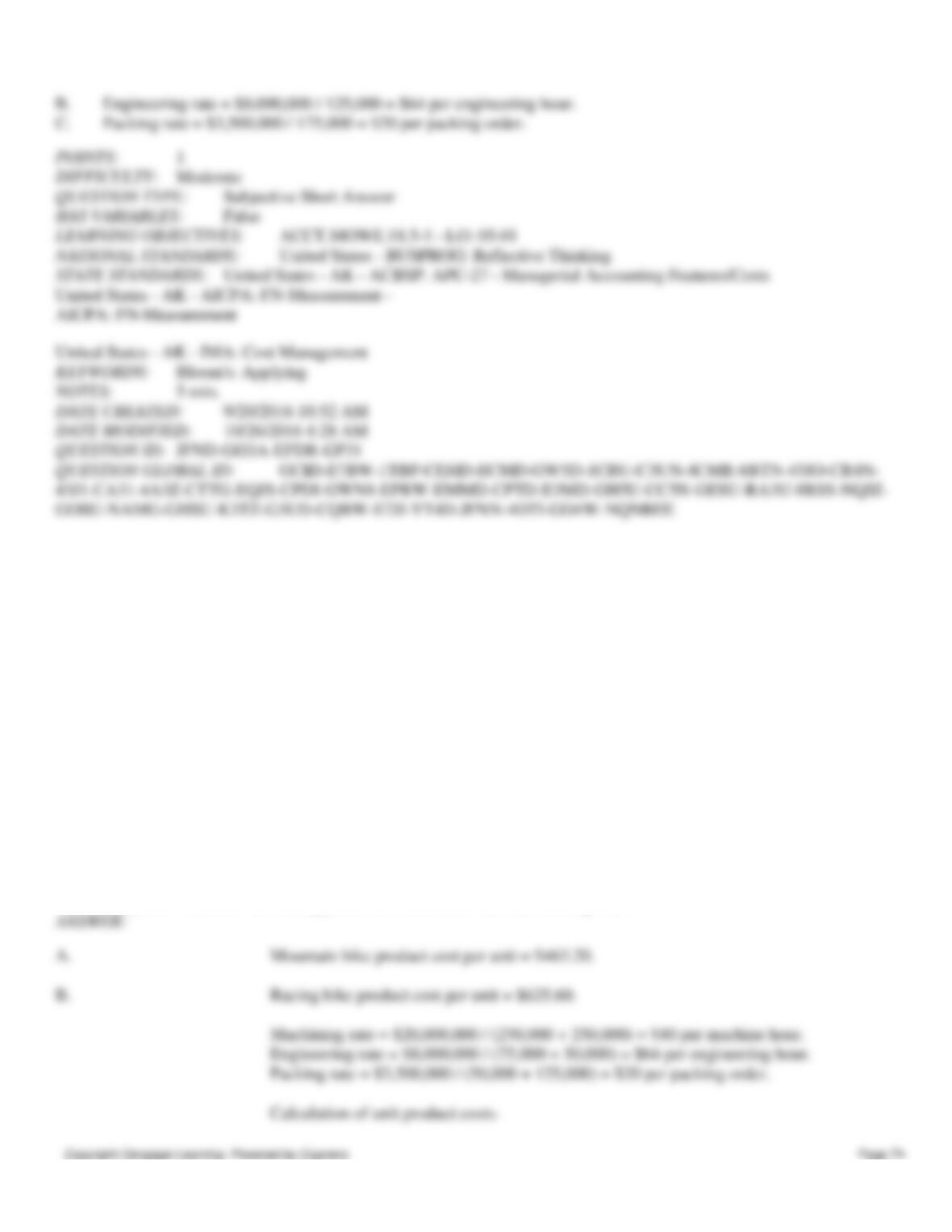
120. Armstrong Company produces a variety of bicycles. One of its plants produces two bicycles: a mountain model and a
racing model. At the beginning of the year, the following data were prepared for this plant:
Mountain Racing
Quantity 250,000 125,000
Selling Price $1,200 $1,000
Unit Prime Cost $ 400 $ 500
In addition, the following information was provided so that overhead costs could be assigned to each product:
Activity Name Activity Driver Activity Cost Racing Mountain
Machining Machine hours $20,000,000 250,000 250,000
Engineering Engineering hours $ 8,000,000 75,000 50,000
Packing Packing orders $ 3,500,000 50,000 125,000
A. Calculate the activity rate for machining.
B. Calculate the activity rate for engineering.
C. Calculate the activity rate for packing.
Chapter 5
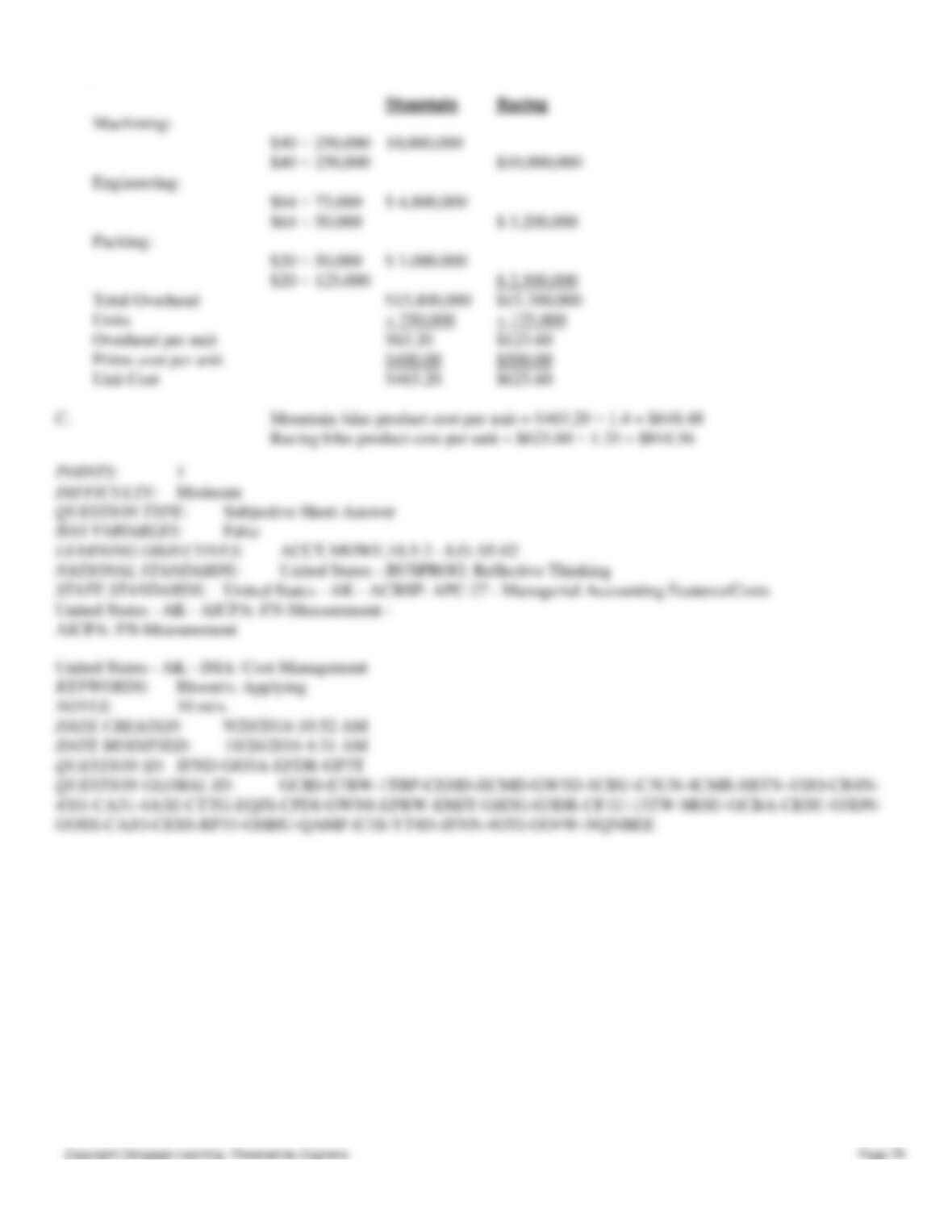
121. Armstrong Company produces a variety of bicycles. One of its plants produces two bicycles: a mountain model and a
racing model. At the beginning of the year, the following data were prepared for this plant:
Mountain Racing
Quantity 250,000 125,000
Selling Price $1,200 $1,000
Unit Prime Cost $ 400 $ 500
In addition, the following information was provided so that overhead costs could be assigned to each product:
Activity Name Activity Driver Activity Cost Racing Mountain
Machining Machine hours $20,000,000 250,000 250,000
Engineering Engineering hours $ 8,000,000 75,000 50,000
Packing Packing orders $ 3,500,000 50,000 125,000
Armstrong Company uses activity-based costing to calculate product costs.
A. Calculate the per unit product cost for a mountain bike.
B. Calculate the per unit product cost for a racing bike.
C. Assume Armstrong Company adds 40% to the cost of a mountain bike and 35% to the cost of a racing bike obtain
the selling prices. Calculate the selling prices for a mountain bike and a racing bike.
Chapter 5
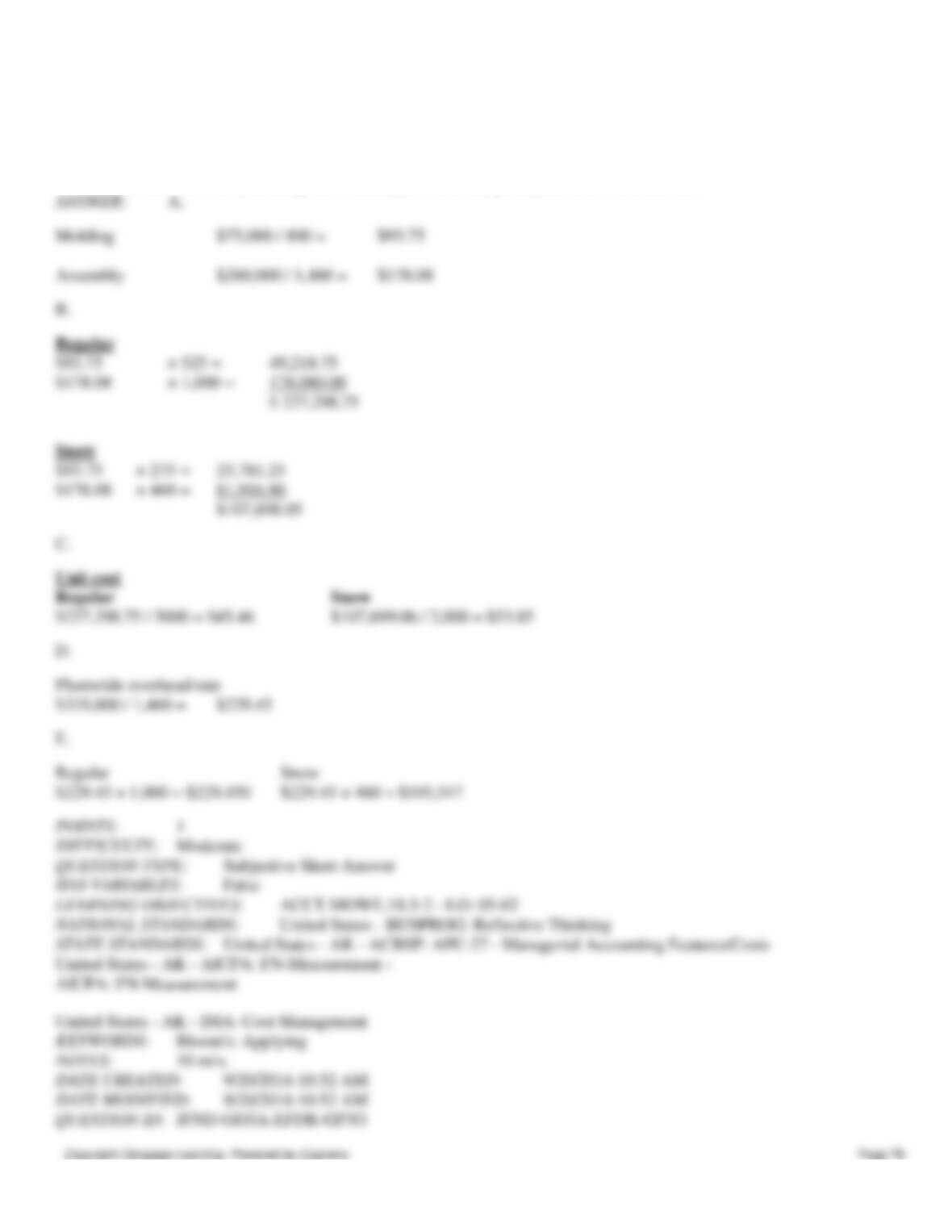
122. Tires Unlimited Corp. produces two types of tires, regular and snow tires. The company uses activity-based costing
and has identified two activities and their budgeted costs:
Molding $ 75,000
Assembly $ 260,000
Molding is based on mixing hours and assembly is based on machine hours. Information regarding each product is as
follows:
Regular tire Snow tire
Units produced 5,000 2,000
Mixing hours 525 275
Machine hours 1,000 460
Required:
A. Calculate the activity rate for molding and assembly. Round your answer to two decimal places.
Chapter 5
B. Calculate how much total overhead is assigned to each type of tire.
C. Calculate the unit overhead assigned to each type of tire.
D. Assume the company does not use ABC costing. Calculate the plantwide overhead rate, based on machine hours.
Round your answer to two decimal places.
E. Calculate the total overhead assigned to each type of tire using the plantwide overhead rate.
123. Randy Company produces candy sticks (hooked and straight). Both products pass through two producing
departments. The hooked sticks’s production is much more labor-intensive than the straight sticks. The straight stick is
also more popular. The following data have been gathered for the two products:
Product Data
Hooked Straight
Units produced per year 200,000 2,000,000
Machine hours 10,000 40,000
Packing orders 30,000 30,000
Randy has decided to use activity-based costing and has developed two types of activities, machine related (based on
machine hours), and other overhead (based on packing orders). Machine-related costs equal $160,000. Other overhead
costs equal $240,000.
A. Calculate the activity rate for machine-related costs based on machine hours.
B. Calculate the activity rate for other overhead costs based on packing orders.
C. Using the two activity rates, calculate the overhead cost per unit for hooked sticks. (Carry out computations to
three decimal places.)
D. Using the two activity rates, calculate the overhead cost per unit for straight sticks. (Carry out computations to
three decimal places.)