177) What is the LIFO conformity rule?
178) What is the effect of an error in the ending inventory balance on the accounts reported in
the income statement?
179) Explain how the inventory turnover ratio and the days’ sales in inventory ratio are used to
evaluate inventory management.
180) Identify and describe the four inventory valuation methods.
181) Explain how the lower of cost or market rule is used to value inventory.
182) Discuss the important accounting features of a periodic inventory system including
accounts and procedures used.
183) Explain the reason a company might use the retail inventory method for valuing inventory.
184) Explain the reason a company might use gross profit inventory method for valuing
inventory.
185) When inventory costs are declining, explain the impact to the balance sheet and income
statement using the FIFO method.
186) The company’s inventory manager receives compensation that includes a bonus based on
gross profit. You discover that the inventory manager has knowingly overstated ending inventory
by $2 million. What effect does this error have on the financial statements of the company and
specifically gross profit? Why would the manager knowingly overstate ending inventory? Would
this be considered an ethics violation?
187) Mary’s Antiques does not have its own retail location, instead maintains inventory in its
warehouse and sells merchandise through Oldtime Antique Mall. Oldtime does not assume
responsibility for goods until they are sold to customers at which time it takes a commission for
items sold and sends the sale proceeds to Mary’s. Identify which company has the role of the
consignor and the consignee. Which company should include any unsold goods as part of its
inventory?
188) What advantages does a perpetual inventory system have over periodic inventory system?
189) Patrick Randall of Sports Supplies finds that maintaining appropriate levels of inventories
while controlling costs is a major challenge. What are the challenges Patrick refers to?
190) Carolina Company uses the perpetual LIFO method for valuing its ending inventory. The
following financial statement information is available for its first year of operation:
Carolina Company
Income Statement
For the year ended December 31
Sales
$60,000
Cost of goods sold
23,000
Gross profit
$37,000
Expenses
13,000
Income before taxes
$24,000
Carolina’s ending inventory using the perpetual LIFO method was $8,700. Carolina’s accountant
determined that had the company used perpetual FIFO, the ending inventory would have been
$9,100.
a. Determine what the income before taxes would have been, had Carolina used the FIFO
method of inventory valuation instead of LIFO.
b. What would be the difference in income taxes between LIFO and FIFO, assuming a 30% tax
rate?
c. If Carolina wanted to lower the amount of income taxes to be paid, which method would it
choose?
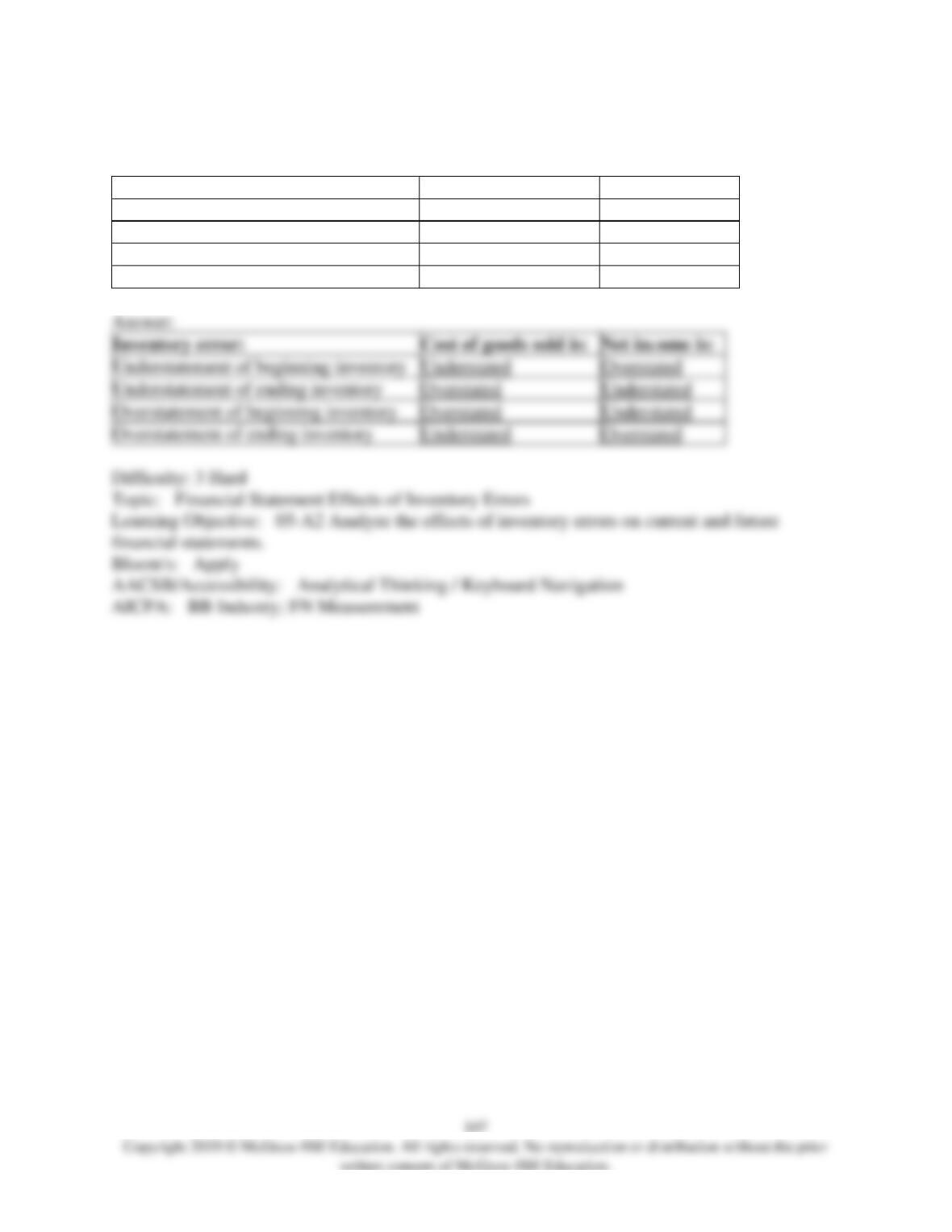
Income before taxes
Income taxes (30%)
191) Evaluate each inventory error separately and determine whether it overstates or understates
cost of goods sold and net income.
Inventory error:
Cost of goods sold is:
Net income is:
Understatement of beginning inventory
________
________
Understatement of ending inventory
________
________
Overstatement of beginning inventory
________
________
Overstatement of ending inventory
________
________
Inventory error:
Cost of goods sold is:
Understatement of beginning inventory
Understated
Overstated
Understatement of ending inventory
Overstated
Understated
Overstatement of beginning inventory
Overstated
Understated
Overstatement of ending inventory
Understated
Overstated
192) The Community Store reported the following amounts on their financial statements for
Year 1, Year 2, and Year 3:
For the year ended December 31
Year 1
Year 2
Year 3
Cost of goods sold
$75,000
$87,000
$77,000
Net income
22,000
25,000
21,000
Total current assets
155,000
165,000
110,000
Equity
287,000
295,000
304,000
It was discovered early in Year 4 that the ending inventory on December 31, Year 1 was
overstated by $6,000, and the ending inventory on December 31, Year 2 was understated by
$2,500. The ending inventory on December 31, Year 3 was correct. Ignoring income taxes
determine the correct amounts of cost of goods sold, net income, total current assets, and equity
for each of the years Year 1, Year 2, and Year 3.
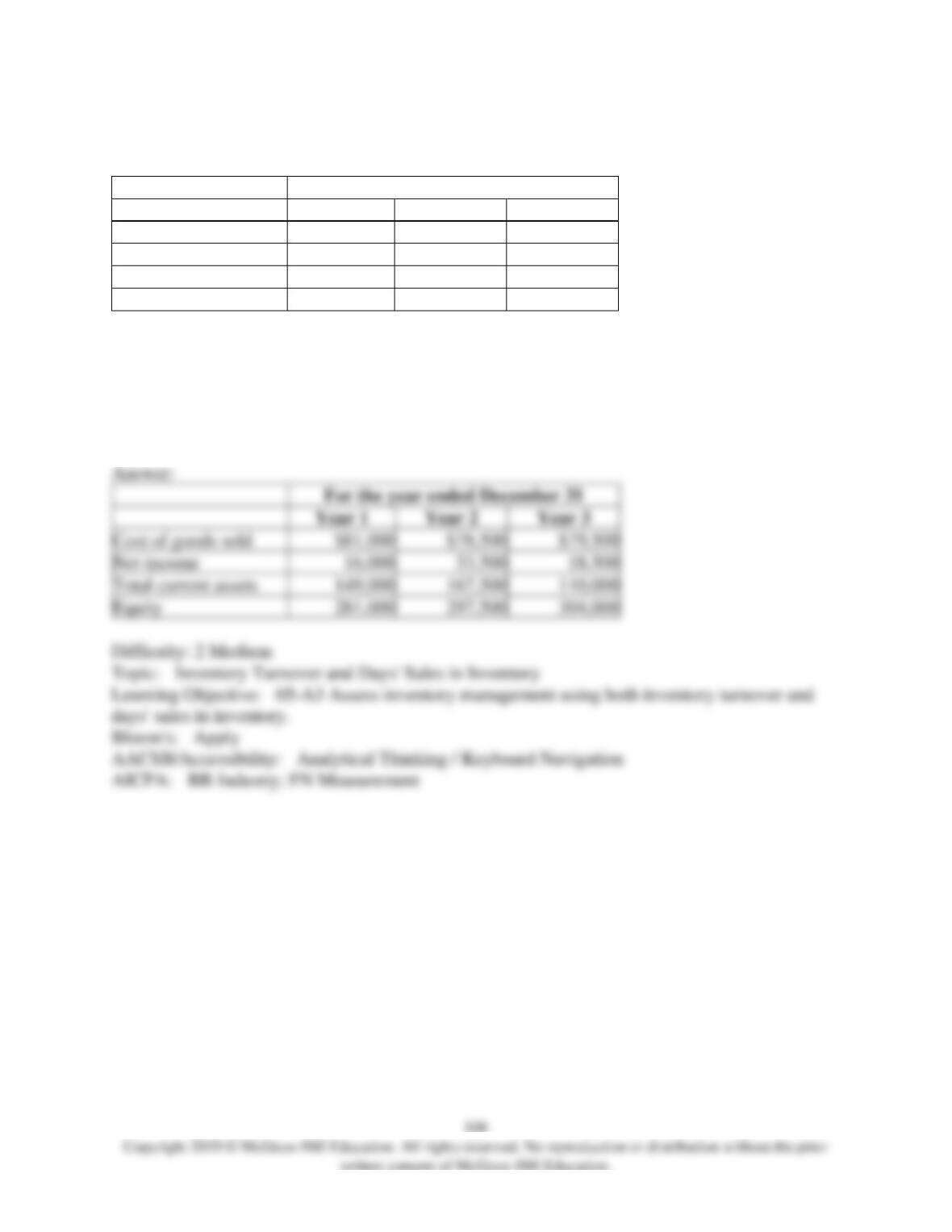
For the year ended December 31
Year 1
Year 2
Year 3
Cost of goods sold
$81,000
$78,500
$79,500
Net income
Total current assets
149,000
167,500
110,000
Equity
281,000
297,500
304,000
193) A company reported the following data:
Year 1
Year 2
Cost of goods sold
$317,500
$279,100
Average inventory
72,000
93,000
Required:
1. Calculate the company’s merchandise inventory turnover for each year.
2. Comment on the company’s efficiency in managing its inventory.
194) A company reported the following data:
Year 1
Year 2
Cost of goods sold
$425,000
$486,000
Ending inventory
140,000
175,000
Required:
1. Calculate the days’ sales in inventory for each year.
2. Comment on the trend in inventory management.
195) A company made the following purchases during the year:
Jan. 10
15 units @ $360 each
Mar. 15
25 units @ $390 each
Apr. 25
10 units @ $420 each
July 30
20 units @ 450 each
Oct. 10
15 units @ $480 each
On December 31, there were 28 units in ending inventory. These 28 units consisted of 2 from the
January 10 purchase, 3 from the March 15 purchase, 4 from the April 25 purchase, 11 from the
July 30 purchase, and 8 from the October 10 purchase. Using specific identification, calculate the
cost of the ending inventory.
2 * $360
=
3 * $390
=
4 * $420
=
11 * $450
=
8 * $480
=
196) A company’s inventory records indicate the following data for the month of July:
July 1
Beginning
380 units at $15 each
July 5
Purchase
270 units at $17 each
July 10
Sale
400 units at $50 each
July 20
Purchase
300 units at $22 each
July 25
Sale
400 units at $50 each
If the company uses the weighted average inventory valuation method and the perpetual
inventory system, what would be the cost of its ending inventory? (Round average cost per unit
to 2 decimals, and final answer to the nearest dollar.)
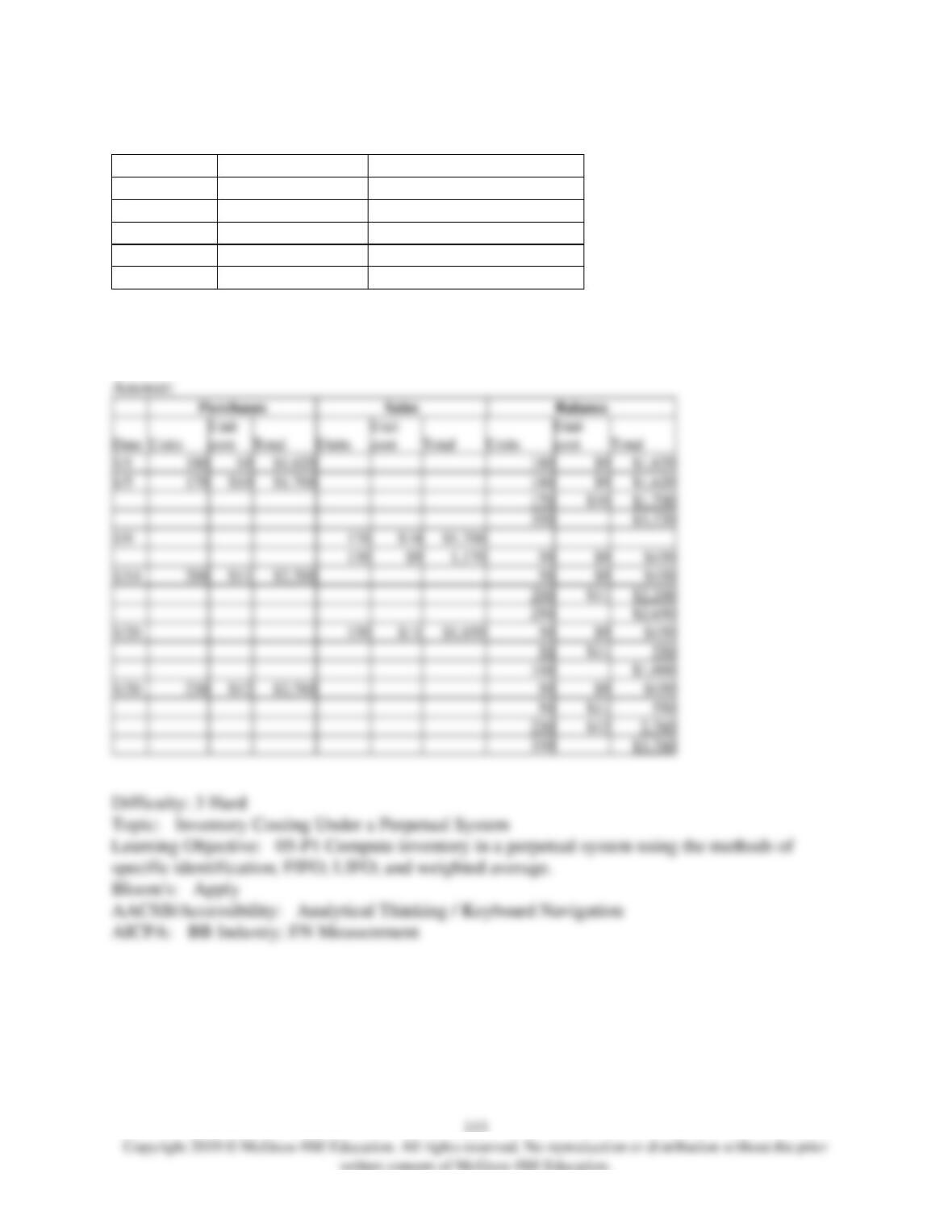
197) A company’s inventory records indicate the following data for the month of April:
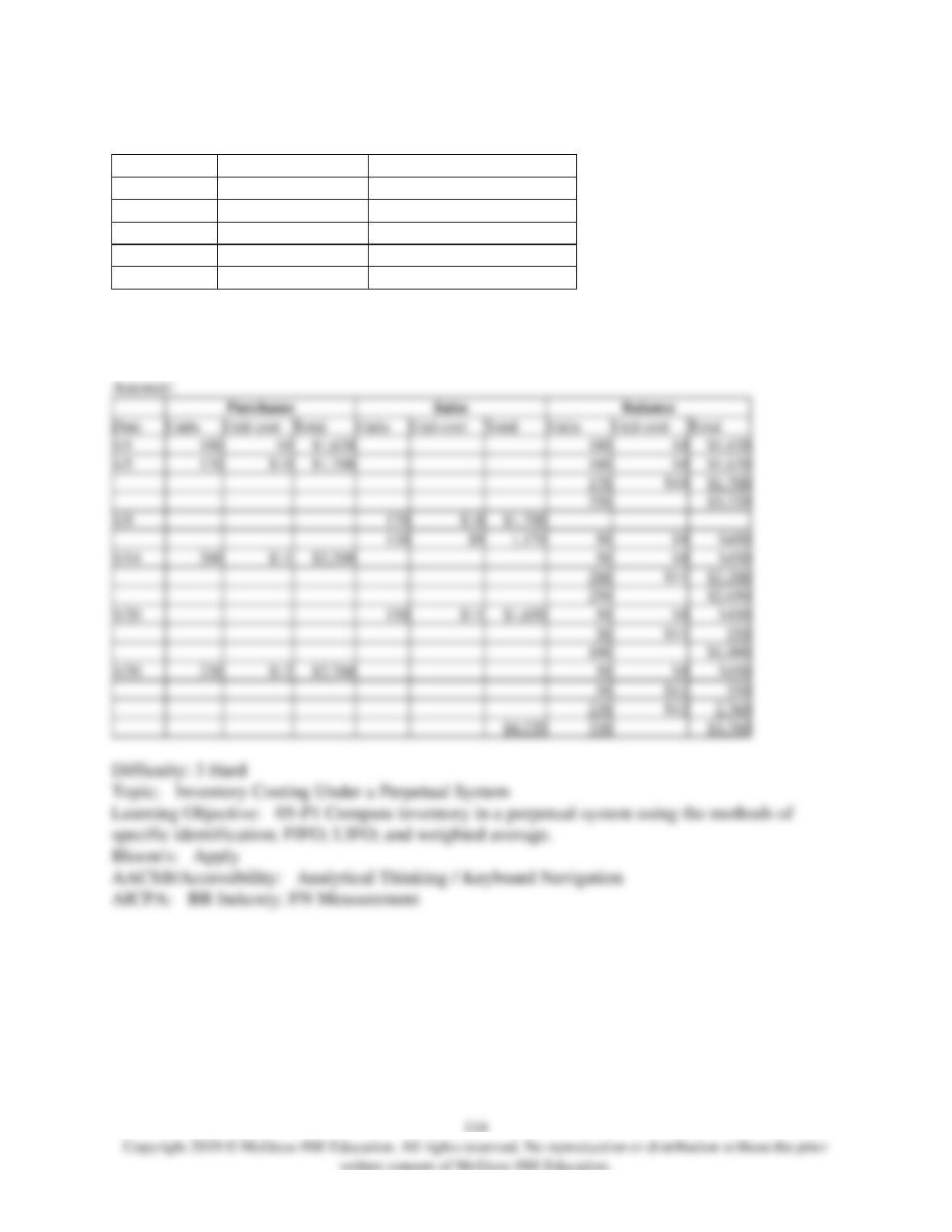
April 1
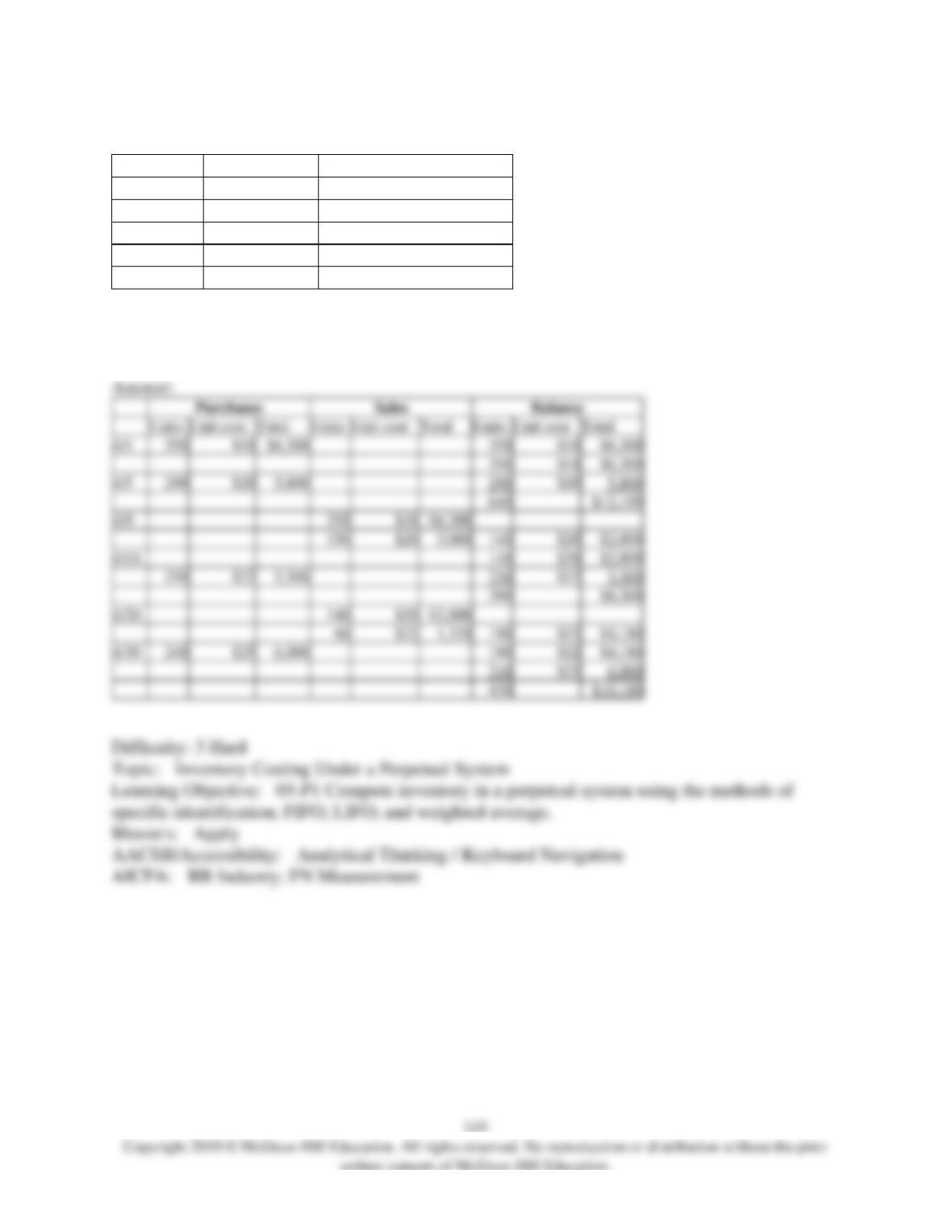
Beginning
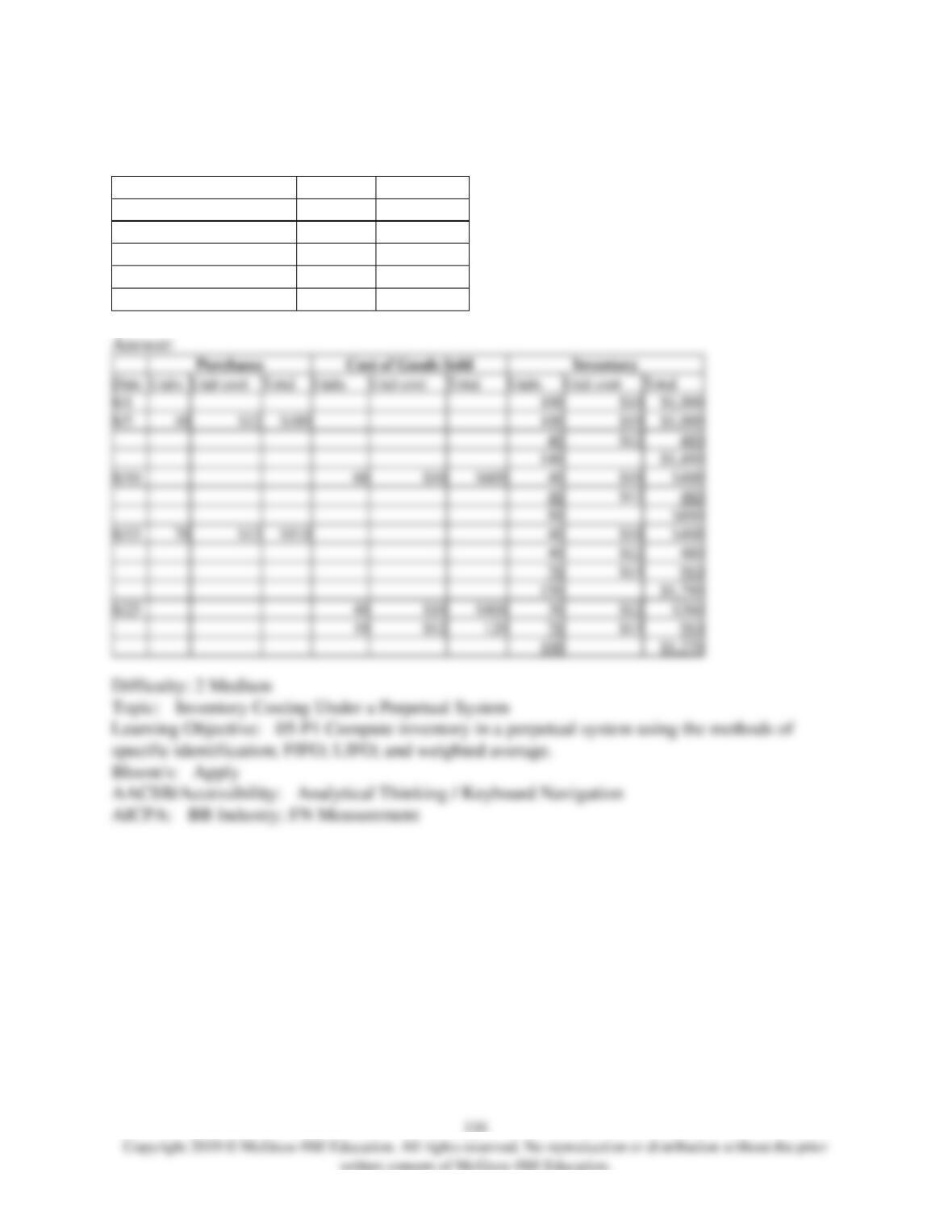
350 units at $18 each
April 5
Purchase
290 units at $20 each
April 9
Sale
500 units at $55 each
April 14
Purchase
250 units at $22 each
April 20
Sale
200 units at $55 each
April 30
Purchase
240 units at $25 each
If the company uses the first-in, first-out (FIFO) method and the perpetual inventory system,
what would be the cost of the ending inventory?
198) A company’s inventory records indicate the following data for the month of January:
Jan. 1
Beginning
180 units at $9 each
Jan. 5
Purchase
170 units at $10 each
Jan. 9
Sale
300 units at $35 each
Jan. 14
Purchase
200 units at $11 each
Jan. 20
Sale
150 units at $35 each
Jan. 30
Purchase
230 units at $12 each
If the company uses the LIFO perpetual inventory system, what would be the cost of the ending
inventory?
199) A company’s inventory records indicate the following data for the month of January:
Jan. 1
Beginning
180 units at $9 each
Jan. 5
Purchase
170 units at $10 each
Jan. 9
Sale
300 units at $35 each
Jan. 14
Purchase
200 units at $11 each
Jan. 20
Sale
150 units at $35 each
Jan. 30
Purchase
230 units at $12 each
If the company uses the LIFO perpetual inventory system, what is the amount of cost of goods
sold for January?
200) A company’s inventory records indicate the following data for the month of April:
April 1
Beginning
350 units at $18 each
April 5
Purchase
290 units at $20 each
April 9
Sale
500 units at $55 each
April 14
Purchase
250 units at $22 each
April 20
Sale
200 units at $55 each
April 30
Purchase
240 units at $25 each
If the company uses the first-in, first-out (FIFO) method and the perpetual inventory system,
what would be the cost of the ending inventory?
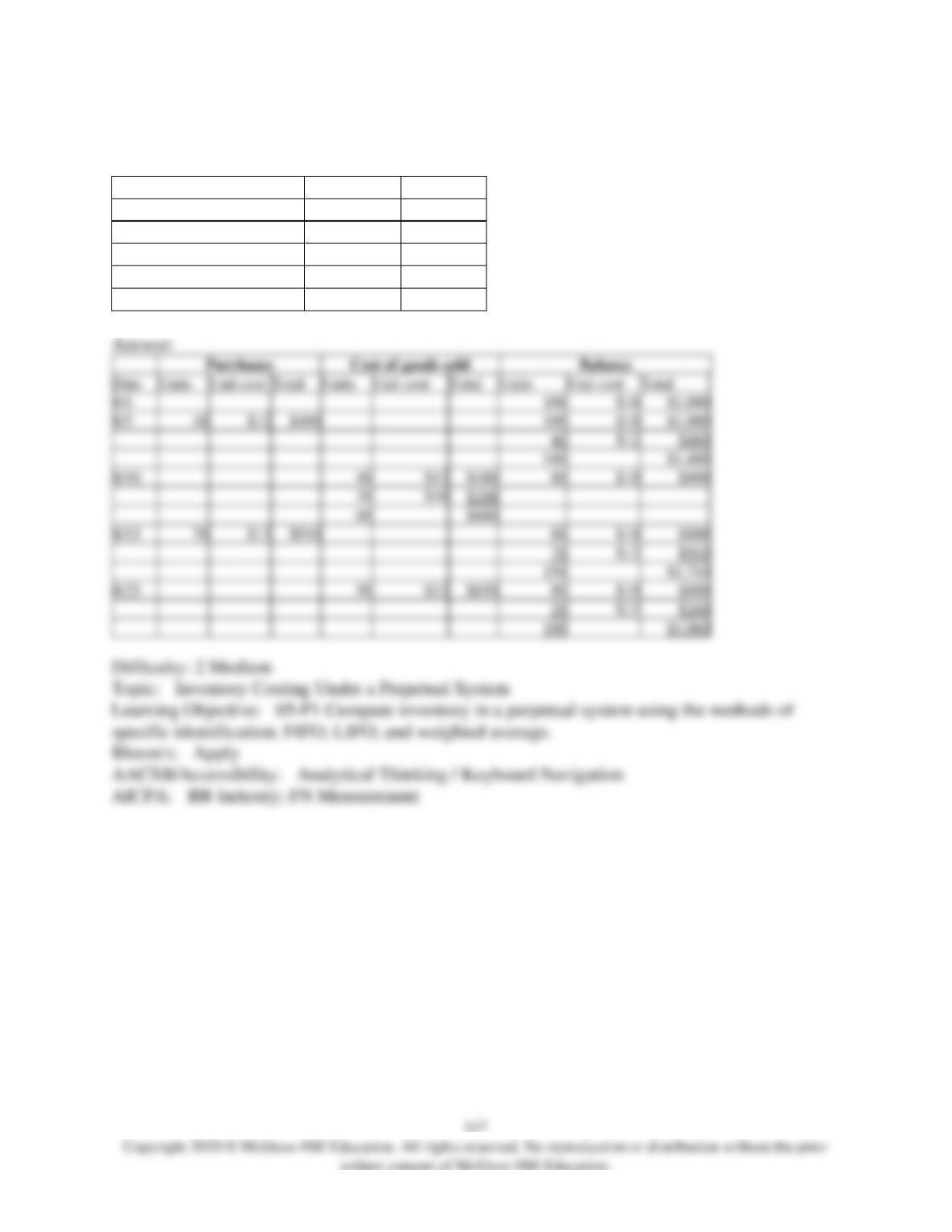
201) Calculate the ending inventory using FIFO for a company that uses a perpetual inventory
system, using the information given below.
Units
Unit Cost
Beginning inventory
100
$10
Aug. 5 purchase
40
12
Aug. 10 sale
60
–
Aug. 15 purchase
70
13
Aug. 25 sale
50
–
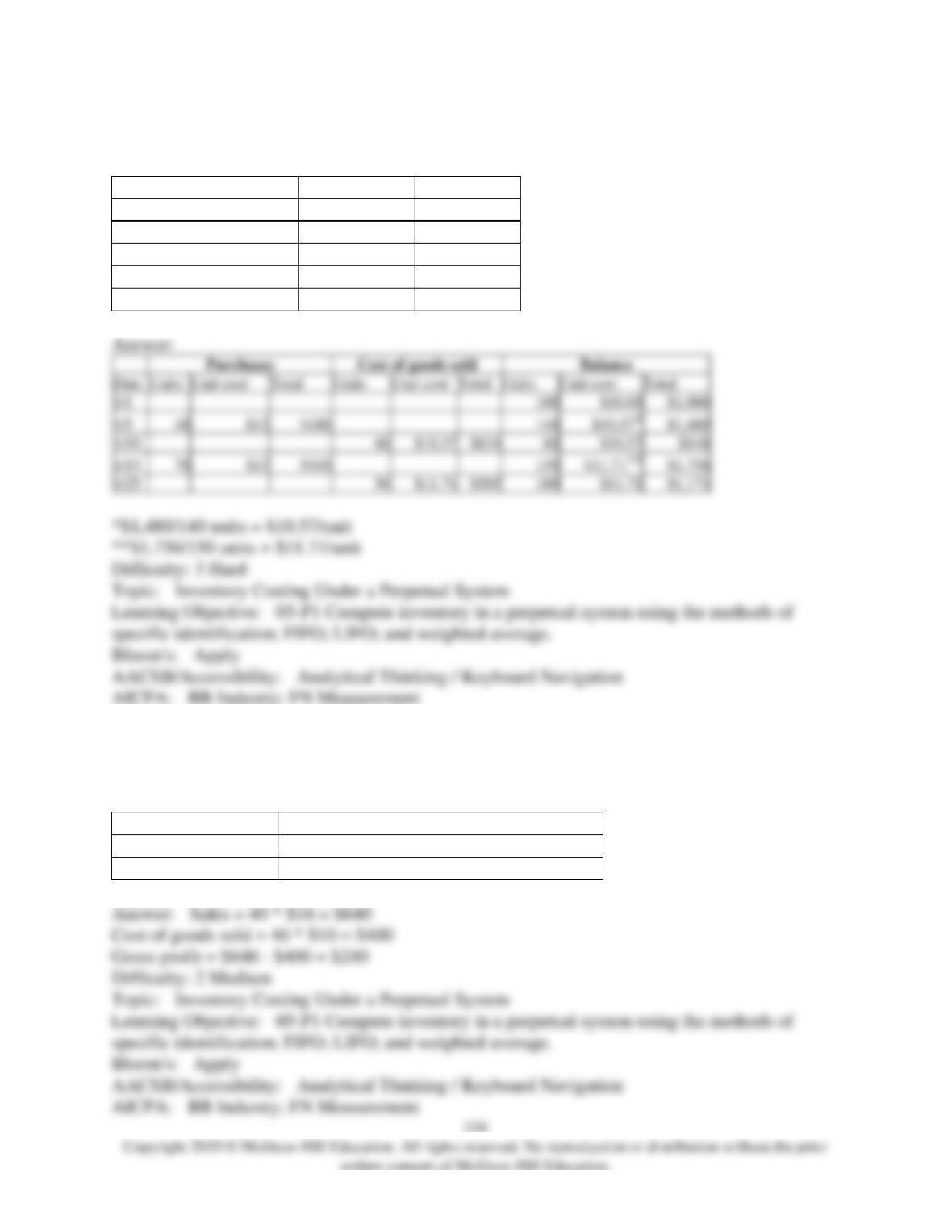
202) Calculate the ending inventory using LIFO for a company that uses a perpetual inventory
system, using the information given below.
Units
Unit Cost
Beginning inventory
100
$10
Aug. 5 purchase
40
12
Aug. 10 sale
60
–
Aug. 15 purchase
70
13
Aug. 25 sale
50
203) Using the information given below for a company that uses a perpetual inventory system,
calculate the ending inventory using weighted average.
Units
Unit Cost
Beginning inventory
100
$10
Jan. 5 purchased
40
12
Jan. 10 sold
60
–
Jan. 15 purchased
70
13
Jan. 25 sold
50
–
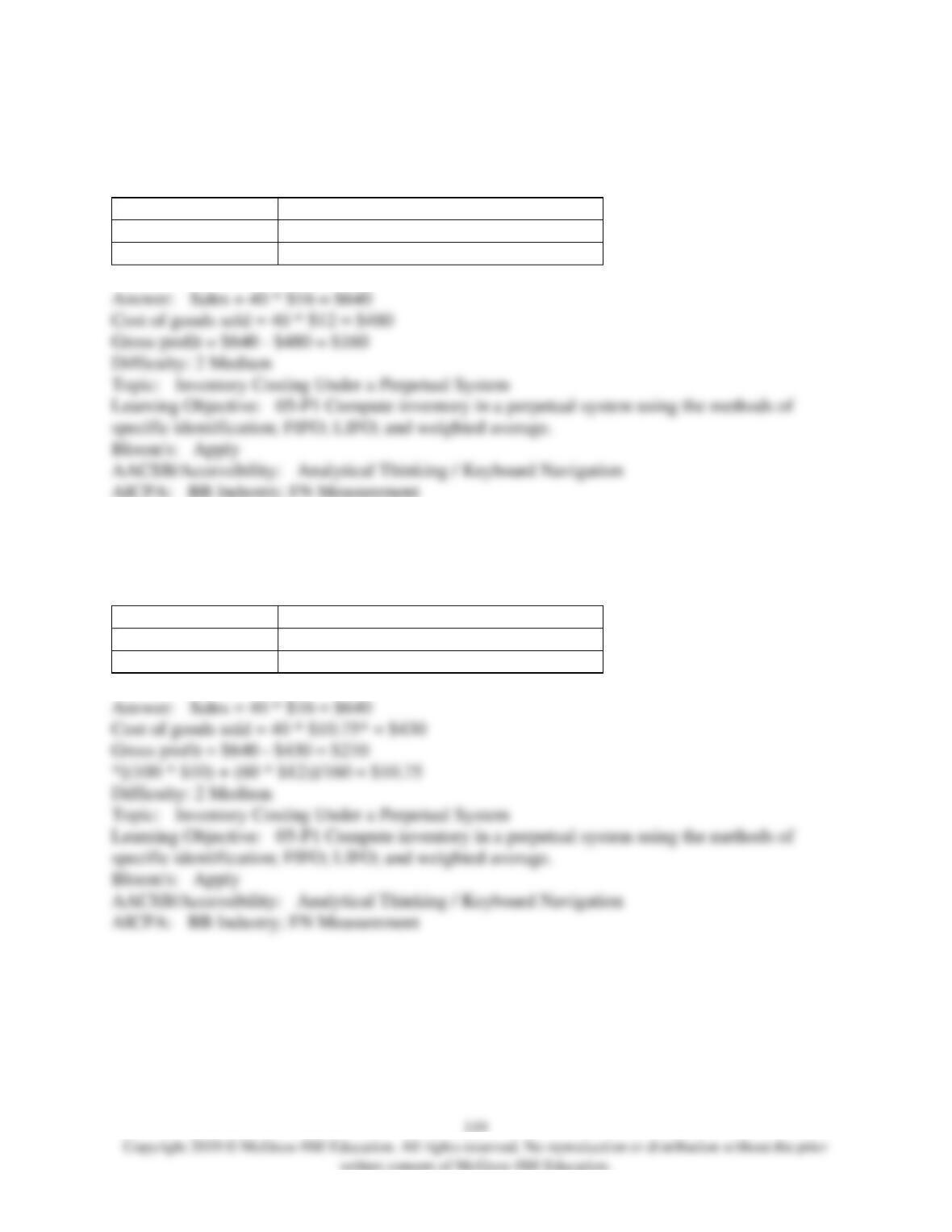
204) Use the information below to determine the sales revenue, cost of goods sold and gross
profit that would be reported for the company related to the March 16 sale assuming the
company uses FIFO inventory valuation and a perpetual inventory system.
January 1:
Purchased 100 units at $10 per unit.
February 5:
Purchased 60 units at $12 per unit.
March 16:
Sold 40 units for $16 per unit.
205) Use the information below to determine the sales revenue, cost of goods sold and gross
profit that would be reported for the company related to the March 16 sale assuming the
company uses LIFO inventory valuation and a perpetual inventory system.
January 1:
Purchased 100 units at $10 per unit.
February 5:
Purchased 60 units at $12 per unit.
March 16:
Sold 40 units for $16 per unit.
206) Use the information below to determine the sales revenue, cost of goods sold and gross
profit that would be reported for the company related to the March 16 sale assuming the
company uses weighted average inventory valuation and a perpetual inventory system.
January 1:
Purchased 100 units at $10 per unit.
February 5:
Purchased 60 units at $12 per unit.
March 16:
Sold 40 units for $16 per unit.