5-92
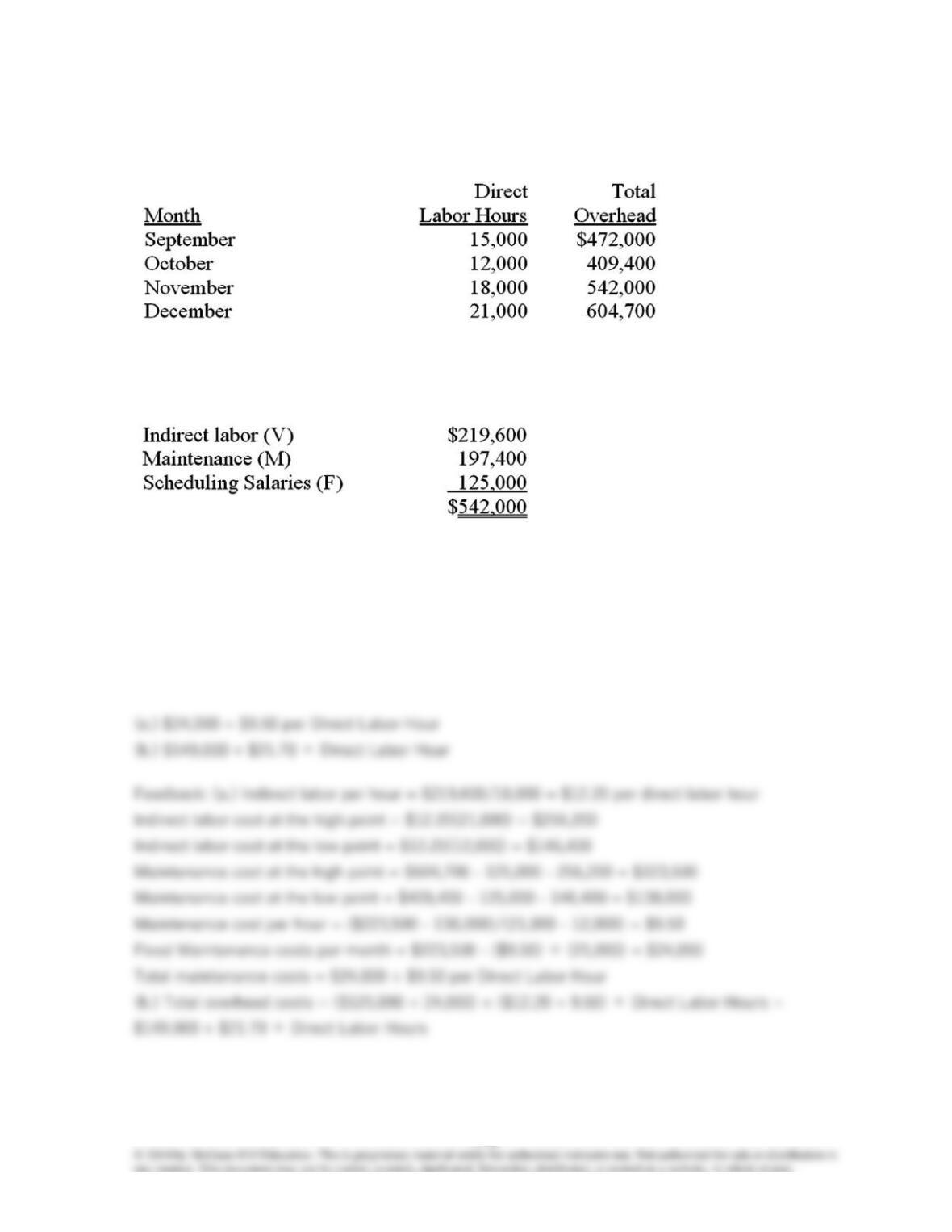
103. The Mallard Company’s total overhead costs at various levels of activity are presented
below:
Assume that the overhead costs above consist of indirect labor, scheduling salaries, and
maintenance. The breakdown of these costs for the month of November is as follows:
Required:
(a.) Using the high-low method, determine the cost formula for maintenance.
(b.) Express the company’s total overhead costs in linear equation form.
5-93
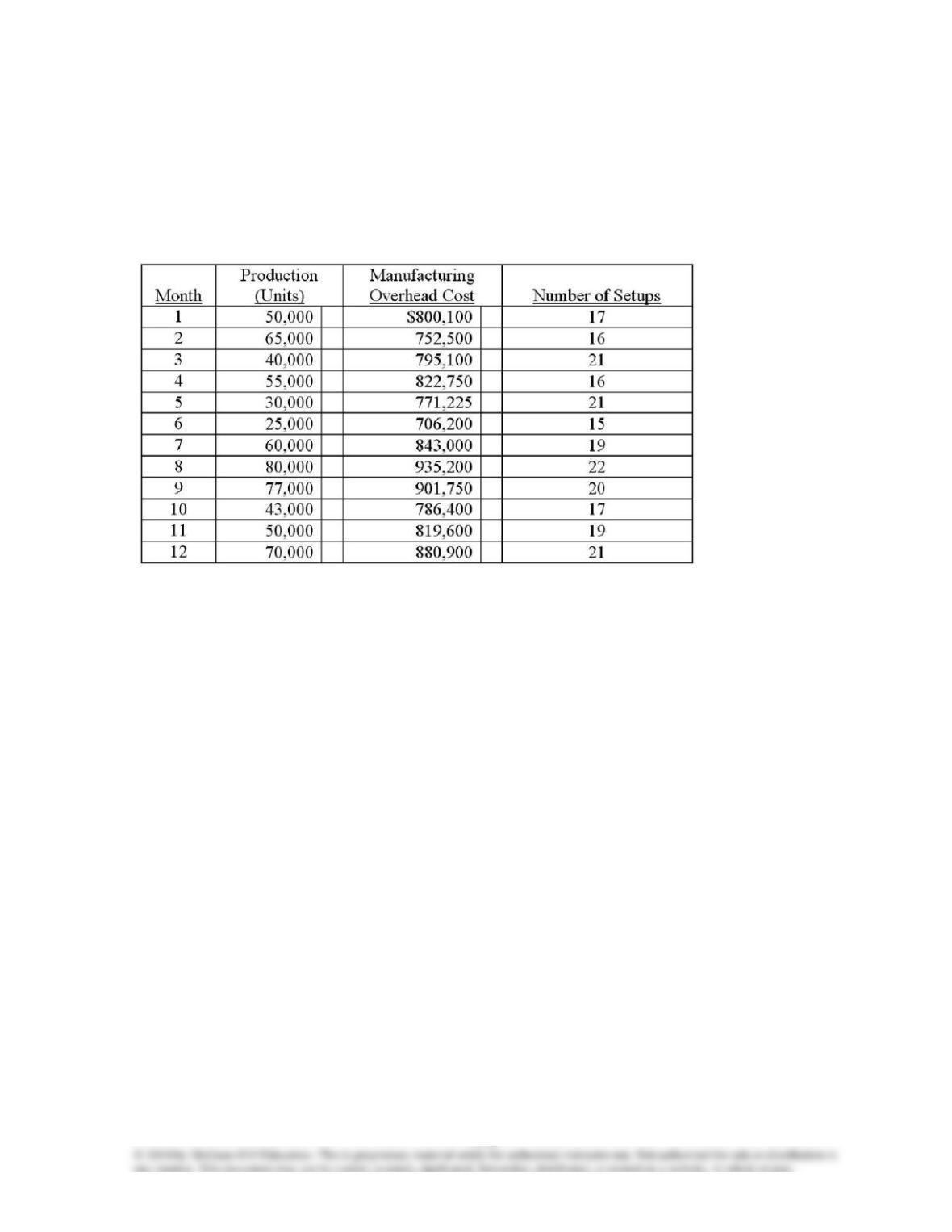
104. The Ottawa Company has traditionally estimated manufacturing overhead costs using
production volume. Some of the production managers believe that the number of set ups may also
have an impact on monthly manufacturing overhead costs. In order to investigate this possibility,
the company collected information on its monthly manufacturing overhead costs, production in
units, and number of setups for 2012.
Regression analysis results of the information presented above are as follows:
Ordinary regression:
Equation: $650,398 + $3.1061 × units
r-square: .707
Multiple regression:
Equation: $464,481 + $2.5356 × units + $11,631.6048 × lot size
r-square: .867
Required:
(a.) Use the results from the ordinary regression and estimate next month’s manufacturing
overhead costs, assuming the company is planning to produce 75,000 units. (final answer should
be rounded to the nearest whole dollar)
(b.) Use the results from the multiple regression and estimate the next month’s manufacturing
costs, assuming the company is planning to produce 75,000 units with an average lot size of 18.
(final answer should be rounded to the nearest whole dollar)
(c.) Comment on which regression seems to be more appropriate under these circumstances.
What additional information would you like to see? Be specific.
105. Disher Enterprises had an average cost of $8.60 during a month when 75,000 units were
produced. When production was 125,000 units several months later, the average cost dropped to
$6.98.
Required:
(a.) Determine the fixed and variable portions of production costs.
(b.) What will unit cost be when production equals 110,000 units?
106. Stottlemeyer Products had costs of $950,000 when sales equaled 55,000 units. When
sales increased to 85,000 units, total costs increased to $1,400,000. The selling price is $21 per
unit.
Required:
(a.) Determine the fixed and variable portions of costs.
(b.) Prepare a contribution margin income statement for a month with sales of 70,000 units.
107. Young, Inc. has received a contract for 8 units of a new product. The contract is a cost–
plus contract, with the total to be received equal to the total labor cost + 30%. Young found that
the first unit of a new product required 90 hours to complete. The second unit was completed
using only 76.5 hours. Young believes that the rate of learning that was observed will continue for
all 8 units of the contract. The labor wage paid is $40/hour. The following factors are available for
various rates of learning: 80% learning, b = -.3219; 85%, b = -.2345; 90%, b = -.1520; 95%, b = –
.0740.
Required:
(a.) What will the total labor cost be for the contract?
(b.) What will be the total fee for the contract?
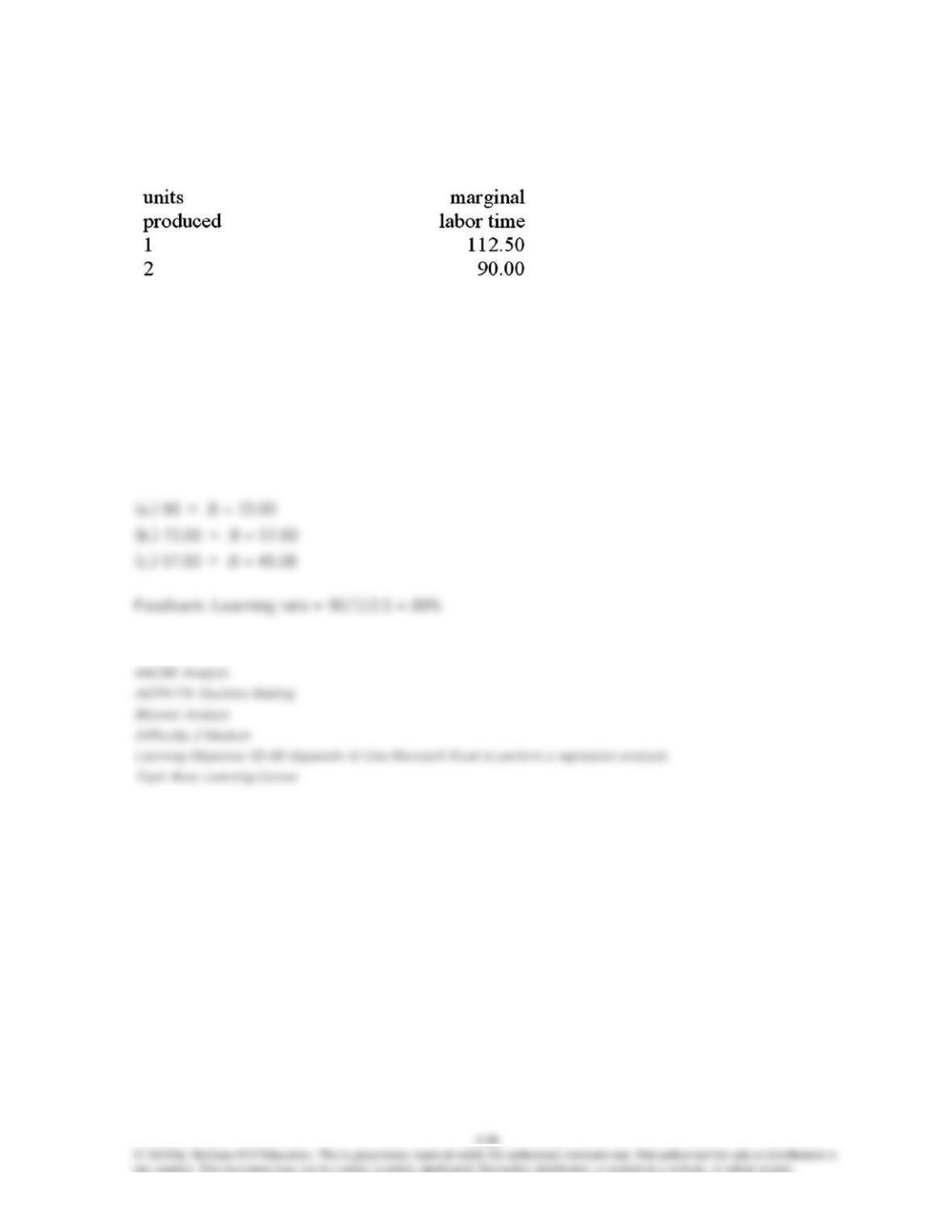
108. Webster Products, Inc., has found that new products follow a learning curve. The first two
units have been completed with the following results:
Required:
(a.) How much time will be needed to complete the 4th unit?
(b.) How much time will be needed to complete the 8th unit?
(c.) How much time will be needed to complete the 16th unit?
109. Explain the difference between the engineering method of cost estimation and the
account analysis method.
110. Describe the engineering method of cost estimation. Provide two advantages and two
disadvantages associated with the engineering approach to cost estimation.
111. Describe two advantages and two disadvantages of the high-low method of cost
estimation.
112. What are “outliers” and what effect does their presence have when using regression
analysis for cost estimation?
113. Describe the effect on cost estimation of four of the following five problems: 1) missing
data, 2) outliers, 3) allocated and discretionary costs, 4) inflation, or 5) mismatched time periods.