12) Stelloh’s Berry Farm accepted a bank-issued credit card in payment of a $1300 sales transaction.
Stelloh’s bank charges 3% to process the transaction. The journal entry to record the sales transaction
will include (Ignore cost of goods sold.):
A) a debit to Accounts Receivable for $1261 and a credit to Sales Revenue for $1261.
B) a debit to Cash for $1300 and a credit to Sales Revenue for $1300.
C) a debit to Cash for $1261, a debit to Credit Card Discount Expense for $39 and a credit to Sales
Revenue for $1300.
D) a debit to Accounts Receivable for $1300, a debit to Credit Card Revenue for $39 and a credit to Sales
Revenue for $1339.
13) If Abby, Inc. sells items to a customer who uses a credit card for $1300, and there is a credit card fee
of 2.5%, Abby will record a(n): (Round your final answer to the nearest dollar.)
A) credit to Sales Revenue for $1267.5.
B) debit to Accounts Receivable for $1267.5.
C) debit to Sales Expense for $32.5.
D) debit to Credit Card Discount Expense for $32.5.
14) Factoring accounts receivable is used by:
A) start-up companies.
B) companies with a weak or no credit history.
C) companies with a significant amount of debt.
D) all of the above.
15) When a merchant sells merchandise and lets the customer pay with a VISA credit card:
A) The strategy may increase sales dramatically, with no additional costs involved.
B) At the time of sale, Credit Card Receivable is debited and Sales Revenue is credited for the
discounted portion of the sale amount.
C) The merchant’s point-of-sale terminal is linked to a VISA server which automatically credits the
merchant’s bank account for the full sale amount.
D) The credit card discount is similar to interest expense and is reported on the income statement
separately from operating income as other income (expense).
16) Smart Company sells office furniture for $3,000 and the customer pays with a VISA card. VISA’s fee
is 2.5%. Prepare the journal entry for the sale, ignoring cost of goods sold. No sales returns are
expected. Omit the explanation.
Account
Debit
Credit
Cash
Credit Card Discount Expense
17) Lincoln Company sold $50,000 of accounts receivable and received $46,750. Prepare the journal
entry for this sale. Omit the explanation.
Account
Debit
Credit
Cash
Financing Expense
7 Learning Objective 5-7
1) Ratios are used only by company management, and not investors, to evaluate the financial health of a
company.
2) The current ratio is a more stringent measure of a firm’s ability to pay current liabilities than the
quick ratio.
3) The higher the quick ratio, the easier it is to pay current liabilities.
4) In order to effectively evaluate the days’ sales outstanding, it should be compared to the company’s
credit terms.
5) Days’ sales outstanding tells a company how long it takes to collect its average level of receivables.
6) When compared to the current ratio, the quick ratio is a less stringent measure of a company’s ability
to pay its current liabilities.
7) Which of the following is considered to be a more stringent measure of a company’s ability to pay its
current liabilities than the current ratio?
A) accounts payable
B) quick ratio
C) liquidity ratio
D) collection period
8) A measure of the ability of an entity to pay all of its current liabilities if they came due immediately is
the:
A) debt ratio.
B) quick ratio.
C) liquidity ratio.
D) accounts receivable turnover.
9) The quick ratio and the day’s sales outstanding measure:
A) a company’s cash conversion cycle.
B) a company’s profitability.
C) a company’s liquidity.
D) all of the above
10) Days’ sales outstanding can be computed in two logical steps. In the second step:
A) the collection period must be determined.
B) the average daily sales are computed.
C) the average daily sales are divided by the average net receivables.
D) the average net receivables are divided by the average daily sales.
11) When computing the quick ratio, the numerator will include all of the following EXCEPT for:
A) net current receivables.
B) short-term investments.
C) inventory.
D) cash and cash equivalents.
12) When calculating the denominator for the quick ratio, you would NOT include:
A) accounts payable.
B) long-term debt.
C) salaries payable.
D) current maturities of long-term debt.
13) If a company wants to increase its quick ratio, it should consider:
A) buying equipment on account.
B) paying off long-term notes payable.
C) issuing long-term notes payable.
D) collecting an accounts receivable.
14) Robin’s Nest had net credit sales for the current period of $510,000 and average net receivables were
$49,000. What is Robin’s Nest’s average daily sales? (Use a 365–day year for your calculations. Round
your final answer to the nearest dollar.)
A) $10
B) $35
C) $134
D) $1397
15) Bird’s Nest had net credit sales for the current period of $550,000 and average net receivables were
$55,000. What is the days’ sales outstanding? (Round any intermediary calculations to two decimal
places and your final answer to the nearest day.)
A) 10 days
B) 150.684932 days
C) 36 days
D) 26 days
16) A company has net credit sales of $2,050,000, a beginning balance of net receivables of $207,000, and
an ending balance of net receivables of $253,000. What is the company’s days’ sales outstanding?
(Round any intermediary calculations to two decimal places and your final answer to the nearest day.)
A) 9 days
B) 37 days
C) 41 days
D) 45 days
17) A company has $24,000 in cash and cash equivalents, $88,000 in short-term investments, $128,000 in
net current receivables, $57,000 in inventory, $15,000 of prepaid insurance and $10,000 of supplies. The
total current liabilities of the firm are $303,000. The quick ratio of the company is: (Round your final
answer to two decimal places.)
A) 0.37.
B) 0.79.
C) 0.98.
D) 1.06.
18) Bamboo Industries, Inc. has $39,000 in cash and cash equivalents, $19,000 in short–term investments,
$129,000 in net current receivables, $58,000 in inventory and $18,000 in prepaid expenses. The total
current liabilities of the firm are $240,000. Bamboo Industries’ current ratio is: (Round your final answer
to two decimal places.)
A) 0.78.
B) 0.85.
C) 1.02.
D) 1.1.
19) A company has net credit sales of $930,000, a beginning balance of net receivables of $76,000, and an
ending balance of net receivables of $93,000. Its days’ sales outstanding is: (Round any intermediary
calculations to two decimal places and your final answer to the nearest day.)
A) 30 days.
B) 11 days.
C) 33 days.
D) 36 days.
20) If the quick ratio is 2, and the current liabilities are $130,000, what is the amount of quick assets?
(Round your final answer to the nearest dollar.)
A) $130,000
B) $65,000
C) $260,000
D) none of the above
21) If the collection period of a company is 60 days, and the average receivables are $90,000 what is the
total amount of the credit sales? (Round any intermediary calculations to two decimal places and your
final answer to the nearest dollar.)
A) $1500
B) $14,795
C) $90,000
D) $547,500
22) When calculating the quick ratio, ________ is included in the numerator.
A) inventory
B) prepaid insurance
C) supplies
D) short-term marketable securities
23) Emma Jones Company has the following information available:
Account
12/31/2017
12/31/2016
Accounts Payable
$76,500
$80,000
Accounts Receivable, net
42,300
49,000
Cash and Cash Equivalents
43,700
70,000
Inventories
100,000
99,000
Long-Term Investments
20,000
100,000
Short-Term Investments
27,000
44,000
Income Taxes Payable
2,000
5,000
Long-Term Notes Payable
20,000
30,000
Did the current ratio improve from 2016 to 2017?
A) No.
B) Yes.
C) It stayed the same.
D) There is not enough information.
24) Mary Smith Company has the following information available:
Account
12/31/2017
12/31/2016
Accounts Payable
$76,500
$80,000
Accounts Receivable, net
42,300
49,000
Cash and Cash Equivalents
43,700
70,000
Inventories
100,000
99,000
Long-Term Investments
20,000
100,000
Short-Term Investments
27,000
44,000
Income Taxes Payable
2,000
5,000
Long-Term Notes Payable
20,000
30,000
Did the quick ratio improve from 2016 to 2017?
A) No.
B) Yes.
C) It stayed the same.
D) There is not enough information.
25) Excalibur Company has calculated the following ratios:
Ratio
12/31/2017
12/31/2016
Current Ratio
2.25
2.00
Quick Ratio
1.10
0.50
Collection Period
30 days
60 days
Did the company’s liquidity improve in 2017?
A) No.
B) Yes, all the ratios improved.
C) There is conflicting information. Two ratios improved and one ratio declined.
D) There is not enough information to assess.
26) Rockford Moving Company has calculated the following ratios:
Ratio
12/31/2017
12/31/2016
Current Ratio
1.25
2.00
Quick Ratio
1.10
1.50
Collection Period
30 days
60 days
Did the company’s liquidity improve in 2017?
A) No.
B) Yes.
C) There is conflicting information. One ratio improved and two ratios did not improve.
D) There is not enough information to assess.
27) Days’ sales in receivables is also called:
A) days’ sales outstanding
B) collection period
C) accounts receivable turnover
D) A and B
28) Accounts receivable turnover equals:
A) days’ sales in receivables.
B) average collection period.
C) average net accounts receivable.
D) net credit sales divided by average net accounts receivable.
29) The Daisy Company had net credit sales of $850,000 for the year. Cash sales for the year were
$1,170,000. Its receivables at the beginning of the year were $43,000 and at the end of the year they had
increased to $86,000. The Daisy Company has credit terms of net 30 days. Compute the days’ sales
outstanding and evaluate the ratio as strong or weak. (Round any intermediary calculations to two
decimal places and your final answer to the nearest day.)
A) Days’ sales outstanding 28 days; strong
B) Days’ sales outstanding 28 days; weak
C) Days’ sales outstanding 12 days; strong
D) Days’ sales outstanding 12 days; weak
71
30) Kaley Kaimainn, the controller for Supplies Unlimited has the following accounts:
Account
12/31/2017
12/31/2016
12/31/2015
Cash and Cash Equivalents
$12,000
$15,000
Short-Term Investments
10,000
5,000
Current Receivables, net
22,000
32,000
$40,000
Inventory
26,000
18,000
Prepaid Insurance
2,000
3,000
Salaries Payable
17,000
28,000
Short-Term Notes Payable
12,000
16,000
Credit Sales for year
300,000
200,000
1. Compute the Current Ratio for 2016 and 2017.
2. Did the Current Ratio improve?
3. Compute the Quick Ratio for 2016 and 2017.
4. Did the Quick Ratio improve?
5. Compute the Collection Period for 2016 and 2017.
6. Did the Collection Period improve?
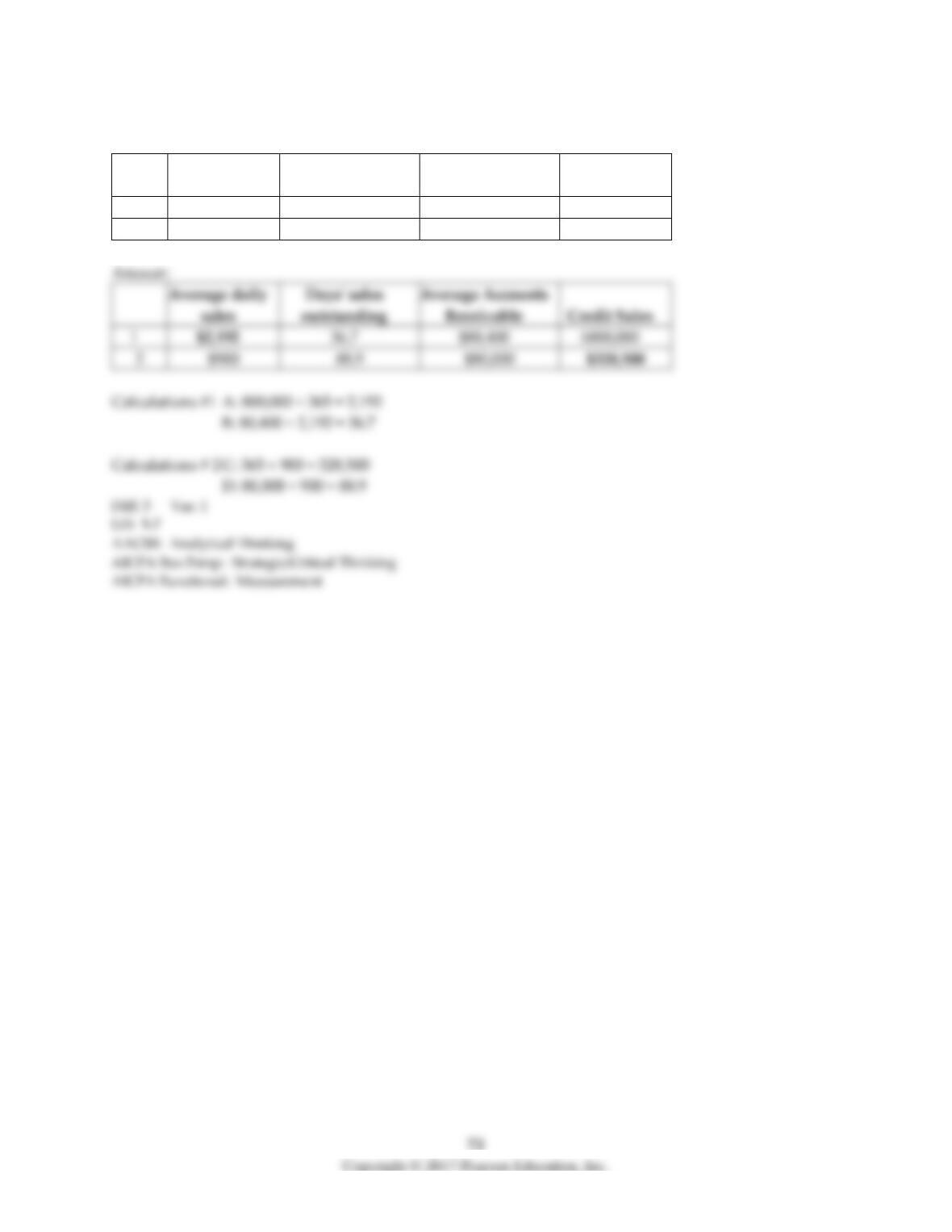
31) Complete the following chart by filling in the missing items. Use a 365-day year.
Average daily
sales
Days’ sales
outstanding
Average Accounts
Receivable
Credit Sales
1
A
B
$80,400
$800,000
2
$900
D
$80,000
C
Average daily
Days’ sales
Average Accounts
2
$900
$80,000
74
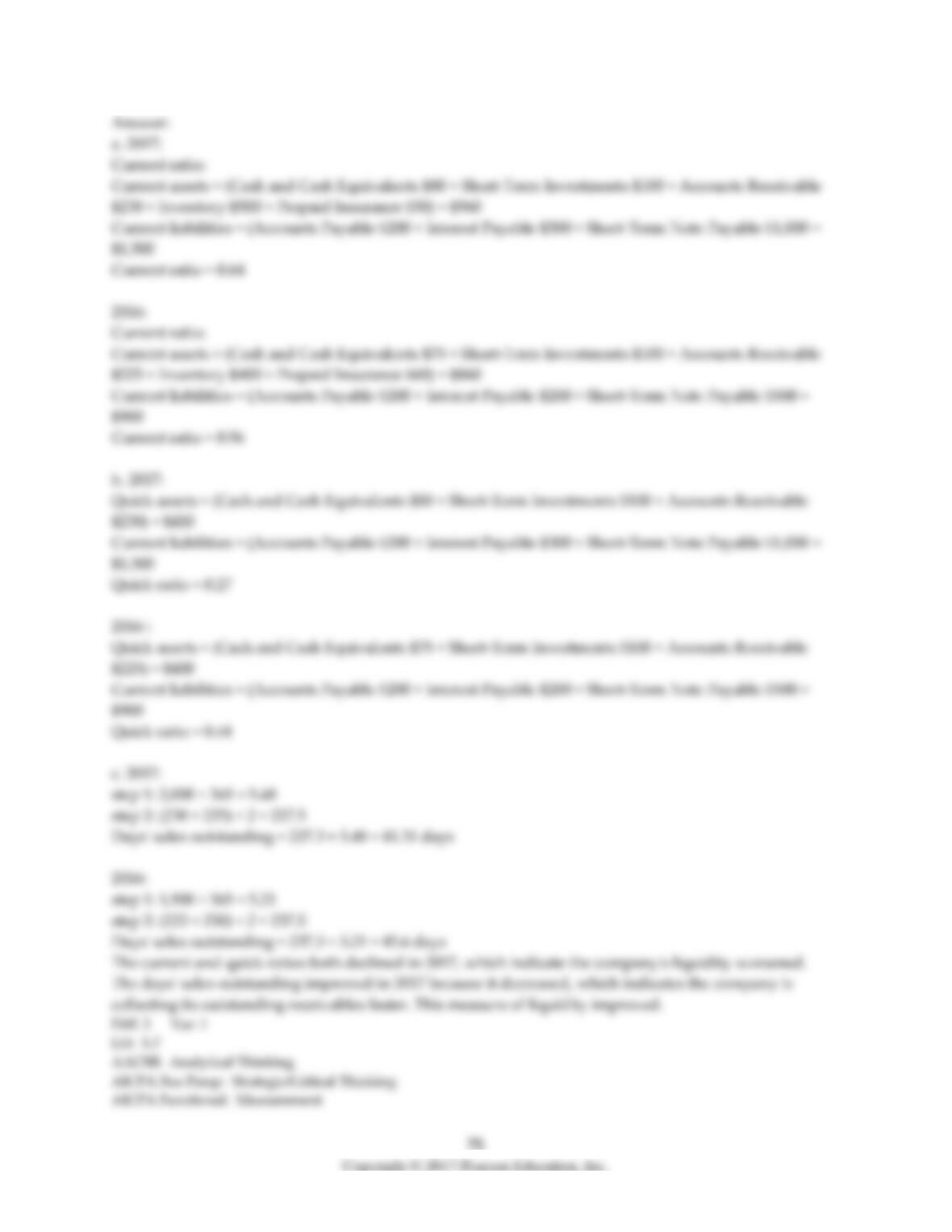
32) The comparative financial statements of Walters Company for 2017, 2016, and 2015 contain the
following selected data:
2017
2016
2015
Cash and Cash Equivalents
$80
$75
$60
Short-Term Investments
100
100
100
Accounts Receivable, net
230
225
250
Inventory
500
400
300
Prepaid Insurance
50
60
70
Accounts Payable
200
200
200
Interest Payable
300
200
100
Short-Term Note Payable
1,000
500
200
Long-Term Note Payable
1,000
500
100
Net Cash Sales
2,000
1,500
1,000
Net Credit Sales
2,000
1,900
1,800
Compute the following ratios for 2017 and 2016 and indicate which ratios improved and which ratios
deteriorated:
a. Current ratio
b. Quick ratio
c. Days’ sales outstanding
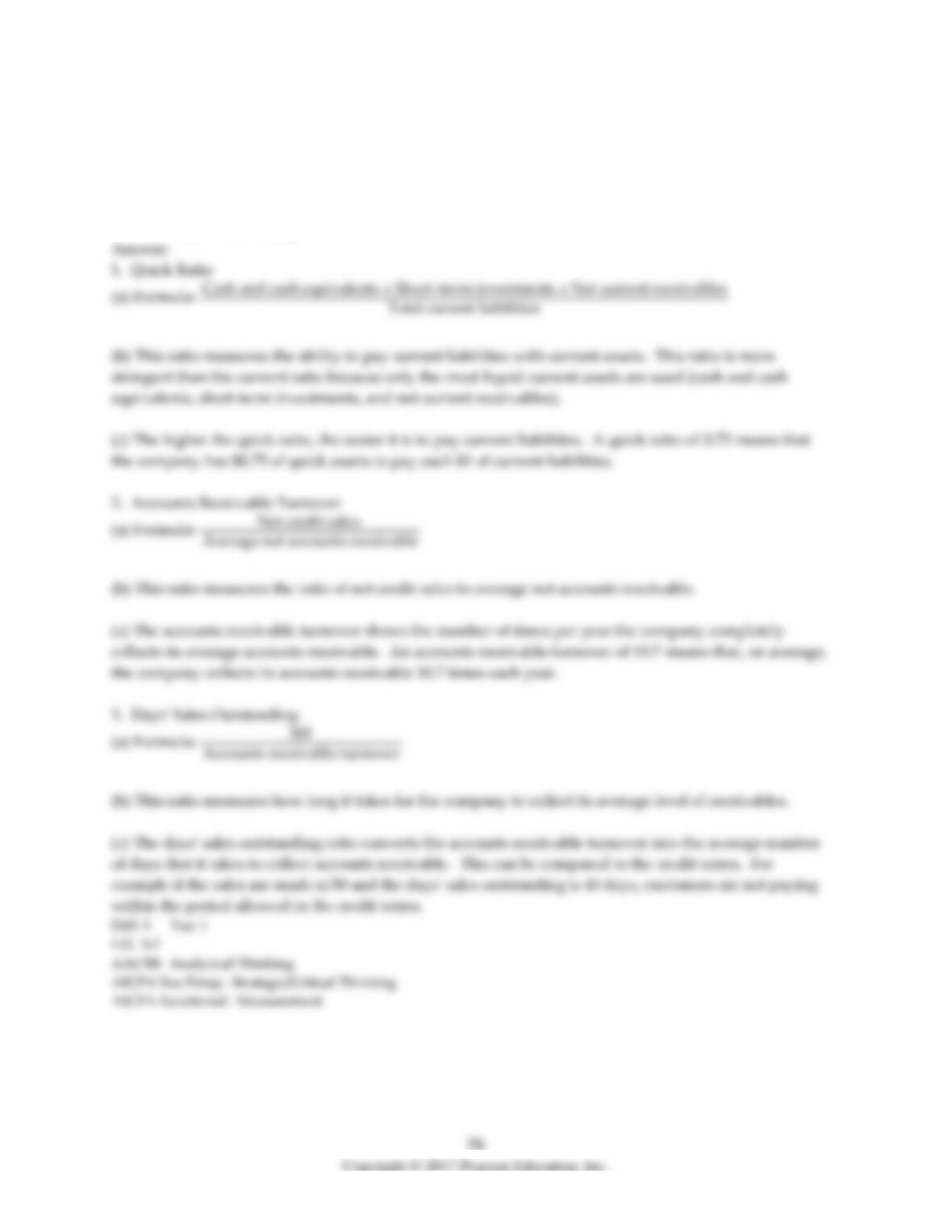
33) For each of the following ratios, (a) provide the formula for computing the ratio, (b) state what the
ratio measures and (c) discuss how the ratio is interpreted.
1. Quick Ratio
2. Accounts Receivable Turnover
3. Days’ Sales Outstanding