Chapter 5 – Activity-Based Costing and Management
101. Element Cellars produces wine in northern Oregon. Consider the following selected
costs that arose during the current year:
1. Safety costs at winery
2. Truckload shipping costs
3. Building maintenance costs
4. Bottle and cork cost
5. Development cost of new, after-dinner wine
6. Tasting and testing costs
Required:
A. Briefly distinguish between unit-level and product-sustaining activities.
B. Classify the six costs listed as arising from a unit-level, batch-level, product-sustaining, or
facility-level activity.
Solution:
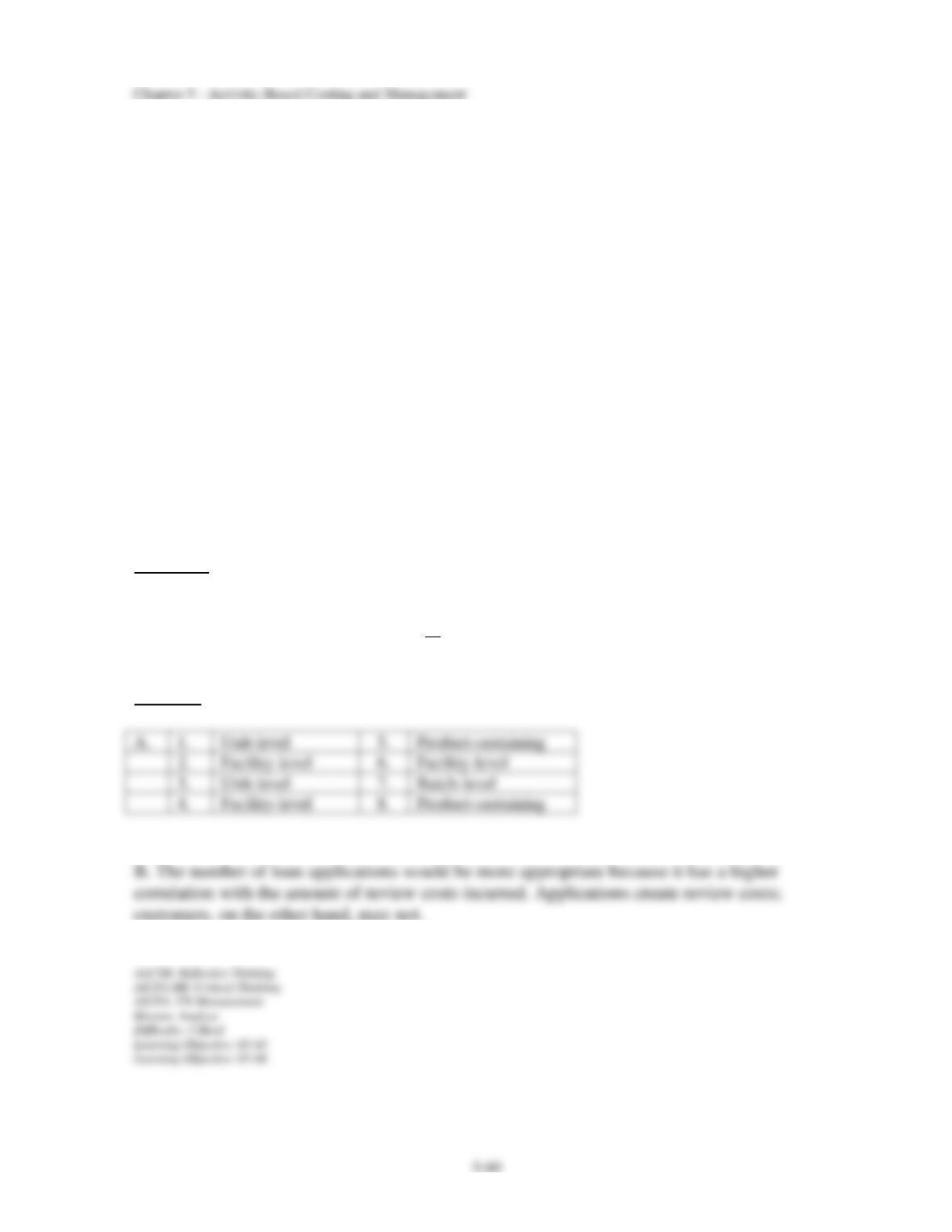
102. Consider the following costs that relate to a bank and a manufacturer of software:
Bank
1. Review costs of commercial loan applications
2. Operating costs of human resources department
3. Immediate processing costs of a specific customer’s cash deposit
4. Bank membership costs of joining local Chamber of Commerce
Software manufacturer
5. Label and packaging charges from a commercial printer for a new software release
6. Air conditioning/heating costs of the firm’s production plant
7. Transport costs of moving the finished products from production run no. 1 to the company’s
warehouse
8. Design and development costs of new spreadsheet software
Required:
A. Classify the eight costs listed as arising from either a unit-level, batch-level, product-
sustaining, or facility-level activity.
B. Would number of loan applications or number of customers be a more appropriate cost-
driver base for #1 above? Briefly explain.
Solution:
103. Washburn Corporation produces flat-screen computer monitors. Consider the following
selected costs that arose during the current year:
1. Direct materials used: $3,640,000
2. Plant rent, utilities, and taxes: $1,229,000
3. New technology design engineering: $2,040,000
4. Materials receiving: $318,000
5. Manufacturing-run/set-up charges: $115,000
6. Equipment depreciation: $92,000
7. General management salaries: $1,564,000
Required:
A. Briefly distinguish between batch-level and facility-level activities.
B. Determine the cost of the firm’s unit-level, batch-level, product-sustaining, and facility-
level activities.
Solution:
104. At a recent professional meeting, two controllers discussed product-costing problems in
their respective companies. Both controllers are familiar with ABC systems, but neither of
their firms utilizes such a system.
Controller D reported that part of the problem in his firm results from major differences
among product lines with respect to unit volume, utilization of activities, quality assurance
requirements established by customers, and product size. Controller M noted that in her
company, which manufactures consumer goods, all items undergo the same basic production
processes in the same sequence. Lately, however, there has been a significant increase in the
number of item colors.
Both controllers are worried about the potential distortion of product costs under their
traditional product-costing systems.
Required:
Which controller should be more concerned about the potential distortion? Explain.
Solution:
105. Define the term “cost driver” and discuss the factors that are important in the selection of
appropriate cost drivers.
Solution:
5-64
106. Marvel Bank & Trust operates in a very competitive marketplace, using a traditional
labor-hour-based system to determine the cost of processing its mortgage loans. Recently, the
firm explored a switch to activity-based costing to determine the wisdom of its previous ways.
The following information is available:
Activity
Cost
Drive
Driver Units
Application processing
$900,000
Applications
4,000
Loan underwriting
800,000
Underwriting hours
16,000
Loan closure
880,000
Legal hours
8,000
Total
$2,580,000
Two loan applications, among many others, were originated and closed during the year. No.
7439 consumed 3.5 hours in loan underwriting and 1.5 hours in loan closure, for a total of 5.0
hours. No. 7809 also required 5.0 hours of time, subdivided as follows: 2.0 hours in loan
underwriting and 3.0 hours in loan closure.
Required:
A. Use an activity-based-costing system and determine the cost of processing, underwriting,
and closing the two loan applications.
B. Determine the cost of processing the two loans if Marvel uses the traditional labor-hour-
based system. Conversations with management found that, on average, each application took
nine labor hours of processing time, excluding underwriting and closure.
C. Is Marvel making a mistake by continuing to use a traditional system that is based on an
average labor cost per hour? Why?
107. Consider the nine activities that follow.
1. A software company: Developing computer coding for a new spreadsheet package.
2. A breakfast cereal company: Painting the office of a maintenance supervisor at a plant that
produces cereal.
3. A major metropolitan hospital: Examining a new patient.
4. A regional airline carrier: The 90 minutes that a Boeing 757 sits idle on the ground between
flights.
5. A retail office supply store: Moving cases of paper from one location to another in the same
warehouse.
6. A company that makes watches: Attaching a watch band to the watch’s face.
7. A shipping company: Reprocessing cargo that had been sorted incorrectly on a
malfunctioning sorting machine.
8. An investment company: Correcting errors made by company personnel in customer
accounts.
9. A major hotel chain: Upgrading the quality of bedding used at hotels in very competitive
marketplaces.
Required:
Categorize each of the activities as either value-added or non-value-added for the
companies noted.
Solution:
Chapter 5 – Activity-Based Costing and Management
Difficulty: 3 Hard
Learning Objective: 05-08
108. Trayton Enterprises, which manufactures lawn mowers, recently installed a just-in-time
purchasing system and an activity-based management program.
Required:
A. Determine whether the following items would be apt to increase or decrease as a result of
the just-in-time system:
1. Inventory storage costs.
2. Number of suppliers used.
3. Number of raw material shipments handled.
4. Dollars available for alternative investment opportunities.
5. Quality of raw materials purchased.
B. Identify the following items as value-added activities, non-value-added activities, or both.
1. Attaching the engine to the mower’s body.
2. Installing a new air-conditioning system in the executive offices.
3. Replacing a defective wheel with a new wheel.
4. Designing and printing an owner’s instruction manual for a new model.
5. Moving completed mowers to the finished-goods warehouse.
6. Attaching the handle to the mower’s body. The process took longer than normal because of
a worker slowdown caused by disgruntled employees.
Solution:
5-67
109. Sampler, Inc., which sells books to college bookstores and individuals, uses activity-
based costing and activity-based management. The following information is available for the
company’s three cost pools:
Activity
Cost Driver
Cost-Driver
Quantity
Percent of Cost-Driver
Activity for Bookstore
transactions
Percent of Cost-Driver
Activity for Transactions to
Individuals
Incoming
Receipts
Number of
Purchase orders
3,000
20%
80%
Warehousing
Number of
inventory moves
8,000
60
40
Outgoing
shipments
Number of
shipments
18,000
30
70
Bookstore sales totaled $8,400,000, and sales to individuals amounted to $2,400,000. Costs
for the three activities were: Incoming receipts, $450,000; warehousing, $520,000; and
outgoing shipments, $630,000. A review of the company’s activities found various
inefficiencies with respect to the warehousing of textbooks (acquired for eventual sale to
bookstores) and outgoing shipments to individuals. These inefficiencies resulted in an extra
500 moves and 400 shipments, respectively.
Required:
A. What is a non-value-added activity?
B. How much did non-value-added activities cost Sampler this past year?
C. Which of the two markets—sales to bookstores or sales to individuals—resulted in lower
overall costs for incoming receipts, warehousing, and outgoing shipments? Evaluate these
costs in both absolute dollars and as a percentage of sales. In addition, present a possible
explanation for your results. Note: Exclude costs that arose from inefficient operations.
5-69
110. Non-value-added costs occur in nonmanufacturing organizations as well as in
manufacturing firms.
Required:
A. Explain what is meant by a non-value-added cost.
B. Identify two potential non-value-added costs for each of the following service providers:
airlines, banks, and hotels.
Solution:
5-70
111. Anton’s Fresh Fish and Produce is a wholesale distributor that operates in central
Florida. An analysis of two of the company’s customers, Seaside Spa and Sigma Assisted
Living, reveals the data that follows the requirements for this problem for a recent 12-month
period.
Anton’s uses activity-based costing to determine the cost of servicing its customers. The
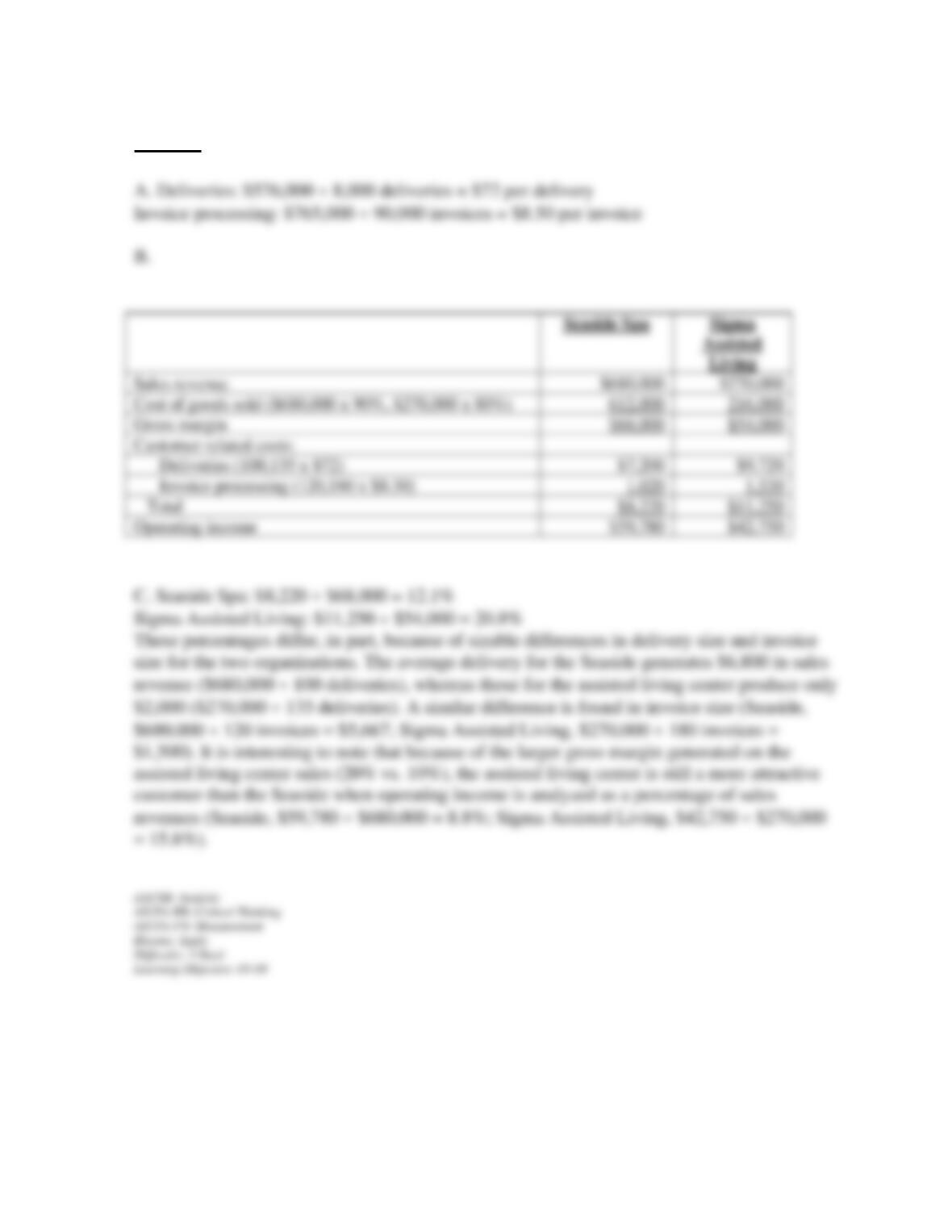
company had total delivery costs during the year of $576,000 and 8,000 deliveries, along with
cost of $765,000 for the administrative processing of 90,000 invoices.
Required:
A. Compute the pool rates for deliveries and invoice processing.
B. Compute the operating income that Anton’s earned from these two customers.
C. Compute the total of customer-related costs (deliveries and invoice processing) for each
customer as a percentage of gross margin, and analyze the results for management. Explain
any significant differences that you find.
Seaside Spa
Sigma
Sales revenue
$680,000
$270,000
Cost of goods sold
90% of sales
80% of sales
Number of Deliveries
100
135
Number of Invoices
120
180
Chapter 5 – Activity-Based Costing and Management
5-71
Solution:
5-72
112. Tennair Corporation manufactures cooling system components. The company has
gathered the following information about two of its customers: Evans Equipment and Rogers
Refrigeration.
Evans
Equipment
Rogers
Refrigeration
Sales revenue
$215,000
$154,000
Cost of goods sold
95,000
68,000
General selling costs
30,000
21,500
General administrative costs
21,000
15,050
Cost-driver data used by the firm and traceable to Evans and Rogers are:
Customer Activity
Cost Driver
Pool Rate
Sales activity
Sales visits
$900
Order taking
Sales orders
250
Special handling
Units handled
30
Special shipping
Shipments
600
Customer Activity
Evans Equipment
Rogers Refrigeration
Sales activity
8 visits
5 visits
Order taking
17 orders
22 orders
Special handling
600 units
550 units
Special shipping
19 shipments
30 shipments
Required:
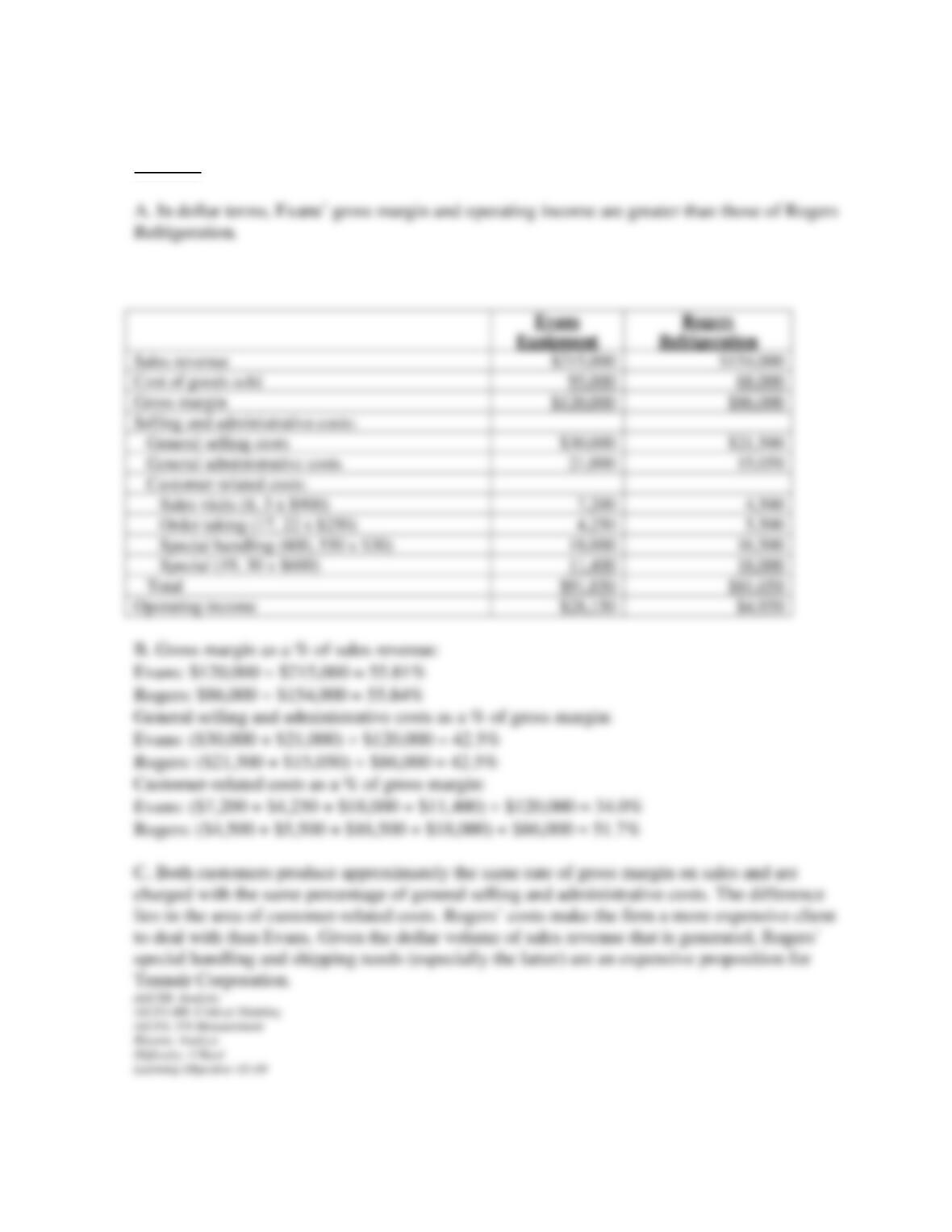
A. Perform a customer profitability analysis for Tennair. Compute the
gross margin and operating income on transactions related to Evans
Equipment and Rogers Refrigeration.
B. Compute gross margin as a percentage of sales revenue. Then compute
(1) general selling and administrative costs as a percentage of gross
margin and (2) total customer-related costs (i.e., costs that arise from sales
visits, order taking, and special handling and shipping) as a percentage of
gross margin.
C. On the basis of your calculations, which of the two customers is “more
costly” to deal with? Briefly explain.
Chapter 5 – Activity-Based Costing and Management
5-73
Solution:
5-74
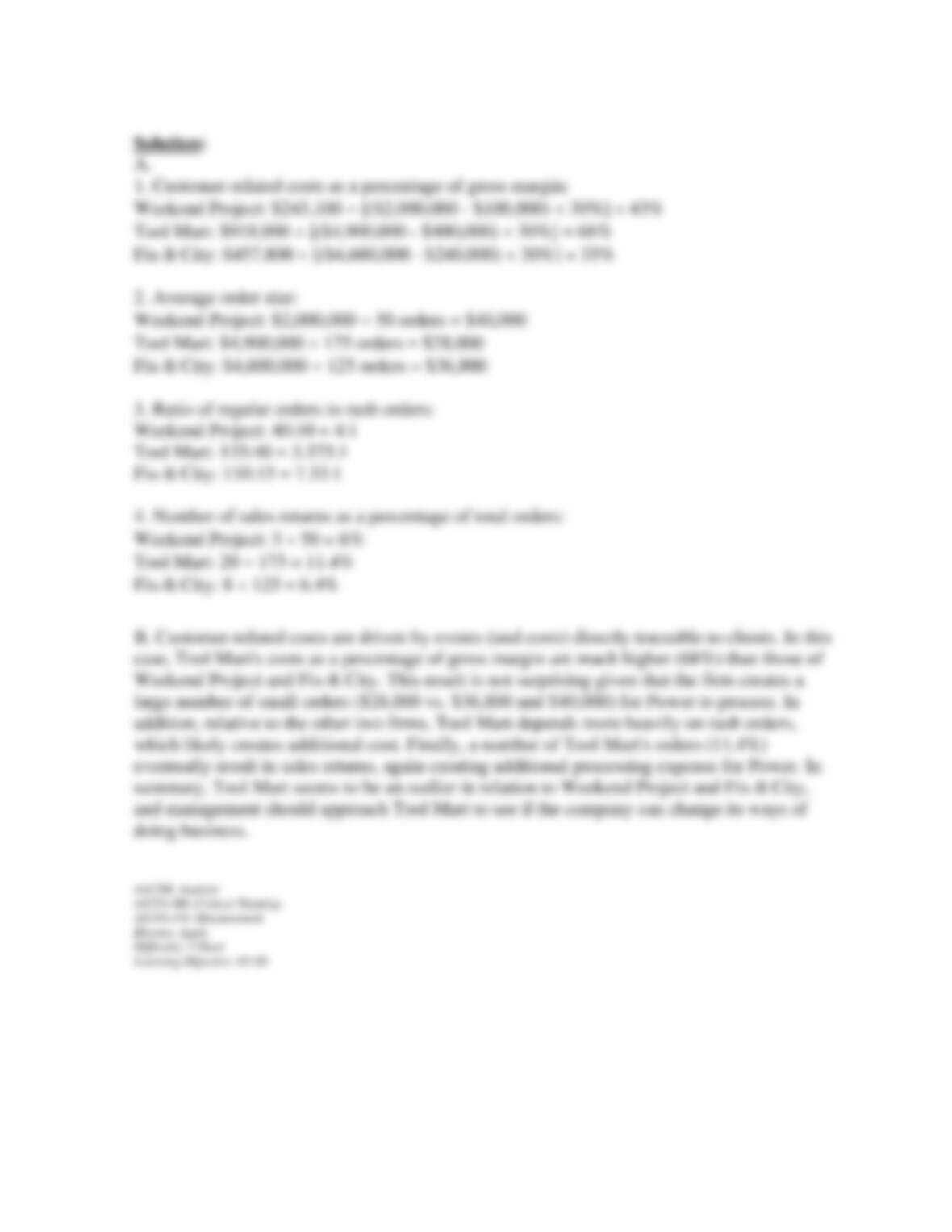
113. Power Corporation sells a line of power tools to home improvement chains, generating a
cost of goods sold equal to 70% of net sales. The selected data that follow relate to the period
just ended for the company’s three largest customers: Weekend Project, Tool Mart, and Fix-It
City.
Power’s management recently attended a seminar and learned that customers with excessive
requests and demands can have a significant, negative impact on corporate profitability
Required:
A. For each of the three chains, compute:
1. Total customer-related costs as a percentage of gross margin.
2. The average order size (ignoring sales returns).
3. The ratio of regular orders to rush orders.
4. The number of sales returns as a percentage of the number of total orders.
B. Prepare a brief summary of your findings. Should Power work with any of the chains in an
effort to improve results? Explain.
Weekend Project
Tool Mart
Fix-It City
Gross sales volume:
Dollars
$2,000,000
$4,900,000
$4,600,000
Number of Orders
50
175
125
Type of order:
Regular
40
135
110
Rush
10
40
15
Sales returns:
Dollars
$100,000
$400,000
$240,000
Number of returns
3
20
8
Total customer-related costs
$245,100
$918,000
$457,800
Chapter 5 – Activity-Based Costing and Management
5-75
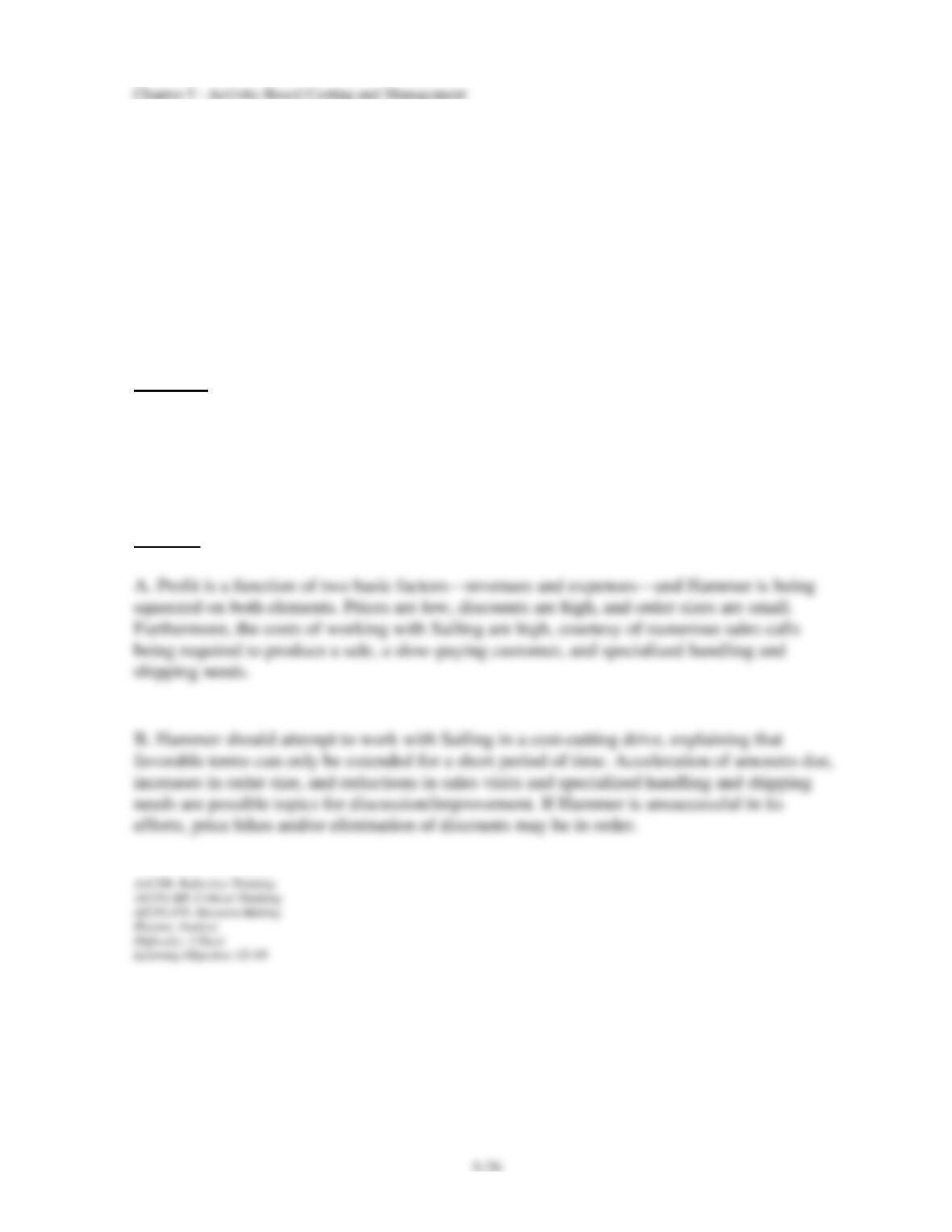
114. Sailing Manufacturing is a relatively new customer of Hammer Enterprises. In the short
period that the two companies have done business with each other, Hammer has found Sailing
to be, in management’s words, “an expensive proposition.” Numerous sales visits are typically
required to “close a deal,” with selling prices and discounts offered being among the most
attractive in the industry. Complicating matters, Sailing is slow to settle its account, orders in
small quantities, and often has numerous specialized shipping and handling needs.
A recent customer profitability analysis has painted a very negative picture of Sailing
Manufacturing, and Hammer’s managers are questioning whether an on-going relationship
with the firm is warranted.
Required:
A. Briefly explain why the customer profitability analysis painted a negative picture of
Sailing Manufacturing.
B. What actions are available to Hammer Enterprises to improve Sailing’s profitability?
Solution: