Chapter 05 – Communicating and Interpreting Accounting Information
Chapter 05 – Communicating and Interpreting Accounting Information
5-55
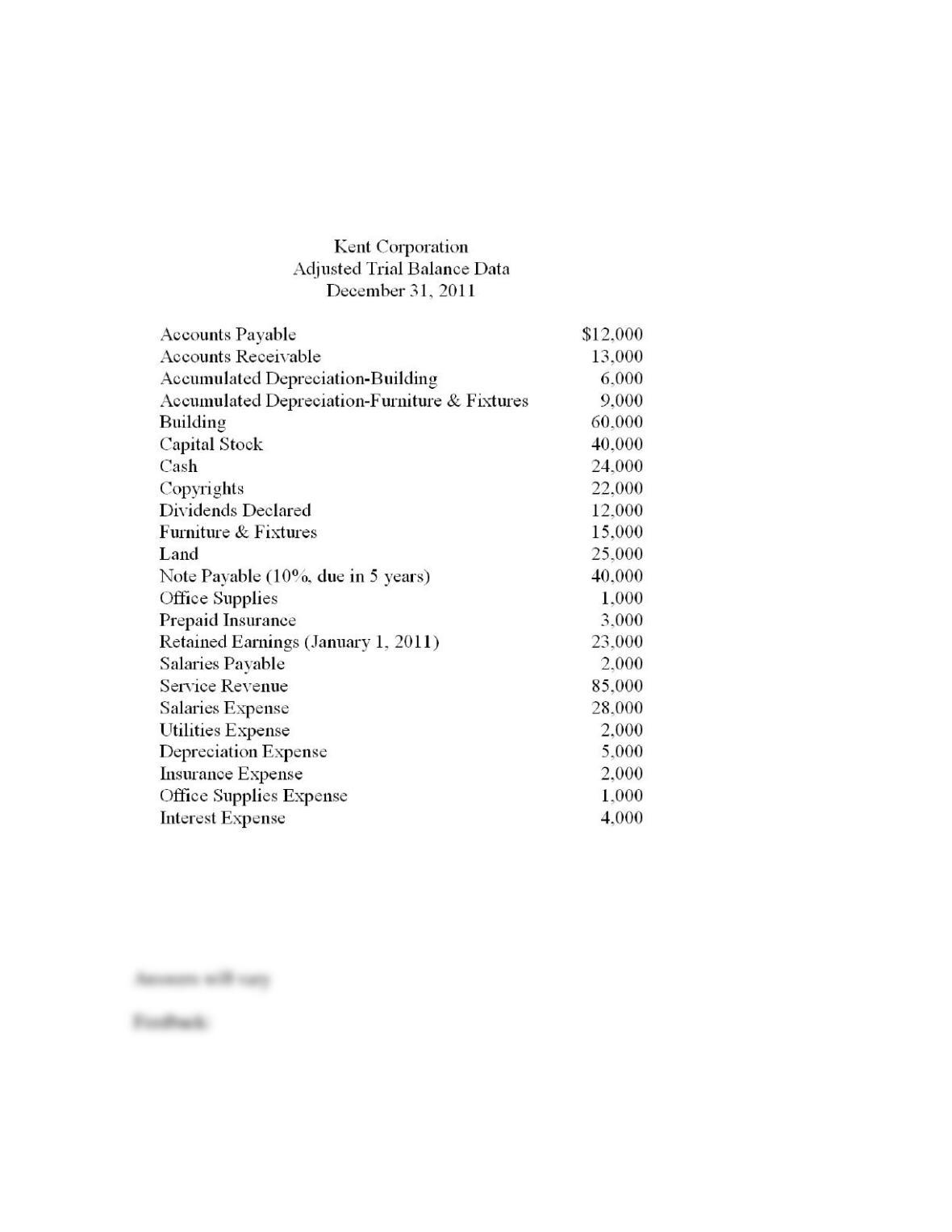
100. The following data were taken from the adjusted trial balance of Kent Corporation.
Required:
Prepare a classified balance sheet in good form at December 31, 2011. (Ignore income taxes).
Chapter 05 – Communicating and Interpreting Accounting Information
5-56
Chapter 05 – Communicating and Interpreting Accounting Information
101. At the beginning of 2011, Jeffrey Company disposed of a segment of its business and
incurred a pretax loss of $40,000 on the disposal. In the same year, a flood caused $15,000 of
damages to the building. The flood damage qualified as an extraordinary item. Income from
continuing operations before taxes was $100,000 for 2011 and a 20% tax rate applied to all of
the items above. Prepare a partial income statement starting with income from continuing
operations before taxes for the year ending 2011 and concluding with net income.
Chapter 05 – Communicating and Interpreting Accounting Information
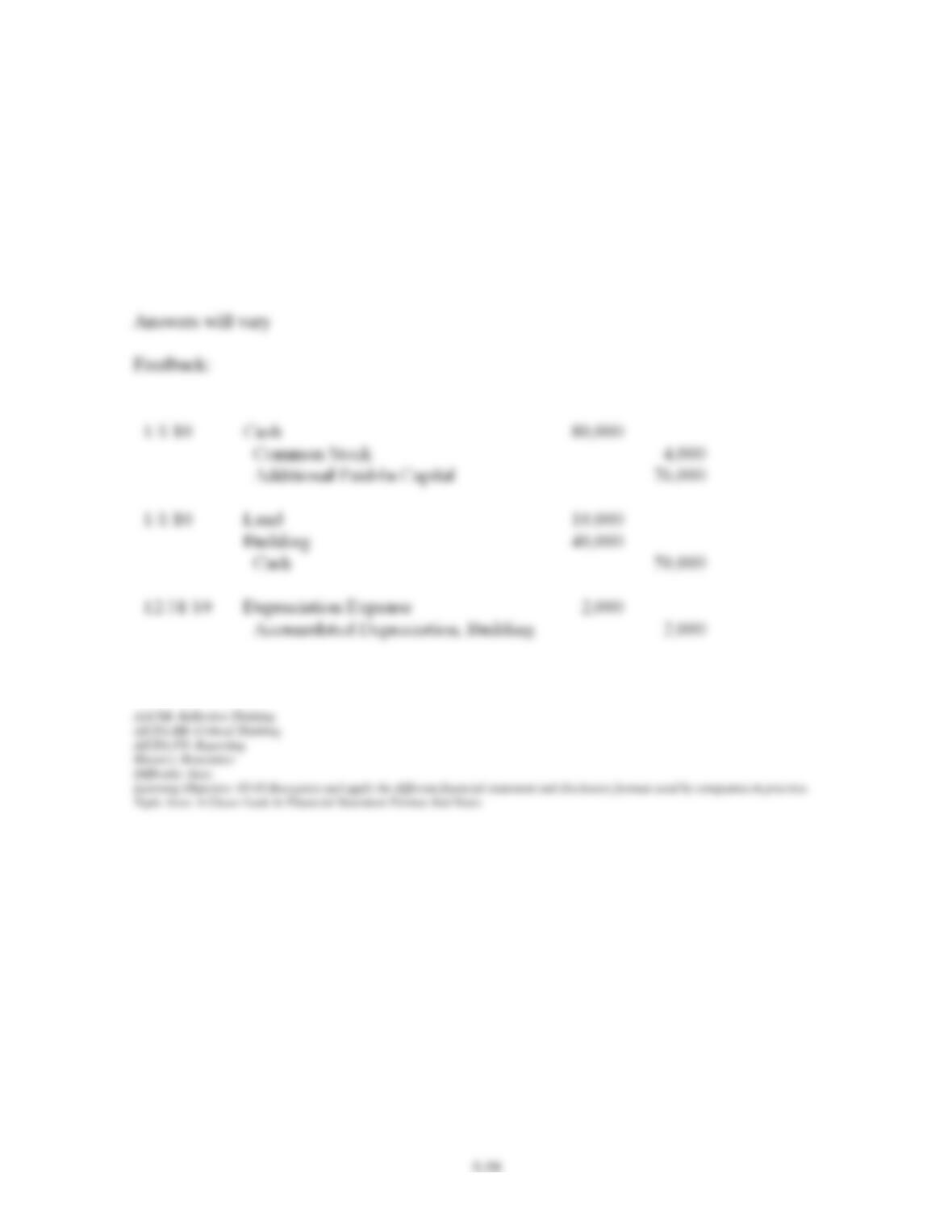
102. Dakota Equipment, Inc issued 4,000 shares of its $1 par value common stock for $20 per
share on January 1, 2011. On the same day, the company purchased a piece of land costing
$10,000 and a building costing $40,000. The yearly depreciation on the building is $2,000.
Required: Prepare the general journal entries to record the stock issue and the purchase of the
land and building on January 1 and the depreciation expense on December 31, 2011
(assuming that no adjusting entries were made during the year).
Chapter 05 – Communicating and Interpreting Accounting Information
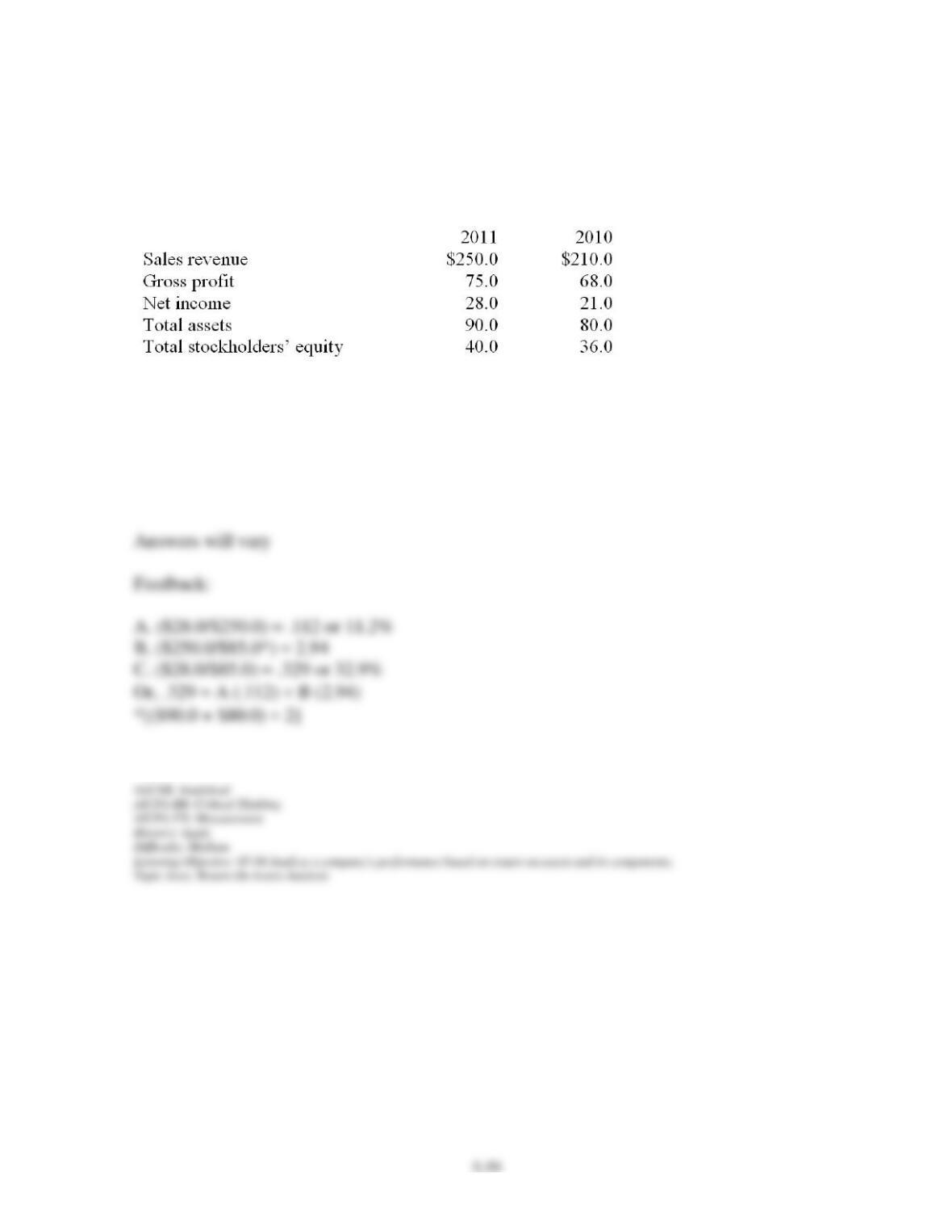
103. Twin Lakes, Inc. reported the following December 31 amounts in its financial
statements:
Compute the following for the 2011:
A. Net profit margin
B. Asset turnover
C. Return on assets
Chapter 05 – Communicating and Interpreting Accounting Information
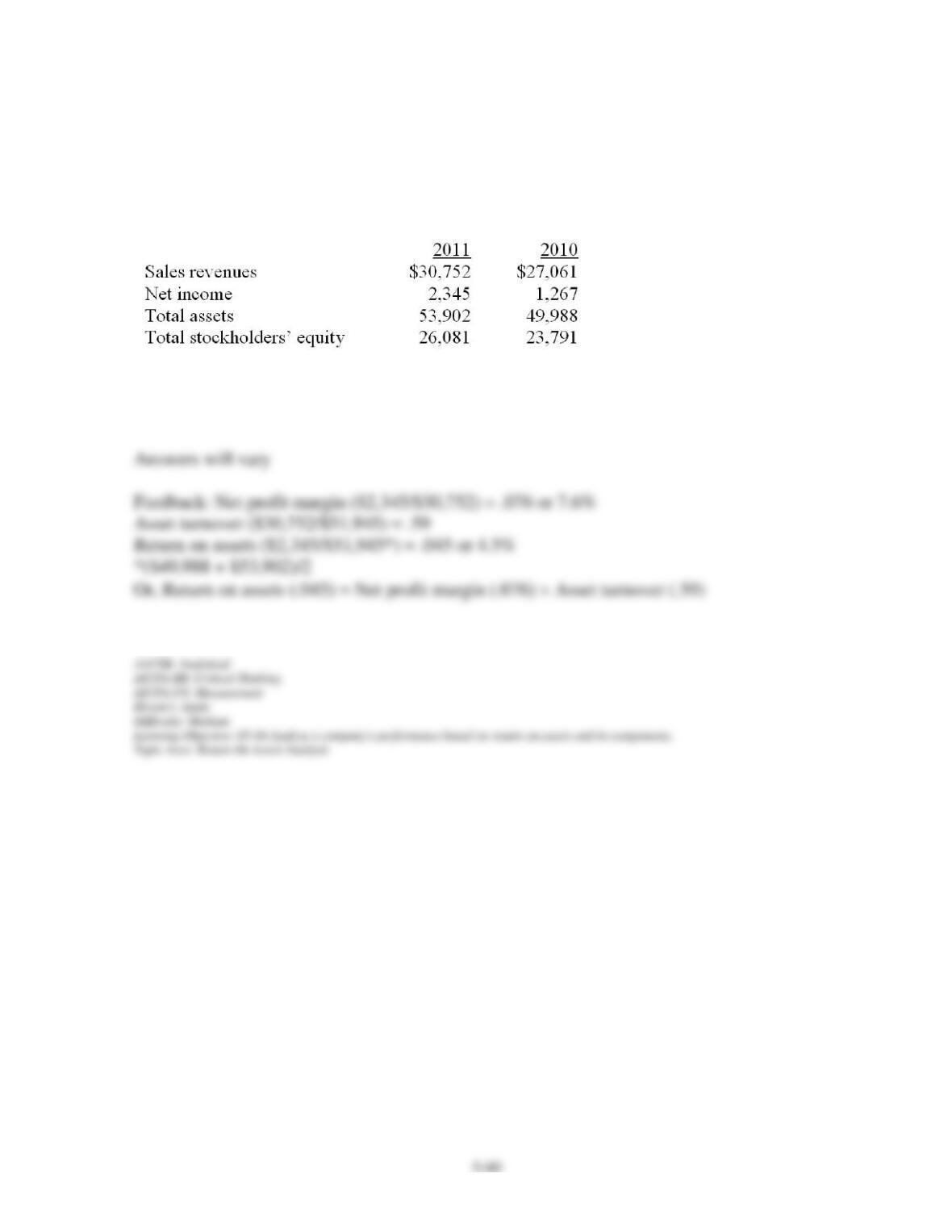
104. The following information was taken from the income statement and balance sheet of
The Mickey Company for the years 2010 and 2011:
Compute the following ratios for 2011: Net profit margin, Asset turnover, and Return on
assets.
Chapter 05 – Communicating and Interpreting Accounting Information
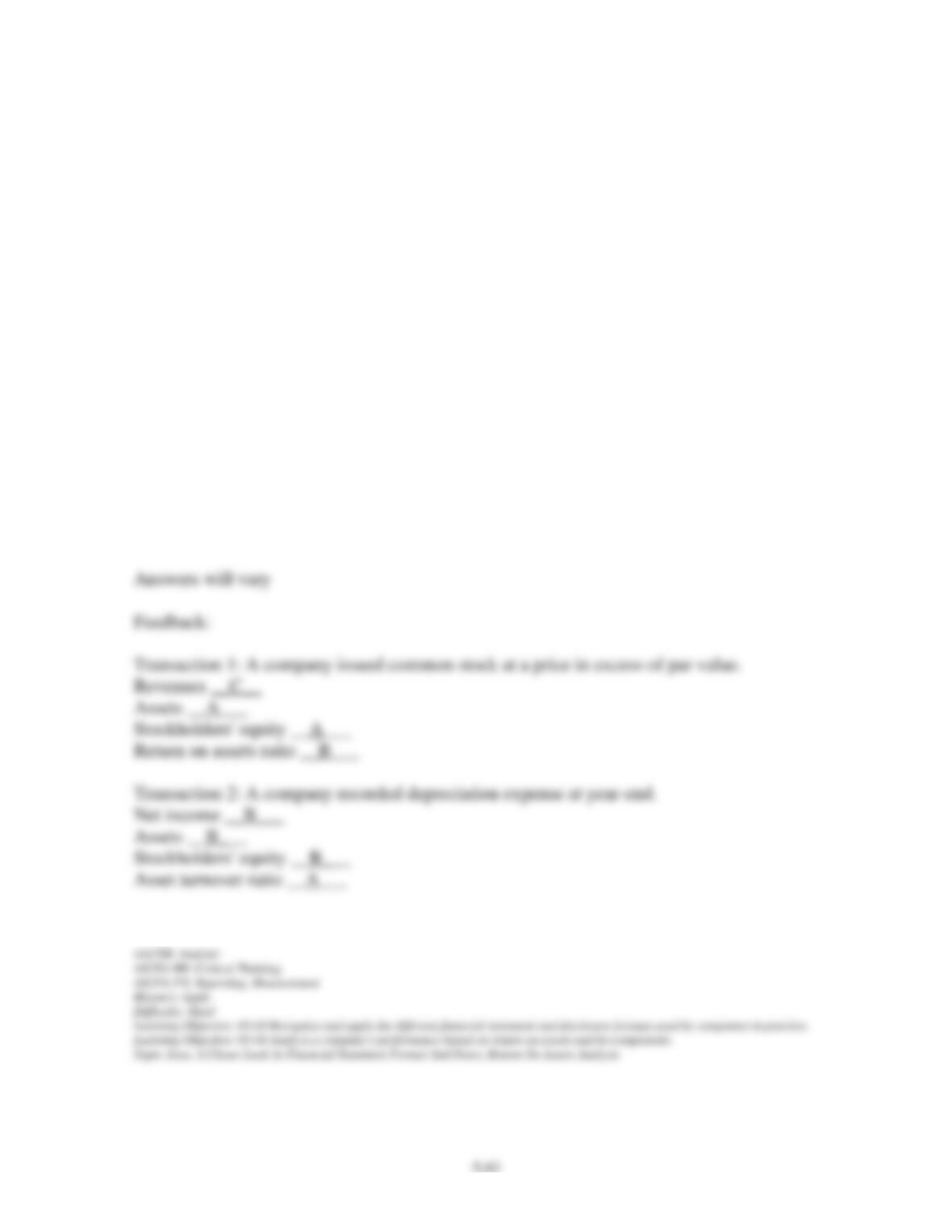
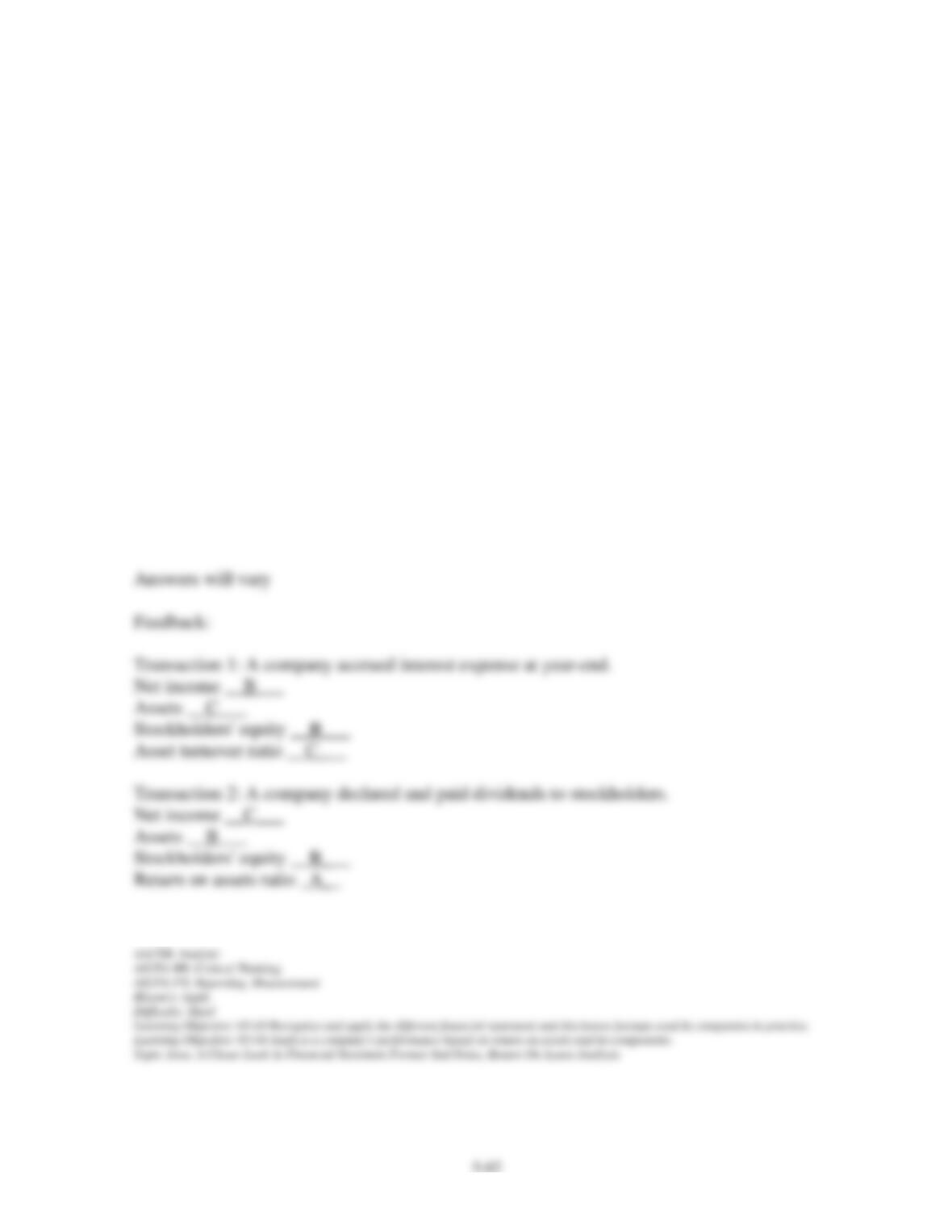
105. Determine the effect of the following transactions on the identified financial statement
components and ratios. Code your answers as follows:
A: If the transaction results in an increase in the financial statement component or ratio.
B: If the transaction results in a decrease in the financial statement component or ratio.
C. If the transaction does not affect the financial statement component or ratio.
Transaction 1: A company issued common stock at a price in excess of par value.
Revenues_____
Assets_____
Stockholders’ equity_____
Return on assets ratio_____
Transaction 2: A company recorded depreciation expense at year-end.
Net income_____
Assets_____
Stockholders’ equity_____
Asset turnover ratio_____
Chapter 05 – Communicating and Interpreting Accounting Information
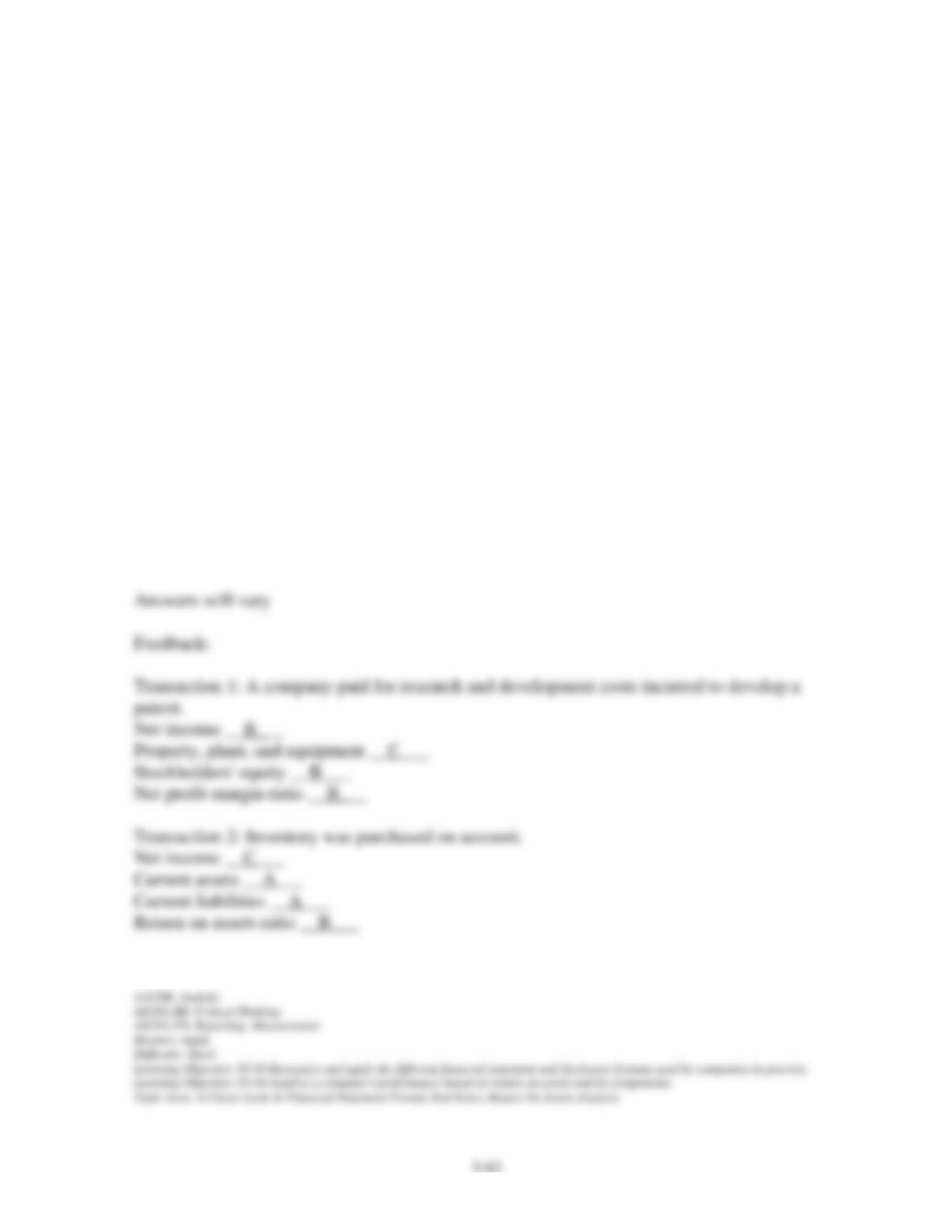
106. Determine the effect of the following transactions on the identified financial statement
components and ratios. Code your answers as follows:
A: If the transaction results in an increase in the financial statement component or ratio.
B: If the transaction results in a decrease in the financial statement component or ratio.
C. If the transaction does not affect the financial statement component or ratio.
Transaction 1: A company accrued interest expense at year-end.
Net income_____
Assets_____
Stockholders’ equity_____
Asset turnover ratio_____
Transaction 2: A company declared and paid dividends to stockholders.
Net income_____
Assets_____
Stockholders’ equity_____
Return on assets ratio_____
Chapter 05 – Communicating and Interpreting Accounting Information
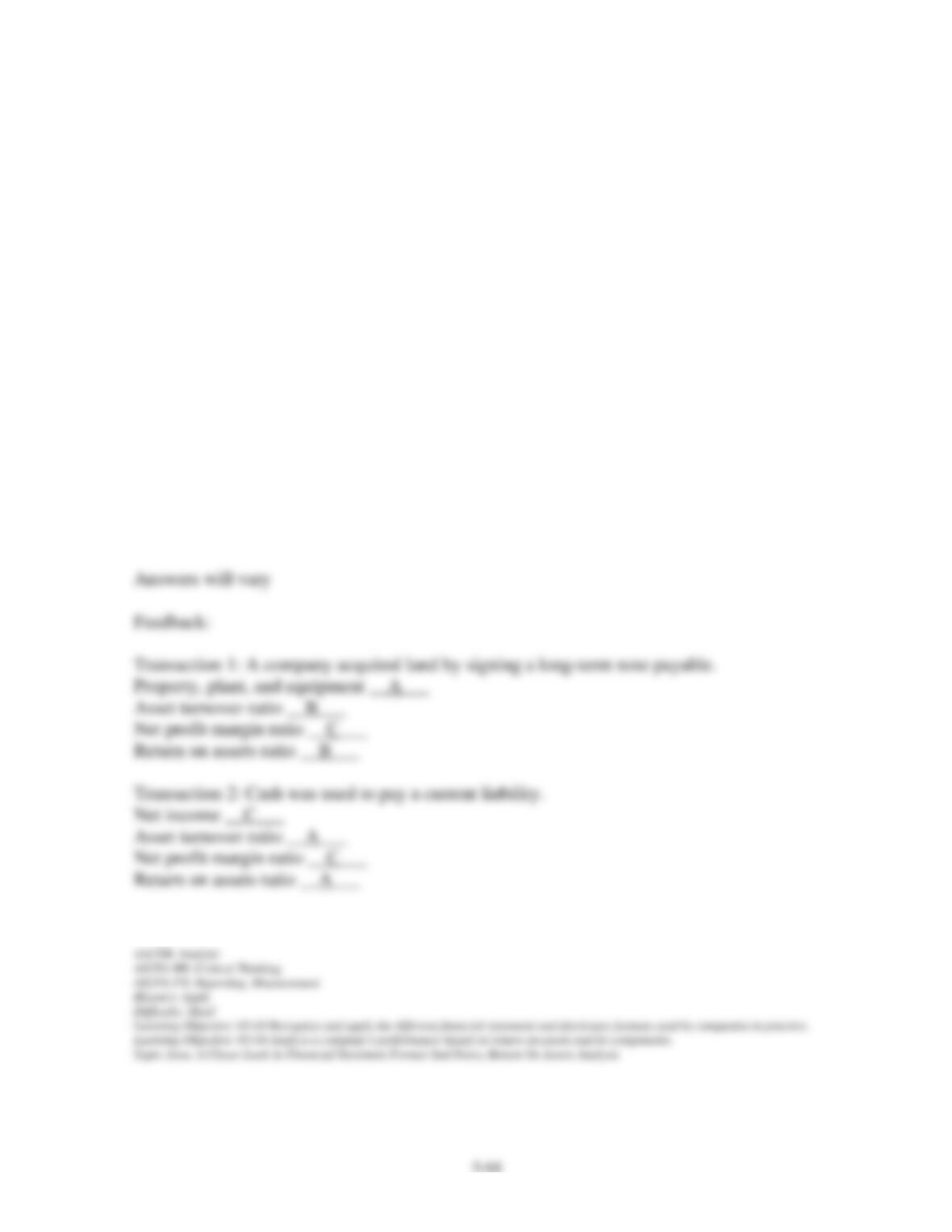
107. Determine the effect of the following transactions on the identified financial statement
components and ratios. Code your answers as follows:
A: If the transaction results in an increase in the financial statement component or ratio.
B: If the transaction results in a decrease in the financial statement component or ratio.
C. If the transaction does not affect the financial statement component or ratio.
Transaction 1: A company paid for research and development costs incurred to develop a
patent.
Net income_____
Property, plant, and equipment_____
Stockholders’ equity_____
Net profit margin ratio_____
Transaction 2: Inventory was purchased on account.
Net income_____
Current assets_____
Current liabilities_____
Return on assets ratio_____
Chapter 05 – Communicating and Interpreting Accounting Information
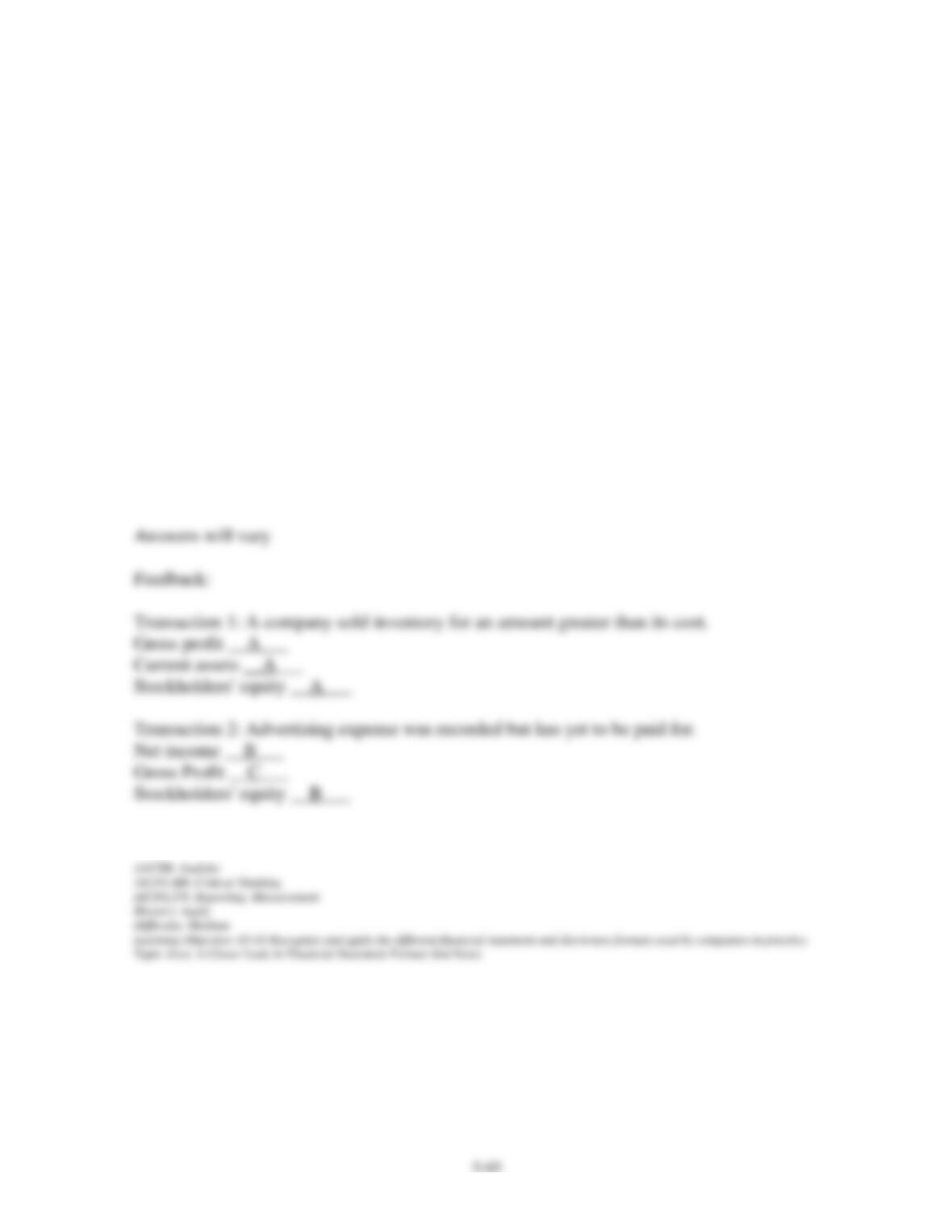
108. Determine the effect of the following transactions on the identified financial statement
components and ratios. Code your answers as follows:
A: If the transaction results in an increase in the financial statement component or ratio.
B: If the transaction results in a decrease in the financial statement component or ratio.
C. If the transaction does not affect the financial statement component or ratio.
Transaction 1: A company acquired land by signing a long-term note payable.
Property, plant, and equipment_____
Asset turnover ratio_____
Net profit margin ratio_____
Return on assets ratio_____
Transaction 2: Cash was used to pay a current liability.
Net income_____
Asset turnover ratio_____
Net profit margin ratio_____
Return on assets ratio_____
Chapter 05 – Communicating and Interpreting Accounting Information
109. Determine the effect of the following transactions on the financial statements
components identified. Code your answers as follows:
A: If the transaction results in an increase in the financial statement component or ratio.
B: If the transaction results in a decrease in the financial statement component or ratio.
C. If the transaction does not affect the financial statement component or ratio.
Transaction 1: A company sold inventory for an amount greater than its cost.
Gross profit_____
Current assets_____
Stockholders’ equity_____
Transaction 2: Advertising expense was recorded but has yet to be paid for.
Net income_____
Gross Profit_____
Stockholders’ equity_____
Chapter 05 – Communicating and Interpreting Accounting Information
110. Describe relevance and reliability as they pertain to financial reporting.
111. Describe the return on assets ratio and the DuPont approach for calculating return on
assets.