8) Which of the following is subtracted from Net sales revenue to arrive at Gross profit?
A) Cost of goods available for sale
B) Cost of goods sold
C) Sales discounts and Sales returns and allowances
D) Operating expenses
9) Which of the following is subtracted from Gross profit to arrive at Operating income?
A) Cost of goods available for sale
B) Cost of goods sold
C) Sales discounts and Sales returns and allowances
D) Operating expenses
10) Where do Inventory and Cost of goods sold appear?
A) On the balance sheet and statement of owner’s equity, respectively
B) On the statement of owner’s equity and income statement, respectively
C) On the balance sheet and income statement, respectively
D) On the income statement and statement of cash flows, respectively
11) Which of the following is subtracted from Sales revenue to arrive at Net sales revenue?
A) Cost of goods available for sale
B) Cost of goods sold
C) Sales discounts and Sales returns and allowances
D) Operating expenses
12) In a multi-step income statement, Operating expenses are subtracted from Gross profit to compute:
A) Net loss.
B) Other income.
C) Net income.
D) Operating income.
13) On a merchandising balance sheet, Merchandise inventory is listed as a(n):
A) current asset.
B) current liability.
C) expense.
D) revenue.
14) Which of the following is NOT shown on a single-step income statement?
A) Gross profit
B) Net sales revenue
C) Cost of goods sold
D) Sales discounts
15) Please refer to the following trial balance.
Debit
Credit
Cash
$5,000
Accounts receivable
14,000
Inventory
20,000
Supplies
5,000
Land
100,000
Accounts payable
$3,000
Notes payable
25,000
Capital
90,000
Drawing
1,000
Sales revenues
160,000
Sales returns and allowances
2,000
Sales discounts
3,000
Cost of goods sold
80,000
Salary expense
5,000
Utility expense
23,000
Rent expense
18,000
Interest expense
2,000
Totals
$278,000
$278,000
How much are Net sales revenues?
A) $155,000
B) $160,000
C) $27,000
D) $75,000
16) Please refer to the following trial balance.
Debit
Credit
Cash
$5,000
Accounts receivable
14,000
Inventory
20,000
Supplies
5,000
Land
100,000
Accounts payable
$3,000
Notes payable
25,000
Capital
90,000
Drawing
1,000
Sales revenues
160,000
Sales returns and allowances
2,000
Sales discounts
3,000
Cost of goods sold
80,000
Salary expense
5,000
Utility expense
23,000
Rent expense
18,000
Interest expense
2,000
Totals
$278,000
$278,000
How much is the Gross profit percentage?
A) 50.0%
B) 51.6%
C) 46.8%
D) 48.4%
17) In a multi-step income statement, which of the following items are NOT included in Operating income?
A) Net sales
B) Interest expense
C) Selling expenses
D) General expenses
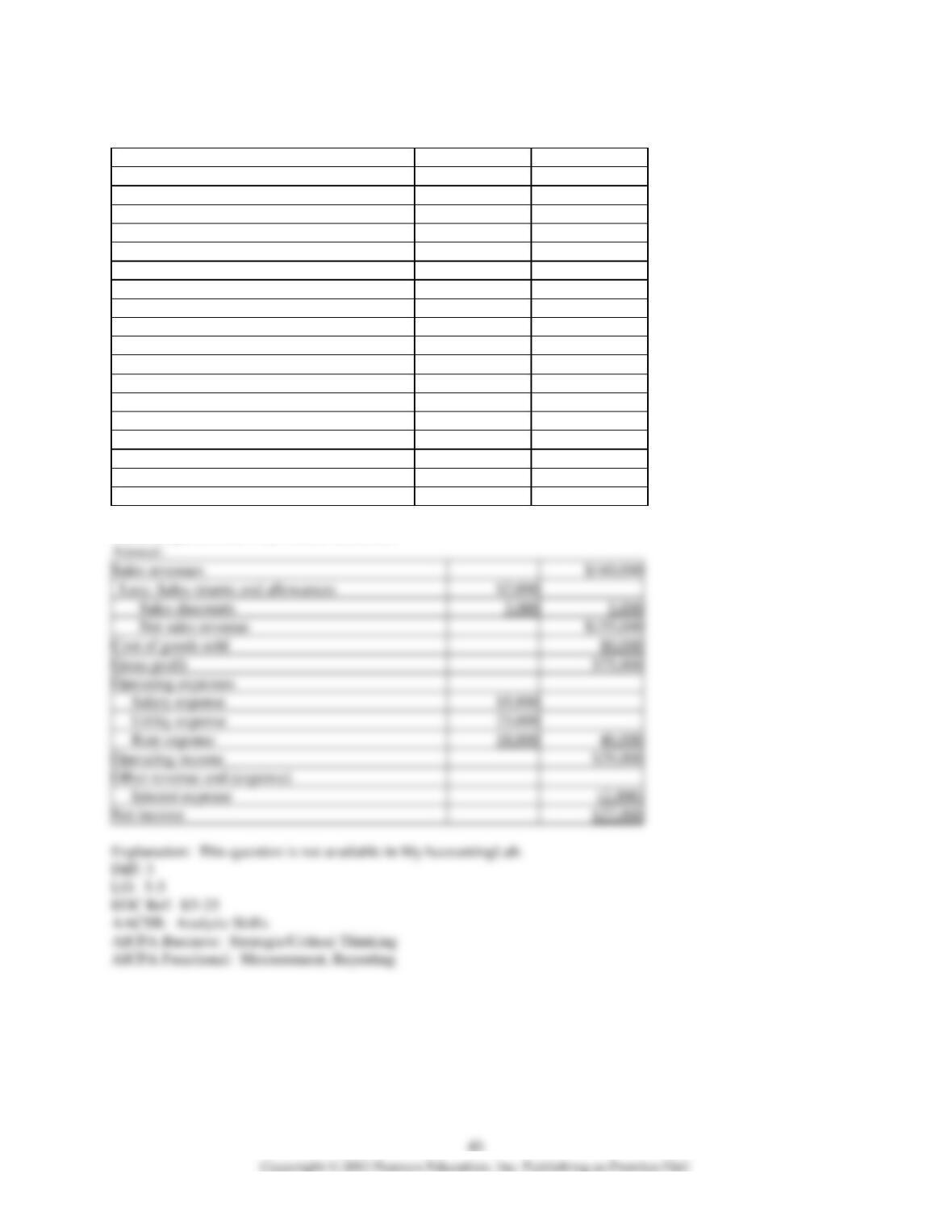
18) Please refer to the following trial balance.
Debit
Credit
Cash
$5,000
Accounts receivable
14,000
Inventory
20,000
Supplies
5,000
Land
100,000
Accounts payable
$3,000
Notes payable
25,000
Capital
90,000
Drawing
1,000
Sales revenues
160,000
Sales returns and allowances
2,000
Sales discounts
3,000
Cost of goods sold
80,000
Salary expense
5,000
Utility expense
23,000
Rent expense
18,000
Interest expense
2,000
Totals
$278,000
$278,000
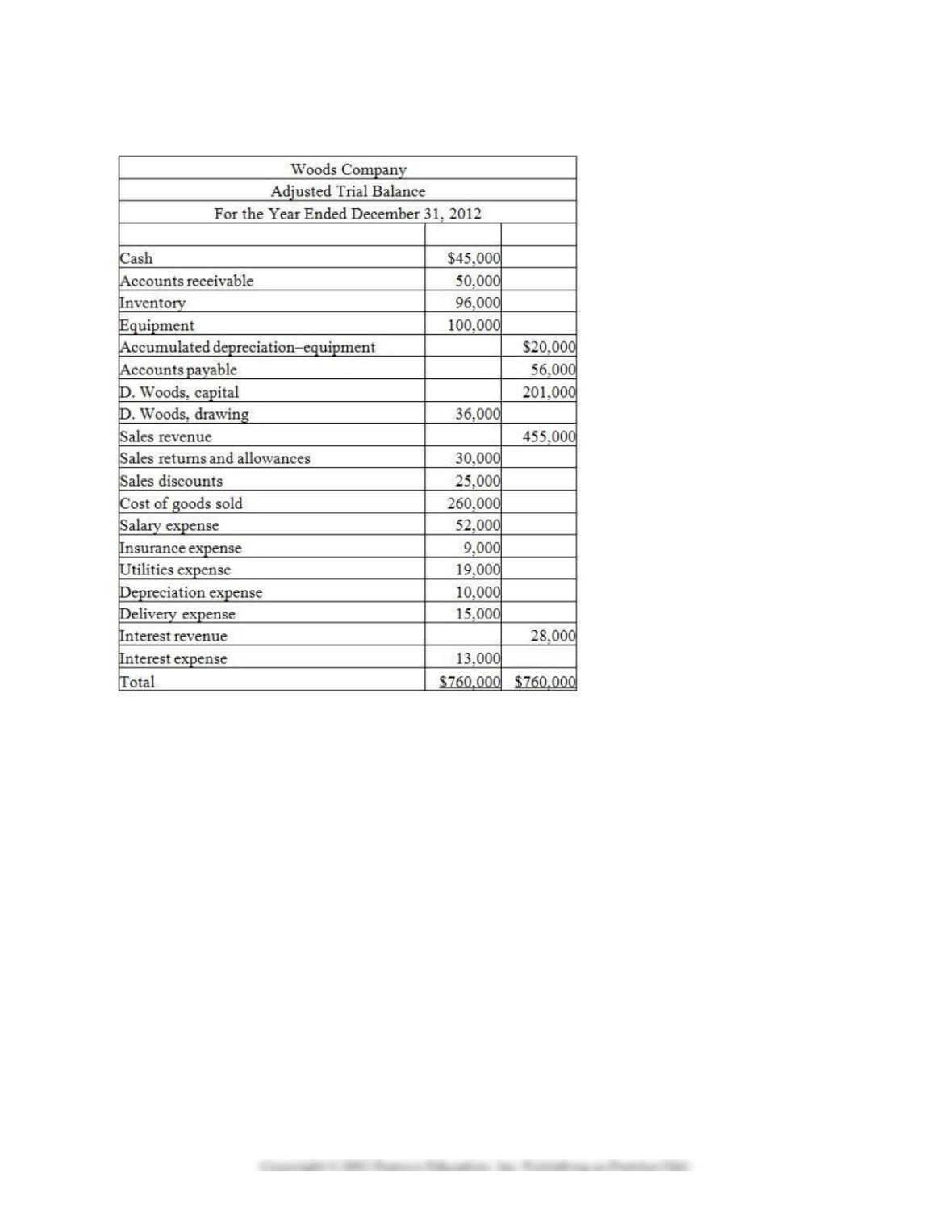
Please prepare a multi-step income statement:
Sales revenues
Gross profit
Operating expenses
Operating income
Other revenue and (expense)
Net income
46
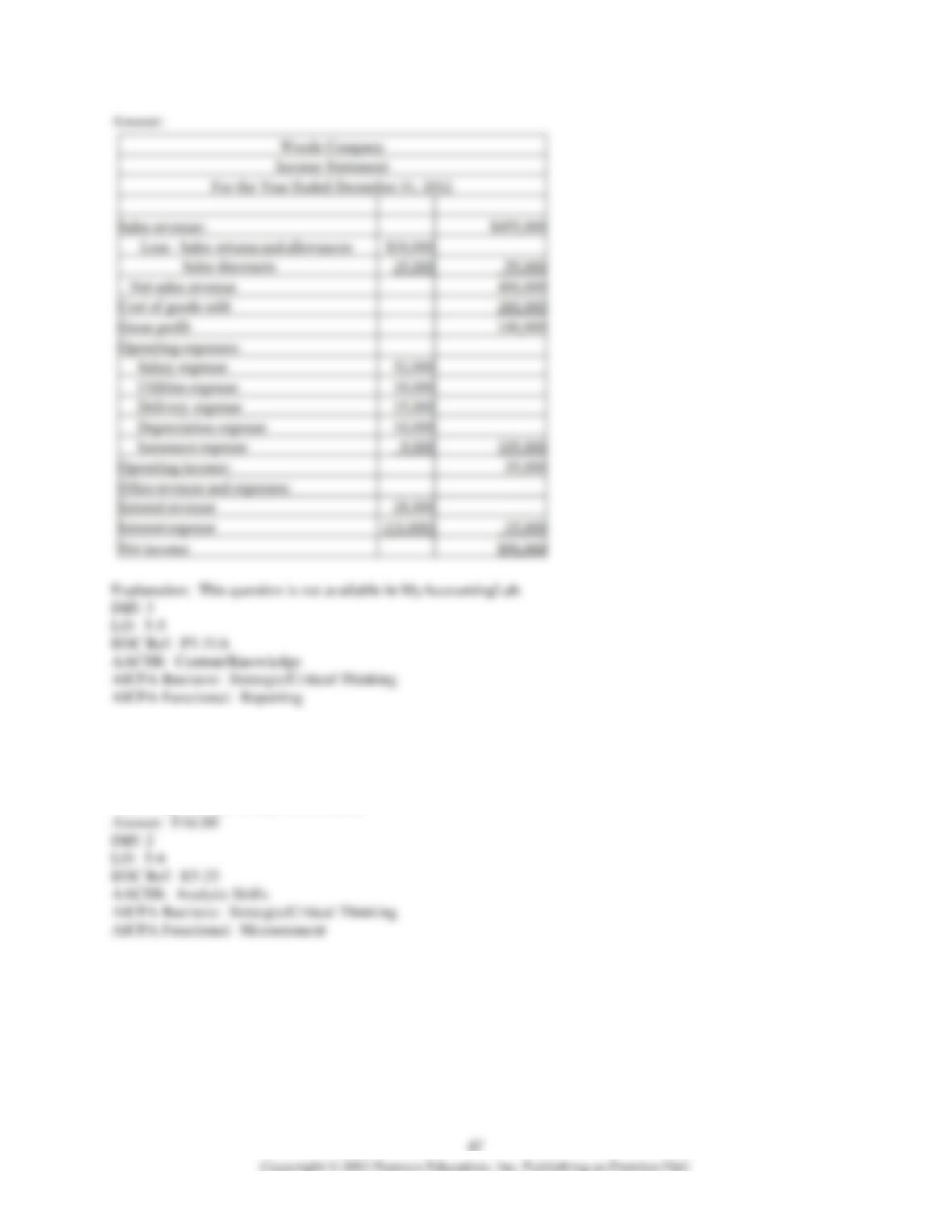
19) An adjusted trial balance for Woods Company is presented below. Prepare a multiple-step income statement for
the company.
Learning Objective 5-6
1) Smith Company tries to manage their inventory levels so that they will have just enough to meet customer
demand, without keeping an excess of funds tied up in inventory. Given this situation, Smith Company hopes to
have a high number of days in inventory.
2) A small increase in the gross profit percentage could indicate:
A) a decrease in operating expenses.
B) a significant rise in net income.
C) lower inventory turnover.
D) a decrease in net income.
3) Which of the following is the result of gross profit divided by net sales?
A) Current ratio
B) Gross profit percentage
C) Debt ratio
D) Rate of inventory turnover
4) Which of the following is the result of cost of goods sold divided by average inventory?
A) Current ratio
B) Gross profit percentage
C) Debt ratio
D) Rate of inventory turnover
5) Which of the following is the gross profit percentage?
A) Gross profit minus net sales revenue
B) Gross profit divided by net sales revenue
C) Gross profit plus net sales revenue
D) Gross profit times net sales revenue
6) Which of the following correctly describes the rate of inventory turnover?
A) It is how quickly inventory is received from the supplier after the order is placed.
B) It is how many days it takes the inventory to travel between the seller’s warehouse and the buyer’s warehouse.
C) It is how rapidly inventory is sold.
D) It is how many days it takes from the time an order is received to the day it is shipped.
7) Which of the following correctly describes the gross profit percentage?
A) For most companies, the gross profit percentage changes little from year to year.
B) Merchandising companies strive to increase the gross profit percentage.
C) The gross profit percentage is one of the most carefully watched measures of profitability.
D) All of the above are true.
8) A company‘s net sales revenue is $540,000. Its cost of goods sold is $360,000. Its gross profit percentage is:
A) 33.33%.
B) 66.67%.
C) 100%.
D) 300%.
9) A company‘s net sales revenues are $1,000,000. Its cost of goods sold is $400,000. Which of the following is its
gross profit percentage?
A) 40%
B) 60%
C) 167%
D) 250%
10) A company’s cost of goods sold is $1,000,000. Its average inventory is $100,000. Which of the following is its
rate of inventory turnover?
A) .01
B) .1
C) 10
D) 100
11) A company’s net sales revenue is $20,000,000. Its cost of goods sold is $15,000,000. Its beginning inventory is
$100,000, and its ending inventory is $200,000. Which of the following is its rate of inventory turnover?
A) 01
B) 0.1
C) 10
D) 100
12) Which of the following is used to determine the rate of inventory turnover?
A) Cost of goods sold divided by Gross profit
B) Cost of goods sold divided by Average inventory
C) Cost of goods sold times Average inventory
D) Cost of goods sold times Gross profit
13) Alpha Company had $45,000 in beginning inventory and $80,000 in ending inventory. Cost of goods sold for
the period was $25,000. The inventory turnover is:
A) 0.56.
B) 0.3125.
C) 0.4.
D) 4.0.
14) A high rate of inventory turnover indicates which of the following?
A) The company is losing inventory to shrinkage.
B) The company is making high net income.
C) The company is experiencing a rapid decline in inventory levels.
D) The company sells its inventory rapidly.
15) Beginning inventory is $42,000 and Ending inventory is $58,000. Cost of goods sold is $600,000. How much
is the inventory turnover?
A) 10.3
B) 14.3
C) 12.0
D) 1.2
16) Beginning inventory is $42,000 and Ending inventory is $58,000. Cost of goods sold is $600,000. Calculate
days in inventory.
A) 30.4
B) 25.6
C) 135.3
D) 3.4
17) Inventory turnover is 8.0. Calculate days in inventory.
A) 14.5
B) 2.5
C) 57.0
D) 45.6
18) Smith Company has a low number of days in inventory. This indicates that:
A) their inventory sales are producing low profits.
B) the cost of inventory is very high.
C) the company has a low gross profit percentage.
D) their inventory is turning over rapidly.
Learning Objective 5-7
1) With a periodic inventory method, purchases, purchase discounts, and purchase returns and allowances are
recorded in separate accounts.