5.4-37 The following item appeared on the December 31, 2011, balance sheet of The Cyclery:
Receivables, less allowance of $1,100 …..$18,000
On January 5, 2009, owner Sean Viesters wrote off a $1,000 customer account. After the write-off, what
is the value of the net receivables?
A) $17,000
B) $18,000
C) $16,900
D) $17,900
5.4-38 Portia Incorporated uses the aging-of-receivables method to estimate uncollectibles. Receivables
amounting to $2,000,000 are overdue by more than 30 days, and management estimates 2% will be
uncollectible. All other receivables are deemed to be collectible. Allowance for Uncollectible Accounts
prior to adjustment has a debit balance of $1,900. The amount of expense reported on the income
statement and the balance in Allowance for Uncollectible Accounts, respectively, will be:
A) $41,900 and $40,000.
B) $40,000 and $38,100.
C) $38,100 and 40,000.
D) $40,000 and $41,900.
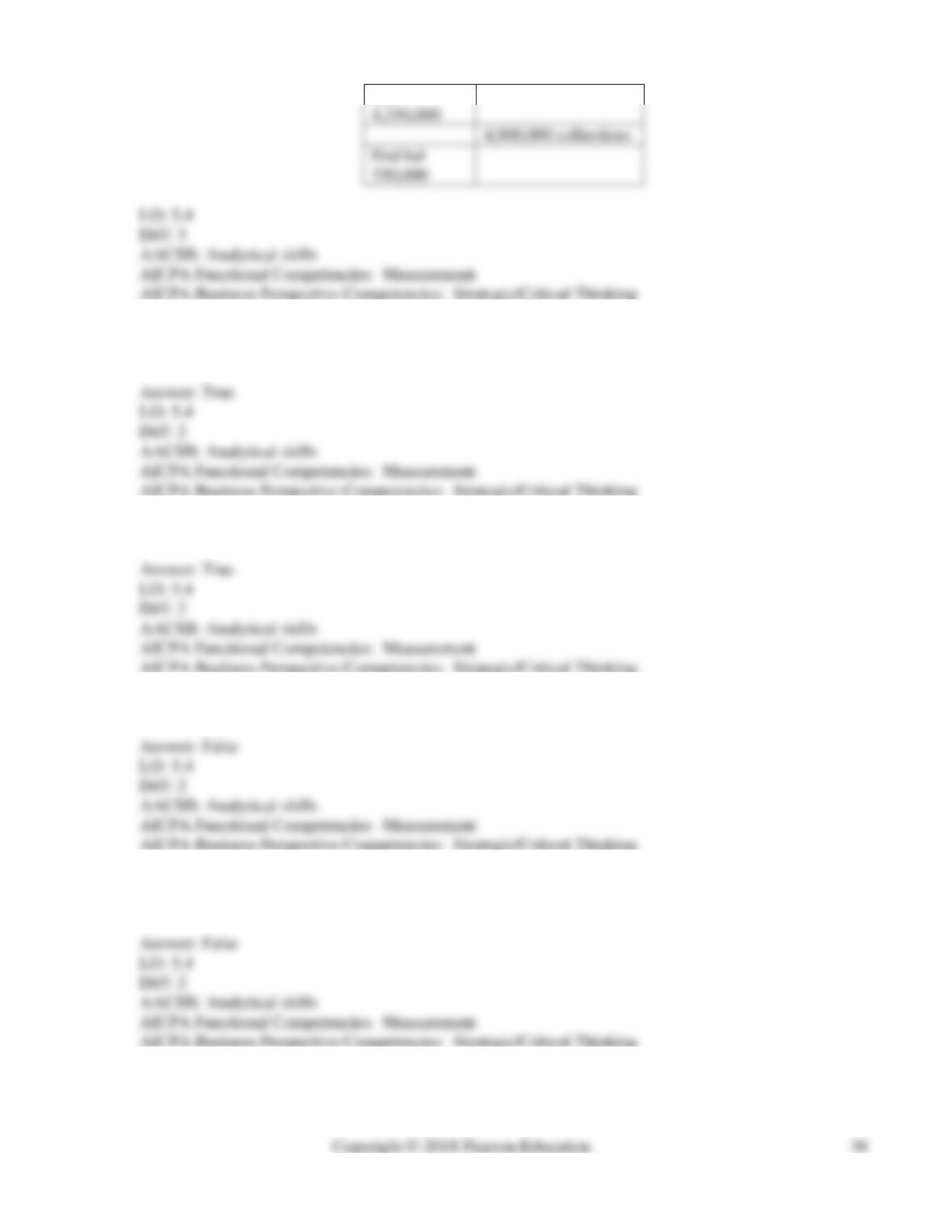
5.4-39 The balance in Accounts Receivable was $650,000 at the beginning of the year and $350,000 at the end of
the year. Sales for the year totaled $4,100,000. During the year, $400,000 in customer accounts were
written off. How much cash was collected from customers during the period?
A) $3,750,000
B) $4,000,000
C) $4,400,000
D) $4,800,000
Bal
End bal
5.4-40 The payee of the note records interest on a note receivable as interest revenue.
5.4-41 Notes receivable due within a year or less are current assets.
5.4-42 The maturity value of a note is the sum of the principal amount of a note less the interest due at maturity.
5.4-43 The maturity value of a note is always the same as its face value.
5.4-44 The fee charged by a bank credit card company increases the amount of sales revenue a merchant receives
in a sales transaction.
5.4-45 Accounts receivable can be sold to a factor as a means of speeding up cash flows.
5.4-46 Armistad Inc. wishes to speed up cash flow and contacts Free Cash.com to sell $600,000 in Accounts
Receivable, receiving 98% in cash for the receivables. Armistad should debit cash for $588,000, debit
Financing Expense for $12,000, and credit Accounts Receivable for $600,000.
5.4-47 Company A has a Note Receivable of $5,000. The note will be collected in installments. $1,000 is due
within a year and the remainder is due after a year. The classification of the note on the balance sheet is:
A) all $5,000 is a current asset.
B) all $5,000 is a long term asset.
C) $1,000 is a current asset and $4,000 is a long term asset.
D) $4,000 is a current asset and $1,000 is a long term asset.
5.4-48 When a note matures, the payee should record:
A) interest expense.
B) interest revenue.
C) interest payable.
D) unearned revenue.
5.4-49 When a note matures, the maker should record:
A) interest expense.
B) interest revenue.
C) interest payable.
D) unearned revenue.
5.4-50 A maker and a payee record the same note, respectively, as a:
A) Note Receivable and Note Payable.
B) Note Receivable and Account Receivable.
C) Note Payable and Note Receivable.
D) Note Payable and Account Payable.
5.4-51 The journal entry to record a note received from a customer to apply on account is:
A) debit Note Receivable and credit Service Revenue.
B) debit Service Revenue and credit Note Receivable.
C) debit Note Payable and credit Note Receivable.
D) debit Note Receivable and credit Accounts Receivable.
5.4-52 The Last Bank lends money to a customer on a six month note. The bank accrues interest on the note at
the end of the year. The journal entry would include:
A) a debit to Cash and a credit to Interest Revenue.
B) a debit to Cash and a credit to Interest Payable.
C) a debit to Interest Receivable and a credit to Interest revenue.
D) a debit to Interest Revenue and a credit to Interest Receivable.
5.4-53 Calside Company signed a 15-month, $50,000, 6% note on June 1, 2011. The amount of interest to be
accrued on December 31, 2011, is:
A) $3,000.
B) $1,750.
C) $1,500.
D) $1,141.
5.4-54 The due date of a 120 day, 10% note for $30,000, dated April 12 is:
A) August 9.
B) August 10.
C) August 11.
D) August 12.
5.4-55 If the interest on a note is 12.5% and the principal was $100,000, what is the maturity value of the
note, if the note is outstanding for 7 months?
(Round to the nearest dollar.)
A) $1,143.
B) $7,292.
C) $107,292.
D) $112,500.
5.4-56 The interest on a note is $800, the interest rate is 6% and the note is for 60 days. What is the principal of
the note?
(Use a 360 day year)
A) $48,000.
B) $60,000.
C) $80,000.
D) cannot be determined from the facts.
5.5-1 Current assets include:
a. A) cash and receivables only.
b. B) cash and payables only.
c. C) cash, receivables and inventory.
d. D) cash, payables and retained earnings.
5.5-2 As a general rule of thumb, a strong current ratio is:
e. A) 1.0 or higher.
f. B) .50 or higher.
g. C) 1.5 or higher.
h. D) none of the above.
5.5-3 A measure of a company’s ability to pay current liabilities with current assets is the:
i. A) liability ratio.
j. B) current ratio.
k. C) debt ratio.
l. D) asset ratio.
5.5-4 Ratios can help investors and creditors evaluate the financial health of a company.
5.5-5 Because it includes only cash and short-term investments in the numerator, the current ratio is a more
stringent measure of a firm’s ability to pay current liabilities than the quick ratio.
5.5-6 In order to effectively evaluate the days’ sales in receivables, it should be compared to the company’s
credit terms.
5.5-7 The collection period is computed as 365 divided by one day’s sales.
5.5-8 If credit sales are $2,920,000, then one day’s sale is equal to $8,000.
5.5-9 If the current ratio of a company equals 2.1, the quick ratio will always be lower than 2.1. (Assume that
the company also has inventory and prepaid expenses.)
5.5-10 Which of the following is considered to be a more stringent measure of a company’s ability to pay
its current liabilities than the current ratio?
A) Accounts payable
B) Quick ratio
C) Liquidity ratio
D) Collection period
5.5-11 A measure of the ability of an entity to pay all of its current liabilities if they come due immediately is
the:
A) current ratio.
B) quick ratio.
C) liquidity ratio.
D) accounts receivable turnover.
5.5-12 An indication of how many days’ sales remain in Accounts Receivable awaiting collection is the:
A) current ratio.
B) quick ratio.
C) days’ sales in receivables.
D) accounts receivable turnover.
5.5-13 The quick ratio and the number of days’ sales in receivables measure:
A) a company’s ability to pay its long-term debts.
B) a company’s profitability.
C) a company’s liquidity.
D) all of the above
5.5-14 The order of liquidity of current assets is:
A) cash and cash-equivalents, accounts receivable, short-term investments.
B) short-term investments, cash and cash equivalents, accounts receivable.
C) cash and cash-equivalents, short-term investments, accounts receivable.
D) cash and cash-equivalents, short-term investments, prepaid expenses.
5.5-15 Which of the following would NOT be included in the numerator of the acid-test ratio?
A) Accounts receivable
B) Cash-equivalents
C) Inventories
D) Short-term investments
5.5-16 The number of days it takes to collect the average amount of receivables is called the:
A) receivables turnover ratio.
B) days’ sales in receivables.
C) current ratio.
D) collection ratio.
5.5-17 The numerator in the calculation of the quick ratio includes which of the following items?
A) Total current assets
B) Total current assets less inventory only
C) Total current assets less prepaid expenses only
D) The sum of cash, short-term investments, and net current receivables
5.5-18 Alex Rhodes’ net sales for the current period were $114,000 and average receivables were $96,250.
What is the amount of one day’s sales (rounded)?
A) $312
B) $264
C) $427
D) $557
5.5-19 Net sales for the current period were $114,000 and average receivables were $96,250. What is the
amount of day’s sales in receivables?
A) 233 days
B) 266 days
C) 308 days
D) 416 days
5.5-20 A company with net sales of 1,642,500, a beginning balance of net receivables of $187,500, and an
ending balance of net receivables of $235,500 has a days’ sales in receivables (rounded) of:
A) 42 days.
B) 47 days.
C) 52 days.
D) 56 days.
5.5-21 A company has $40,000 in cash, $75,000 in short-term investments, $263,000 in net current receivables,
and $110,000 in inventory. The total current liabilities of the firm are $305,000. The quick ratio of the
company is:
A) 0.63.
B) 1.24.
C) 1.60.
D) 1.76.
5.5-22 Barts Industries, Inc., has $30,000 in cash, $15,000 in short-term investments, $75,000 in net current
receivables, and $12,000 in prepaid expenses. The total current liabilities of the firm are $90,000. Barts
Industries’ current ratio is:
A) 1.47.
B) 1.71.
C) 0.64.
D) 1.33.
5.5-23 A company with net sales of $800,000, a beginning balance of net receivables of $70,000, and an ending
balance of net receivables of $90,000 has a collection period (rounded) of:
A) 110 days.
B) 41 days.
C) 36 days.
D) 32 days.
5.5-24 If the current ratio is 3.2, and the current liabilities are $110,000, what is the amount of current assets?
A. $320,000
B. $352,000
C. $176,000
D. $ 34,375
3.2/1=CA/110,000
CA=352,000
5.5-25 If the collection period of a company is 31 days, and the average receivables is $70,060, what is the total
amount of the credit sales?
A. $2,171,860
B. $ 824,900
C. $ 83,126
D. $ 2,260
5.5-26 To shorten the collection period, a company may:
A) increase average receivables.
B) decrease average receivables.
C) decrease the discount offered.
D) both increase average receivables and decrease total sales.
5.5-27 The collection period of Armie’s for 2011 was 30 days; total credit sales were $7,300,000; and average
receivables were $600,000. If sales increase to $8,030,000, and the average receivables stays the same,
what happens?
A) The collection period is now 32 days.
B) The average receivables are now $660,000.
C) One day’s sales equals $20,000.
D) The collection period is now 27 days.
5.5-28 To increase the quick ratio from 1.2 to 2.0, Unga’s Dress and Accessory Shoppe should:
A) pay off $80 in short-term notes.
B) pay off $80 in long-term notes.
C) execute a short-term note for $80.
D) issue $60 in bonds.
5.5-29 In 2009, Krane Company purchases $75,000 of U.S. Treasury bills. This purchase would be reported on
Krane Company’s 2009 statement of cash flows as:
A) a financing activity.
B) an operating activity.
C) an investing activity.
D) none of the above.
5.5-30 On a statement of cash flows, collections of accounts receivables are classified as:
A) an operating activity.
B) an investing activity.
C) a financing activity.
D) none of the above.
5.5-31 On October 15, 2011, Maxx Duggan Enterprises accepts a $10,000 note receivable from the YNR
Company in exchange for cash. The acceptance of the note receivable would be classified on Maxx
Duggan’s 2011 statement of cash flows as:
A) an operating activity.
B) an investing activity.
C) a financing activity.
D) none of the above.