
Chapter 5 – Activity-Based Costing and Management
83. The adoption of a 24/7 employee hotline for workplace complaints is an example of a:
84. Customer profitability analysis is tied closely to:
85. When determining customer profitability, activity-based costing can be used to analyze:
86. Generally speaking, companies prefer doing business with customers who:
87. Which of the following can have a negative impact on a particular sale’s profitability?
88. Arnold Corporation’s customers differ greatly with respect to number of required sales
contacts (e.g., phone calls and sales visits), account payment patterns, and design/engineering
change orders. Which of the following choices likely denotes an ideal customer from
Arnold’s perspective?
Required Sales
Contacts
Account Payment
Patterns
Design/Engineering
Change Orders
89. Of the following organizations, activity-based costing (ABC) cannot be used by:
90. A hospital administrator is in the process of implementing an activity-based-costing
system. Which of the following tasks would not be part of this process?
91. Which of the following cost drivers would best be associated with the activity of
physician time in a medical clinic?
A. Number of new patient visits.
92. Which of the following best explains the main advantages of time-driven-activity-based
costing for services over the use of conventional ABC?
Chapter 5 – Activity-Based Costing and Management
Essay Questions
93. Charger Industries currently assigns overhead to products by using a predetermined rate
based on direct labor hours. The company is considering the adoption of an activity-based
costing (ABC) system, and management desires a brief overview of this system before it
makes a final decision.
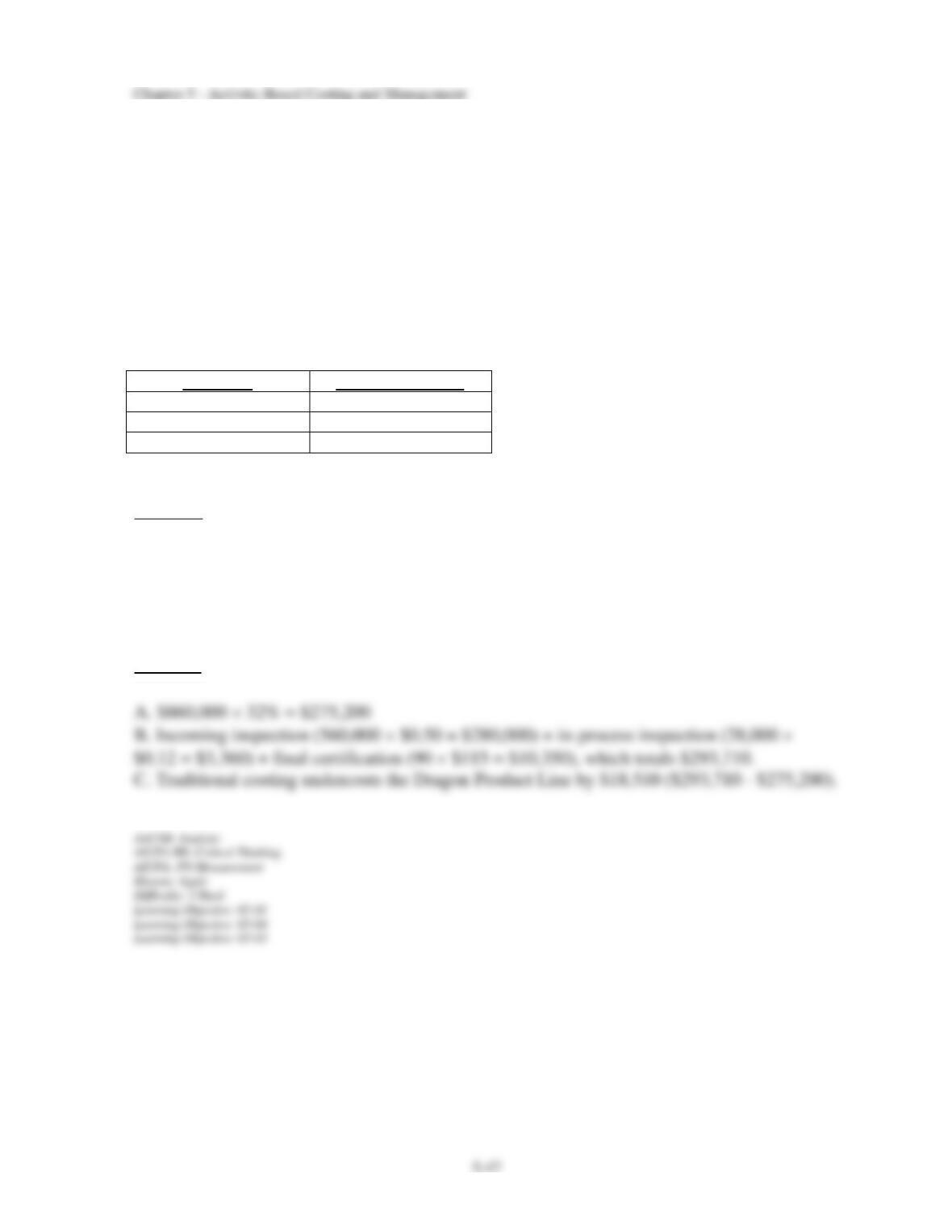
Required: Compare ABC with the company’s current system, focusing on the number of cost
pools and cost drivers, costing accuracy, and cost distortion.
Solution:
94. Whitman Enterprises uses a traditional-costing system to estimate quality-control costs for
its Dragon product line. Costs are estimated at 32% of direct-labor cost, and direct labor
totaled $860,000 for the quarter just ended. Management is contemplating a change to
activity-based costing, and has established three cost pools: incoming material inspection, in-
process inspection, and final product certification. Number of parts, number of units, and
number of orders have been selected as the respective cost drivers.
The following data show the pool rates that have been calculated by the company along with
the quantity of driver units for the Dragon’s:
Pool Rate
Driver Quantities
$0.50 per part
20 parts
0.12 per unit
28,000 units
115.00 per order
90 orders
Required:
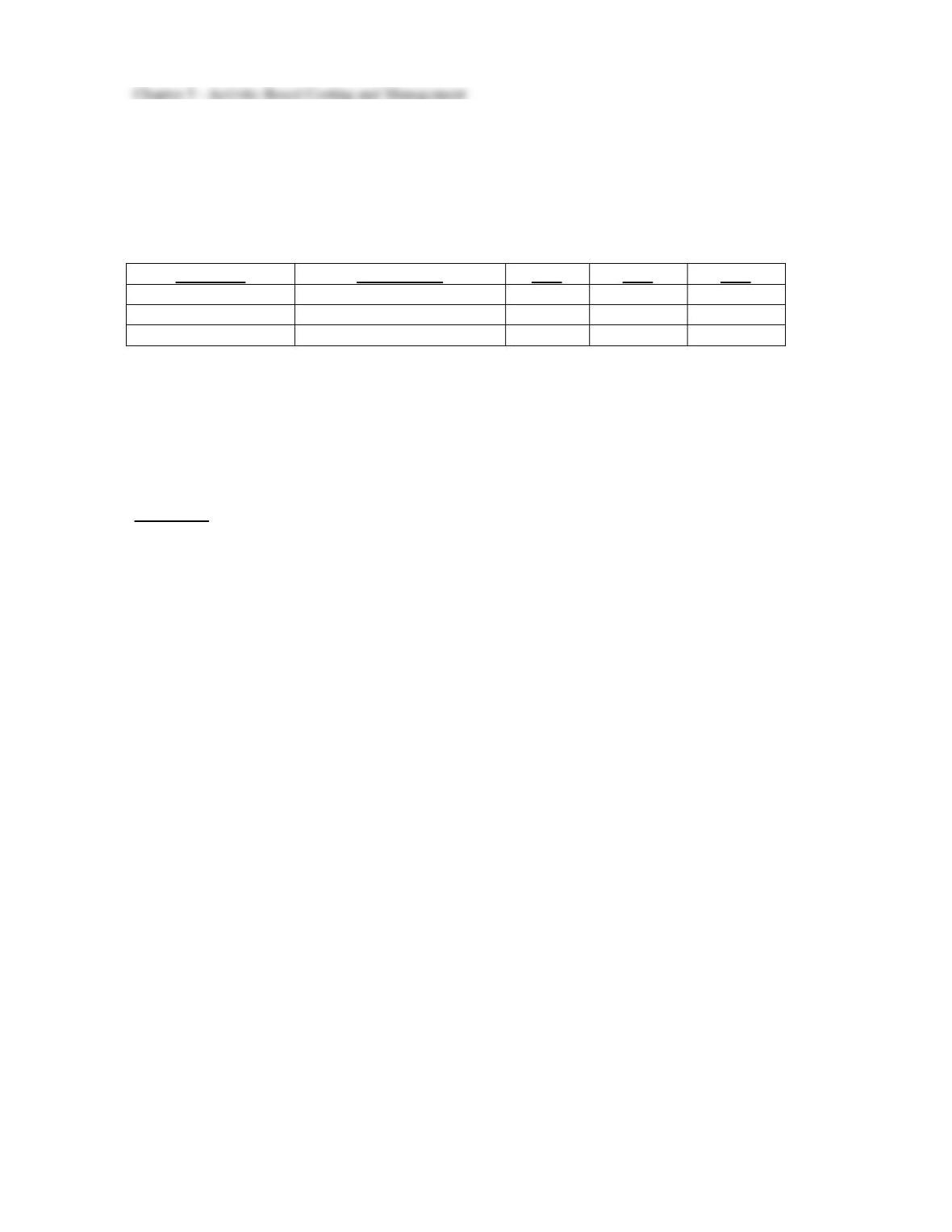
A. Calculate the quarterly quality-control cost that is allocated to the Dragon product line
under Whitman’s traditional-costing system.
B. Calculate the quarterly quality-control cost that is allocated to the Dragon product line if
activity-based costing is used.
C. Does the traditional approach under- or overcost the product line? By what amount?
Solution:
5-48
95. Todd Manufacturing, contemplating the adoption of an activity-based costing system, has
established three activity-cost pools: machine setup, quality assurance, and engineering. These
cost pools, the appropriate cost driver, and the percentage of each cost driver consumed by the
company’s products (H15, H16, and H17) follow.
Cost Pool
Cost Driver
H15
H16
H17
Machine setup
Number of setups
50%
20%
30%
Quality assurance
Number of inspections
70%
15%
15%
Engineering
Number of change orders
15%
10%
75%
Estimated costs for these three activities, which account for 80% of the firm’s total
overhead, are $400,000, $500,000, and $120,000, respectively. Todd currently
applies manufacturing overhead to products on the basis of machine hours.
Required:
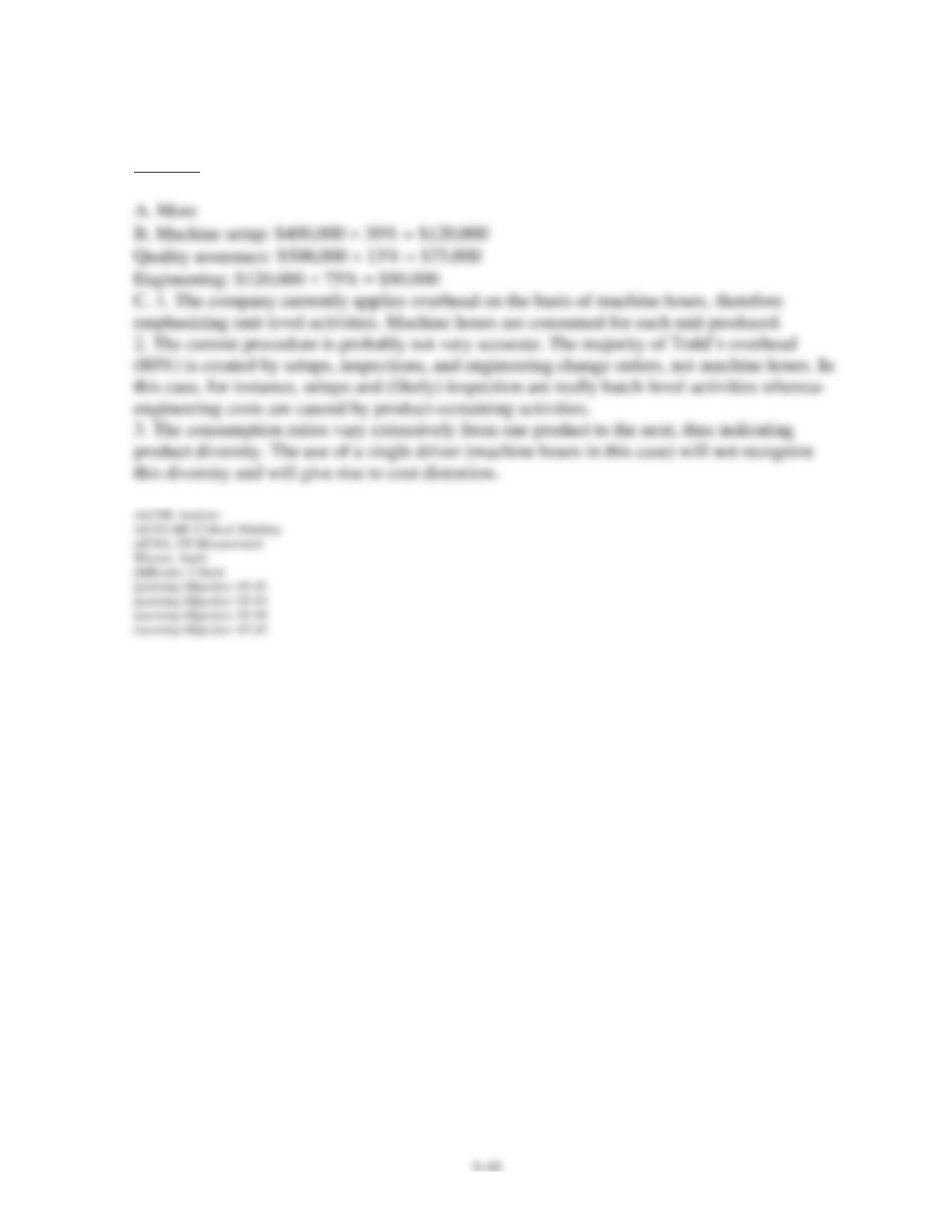
A. Will activity-based costing systems require more or fewer cost pools than
traditional costing systems? No explanation is necessary.
B. Calculate the cost of machine setup, quality assurance, and engineering to be
charged to product H17.
C. Consider the company’s current overhead application procedure.
1. Is Todd emphasizing unit-level activities, batch-level activities, product-sustaining
activities, or facility-level activities? Explain.
2. How accurate will the current costing procedure be given the nature of most of the
company’s activities? Briefly discuss.
3. How accurate will the current costing procedure be given the consumption ratios of
the firm? Briefly discuss.
Chapter 5 – Activity-Based Costing and Management
Solution:
96. Kettle Company produces two products (F56 and F57), applying manufacturing overhead
on the basis of direct labor hours. Anticipated unit production costs (material, labor, and
overhead) and manufacturing volumes are:
F56: 2,000 units, $234
F57: 3,500 units, $271
Kettle’s overhead arises because of various activities, one of which is purchase-order
processing. Budgeted cost for this activity is expected to be $70,000. The firm believes that
the number of purchase orders processed is a key cost driver and expects the following
activity for its products: F56, 10 purchase orders; F57, 40 purchase orders. Kettle’s selling
prices are based heavily on cost.
Required:
A. Activity-based costing (ABC) is said to result in improved costing accuracy when
compared with traditional costing procedures. Briefly explain how this improved accuracy is
attained.
B. Compute:
1. the pool rate for purchase-order processing.
2. the purchase-order processing cost to be charged to one unit of F56.
C. Assume that Kenyon switched to activity-based costing and calculated total unit production
costs as follows: F56, $285; F57, $220.
1. Which of the two products, F56 or F57, was overcosted prior to the change to ABC? No
explanation is necessary.
2. Which of the two products, F56 or F57, may have been less competitive in the marketplace
prior to the change to ABC? Briefly explain.
Solution:
5-51
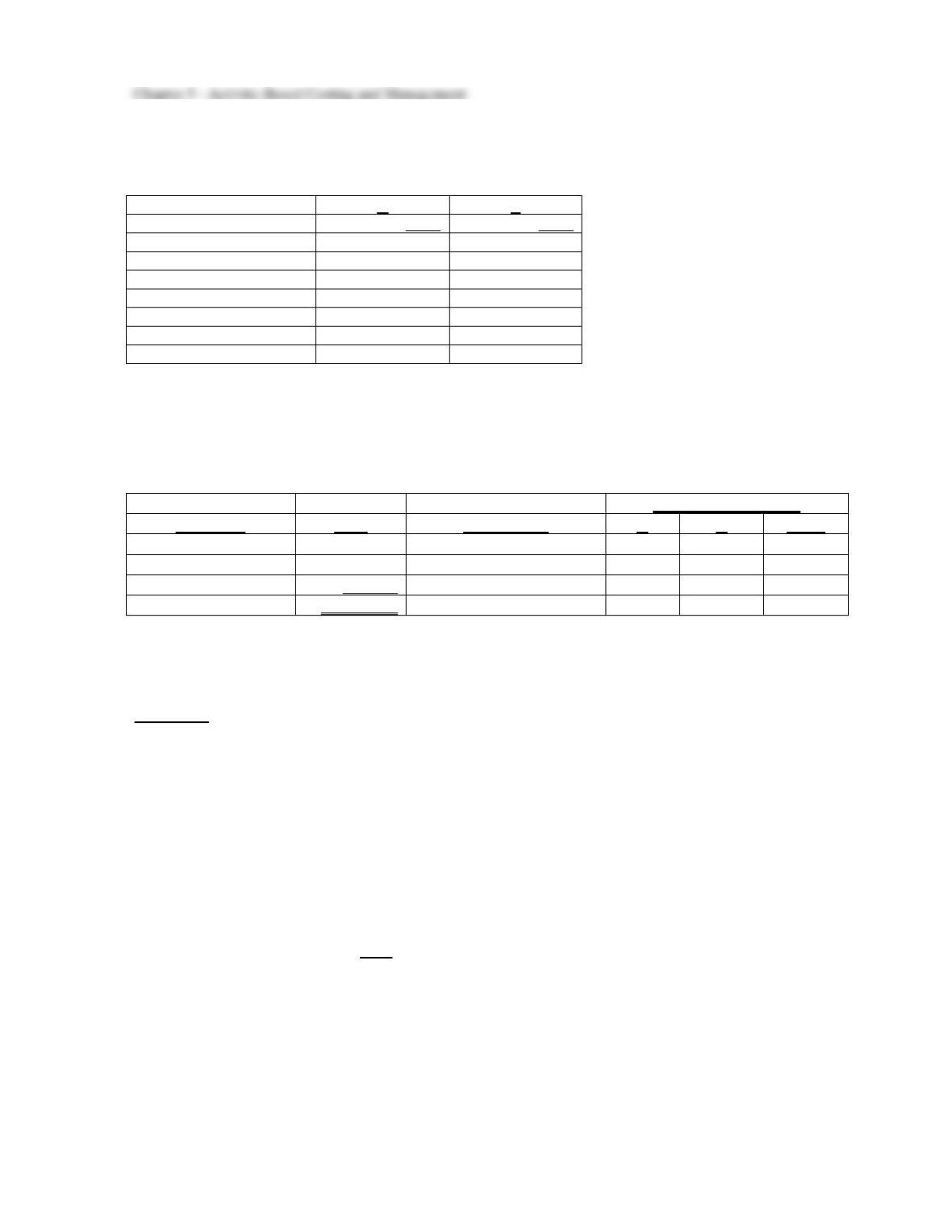
97. Javier Industries manufactures two products: A and B. A review of the company’s
accounting records revealed the following per-unit costs and production volumes:
A
B
Production volume (units)
2,500
5,000
Direct material
$40
$60
Direct labor:
15
2 hours at $12
24
3 hours at $12
36
Manufacturing overhead
2 hours at $93
186
3 hours at $93
279
Manufacturing overhead is currently computed by spreading overhead of $1,860,000 over
20,000 direct labor hours. Management is considering a shift to activity-based costing in an
effort to improve the firm’s accounting procedures, and the following data are available:
Cost Driver Volume
Cost Pool
Cost
Cost Driver
A
B
Total
Setups
$240,000
Number of setups
100
20
120
General factory
1,500,000
Direct labor hours
5,000
15,000
20,000
Machine processing
120,000
Machine Hours
2,200
800
3,000
$1,860,000
Javier determines selling prices by adding 40% to a product’s total cost.
Required:
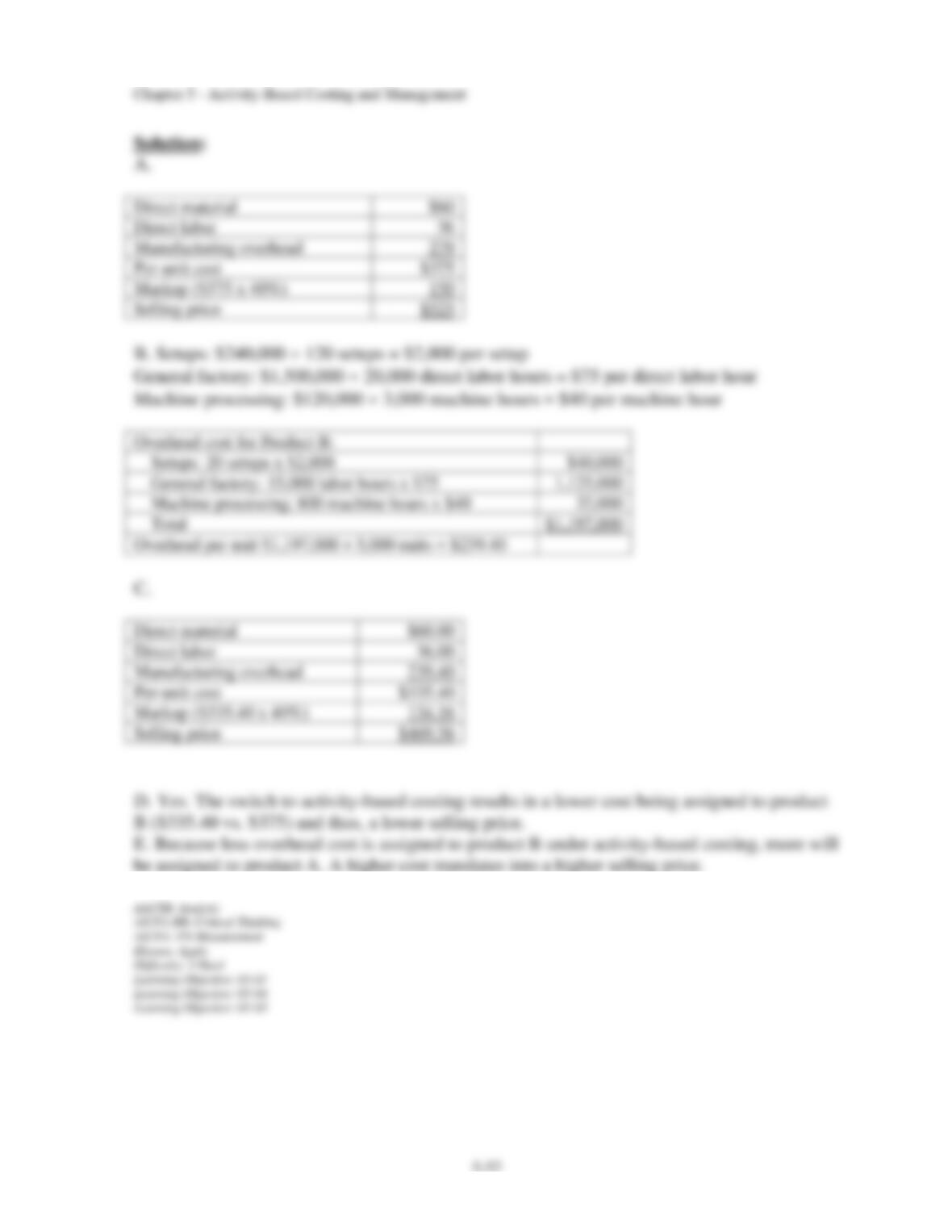
A. Compute the per-unit cost and selling price of product B by using Javier’s current costing
procedures.
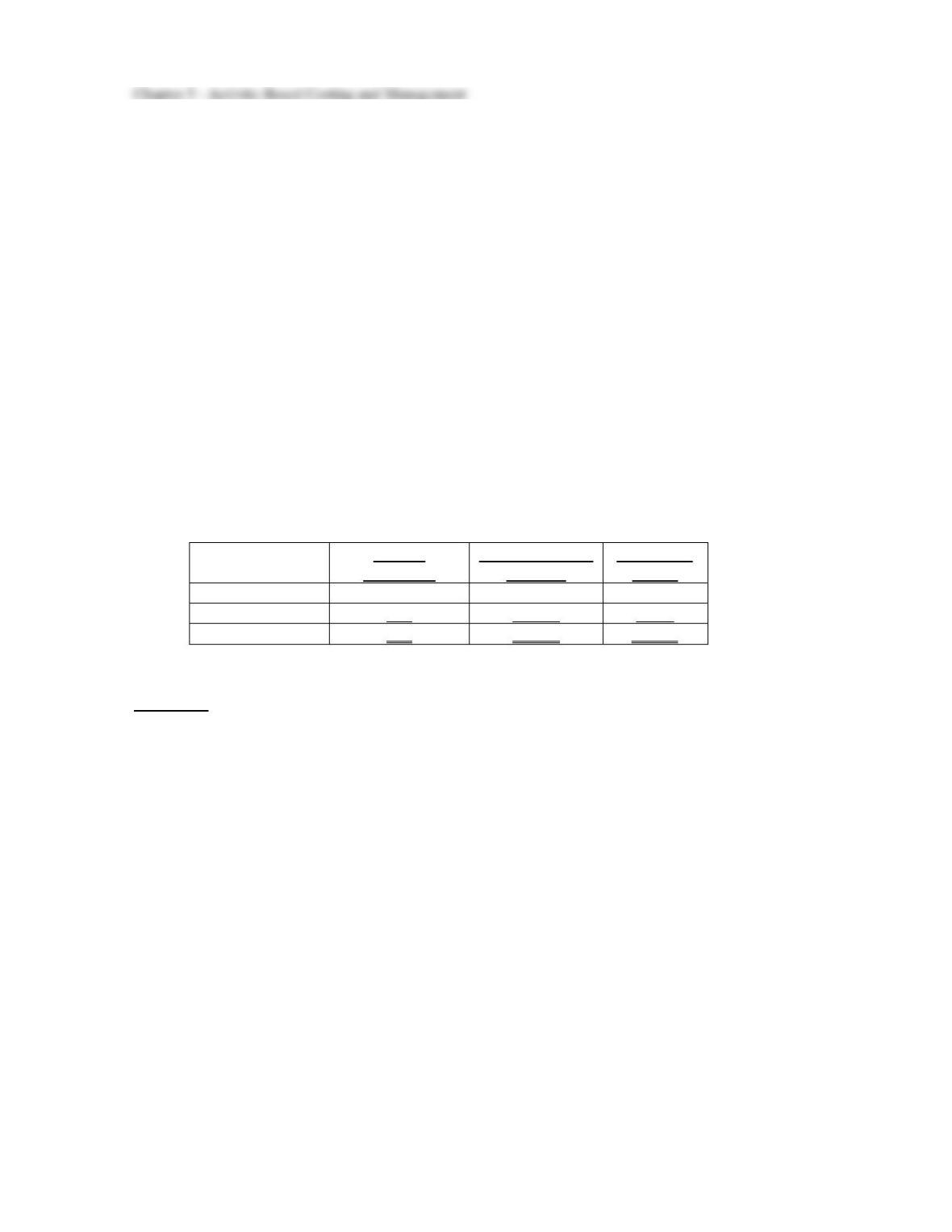
B. Compute the per-unit overhead cost of product B if the company switches to activity-based
costing.
C. Compute B’s total per-unit cost and selling price under activity-based costing.
D. Javier has recently encountered significant international competition for product B, with
considerable business being lost to very aggressive suppliers. Will activity-based costing
allow the company to be more competitive with product B from a price perspective? Briefly
explain.
E. Will the cost and selling price of product A likely increase or decrease if Javier changes to
activity-based costing? Why? Hint: No calculations are necessary.
5-53
98. Fairchild, Inc., manufactures two products, Regular and Deluxe, and applies overhead on
the basis of direct labor hours. Anticipated overhead and direct labor time for the upcoming
accounting period are $1,600,000 and 25,000 hours, respectively. Information about the
company’s products follows.
Regular—
Estimated production volume: 3,000 units
Direct materials cost: $28 per unit
Direct labor per unit: 3 hours at $15 per hour
Deluxe—
Estimated production volume: 4,000 units
Direct materials cost: $42 per unit
Direct labor per unit: 4 hours at $15 per hour
Fairchild’s overhead of $1,600,000 can be identified with three major activities: order
processing ($250,000), machine processing ($1,200,000), and product inspection ($150,000).
These activities are driven by number of orders processed, machine hours worked, and
inspection hours, respectively. Data relevant to these activities follow.
Orders
Processed
Machine Hours
Worked
Inspection
Hours
Regular
320
16,000
4,000
Deluxe
180
24,000
6,000
Total
500
40,000
10,000
Required:
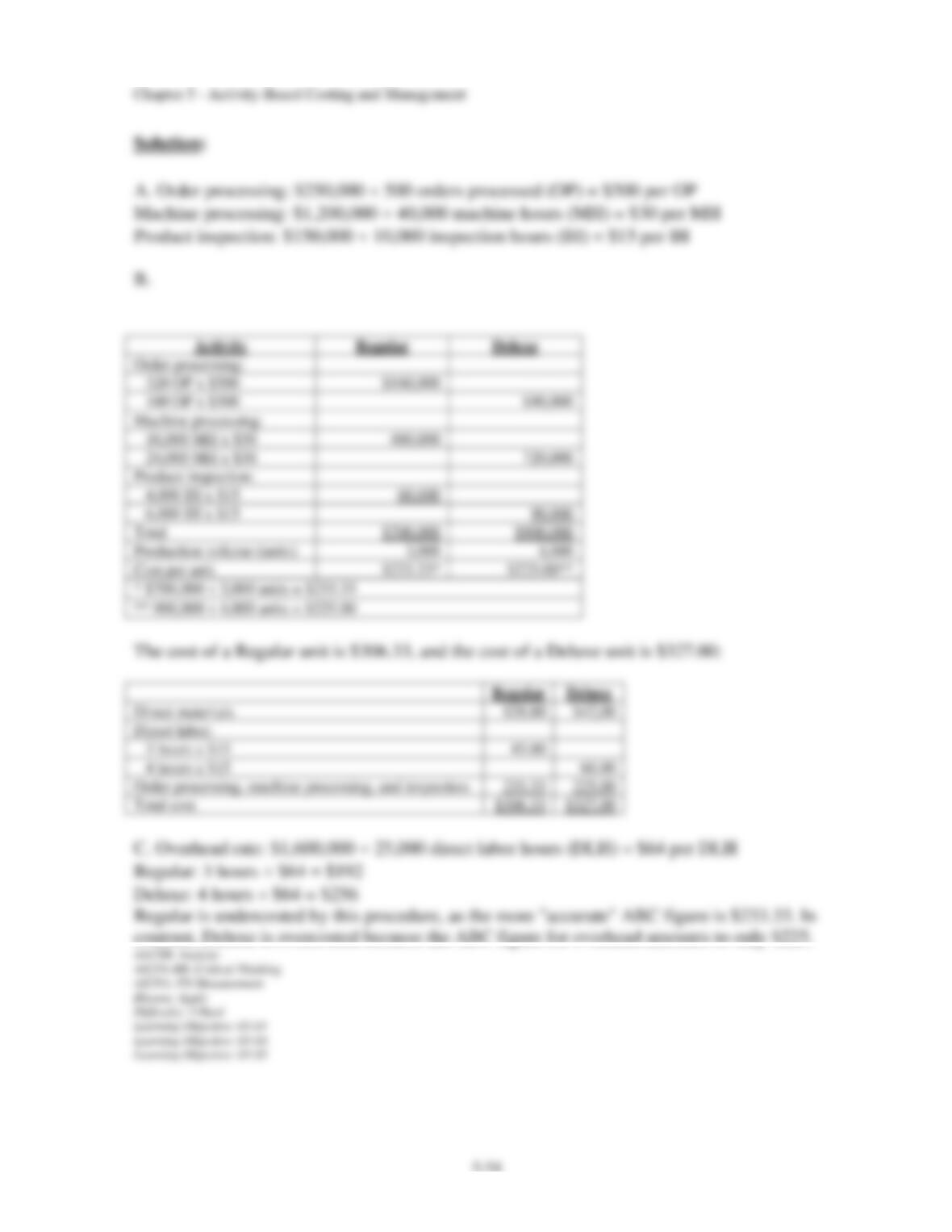
A. Compute the pool rates that would be used for order processing, machine processing, and
product inspection in an activity-based costing system.
B. Assuming use of activity-based costing, compute the unit manufacturing costs of Regular
and Deluxe if the expected manufacturing volume is attained.
C. How much overhead would be applied to a unit of Regular and Deluxe if the company
used traditional costing and applied overhead solely on the basis of direct labor hours? Which
of the two products would be undercosted by this procedure? Overcosted?
5-55
99. Private Corporation manufactures two types of transponders—no. 156 and no. 157—and
applies manufacturing overhead to all units at the rate of $76.50 per machine hour. Production
information follows.
No. 156
No. 157
Anticipated volume (units)
6,000
14,000
Direct material cost
$40
$65
Direct labor cost
25
25
The controller, who is studying the use of activity-based costing, has determined that the
firm’s overhead can be identified with three activities: manufacturing setups, machine
processing, and product shipping. Data on the number of setups, machine hours worked, and
outgoing shipments, the activities’ three respective cost drivers, follow.
No. 156
No. 157
Total
Setups
60
40
100
Machine hours worked
15,000
25,000
40,000
Outgoing shipments
120
80
200
The firm’s total overhead of $3,060,000 is subdivided as follows: manufacturing setups,
$260,000; machine processing, $2,400,000; and product shipping, $400,000.
Required:
A. Compute the pool rates that would be used for manufacturing setups, machine processing,
and product shipping in an activity-based costing system.
B. Assuming use of activity-based costing, compute the unit overhead costs of product nos.
156 and 157 if the expected manufacturing volume is attained.
C. Assuming use of activity-based costing, compute the total cost per unit of product no. 156.
D. If the company’s selling price is based heavily on cost, would a switch to activity-based
costing from the current traditional system result in a price increase or decrease for product
no. 156? Show computations.
Chapter 5 – Activity-Based Costing and Management
Solution:
5-57
100. The controller for Norton Machining has established the following overhead cost pools
and cost drivers:
Overhead Cost Pool
Budgeted Overhead
Cost
Cost Driver
Machine setups
$240,000
Number of setups
Material handling
90,000
Units of raw material
Quality control inspection
48,000
Number of Inspections
Other overhead costs
160,000
Machine hours
Total
$538,000
Overhead Cost Pool
Budgeted Level for
Cost Driver
Pool Rate
Machine setups
200 setups
$1,200 per setup
Material handling
60,000 units
$1.50 per unit
Quality control
1,200 inspections
$40 per inspection
Other overhead
20,000 machine hours
$8 per machine hour
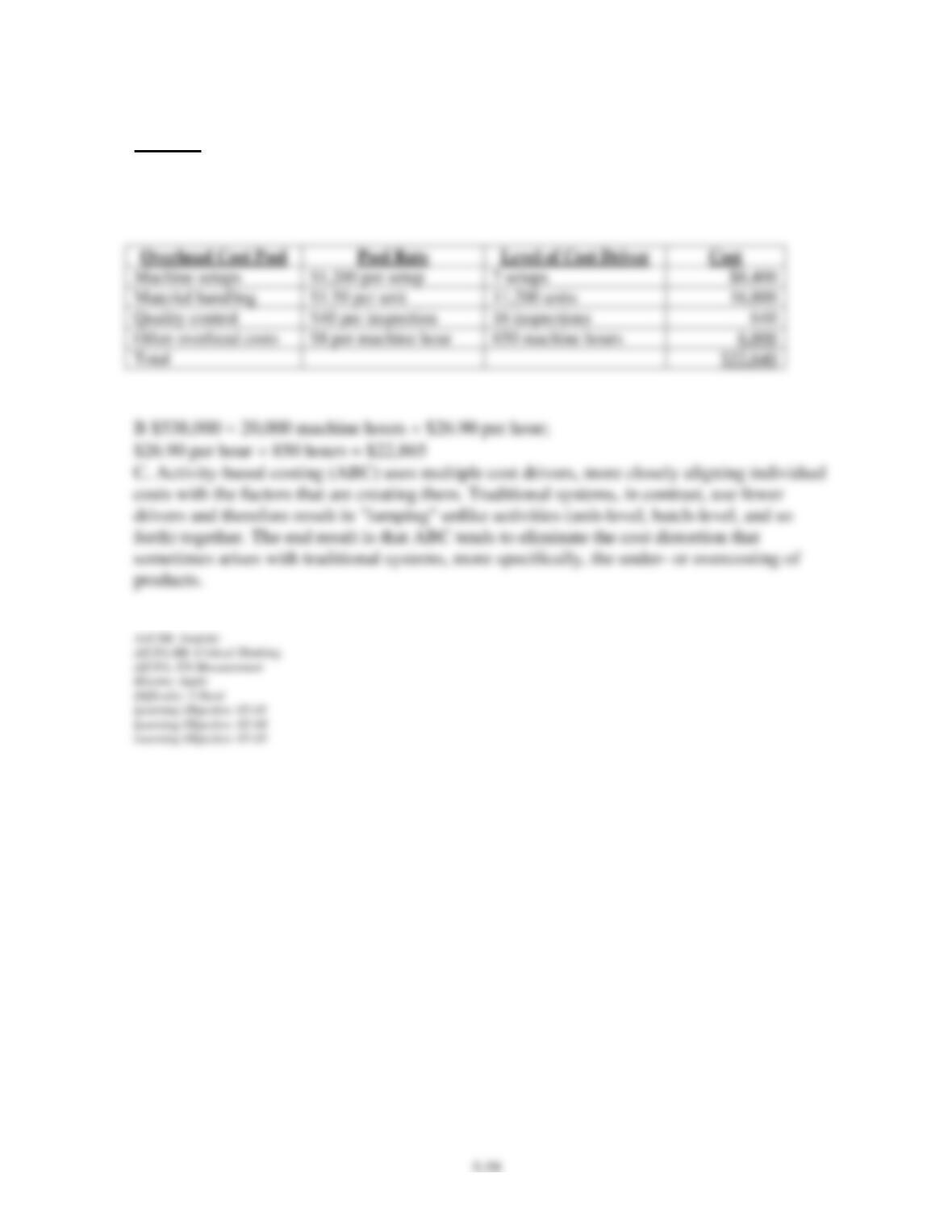
Order no. 715 has the following production requirements:
Machine setups: 7
Raw material: 11,200 units
Inspections: 16
Machine hours: 850
Required:
A. Compute the total overhead that should be assigned to order no. 715 by using activity–
based costing.
B. Suppose that Norton were to use a single, predetermined overhead rate based on machine
hours. Compute the rate per hour and the total overhead assigned to order no. 715.
C. Discuss the merits of an activity-based costing system in comparison with a traditional
costing system.
Chapter 5 – Activity-Based Costing and Management
Solution:
A.