87. Sales returns and allowances occur when the buyer returns the goods or the seller reduces
the customer’s balance owed.
88. A sales allowance is recorded as a debit to Accounts Receivable and a credit to Sales
Allowances.
89. The Sales Returns account is an expense account.
90. If a company has total revenues of $100,000, sales discounts of $3,000, sales returns of
$4,000, and sales allowances of $2,000, the income statement will report net revenues of
$91,000.
91. Accounts receivable are reported at their net realizable value.
92. The net realizable value of accounts receivable is the full amount owed by customers.
93. Customers’ accounts that we no longer consider collectible are referred to as uncollectible
accounts (or bad debts).
94. The direct write-off method involves recording an adjustment at the end of each period to
account for the possibility of future uncollectible accounts.
95. The adjustment to account for future bad debts has the effect of (1) reducing assets and (2)
increasing liabilities.
96. The adjustment for uncollectible accounts involves a debit to Bad Debt Expense and a
credit to the Allowance for Uncollectible Accounts.
97. The Allowance for Uncollectible Accounts is a contra asset account representing the
amount of accounts receivable that we do not expect to collect.
98. Bad debt expense is the amount of the adjustment to the allowance for uncollectible
accounts that represents the cost of the estimated future bad debts.
99. One disadvantage of the allowance method (over the direct write-off method) for
recording uncollectible accounts is that it generally matches bad debt expense with the
revenue it helped to generate.
100. If a company is owed $10,000 by its customers, but it expects that $1,000 will not be
collected, accounts receivable in the balance sheet are reported at the net amount of $9,000.
101. Under the allowance method, when a company writes off an account receivable as an
actual bad debt, it reduces total assets.
102. Under the allowance method, when a company writes off an account receivable as an
actual bad debt, it records an expense.
103. Under the allowance method, the write-off of an actual bad debt is recorded with a debit
to the Allowance for Uncollectible Accounts and a credit to Accounts Receivable.
104. Under the allowance method, when a company collects cash from an account previously
written off, total assets increase.
105. A credit balance in the Allowance for Uncollectible Accounts before adjustment
indicates that last year’s estimate of uncollectible accounts may have been too high.
106. A debit balance in the Allowance for Uncollectible Accounts before adjustment indicates
that last year’s estimate of uncollectible accounts was too low.
107. The aging method for estimating uncollectible accounts considers that a higher
percentage of “older” accounts will not be collected compared to “newer” accounts.
108. A company expects 5% of its newer accounts receivable to be uncollectible and 20% of
its older accounts to be uncollectible. If the company has $40,000 of newer accounts and
$5,000 of older accounts, the total estimate of uncollectible accounts is $2,000.
109. Under the direct write-off method, bad debt expense is recorded at the time accounts are
known to be uncollectible.
110. The direct write-off method is used for tax purposes but is generally not permitted for
financial reporting.
111. The direct write-off method violates the matching principle.
112. Under the direct write-off method, recording an estimate of future uncollectible accounts
includes a debit to Bad Debt Expense and a credit to the Allowance for Uncollectible
Accounts.
113. Notes receivable are similar to accounts receivable but are more formal credit
arrangements evidenced by a written debt instrument, or note.
114. Notes receivable typically arise from sales to customers.
115. Notes receivable are assets and are reported in the balance sheet.
116. Interest on a note receivable is calculated as the face value of the note times the annual
interest rate stated on the note times the fraction of the year the note is outstanding.
117. A $10,000 note that has a stated interest rate of 10% and is due in six months would have
interest of $1,000.
118. Accrued interest on a note receivable is interest earned by the end of the year but not yet
received.
119. Accrued interest on a note receivable has the effects of increasing assets and increasing
liabilities.
120. Two important ratios that help in understanding the company’s effectiveness in managing
receivables are the receivables turnover ratio and the average collection period.
121. The receivables turnover ratio shows the number of times during a year that the average
accounts receivable balance is collected (or “turns over”).
122. The receivables turnover ratio equals average accounts receivable divided by net credit
sales.
123. A lower receivables turnover ratio generally indicates more favorable management of
accounts receivable by company managers.
124. The average collection period shows the approximate number of days the average
accounts receivable balance is outstanding.
125. The percentage-of-receivables method for estimating uncollectible accounts is
commonly referred to as the balance sheet method, because the estimate of bad debts is based
on a balance sheet amount—accounts receivable.
126. The percentage-of-credit-sales method for estimating uncollectible accounts is
commonly referred to as the income statement method, because it always results in a higher
amount of net income being reported in the income statement.
127. Even though the percentage-of-receivables method and the percentage-of-credit-sales
method use different accounts to estimate future uncollectible accounts, the amount of bad
debt expense reported in the income statement will always be the same under the two
methods.
128. From an income statement perspective, the percentage-of-credit-sales method is typically
preferable because it better matches the revenues (credit sales) with their related expenses
(bad debts).
129. From a balance sheet perspective, the percentage-of-receivables method is typically
preferable because assets (net accounts receivable) are reported closer to their net realizable
value.
130. The percentage-of-credit-sales method (income statement method) is allowed only if
amounts do not differ significantly from estimates using the percentage-of-receivables
method.
131. A company offers a 20% trade discount when providing services of $5,000 or more to its
customers. Record the transaction when the company provides services of $8,000 (not
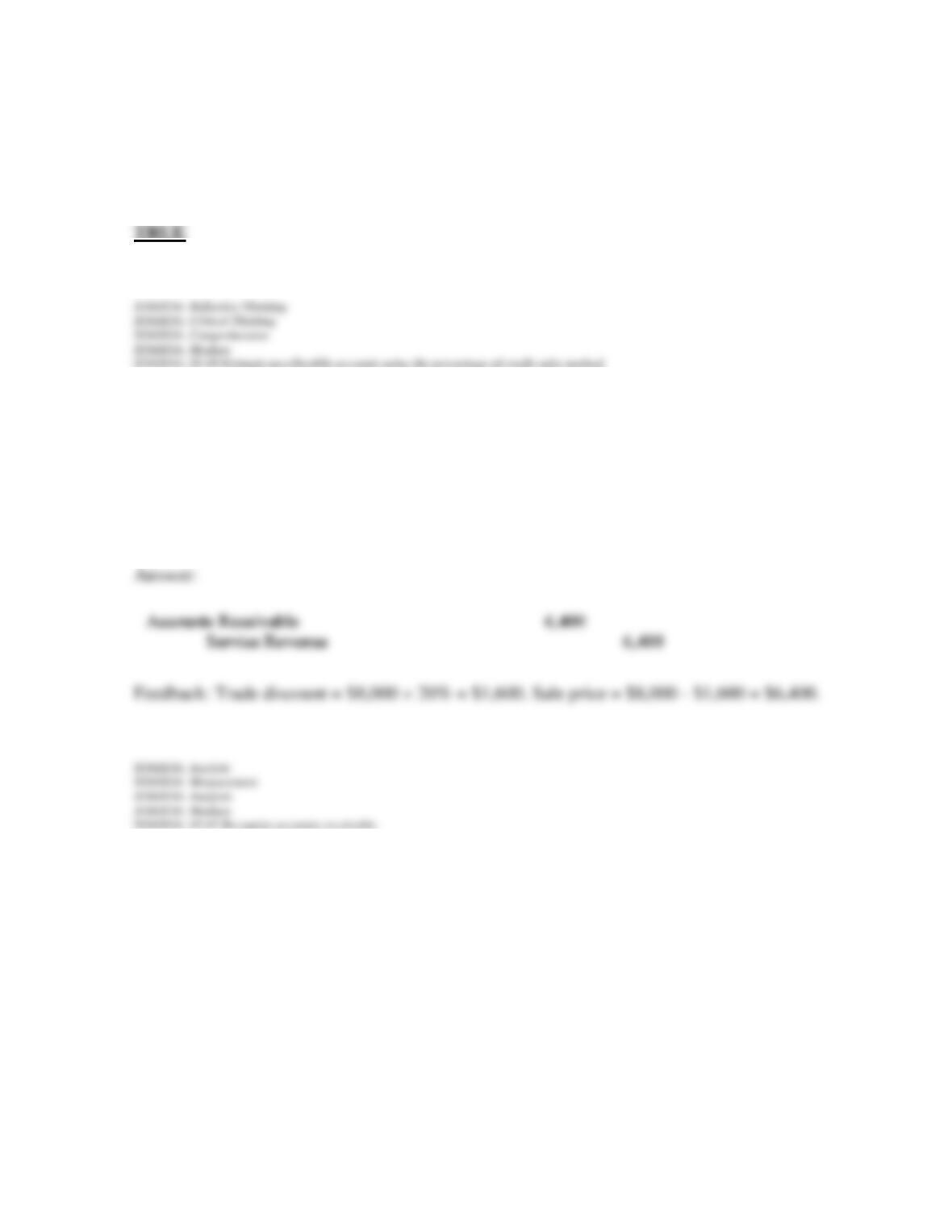
including the trade discount) on account.
132. On February 23, a company provides services on account to a customer for $4,500. The
customer pays in full for those services on March 4. Record the transactions for the company
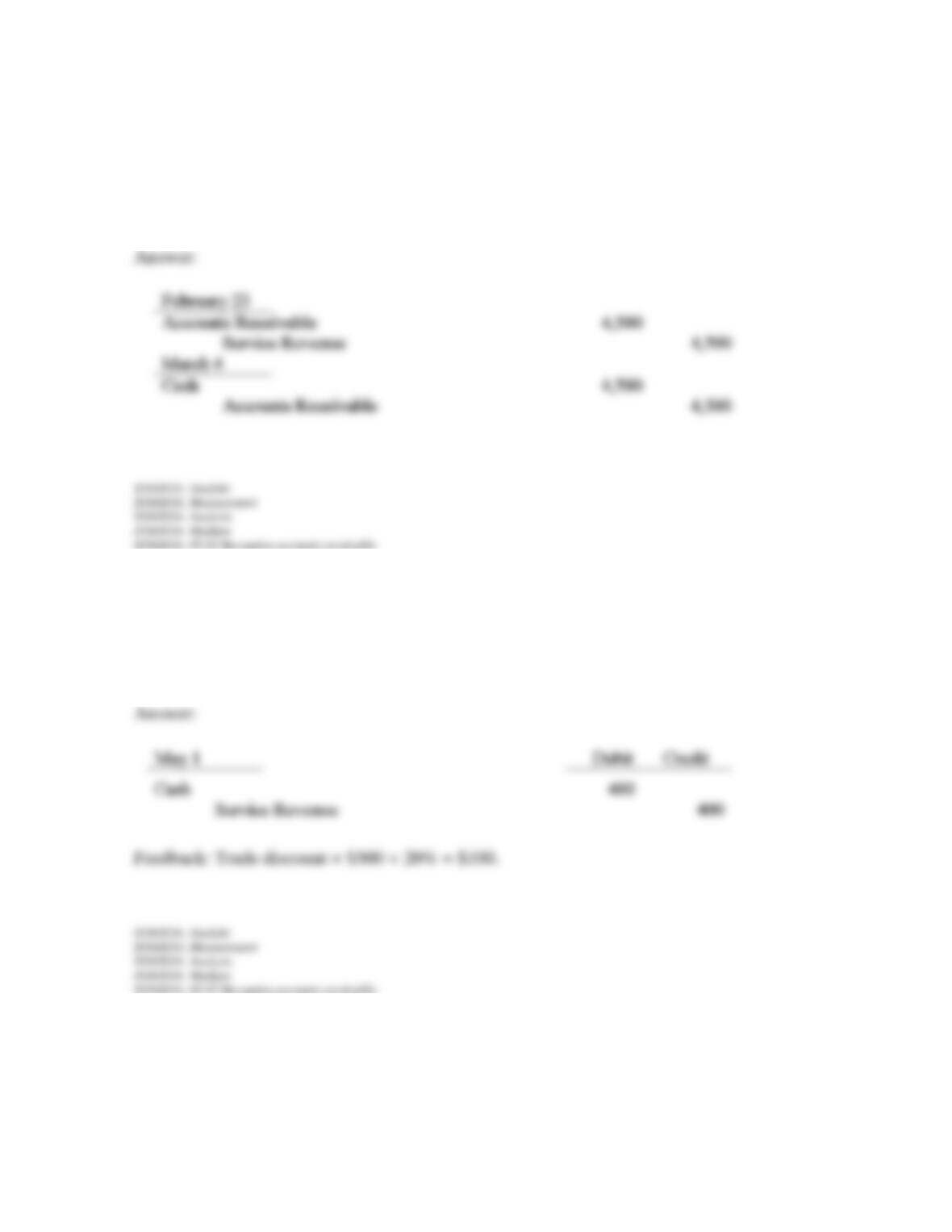
when the services are provided on February 23 and when the cash is collected on March 4.
133. Suppose Casey Title Company normally charges $500 for services related to selling a
house. As part of a summer special, Casey offers customer’s a trade discount of 20%. On July
9, Linda Holmes uses the services of Casey and pays cash equal to the discounted price.
Record the revenue earned by Casey on July 9.
134. Listed below are five terms followed by a list of phrases that describe or characterize the
terms. Match each phrase with the best term by placing the letter designating the term in the
space provided.
Terms:
a. Credit sales
b. Sales returns
c. Sales allowances
d. Sales discounts
e. Trade discounts
_____ When a customer returns a product.
135. Listed below are five terms followed by a list of phrases that describe or characterize the
terms. Match each phrase with the best term by placing the letter designating the term in the
space provided.
Terms:
a. Credit sales
b. Sales returns
c. Sales allowances
d. Sales discounts
e. Trade discounts
_____ Deducted from list price.
136. Listed below are five terms followed by a list of phrases that describe or characterize the
terms. Match each phrase with the best term by placing the letter designating the term in the
space provided.
Terms:
a. Credit sales
b. Sales returns
c. Sales allowances
d. Sales discounts
e. Trade discounts
_____ Sale on account to customers.
137. Listed below are five terms followed by a list of phrases that describe or characterize the
terms. Match each phrase with the best term by placing the letter designating the term in the
space provided.
Terms:
a. Credit sales
b. Sales returns
c. Sales allowances
d. Sales discounts
e. Trade discounts
_____ Offered to induce prompt payment.
138. Listed below are five terms followed by a list of phrases that describe or characterize the
terms. Match each phrase with the best term by placing the letter designating the term in the
space provided.
Terms:
a. Credit sales
b. Sales returns
c. Sales allowances
d. Sales discounts
e. Trade discounts
_____ Refund because of some deficiency in the company’s product or service.