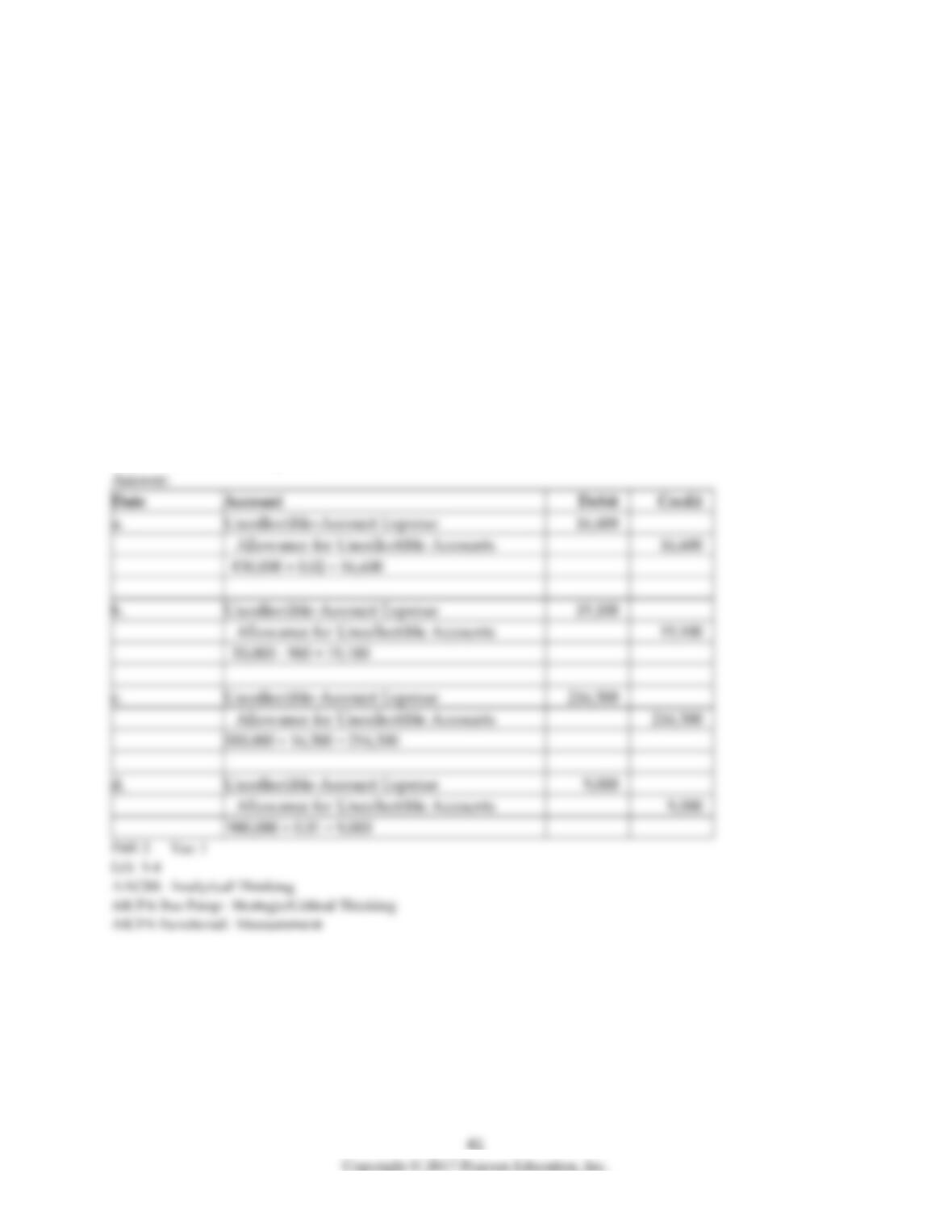
50) Consider the following INDEPENDENT situations for Tommy Company:
a. The Allowance for Uncollectible Accounts has a $1,200 credit balance prior to adjustment. Net credit
sales during the year are $830,000 and 2% are estimated to be uncollectible. Accounts Receivable has a
balance of $110,000 at the end of the year. The company uses the percent-of-sales method.
b. The Allowance for Uncollectible Accounts has a $900 credit balance prior to adjustment. Based on an
aging schedule of accounts receivable prepared at the end of the year, $20,000 of accounts receivable are
estimated to be uncollectible. Accounts Receivable has a balance of $104,000 at the end of the year.
c. The Allowance for Uncollectible Accounts has a $16,300 debit balance prior to adjustment. Based on
an aging schedule of accounts receivable prepared at the end of the year, $200,000 of accounts receivable
are estimated to be uncollectible. Accounts Receivable has a balance of $958,000 at the end of the year.
d. The Allowance for Uncollectible Accounts has a $500 credit balance prior to adjustment. Net credit
sales during the year are $900,000 and 1% are estimated to be uncollectible. Accounts Receivable has a
balance of $825,000 at the end of the year. The company uses the percent–of-sales method.
Required:
Prepare the adjusting journal entries for uncollectible accounts for each INDEPENDENT situation.
Explanations are not required.
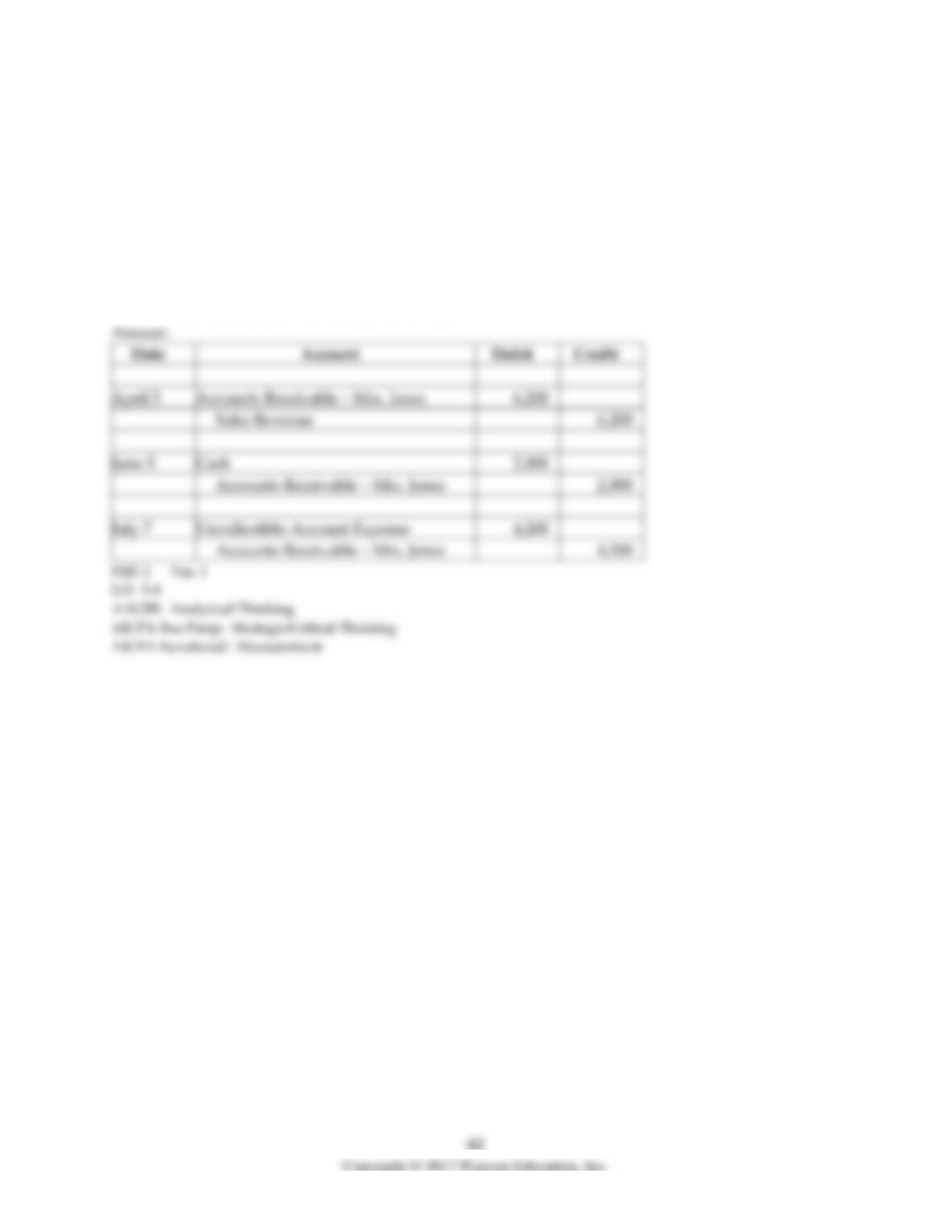
51) Journalize the following transactions for The Technology Store. The Technology Store uses the direct
write-off method of accounting for uncollectible receivables. Ignore Cost of Goods Sold. Explanations
are not required.
April 5 The Technology Store sells $6,200 of computer equipment on account to Mrs. Jones.
June 5 Mrs. Jones pays The Technology Store $2,000 of the amount she owes.
July 7 After repeated attempts to collect the balance due from Mrs. Jones fail, The Technology Store
writes-off the remainder of the amount she owes.
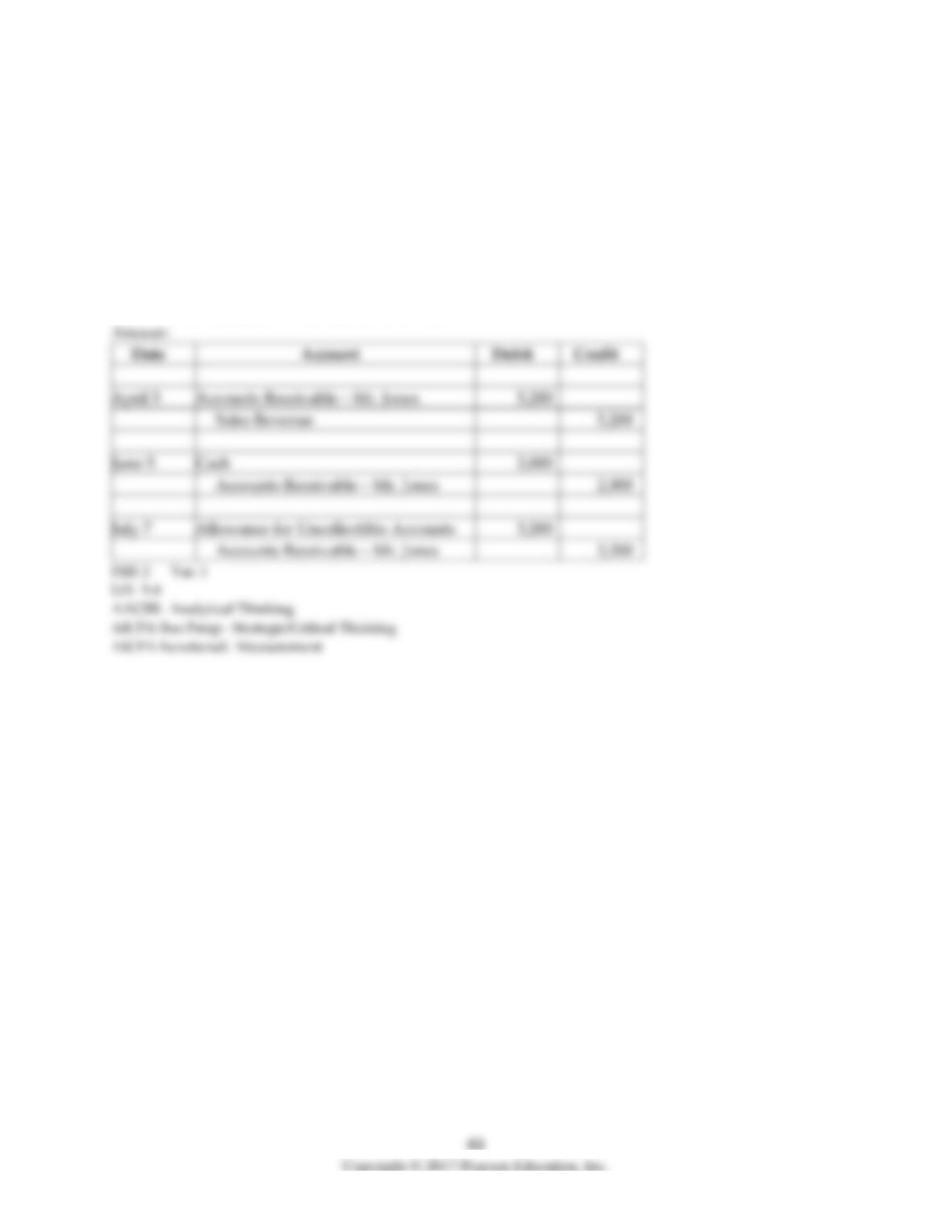
52) Journalize the following transactions for The Computer Store. The Computer Store uses the
allowance method of accounting for uncollectible receivables. Ignore Cost of Goods Sold Explanations
are not required.
April 5 The Computer Store sells $5,200 of computer equipment on account to Mr. Jones.
June 5 Mr. Jones pays The Computer Store $2,000 of the amount he owes.
July 7 After repeated attempts to collect the balance due from Mr. Jones fail, The Computer Store
writes-off the remainder of the amount he owes.
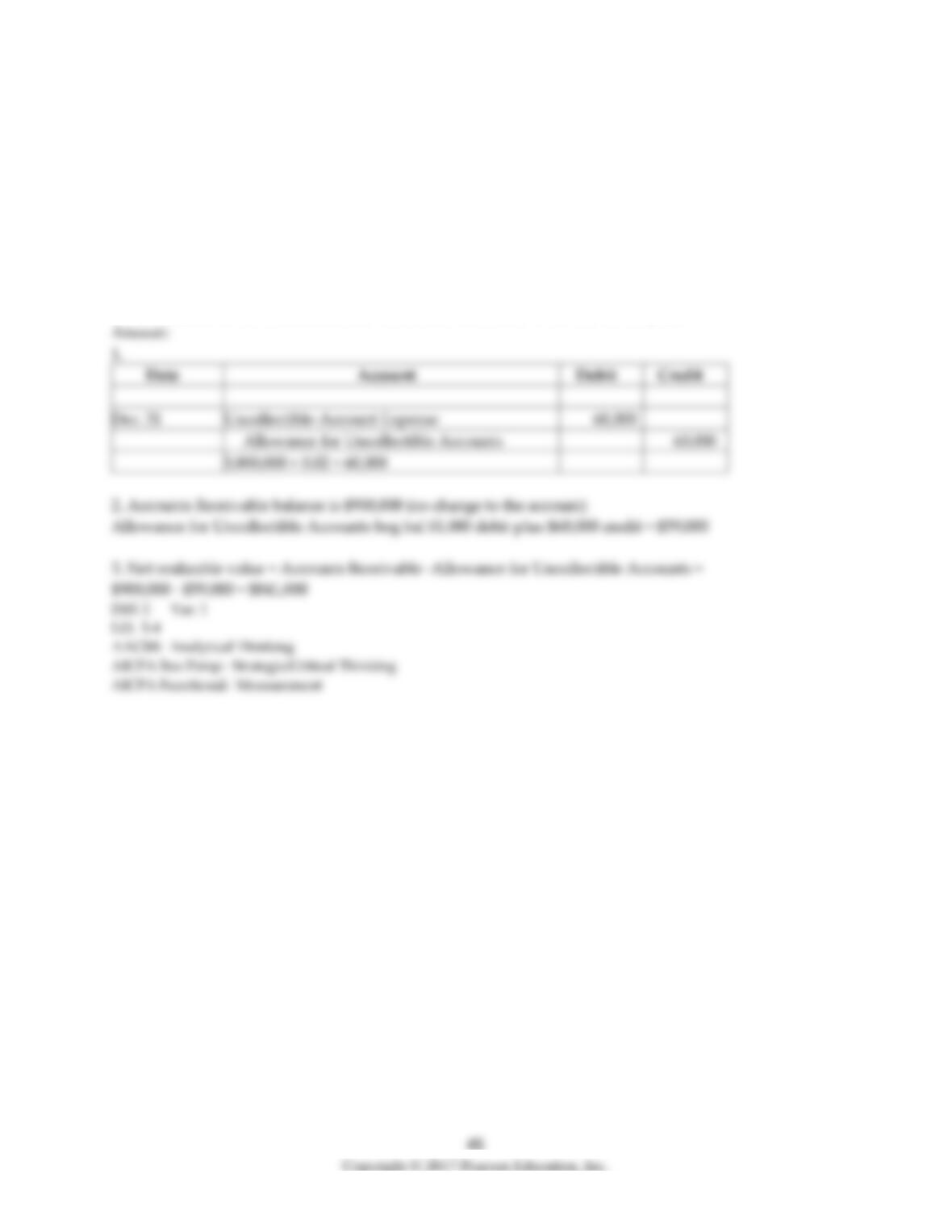
53) At the end of the current year, Accounts Receivable has a balance of $900,000, the Allowance for
Uncollectible Accounts has a debit balance of $1,000 and net credit sales for the year are $3,000,000.
Using the aging-of-receivables method, the balance of Allowance for Uncollectible Accounts is
estimated at $30,000.
Required:
Determine the net realizable value of accounts receivable at the end of the year.
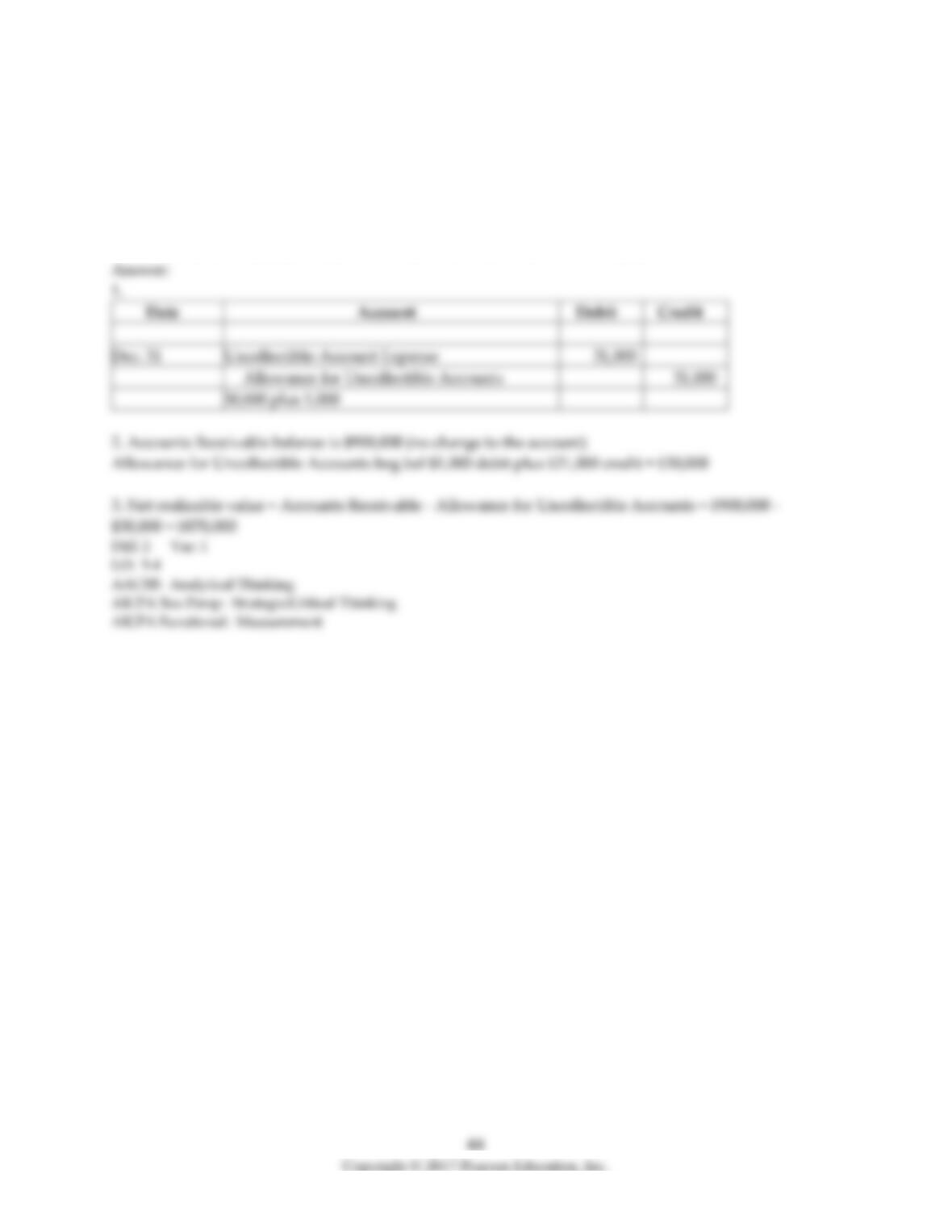
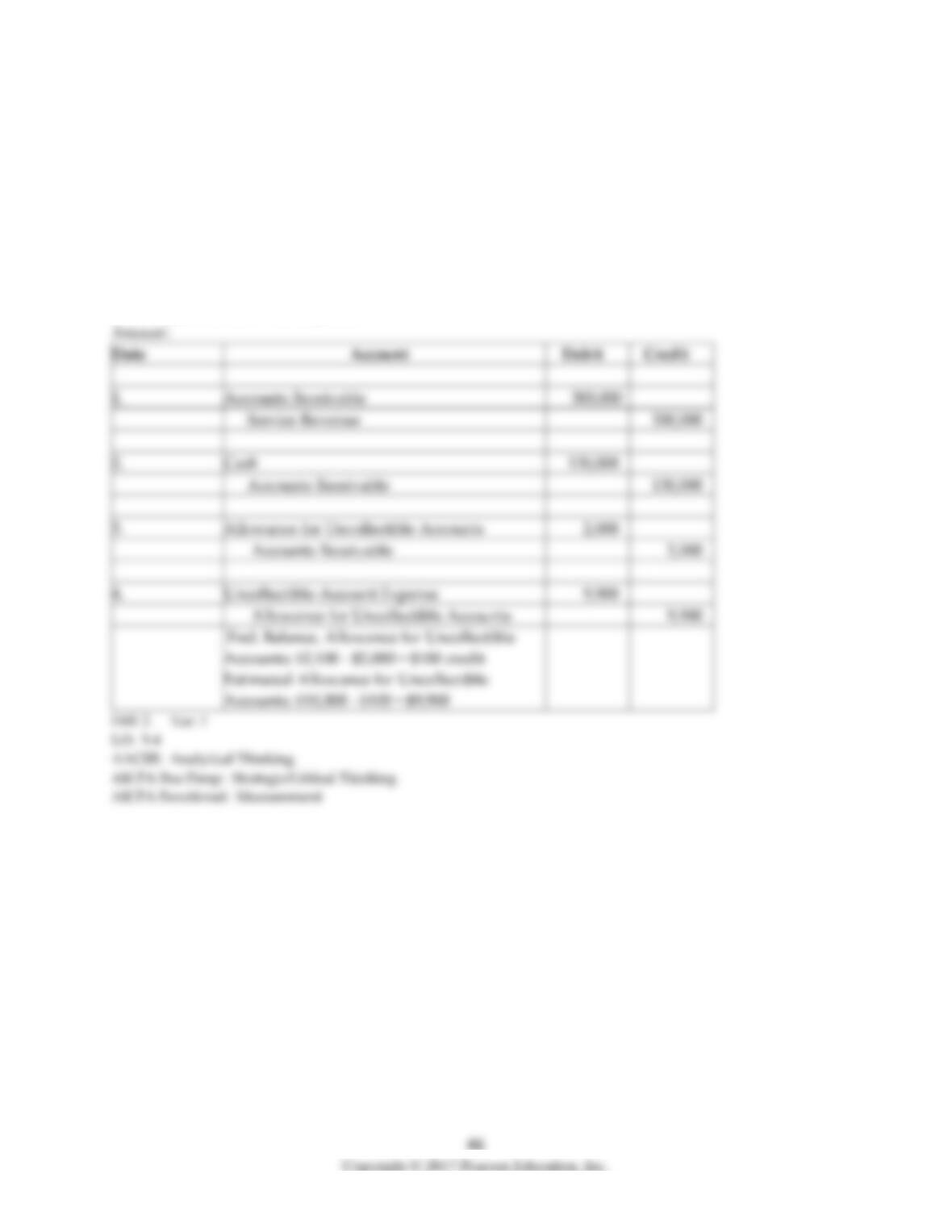
54) At the end of the current year, Accounts Receivable has a balance of $900,000, the Allowance for
Uncollectible Accounts has a debit balance of $1,000 and net credit sales for the year are $3,000,000. The
company uses the percent-of-sales method. Its credit department has determined that uncollectible
accounts will amount to 2% of net credit sales.
Required:
1. Prepare the year– end adjusting journal entry. Omit the explanation.
2. Determine the adjusted balances for Accounts Receivable and the Allowance for Uncollectible
Accounts.
3. Determine the net realizable value of accounts receivable at the end of the year.
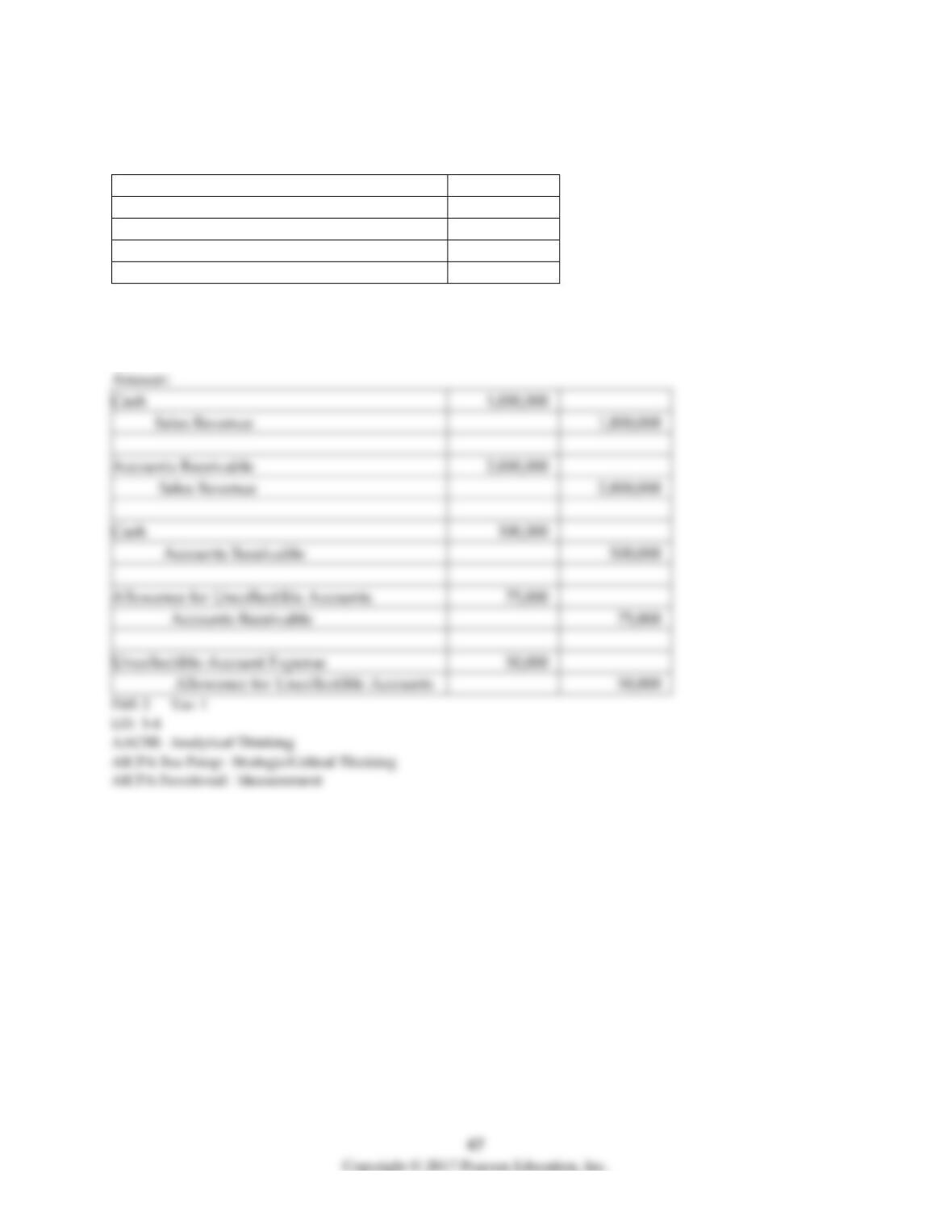
55) Johnsen Company earned service revenue on account of $300,000 and had cash collections of
$130,000 for the year. During the year, uncollectible accounts receivable of $2,000 were written off. At
December 31, an aging-of-accounts receivable schedule indicated that Johnsen Company will not collect
$10,000 of accounts receivable. There was a credit balance of $2,100 in the Allowance for Uncollectible
Accounts at the beginning of the year.
Required:
Journalize the entries to record (1) service revenue, (2) cash collections, (3)write-off of the uncollectible
receivables and (4) the adjusting entry to record Uncollectible-Account Expense. Ignore Cost of Goods
Sold. Explanations are not required.
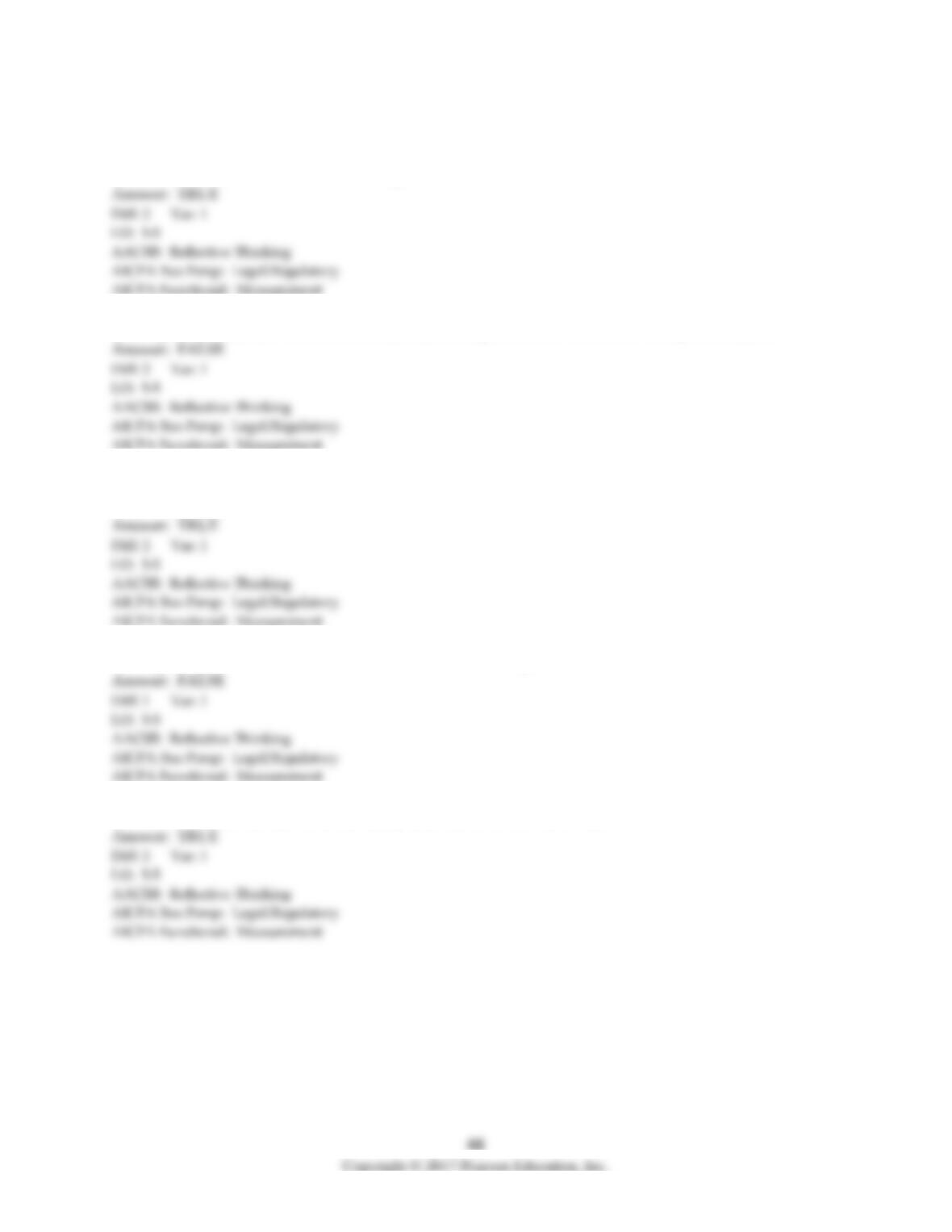
56) During its first year of operations, Ness Company had the following transactions. The company uses
the percent-of–sales method to estimate uncollectible accounts.
Cash Sales
$1,000,000
Credit Sales
$2,000,000
Collections on Account
$500,000
Write-offs of uncollectible accounts
$75,000
Uncollectible-Account Expense
2.5%
Required:
Prepare all journal entries for these transactions. Explanations are not required. Ignore Cost of Goods
Sold.
Cash
Accounts Receivable
Cash
500,000
Allowance for Uncollectible Accounts
Uncollectible-Account Expense
5 Learning Objective 5-5
1) The maker of a note records interest expense.
2) The principal amount of a note is the amount lent by the debtor and borrowed by the creditor.
3) The maturity value of a note is the sum of the principal amount of a note plus the interest over the
term of the note.
4) The principal amount of a note is the amount borrowed by the creditor.
5) Interest rates are always for an annual period unless stated otherwise.
6) On December 31, 2017, Sandy Company has a Note Receivable of $5000. The note will be collected in
installments. $1000 is due on December 31, 2018 and $1000 is due every year after December 31, 2018.
The classification of the note on Sandy Company’s balance sheet at December 31, 2017 is:
A) all $5000 is a current asset.
B) all $5000 is a long term asset.
C) $1000 is a current asset and $4000 is a long-term asset.
D) $4000 is a current asset and $1000 is a long-term asset.
7) A company borrows $10,700 from the bank at 13% interest for thirty days. $10,700 is the ________ of
the note. The maturity value of the note is ________. For computation of interest, use a 365 day year.
(Round your final answer to the nearest dollar.)
A) maturity value; $10,814
B) present value; $10,700
C) future value; $10,700
D) principal; $10,814
8) Regarding the two parties to a note, the:
A) creditor has a note receivable and the debtor has a note payable.
B) creditor has a note payable and the debtor has a note receivable.
C) creditor is also called the maker of the note.
D) debtor is also called the lender.
9) When a note matures:
A) the debtor must pay the creditor only the interest on the note.
B) the creditor must pay the debtor only the interest on the note.
C) the debtor must pay the creditor the maturity value of the note.
D) the creditor must pay the debtor the maturity value of the note.
10) A six months, 11% note for $14,000, dated April 15, is received from a customer. The maturity value
of the note is:
A) $770.
B) $14,000.
C) $14,770.
D) $15,540.
11) A debtor and a creditor record the same note, respectively, as a:
A) note receivable and note payable.
B) note receivable and account receivable.
C) note payable and note receivable.
D) note payable and account payable.
12) On May 1, 2017, Mary Smith signed a $8000 promissory note with Continental Bank. The note is due
in one year with 9% interest. What journal entry should the bank prepare on May 1, 2017?
A) Debit Cash for $8000 and credit Notes Payable for $8000.
B) Debit Notes Receivable for $8720 and credit Cash for $8720.
C) Debit Notes Receivable for $8000 and credit Cash for $8000.
D) Debit Cash for $8720 and credit Accounts Receivable for $8720.
13) Emporium Bank lends money to a customer on a six month note. What journal entry does the bank
prepare?
A) debit Note Receivable and credit Service Revenue
B) debit Cash and credit Note Payable
C) debit Note Receivable and credit Cash
D) debit Cash and credit Note Receivable
14) On October 1, 2017, the Early Bank lends money to a customer on a six month note. The bank
accrues interest on the note at December 31, 2017. The bank’s journal entry on December 31, 2017 would
include a:
A) debit to Cash and a credit to Interest Revenue for three months of interest.
B) debit to Cash and a credit to Interest Payable for three months of interest.
C) debit to Interest Receivable and a credit to Interest Revenue for three months of interest.
D) debit to Interest Revenue and a credit to Interest Receivable for three months of interest.
15) Fourth Company receives a note from a customer for a $6000 sale. On the date of sale, what journal
entry did Fourth Company prepare? Ignore cost of goods sold.
A) debit Accounts Receivable for $6000 and credit Sales Revenue for $6000
B) debit Notes Receivable for $6000 and credit Cash for $6000
C) debit Notes Receivable for $6000 and credit Sales Revenue for $6000
D) debit Cash for $6000 and credit Notes Receivable for $6000
16) If a company receives a note receivable on account, what journal entry is prepared?
A) debit Accounts Receivable and credit Notes Payable
B) debit Notes Receivable and credit Sales Revenue
C) debit Cash and credit Accounts Receivable
D) debit Notes Receivable and credit Accounts Receivable
17) The journal entry to record accrued interest on a note receivable at year end is:
A) debit Interest Receivable and credit Interest Revenue.
B) debit Note Receivable and credit Interest Revenue.
C) debit Interest Receivable and credit Note Receivable.
D) debit Cash and credit Interest Receivable.
18) Lennon Company signed a 12-month, $59,000, 9% note on June 1, 2017. The amount of interest to be
accrued on December 31, 2017, is: (Round your final answer to the nearest dollar.)
A) $443.
B) $2655.
C) $3098.
D) $5310.
19) The maturity value of a $53,000 note at 9% for 5 months is: (Round your final answer to the nearest
dollar.)
A) $53,000.
B) $54,988.
C) $55,385.
D) $57,770.
20) The maturity value of a 6 month, 7% note for $45,000, dated May 12 is: (Round your final answer to
the nearest dollar.)
A) $1575.
B) $45,000.
C) $48,150.
D) $46,575.
21) If the interest rate on a note is 10.5% and the principal was $60,000, what is the maturity value of the
note, if the term of the note is 7 months? (Round your final answer to the nearest dollar.)
A) $60,000
B) $63,675
C) $66,300
D) $62,625
22) On December 31, 2015, the lender on a $5800, 120-day,12% note dated November 5, 2015, will
recognize: (Use a 365 day year and round your final answer to the nearest dollar.)
A) interest receivable, $229.
B) interest receivable, $107.
C) interest payable, $229.
D) interest payable, $107.
23) The Watertown Bank lent Sandy’s Pastry Store $40,000 on a 4 month, 7% note dated May 31, 2017.
The fiscal year end of the bank is June 30. Round all amounts to the nearest dollar.
Required:
1. Determine the due date of the note.
2. Determine the maturity value of the note.
3. Prepare the journal entries made by the bank. Omit explanations.
24) On December 1, the Youngstown Company accepted a $8,000 note in settlement of an overdue
Accounts Receivable. The note bears 8% interest for 3 months. The Youngstown Company has a year
end of December 31.
Required:
Prepare the journal entries to record the (1) transaction on December 1, (2) the accrued interest at
December 31, and (3) the collection of the note on March 1. Round any amounts to the nearest dollar.
Omit explanations.
25) Following are key terms relating to notes receivable, as well as a list of definitions.
A. Creditor
B. Debtor
C. Interest
D. Maturity date
E. Maturity value
F. Principal
G. Term
________ 1. The amount of money borrowed by the debtor
________ 2. Another term for the lender
________ 3. The cost of borrowing money stated as an annual percentage rate
________ 4. The length of time from when the note was signed to when the note must be paid
________ 5. The maker of the note
________ 6. The date on which the debtor must pay the note
________ 7. The sum of the principal and the interest on the note
Required: Place the appropriate letter (A-G) on the line in front of the statement describing the term.
6 Learning Objective 5-6
1) Accepting credit cards can increase revenue for a company, but the added revenue comes at a cost.
2) When a company factors its receivables, accounts receivable will be debited.
3) Accounts receivable can be sold to a factor as a means of speeding up cash flows.
4) Cash that results from collections on account are reported as operating activities on the statement of
cash flows.
5) Factoring receivables is not as expensive as retaining the receivables on the books and ultimately
collecting the full amount from the customers.
6) A factor earns revenue by paying a discounted price for a receivable, and then, it is hoped, collecting
the full amount from the customer.
7) To shorten the collection period on credit sales, a company may:
A) emphasize credit card sales.
B) charge interest on unpaid customer accounts that exceed a certain age.
C) increase the discount offered for early payment.
D) all of the above.
8) On a statement of cash flows, collection of accounts receivable are classified as:
A) an financing activity.
B) an investing activity.
C) an operating activity.
D) noncash investing and financing activity.
9) Trevino Company has decided to factor its accounts receivable in order to get the immediate receipt
of cash. The journal entry to record the factoring of the receivables would include:
A) a debit to Accounts Receivable and a credit to Cash.
B) a debit to Cash and a credit to Accounts Receivable.
C) a debit to Cash, debit to Financing Expense and credit to Accounts Receivable.
D) a debit to Cash, credit to Interest Revenue and credit to Accounts Receivable.
10) Which of the following is a CORRECT statement regarding methods to speed up the collection of
cash from receivables?
A) Factoring is used frequently by companies since it is an inexpensive way to raise cash.
B) Credit card companies will charge a fee of 20-30% of the total amount of the sale.
C) The company that factors its receivables maintains control over the collection process.
D) Credit Card Discount Expense is reported on the income statement.
11) Selling accounts receivable typically:
A) decreases total assets and increases revenues.
B) decreases total assets and increases expenses.
C) increases total assets and increases revenues.
D) has no effect on total assets and decreases expenses.