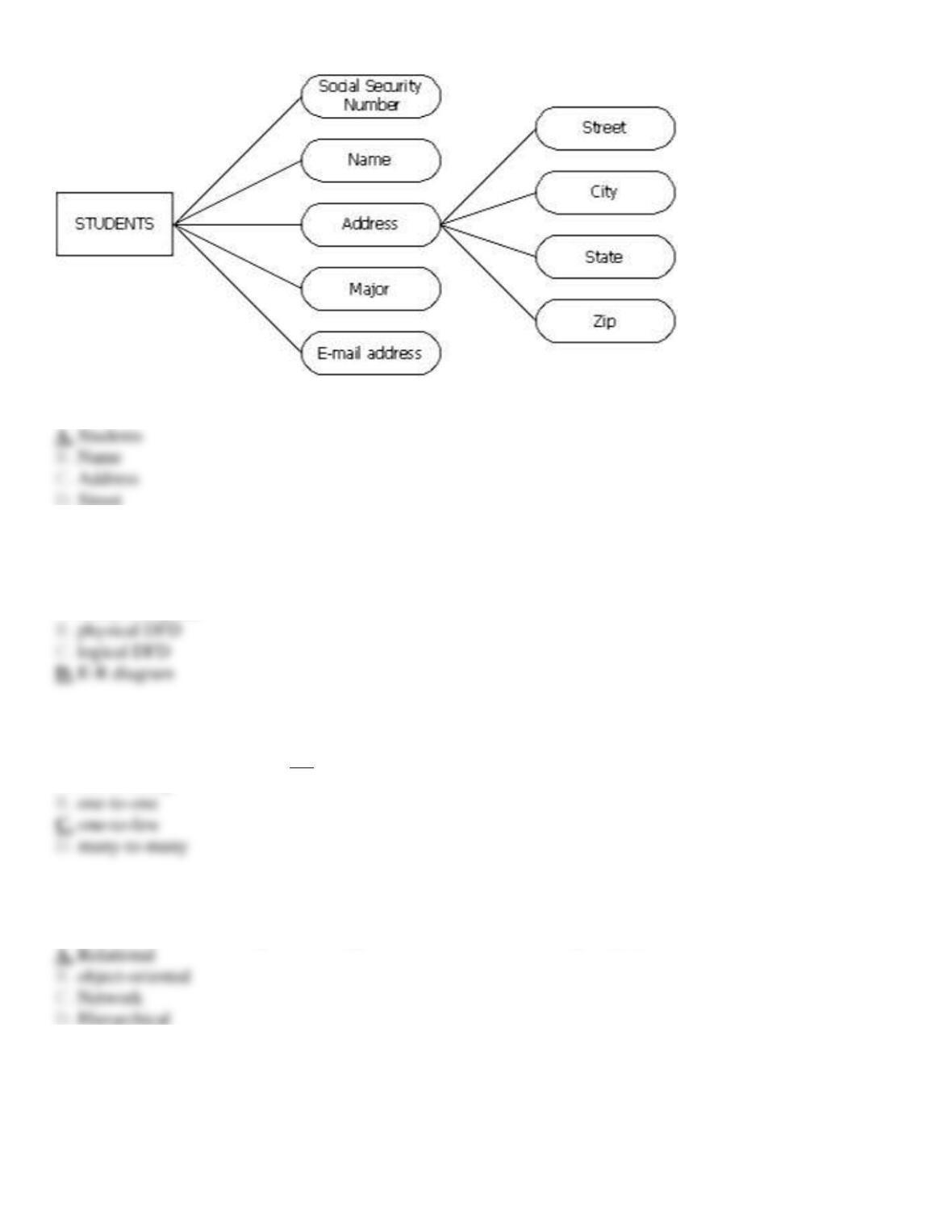
108. For the following diagram, which item is the entity?
109. The mapping of the relationships between entities would be used in the development of a(n):
A. context diagram
110. Which of the following is not a relationship type?
A. one-to-many
111. Which of the following database types has dominance in contemporary systems?
112. Each relationship in an E-R diagram has a ____ that shows the degree to which each entity participates in
the relationship.
A. maximum cardinality
113. A decision maker prepares a presentation in a suitable format for a given decision at a given point in time
when using a(n):
A. neural network (NN)
114. The principal difference between an executive information system (EIS) and a decision support system
(DSS) is that an EIS:
115. The information system which emulates the problem-solving techniques of humans is called a(n):
A. executive information system (EIS)
117. The computer-based system of hardware and software that mimics the human brain’s ability to recognize
patterns or predict outcomes using less-than-complete information is referred to as:
A. group support systems
118. A software program that may be integrated into DSS or other software tools is a(n):
A. group support systems
119. A meaningful change in the state of an enterprise such as hiring employees, purchasing inventory, and
collecting cash from customers are called ______________________________.
120. The ______________________________ approach to database design attempts to describe all aspects of
the business events and processes under consideration.
121. Analyzing collected historical data with multidimensional analytic tools and exploratory techniques is
called ______________________________.
122. Primary key ______________________________ in a relational table must be a unique identifier for a
row.
123. In the ______________________________ to business event processing, each application collects and
manages its own data.
124. A(n) ______________________________ depicts the fields comprising a record.

125. ______________________________ is the process of grouping or categorizing data according to common
attributes.
126. Another name for sequential coding is ______________________________ coding.
127. The uniform product codes (UPCs) used by supermarkets and other retailers are examples of a(n)
______________________________ coding scheme.
128. ______________________________ coding schemes attach specific meaning to particular character
positions by ordering items in descending order where each successive rank order is a subset of the rank above
it.
129. Because it uses alphabetic characters, a(n) ______________________________ coding system makes it
easier for human beings to remember the codes.
130. A(n) ______________________________ is a code that includes an extra digit that can be used to check
the accuracy of the code.
131. The ______________________________ approach to business event processing concentrates on the
process being performed, with data playing a secondary or supportive role to the programs.
132. A(n) ______________________________ is a set of integrated programs designed to simplify the tasks of
creating, accessing, and managing a database.

133. Decoupling the data from the system applications is called ______________________________.
134. Systems that decouple data from system applications are often referred to as having
______________________________ architecture.
135. The way a user thinks of data in a database is called the user’s ______________________________.
136. The ______________________________ is the way data is actually stored on computer hardware.
137. A description of a portion of a schema is referred to as a(n) ______________________________.
138. A(n) ______________________________ language is used to access a database and to produce inquiry
reports.
139. ______________________________ is the use of information systems facilities to focus on the collection,
140. ______________________________ refers to the exploration, aggregation, and analysis of large quantities
of varied data from across the organization.
141. ______________________________ is the most popular data modeling approach.

142. In developing a data model, the term ______________________________ describes an association
between entities.
143. A(n) ______________________________ depicts user requirements for data stored in a database.
144. A(n) ______________________________ allows non-technical users to bypass the programmer and to
access the database directly.
145. ______________________________ is another name for query language.
146. A(n) ______________________________ uniquely identifies any row within a relational table.
147. Database table ______________________________ each store one specific attribute of the type of things
stored in a table.
148. In a(n) ______________________________ database model, records are organized in a pyramid
structure.
149. In a(n) ______________________________ database model, a child record may have more than one
parent.

150. In a(n) ______________________________ database model, data are logically organized into two–
dimensional tables.
151. A(n) ______________________________ database model allows both simple and complex objects,
including video clips and pictures, to be stored.
152. The goal of ______________________________ is to produce a database model that contains
relationships that are in 3NF.
153. An attribute is ______________________________ on a second attribute if the value for the first attribute
determines a value for the second attribute at any time.
154. A(n) ______________________________ happens when an attribute is dependent on a portion of the
primary key not on the entire key.
155. A(n) ______________________________ table contains repeating attributes (or fields) within each row
(or record).
156. A relation is in ______________________________ if it does not contain repeating groups.
157. ______________________________ are problems in a relation table caused by the existence of functional
dependencies.

158. A table is in ______________________________ if it is in first normal form and no non-key attribute is
dependent on only a portion of the primary key.
159. A(n) ______________________________ is the attribute whose value is unique for every entity that will
appear in the database.
160. ______________________________ is a measure of the highest level of participation that one entity can
have in another entity.
161. In set theory, a two-dimensional collection of information is called a(n)
______________________________.
162. A(n) ______________________________ is an information system that assists managers with
unstructured decisions by retrieving and analyzing data for purposes of identifying and generating useful
information.
163. A(n) ______________________________ is mainly about collecting and presenting information and less
about doing additional processing and calculations.

164. A(n) ______________________________ is a computer-based system that supports collaborative
intellectual work such as idea generation, elaboration, analysis, synthesis, information sharing, and decision
making.
165. A computer’s ability to imitate human decision making when confronting situations that are complex and
ambiguous is called ______________________________.
166. A(n) ______________________________ can be used to capture and retain the expertise of retiring
employees.
ES
167. A(n) ______________________________ is a software program integrated into a decision support system
or other software tool that can perform tasks without further direction from the user.
168. A(n) ______________________________ is a computer hardware and software system that mimics the
human brain’s ability to recognize patterns or predict outcomes using less-than-complete information.
169. ______________________________ is the process of capturing, storing, retrieving, and distributing the
knowledge of the individuals in an organization for use by others in the organization to improve the quantity
and efficiency of decision making.

170. ______________________________ is a method for freely and creatively generating as many ideas as
possible without undue regard for their practicality or realism.
171. List 1 shows the coding schemes discussed and illustrated in Chapter 5, while List 2 contains eight coding
examples.
List 1 –
Coding
Schemes
A.
Sequential (serial)
D.
Hierarchical
B.
Block
E.
Mnemonic
C.
Significant digit
F.
Check digit

List 2 –
Coding
Examples
1.
Sue Smith is taking three college courses
this semester¾AC 340, FI 101, and EN
280. When you check with the Registrar’s
Office, you learn that Sue is enrolled in
Accounting Information Systems,
Principles of Finance, and English
Literature.
2.
Pat Conroy’s ZIP code is 29902. The first
digit shows that Pat resides in South
Carolina. The last two digits (02) indicate
that he lives in the town of Beaufort, which
is located in Beaufort County¾designated
by the digits 99.
3.
Joe Langdon was the 151st employee hired
by Acme Company. His employee ID
number is 151.
4.
The uniform product code for an 18-ounce
jar of Peter Pan Smart Choice peanut butter
is 45300 00227, while the 28-ounce size of
the same product has a code of 45300
00220. Both are manufactured by Hunt-
Wesson, Inc., as indicated by the first five
digits (45300) of the UPC.
5.
Will Wodger’s charge account number with
J. C. Penney Co. is 923456-7. The 7 on the
end of the number was generated by a
computer algorithm in order to verify the
accuracy with which the first six digits
(923456) are keyed into the computer.
6.
Part of Xylox, Inc.’s general ledger chart of
accounts reveals the following:
Acc. #
Account Title
1111
Petty Cash
1112
Change Fund
1113
Cash in Bank
1121
Trade Account Receivables
You learn from the company’s controller
that the account numbers mean the
following:
First digit –
1XXX
Assets
Second digit –
1XX
Current Assets
Third digit –
1X
Current Asset Type (1X = Cash; 2X = Receivables)
Fourth digit –
1
Specific account
7.
An example of a customer number at Fixit’s
Hardware is 1 0 3 548, where:
1
=
Retail or wholesale customer
0
=
Sales tax or not (1 = tax; 0 = no tax)
3
=
Sales tax code (used to look up the tax rate)
548
=
Unique identifier of a specific customer
8.
Rachel Rigby’s employee number is AFP-
293. Rachel works in the Assembly
Department (A), is a full-time employee
(F), and is paid on a piecework basis (P).
The 293 is her unique identifier.
Required:
On your solution sheet, list the numbers 1 through 8 from List 2. Next to each number, show the capital letter from List 1 that best describes the
coding type represented by each example. HINT: Some letters from List 1 may be used for more than one coding example, while some letters may
not be used at all.
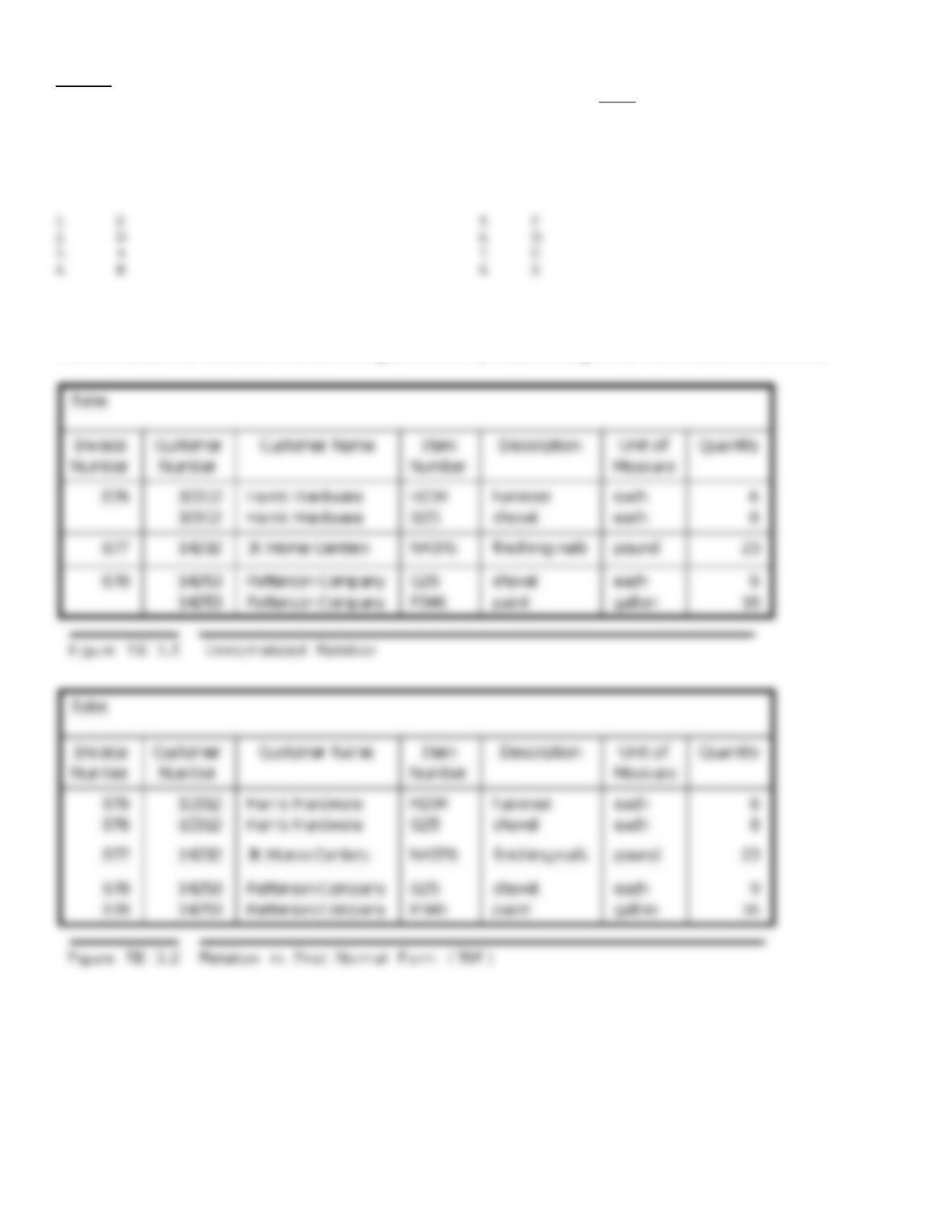
172. Normalize the database structure in Figure TB 5.1 by transforming it into first normal form (1NF).
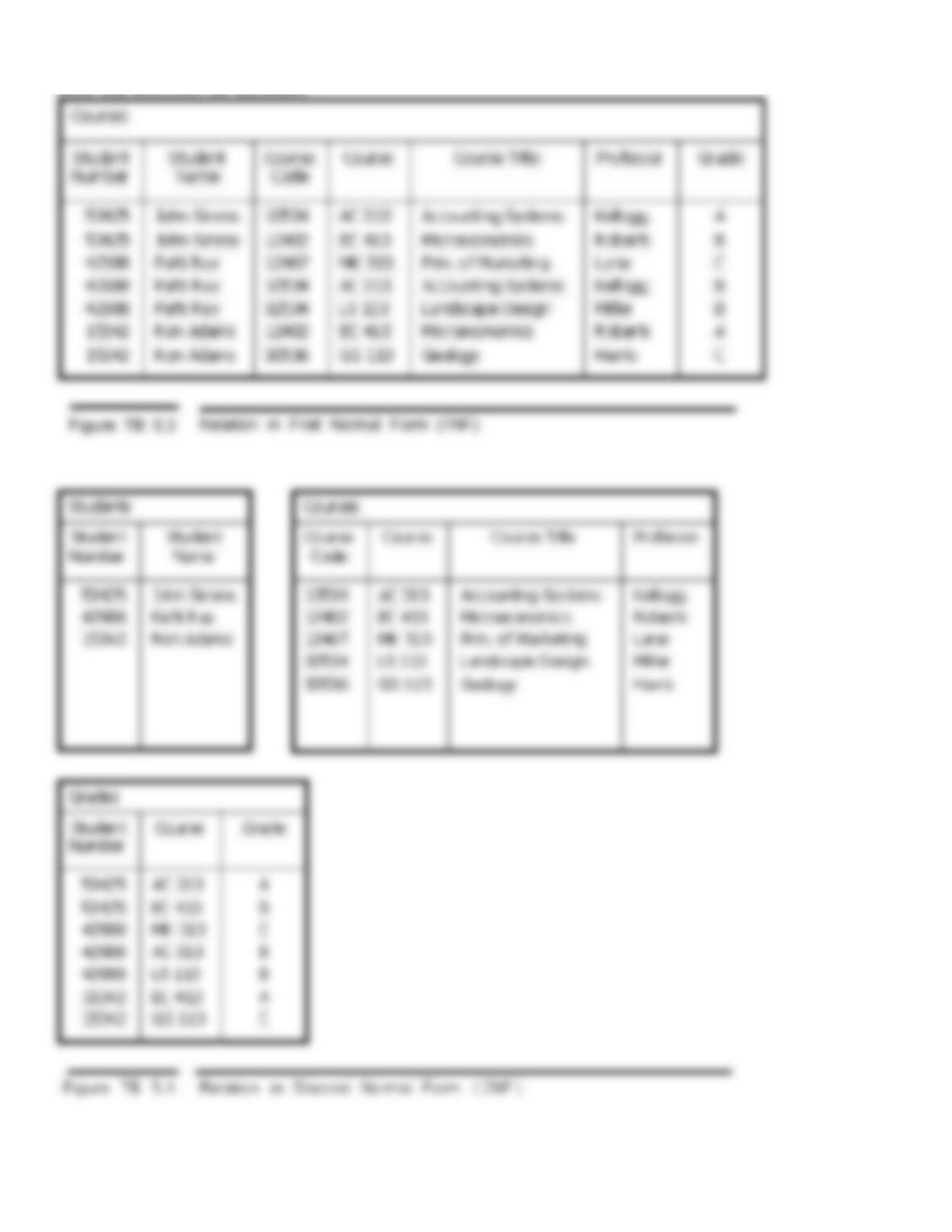
173. Transform the relation in Figure TB 5.3 to second normal form (2NF). Label each new relation with a
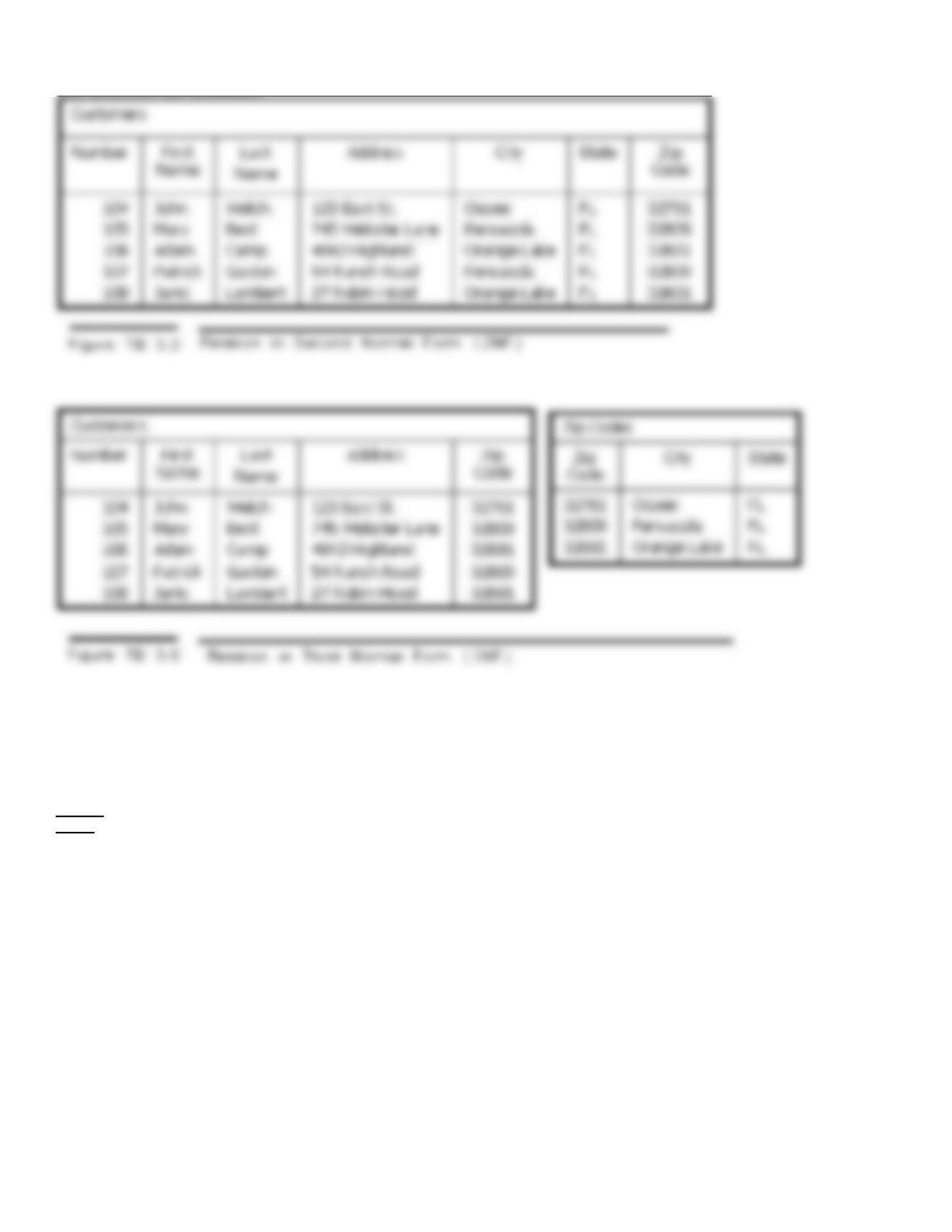
174. Transform the relation in Figure TB 5.5 to third normal form (3NF). Label each new relation with a name
that describes the attributes.
175. Given the following:
List 1 –
Terms
A.
data mining
F.
group support system
B.
data warehousing
G.
intelligent agent
C.
decision support system
H.
knowledge management
D.
executive information system
I.
neural network
E.
expert system
List 2 –
Descripti
ons
1.
This applies expertise extracted from a human expert to provide specific recommendations on problems or decisions.
2.
These systems are mainly about collecting and presenting information and often have the ability to drill down.
3.
This is a computer hardware and software system that mimics the human brain’s ability to recognize patterns or predict outcomes using
less-than-complete information.
4.
This is a computer-based system that supports collaborative intellectual work such as idea generation, elaboration, analysis, synthesis,
information sharing, and decision making.
5.
This is a software program that may be integrated into a decision support system or other software tool (such as word processing,
spreadsheet, or database packages).
6.
A spreadsheet is a typical component of this system.
7.
This is the process of capturing, storing, retrieving, and distributing the knowledge of the individuals in an organization for use by
others in the organization to improve the quality and efficiency of decision making across the firm.
8.
This is the use of information systems facilities to focus on the collection, organization, integration, and long-term storage of entity-
wide data.
9.
This is used to better understand an organization’s business processes, trends within these processes, and potential opportunities to
improve the effectiveness and efficiency of the organization.
Required:
On your solution sheet, list the numbers 1 through 9 from List 2. Next to each number, show the capital letter from List 1 that best fits the description
from List 2.
1.
E
6.
C
2.
D
7.
H
3.
I
8.
B
4.
F
9.
A
5.
G