Chapter 05 Cost-Volume-Profit Relationships Answer Key
True / False Questions
1.
Incremental analysis is generally the most complicated and least direct approach to
decision making.
2.
One assumption in CVP analysis is that the number of units produced and sold does not
change.
3.
Reynold Enterprises sells a single product for $25. The variable expense per unit is $15
and the fixed expense per unit is $5 at the current level of sales. The company’s net
operating income will increase by $10 if one more unit is sold.
4.
One way to compute the total contribution margin is to deduct total fixed expenses from
net operating income.
5.
On a cost-volume-profit graph, the revenue line will be shown below the total expense line
for any activity level above the break-even point.
6.
If sales volume decreases, and all other factors remain unchanged, the contribution
margin ratio will decrease.
7.
The impact on net operating income of a given dollar change in sales can be computed by
multiplying the contribution margin by the dollar change in sales.
8.
In two companies making the same product and with the same total sales and total
expenses, the contribution margin ratio will be higher in the company with a higher
proportion of fixed expenses in its cost structure.
9.
At the break-even point, the total contribution margin and fixed expenses are equal.
10.
All other things the same, an increase in total fixed expenses will increase the break-even
point.
11.
All other things the same, a reduction in the variable expense per unit will decrease the
break-even point.
12.
All other things the same, an increase in variable expense per unit will reduce the break-
even point.
13.
For a capital intensive, automated company the break-even point will tend to be higher
and the margin of safety will be lower than for a less capital intensive company with the
same sales.
14.
The unit sales volume necessary to reach a target profit is determined by dividing the sum
of the fixed expenses and the target profit by the contribution margin per unit.
15.
The margin of safety in dollars equals the excess of actual sales over budgeted sales.
16.
All other things the same, if the fixed expenses increase in a company then one would
expect the margin of safety to increase.
17.
As total sales increase beyond the break-even point, the degree of operating leverage will
decrease.
18.
If two companies produce the same product and have the same total sales and same total
expenses, operating leverage will be higher in the company with a higher proportion of
fixed expenses in its cost structure.
19.
The degree of operating leverage in a company is largest at the break-even point and
decreases as sales rise.
20.
All other things the same, in periods of increasing sales, net operating income will tend to
increase more rapidly in a company with high fixed costs and low variable costs than in a
company with high variable costs and low fixed costs.
21.
The overall contribution margin ratio for a company producing three products may be
obtained by adding the contribution margin ratios for the three products and dividing the
total by three.
Multiple Choice Questions
22.
Contribution margin is the amount remaining after:
23.
If a company decreases the variable expense per unit while increasing the total fixed
expenses, the total expense line relative to its previous position will:
24.
The contribution margin ratio is equal to:
25.
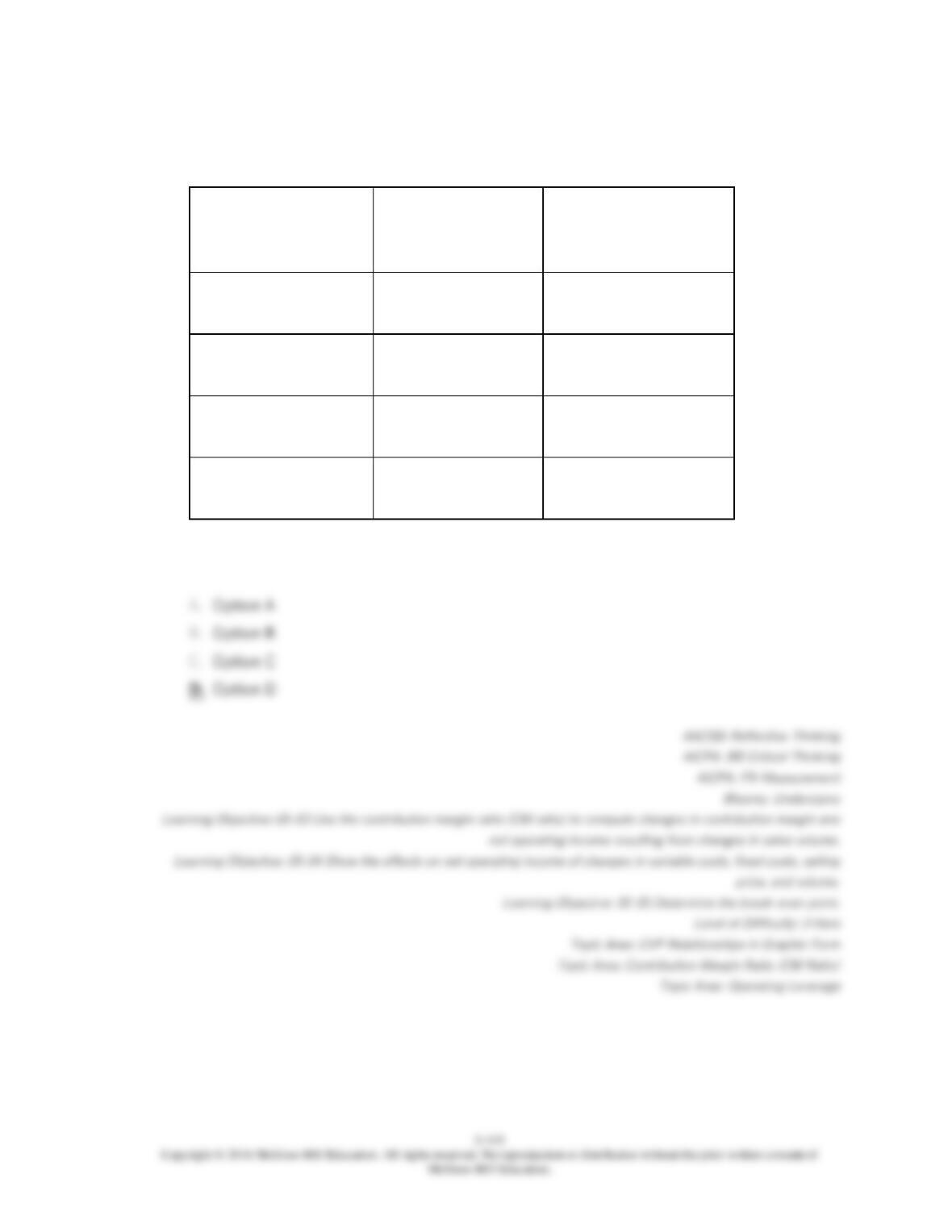
Garth Corporation sells a single product. If the selling price per unit and the variable
expense per unit both increase by 10% and fixed expenses do not change, then:
Contribution
margin per unit
Contribution
margin ratio
Break-even
in units
Increases
Increases
Decreases
No change
No change
No change
No change
Increases
No change
Increases
No change
Decreases
26.
Assume a company sells a single product. If Q equals the level of output, P is the selling
price per unit, V is the variable expense per unit, and F is the fixed expense, then the
break-even point in sales dollars is:
27.
The break-even in units sold will decrease if there is an increase in:
28.
Which of the following is NOT a correct definition of the break-even point?
29.
The margin of safety is:
30.
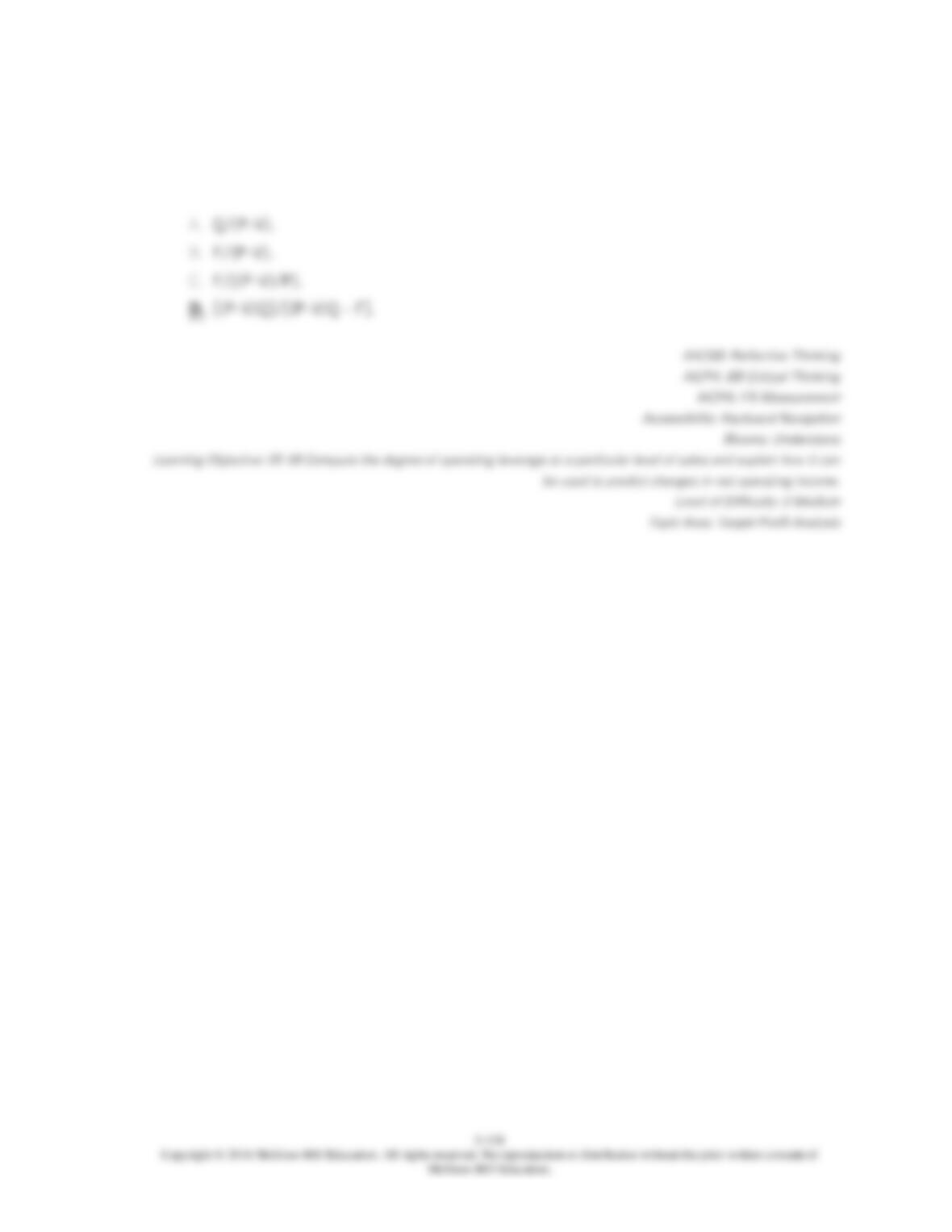
If Q equals the level of output, P is the selling price per unit, V is the variable expense per
unit, and F is the fixed expense, then the degree of operating leverage is equal to:
31.
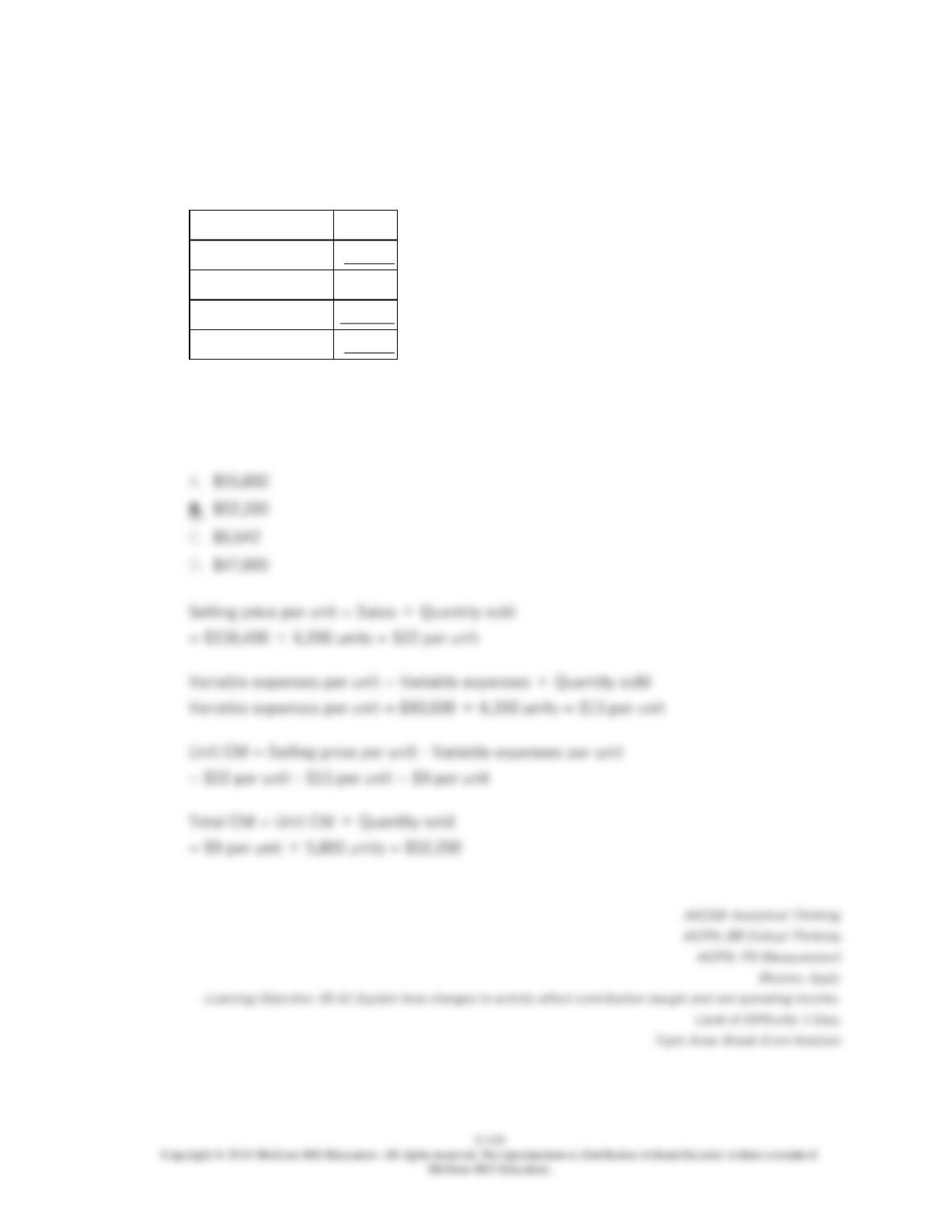
Brees Inc., a company that produces and sells a single product, has provided its
contribution format income statement for April.
Sales (6,200 units)
$136,400
Variable expenses
80,600
Contribution margin
55,800
Fixed expenses
48,700
Net operating income
$7,100
If the company sells 5,800 units, its total contribution margin should be closest to:
32.
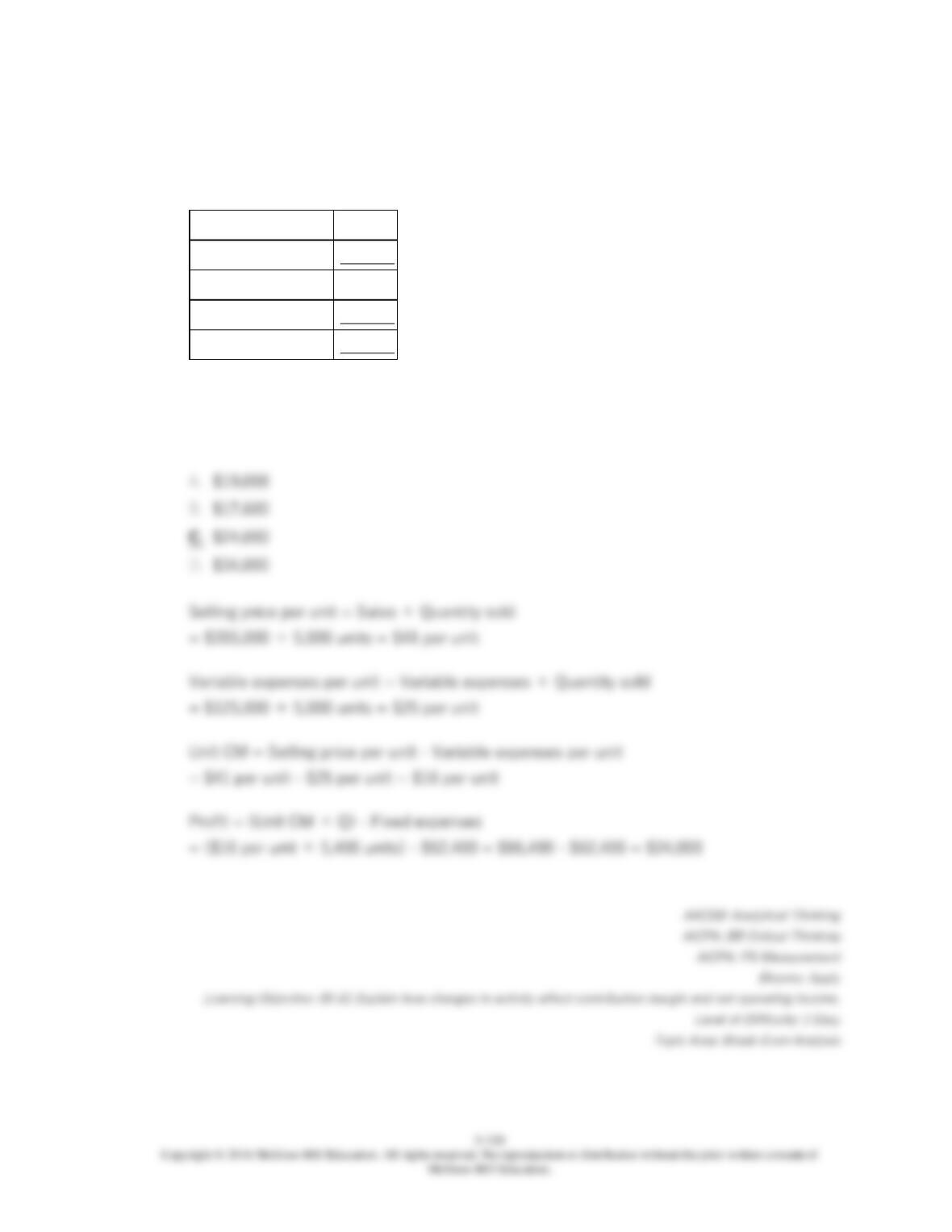
Ofarrell Corporation, a company that produces and sells a single product, has provided its
contribution format income statement for March.
Sales (5,000 units)
$205,000
Variable expenses
125,000
Contribution margin
80,000
Fixed expenses
62,400
Net operating income
$17,600
If the company sells 5,400 units, its net operating income should be closest to:
33.
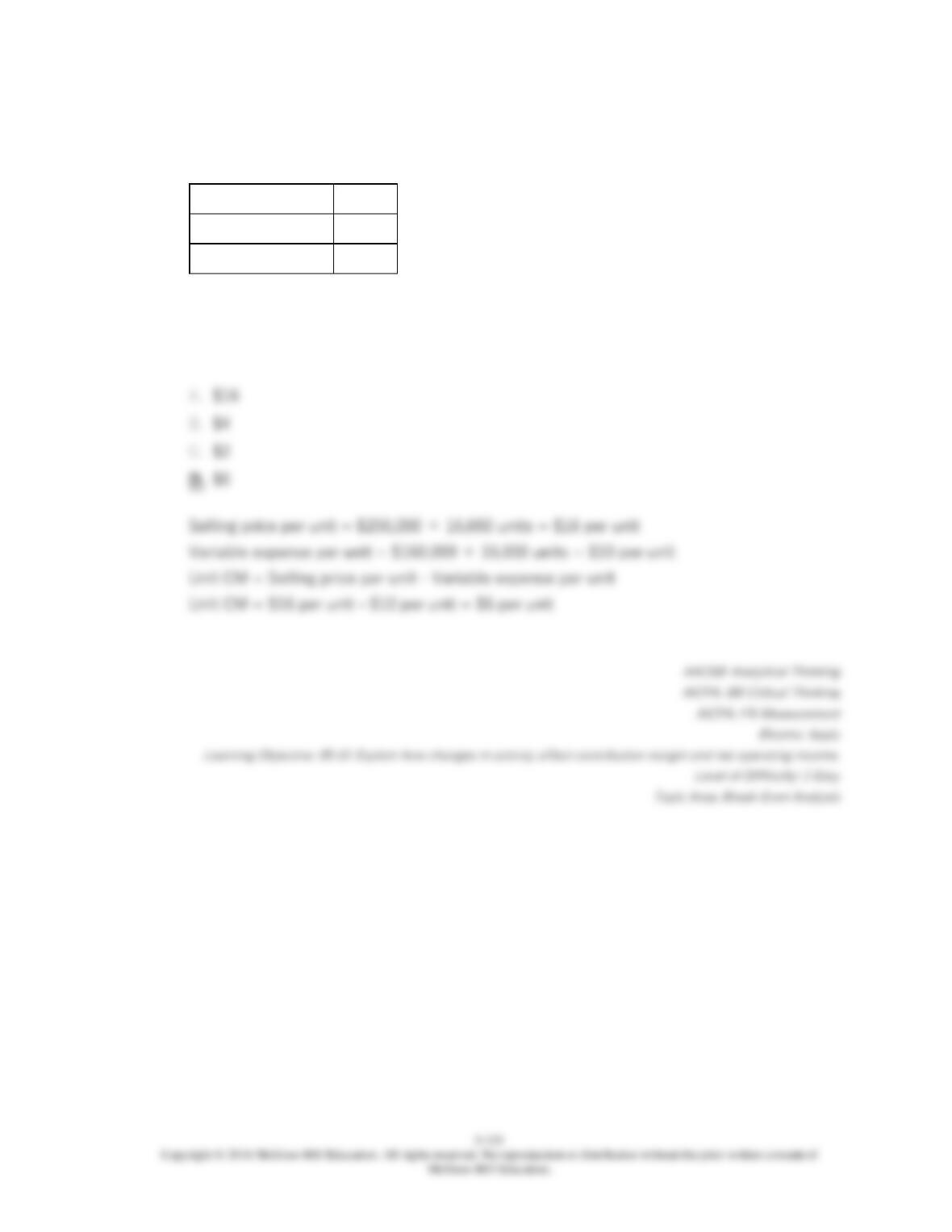
The records of the Dodge Corporation show the following results for the most recent year:
Sales (16,000 units)
$256,000
Variable expenses
$160,000
Net operating income
$32,000
Given these data, the unit contribution margin was:
34.
Florek Inc. produces and sells a single product. The company has provided its contribution
format income statement for March.
Sales (5,700 units)
$228,000
Variable expenses
131,100
Contribution margin
96,900
Fixed expenses
86,300
Net operating
income
$10,600
If the company sells 5,900 units, its net operating income should be closest to:
35.
Spartan Systems reported total sales of $300,000, at a price of $20 and per unit variable
expenses of $12, for the sales of their single product.
Total
Per Unit
Sales
$300,000
$20
Variable expenses
180,000
12
Contribution margin
120,000
$8
Fixed expenses
100,000
Net operating income
$20,000
What is the amount of contribution margin if sales volume increases by 30%?
36.
Lepage Corporation has provided its contribution format income statement for January.
The company produces and sells a single product.
Sales (4,400 units)
$211,200
Variable expenses
127,600
Contribution margin
83,600
Fixed expenses
66,400
Net operating income
$17,200
If the company sells 4,700 units, its total contribution margin should be closest to:
37.
At a break-even point of 800 units sold, White Corporation’s variable expenses are $8,000
and its fixed expenses are $4,000. What will the Corporation’s net operating income be at
a volume of 801 units?