Accounting Information Systems, 2e (Kay/Ovlia)
Chapter 5 Business Processes: Purchasing, Sales, and Payroll Cycles
Objective 1
1) In a gap analysis, the gap between the baseline modules and the customization required to
meet enterprise-specific needs is analyzed.
2) The advantage to the stages approach to customizing an accounting system is that the new
system goes “live” all at once.
3) A disadvantage to the stages approach to customizing an accounting system is time line for the
project may seem prolonged.
4) The stages approach to customization involves customizing and installing customer, vendor,
employee, and remaining modules for the entire enterprise at the same time.
5) When customizing an accounting system, order in which work is performed must be
considered.
6) Programming to customize the baseline system carry forward into later versions, saving some
enterprises millions of dollars for customizations that do not need to be abandoned or redone.
7) Each step in the business process and workflow must be documented.
8) As business processes for a new system are planned, workflow management is not considered.
9) Customizing a baseline accounting system can prove costly with unexpected cost overruns
and delays.
10) By changing business processes to match the baseline system, a company can expect to
increase the need for custom programming.
11) A ________ identifies the differences between the baseline modules and the customization
required to meet enterprise-specific needs.
12) The ________ approach to customization involves customizing and installing customer,
vendor, employee, and remaining modules for the entire enterprise at the same time.
13) The biggest disadvantage to the ________ approach is that the new system goes live all at
once.
14) The enormity of installing an enterprise system for a huge enterprise can be overwhelming in
terms of resources and ________.
15) The ________ approach customizes one module or geographic location at a time, stage by
stage, until the entire enterprise has been converted to the new system.
16) The advantage to the ________ approach is the ability to test and resolve issues on a smaller
scale.
17) The disadvantage to the ________ approach is that the time line for such a project may seem
prolonged.
18) Whether you use the big bang or stages approach when customizing an accounting system,
________ must be considered.
19) ________ provides a workflow management system that automatically forwards documents
to the next user in the workflow.
20) Each step in the business process and workflow must be documented using a(n) ________.
21) A system that automates workflow by automatically forwarding the electronic document to
the next step in the business process is called a ________.
22) A gap analysis is done to
A) Identify the company’s current business processes
B) Help employees adjust to the new system
C) Compare the baseline accounting system to the customized accounting system that meets the
company’s needs
D) Conform business processes to regulatory requirements
23) The customization approach that involves customizing one module at a time is called
A) Gap analysis
B) Stages
C) Workflow management
D) Big bang
24) The customization approach that involves the system going “live” all at once is called
A) Gap analysis
B) Stages
C) Workflow management
D) Big bang
25) What is the big bang approach to customizing an accounting system? What are the
advantages and disadvantages?
26) What is the stages approach to customizing an accounting system? What are the advantages
and disadvantages?
27) What is a workflow management system? Provide an example.
1) When data flow is shown going into or from a database table, data will be entered, updated,
and retrieved using database field contents within the table.
2) A database designer or other IT professional, may want to put the customer balance as a field
in the Sales Receipts table to speed up retrieval.
3) One advantage to using ________ is simplicity.
4) As business processes for a new system are planned, ________ management is also
considered.
5) When ________ is shown going into or from a database table, data will be entered, updated,
and retrieved using database field contents within the table.
6) What are the pools and swim lanes in the Nice Lawn Sales Narrative?
A) Swim lanes: Customer, Accounting, Warehouse, Data; Pool: Nice Lawn
B) Swim lanes: Customer, Credit Card Company, Warehouse; Pool: Data
C) Swim lanes: Bank, Warehouse, Credit Card Company; Pool: Credit Card Company and Data
D) Swim lanes: Nice Lawn, Bank, Warehouse, Data; Pool: Bank
7) What are the activities in the Nice Lawn Sales Narrative?
A) Verify customer’s credit, Authorize shipping, Verify item availability, Generate invoice
B) Verify customer’s credit, Verify item availability, Update the database tables, Generate
invoice
C) Process customer order, Authorize shipping, Package items, Ship items, Notify Accounting
items shipped, Generate invoice
D) Receive customer’s order, Verify customer’s credit, Ship items, Notify Accounting items
shipped, Generate invoice, Update database tables
8) What are the datastores (database tables) in the Nice Lawn Sales Narrative?
A) Item, Sales Order, Vendor, Sales Order Line
B) Customer, Item, Sales Order, Sales Order Line
C) Customer, Vendor, Invoice
D) Customer, Price, Item, Invoice, Invoice Line

9) What are the decision points in the Nice Lawn Sales narrative?
A) Verify Customer Identity, Verify Item Availability, Verify Customer Credit
B) Verify Customer Purchase Verify Item Availability, Verify Shipping
C) Verify Customer Identity, Verify Shipping Authorization, Verify Customer Address
D) Verify Customer Identity, Verify Package Items, Verify Customer Address
10) When recording a customer payment, which table is usually NOT used?
A) Customer table
B) Cash Receipts table
C) Sales Order table
D) Sales Order Line table
11) When depositing a customer payment, which table is usually NOT used?
A) Cash Account table
B) General Ledger table
C) Sales Order table
D) Customer table
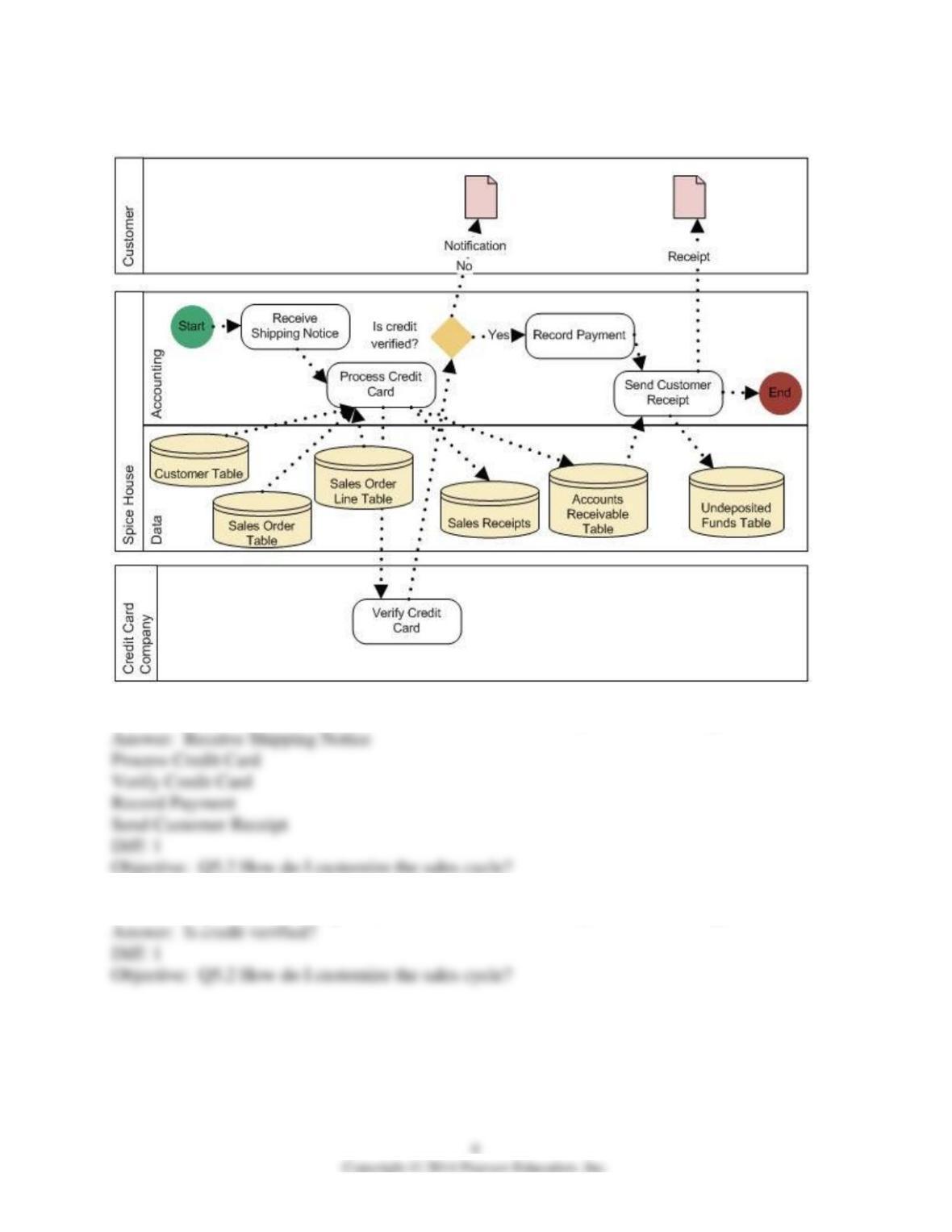
Spice House Receive Customer Payment BPMN
12) List the activities in the Spice House Receive Customer Payment BPMN diagram.
13) List the gateways in the Spice House Receive Customer Payment BPMN diagram.
14) List the database tables in the Spice House Receive Customer Payment BPMN diagram.
15) Create a business process map organizer for Spice House Receive Customer Payment BPMN
diagram.
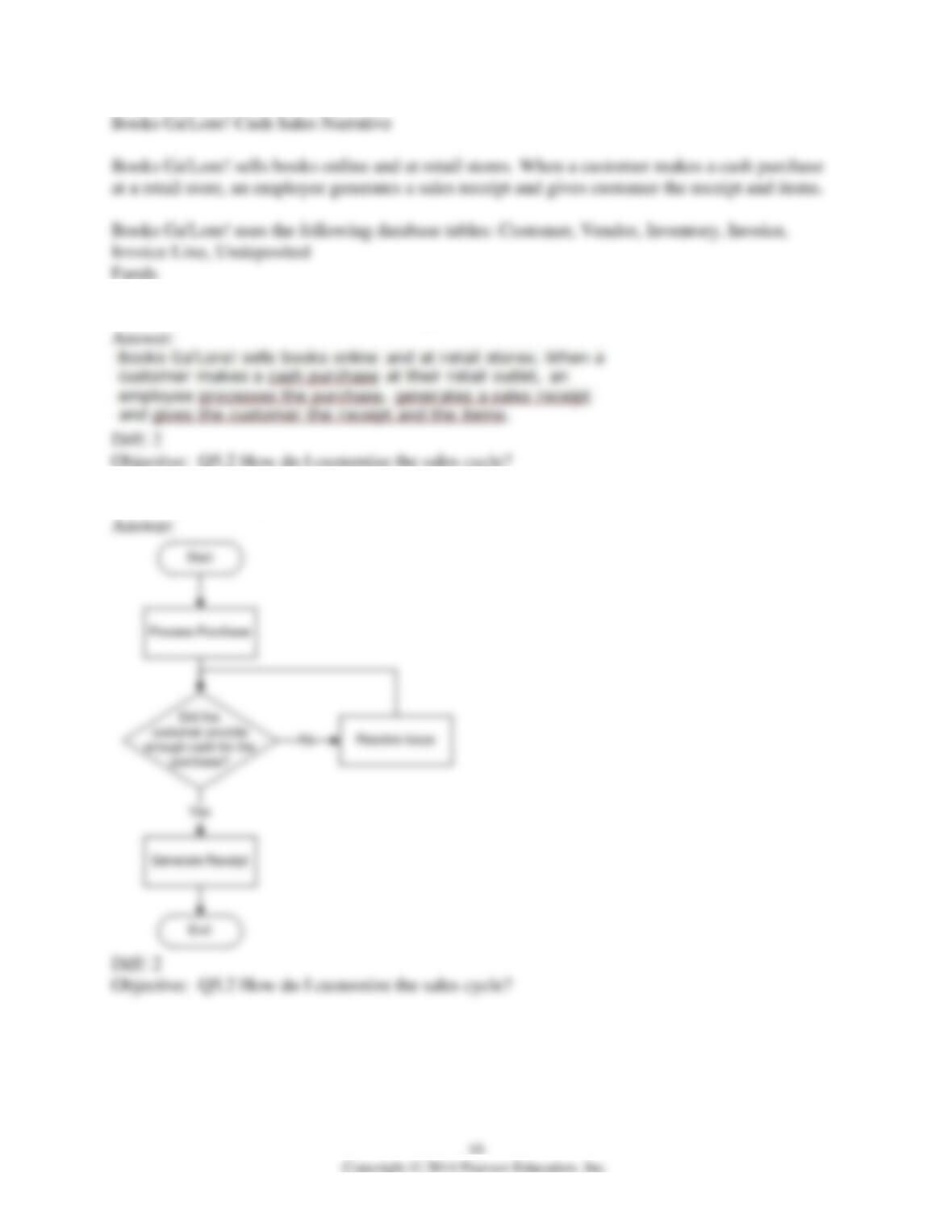
16) Annotate the Books Ga’Lore! Cash Payment narrative.
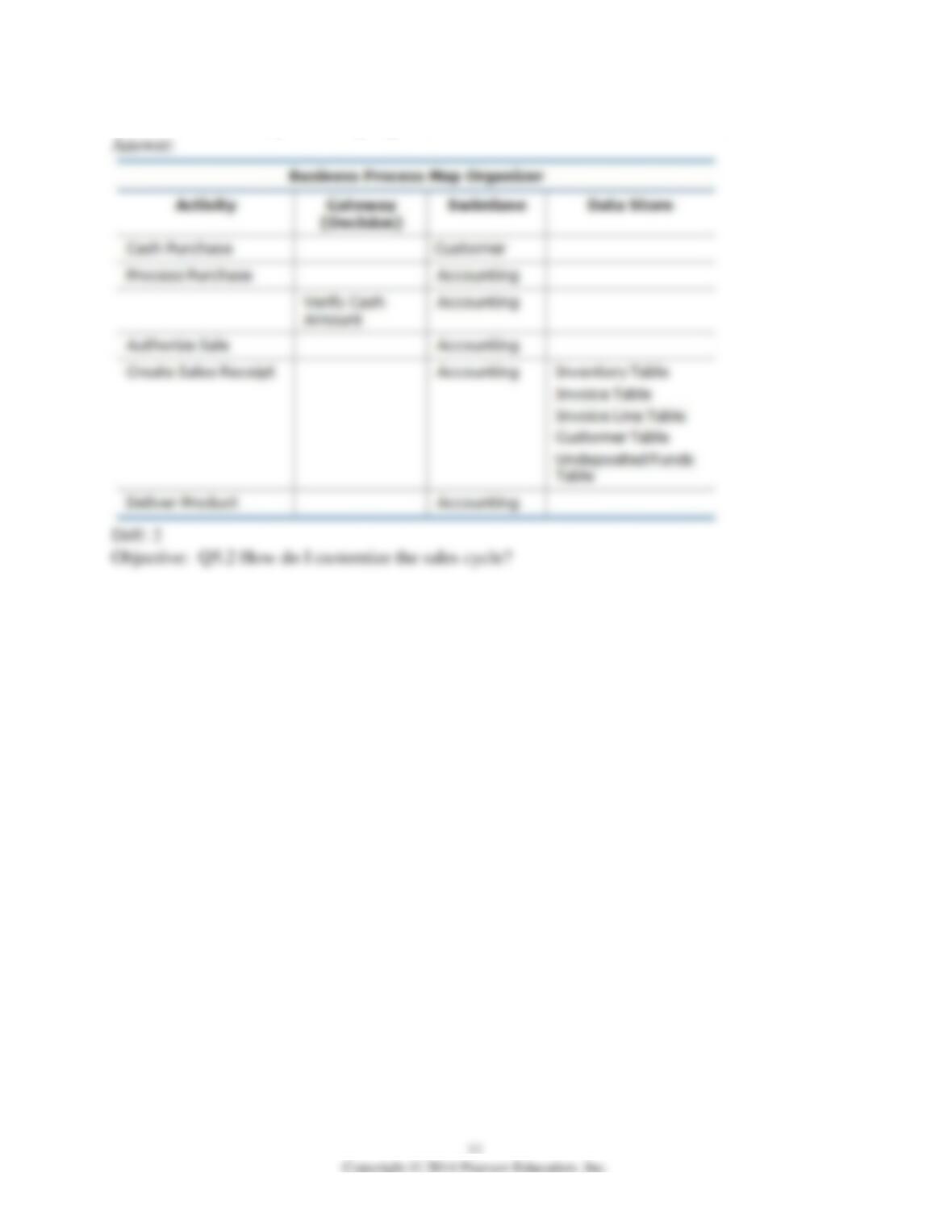
17) Create a flowchart for the Books Ga’Lore! Cash Sale narrative.
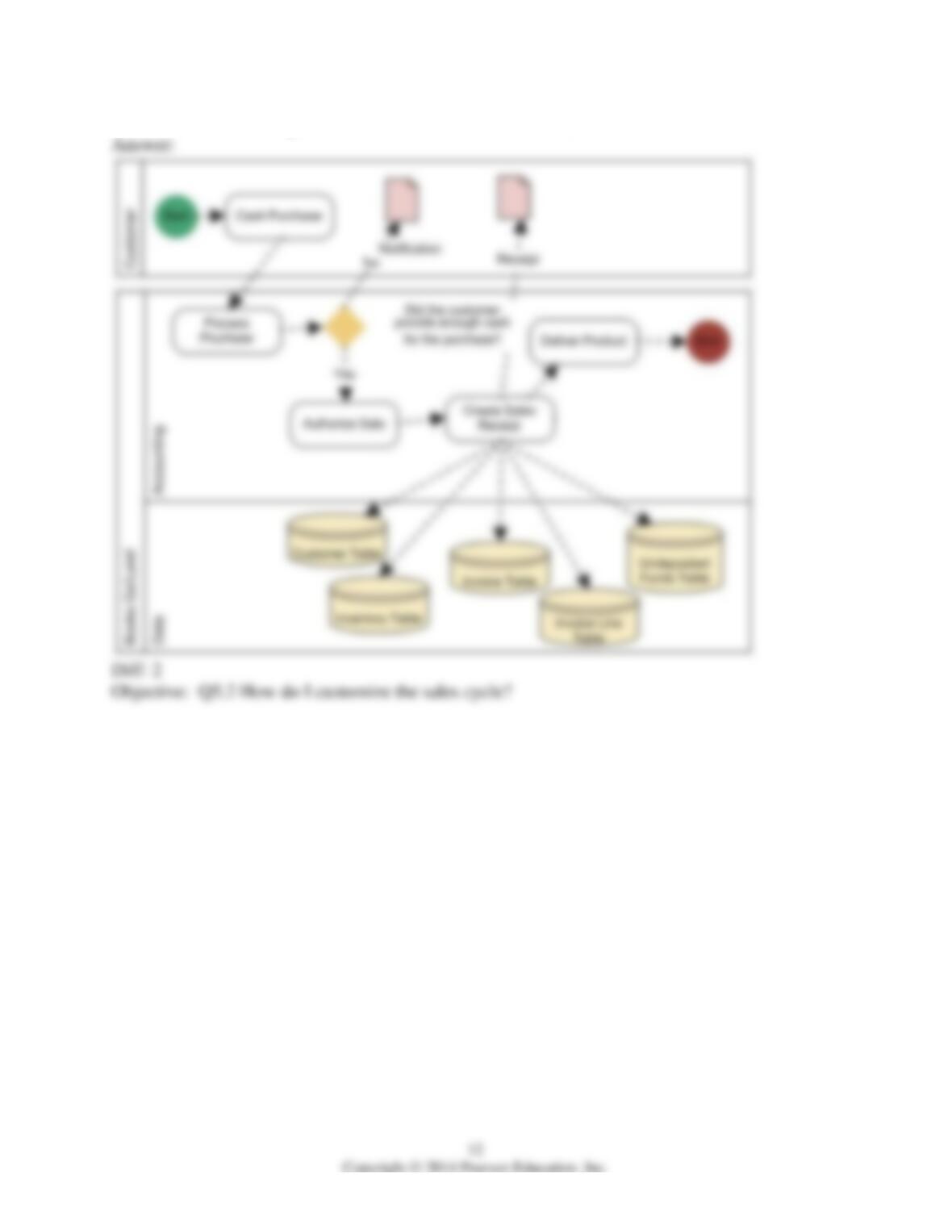
18) Create a business process map organizer table for the Books Ga’Lore! Cash Sale narrative.
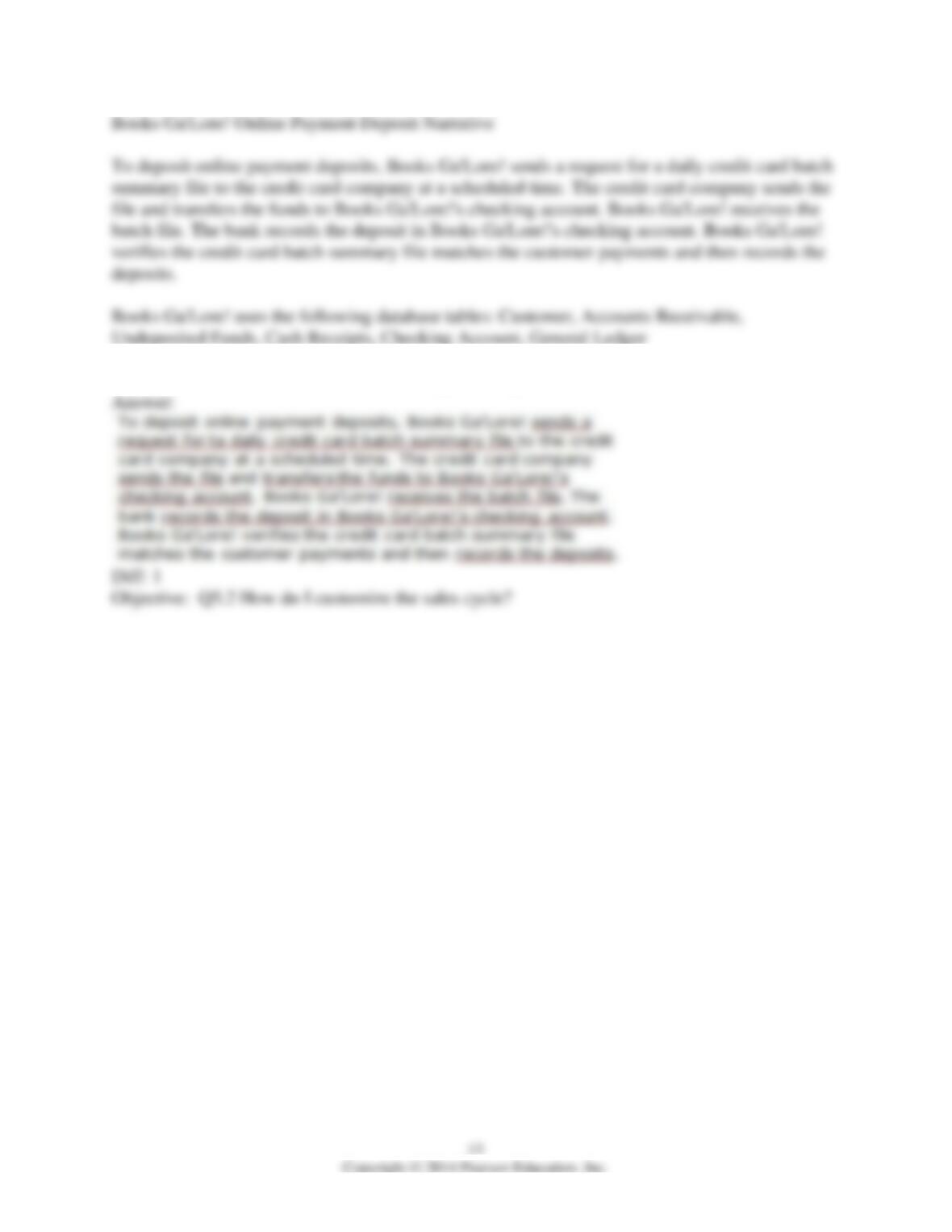
19) Create a BPMN diagram for the Books Ga’Lore! Cash Sale narrative.
20) Annotate the Books Ga’Lore! Online Payment Deposit narrative.
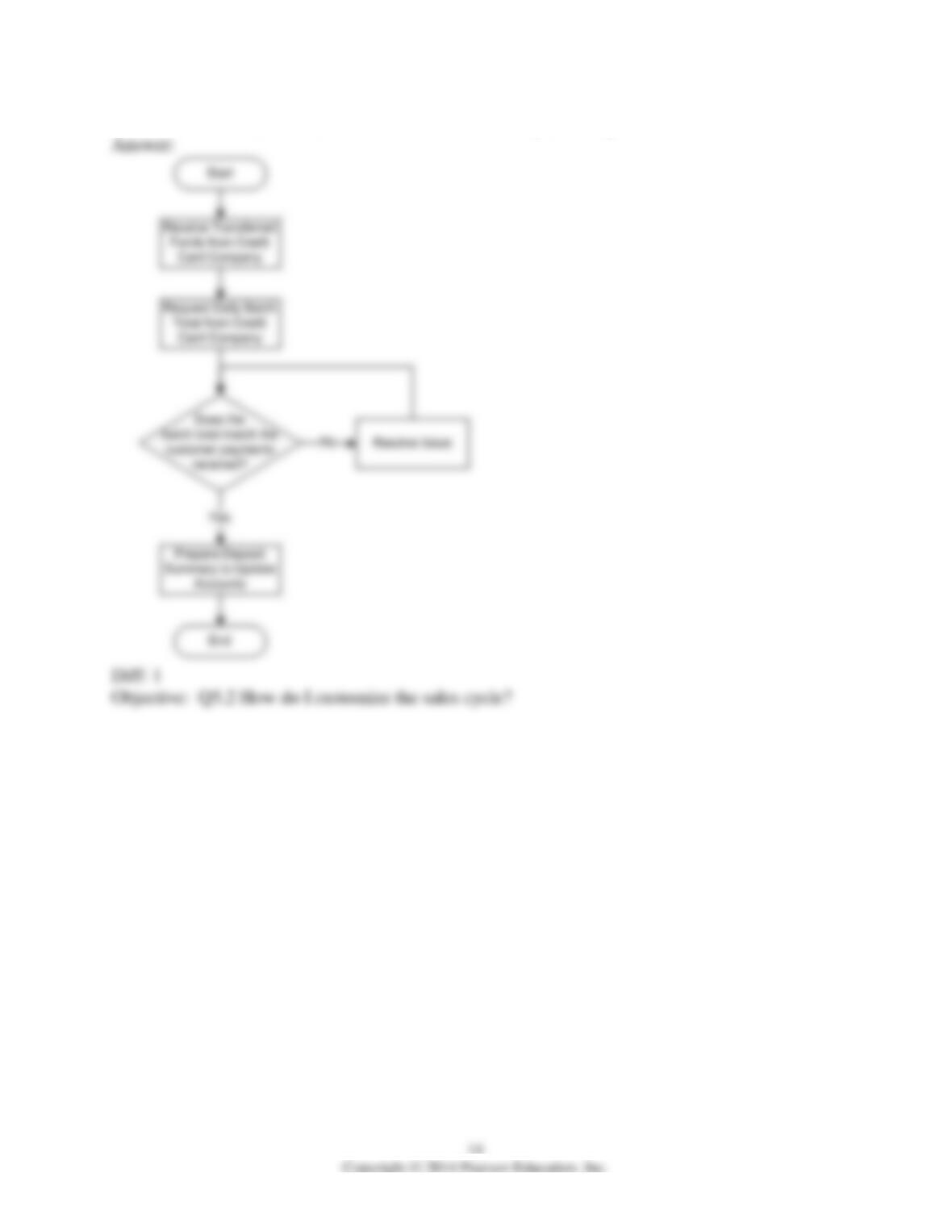
21) Create a flowchart for the Books Ga’Lore! Online Payment Deposit narrative.
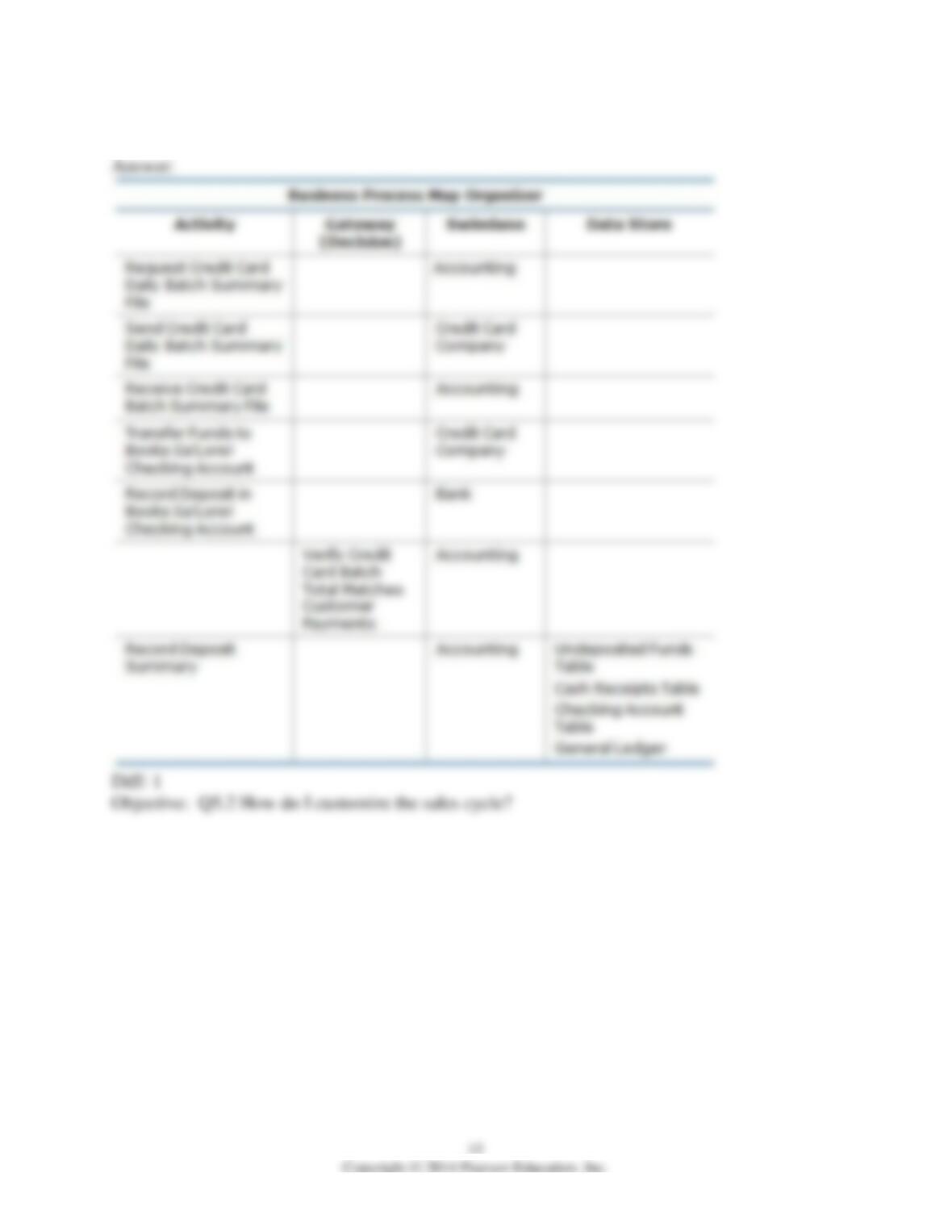
22) Create a business process map organizer for the Books Ga’Lore! Online Payment Deposit
narrative.
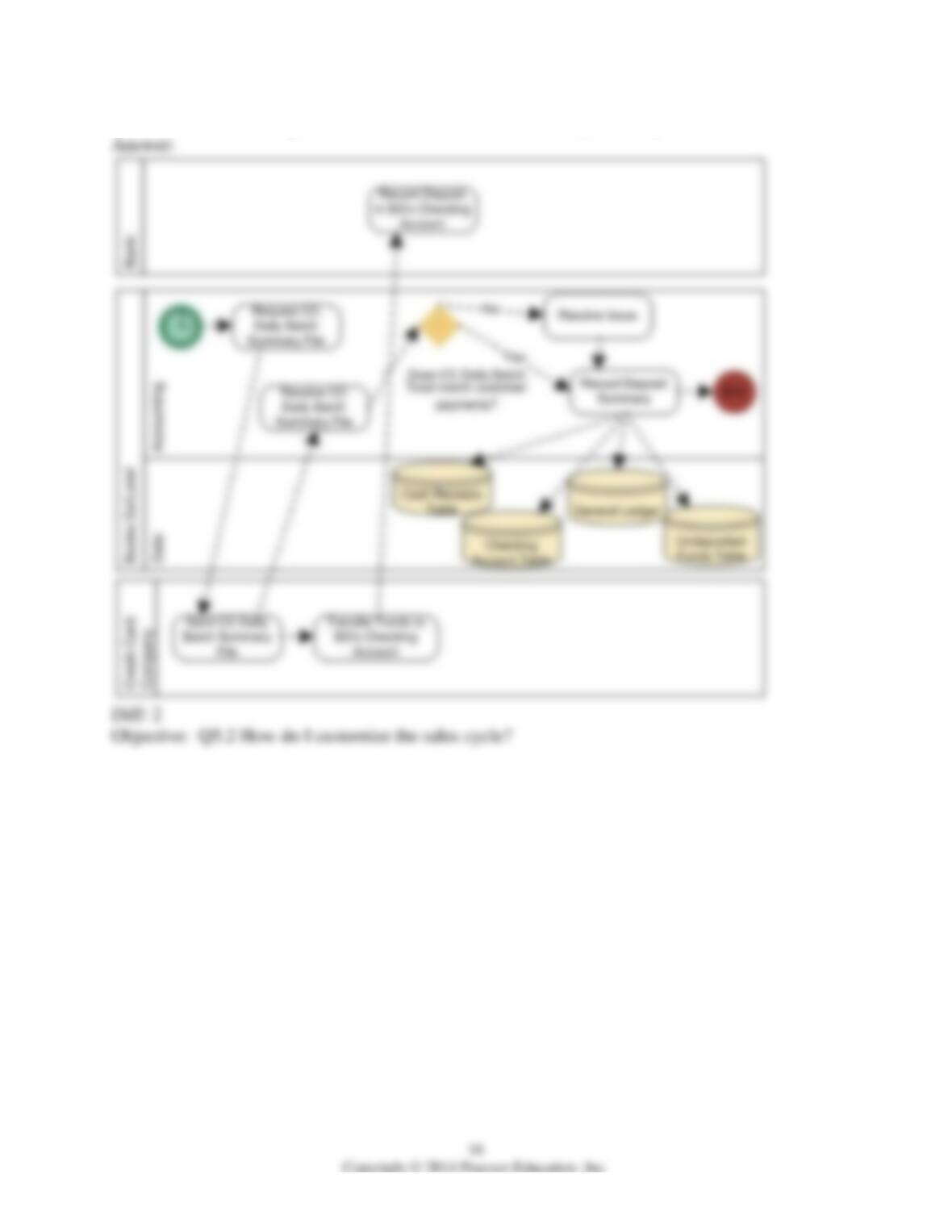
23) Create a BPMN diagram for the Books Ga’Lore! Online Payment Deposit narrative.
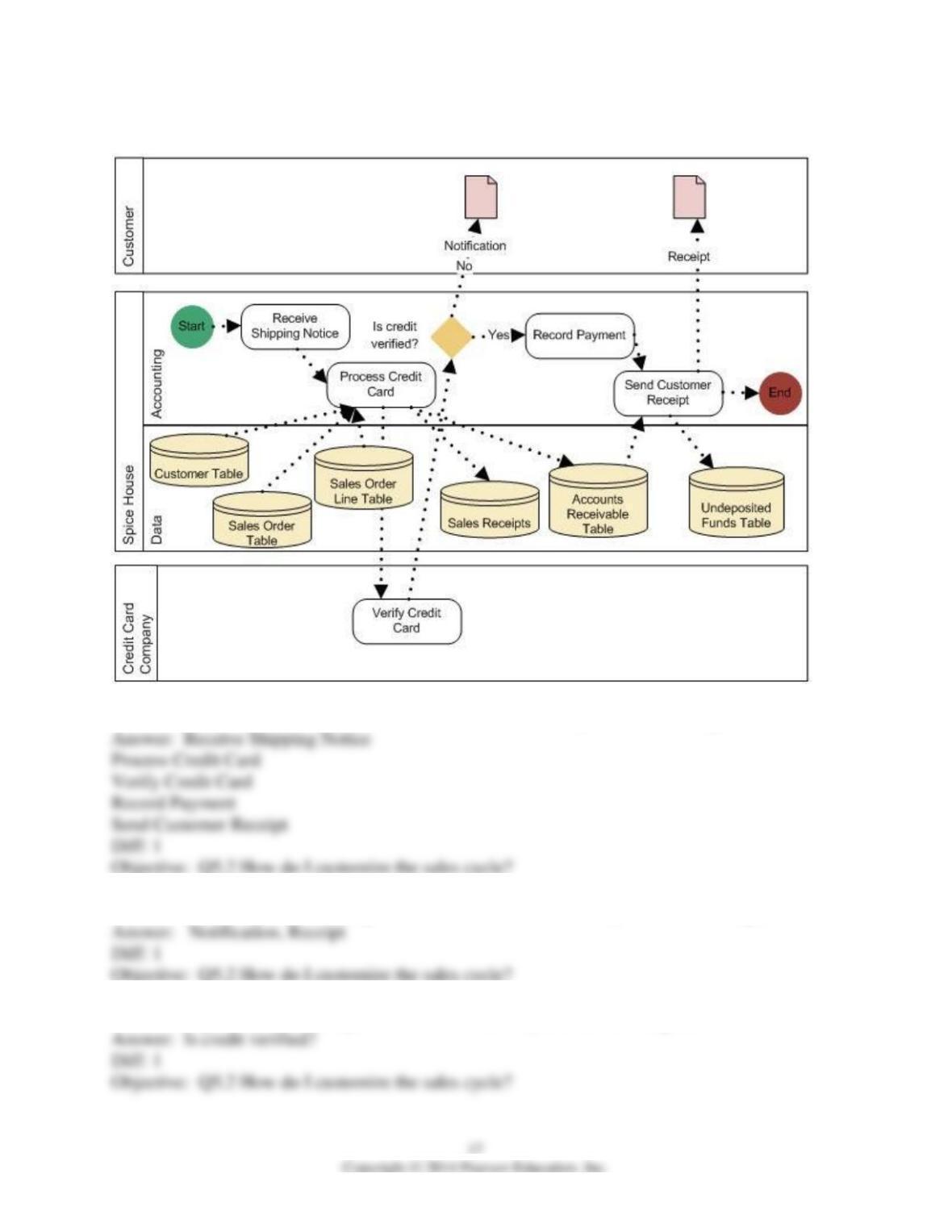
Spice House Receive Customer Payment BPMN
24) List the activities in the Spice House Receive Customer Payment BPMN diagram.
25) List the data object(s) in the Spice House Receive Customer Payment BPMN diagram.
26) List the gateway(s) in the Spice House Customer Payment BPMN diagram.
27) List the swim lane(s) and pool(s) in the Spice House Customer Payment BPMN diagram.
1) Computer software may be programmed to run at a specific time each day to perform a task,
such as, checking inventory stock levels.
2) When a bill is paid, the accountant’s personal checking account is reduced for the amount of
the payment.
3) The Purchase Order Line table is an intersection table required to eliminate the many-to-many
relationship between the Purchase Order table and the Item table.
4) The purchase order is sent to the vendor. The enterprise does not keep a copy.
5) Database tables are updated when a purchase order is created.
6) Typically, vendors mail the bill separately from the items shipped.
7) Typically, the vendor module consist of the ________, ________, ________ components.
8) A ________ is a document that lists items to be ordered, quantity, vendor information, and the
date.
9) The document that lists all the items delivered and is included with the items is called a
________.
10) The Create Purchase Orders, Receive Items, and Enter Bills are in which baseline accounting
system?
A) Reporting
B) Customer
C) Banking
D) Vendor
11) Which table would be used when processing a purchase order?
A) Customer table
B) Employee table
C) Item table
D) Invoice Line table
12) When receiving inventory, which table is usually NOT used?
A) Cash Account table
B) Purchase Order table
C) Vendor table
D) Item table
13) The Nice Lawn Purchase Narrative includes how many components of the purchasing cycle?
A) 1
B) 2
C) 3
D) 4
14) In the create purchases order component of the Nice Lawn Purchase Narrative, what are the
pools and swim lanes?
A) Swim lanes: Data, Warehouse, Accounting, Customer; Pool: Vendor
B) Swim lanes: Data, Purchasing, Accounting, Vendor, Credit Card Company; Pool: Nice Lawn
C) Swim lanes: Data, Warehouse, Accounting, Vendor; Pool: Credit Card Company
D) Swim lanes: Data, Purchasing, Accounting, Vendor; Pool: Nice Lawn
15) In the create purchases order component of the Nice Lawn Purchase Narrative, what are the
database tables?
A) Item table, Vendor table, Purchase Order table, Purchase Order Line table, Employee table
B) Item table, Customer table, Invoice Order table, Invoice Order Line table, Employee table
C) Item table, Address table, Purchase Order table, Purchase Order Line table, Employee table
D) Item table, Vendor table, Purchase Order table, Accounts Payable table
16) In the receive items component of the Nice Lawn Purchase Narrative, what are the pools and
swim lanes?
A) Swim lanes: Data, Warehouse, Accounting, Customer; Pool: Vendor
B) Swim lanes: Data, Warehouse, Accounting, Vendor; Pool: Credit Card Company
C) Swim lanes: Data, Purchasing, Accounting, Vendor; Pool: Nice Lawn
D) Swim lanes: Data, Warehouse, Purchasing, Vendor; Pool: Vendor