Financial Accounting, 11e (Harrison/Horngren/Thomas)
Chapter 5 Short-Term Investments & Receivables
1 Learning Objective 5-1
1) Short-term investments, which are classified as current assets, may be divided into held–to-maturity
securities, trading securities and available-for-sale securities.
2) The purpose of purchasing a trading security is to sell it within the near term, at its cost.
3) An unrealized gain occurs when a company sells a trading security.
4) Fair value is the amount for which investments in debt or equity securities can be sold.
5) Trading securities may generate dividend revenue.
6) Trading securities are originally recorded at their cost.
7) A company will have an unrealized loss if the fair value of a trading security is greater than its cost.
8) Unrealized gains and losses on trading securities are reported on the income statement.
9) To be classified as a current asset, an investment must either be liquid or the investor must intend to
use it to pay a current liability.
10) At the end of each period, unrealized gains and losses on trading securities are closed and
eventually become part of retained earnings on the income statement.
11) Investments in debt and equity securities create both unrealized and realized gains and losses.
12) Investments in trading securities:
A) are reported after accounts receivable on the balance sheet.
B) are more liquid than cash.
C) are reported at historical cost on the balance sheet.
D) are reported at current fair values on the balance sheet.
13) Stock investments that are expected to be sold within the near term, with the intent of generating
profits on the sale, are called:
A) held-to-maturity investments.
B) trading securities.
C) available-for-sale securities.
D) equity-method investments.
14) Which of the following statements is CORRECT?
A) Trading securities can be current or long-term assets.
B) Available-for-sale securities are always current assets.
C) Held-to-maturity securities are always current assets.
D) Trading securities are always current assets.
15) All investments in securities NOT classified as trading securities or held–to-maturity securities are
classified as:
A) debt securities.
B) equity securities.
C) marketable securities.
D) available-for-sale securities.
16) Matthew Company purchases a trading security for $12,000 cash. The journal entry to record this
transaction will include a:
A) debit to the Investment in Trading Securities account and a credit to Cash.
B) debit to Cash and a credit to the Investment in Trading Securities account.
C) debit to the Long-term Investment account and a credit Cash.
D) debit to the Unrealized Loss on Trading Securities account and a credit to Cash.
17) When a company receives a cash dividend from a trading security, the journal entry includes:
A) a debit to Investment in Trading Securities and credit to Cash.
B) a debit to Dividend Revenue and credit to Cash.
C) a debit to Cash and credit to Investment in Trading Securities.
D) a debit to Cash and credit to Dividend Revenue.
18) An unrealized gain on a trading security:
A) is recorded when a trading security is sold for more than its cost.
B) is recorded when a trading security is sold for less than its cost.
C) is recorded when the fair value of the trading security is more than its cost.
D) is recorded when the fair value of the trading security is less than its cost.
19) Investments in Trading Securities are reported on the:
A) income statement at current fair values.
B) balance sheet at cost.
C) balance sheet at current fair values.
D) income statement at cost.
20) A company’s trading security has a fair value which exceeds its cost. When recording the year-end
adjustment, the:
A) Investment in Trading Securities account will be credited.
B) Unrealized Gain on Trading Securities account will be credited.
C) Unrealized Loss on Trading Securities account will be debited.
D) Realized Gain on Sale of Treasury Securities account will be credited.
21) Unrealized gains on trading securities are reported on the:
A) statement of cash flows as investing activities.
B) balance sheet as an element of other comprehensive income.
C) income statement as an element of other comprehensive income.
D) income statement as Other Revenues and Gains.
22) A realized gain on the sale of a trading security occurs when the:
A) sale price is greater than the trading investment carrying amount.
B) sale price is less than the trading investment carrying amount.
C) sale price is greater than the trading investment original cost.
D) sale price is less than the trading investment original cost.
23) When a company sells a trading security, the Gain on the Sale of Trading Securities is reported in
the:
A) stockholders’ equity section of the balance sheet.
B) short-term investments section of the balance sheet.
C) other revenue, gains, and losses section of the balance sheet.
D) other revenues and gains of the income statement.
24) Strategies to increase the current ratio may include:
A) increasing sales.
B) paying off some current liabilities before the end of the year.
C) reclassifying long-term investments as short-term investments based on a plan to sell the
investments within the next year.
D) all of the above.
25) Trading securities purchased for $400,000, had a fair value of $410,000 at the end of the year. The
adjusting entry to record this difference includes a credit to:
A) Retained Earnings.
B) Unrealized Gain on Trading Securities.
C) Investment in Trading Securities.
D) Accumulated Other Comprehensive Income.
26) Trading securities purchased in 2016 for $90,300, had a fair value of $92,100 on December 31, 2016.
At December 31, 2017 the securities had a fair value of $95,700. The journal entry on December 31, 2017
would include a:
A) debit to the Investment in Trading Securities account for $5400.
B) debit to the Investment in Trading Securities account for $3600.
C) credit to the Unrealized Gain on Trading Securities account for $5400.
D) debit to the Unrealized Loss on Trading Securities account for $3600.
27) Michael Company purchased a trading investment that had a carrying amount of $35,900 when its
management decided to sell it. The investment was purchased for $32,000. If Michael Company sold
this investment for $45,100, Michael will have a(n):
A) Gain on Sale of Trading Security for $13,100.
B) Gain on Sale of Trading Security for $9200.
C) Unrealized Loss on Trading Security of $9200.
D) Unrealized Gain on Trading Security of $13,100.
28) When a company receives a cash dividend from a short-term available-for-sale security, the journal
entry is:
A) debit to Investment in Available-for-Sale Securities and credit Cash.
B) debit to Cash and credit to Dividend Revenue.
C) debit to Dividend Revenue and credit to Cash.
D) debit to Cash and credit to Investment in Available-for-Sale Securities.
29) The Investment in Available-for-Sale Securities account is reported on the:
A) income statement at cost.
B) income statement at current fair value.
C) balance sheet at cost.
D) balance sheet at current fair value.
30) The Unrealized Gains on Investment in Available-for-Sale Securities account is reported on the:
A) income statement.
B) statement of retained earnings.
C) current asset section of the balance sheet.
D) stockholders’ equity section of the balance sheet.
31) When a company sells a short-term available-for-sale security, the Gain on the Sale of the
Investment in Available-for-Sale Securities account is reported on the:
A) revenues section of the income statement.
B) current assets section of the balance sheet.
C) other revenues and gains section of the income statement.
D) stockholders’ equity section of the balance sheet.
32) An investment, which was purchased for $400,000 and classified as an available–for-sale security,
has a fair value of $420,000 at the end of the year. The year-end journal entry will have a credit to:
A) Retained Earnings.
B) Unrealized Gain on Investment in Available-for-Sale Securities.
C) Investment in Available-for-Sale Securities.
D) Gain on Sale of Investment in Available-for-Sale Securities.
33) To be classified as a current asset, an investment must meet which of the following criteria:
A) the investment must be liquid.
B) the investor must intend to either convert the investment to cash within one year or current operating
cycle, whichever is longer, or use it to pay a current liability.
C) the investment must be easily convertible to cash.
D) all of the above
34) Which statement is FALSE?
A) Available-for-sale securities are held with the intent of selling them some time in the future.
B) Held-to-maturity securities are stock investments that the investor has the intent and ability to hold
until they mature.
C) Trading securities are debt and stock investments purchased and expected to be sold within the near
term through active trading.
D) A debt security, not classified as either trading or held–to-maturity, is an available-for-sale security.
35) Which statement is TRUE?
A) Available–for-sale securities are debt securities only.
B) Trading securities are debt securities only.
C) Held-to-maturity securities are debt securities only.
D) Held-to-maturity securities are reported as long-term assets only.
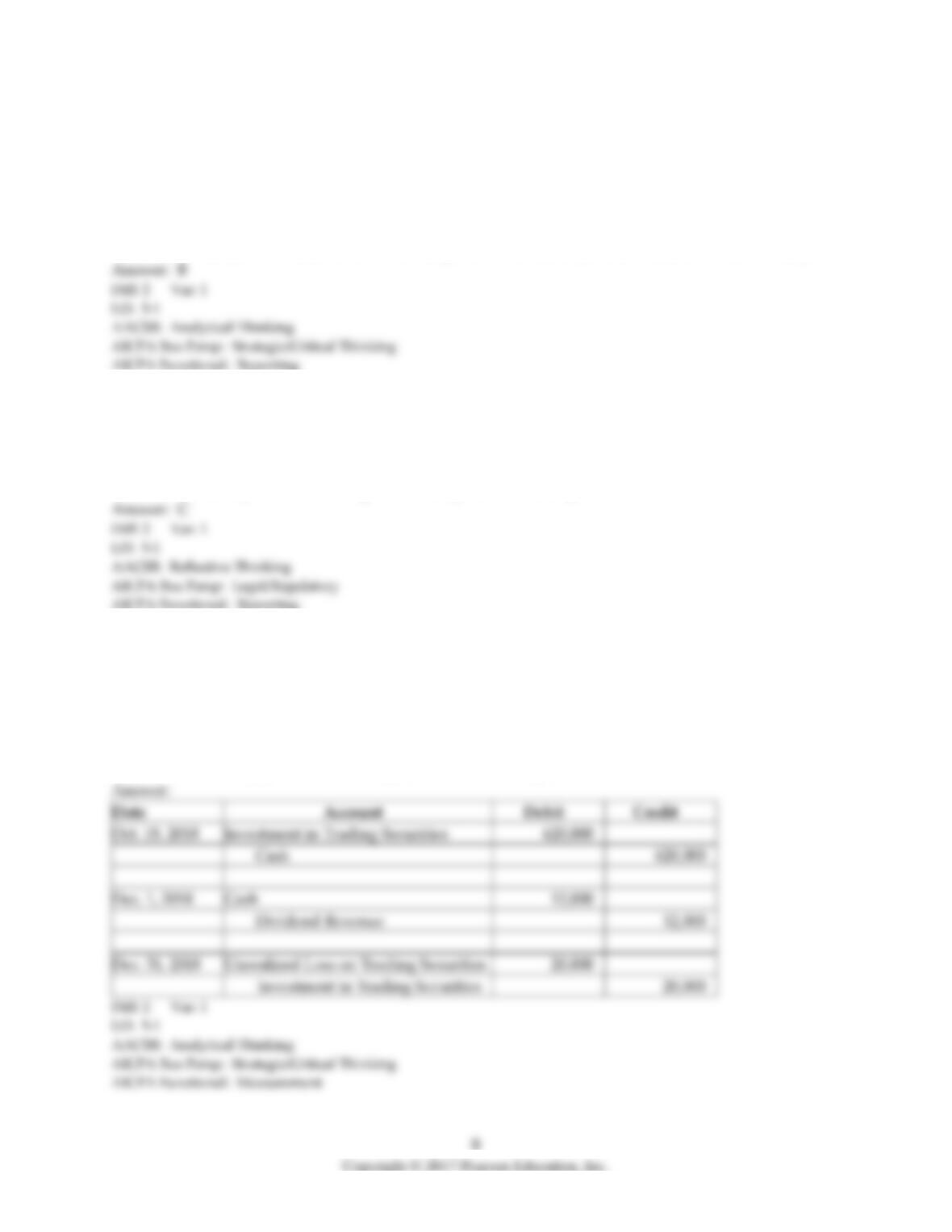
36) Smith Corporation purchases $620,000 of TMI Corporation stock on October 18, 2018. Smith
Corporation classifies this investment as a trading security. On December 1, Smith Corporation received
a cash dividend of $12,000 on the TMI Corporation stock. On December 31, 2018, Smith Corporation’s
investment in TMI Corporation has a fair value of $600,000.
Required:
Prepare the necessary journal entries. Explanations are not required.
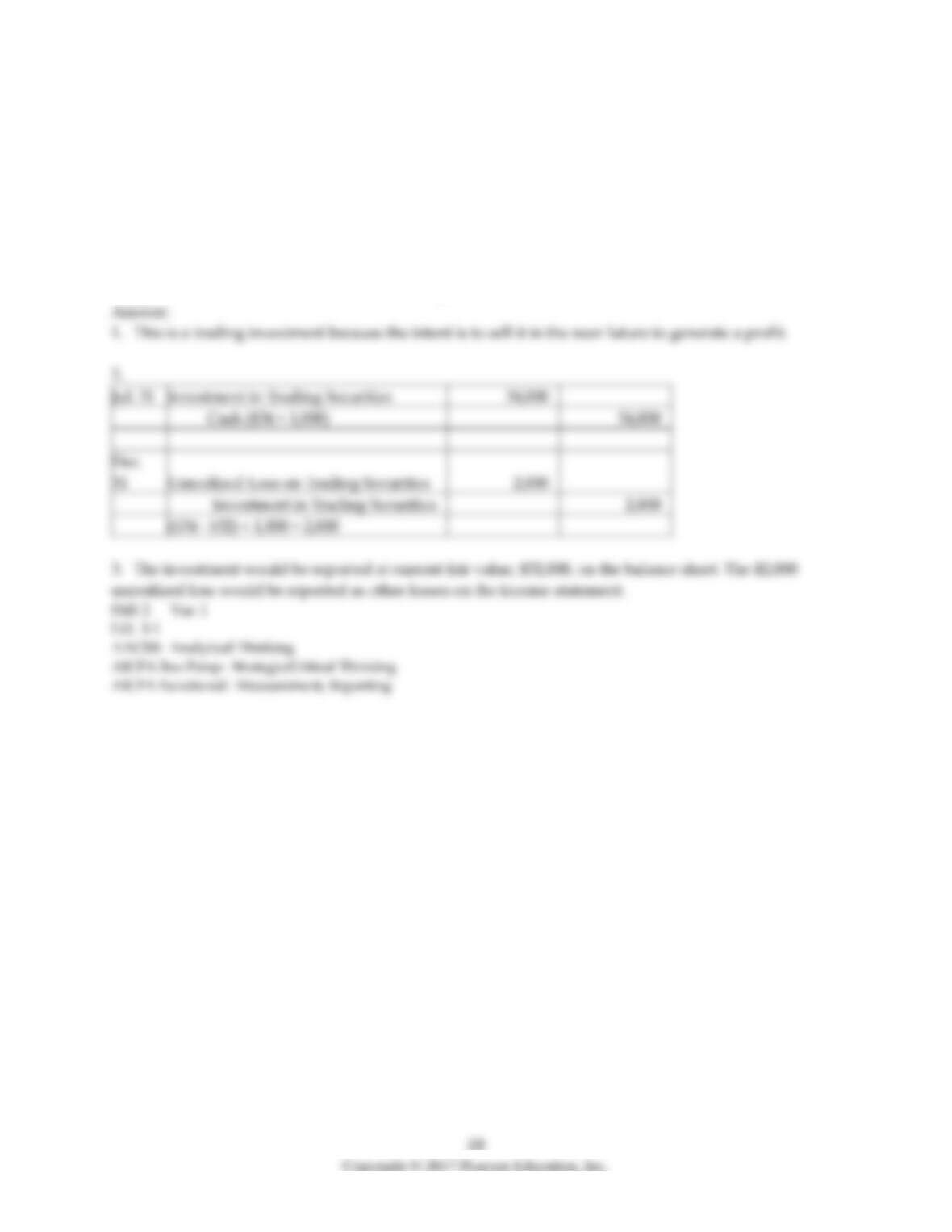
37) Jones Company purchases 1,000 shares of Micro Corporation stock at $34 per share on July 31. The
company expects to hold the stock for 6 months and then sell it. At December 31, the market price of the
stock is $32 per share.
Required:
1. What type of investment is this for Jones Company? Explain your answer.
2. Prepare the necessary journal entries. Explanations are not required.
3. Discuss how Jones Company would report this investment on its balance sheet at December 31 and
any gain or loss on its income statement for the year ended December 31.
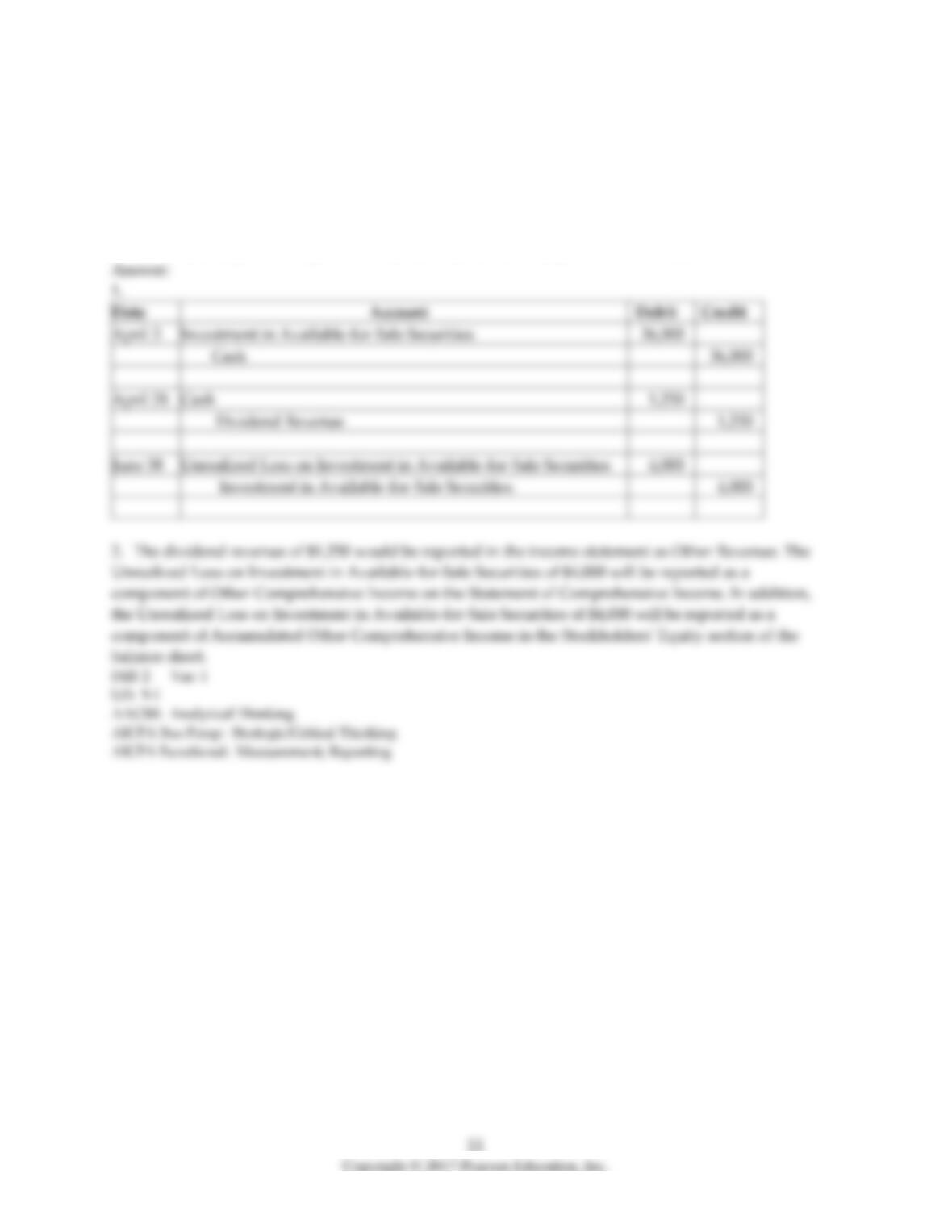
38) On April 3, Jenny’s Store purchased stock in New Company for $36,000, and classified it as a short–
term available-for-sale security. On April 28, Jenny’s Store received dividends from New Company of
$1,250. On June 30, the New Company stock had a fair value of $32,000.
Required:
1. Prepare the journal entries needed to record the transactions. Explanations are not required.
2. What will Jenny’s Store report on its income statement for the year ended December 31?
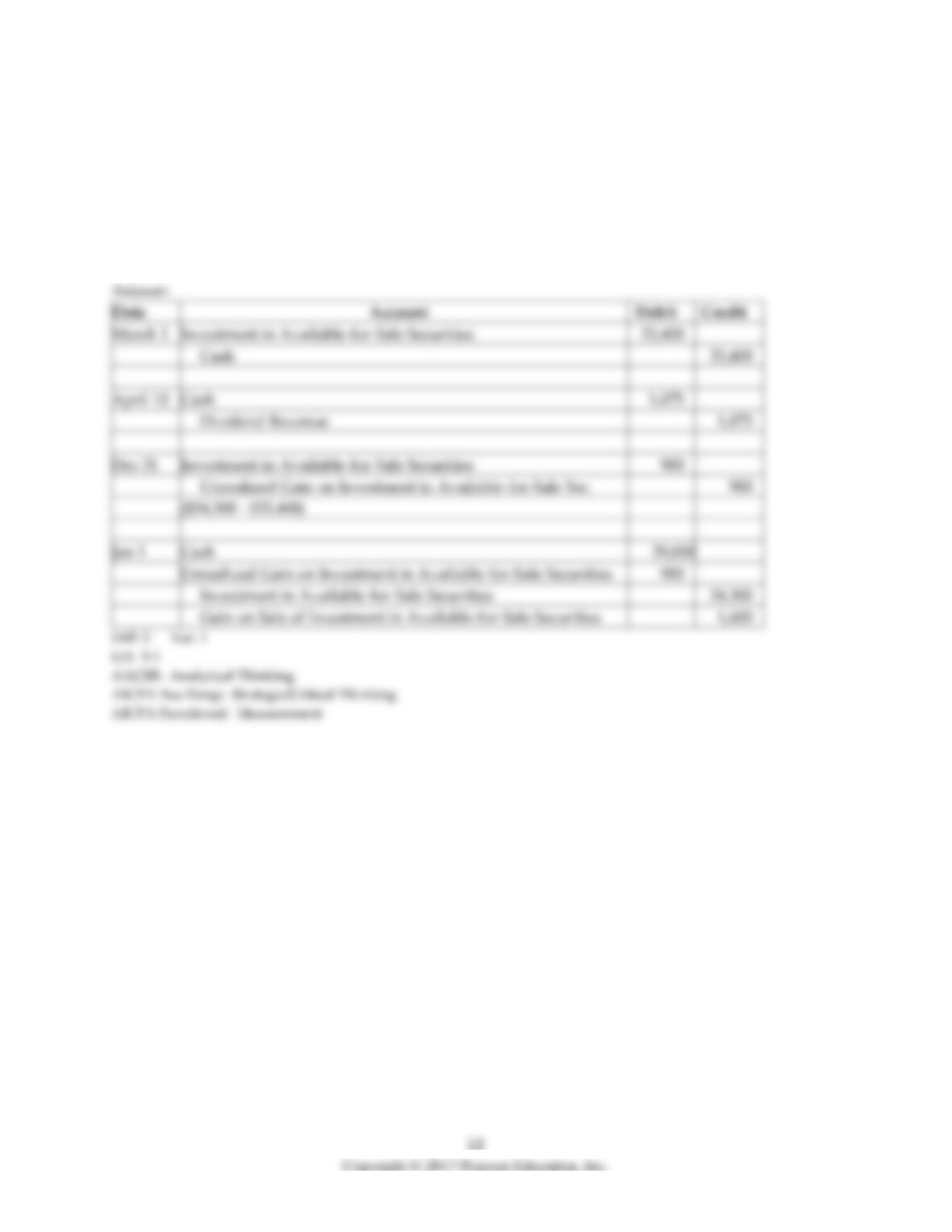
39) On March 1, 2016, Emma’s Toy Store purchased Toy Maker‘s stock for $33,400, as a short-term
available-for-sale security. On April 10, dividends of $1,075 were received from the Toy Maker‘s stock.
On December 31, 2016, the end of Emma’s Toy Store’s accounting year, the Toy Maker’s stock had a fair
value of $34,300. On January 1, 2017, Emma’s Toy Store sold all of the Toy Maker’s stock for $35,000.
Required:
Prepare the journal entries needed to record the transactions for 2016 and 2017. Explanations are not
required.
40) Martin Company has current assets of $10,000 and current liabilities of $8,000. Its management is
concerned about the current ratio and is considering paying Accounts Payable totaling $3,000. Martin
Company has a loan with National Bank which requires Martin to maintain a minimum current ratio of
1.4.
Required:
1. What is the formula for the current ratio?
2. Compute the current ratio before the possible payment of the liabilities of $3,000.
3. Compute the current ratio assuming that Martin Company pays the $3,000 in current liabilities.
4. Compute the current ratio assuming that Martin Company buys inventory of $3,000 on account.
Ignore Requirement 3.
5. Compute the current ratio assuming that Martin Company sells short–term investments with a
carrying value of $3,000 for $3,000. Ignore Requirements 3 and 4.
2 Learning Objective 5-2
1) Retailers, wholesalers, and manufacturers typically disclose sales revenue at the net amount, which
means after sales discounts and sales returns and allowances have been added to gross sales revenue.
2) The revenue recognition principle requires that revenue be recorded only for the net amount that the
company expects to eventually realize.
3) The shipping terms in the sales contract determine when ownership of goods changes hands between
the buyer and the seller.
4) If the credit terms are 2/10, n/30, the buyer can get a 2% discount if the invoice is paid within 20 days
of the invoice date.
5) When goods are shipped FOB destination, revenue is recognized by the seller when the goods leave
the seller’s shipping dock.
6) Nichols Company has shipped goods to one of its customers FOB shipping point. Nichols Company
will recognize sales revenue when:
A) their customer has received the goods.
B) the goods leave Nichols’ shipping dock.
C) the two parties agree that revenue should be recognized.
D) the customer pays the invoice.
7) When goods are shipped FOB destination:
A) revenue is recognized when the goods leave the shipping dock.
B) revenue is recognized when the invoice is mailed to the customer.
C) revenue is recognized only after cash payment is received.
D) revenue is recognized when the goods are received by the customer.
8) Which of the following statements regarding contracts is INCORRECT?
A) The process of revenue recognition is based on contracts that the entity has with outsiders.
B) A contract is an agreement between two parties that creates enforceable rights or performance
obligations.
C) Only written contracts are valid.
D) Identifying the contract with the customer is the first step of the revenue recognition model.
9) A business offers credit terms of 2/15, n/30. These terms indicate that:
A) the total amount of the invoice must be paid within 15 days of the invoice date.
B) a discount of 2% can be taken if the invoice is paid within 15 days of the invoice date.
C) the buyer can take a 2% discount if the bill is paid within 30 days of the invoice date.
D) no discount is offered for early payment.
10) Which of the following is a TRUE statement regarding sales?
A) Sales revenue recognized in a particular period must be reduced by an amount for estimated sales
returns.
B) For the sale of products, the performance obligation is generally satisfied when the customer orders
the goods.
C) Sales returns and allowances increase a company’s profit.
D) If customers return merchandise within the refund period, the Sales Returns account is credited.
11) Leno Company sells goods to the Fallon Company for $10,000. It offers credit terms of 2/10, n/30. If
Fallon Company pays the invoice within the discount period, Leno Company will record a debit to
Cash in the amount of:
A) $10,200.
B) $200.
C) $9800.
D) $10,000.
12) A company has gross revenue of $502,000; sales discounts of $2900; and sales returns and
allowances of $3300. Net revenue is:
A) $495,800.
B) $498,700.
C) $499,100.
D) $502,000.
13) On December 1, Macy Company sold merchandise with a selling price of $1000 on account to Mrs.
Jorgensen, with terms 3/10, n/30. Ignoring cost of goods sold, what journal entry did Macy Company
prepare on December 1? Macy expects no sales returns.
A) Debit Cash for 1000 and credit Accounts Receivable for 1000.
B) Debit Accounts Receivable for 970 and credit Cash for 970.
C) Debit Accounts Receivable for 970 and credit Sales Revenue for 970.
D) Debit Sales Revenue for 1000 and credit Accounts Receivable for 1000.
14) On December 2, a customer returned merchandise, with a selling price of $1200 purchased on
account, to a department store. Ignoring cost of goods sold, which journal entry should the department
store prepare? Assume no sales discount was offered for early payment.
A) Debit Sales Revenue for $1200 and credit Accounts Receivable for $1200.
B) Debit Sales Revenue for $1200 and credit Cash for $1200.
C) Debit Sales Revenue for $1200 and credit Refund Liability for $1200.
D) Debit Refund Liability for $1200 and credit Accounts Receivable for $1200.
15) On December 1, Macy Company sold merchandise with a selling price of $1000 on account to Mrs.
Jorgensen, with terms 3/10, n/30. Mrs. Jorgensen paid the amount due on December 9. Which journal
entry should Macy Company prepare on December 9?
A) Debit Cash for $1000 and credit Sales Revenue for $1000.
B) Debit Sales Revenue for $1000 and credit Cash for $1000.
C) Debit Sales Revenue for $1000, credit Sales Discount for $30, and credit Cash for $970.
D) Debit Cash for $970 and credit Accounts Receivable for $970.
16) On December 1, Macy Company sold merchandise with a selling price of $6000 on account to Mrs.
Jorgensen, with terms 5/10, n/30. On December 3, Mrs. Jorgensen returned merchandise with a selling
price of $500. Mrs. Jorgensen paid the amount due on December 9. What journal entry did Macy
Company prepare on December 9?
A) Debit Cash for $5225 and credit Sales Revenue for $5225.
B) Debit Sales Revenue for $500 and credit Cash for $500.
C) Debit Sales Revenue for $5500, credit Sales Discount for $275 and credit Cash for $5225.
D) Debit Cash for $5225 and credit Accounts Receivable for $5225.
17) On December 1, Macy Company sold merchandise with a selling price of $3000 on account to Mrs.
Jorgensen, with terms 4/10, n/30. On December 3, Mrs. Jorgensen returned merchandise with a selling
price of $900. Mrs. Jorgensen paid the amount due on December 19. What journal entry did Macy
Company prepare on December 19? (Assume all sales are recorded at the net amount.)
A) Debit Cash for $2016 and credit Sales Revenue for $2016.
B) Debit Cash for $2100 and credit Accounts Receivable for $2016 and credit Sales Discounts Forfeited
84.
C) Debit Cash for $2016 and credit Accounts Receivable for $2016.
D) Debit Cash for $2016, debit Sales Discounts Forfeited for 84 and credit Accounts Receivable for
$2100.
18) To satisfy a performance obligation means that:
A) the provider has substantially completed the service for the customer.
B) the goods have been transferred to the customer who has assumed ownership and control over
goods.
C) the selling entity has done everything required to earn the revenue.
D) All of the above statements are correct.
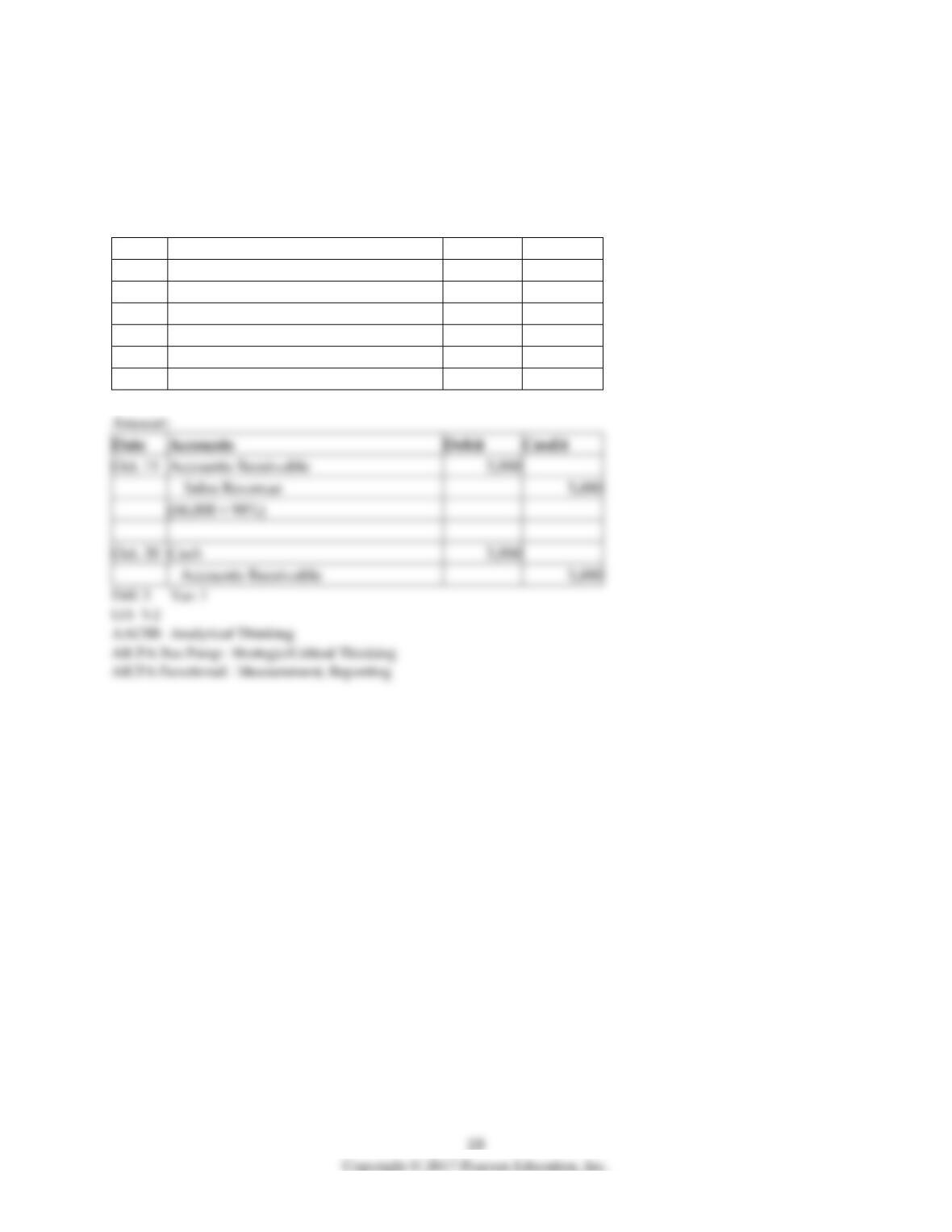
19) On October 11, Younger Company sold merchandise with a selling price of $6,000 on account to
Main Street Office Supplies, with terms 2/10, n/30. No sales returns are expected. On October 20,
Younger received the full amount due from Main Street.
Ignoring cost of goods sold, prepare the journal entries for Younger Company. Omit explanations.
Date
Accounts
Debit
Credit
Date
Accounts
Debit
Credit
Oct. 11
Accounts Receivable
($6,000 × 98%)
Oct. 20
Cash
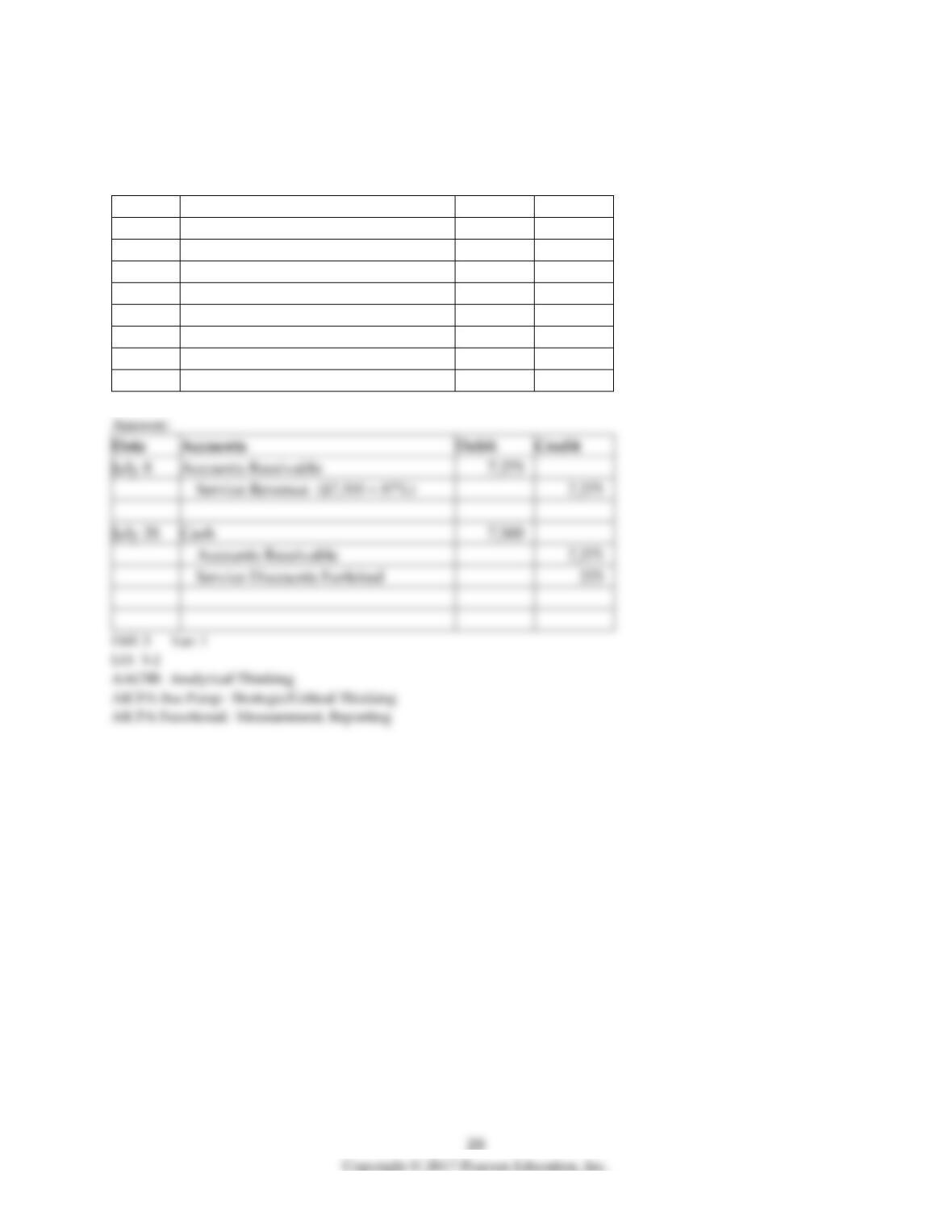
20) On July 8, ABC Plumbing provided services of $7,500 on account to First Bank, with terms 3/10,
n/30. On July 28, ABC received the full amount due from First Bank.
Prepare the journal entries for ABC Plumbing. Omit explanations.
Date
Accounts
Debit
Credit
July 8
Accounts Receivable
July 28
Cash