Accounting, 9e (Horngren)
Chapter 5 Merchandising Operations
Learning Objective 5-1
1) The periodic inventory system is normally used for relatively inexpensive goods.
2) When a company uses the perpetual inventory method, the inventory account should stay current at all times.
3) The accounting cycle for a merchandising company begins with the purchase of inventory.
4) The periodic inventory system keeps a running record of inventory and cost of goods sold.
5) The perpetual inventory system keeps a running record of inventory and cost of goods sold.
6) Which of the following assets does a merchandising company-but NOT a service company-need?
A) Accounts receivable
B) Prepaid insurance
C) Merchandise inventory
D) Equipment
7) Which of the following assets MUST a merchandising company have for daily operations?
A) Accounts receivable
B) Prepaid insurance
C) Merchandise inventory
D) Equipment
8) Inventory is the:
A) items purchased to run the daily operations of a business.
B) items held by a company to be sold to customers.
C) expenses of a company that were incurred.
D) equipment that was purchased.
9) Merchandising consists of:
A) manufacturing products.
B) providing a service.
C) buying and selling products.
D) purchasing raw materials.
10) In a periodic system, inventory balances and the cost of goods sold for the current period are determined:
A) at the time of sale.
B) on a frequent basis.
C) on the first day of each year.
D) when a physical inventory count is taken.
11) What is the first step in the accounting cycle for a merchandising company?
A) The company sells inventory to customers, creating accounts receivable.
B) The company collects cash.
C) The company buys inventory.
D) The company delivers inventory to customers.
12) Under a perpetual inventory system, which of the following would NOT be required?
A) Record cost of goods sold with each sale
B) Updating the inventory balance with each sale
C) Detailed inventory records
D) A weekly count of the inventory
Learning Objective 5-2
1) Credit terms of 2/10, n/30 mean that the purchaser may deduct 2 percent if the invoice is paid within 10 days,
with the full amount due in 30 days if the early payment option is NOT exercised.
2) Freight in should be added to the inventory account if the company uses the perpetual inventory method.
3) Purchase returns and allowances decrease the net amount of cash that will be paid for the inventory, and so they
should reduce the cost of the inventory as recorded in the Inventory account.
4) In a perpetual inventory system, the entry to record the inventory purchased includes a credit to Cost of goods
sold.
5) When a company is purchasing inventory, and there are either returns or allowances for damaged goods, those
amounts are recorded as a debit to the Sales returns and allowances account.
6) When a company is purchasing inventory, and pays early to take advantage of the purchase discount offered by
the vendor, that amount is debited to the Inventory account.
7) A company receives an invoice that indicates that title to the merchandise will pass to the company when they
receive the goods. This situation is described as FOB destination.
8) Credit terms of 2/10, n/30 indicate that a 2% discount may be taken if the invoice is paid within 10 days, but the
total invoice amount is due if paid on the 11th through the 30th day after the invoice date.
9) Freight out is an addition to the Inventory account if the company uses the perpetual inventory method.
10) What is a purchase return?
A) A return of merchandise that is defective or damaged
B) A customer refund from the sale of inventory
C) A price reduction
D) A return of cash to the purchaser
11) A purchase return of goods purchased on credit is recorded by the purchasing company as a debit to what
account?
A) Accounts receivable
B) Inventory
C) Cost of goods sold
D) Accounts payable
12) What is freight out?
A) Transportation costs to ship goods into the warehouse
B) Inventory costs
C) Costs that are not expensed
D) Transportation costs to ship goods out of the warehouse
13) What is freight in?
A) Transportation costs to ship goods into the warehouse
B) Transportation costs that are not recorded
C) Costs that are expensed
D) Transportation costs to ship goods out of the warehouse
14) In the credit terms of 2/10, n/30, what does the 2/10 mean?
A) The invoice must be paid in 2 days or a 10% late charge will be assessed.
B) The invoice was printed 2 days after the sale and is due in 10 days.
C) The goods shipped took 2 days to arrive and the charge was $10.00.
D) The purchaser may take a 2% discount if the invoice is paid in 10 days.
15) A company uses the perpetual inventory method. Which of the following entries would be made to record a
purchase of inventory on account?
A) The accounting entry would be a debit to Purchases and a credit to Accounts payable.
B) The accounting entry would be a debit to Accounts payable and a credit to Purchases.
C) The accounting entry would be a debit to Inventory and a credit to Accounts payable.
D) The accounting entry would be a debit to Accounts payable and a credit to Inventory.
16) A company that uses the perpetual inventory method purchases inventory of $1,000 on account with terms of
2/10, n/30. Which of the following entries would be made to record the payment if it is made within 10 days?
A) $1,000 debit to Accounts payable and a $1,000 credit to Cash
B) $1,000 debit to Accounts payable, a $20 credit to Inventory and a $980 credit to Cash
C) $20 debit to Inventory, a $1,000 debit to Accounts payable and a $1,020 credit to Cash
D) $980 debit to Accounts payable, a $20 debit to Inventory and a $1,000 credit to Cash
17) A company that uses the perpetual inventory method purchases inventory of $1,000 on account with terms of
2/10, n/30. Which of the following entries would be made to record the payment if it is made 20 days later?
A) $1,000 debit to Accounts payable and a $1,000 credit to Cash
B) $1,000 debit to Accounts payable, a $20 credit to Inventory and a $980 credit to Cash
C) $20 debit to Inventory, a $1,000 debit to Accounts payable and a $1,020 credit to Cash
D) $980 debit to Accounts payable, a $20 debit to Inventory and a $1,000 credit to Cash
18) If a company, using a perpetual inventory system, purchases inventory on account, and later returns $200 of
goods to the vendor, what entry would be made to record the return of goods to the vendor?
A) $200 debit to Purchases and a $200 credit to Accounts payable
B) $200 debit to Accounts payable and a $200 credit to Inventory
C) $200 debit to Inventory and a $200 credit to Accounts payable
D) $200 debit to Accounts payable and a $200 credit to Purchases
19) Which of the following is TRUE about freight in?
A) Freight in is added to the cost of merchandise inventory.
B) Freight in is a selling expense.
C) Freight in is an operating expense.
D) Freight in is deducted from Accounts payable.
20) A company that uses the perpetual inventory method purchases inventory of $1,000 on account with terms of
2/10, n/30. Defective inventory of $200 is returned 2 days later and the accounts are appropriately adjusted. If the
company paid the vendor within 10 days, which of the following entries would be made to record the payment?
A) $800 debit to Accounts payable and an $800 credit to Cash
B) $784 debit to Accounts payable, a $16 debit to Inventory and an $800 credit to Cash
C) $16 debit to Inventory, an $800 debit to Accounts payable and an $816 credit to Cash
D) $800 debit to Accounts payable, a $16 credit to Inventory and a $784 credit to Cash
21) A company that uses the perpetual inventory method purchases inventory of $1,000 on account with terms of
2/10, n/30. Defective inventory of $200 is returned 2 days later and the accounts are appropriately adjusted. If the
company paid the vendor 25 days later, which of the following entries would be made to record the payment?
A) $800 debit to Accounts payable and an $800 credit to Cash
B) $784 debit to Accounts payable, a $16 debit to Inventory and an $800 credit to Cash
C) $16 debit to Inventory, an $800 debit to Accounts payable and an $816 credit to Cash
D) $800 debit to Accounts payable, a $16 credit to Inventory and a $784 credit to Cash
22) FOB shipping point means that the:
A) seller normally pays the transportation costs.
B) buyer normally pays the transportation costs.
C) buyer and the seller split the shipping costs.
D) shipping costs are billed to the seller.
23) The terms on an invoice are 3/10, n/25. This means that a:
A) discount of 10% is allowed if the invoice is paid in 3 days.
B) discount of 3% is allowed if the invoice is paid in 10 days.
C) discount of 25% is allowed if the invoice is paid in 10 days.
D) discount of 3% is allowed if the invoice is paid after 25 days.
24) An invoice in the amount of $600.00 for merchandise purchased is shown with a 4/10, n/30 discount. To get the
discount, the amount to pay on or before the tenth day is:
A) $552.50.
B) $540.25.
C) $576.00.
D) $600.00.
25) An invoice is dated April 28 for $235.00 and is shown with payment terms of 5/10, n/30. If the invoice is paid
on May 12, the amount to pay will be:
A) $235.00.
B) $211.50.
C) $223.25.
D) $230.00.
26) Which of the following means that the shipment is free on board at the point of shipment and the buyer pays all
shipping costs?
A) FOB destination
B) FOB shipping point
C) COD
D) 4/10, eom
27) FOB Destination means that the:
A) seller normally pays the transportation costs.
B) buyer normally pays the transportation costs.
C) buyer and the seller split the shipping costs.
D) shipping costs are billed to the buyer.
28) A company that uses the perpetual inventory method purchases inventory for $2,000 from a vendor on account,
FOB shipping point, with terms of 2/10, n/30. The company paid the shipper $100 cash for freight in. Which of the
following entries would be made to record payment to the vendor if the payment is made within 10 days?
A) $1,960 debit to Accounts payable and a $1,960 credit to Cash
B) $2,000 debit to Accounts payable, a $100 debit to Inventory and a $1,960 credit to Cash
C) $2,000 debit to Accounts payable, a $40 credit to Inventory and a $1,960 credit to Cash
D) $1,960 debit to Accounts payable, a $40 debit to Inventory and a $2,000 credit to Cash
29) A company that uses the perpetual inventory method purchased inventory for $2,000 from a vendor on account,
FOB shipping point, with terms of 2/10, n/30. The company paid the shipper $100 cash for freight in. The company
paid the vendor 9 days after the sale. Assuming this was the only transaction affecting inventory, and that there was
no beginning balance, what would the cost basis of the inventory be?
A) $1,960
B) $2,000
C) $2,060
D) $2,100
30) A company that uses the perpetual inventory method purchased inventory for $2,000 from a vendor on account,
FOB shipping point, with terms of 2/10, n/30. The company paid the shipper $100 cash for freight in. The company
then returned $200 of damaged goods and got an allowance from the vendor. The company paid the vendor 8 days
after the sale. Assuming this was the only transaction affecting inventory, and that there was no beginning balance,
what would the cost basis of the inventory be?
A) $1,764
B) $1,864
C) $2,100
D) $1,900
31) Using the perpetual inventory system, discounts taken on an invoice, such as 3/10, n/30, would be:
A) debited to Inventory.
B) credited to Inventory.
C) debited to Cost of goods sold.
D) credited to Cost of goods sold.
32) When a company ships goods to a customer and pays for freight out, how is that cost recorded?
A) As an operating expense
B) As an addition to the cost of inventory
C) As a reduction of sales revenue
D) As an addition to cost of goods sold
33) A company has purchased inventory and receives an invoice that indicates that the buyer must pay the
transportation costs of delivering the merchandise. Which of the following will most likely be noted as the delivery
terms?
A) FOB destination
B) FOB shipping point
C) FOB 2/10, n/30
D) None of the above
34) Compute the amount of payment for an invoice of $5,600, 4/10, n/30 paid on the 7th day.
A) $5,600
B) $5,040
C) $5,376
D) $5,570
35) A company purchased inventory for $2,200 on account, and recorded the following journal entry:
Inventory
2,200
Accounts payable
2,200
The vendor’s invoice showed terms of 3/10, n/30. Please provide the journal entry for the payment of the invoice on
the 17th day (using the perpetual inventory method).
Accounts payable
2,200
Cash
2,200
36) A company purchased inventory for $2,200 on account, and recorded the following journal entry:
Inventory
2,200
Accounts payable
2,200
The vendor’s invoice showed terms of 3/10, net 30. Please provide the journal entry for the payment of the invoice
on the 7th day (using the perpetual inventory method).
Accounts payable
2,200
2,134
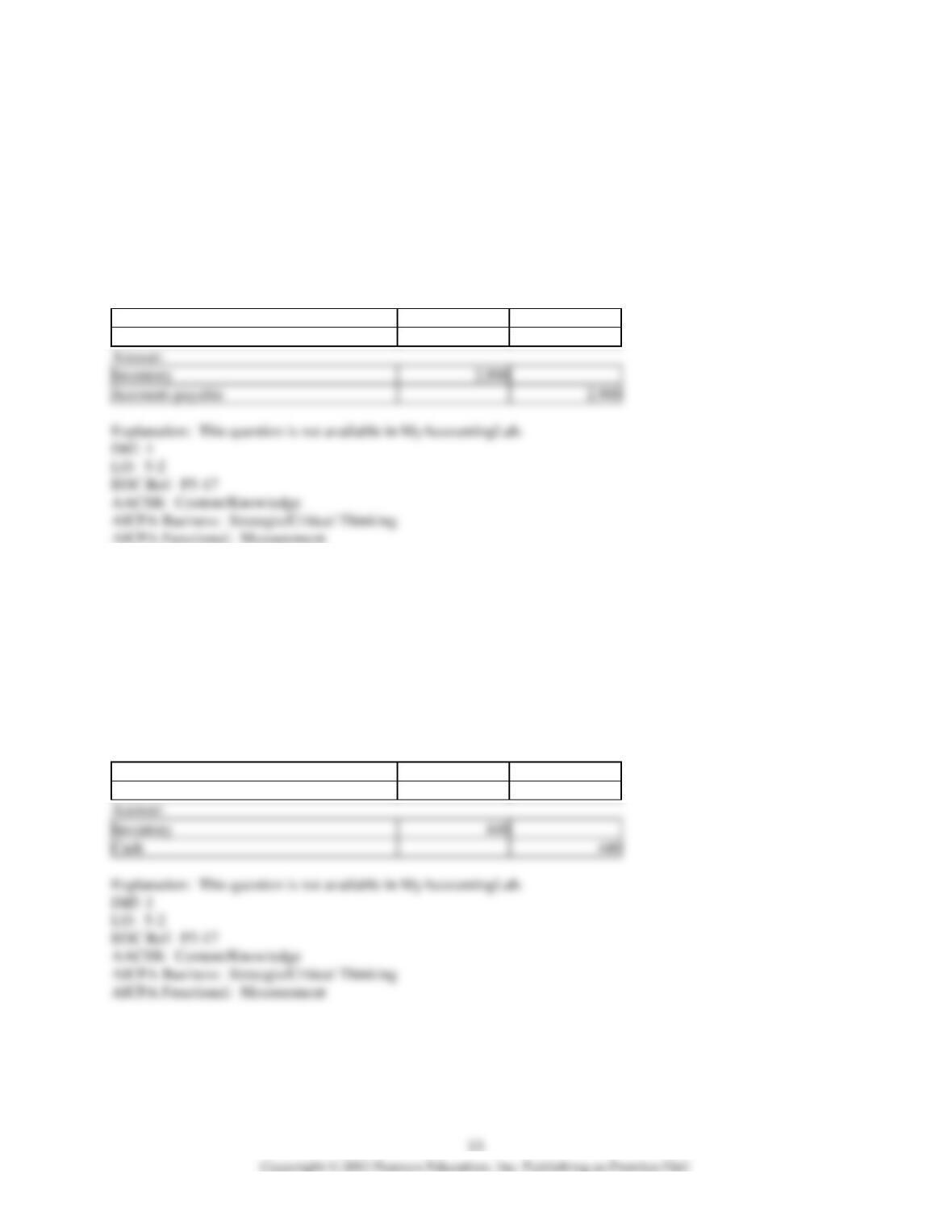
37) Reid Art Supply Company uses a perpetual inventory system. The company had the following transactions
during August, 2012:
Aug. 5 Reid Company purchased $2,900 of merchandise on account. Freight and credit terms were FOB shipping
point, 3/15, n/60.
Aug. 9 Reid Company paid transportation costs of $440 for the Aug. 5 purchase.
Aug. 10 Reid Company returned $600 of defective merchandise that had been purchased on Aug. 5.
Aug. 15 Reid Company paid for the merchandise purchased on Aug. 5.
Please provide the journal entry on Aug. 5.
Inventory
Accounts payable
38) Reid Art Supply Company uses a perpetual inventory system. The company had the following transactions
during August, 2012:
Aug. 5 Reid Company purchased $2,900 of merchandise on account. Freight and credit terms were FOB shipping
point, 3/15, n/60.
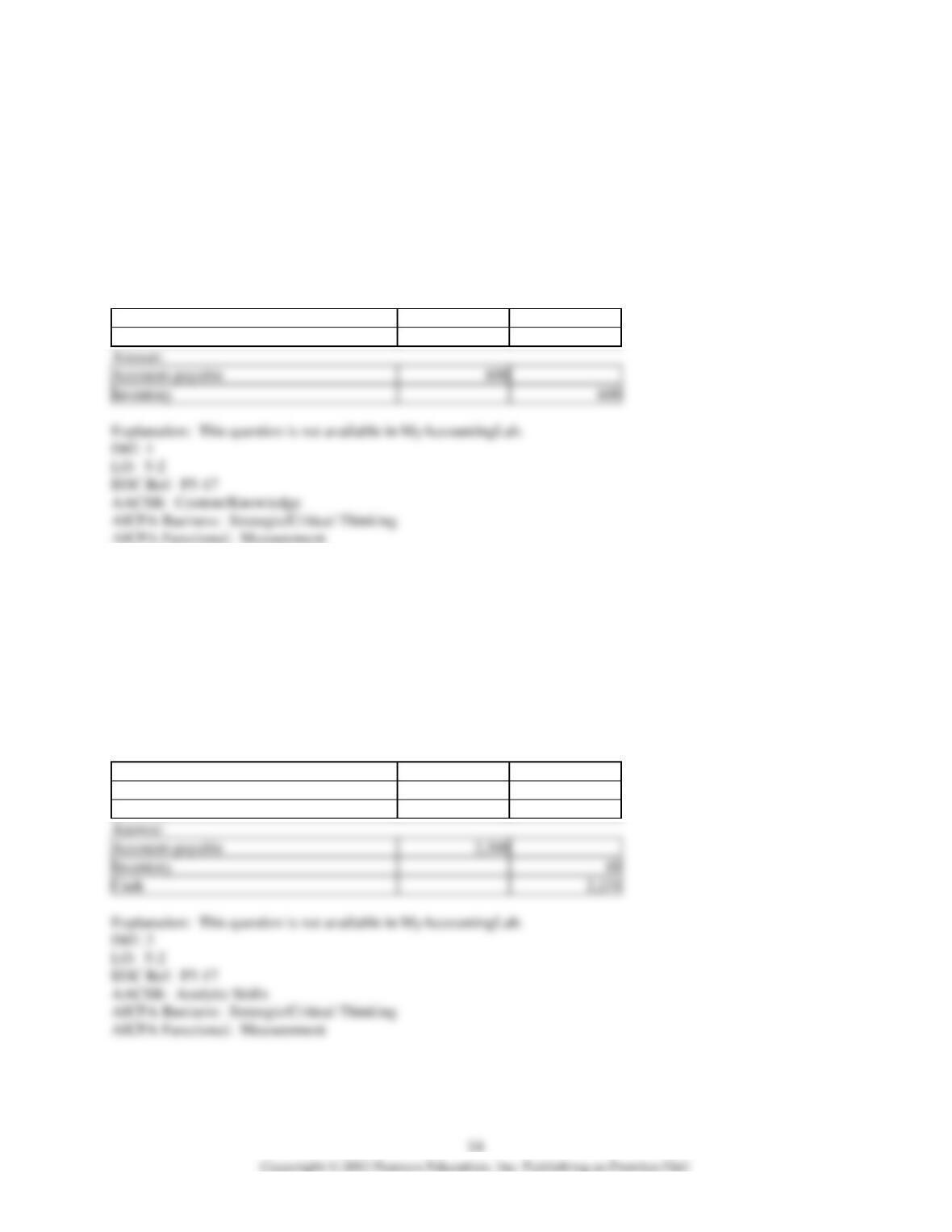
Aug. 9 Reid Company paid transportation costs of $440 for the Aug. 5 purchase.
Aug. 10 Reid Company returned $600 of defective merchandise that had been purchased on Aug. 5.
Aug. 15 Reid Company paid for the merchandise purchased on Aug 5.
Please provide the journal entry on Aug. 9.
Inventory
Cash
39) Reid Art Supply Company uses a perpetual inventory system. The company had the following transactions
during August, 2012:
Aug. 5 Reid Company purchased $2,900 of merchandise on account. Freight and credit terms were FOB shipping
point, 3/15, n/60.
Aug. 9 Reid Company paid transportation costs of $440 for the Aug. 5 purchase.
Aug. 10 Reid Company returned $600 of defective merchandise that had been purchased on Aug.5.
Aug. 15 Reid Company paid for the merchandise purchased on Aug. 5.
Please provide the journal entry on Aug. 10.
Accounts payable
Inventory
40) Reid Art Supply Company uses a perpetual inventory system. The company had the following transactions
during August, 2012:
Aug. 5 Reid Company purchased $2,900 of merchandise on account. Freight and credit terms were FOB shipping
point, 3/15, n/60.
Aug. 9 Reid Company paid transportation costs of $440 for the Aug. 5 purchase.
Aug. 10 Reid Company returned $600 of defective merchandise that had been purchased on Aug. 5.
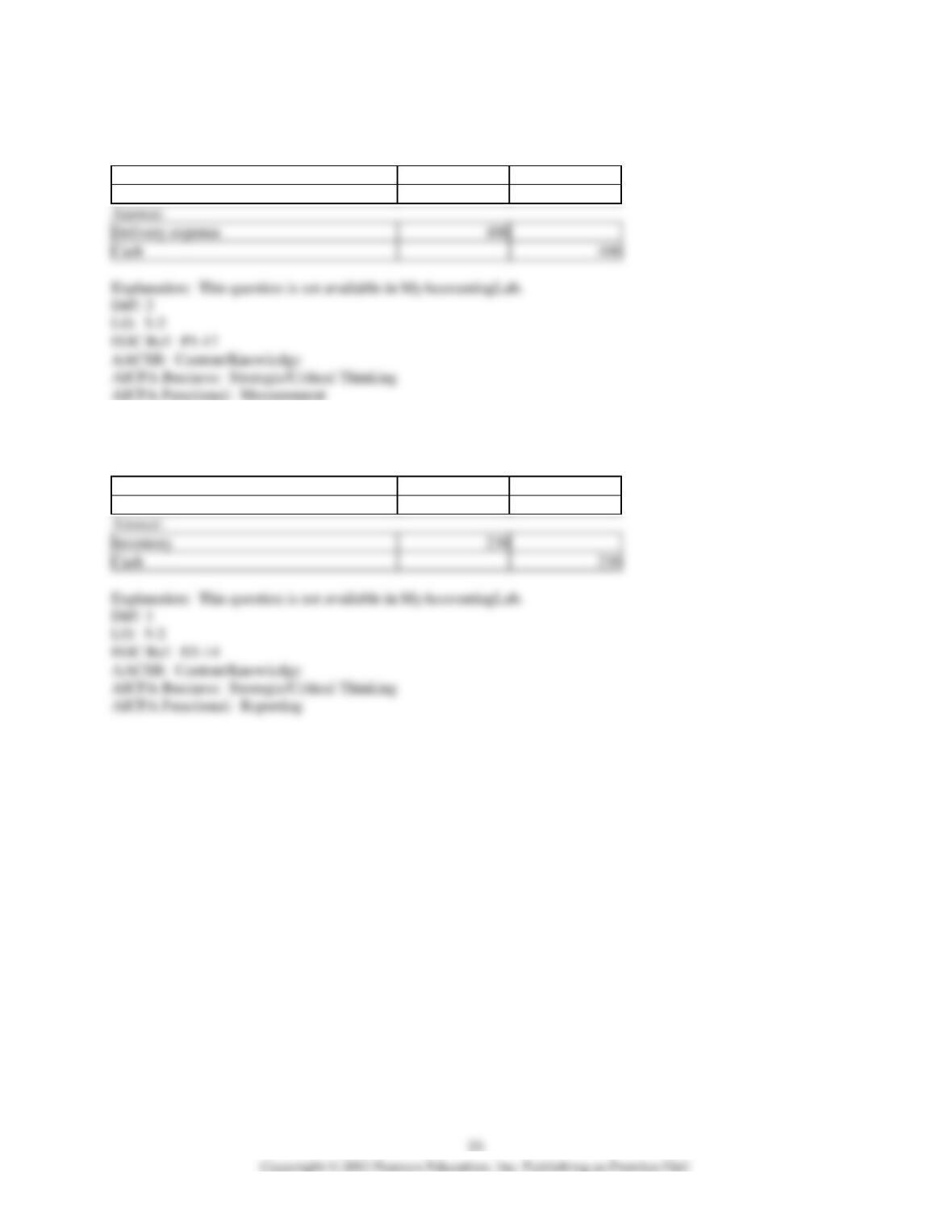
Aug. 15 Reid Company paid for the merchandise purchased on Aug. 5.
Please provide the journal entry on Aug. 15.
Accounts payable
Inventory
Cash
41) Oscar’s Packaging shipped goods to a customer and paid the freight out of $400 in cash. Please provide the
journal entry for the payment of freight out.
Delivery expense
Cash
42) Journalize the following transactions (using the perpetual inventory method). Paid $230 cash for freight in on
merchandise purchased.
Inventory
Cash
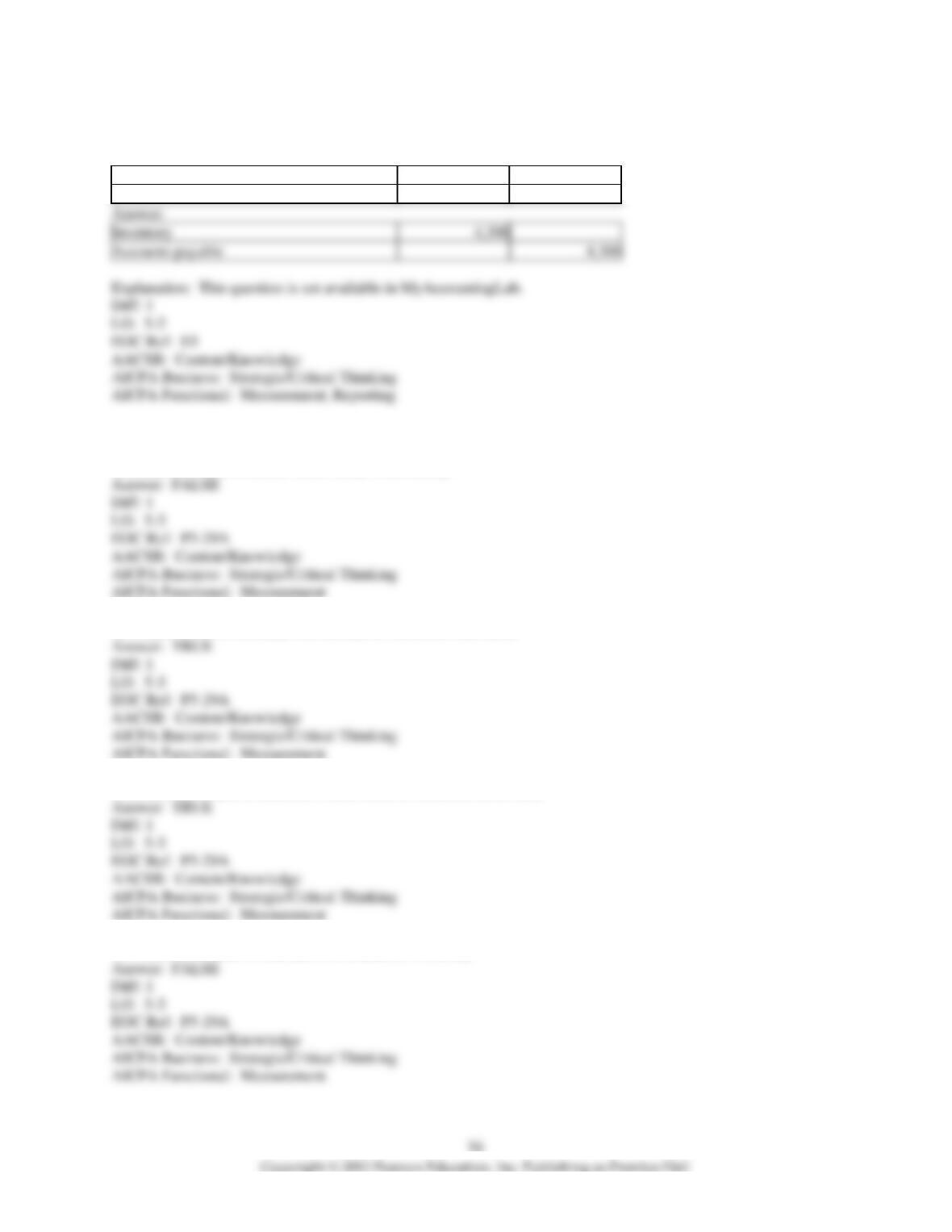
43) Journalize the following transactions (using the perpetual inventory method). Purchased merchandise on
account for $4,300.
Inventory
Accounts payable
Learning Objective 5-3
1) A sales return is recorded with a credit to Inventory.
2) A sales return is recorded with a credit to Accounts receivable.
3) A sales allowance is recorded with a credit to Accounts receivable.
4) A sales allowance is recorded with a debit to Inventory.
5) A company uses the perpetual inventory method. To record a sale of merchandise on account will require an
entry to record revenue and an entry to record cost of goods sold.
6) Net sales revenue is equal to Sales revenue less Cost of goods sold.
7) Which of the following is GENERALLY a merchandiser’s major cost?
A) Salary expense
B) Buildings
C) Advertising
D) Cost of goods sold
8) A company sold merchandise for $350 that cost $221. The entry to record the cost of the merchandise sold would
be a:
A) debit to Sales and a credit to Cash for $350.
B) debit to Cash and a credit to Sales for $350.
C) debit to Cost of goods sold and a credit to Inventory for $221.
D) debit to Inventory for $221 and a credit to Cost of goods sold for $221.
9) What is the difference between a sales return and a sales allowance?
A) A sales return reduces the amount receivable from the customer, but an allowance does not.
B) A sales return involves an adjustment to Inventory, but a sales allowance does not.
C) A sales return requires a debit to Sales returns and allowances, but a sales allowance does not.
D) A sales allowance is deducted from Sales revenue to calculate net sales, but a sales return is not.
10) A company sells merchandise for $1,000 on account with terms of 2/10, n/30. Defective merchandise of $200 is
returned 2 days later. Which of the following entries would be made to record the cash receipt for the sale if the
payment is received within 10 days?
A) The accounting entry would be an $800 debit to Cash and an $800 credit to Accounts receivable.
B) The accounting entry would be a $784 debit to Cash, a $16 debit to Sales discounts and an $800 credit to
Accounts receivable.
C) The accounting entry would be a $16 debit to Sales discounts, an $800 debit to Cash and an $816 credit to
Accounts receivable.
D) The accounting entry would be an $800 debit to Cash, a $16 credit to Sales discounts and a $784 credit to
Accounts receivable.
11) A company sells merchandise for $1,000 on account with terms of 2/10, n/30. Defective merchandise of $200 is
returned 2 days later. Which of the following entries would be made to record the cash receipt for the sale if the
payment is received 20 days later?
A) The accounting entry would be an $800 debit to Cash and an $800 credit to Accounts receivable.
B) The accounting entry would be a $784 debit to Cash, a $16 debit to Sales discounts and an $800 credit to
Accounts receivable.
C) The accounting entry would be a $16 debit to Sales discounts, an $800 debit to Cash and an $816 credit to
Accounts receivable.
D) The accounting entry would be an $800 debit to Cash, a $16 credit to Sales discounts and a $784 credit to
Accounts receivable.
12) Which of the following describes Net sales revenue?
A) Sales less Cost of goods sold
B) Sales less Sales discounts
C) Sales less Sales returns and allowances
D) Sales less Sales discounts less Sales returns and allowances
13) Which of the following are the normal balances of Sales, Sales discounts, and Sales returns and allowances,
respectively?
A) Debit, credit, and credit
B) Debit, debit, and credit
C) Credit, debit, and debit
D) Credit, credit, and debit
14) In a perpetual inventory system, merchandise returned by the customer for a refund is called a:
A) sales return.
B) sales allowance.
C) sales discount.
D) sales adjustment.
15) Referring to the following table, what is Net sales revenue?
Sales revenue
$460,000
Cost of goods sold
300,000
Operating expenses
85,000
Sales discounts
20,000
Sales returns and allowances
15,000
Interest revenue
5,000
A) $400,000
B) $415,000
C) $425,000
D) $455,000
16) Referring to the following table, what is Gross profit?
Sales revenue
$460,000
Cost of goods sold
300,000
Operating expenses
85,000
Sales discounts
20,000
Sales returns and allowances
15,000
Interest revenue
5,000
A) $90,000
B) $125,000
C) $140,000
D) $160,000