Chapter 4: Accounting for Merchandising Businesses
101. Sales to customers who use bank credit cards such as MasterCard and Visa are usually
recorded by a(n):
a. decrease in Bank Credit Card Sales, increase in Credit Card Expense, and increase in Sales.
b. increase in Cash, increase in Credit Card Expense, and increase in Sales.
c. increase in Cash, decrease in Credit Card Expense, and increase in Sales.
d. decrease in Sales, increase in Credit Card Expense, and decrease in Cash.
102. In recording the cost of merchandise sold for cash using a perpetual inventory system, the
effect on the accounts is:
a. increase Cost of Merchandise Sold; increase Cash.
b. increase Cost of Merchandise Sold; decrease Merchandise Inventory.
c. increase Merchandise Inventory; decrease Cost of Merchandise Sold.
d. increase Accounts Receivable; decrease Merchandise Inventory.
103. When merchandise that was sold on account is returned, which accounts are affected?
a. Cash, accounts receivable, cost of goods sold, and sales returns
b. Sales returns, accounts receivable, merchandise inventory, and cost of goods sold
c. Sales returns, accounts receivable, purchases, and cost of goods sold
d. Sales returns, accounts receivable, purchases, and merchandise inventory
104. For the perpetual inventory system, which of the following effects does not occur upon the
return from a customer of merchandise sold on account?
a. Increases Sales Returns and Allowances and decreases Accounts Receivable
b. Decreases Cost of Merchandise Sold and increases Merchandise Inventory
c. Increases Purchase Returns and Allowances and decreases Merchandise Inventory
d. All of these occur.
105. If merchandise sold on account is returned to the seller, the seller may inform the customer of
the details by issuing a:
a. sales invoice.
b. purchase invoice.
c. credit memorandum.
d. debit memorandum.
Chapter 4: Accounting for Merchandising Businesses
106. Merchandise subject to terms 2/10, n/30, FOB shipping point, is sold on account to a customer
for $35,000. The seller issued a credit memorandum for $8,000 prior to payment. What is the
amount of the cash discount allowable?
a. $700
b. $540
c. $860
d. $350
107. Orange Co. sells merchandise on credit to Zea Co. in the amount of $9,000. The invoice is
dated on September 15 with terms of 1/15, net 45. What is the amount of the discount, and up
to what date must the invoice be paid in order for the buyer to take advantage of the discount?
a. $180, September 30
b. $180, September 25
c. $90, September 30
d. $90, September 25
108. Based on the following information, what would be recorded as purchases discount if the
invoice is paid within the discount period?
1. $5,000 of merchandise inventory was ordered on April 2, 2015.
2. $2,000 of this merchandise was received on April 5, 2015.
3. On April 6, 2015, an invoice dated April 4, 2015, with terms of 2/10, net 30 for $2,150
which included a $150 prepaid freight cost, was received.
4. On April 10, 2015, $500 of the merchandise was returned to the seller.
a. $100
b. $30
c. $43
d. $33
109. In credit terms of 1/10, n/30, the “10” represents the:
a. number of days in the discount period.
b. full amount of the invoice.
c. number of days when the entire amount is due.
d. percent of the cash discount.
Chapter 4: Accounting for Merchandising Businesses
110. When purchases of merchandise are made for cash, under the perpetual inventory system, the
transaction:
a. increases Cash; decreases Merchandise Inventory.
b. increases Merchandise Inventory; decreases Cash.
c. increases Merchandise Inventory; decreases Cash Discounts.
d. increases Merchandise Inventory; decreases Purchases.
111. When merchandise is purchased to resell to customers, it is recorded in the account entitled:
a. Supplies.
b. Cost of Goods Sold.
c. Merchandise Inventory.
d. Sales.
112. Using a perpetual inventory system, the purchase of $30,000 of merchandise on account would
include a(n):
a. increase in Sales.
b. increase in Merchandise Inventory.
c. decrease in Merchandise Inventory.
d. decrease in Sales.
113. Using a perpetual inventory system, the return of merchandise purchased on account includes
a(n):
a. increase in Sales.
b. increase in Merchandise Inventory.
c. decrease in Merchandise Inventory.
d. decrease in Sales.
114. The amount of the total cash paid to the seller for merchandise purchased would normally
include:
a. only the list price.
b. only the sales tax.
c. the list price plus the sales tax.
d. the list price less the sales tax.
Chapter 4: Accounting for Merchandising Businesses
115. A sales invoice included the following information: merchandise price, $8,000; terms 2/10,
n/eom. Assuming that a credit for merchandise returned of $1,000 is granted prior to payment,
and that the invoice is paid within the discount period, what is the amount of cash received by
the seller?
a. $6,840
b. $7,000
c. $6,860
d. $7,840
116. A sales invoice included the following information: merchandise price, $6,000; terms 2/10,
n/eom. Assuming that a credit for merchandise returned of $600 is granted prior to payment,
and that the invoice is paid within the discount period, what is the amount of cash received by
the seller?
a. $5,880
b. $5,292
c. $5,586
d. $5,592
117. Merchandise subject to terms 1/10, n/30, FOB shipping point, is sold on account to a customer
for $17,500. The seller issued a credit memorandum for $4,000 prior to payment. What is the
amount of the cash discount allowable?
a. $215
b. $175
c. $135
d. $140
118. If the buyer is to pay the delivery expense of delivering merchandise, delivery terms are stated
as:
a. FOB shipping point.
b. FOB destination.
c. FOB n/30.
d. FOB buyer.
119. If the seller is to pay the delivery expense of delivering merchandise, the delivery terms are
stated as:
a. FOB shipping point.
b. FOB destination.
c. FOB n/30.
d. FOB seller.
Chapter 4: Accounting for Merchandising Businesses
120. If title to merchandise purchases passes to the buyer when the goods are shipped from the
seller, the terms are:
a. n/30.
b. FOB shipping point.
c. FOB destination.
d. consigned.
121. If title to merchandise purchases passes to the buyer when the goods are delivered to the
buyer, the terms are:
a. consigned.
b. b. n/30.
c. FOB shipping point.
d. FOB destination.
122. Merchandise with an invoice price of $10,000 is purchased subject to terms of 2/10, n/30, FOB
destination. Transportation costs paid by the seller totaled $300. What is the net cost of the
merchandise?
a. $10,300
b. $10,100
c. $9,800
d. $9,506
123. Which term indicates that merchandise is free of transportation charges to the buyer?
a. FOB destination
b. Transportation out
c. FOB shipping point
d. Transportation in
124. Inventory shortage is recorded when:
a. merchandise is returned by a buyer.
b. merchandise purchased from a seller is incomplete or short.
c. merchandise is returned to a seller.
d. there is a difference between a physical count of inventory and inventory records.
Chapter 4: Accounting for Merchandising Businesses
125. By dividing gross profit by cost of merchandise sold we arrive at:
a. gross profit percent.
b. average markup percent.
c. ratio of sales to assets.
d. sales percent.
126. Ratio of sales to assets is calculated by:
a. dividing average total assets by net sales.
b. dividing net sales by total current assets.
c. dividing net sales by average total assets.
d. dividing total current assets by net sales.
127. If sales is $50,000 and cost of merchandise sold is $35,000, how much would be the markup
percent?
a. 30.0%
b. 70.0%
c. 42.9%
d. 14.3%
128. If net sales is $100,000, total assets at the beginning of the year is $45,000, and total assets at
end of the end of the year is $55,000, how much would be the ratio of sales to assets?
a. 1.0
b. 1.8
c. 2.2
d. 2.0
129. Cash paid to purchase long-term investments would be reported in the statement of cash flows
in:
a. the cash flows from operating activities section.
b. the cash flows from financing activities section.
c. the cash flows from investing activities section.
d. a separate schedule.

Chapter 4: Accounting for Merchandising Businesses
130. Which of the following should be shown on a statement of cash flows under the financing
activity section?
a. The purchase of a long-term investment in the common stock of another company
b. The payment of cash to retire a long-term note
c. The proceeds from the sale of a building
d. The issuance of a long-term note to acquire land
131. Under the indirect method for preparing the statement of cash flows, increases in current
liabilities are the net income in the cash flows from operating activities section.
a. subtracted from
b. added to
c. not used when calculating
d. equal to
132. Which of the following would not affect the operating activities section of the statement of
cash flows, using the indirect method?
a. Decrease in merchandise inventory
b. Payment on a note payable
c. Decrease in unearned rent
d. Depreciation expense
133. A company has a net income of $70,000 and depreciation expenses of $20,000. During the
year, its accounts payable balance decreased by $15,000. What is the net cash flow from
operating activities using the indirect method for preparing the statement of cash flows?
a. $90,000
b. $105,000
c. $50,000
d. $75,000
134. Under the indirect method for preparing the statement of cash flows, decreases in current
assets are net income in the cash flows from operating activities section.
a. subtracted from
b. added to
c. not used in calculating
d. cannot tell from the information given
Chapter 4: Accounting for Merchandising Businesses
135. A payment of dividends decreases which section on the statement of cash flows?
a. Operating activities
b. Investing activities
c. Financing activities
d. None of these
136. ONI, Inc. purchased $60,000 of equipment for cash. How does this transaction impact the
statement of cash flows?
a. Decreases the cash flow from operating activities by $60,000
b. Decreases equipment by $60,000
c. Decreases the cash flow from investing activities section by $60,000
d. This transaction would not affect the statement of cash flows.
137. Investing activities include:
a. collecting cash on loans made.
b. obtaining cash from creditors.
c. obtaining capital from owners.
d. repaying money previously borrowed.
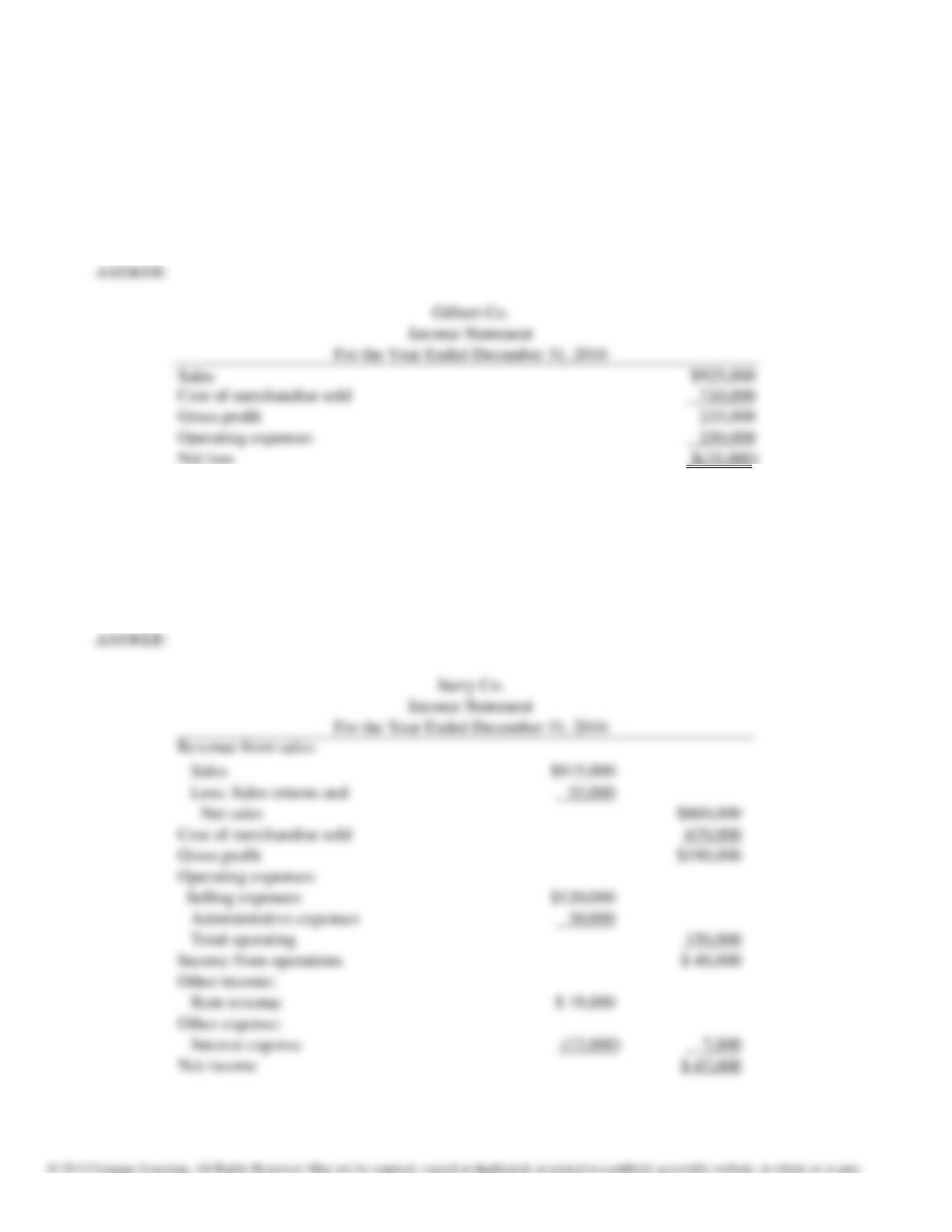
138. The following data for the year ended June 30, 2016, were extracted from the accounting
records of Roof Co.:
Cost of merchandise sold
$300,000
Operating expenses
95,000
Sales
450,000
Prepare a multiple-step income statement for the current year ended June 30, 2016.
Gross profit
Chapter 4: Accounting for Merchandising Businesses
139. The following data for the current year ended December 31, 2016, were extracted from the
accounting records of Gilbert Co.:
Cost of merchandise sold
$710,000
Operating expenses
250,000
Sales
925,000
Prepare a multiple-step income statement for the year ended December 31, 2016.
Gross profit
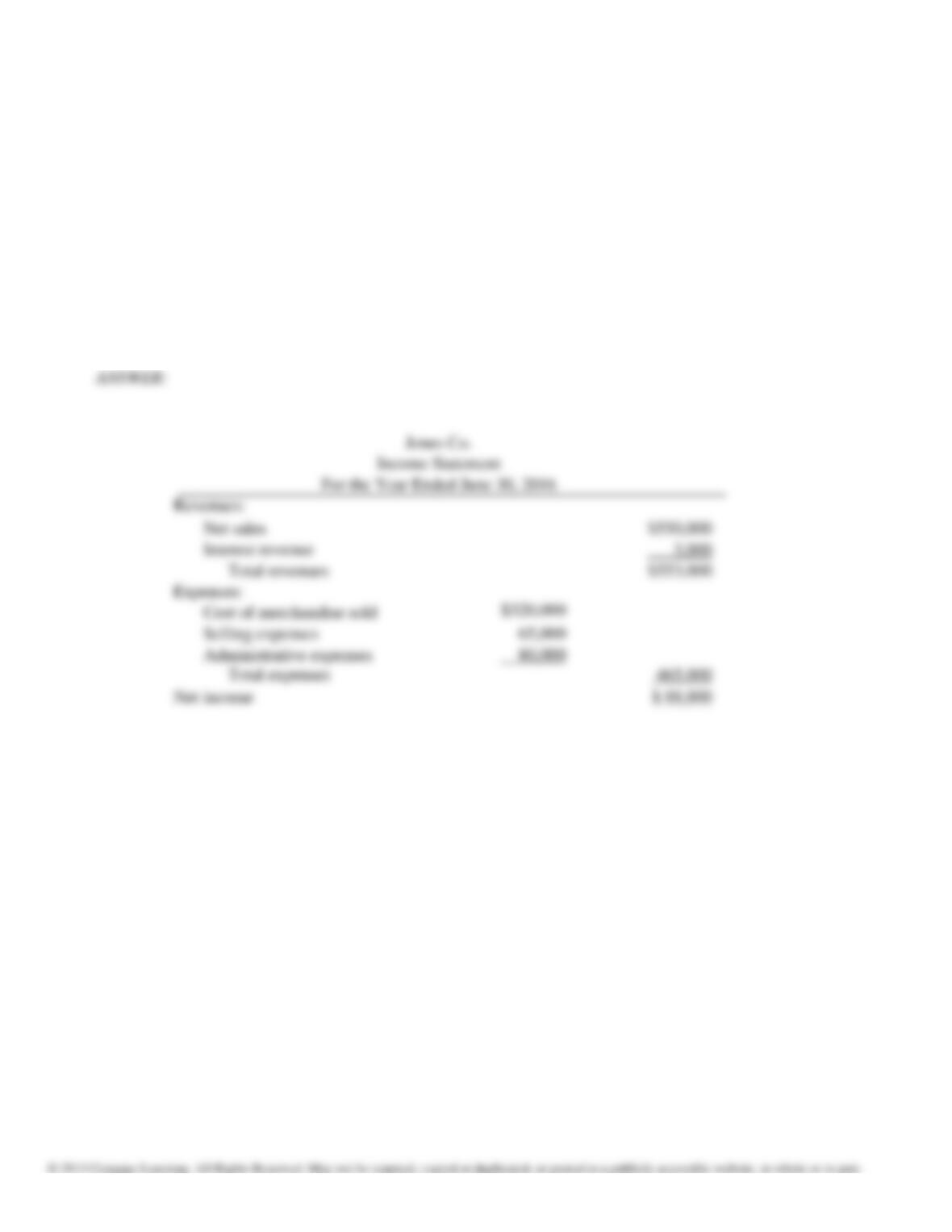
140. Prepare a multiple-step income statement for Surry Co. from the following data for the year
ended December 31, 2016.
Sales, $915,000; cost of merchandise sold, $670,000; administrative expenses, $30,000;
interest expense, $12,000; rent revenue, $19,000; sales returns and allowances, $55,000;
selling expenses, $120,000.
Cost of merchandise sold
Operating expenses:
Income from operations
Chapter 4: Accounting for Merchandising Businesses
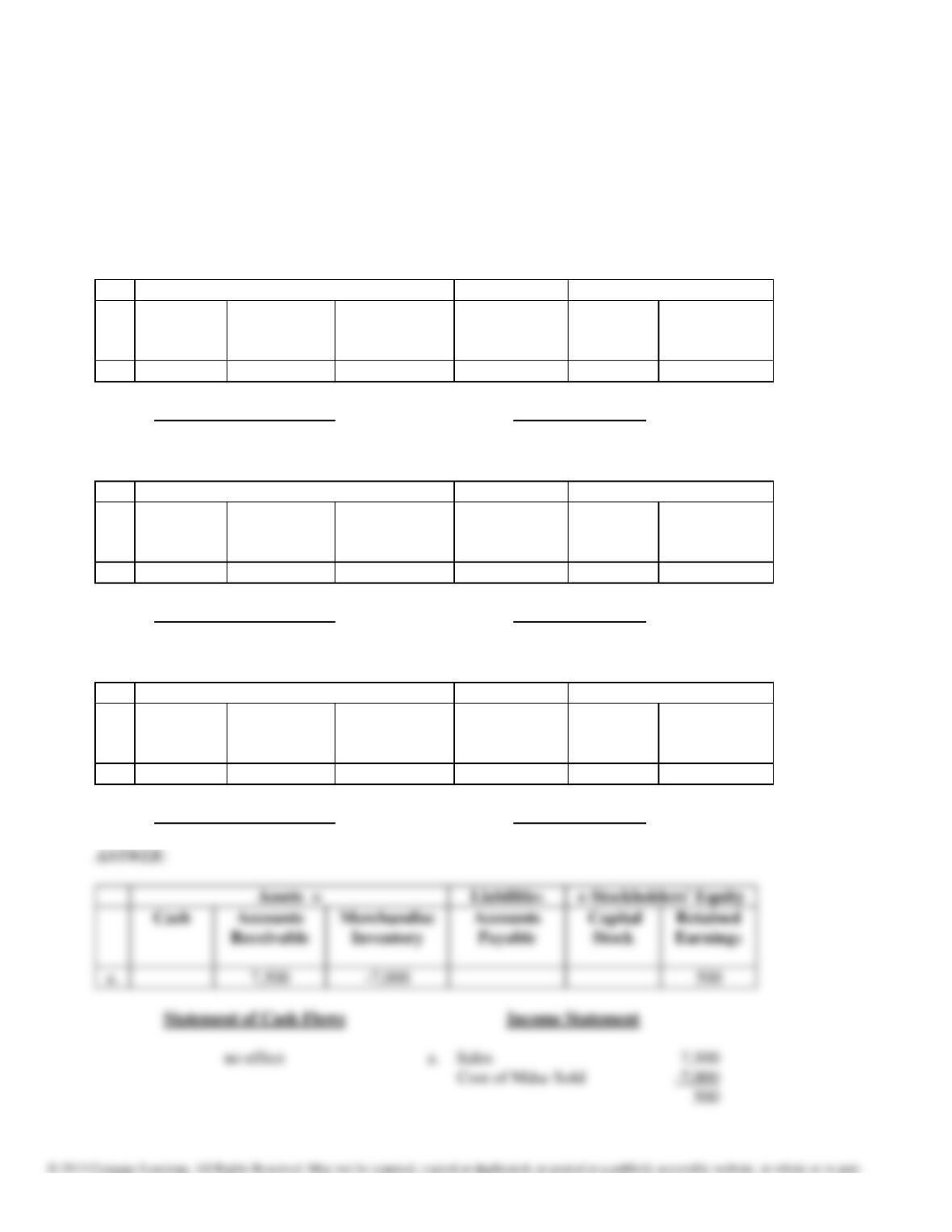
141. Selected data from the ledger of Jones Co. after adjustment at June 30, the end of the fiscal
year, are listed as follows:
Accounts Receivable
$ 25,000
Prepaid Insurance
$ 2,250
Accumulated Depreciation
35,200
Notes Payable
60,150
Administrative Expenses
80,000
Retained Earnings
55,000
Capital Stock
40,000
Salaries Payable
3,000
Cost of Merchandise Sold
320,000
Sales (net)
550,000
Dividends
22,000
Selling Expenses
65,000
Interest Revenue
3,000
Supplies
2,750
Office Equipment
70,500
Prepare a single-step income statement for the year ended June 30, 2016.
Interest revenue
Selling expenses
Chapter 4: Accounting for Merchandising Businesses
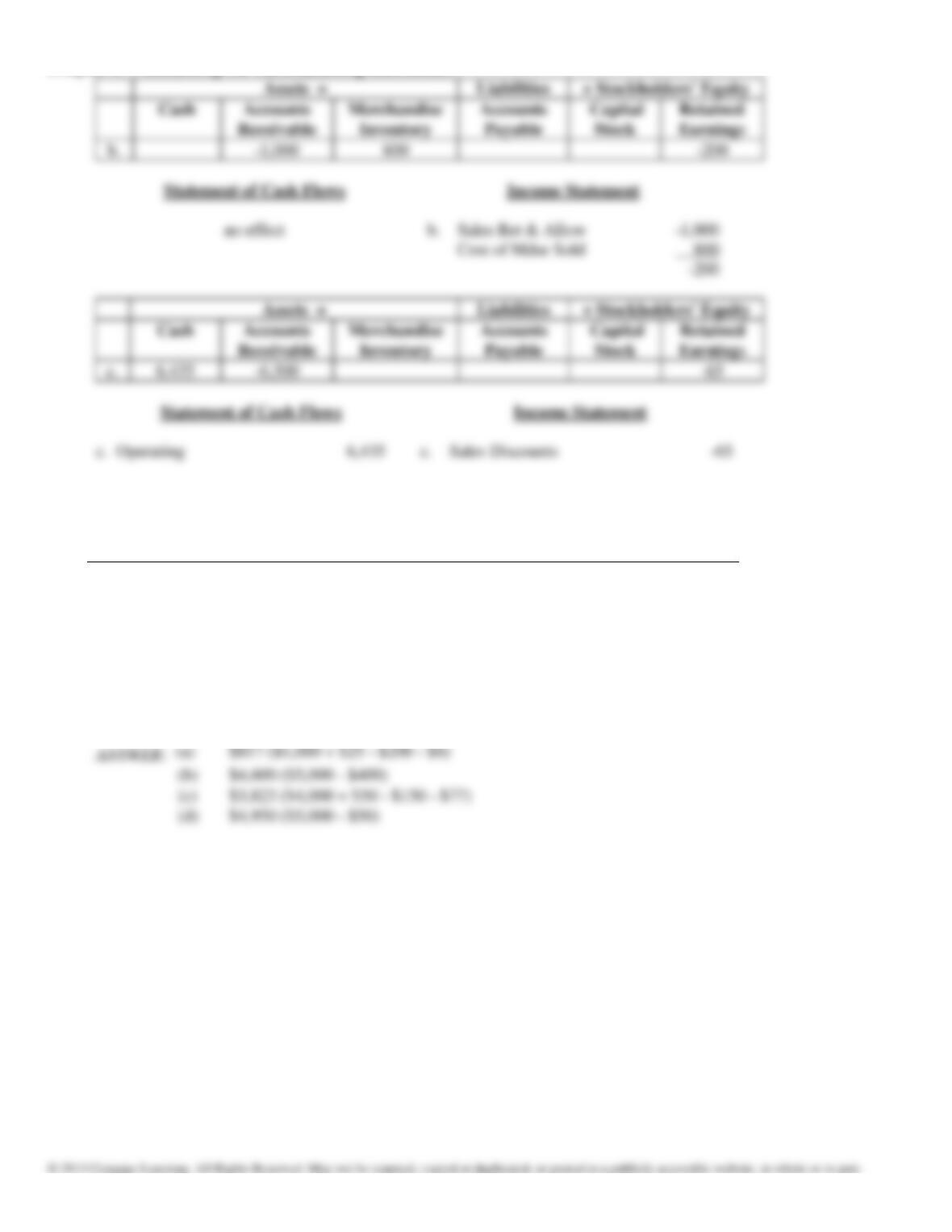
142. Merchandise with a list price of $7,500 and a cost of $7,000 is sold on account, terms 1/10,
n/30. Prior to payment, merchandise with a list price of $1,000 and a cost of $800 is returned.
The correct amount is paid within the discount period.
Record the following transactions, using the integrated financial statement framework that
follows:
(a) Sold the merchandise.
(b) Received the returned merchandise
(c) Received the amount owed.
Assets =
Liabilities
+ Stockholders’ Equity
Cash
Accounts
Receivable
Merchandise
Inventory
Accounts
Payable
Capital
Stock
Retained
Earnings
a.
Statement of Cash Flows
Income Statement
Assets =
Liabilities
+ Stockholders’ Equity
Cash
Accounts
Receivable
Merchandise
Inventory
Accounts
Payable
Capital
Stock
Retained
Earnings
b.
Statement of Cash Flows
Income Statement
Assets =
Liabilities
+ Stockholders’ Equity
Cash
Accounts
Receivable
Merchandise
Inventory
Accounts
Payable
Capital
Stock
Retained
Earnings
c.
Statement of Cash Flows
Income Statement
Assets =
Cash
Accounts
Cost of Mdse Sold
Chapter 4: Accounting for Merchandising Businesses
800
-6,500
143. Details of invoices for purchases of merchandise are as follows:
Merchandise
Transportation
Terms
Returns and
Allowances
a. $1,000
$25
FOB shipping point, 1/10, n/30
$200
b. 5,000
—
FOB destination, n/30
400
c. 4,000
50
FOB shipping point, 2/10, n/30
150
d. 5,000
—
FOB destination, 1/10, n/30
—
Determine the amount to be paid in full settlement of each of the invoices, assuming that credit
for returns and allowances was received prior to payment and that all invoices were paid
within the discount period. Also assume that the seller has prepaid the transportation expenses.
Chapter 4: Accounting for Merchandising Businesses
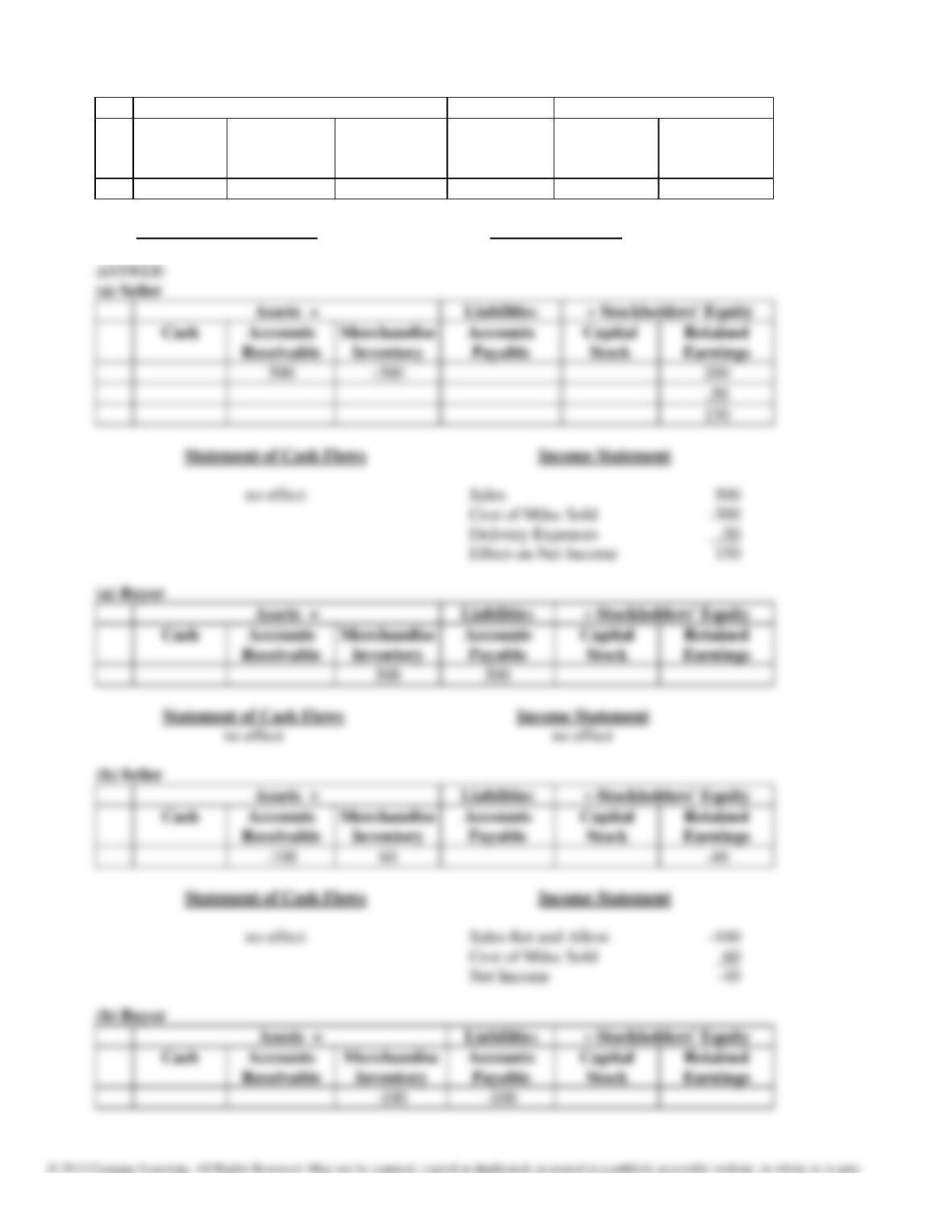
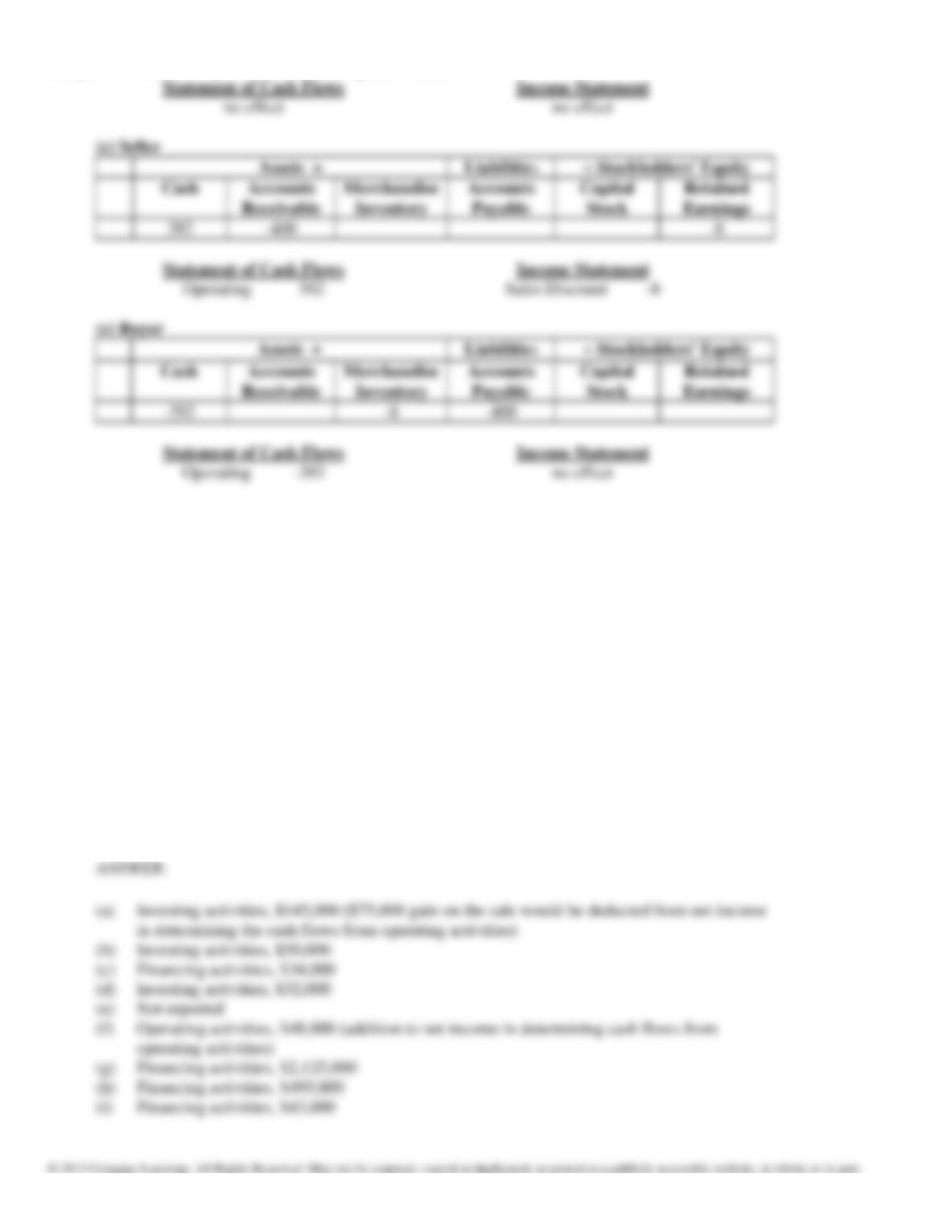
144. Based on the information below, illustrate the effects on the accounts and financial statements
of the Seller and the Buyer. Both use a perpetual inventory system.
(a)
Seller sells Buyer on account merchandise costing $300 for $500, terms 2/10, net 30, FOB
destination. The transportation charge is $50.
(b)
Buyer returns as defective $100 worth of the $500 merchandise received. The seller’s cost
is $60.
(c)
Buyer pays within the discount period.
(a) Seller
Assets =
Liabilities
+ Stockholders‘ Equity
Cash
Accounts
Receivable
Merchandise
Inventory
Accounts
Payable
Capital
Stock
Retained
Earnings
Statement of Cash Flows
Income Statement
(a) Buyer
Assets =
Liabilities
+ Stockholders‘ Equity
Cash
Accounts
Receivable
Merchandise
Inventory
Accounts
Payable
Capital
Stock
Retained
Earnings
Statement of Cash Flows
Income Statement
(b) Seller
Assets =
Liabilities
+ Stockholders‘ Equity
Cash
Accounts
Receivable
Merchandise
Inventory
Accounts
Payable
Capital
Stock
Retained
Earnings
Statement of Cash Flows
Income Statement
(b) Buyer
Assets =
Liabilities
+ Stockholders‘ Equity
Cash
Accounts
Receivable
Merchandise
Inventory
Accounts
Payable
Capital
Stock
Retained
Earnings
Statement of Cash Flows
Income Statement
(c) Seller
Assets =
Liabilities
+ Stockholders‘ Equity
Cash
Accounts
Receivable
Merchandise
Inventory
Accounts
Payable
Capital
Stock
Retained
Earnings
Statement of Cash Flows
Income Statement
Chapter 4: Accounting for Merchandising Businesses
(c) Buyer
Assets =
Liabilities
+ Stockholders‘ Equity
Cash
Accounts
Receivable
Merchandise
Inventory
Accounts
Payable
Capital
Stock
Retained
Earnings
Statement of Cash Flows
Income Statement
Statement of Cash Flows
Income Statement
+ Stockholders‘ Equity
Statement of Cash Flows
Income Statement
Chapter 4: Accounting for Merchandising Businesses
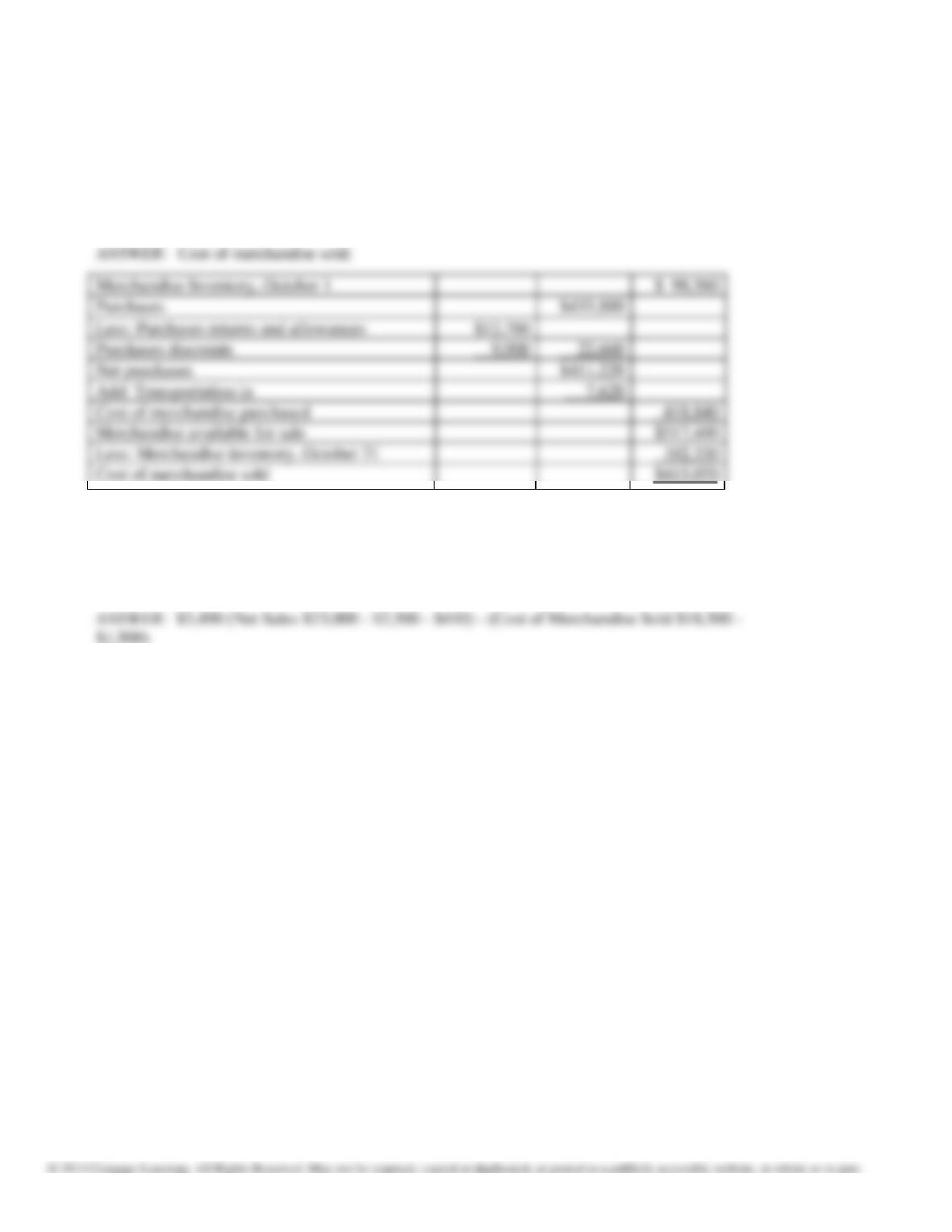
145. State the section(s) of the statement of cash flows prepared by the indirect method (operating
activities, investing activities, financing activities, or not reported) and the amount that would
be reported for each of the following transactions:
(a) Received $145,000 from the sale of land costing $70,000.
(b) Purchased investments for $50,000.
(c) Declared $35,000 cash dividends on stock. $5,000 dividends were payable at the
beginning of the year, and $6,000 were payable at the end of the year.
(d) Acquired equipment for $32,000 cash.
(e) Declared and issued 100 shares of $20 par common stock as a stock dividend, when the
market price of the stock was $32 a share.
(f) Recognized by an adjusting entry depreciation for the year, $48,000.
(g) Issued 85,000 shares of $10 par common stock for $25 a share, receiving cash.
(h) Issued $500,000 of 20-year, 10% bonds payable at 99.
(i) Borrowed $43,000 from Busey National Bank, issuing a 5-year, 8% note for that
amount.
Chapter 4: Accounting for Merchandising Businesses
Merchandise Inventory, October 1
$ 98,560
Merchandise Inventory, October 31
102,330
Purchases
433,880
Purchases Returns & Allowances
12,760
Purchases Discounts
9,900
Transportation In
7,620
146. Based on the following data, determine the cost of merchandise sold for October.
147. Gold Co. sold merchandise to Bronze Co. on account, $23,000, terms 2/15, net 45. The cost of
the merchandise sold is $18,500. Gold Co. issued a credit memorandum for $2,500 for
merchandise returned that originally cost $1,900. Bronze Co. paid the invoice within the
discount period. What is the amount of net income earned by Gold Co. on the transactions?