77) On December 31, 2019, Krug Company prepared adjusting entries that included the
following items:
Depreciation expense: $31,000.
Accrued sales revenue: $29,000.
Accrued expenses: $12,000.
Used insurance: $9,000; the insurance was initially recorded as prepaid.
Rent revenue earned: $7,000; the rent was initially prepaid by the tenant and credited to unearned
rent revenue.
If Krug Company reported stockholders’ equity of $280,000 prior to the adjusting entries, how
much is Krug’s stockholders’ equity after the adjusting entries?
A) $280,000.
B) $262,000.
C) $295,000.
D) $264,000.
78) On July 1, 2019, Goode Company borrowed $100,000. The company signed a note payable
with interest at 6 percent per year. The note and interest are due on December 31, 2019. On
December 31, 2019, Goode paid $103,000 to settle the debt in full. Assuming no accruals for
interest have been made during the year, transaction analysis of the $103,000 cash payment on
December 31, 2019 should reflect which of the following?
A) A decrease in assets of $103,000 and a decrease in liabilities of $103,000.
B) A decrease in assets of $100,000, a decrease in stockholders’ equity of $3,000, and a decrease
in liabilities of $103,000.
C) A decrease in stockholders’ equity of $100,000, a decrease in liabilities of $3,000, and a
decrease in assets of $103,000.
D) A decrease in liabilities of $100,000, a decrease in stockholders’ equity of $3,000, and a
decrease in assets of $103,000.
79) On January 1, 2019, Ryan Company paid the premium on a three-year insurance policy in
the amount of $6,000. At that time, the full amount paid was recorded as prepaid insurance. After
recording the adjusting entry for the insurance policy on December 31, 2019, what would be the
balance in Ryan Company’s prepaid insurance account?
A) $6,000.
B) $2,000.
C) $3,000.
D) $4,000.
80) Assume Idaho Company recorded the following adjusting journal entry at year-end:
Insurance expense
$2,000
Prepaid insurance
$2,000
If the beginning balance in prepaid insurance was $500, and $2,500 was paid for an insurance
premium during the year, what is the ending balance in the prepaid insurance account after the
above adjusting entry?
A) $1,200.
B) $700.
C) $2,200.
D) $1,000.
81) Failure to make an adjusting entry to recognize rent revenue receivable would cause which
of the following?
A) An understatement of assets, net income, and stockholders’ equity.
B) An overstatement of assets and stockholders’ equity and an understatement of net income.
C) No effect on assets, liabilities, net income, or stockholders’ equity.
D) An overstatement of assets, net income, and stockholders’ equity.
82) Which of the following best describes the difference between an unadjusted trial balance and
an adjusted trial balance?
A) An unadjusted trial balance is prepared at the start of the accounting period and is not
provided to external decision makers, while an adjusted trial balance is prepared at the end of the
period and is provided to external decision makers.
B) An unadjusted trial balance is prepared by companies that make adjusting entries, while an
adjusted trial balance is prepared by companies that do not make adjusting entries.
C) An unadjusted trial balance is prepared before the adjusting entries have been made, while an
adjusted trial balance is prepared after the adjusting entries have been made.
D) An unadjusted trial balance is prepared after the post-closing trial balance.
83) Which of the following accounts would most likely not require an adjusting entry at year-
end?
A) Unearned subscription revenue.
B) Office supplies.
C) Cash.
D) Prepaid rent.
84) On December 31, 2019, The Bates Company’s revenue is $300,000 and expenses total
$160,000 before consideration of the following:
Accrued wages total $11,000;
Accrued revenues total $36,000;
Depreciation expense is $17,000;
Rental revenue of $9,000 was earned; the rent from a tenant was initially recorded by Bates as
unearned rent revenue;
The income tax rate is 40% of income before income taxes.
What is Bates’ net income after consideration of the above information?
A) $94,200.
B) $157,000.
C) $140,000.
D) $88,800.
85) Which of the following statements is correct?
A) Balance sheet accounts are permanent accounts and do not retain their balances from one
period to the next.
B) Balance sheet accounts are temporary accounts and do retain their balances from one period
to the next.
C) Income statement accounts are permanent accounts and do retain their balances from one
period to the next.
D) Income statement accounts are temporary accounts and do not retain their balances from one
period to the next.
86) Which of the following will result in an increase in earnings per share?
A) Accruing expenses at year-end.
B) Selling additional shares of common stock during the year.
C) Accruing revenue at year-end.
D) Receiving cash from a tenant that is recorded as unearned revenue.
87) Which of the following statements regarding earnings per share is not correct?
A) Earnings per share can be reported on the income statement.
B) The numerator is net income.
C) The denominator is the average number of shares of common stock outstanding.
D) Earnings per share does not have to be disclosed on the income statement or the notes to the
financial statements.
88) Which of the following statements does not correctly describe the relationship between the
income statement and the ending retained earnings balance?
A) Net income increases the ending balance of retained earnings.
B) A net loss decreases the ending retained earnings balance.
C) A net loss does not affect the ending retained earnings balance.
D) Net income and net loss both affect the ending retained earnings balance.
89) Which of the following statements regarding the balance sheet is false?
A) Buildings and equipment are reported at book value.
B) Assets are reported in the order of liquidity.
C) Current liabilities are obligations to be paid with current assets.
D) The balance sheet reflects balances for a period of time.
90) A calendar-year reporting company preparing its annual financial statements should use the
phrase “At December 31, 2019” in the heading of which of the following?
A) On all of the required financial statements.
B) On only the income statement.
C) On the income statement and balance sheet, but not the statement of cash flows.
D) On the balance sheet only.
91) The declaration of a $5,000 dividend by JLH Company would be reported on which of JLH’s
financial statements?
A) The income statement only.
B) The statement of stockholders’ equity.
C) The balance sheet only.
D) The statement of cash flows.
92) Which of the following statements is inaccurate with respect to the total asset turnover
ratio?
A) The ratio is calculated as sales revenues divided by total assets at year-end.
B) The ratio is decreased when additional plant and equipment is purchased.
C) A high ratio implies efficient management of assets.
D) The ratio is decreased when additional inventory is purchased.
93) Top Company’s 2019 sales revenue was $200,000 and 2018 sales revenue was $180,000.
Top’s total assets as of December 31, 2019 were $150,000 and total assets as of January 1, 2019
were $130,000. What is Top’s total asset turnover ratio?
A) 1.48
B) 1.33
C) 1.36
D) 1.43
94) Which of the following correctly describes the closing entry process?
A) The closing process reduces the balances in the permanent accounts to zero at the end of each
period.
B) The closing entries are usually prepared prior to the adjusted trial balance.
C) The closing process creates a zero balance in all temporary accounts at the end of each period.
D) The closing process creates a zero balance at the end of each period for all accounts on the
year-end trial balance.
95) Which of the following account balances would not be affected by closing entries?
A) Interest expense.
B) Accumulated depreciation.
C) Treasury stock.
D) Retained earnings.
96) Which of the following account balances would be closed at year-end?
A) Interest expense.
B) Accumulated depreciation.
C) Retained earnings.
D) Unearned revenues.
97) Which of the following account balances would not be closed at year-end by debiting the
account?
A) Interest revenue.
B) Gain on sale of building.
C) Sales revenue.
D) Unearned revenue.
98) Which of the following account balances would be closed at year-end by crediting the
account?
A) Investment revenue.
B) Loss on sale of building.
C) Sales revenue.
D) Unearned revenues.
99) Which one of the following accounts would not be closed at the end of the accounting year?
A) Utilities expense.
B) Sales revenue.
C) Prepaid rent.
D) Wages expense.
100) A post-closing trial balance would show a zero balance in which one of the following
accounts?
A) Supplies.
B) Accounts receivable.
C) Accumulated depreciation.
D) Income tax expense.
101) Which of the following correctly describes the accounts reported on the post-closing trial
balance?
A) They include permanent and temporary accounts with non-zero balances.
B) The ending retained earnings balance includes the current period net income.
C) They include only temporary account balances.
D) They do not include stockholders’ equity account balances.
102) Which of the following is not a correct closing entry?
A)
Retained earnings
xxx
Revenues
xxx
Expenses
xxx
B)
Revenues
xxx
Gain on sale of land
xxx
Expenses
xxx
Retained earnings
xxx
C)
Revenues
xxx
Loss on sale of Building
xxx
Expenses
xxx
Retained earnings
xxx
D)
Loss on sale of land
xxx
Expenses
xxx
Revenues
xxx
Retained earnings
xxx
103) Which of the following accounts requires a debit to close the account at year-end?
A) Prepaid rent.
B) Sales revenue.
C) Unearned revenue.
D) Wage expense.
104) Which of the following accounts would not be included in the closing process at year-end?
A) Rent expense.
B) Sales revenue.
C) Additional paid-in capital.
D) Cost of goods sold.
105) Describe the adjusted trial balance.
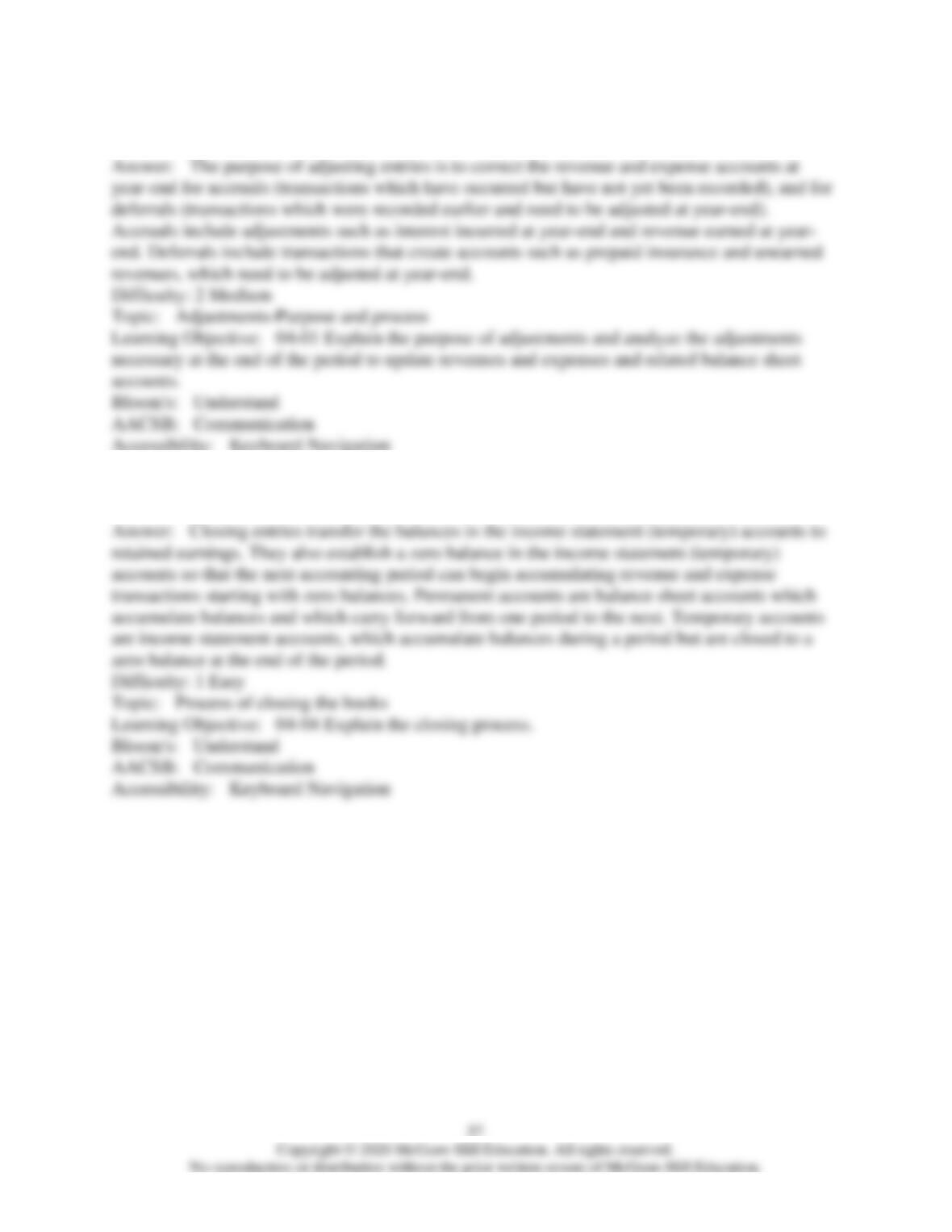
106) What is the purpose of adjusting entries? Give two examples of accruals and deferrals.
107) What are the purposes of closing entries? Describe permanent and temporary accounts.
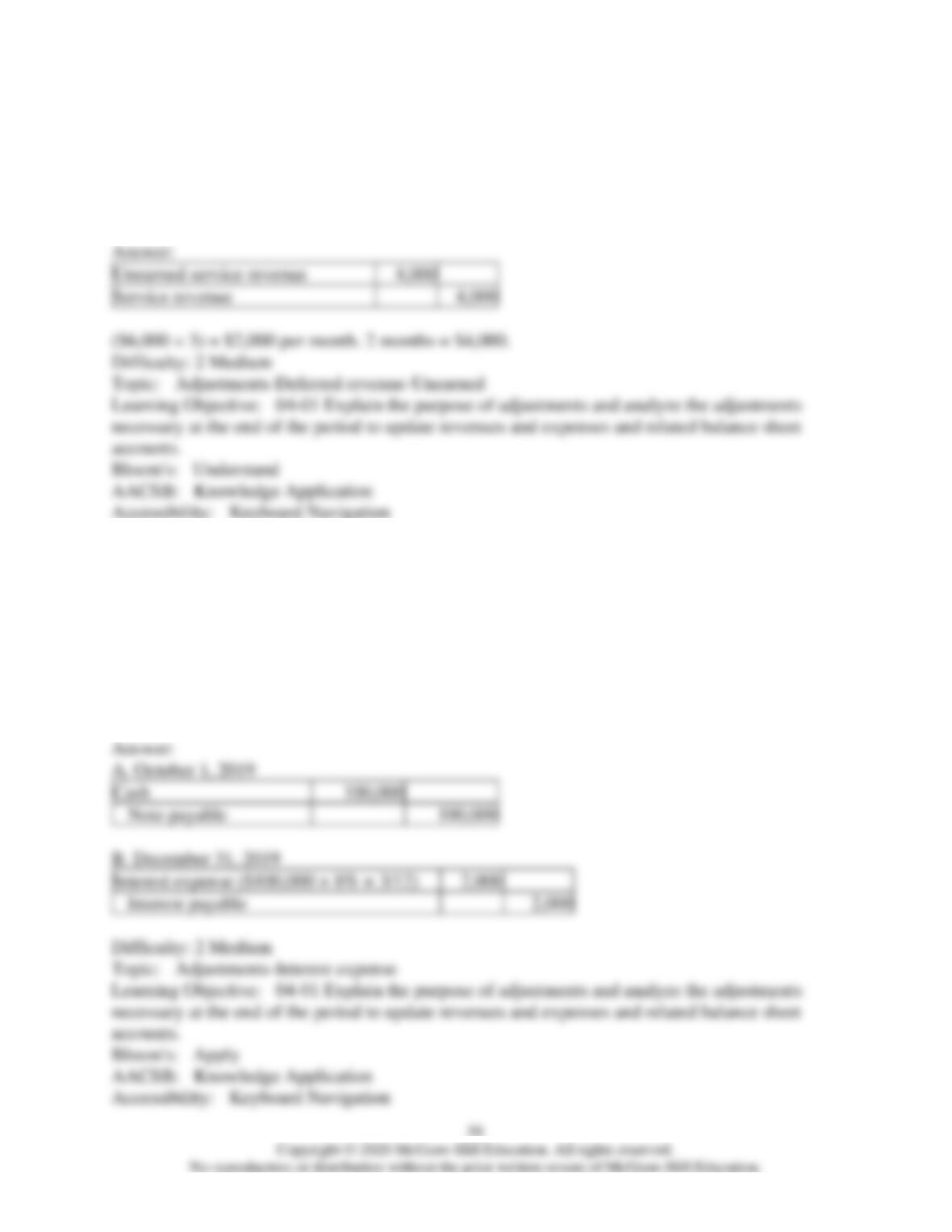
108) On November 1, 2019, Bug Busters collected $6,000 in advance for three months of service
to be provided beginning on that date. Bug credited unearned service revenue for $6,000. The
books are adjusted only at year-end.
Prepare the adjusting entry required on December 31, 2019.
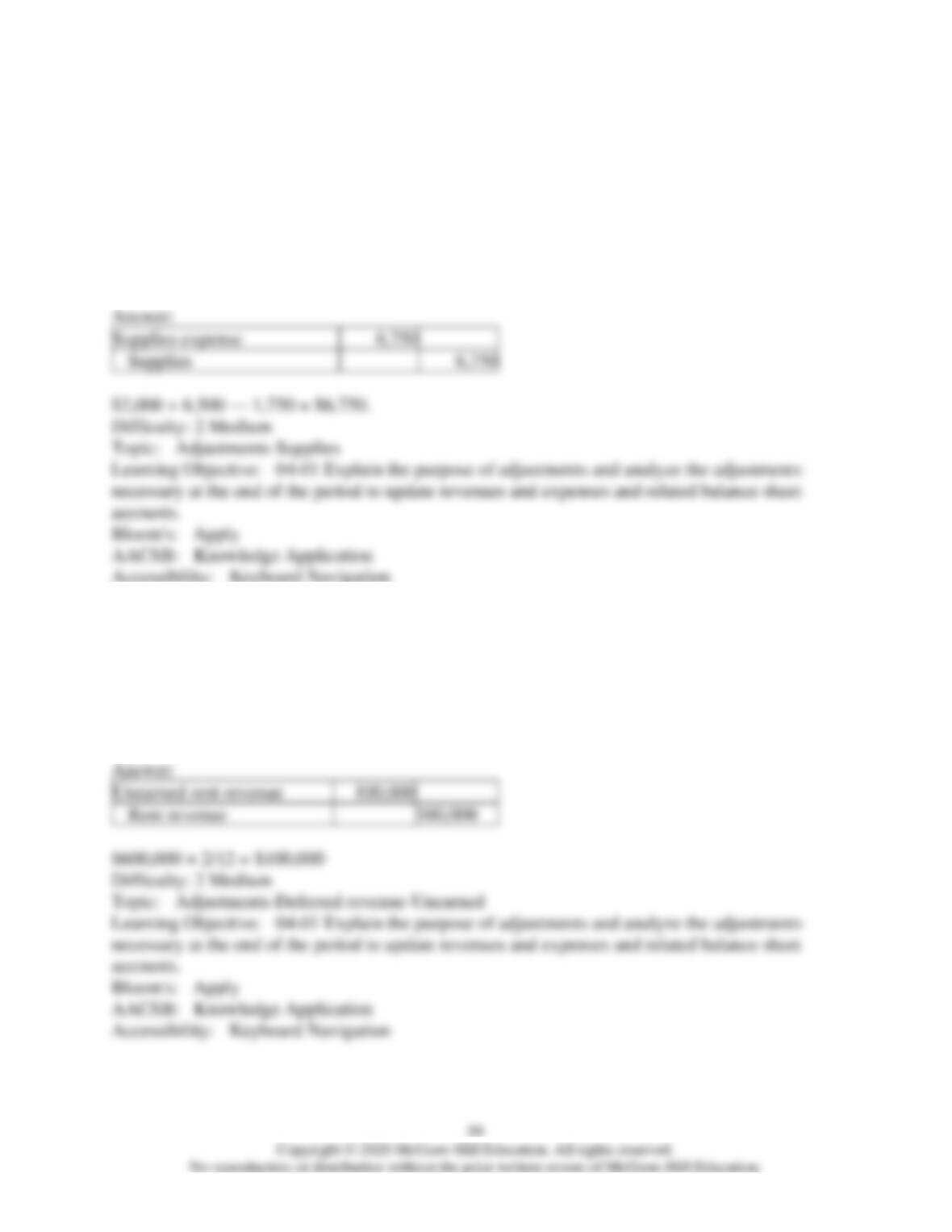
109) Below are two related transactions for Golden Corporation. The annual accounting period
ends December 31. The books are adjusted only at year-end.
A. October 1, 2019: Golden Corporation borrowed $100,000 and signed a note providing for 8%
interest. The principal and interest are due in one year on September 30, 2020.
B. December 31, 2019: End of the annual accounting period.
Prepare the required journal entry at October 31 and December 31, 2019 for each of the above
items.
110) Bridge Company keeps a small inventory of supplies used for cleaning and maintenance
purposes. On January 1, 2019, the inventory of supplies on hand was $2,000. During the year,
supplies purchased were debited to the supplies account in the amount of $6,500. On December
31, 2019, the amount of supplies in the storeroom was $1,750. The books are adjusted only at
year-end.
Prepare the adjusting entry required at December 31, 2019.
111) On November 1, 2019, Bruce Company leased some of its office space to Fairlane
Company and immediately collected $600,000 for twelve months rent in advance. Bruce debited
cash and credited unearned rent revenue for $600,000.
Prepare the December 31, 2019 adjusting entry Bruce should make in respect to the rent,
assuming no adjusting entries have been made during the year.
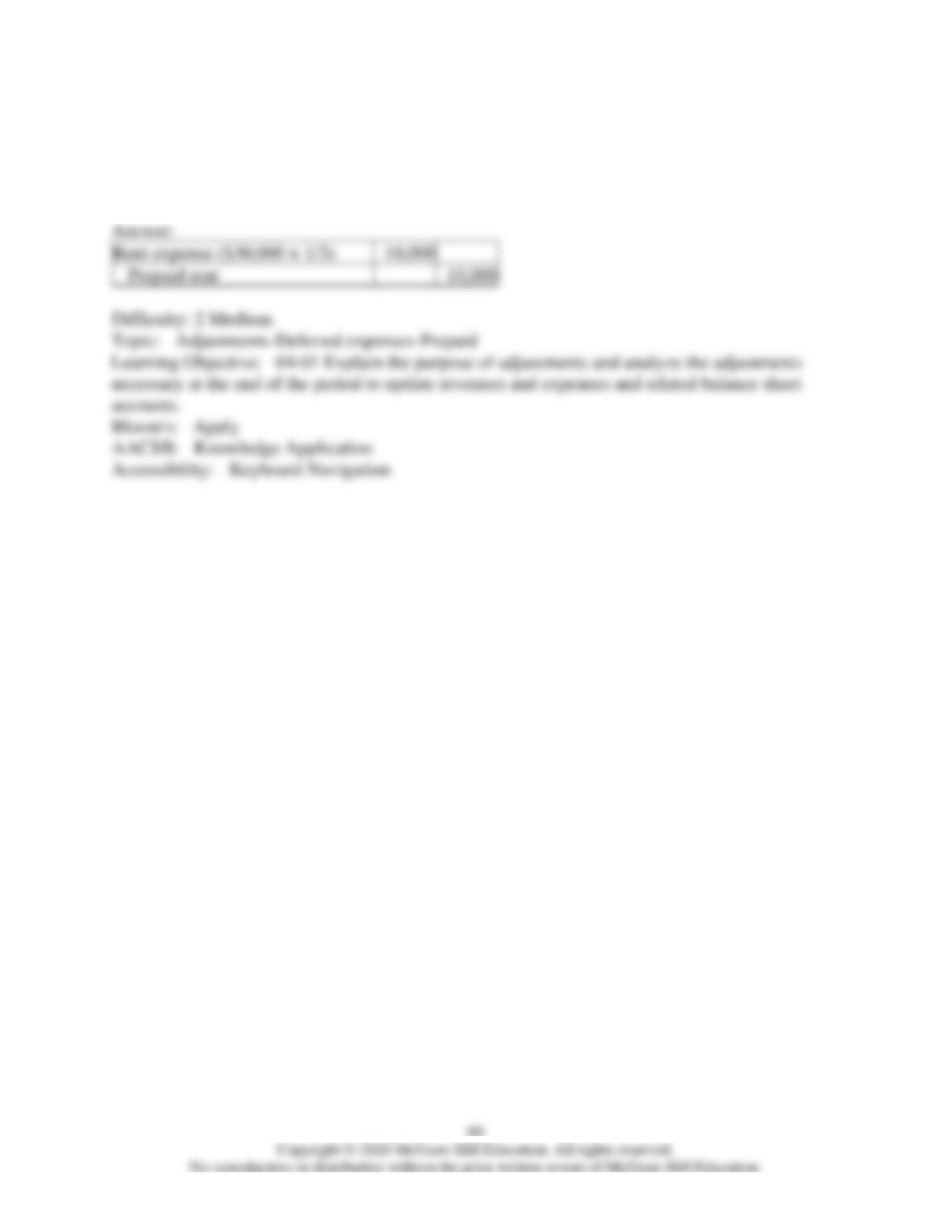
112) On December 1, 2019, Fleet Company paid $30,000 for three months rent and debited
prepaid rent for $30,000; the payment was for rent beginning December 1, 2019.
Prepare Fleet’s adjusting entry required on December 31, 2019.