CHAPTER 4
INCOME STATEMENT AND RELATED INFORMATION
IFRS questions are available at the end of this chapter.
TRUE-FALSE—Conceptual
Answer No. Description
MULTIPLE CHOICE—Conceptual
Answer No. Description
Test Bank for Intermediate Accounting, Fifteenth Edition
4 – 2
MULTIPLE CHOICE—Conceptual (cont.)
Answer No. Description
MULTIPLE CHOICE—Computational
Answer No. Description
Income Statement and Related Information
4 – 3
MULTIPLE CHOICE—Computational (cont.)
MULTIPLE CHOICE—CPA Adapted
Answer No. Description

Test Bank for Intermediate Accounting, Fifteenth Edition
4 – 4
BRIEF EXERCISES
Item Description
BE4–115 Definitions.
BE4–116 Terminology.
BE4–117 Income statement disclosures.
EXERCISES
E4–118 Calculate net income from change in stockholders’ equity.
E4–119 Calculate net income from change in stockholders’ equity.
E4–120 Income statement classifications.
E4–121 Income statement relationships.
E4–122 Multiple-step income statement.
E4–123 Classification of income and retained earnings statement items.
PROBLEMS
Item Description
P4–124 Multiple-step income statement.
P4–125 Income statement form.
P4–126 Multiple-step income statement.
P4–127 Single-step income statement.
P4–128 Income statement and retained earnings statement.
P4–129 Irregular items and financial statements.
CHAPTER LEARNING OBJECTIVES
1. Understand the uses and limitations of an income statement.
2. Describe the content and format of the income statement.
3. Prepare an income statement.
4. Explain how to report various income items.
5. Identify where to report earnings per share information.
6. Understand the reporting of accounting changes and errors.
7. Prepare a retained earnings statement.
8. Explain how to report other comprehensive income.
9. Compare the accounting procedures for income reporting under GAAP and IFRS.

Income Statement and Related Information
4 – 5
SUMMARY OF LEARNING OBJECTIVES BY QUESTIONS
Item
Type
Item
Type
Item
Type
Item
Type
Item
Type
Item
Type
Item
Type
Learning Objective 1
1.
TF
21.
MC
S24.
MC
27.
MC
30.
MC
117.
BE
2.
TF
22.
MC
S25.
MC
28.
MC
115.
BE
118.
E-
CT
3.
TF
23.
MC
26.
MC
29.
MC
116.
BE
119.
E-
CT
Learning Objective 2
4.
TF
32.
MC
31.
MC
127.
P
Learning Objective 3
5.
TF
31.
MC
P38.
MC
74.
MC
107.
MC
120.
E
127.
P
6.
TF
32.
MC
70.
MC
75.
MC
108.
MC
121.
E
128.
P
7.
TF
33.
MC
71.
MC
76.
MC
109.
MC
122.
E
8.
TF
34.
MC
72.
MC
105.
MC
110.
MC
124.
P
9.
TF
P37.
MC
73.
MC
106.
MC
111.
MC
126.
P
Learning Objective 4
7.
TF
S36.
MC
45.
MC
53.
MC
82.
MC
89.
MC
123.
E
10.
TF
39.
MC
46.
MC
54.
MC
83.
MC
110.
MC
124.
P
11.
TF
40.
MC
48.
MC
77.
MC
84.
MC
111.
MC
125.
P
12.
TF
41.
MC
S49.
MC
78.
MC
85.
MC
112.
MC
126.
P
13.
TF
42.
MC
50.
MC
79.
MC
86.
MC
113.
MC
128.
P
14.
TF
43.
MC
51.
MC
80.
MC
87.
MC
115.
BE
129.
P
35.
MC
44.
MC
52.
MC
81.
MC
88.
MC
116.
BE
Learning Objective 5
55.
MC
63.
MC
92.
MC
116.
E
127.
P
56.
MC
64.
MC
93.
MC
124.
P
128.
P
57.
MC
90.
MC
94.
MC
125.
P
58.
MC
91.
MC
115.
E
126.
P
Learning Objective 6
15.
TF
47.
MC
62.
MC
116.
BE
126.
P
129.
P
16.
TF
P59.
MC
114.
MC
123.
E
127.
P
17.
TF
61.
MC
115.
BE
124.
P
128.
P
Learning Objective 7
18.
TF
96.
MC
99.
MC
128.
P
60.
MC
97.
MC
116.
BE
95.
MC
98.
MC
123.
E
Learning Objective 8
19.
TF
65.
MC
67.
MC
69.
MC
101.
MC
103.
MC
116.
BE
20.
TF
66.
MC
68.
MC
100.
MC
102.
MC
104.
MC
Learning Objective 9 – IFRS Questions
1.
TF
2.
TF
3.
TF
4.
TF
5.
TF
6.
MC
7.
MC
8.
MC
9.
MC
10.
MC
11.
MC
12.
SA
13.
SA

Test Bank for Intermediate Accounting, Fifteenth Edition
4 – 6
Note: TF = True-False E = Exercise CT= Critical Thinking
MC = Multiple Choice P = Problem BE = Brief Exercise

Income Statement and Related Information
4 – 7
TRUE-FALSE—Conceptual
1. The income statement is useful in assessing the risk or uncertainty of achieving future cash
flows.
2. A strength of the income statement as compared to the balance sheet is that items which
cannot be measured reliably can be reported in the income statement.
3. Earnings management generally makes income statement information more useful for
predicting future earnings and cash flows.
4. The transaction approach of income measurement focuses on the income-related activities
that have occurred during the period.
5. Companies frequently report income tax expense as the last item before net income on a
single-step income statement.
6. Revenues and gains increase both net income and owners’ equity.
7. The phrase “income from continuing operations” is used only when gains or losses on
discontinued operations occur.
8. The primary advantage of the multiple-step format lies in the simplicity of presentation and
the absence of any implication that one type of revenue or expense item has priority over
another.
9. Gross profit and income from operations are reported on a multiple-step but not on a single-
step income statement.
10. The accounting profession has adopted a current operating performance approach to
income reporting.
11. Companies report the results of operations of a component of a business that will be
disposed of separately from continuing operations.
12. A company should report a restructuring charge as an extraordinary item because these
write-offs are not part of a company’s ordinary and typical activities.
13. Discontinued operations, extraordinary items, and unusual gains and losses are all reported
net of tax in the income statement.
14. Intraperiod tax allocation relates the income tax expense of a fiscal period to the specific
items that give rise to the amount of the tax provision.
15. A company that reports a discontinued operation or an extraordinary item must report per
share amounts for these items.
16. Dividends declared on common and preferred stock are subtracted from net income in the
computation of earnings per share.

Test Bank for Intermediate Accounting, Fifteenth Edition
4 – 8
17. Prior period adjustments can either be added or subtracted in the Retained Earnings
Statement.
18. Companies often restrict retained earnings to comply with contractual requirements or
current necessity.
19. Comprehensive income includes all changes in equity during a period except those
resulting from distributions to owners.
20. The components of other comprehensive income can be reported in the statement of
comprehensive income.
True False Answers—Conceptual
Item
Ans.
Item
Ans.
Item
Ans.
Item
Ans.
MULTIPLE CHOICE—Conceptual
21. The major elements of the income statement are
a. revenue, cost of goods sold, selling expenses, and general expense.
b. operating section, nonoperating section, discontinued operations, extraordinary items,
and cumulative effect.
c. revenues, expenses, gains, and losses.
d. revenues, irregular items, and general expenses.
22. Which of the following is true about the information provided in the income statement?
a. It helps in evaluating the past performance of the enterprise.
b. It provides a basis for predicting future performance.
c. It helps assess the risk or uncertainty of achieving future cash flows.
d. All of these answer choices are correct.
23. Which of the following is false about an income statement?
a. Items that cannot be measured reliably are not reported in the income statement.
b. It is used to measure the solvency of a company.
c. Income measurement involves judgment.
d. Income numbers are affected by the accounting methods employed.
S24. Which of the following would represent the least likely use of an income statement
prepared for a business enterprise?
a. Use by customers to determine a company’s ability to provide needed goods and
services.
b. Use by labor unions to examine earnings closely as a basis for salary discussions.
c. Use by government agencies to formulate tax and economic policy.
d. Use by investors interested in the financial position of the entity.

Income Statement and Related Information
4 – 9
S25. The income statement reveals
a. resources and equities of a firm at a point in time.
b. resources and equities of a firm for a period of time.
c. net earnings (net income) of a firm at a point in time.
d. net earnings (net income) of a firm for a period of time.
26. The income statement provides investors and creditors with information to predict all of
the following except the:
a. amount of future cash flows.
b. sources of future cash flows.
c. timing of future cash flows.
d. uncertainty of future cash flows.
27. Which of the following is an example of managing earnings down?
a. Changing estimated bad debts from 3 percent to 2.5 percent of sales.
b. Revising the estimated life of equipment from 10 years to 8 years.
c. Not writing off obsolete inventory.
d. Reducing research and development expenditures.
28. Which of the following is an example of managing earnings up?
a. Decreasing estimated salvage value of equipment.
b. Writing off obsolete inventory.
c. Underestimating warranty claims.
d. Accruing a contingent liability for an ongoing lawsuit.
29. What might a manager do during the last quarter of a fiscal year if she wanted to improve
current annual net income?
a. Increase research and development activities.
b. Relax credit policies for customers.
c. Delay shipments to customers until after the end of the fiscal year.
d. Delay purchases from suppliers until after the end of the fiscal year.
30. What might a manager do during the last quarter of a fiscal year if she wanted to decrease
current annual net income?
a. Delay shipments and sales to customers until after the end of the fiscal year.
b. Relax credit policies for customers.
c. Pay suppliers all amounts owed.
d. Delay purchases from suppliers until after the end of the fiscal year.
31. Which of the following is an advantage of the single-step income statement over the
multiple-step income statement?
a. It reports gross profit for the year.
b. Expenses are classified by function.
c. It matches costs and expenses with related revenues.
d. It does not imply that one type of revenue or expense has priority over another.
32. The single-step income statement emphasizes
a. the gross profit figure.
b. total revenues and total expenses.
c. operating and non-operating expenses.
d. the various components of income from continuing operations.

Test Bank for Intermediate Accounting, Fifteenth Edition
4 – 10
33. Which of the following is an acceptable method of presenting the income statement?
a. A single-step income statement
b. A multiple-step income statement
c. A consolidated statement of income
d. All of these answer choices are correct.
34. Which of the following is not a generally practiced method of presenting the income
statement?
a. Including prior period adjustments in determining net income
b. The single-step income statement
c. The consolidated statement of income
d. Including gains and losses from discontinued operations of a component of a business
in determining net income
35. The occurrence which most likely would have no effect on 2014 net income (assuming
that all amounts involved are material) is the
a. sale in 2014 of an office building contributed by a stockholder in 1983.
b. collection in 2014 of a receivable from a customer whose account was written off in
2013 by a charge to the allowance account.
c. settlement based on litigation in 2014 of previously unrecognized damages from a
serious accident that occurred in 2012.
d. worthlessness determined in 2014 of stock purchased on a speculative basis in 2010.
S36. The occurrence that most likely would have no effect on 2014 net income is the
a. sale in 2014 of an office building contributed by a stockholder in 1961.
b. collection in 2014 of a dividend from an investment.
c. correction of an error in the financial statements of a prior period discovered
subsequent to their issuance.
d. stock purchased in 1996 deemed worthless in 2014.
P37. Which of the following is not a selling expense?
a. Advertising expense
b. Office salaries expense
c. Freight-out
d. Store supplies consumed
P38. The accountant for the Lintz Sales Company is preparing the income statement for 2014
and the balance sheet at December 31, 2014. The January 1, 2014 merchandise
inventory balance will appear
a. only as an asset on the balance sheet.
b. only in the cost of goods sold section of the income statement.
c. as a deduction in the cost of goods sold section of the income statement and as a
current asset on the balance sheet.
d. as an addition in the cost of goods sold section of the income statement and as a
current asset on the balance sheet.
39. In order to be classified as an extraordinary item in the income statement, an event or
transaction should be
a. unusual in nature, infrequent, and material in amount.
b. unusual in nature and infrequent, but it need not be material.
c. infrequent and material in amount, but it need not be unusual in nature.
d. unusual in nature and material, but it need not be infrequent.

Income Statement and Related Information
4 – 11
40. Which of the following is true of accounting for changes in estimates?
a. A company recognizes a change in estimate by making a retrospective adjustment to
the financial statements
b. A company accounts for changes in estimates only in the period of change, even
though it affects the future periods
c. Changes in estimates are not carried back to adjust prior years
d. Changes in estimates are considered as errors or extraordinary items
41. Which of these is generally an example of an extraordinary item?
a. Loss incurred because of a strike by employees.
b. Write-off of deferred marketing costs believed to have no future benefit.
c. Gain resulting from the devaluation of the U.S. dollar.
d. Gain resulting from the state exercising its right of eminent domain on a piece of land
used as a parking lot.
42. Under which of the following conditions would material flood damage be considered an
extraordinary item for financial reporting purposes?
a. Only if floods in the geographical area are unusual in nature and occur infrequently.
b. Only if the flood damage is material in amount and could have been reduced by
prudent management.
c. Under any circumstances as an extraordinary item.
d. Flood damage should never be classified as an extraordinary item.
43. An item that should be classified as an extraordinary item is
a. write-off of goodwill.
b. gains from transactions involving foreign currencies.
c. losses from moving a plant to another city.
d. gains from a company selling the only investment it has ever owned.
44. How should an unusual event not meeting the criteria for an extraordinary item be
disclosed in the financial statements?
a. Shown as a separate item in operating revenues or expenses if material and
combined with other items if not material in amount.
b. Shown in operating revenues or expenses if material but not shown as a separate item.
c. Shown net of income tax after ordinary net earnings but before extraordinary items.
d. Shown net of income tax after extraordinary items but before net earnings.
45. A change in accounting principle requires that the cumulative effect of the change for prior
periods be shown as an adjustment to:
a. beginning retained earnings of the earliest period presented.
b. net income of the period in which the change occurred.
c. comprehensive income for the earliest period presented.
d. stockholders’ equity of the period in which the change occurred.
46. Which of the following is never classified as an extraordinary item?
a. Losses from a major casualty.
b. Losses from an expropriation of assets.
c. Gain on a sale of the only security investment a company has ever owned.
d. Losses from exchange or translation of foreign currencies.

Test Bank for Intermediate Accounting, Fifteenth Edition
4 – 12
47. Which of the following is a required disclosure in the income statement when reporting the
disposal of a component of the business?
a. The gain or loss on disposal should be reported as an extraordinary item.
b. Results of operations of a discontinued component should be disclosed immediately
below extraordinary items.
c. Earnings per share from continuing operations, discontinued operations, and net
income should be disclosed on the face of the income statement.
d. The gain or loss on disposal should not be segregated, but should be reported together
with the results of continuing operations.
48. When a company discontinues an operation and disposes of the discontinued operation
(component), the transaction should be included in the income statement as a gain or loss
on disposal reported as
a. a prior period adjustment.
b. an extraordinary item.
c. an amount after continuing operations but before extraordinary items.
d. a bulk sale of plant assets included in income from continuing operations.
S49. A material item which is unusual in nature or infrequent in occurrence, but not both should
be shown in the income statement
Net of Tax Disclosed Separately
a. No No
b. Yes Yes
c. No Yes
d. Yes No
50. Income taxes are allocated to
a. extraordinary items.
b. discontinued operations.
c. prior period adjustments.
d. all of these answer choices are correct.
51. Which of the following is true about intraperiod tax allocation?
a. It arises because certain revenue and expense items appear in the income statement
either before or after they are included in the tax return.
b. It is required for extraordinary items and cumulative effect of accounting changes but
not for prior period adjustments.
c. Its purpose is to allocate income tax expense evenly over a number of accounting
periods.
d. Its purpose is to relate the income tax expense to the items which affect the amount of
tax.
52. Companies use intraperiod tax allocation for all of the following items except
a. discontinued operations.
b. extraordinary items.
c. changes in accounting estimates.
d. income from continuing operations.

Income Statement and Related Information
4 – 13
53. Which of the following items would be reported net of tax on the face of the income
statement?
a. Prior period adjustment
b. Unusual gain
c. Change in realizability of receivables
d. Discontinued operations
54. Which of the following items would be reported at its gross amount on the face of the
income statement?
a. Extraordinary loss
b. Prior period adjustment
c. Cumulative effect of a change in an accounting principle
d. Unusual gain
55. Where must earnings per share be disclosed in the financial statements to satisfy
generally accepted accounting principles?
a. On the face of the statement of retained earnings (or, statement of stockholders’
equity.)
b. In the footnotes to the financial statements.
c. On the face of the income statement.
d. On the face of the balance sheet.
56. In calculating earnings per share, companies deduct preferred dividends from net income
if:
a. they are noncumulative though not declared.
b. the dividends are declared.
c. they are convertible preferred shares.
d. they are callable preferred shares.
57. Which of the following earnings per share figures must be disclosed on the face of the
income statement?
a. EPS for income before taxes.
b. The effect on EPS from unusual items.
c. EPS for gross profit.
d. EPS for income from continuing operations.
S58. Earnings per share should always be shown separately for
a. net income and gross margin.
b. net income and pretax income.
c. income before extraordinary items.
d. extraordinary items and prior period adjustments.
P59. A correction of an error in prior periods’ income will be reported
In the income statement Net of tax
a. Yes Yes
b. No No
c. Yes No
d. No Yes

Test Bank for Intermediate Accounting, Fifteenth Edition
4 – 14
60. Which of the following items will not appear in the retained earnings statement?
a. Net loss
b. Prior period adjustment
c. Discontinued operations
d. Dividends
61. Which one of the following types of losses is excluded from the determination of net
income in income statements?
a. Material losses resulting from transactions in the company’s investments account.
b. Material losses resulting from unusual sales of assets not acquired for resale.
c. Material losses resulting from the write-off of intangibles.
d. Material losses resulting from correction of errors related to prior periods.
62. Watts Corporation made a very large arithmetical error in the preparation of its year-end
financial statements by improper placement of a decimal point in the calculation of
depreciation. The error caused the net income to be reported at almost double the proper
amount. Correction of the error when discovered in the next year should be treated as
a. an increase in depreciation expense for the year in which the error is discovered.
b. a component of income for the year in which the error is discovered, but separately
listed on the income statement and fully explained in a note to the financial
statements.
c. an extraordinary item for the year in which the error was made.
d. a prior period adjustment.
63. A company is not required to report a per share amount on the face of the income
statement for which one of the following items?
a. Net income
b. Prior period adjustment
c. Extraordinary item
d. Discontinued operations
64. Earnings per share data are required on the face of the
a. statement of retained earnings
b. statement of stockholders’ equity
c. income statement
d. balance sheet
65. Which of the following is included in comprehensive income?
a. Investments by owners.
b. Unrealized gains on available-for-sale securities.
c. Distributions to owners.
d. Changes in accounting principles.
66. Which of the following is not an acceptable way of displaying the components of other
comprehensive income?
a. Combined statement of retained earnings
b. One statement approach
c. Two statement approach
d. All of these are acceptable ways
Income Statement and Related Information
4 – 15
67. Gains and losses identified as other comprehensive income have the same status as
traditional gains and losses under
a. both the one statement and two statement approaches.
b. neither the one statement or two statement approaches.
c. the one statement approach.
d. the two statement approach.
68. Comprehensive income includes all of the following except
a. dividend revenue.
b. losses on disposal of assets.
c. investments by owners.
d. unrealized holding gains.
69. A statement of stockholders’ equity includes a column for each of the following except
a. accumulated other comprehensive income.
b. common stock.
c. net income.
d. retained earnings.
Multiple Choice Answers—Conceptual
Item
Ans.
Item
Ans.
Item
Ans.
Item
Ans.
Item
Ans.
Item
Ans.
Item
Ans.

Test Bank for Intermediate Accounting, Fifteenth Edition
4 – 16
MULTIPLE CHOICE—Computational
70. Ortiz Co. had the following account balances:
Sales revenue $ 220,000
Cost of goods sold 110,000
Salaries and wages expense 15,000
Depreciation expense 30,000
Dividend revenue 6,000
Utilities expense 12,000
Rent revenue 30,000
Interest expense 18,000
Sales returns and allow. 16,500
Advertising expense 19,500
What would Ortiz report as total revenues in a single-step income statement?
a. $239,500
b. $ 35,000
c. $236,000
d. $220,000
71. Ortiz Co. had the following account balances:
Sales revenue $ 220,000
Cost of goods sold 110,000
Salaries and wages expense 15,000
Depreciation expense 30,000
Dividend revenue 6,000
Utilities expense 12,000
Rent revenue 30,000
Interest expense 18,000
Sales returns and allow. 16,500
Advertising expense 19,500
What would Ortiz report as total expenses in a single-step income statement?
a. $210,500
b. $221,000
c. $204,500
d. $ 94,500
72. For Mortenson Company, the following information is available:
Cost of goods sold $130,000
Dividend revenue 5,000
Income tax expense 12,000
Operating expenses 46,000
Sales revenue 200,000
In Mortenson’s single-step income statement, gross profit
a. should not be reported.
b. should be reported at $17,000.
c. should be reported at $70,000.
d. should be reported at $75,000.

Income Statement and Related Information
4 – 17
73. For Mortenson Company, the following information is available:
Cost of goods sold $130,000
Dividend revenue 5,000
Income tax expense 12,000
Operating expenses 46,000
Sales revenue 200,000
In Mortenson’s multiple-step income statement, gross profit
a. should not be reported
b. should be reported at $17,000.
c. should be reported at $70,000.
d. should be reported at $75,000.
74. The following information was extracted from the 2014 financial statements of Max
Company:
Income from continuing operations before income tax $470,000
Selling and administrative expenses 320,000
Income from continuing operations 329,000
Gross profit 900,000
Income before extraordinary item 290,000
The amount reported for other expenses and losses is
a. $141,000
b. $39,000.
c. $110,000.
d. $150,000.
75. Gross billings for merchandise sold by Lang Company to its customers last year
amounted to $11,720,000; sales returns and allowances were $370,000, sales discounts
were $175,000, and freight-out was $140,000. Net sales last year for Lang Company were
a. $11,720,000.
b. $11,350,000.
c. $11,175,000.
d. $11,035,000.
76. If plant assets of a manufacturing company are sold at a gain of $1,500,000 less related
taxes of $450,000, and the gain is not considered unusual or infrequent, the income
statement for the period would disclose these effects as
a. a gain of $1,500,000 and an increase in income tax expense of $450,000.
b. operating income net of applicable taxes, $1,050,000.
c. a prior period adjustment net of applicable taxes, $1,050,000.
d. an extraordinary item net of applicable taxes, $1,050,000.
77. Manning Company has the following items: write-down of inventories, $360,000; loss on
disposal of Sports Division, $555,000; and loss due to strike, $359,000. Ignoring income
taxes, what amount should Manning Company report as extraordinary losses?
a. $ -0-.
b. $555,000.
c. $719,000.
d. $914,000.

Test Bank for Intermediate Accounting, Fifteenth Edition
4 – 18
78. Garwood Company has the following items: write-down of inventories, $360,000; loss on
disposal of Sports Division, $555,000; and loss due to an expropriation, $359,000.
Ignoring income taxes, what amount should Garwood Company report as extraordinary
losses?
a. $359,000
b. $555,000.
c. $719,000.
d. $914,000.
79. An income statement shows “income before income taxes and extraordinary items” in the
amount of $3,425,000. The income taxes payable for the year are $1,800,000, including
$600,000 that is applicable to an extraordinary gain. Thus, the “income before
extraordinary items” is
a. $2,225,000.
b. $1,025,000.
c. $2,325,000.
d. $1,125,000.
80. Dole Company, with an applicable income tax rate of 30%, reported net income of
$350,000. Included in income for the period was an extraordinary loss from flood damage
of $80,000 before deducting the related tax effect. The company’s income before income
taxes and extraordinary items was
a. $430,000.
b. $500,000.
c. $580,000.
d. $406,000.
81. A review of the December 31, 2014, financial statements of Somer Corporation revealed
that under the caption “extraordinary losses,” Somer reported a total of $1,130,000.
Further analysis revealed that the $1,130,000 in losses was comprised of the following
items:
(1) Somer recorded a loss of $300,000 incurred in the abandonment of equipment
formerly used in the business.
(2) In an unusual and infrequent occurrence, a loss of $600,000 was sustained as a
result of hurricane damage to a warehouse.
(3) During 2014, several factories were shut down during a major strike by employees,
resulting in a loss of $170,000.
(4) Uncollectible accounts receivable of $60,000 were written off as uncollectible.
Ignoring income taxes, what amount of loss should Somer report as extraordinary on its
2014 income statement?
a. $300,000.
b. $600,000.
c. $900,000.
d. $1,130,000.

Income Statement and Related Information
4 – 19
82. At Ruth Company, events and transactions during 2014 included the following. The tax rate
for all items is 30%.
(1) Depreciation for 2012 was found to be understated by $90,000.
(2) A strike by the employees of a supplier resulted in a loss of $75,000.
(3) The inventory at December 31, 2012 was overstated by $120,000.
(4) A flood destroyed a building that had a book value of $1,500,000. Floods are very
uncommon in that area.
The effect of these events and transactions on 2014 income from continuing operations
net of tax would be
a. ($52,500).
b. ($115,500).
c. ($199,500).
d. ($1,249,500).
83. At Ruth Company, events and transactions during 2014 included the following. The tax rate
for all items is 30%.
(1) Depreciation for 2012 was found to be understated by $90,000.
(2) A strike by the employees of a supplier resulted in a loss of $75,000.
(3) The inventory at December 31, 2012 was overstated by $120,000.
(4) A flood destroyed a building that had a book value of $1,500,000. Floods are very
uncommon in that area.
The effect of these events and transactions on 2014 net income net of tax would be
a. ($52,500).
b. ($1,102,500).
c. ($1,165,500).
d. ($1,249,500).
84. During 2014, Lopez Corporation disposed of Pine Division, a major component of its
business. Lopez realized a gain of $2,400,000, net of taxes, on the sale of Pine’s assets.
Pine’s operating losses, net of taxes, were $2,800,000 in 2014. How should these facts be
reported in Lopez’s income statement for 2014?
Total Amount to be Included in
Income from Results of
Continuing Operations Discontinued Operations
a. $2,800,000 loss $2,400,000 gain
b. 400,000 loss 0
c. 0 400,000 loss
d. 2,400,000 gain 2,800,000 loss
85. Sandstrom Corporation has an extraordinary loss of $200,000, an unusual gain of
$140,000, and a tax rate of 40%. At what amount should Sandstrom report each item?
Extraordinary loss Unusual gain
a. $(200,000) $140,000
b. (200,000) 84,000
c. (120,000) 140,000
d. (120,000) 84,000

Test Bank for Intermediate Accounting, Fifteenth Edition
4 – 20
86. Prophet Corporation has an extraordinary loss of $800,000, an unusual gain of $560,000,
and a tax rate of 40%. At what amount should Prophet report each item?
Extraordinary loss Unusual gain
a. $(800,000) $560,000
b. (800,000) 336,000
c. (480,000) 560,000
d. (480,000) 336,000
87. Arreaga Corp. has a tax rate of 40 percent and income before non-operating items of
$928,000. It also has the following items (gross amounts).
Unusual loss $148,000
Extraordinary loss 404,000
Gain on disposal of equipment 32,000
Change in accounting principle
increasing prior year’s income 212,000
What is the amount of income tax expense Arreaga would report on its income statement?
a. $371,200
b. $324,800
c. $396,800
d. $248,000
88. Palomo Corp has a tax rate of 30 percent and income before non-operating items of
$1,071,000. It also has the following items (gross amounts).
Unusual gain $ 69,000
Loss from discontinued operations 549,000
Dividend revenue 18,000
Income increasing prior
period adjustment 222,000
What is the amount of income tax expense Palomo would report on its income statement?
a. $347,400
b. $182,700
c. $249,300
d. $326,700
89. Lantos Company had a 40 percent tax rate. Given the following pre-tax amounts, what
would be the income tax expense reported on the face of the income statement?
Sales revenue $ 500,000
Cost of goods sold 300,000
Salaries and wages expense 40,000
Depreciation expense 55,000
Dividend revenue 45,000
Utilities expense 5,000
Extraordinary loss 50,000
Interest expense 10,000
a. $54,000
b. $34,000
c. $36,000
d. $16,000

Income Statement and Related Information
4 – 21
90. In 2014, Esther Corporation reported net income of $600,000. It declared and paid
preferred stock dividends of $150,000 and common stock dividends of $60,000. During
2014, Esther had a weighted average of 250,000 common shares outstanding. Compute
Esther’s 2014 earnings per share.
a. $1.56
b. $1.80
c. $2.40
d. $3.00
91. In 2014, Linz Corporation reported an extraordinary loss of $1,000,000, net of tax. It
declared and paid preferred stock dividends of $100,000 and common stock dividends of
$300,000. During 2014, Linz had a weighted average of 500,000 common shares
outstanding. As a result of the extraordinary loss, net of tax, the earnings per share would
decrease by
a. $1.20
b. $1.40
c. $1.80
d. $2.00
92. In 2014, Benfer Corporation reported net income of $210,000. It declared and paid
common stock dividends of $24,000 and had a weighted average of 70,000 common
shares outstanding. Compute the earnings per share to the nearest cent.
a. $2.66
b. $2.10
c. $2.70
d. $3.00
93. Benedict Corporation reports the following information:
Net income $750,000
Dividends on common stock $210,000
Dividends on preferred stock $ 90,000
Weighted average common shares outstanding 150,000
Benedict should report earnings per share of
a. $3.00.
b. $3.60
c. $4.40.
d. $5.00.
94. Norling Corporation reports the following information:
Net income $750,000
Dividends on common stock $210,000
Dividends on preferred stock $ 90,000
Weighted average common shares outstanding 250,000
Norling should report earnings per share of
a. $1.80.
b. $2.16
c. $2.64.
d. $3.00.

Test Bank for Intermediate Accounting, Fifteenth Edition
4 – 22
95. Moorman Corporation reports the following information:
Correction of understatement of depreciation expense
in prior years, net of tax $ 860,000
Dividends declared 640,000
Net income 2,000,000
Retained earnings, 1/1/14, as reported 4,000,000
Moorman should report retained earnings, 1/1/14, as adjusted at
a. $3,140,000.
b. $4,000,000.
c. $4,860,000.
d. $6,220,000.
96. Moorman Corporation reports the following information:
Correction of understatement of depreciation expense
in prior years, net of tax $ 860,000
Dividends declared 640,000
Net income 2,000,000
Retained earnings, 1/1/14, as reported 4,000,000
Moorman should report retained earnings, 12/31/14, as adjusted at
a. $3,140,000.
b. $4,500,000.
c. $5,360,000.
d. $6,220,000.
97. Leonard Corporation reports the following information:
Correction of overstatement of depreciation expense
in prior years, net of tax $ 430,000
Dividends declared 320,000
Net income 1,000,000
Retained earnings, 1/1/14, as reported 4,000,000
Leonard should report retained earnings, 1/1/14, as adjusted at
a. $3,570,000.
b. $4,000,000.
c. $4,430,000.
d. $5,110,000.
98. Leonard Corporation reports the following information:
Correction of overstatement of depreciation expense
in prior years, net of tax $ 430,000
Dividends declared 320,000
Net income 1,000,000
Retained earnings, 1/1/14, as reported 4,000,000
Leonard should report retained earnings, 12/31/14, at
a. $3,570,000.
b. $4,250,000.
c. $4,680,000.
d. $5,110,000.

Income Statement and Related Information
4 – 23
99. The following information was extracted from the accounts of Essex Corporation at
December 31, 2014:
CR(DR)
Total reported income since incorporation $3,200,000
Total cash dividends paid (1,600,000)
Unrealized holding loss on available-for-sale securities (240,000)
Total stock dividends distributed (400,000)
Prior period adjustment, recorded January 1, 2014 150,000
What should be the balance of retained earnings at December 31, 2014?
a. $1,110,000.
b. $1,200,000.
c. $1,960,000.
d. $1,350,000.
100. Madsen Company reported the following information for 2014:
Sales revenue $1,530,000
Cost of goods sold 1,050,000
Operating expenses 165,000
Unrealized holding gain on available-for-sale securities 90,000
Cash dividends received on the securities 6,000
For 2014, Madsen would report other comprehensive income of
a. $321,000.
b. $315,000.
c. $96,000.
d. $90,000.
101. Korte Company reported the following information for 2014:
Sales revenue $1,500,000
Cost of goods sold 1,050,000
Operating expenses 165,000
Unrealized holding gain on available-for-sale securities 50,000
Cash dividends received on the securities 6,000
For 2014, Korte would report comprehensive income of
a. $341,000.
b. $335,000.
c. $291,000.
d. $50,000.

Test Bank for Intermediate Accounting, Fifteenth Edition
4 – 24
102. For the year ended December 31, 2014, Transformers Inc. reported the following:
Net income $180,000
Preferred dividends declared 30,000
Common dividend declared 6,000
Unrealized holding loss, net of tax 3,000
Retained earnings 240,000
Common stock 120,000
Accumulated Other Comprehensive Income,
Beginning Balance 15,000
What would Transformers report as its ending balance of Accumulated Other
Comprehensive Income?
a. $18,000
b. $15,000
c. $12,000
d. $3,000
103. For the year ended December 31, 2014, Transformers Inc. reported the following:
Net income $180,000
Preferred dividends declared 30,000
Common dividend declared 6,000
Unrealized holding loss, net of tax 3,000
Retained earnings, beginning balance 240,000
Common stock 120,000
Accumulated Other Comprehensive Income,
Beginning Balance 15,000
What would Transformers report as the ending balance of Retained Earnings?
a. $417,000
b. $399,000
c. $384,000
d. $381,000
104. For the year ended December 31, 2014, Transformers Inc. reported the following:
Net income $180,000
Preferred dividends declared 30,000
Common dividend declared 6,000
Unrealized holding loss, net of tax 3,000
Retained earnings, beginning balance 240,000
Common stock 120,000
Accumulated Other Comprehensive Income,
Beginning Balance 15,000
What would Transformers report as total stockholders’ equity?
a. $516,000
b. $504,000
c. $384,000
d. $360,000
Income Statement and Related Information
4 – 25
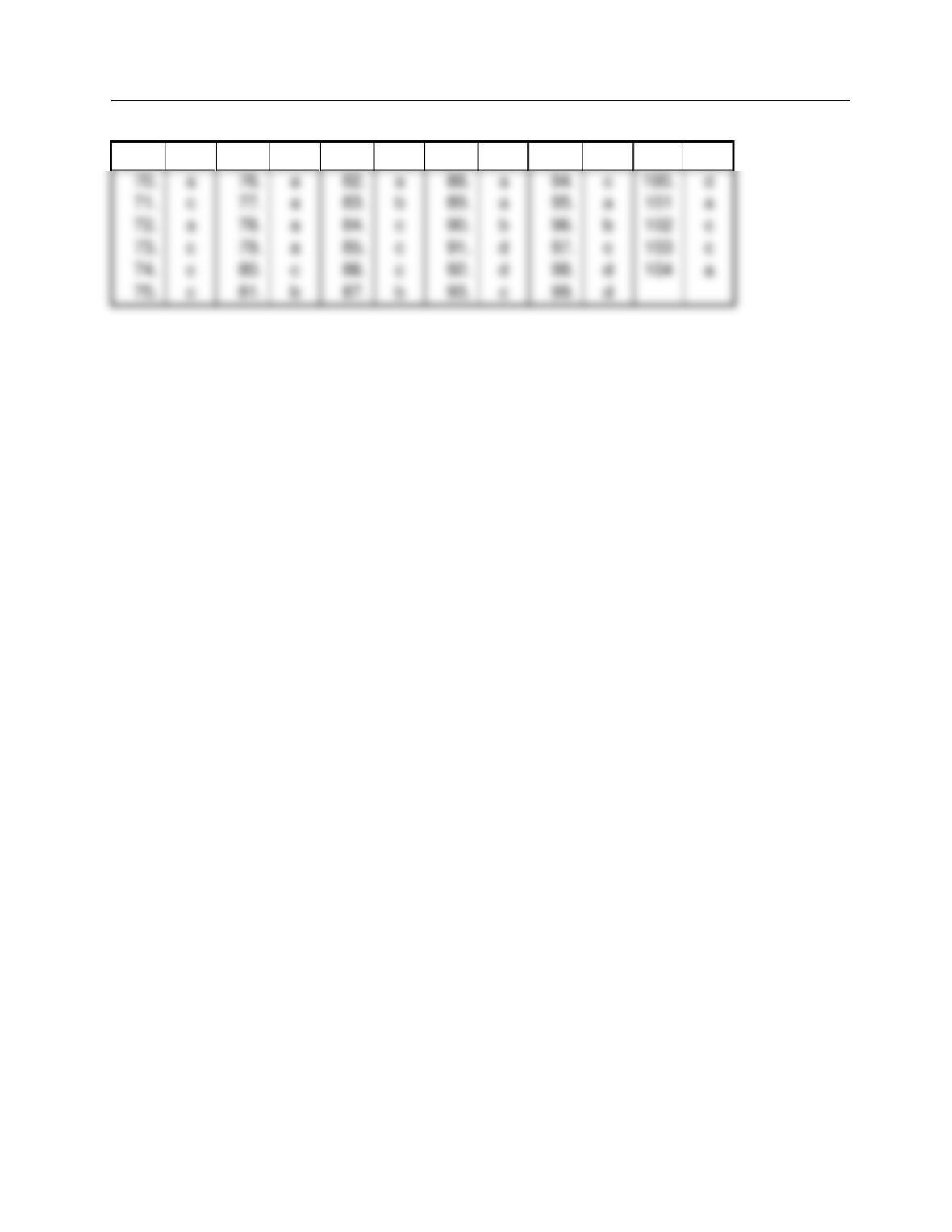
Multiple Choice Answers—Computational
Item
Ans.
Item
Ans.
Item
Ans.
Item
Ans.
Item
Ans.
Item
Ans.
MULTIPLE CHOICE—CPA Adapted
105. Perry Corp. reports operating expenses in two categories: (1) selling and (2) general and
administrative. The adjusted trial balance at December 31, 2014, included the following
expense accounts:
Accounting and legal fees $280,000
Advertising 240,000
Freight-out 150,000
Interest 120,000
Loss on sale of long-term investments 60,000
Officers’ salaries 360,000
Rent for office space 360,000
Sales salaries and commissions 270,000
One-half of the rented premises is occupied by the sales department.
How much of the expenses listed above should be included in Perry’s selling expenses for
2014?
a. $510,000.
b. $660,000.
c. $690,000.
d. $840,000.
106. Perry Corp. reports operating expenses in two categories: (1) selling and (2) general and
administrative. The adjusted trial balance at December 31, 2014, included the following
expense accounts:
Accounting and legal fees $280,000
Advertising 240,000
Freight-out 150,000
Interest 120,000
Loss on sale of long-term investments 60,000
Officers’ salaries 360,000
Rent for office space 360,000
Sales salaries and commissions 270,000
One-half of the rented premises is occupied by the sales department.

Test Bank for Intermediate Accounting, Fifteenth Edition
4 – 26
How much of the expenses listed above should be included in Perry’s general and
administrative expenses for 2014?
a. $820,000.
b. $880,000.
c. $940,000.
d. $1,000,000.
107. Didde Corp. reports operating expenses in two categories: (1) selling and (2) general and
administrative. The adjusted trial balance at December 31, 2014 included the following
expense and loss accounts:
Accounting and legal fees $210,000
Advertising 290,000
Freight-out 120,000
Interest 105,000
Loss on sale of long-term investment 45,000
Officers’ salaries 335,000
Rent for office space 330,000
Sales salaries and commissions 255,000
One-half of the rented premises is occupied by the sales department. Didde’s total selling
expenses for 2014 are
a. $830,000.
b. $710,000.
c. $665,000.
d. $575,000.
108. The following items were among those that were reported on Dye Co.’s income statement
for the year ended December 31, 2014:
Legal and audit fees $520,000
Rent for office space 720,000
Interest on inventory floor plan 840,000
Loss on abandoned equipment used in operations 140,000
The office space is used equally by Dye’s sales and accounting departments. What
amount of the above-listed items should be classified as general and administrative
expenses in Dye’s multiple-step income statement?
a. $880,000.
b. $1,020,000.
c. $1,240,000.
d. $1,720,000.
109. Logan Corp.’s trial balance of income statement accounts for the year ended December 31,
2014 included the following:
Debit Credit
Sales revenue $280,000
Cost of goods sold $150,000
Administrative expenses 40,000
Loss on disposal of equipment 18,000
Sales commission expense 16,000
Interest revenue 10,000
Freight-out 6,000

Income Statement and Related Information
4 – 27
Loss due to earthquake damage 24,000
Bad debt expense 6,000
Totals $260,000 $290,000
Other information:
Logan’s income tax rate is 30%. Finished goods inventory:
January 1, 2014 $160,000
December 31, 2014 140,000
On Logan’s multiple-step income statement for 2014,
Cost of goods manufactured is
a. $176,000.
b. $170,000.
c. $136,000.
d. $130,000.
110. Logan Corp.’s trial balance of income statement accounts for the year ended December 31,
2014 included the following:
Debit Credit
Sales revenue $280,000
Cost of goods sold $150,000
Administrative expenses 40,000
Loss on disposal of equipment 18,000
Sales commission expense 16,000
Interest revenue 10,000
Freight-out 6,000
Loss due to earthquake damage 24,000
Bad debt expense 6,000
Totals $260,000 $290,000
Other information:
Logan’s income tax rate is 30%. Finished goods inventory:
January 1, 2014 $160,000
December 31, 2014 140,000
On Logan’s multiple-step income statement for 2014,
Income before extraordinary item is
a. $88,000.
b. $54,000.
c. $37,800.
d. $21,000.

Test Bank for Intermediate Accounting, Fifteenth Edition
4 – 28
111. Logan Corp.’s trial balance of income statement accounts for the year ended December 31,
2014 included the following:
Debit Credit
Sales revenue $280,000
Cost of goods sold $150,000
Administrative expenses 40,000
Loss on sale of equipment 18,000
Commissions to salespersons 16,000
Interest revenue 10,000
Freight-out 6,000
Loss due to earthquake damage 24,000
Bad debt expense 6,000
Totals $260,000 $290,000
Other information:
Logan’s income tax rate is 30%. Finished goods inventory:
January 1, 2014 $160,000
December 31, 2014 140,000
On Logan’s multiple-step income statement for 2014,
Extraordinary loss is
a. $16,800.
b. $24,000.
c. $29,400.
d. $42,000.
112. Chase Corp. had the following infrequent transactions during 2014:
A $375,000 gain from selling the only investment Chase has ever owned.
A $525,000 gain on the sale of equipment.
A $175,000 loss on the write-down of inventories.
In its 2014 income statement, what amount should Chase report as total infrequent net
gains that are not considered extraordinary?
a. $200,000.
b. $350,000.
c. $725,000.
d. $900,000.
113. James, Inc. incurred the following infrequent losses during 2014:
A $210,000 write-down of equipment leased to others.
A $120,000 adjustment of accruals on long-term contracts.
A $180,000 write-off of obsolete inventory.
In its 2014 income statement, what amount should James report as total infrequent losses
that are not considered extraordinary?
a. $510,000.
b. $390,000.
c. $330,000.
d. $300,000.
Income Statement and Related Information
4 – 29
114. Which of the following should be reported as a prior period adjustment?
Change in Estimated Lives Mistakes in the Application of
of Depreciable Assets Accounting Principles
a. Yes Yes
b. No Yes
c. Yes No
d. No No
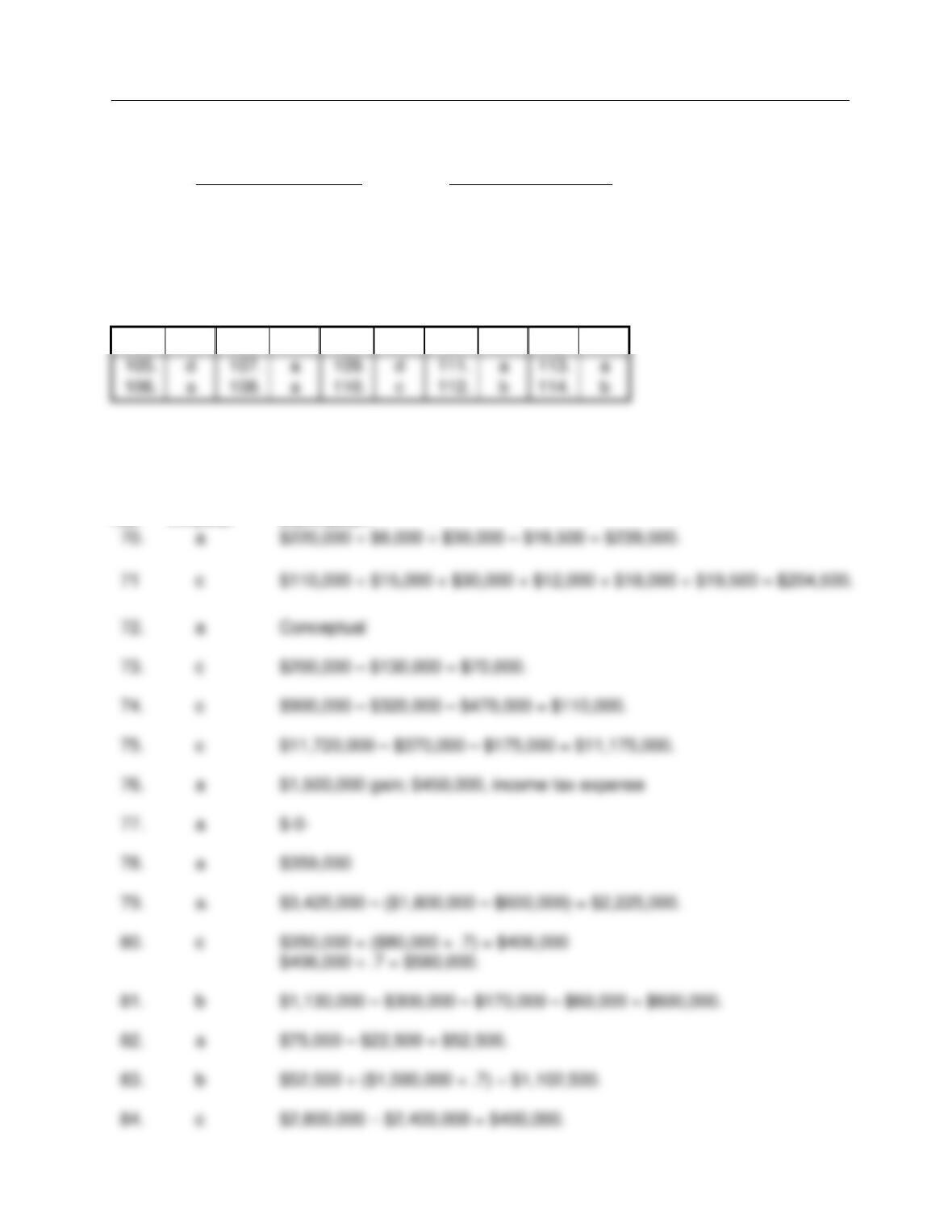
Multiple Choice Answers—CPA Adapted
Item
Ans.
Item
Ans.
Item
Ans.
Item
Ans.
Item
Ans.
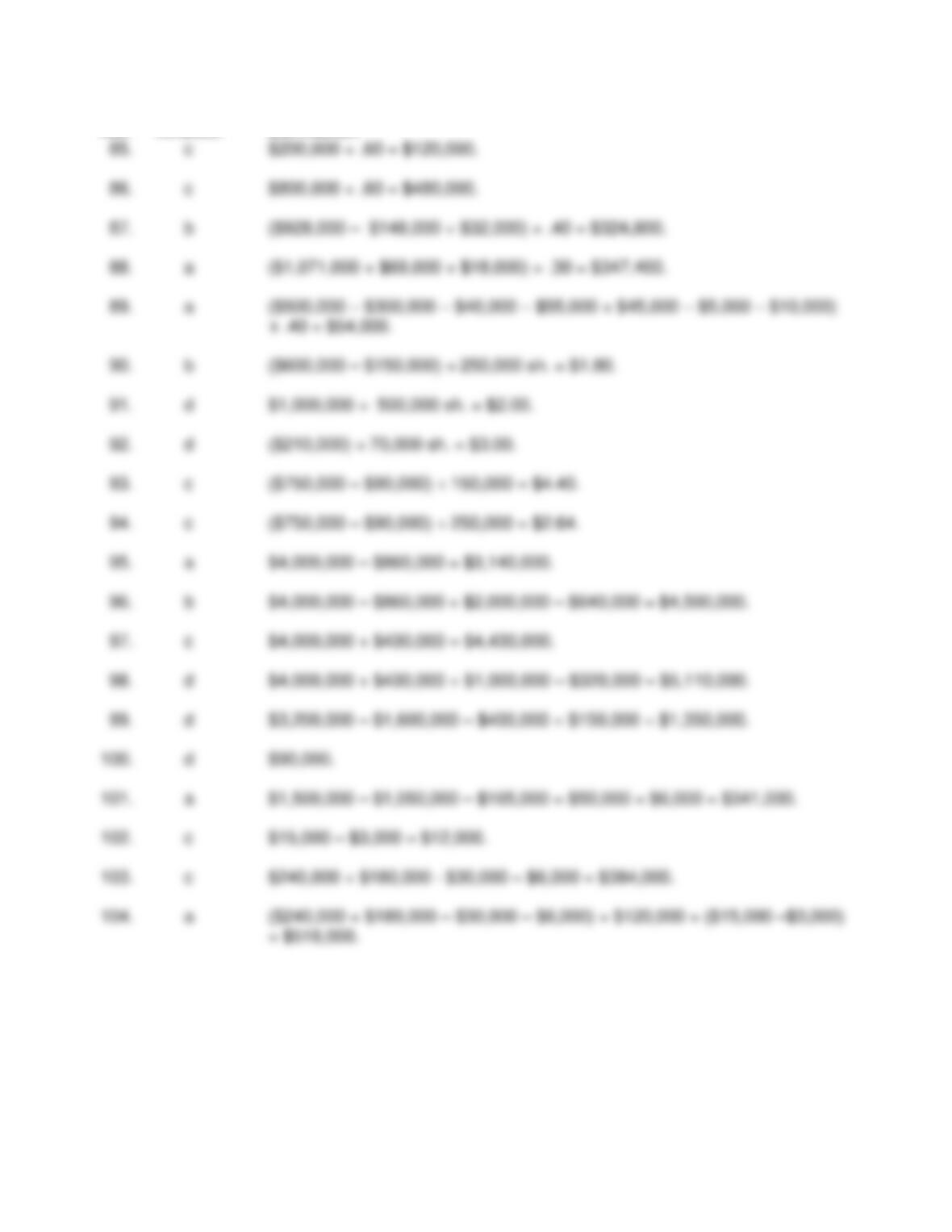
DERIVATIONS — Computational
No. Answer Derivation
Test Bank for Intermediate Accounting, Fifteenth Edition
4 – 30
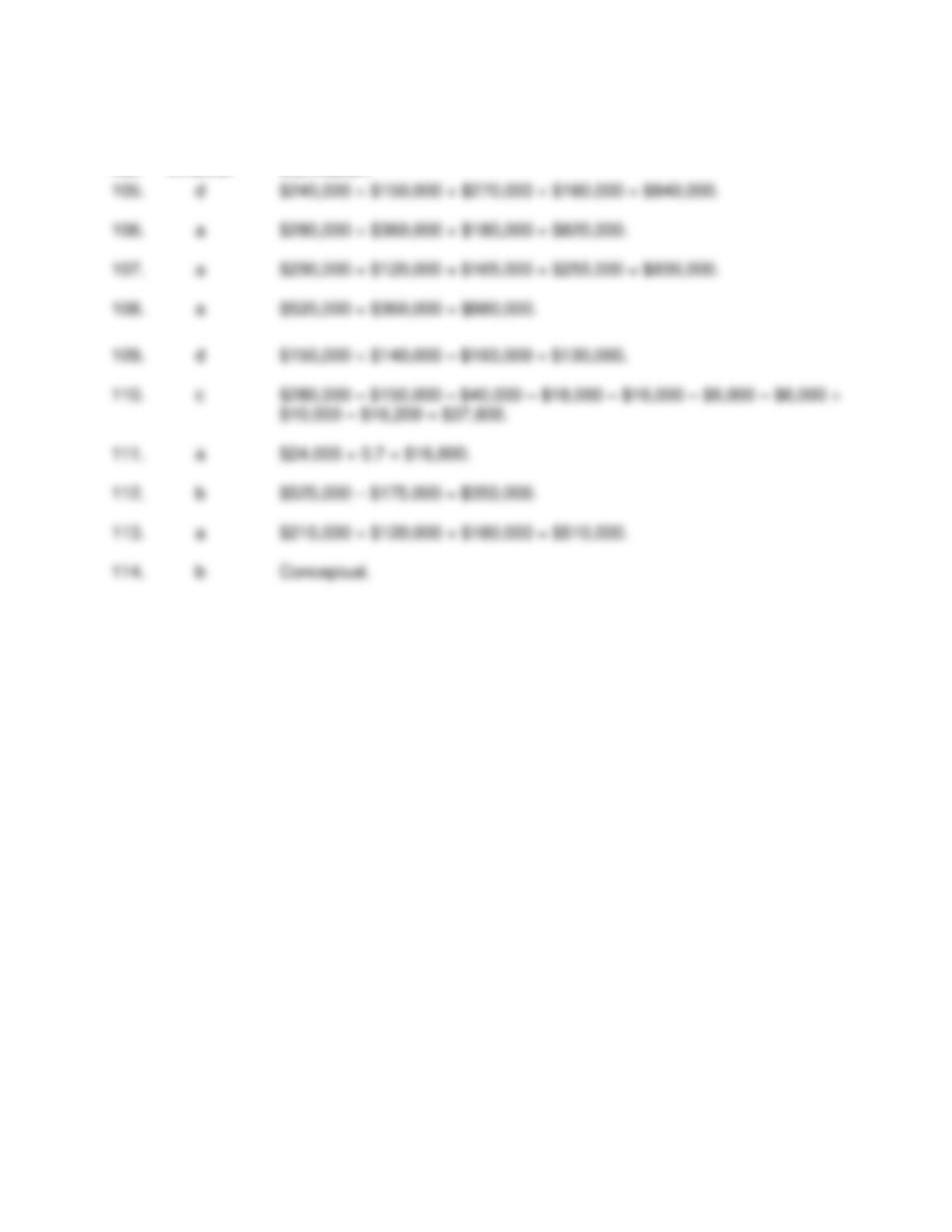
No. Answer Derivation
Income Statement and Related Information
4 – 31
DERIVATIONS — CPA Adapted
No. Answer Derivation
Test Bank for Intermediate Accounting, Fifteenth Edition
4 – 32
BRIEF EXERCISES
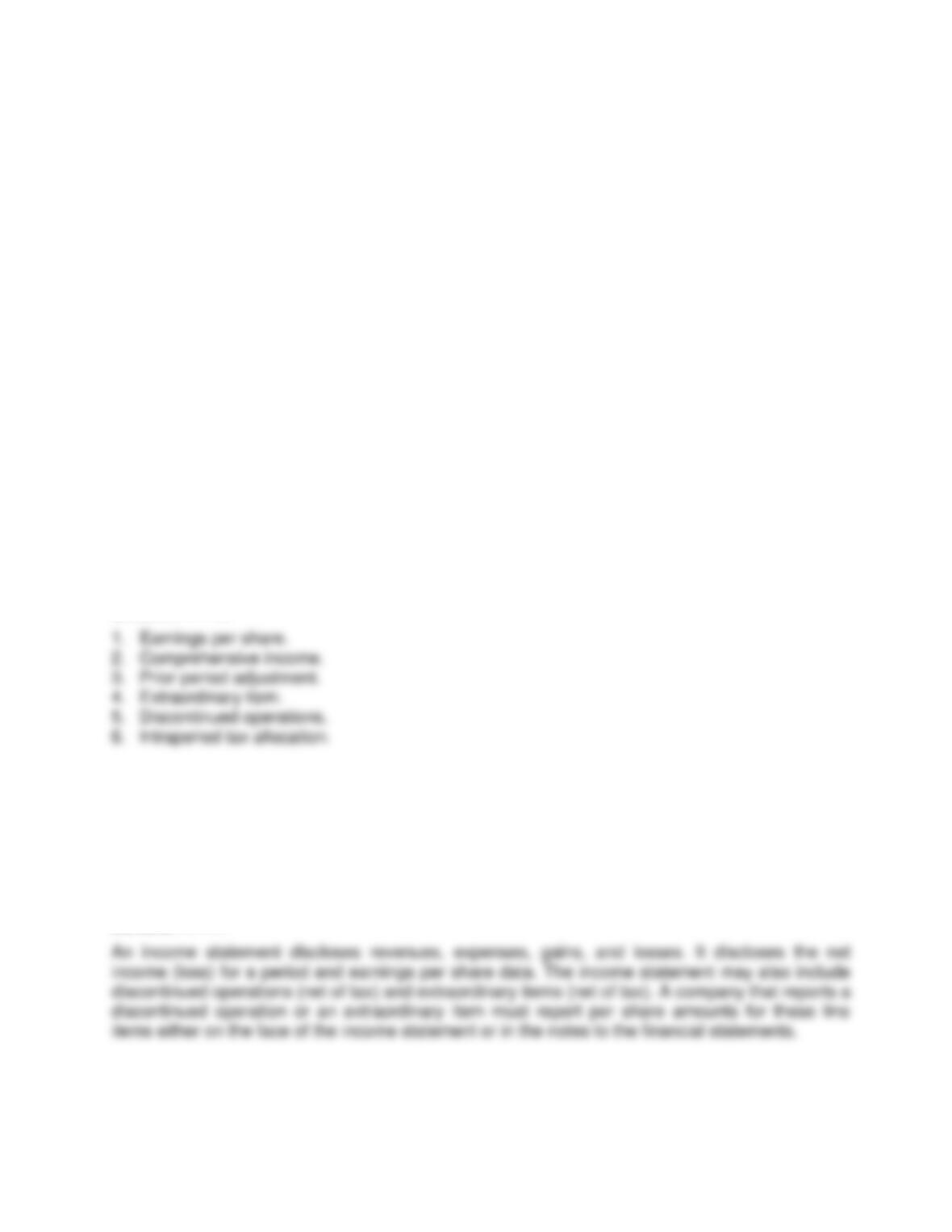
BE. 4–115—Definitions.
Provide clear, concise answers for the following.
1. What are revenues?
2. What are expenses?
3. What are gains?
4. What are losses?
5. What are the criteria (in addition to materiality) that must be met to classify an event or
transaction as extraordinary?
6. When does a discontinued operation occur?
7. Indicate how earnings per share is computed.
8. State the primary category of prior period adjustments and indicate how they are reported in
the financial statements.
Solution 4-115
Income Statement and Related Information
4 – 33
BE. 4–116—Terminology.
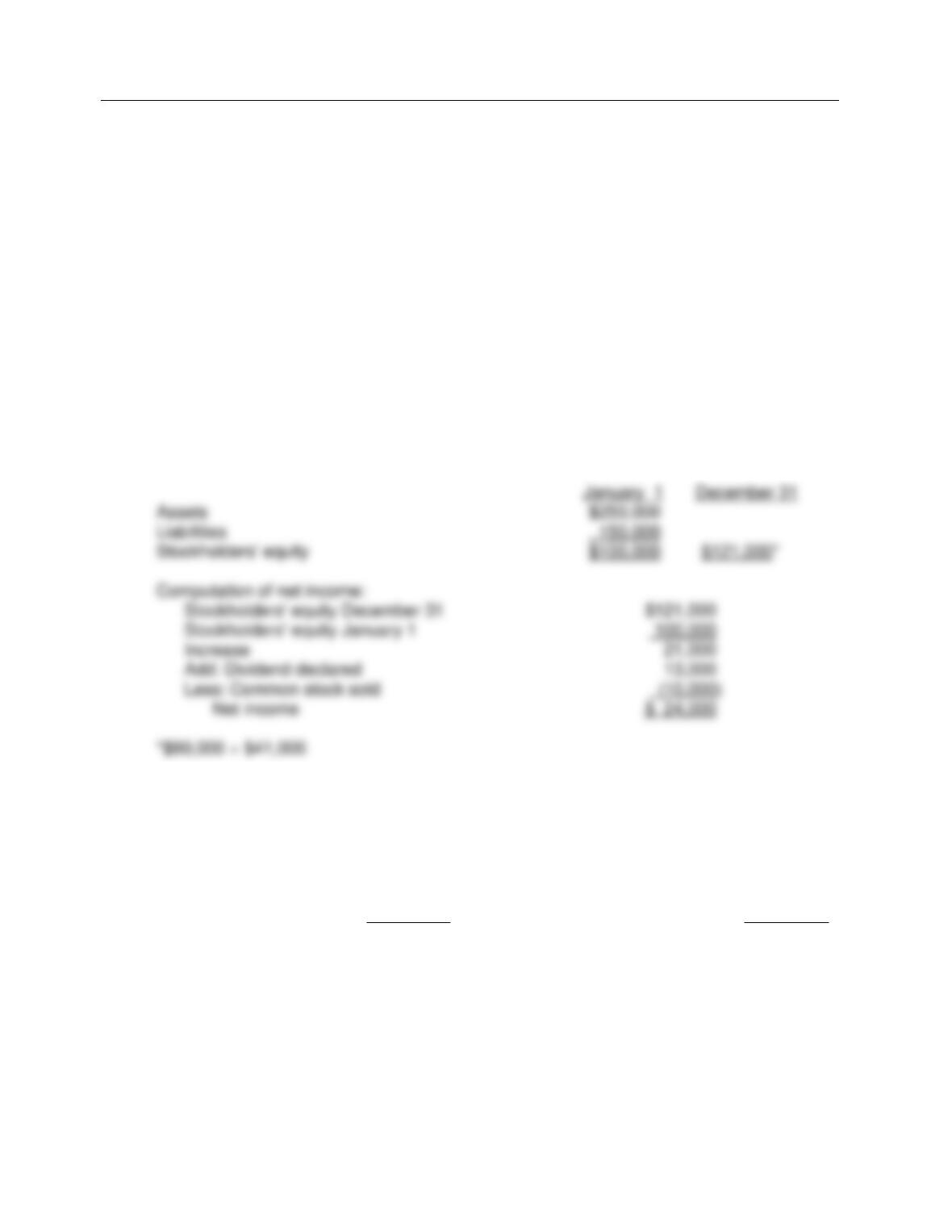
In the space provided, write the word or phrase that is defined or indicated.
1. Net income minus preferred dividends
divided by the weighted average of shares
outstanding. 1. ________________________________
2. All changes in equity during a period except
those resulting from investments by owners
and distributions to owners. 2. ________________________________
3. A correction of an error is reported as a 3. ________________________________
4. An event or transaction which is unusual
in nature and infrequent in occurrence. 4. ________________________________
5. The income statement category for a
disposal of a component of a business. 5. ________________________________
6. Relating tax expense to specific items
on the income statement. 6. ________________________________
Solution 4-116
BE. 4–117—Income statement disclosures.
What is disclosed in an income statement? Be specific.
Solution 4-117
Test Bank for Intermediate Accounting, Fifteenth Edition
4 – 34
EXERCISES
Ex. 4-118—Calculation of net income from the change in stockholders’ equity.
Presented below is certain information pertaining to Edson Company.
Assets, January 1 $250,000
Assets, December 31 230,000
Liabilities, January 1 150,000
Common stock, December 31 80,000
Retained earnings, December 31 41,000
Common stock sold during the year 10,000
Dividends declared during the year 13,000
Compute the net income for the year.
Solution 4-118
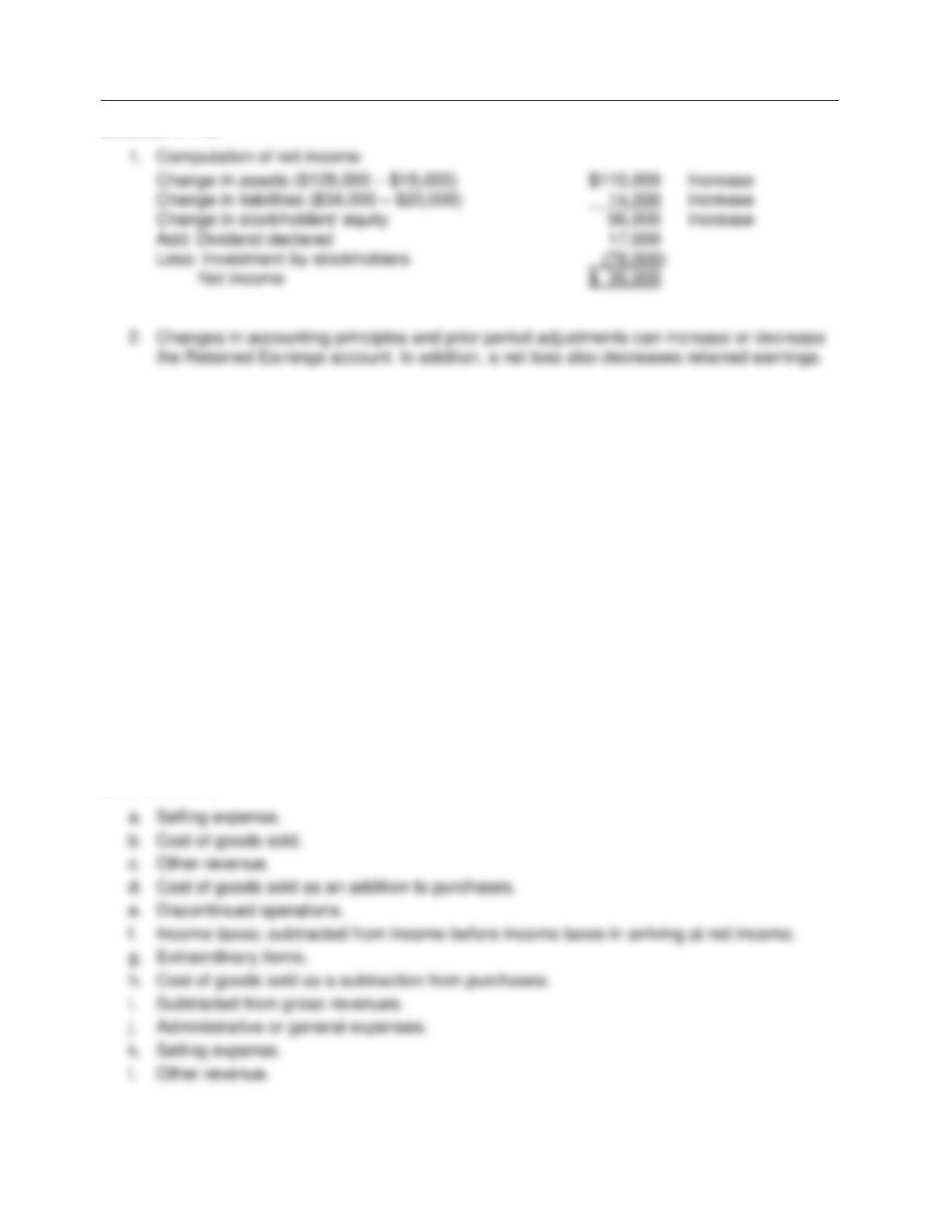
Ex. 4-119—Calculation of net income from the change in stockholders’ equity.
Presented below are changes in the account balances of Wenn Company during the year, except
for retained earnings.
Increase Increase
(Decrease) (Decrease)
Cash $29,000 Accounts payable $34,000
Accounts receivable (net) (18,000) Bonds payable (20,000)
Inventory 52,000 Common stock 62,000
Plant assets (net) 47,000 Paid-in capital 16,000
The only entries in Retained Earnings were for net income and a dividend declaration of $17,000.
1. Compute the net income for the current year.
2. Explain what else can affect the Retained Earnings account.

Income Statement and Related Information
4 – 35
Test Bank for Intermediate Accounting, Fifteenth Edition
4 – 36
Solution 4-119
Ex. 4-120—Income statement classifications.
Indicate the major section or subsection of a multiple-step income statement in which each of the
following items would usually appear:
a. Advertising
b. Depletion
c. Dividend revenue
d. Freight-in
e. Loss on disposal of a component of a business, net of tax
f. Income taxes
g. Major casualty loss, net of tax
h. Purchase discounts
i. Sales discounts
j. Officers’ salaries
k. Freight-out
l. Interest income
Solution 4-120
Income Statement and Related Information
4 – 37
Ex. 4-121—Income statement relationships.
Fill in the appropriate blanks for each of the independent situations below.
Company A Company B Company C
Sales revenue (a) $_______ $343,400 $540,000
Beginning inventory 52,600 (d) _______ 90,000
Net purchases 195,300 255,600 (g) _______
Ending inventory 52,200 108,000 63,000
Cost of goods sold (b) _______ (e) _______ 427,000
Gross profit 75,300 118,000 (h) _______
Operating expenses (c) _______ 50,000 48,000
Income before taxes 6,000 (f) _______ (i) _______
Solution 4–121
Ex. 4-122—Multiple-step income statement.
Listed below in scrambled order are 13 income statement categories. Use the numerals 1 through
13 to indicate the order in which these categories should appear on a multiple-step income
statement.
( ) Discontinued operations.
( ) Cost of goods sold.
( ) Other revenues and gains.
( ) Net income.
( ) Income taxes.
( ) Sales revenue.
( ) Gross profit on sales.
( ) Income from operations.
( ) Income from continuing operations before income taxes.
( ) Operating expenses.
( ) Extraordinary item.
( ) Income before extraordinary items.
( ) Income from continuing operations.
Solution 4-122

Test Bank for Intermediate Accounting, Fifteenth Edition
4 – 38
Ex. 4-123—Classification of income statement and retained earnings statement items.
For each of the items listed below, indicate how it should be treated in the financial statements.
Use the following letter code for your selections:
a. Ordinary or unusual (but not extraordinary) item on the income statement
b. Discontinued operations
c. Extraordinary item on the income statement
d. Prior period adjustment
_____ 1. The bad debt rate was increased from 1% to 2%, thus increasing bad debt
expense.
_____ 2. Obsolete inventory was written off. This was the first loss of this type in the
company’s history.
_____ 3. An uninsured casualty loss was incurred by the company. This was the first loss of
this type in the company’s 50-year history.
_____ 4. Recognition of income earned last year which was inadvertently omitted from last
year’s income statement.
_____ 5. The company sold one of its warehouses at a loss.
_____ 6. Settlement of litigation with federal government related to income taxes of three
years ago. The company is continually involved in various adjustments with the
federal government related to its taxes.
_____ 7. A loss incurred from expropriation (the company owned resources in South
America which were taken over by a dictator unsympathetic to American
business).
_____ 8. The company neglected to record its depreciation in the previous year.
_____ 9. Discontinuance of all production in the United States. The manufacturing
operations were relocated in Mexico.
_____ 10. Loss on sale of investments. The company last sold some of its investments two
years ago.
_____ 11. Loss on the disposal of a component of a business.
Solution 4-123
Income Statement and Related Information
4 – 39
PROBLEMS
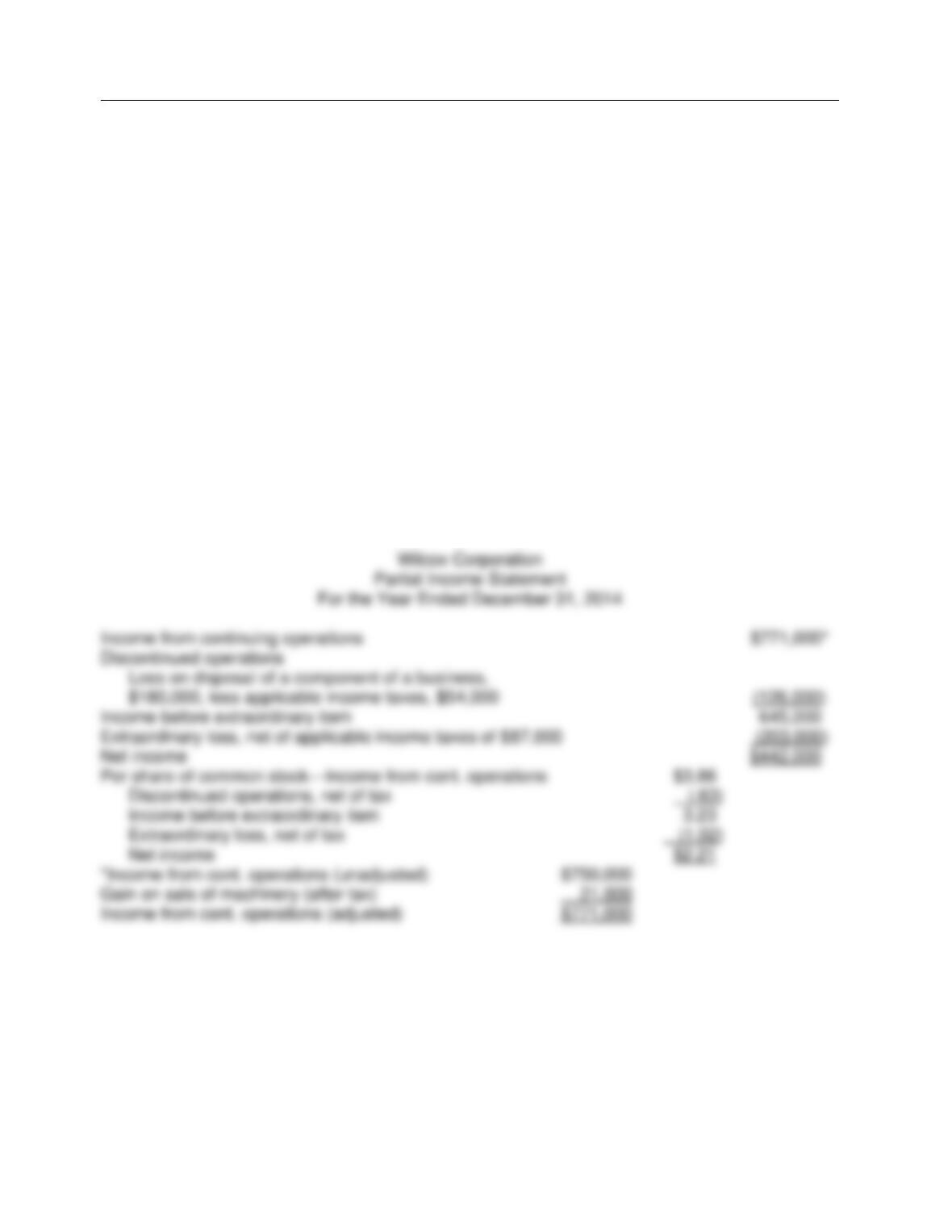
Pr. 4-124—Multiple-step income statement.
Presented below is information related to Farr Company.
Retained earnings, December 31, 2014 $ 650,000
Sales revenue 1,500,000
Selling and administrative expenses 240,000
Hurricane loss (pre-tax) on plant (extraordinary item) 290,000
Cash dividends declared on common stock 33,600
Cost of goods sold 880,000
Gain resulting from computation error on depreciation charge in 2013 (pre-tax) 520,000
Other revenue 120,000
Other expenses 100,000
Instructions
Prepare in good form a multiple-step income statement for the year 2015. Assume a 30% tax rate
and that 80,000 shares of common stock were outstanding during the year.
Solution 4-124
Test Bank for Intermediate Accounting, Fifteenth Edition
4 – 40
Pr. 4-125—Income statement form.
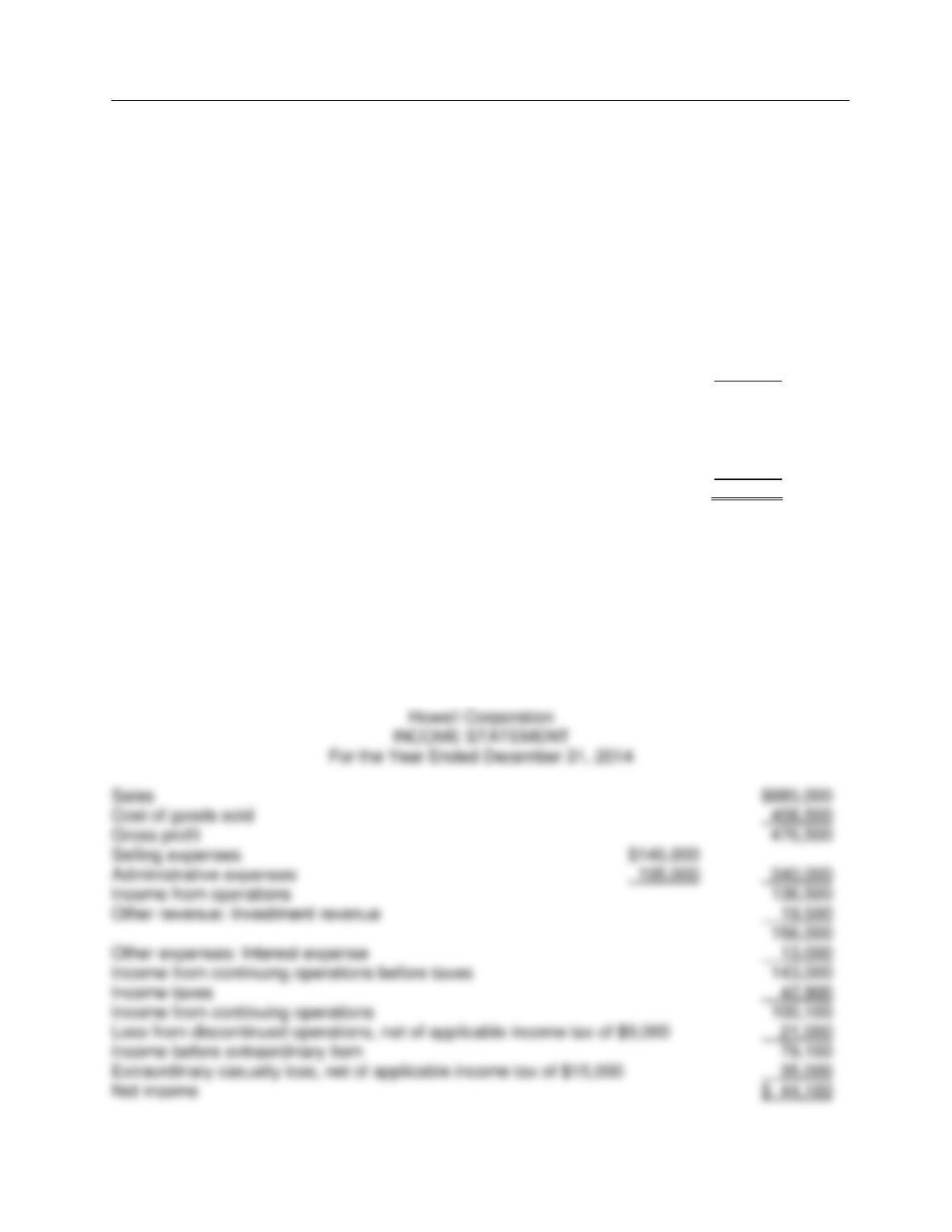
Wilcox Corporation had income from continuing operations of $750,000 (after taxes) in 2014. In
addition, the following information, which has not been considered, is as follows.
1. In 2014, Wilcox experienced an uninsured earthquake loss in the amount of $290,000.
2. A machine was sold for $140,000 cash during the year at a time when its book value was
$110,000. (Depreciation has been properly recorded.) The company often sells machinery of
this type.
3. Wilcox decided to discontinue its stereo division in 2014. During the current year, the loss on
the disposal of this component of the business was $180,000 less applicable taxes.
Instructions
Present in good form the income statement of Wilcox Corporation for 2014 starting with “income
from continuing operations.” Assume that Wilcox’s tax rate is 30% and 200,000 shares of
common stock were outstanding during the year.
Solution 4-125
Income Statement and Related Information
4 – 41
Pr. 4-126—Multiple-step income statement.
Shown below is an income statement for 2014 that was prepared by a poorly trained bookkeeper
of Howell Corporation.
Howell Corporation
INCOME STATEMENT
December 31, 2014
Sales revenue $ 885,000
Investment revenue 19,500
Cost of goods sold (408,500)
Selling expenses (145,000)
Administrative expenses (195,000)
Interest expense (13,000)
Income before special items 143,000
Special items
Loss on disposal of a component of the business (30,000)
Major casualty loss (extraordinary item) (50,000)
Net federal income tax liability (18,900)
Net income $ 44,100
Instructions
Prepare a multiple-step income statement for 2014 for Howell Corporation that is presented in
accordance with generally accepted accounting principles (including format and terminology).
Howell Corporation has 50,000 shares of common stock outstanding and has a 30% federal
income tax rate on all tax related items. Round all earnings per share figures to the nearest cent.
Solution 4-126

Test Bank for Intermediate Accounting, Fifteenth Edition
4 – 42
Solution 4-126 (cont.)
Pr. 4-127—Single-step income statement.
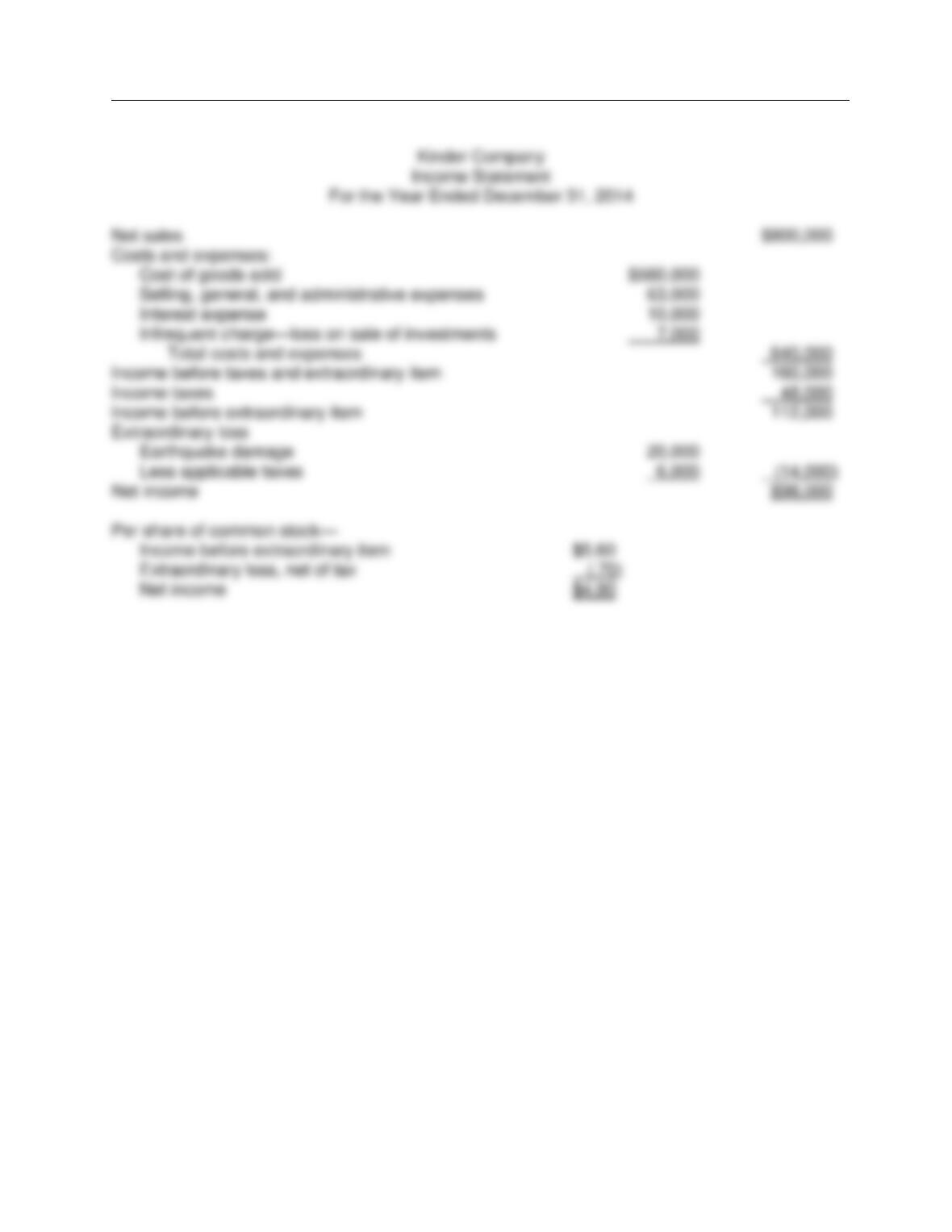
Presented below is an income statement for Kinder Company for the year ended December 31,
2014.
Kinder Company
Income Statement
For the Year Ended December 31, 2014
Net sales $800,000
Costs and expenses:
Cost of goods sold 560,000
Selling, general, and administrative expenses 70,000
Other, net 30,000
Total costs and expenses 660,000
Income before income taxes 140,000
Income taxes 42,000
Net income $98,000
Additional information:
1. “Selling, general, and administrative expenses” included a usual but infrequent charge of
$7,000 due to a loss on the sale of investments.
2. “Other, net” consisted of interest expense, $10,000, and an extraordinary loss of $20,000
before taxes due to earthquake damage. If the extraordinary loss had not occurred, income
taxes for 2014 would have been $48,000 instead of $42,000.
4. Kinder had 20,000 shares of common stock outstanding during 2014.
Instructions
Using the single-step format, prepare a corrected income statement, including the appropriate per
share disclosures.
Income Statement and Related Information
4 – 43
Solution 4-127

Test Bank for Intermediate Accounting, Fifteenth Edition
4 – 44
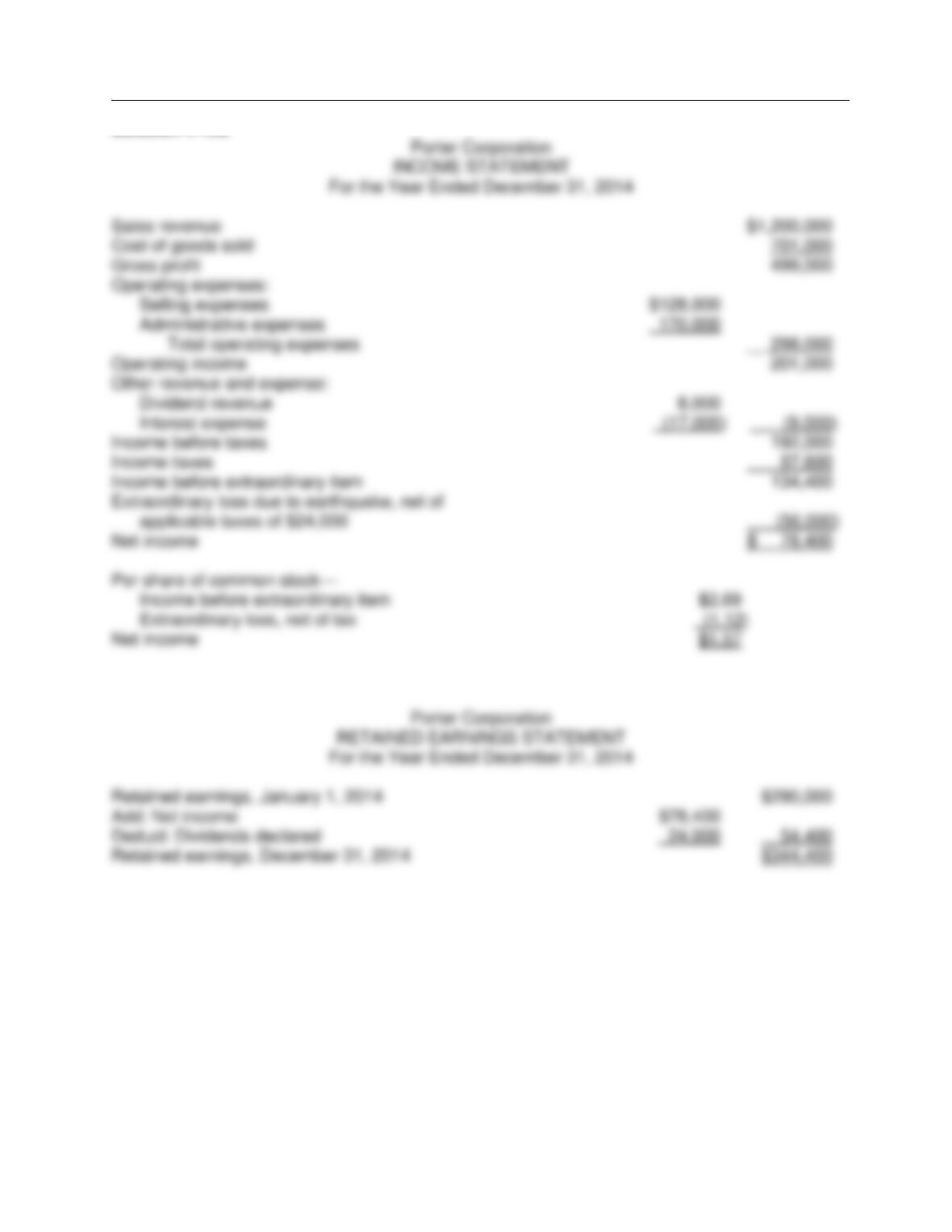
Pr. 4-128—Income statement and retained earnings statement.
Porter Corporation’s capital structure consists of 50,000 shares of common stock. At December
31, 2014 an analysis of the accounts and discussions with company officials revealed the
following information:
Sales revenue $1,200,000
Earthquake loss (net of tax) (extraordinary item) 56,000
Selling expenses 128,000
Cash 60,000
Accounts receivable 90,000
Common stock 200,000
Cost of goods sold 701,000
Accumulated depreciation-machinery 180,000
Dividend revenue 8,000
Unearned service revenue 4,400
Interest payable 1,000
Land 370,000
Patents 100,000
Retained earnings, January 1, 2014 290,000
Interest expense 17,000
Administrative expenses 170,000
Dividends declared 24,000
Allowance for doubtful accounts 5,000
Notes payable (maturity 7/1/17) 200,000
Machinery 450,000
Materials 40,000
Accounts payable 60,000
The amount of income taxes applicable to ordinary income was $57,600, excluding the tax effect
of the earthquake loss which amounted to $24,000.
Instructions
(a) Prepare a multiple-step income statement.
(b) Prepare a retained earnings statement.
Income Statement and Related Information
4 – 45
Solution 4-128 Porter Corporation

Test Bank for Intermediate Accounting, Fifteenth Edition
4 – 46
Pr. 4-129—Irregular items and financial statements.
The accountant preparing the income statement for Bakersfield, Inc. had some doubts about the
appropriate accounting treatment of the seven items listed below during the fiscal year ending
December 31, 2014. Assume a tax rate of 40 percent.
1. The corporation experienced an uninsured flood loss of $70,000 before taxes. While this
loss meets the criteria of an extraordinary item, it has not been recorded.
2. The corporation disposed of its sporting goods division during 2014. This disposal meets
the criteria for discontinued operations. The division correctly calculated income from
operating this division of $110,000 before taxes and a loss of $12,000 before taxes on the
disposal of the division. All of these events occurred in 2014 and have not been recorded.
3. The company recorded advances of $10,000 to employees made December 31, 2014 as
Salaries and Wages Expense.
4. Dividends of $10,000 during 2014 were recorded as an operating expense.
5. In 2014, Bakersfield changed its method of accounting for inventory from the first-in-first-
out method to the average cost method. Inventory in 2014 was correctly recorded using
the average cost method. The new inventory method would have resulted in an additional
$125,000 of cost of goods sold (before taxes) being reported on prior years’ income
statement.
6. Office equipment purchased January 1, 2014 for $60,000 was incorrectly charged to
Supplies Expense at the time of purchase. The office equipment has an estimated three–
year service life with no expected salvage value. Bakersfield uses the straight-line method
to depreciate office equipment for financial reporting purposes. This error has not been
recorded.
7. On January 1, 2010, Bakersfield bought a building that cost $85,000, had an estimated
useful life of ten years, and had a salvage value of $5,000. Bakersfield uses the
straight-line depreciation method to depreciate the building. In 2014, it was estimated that
the remaining useful life was eight years and the salvage value was zero. Depreciation
expense reported on the 2014 income statement was correctly calculated based on the
new estimates. No adjustment for prior years’ depreciation estimates was made.
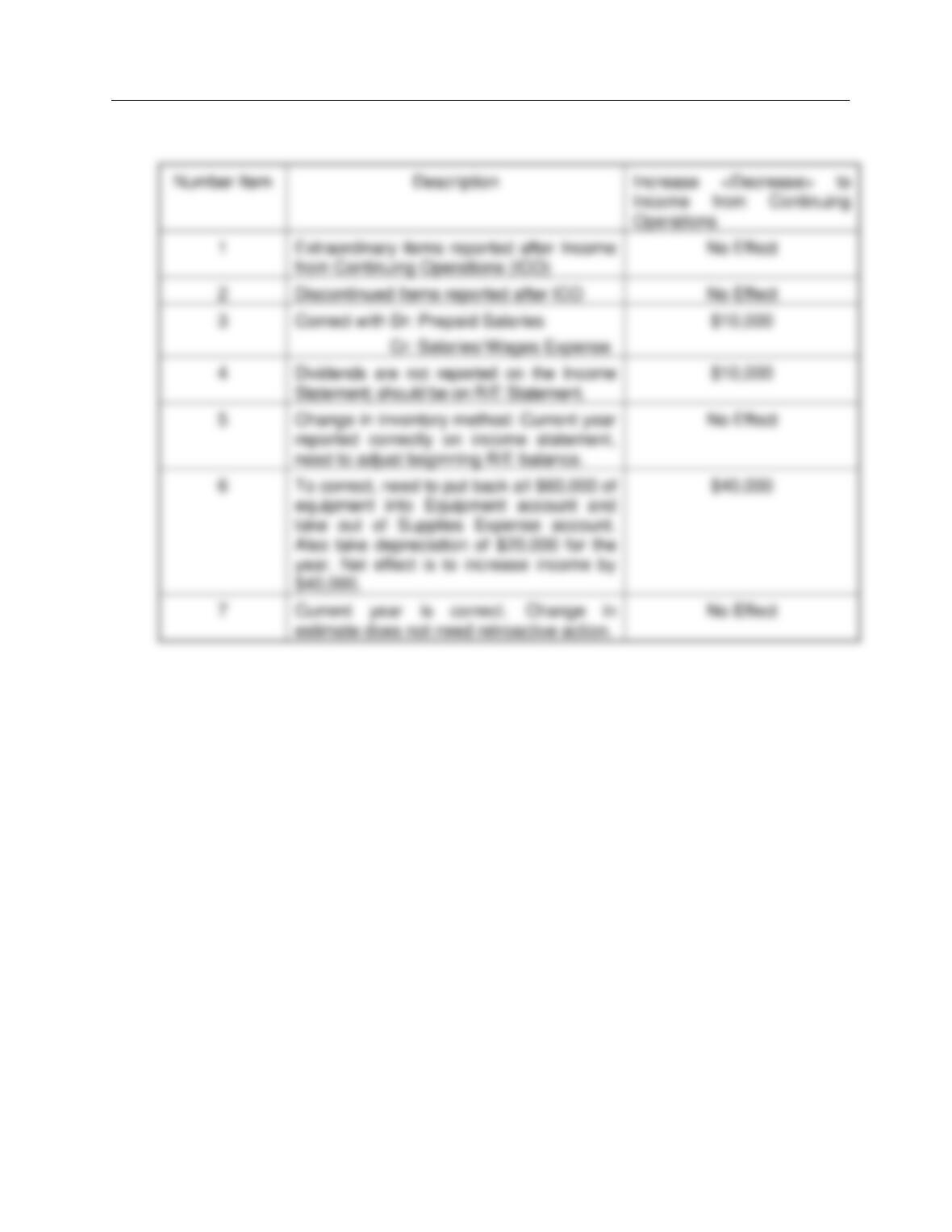
Part A. For each item, record corrections to income from continuing operations before
taxes, if any. Denote any negative numbers by using brackets < >.
Income Statement and Related Information
4 – 47
Solution 4-129
Test Bank for Intermediate Accounting, Fifteenth Edition
4 – 48
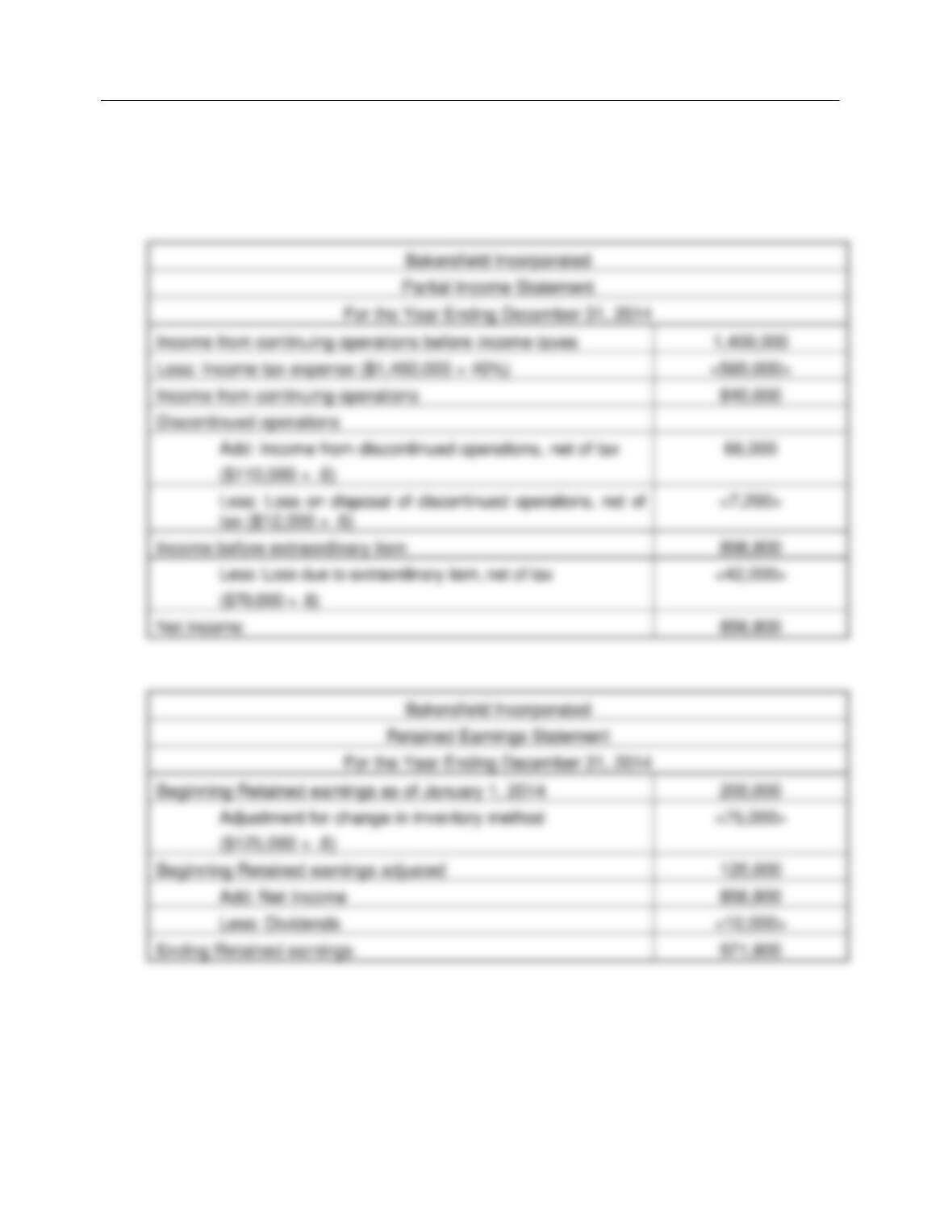
Part B. At January 1, 2014, Bakersfield, Inc.’s retained earnings balance was $200,000.
Assume that income from continuing operations (before taxes) and after correctly
considering any of the seven additional items was $1,400,000. Prepare the income
statement and retained earnings statement. Denote negative numbers by using
brackets < >. Do not disclose earnings per share data.

Income Statement and Related Information
4 – 49
IFRS QUESTIONS
True/False
1. Both U.S. GAAP and IFRS discuss income statement presentation using either a
single-step or multi-step approach.
2. Under IFRS, both revenues and expenses and other income and expenses are reported as
part of income from operations.
3. IFRS allows for revaluation of long-term tangible and intangible assets with the differences
impacting equity but not net income.
4. Both IFRS and U.S. GAAP allow for comprehensive income to be reported in either a
Statement of Stockholders’ Equity or a Statement of Recognized Income and Expense.
5. Under IFRS, a company may classify expenses by function, but must also disclose the
classification of expenses by nature.
Answers to True/False:
Multiple Choice:
6. The IFRS income statement classification of expenses by nature results in descriptions
which include all of the following except
a. salaries
b. depreciation
c. distribution
d. utilities
7. Boston Company owns more than 50 percent of the ordinary shares of Dynamic Company.
Assume Boston net income of $225,000 is allocated as $180,000 to Boston and $45,000 to
noncontrolling interest. In Boston’s consolidated income statement that includes Dynamic,
under IFRS, how will the amount of non-controlling interest be reported?
a. $45,000 will be presented as an item of expense below the net income.
b. $45,000 will be presented as an item of expense above the net income.
c. $45,000 will be presented as an allocation to net income below the net income.
d. $45,000 will not be presented on the face of the income statement.
8. An IFRS statement might include all of the following except
a. net income or loss
b. unrealized gains or losses on the revaluation of long-term assets
c. cumulative effect of a change in accounting principle
d. extraordinary gain or loss
9. Discontinued operations of a component of a business are classified as a separate item in the
income statement:
a. after “income from continuing operations”.
b. before “income from continuing operations”.
c. between income from operations and income before income tax.
d. immediately after “gross profit”.
Test Bank for Intermediate Accounting, Fifteenth Edition
4 – 50
10. If a company prepares a consolidated income statement, IFRS requires that net income be
reported for:
a. the controlling interest only.
b. the noncontrolling interest only.
c. both the controlling and the noncontrolling interest.
d. as a single amount only.
11. Which of the following is true of expense classification under IFRS?
a. The nature–of-expense method identifies the major cost drivers of the company.
b. The nature–of-expense method does not classify the expenses into various subtotals.
c. The function–of-expense method is simple to apply because allocations of expense to
different functions are not necessary.
d. IFRS allows only function-of-expense method for expense classification.
Answers to Multiple Choice:
Short Answer:
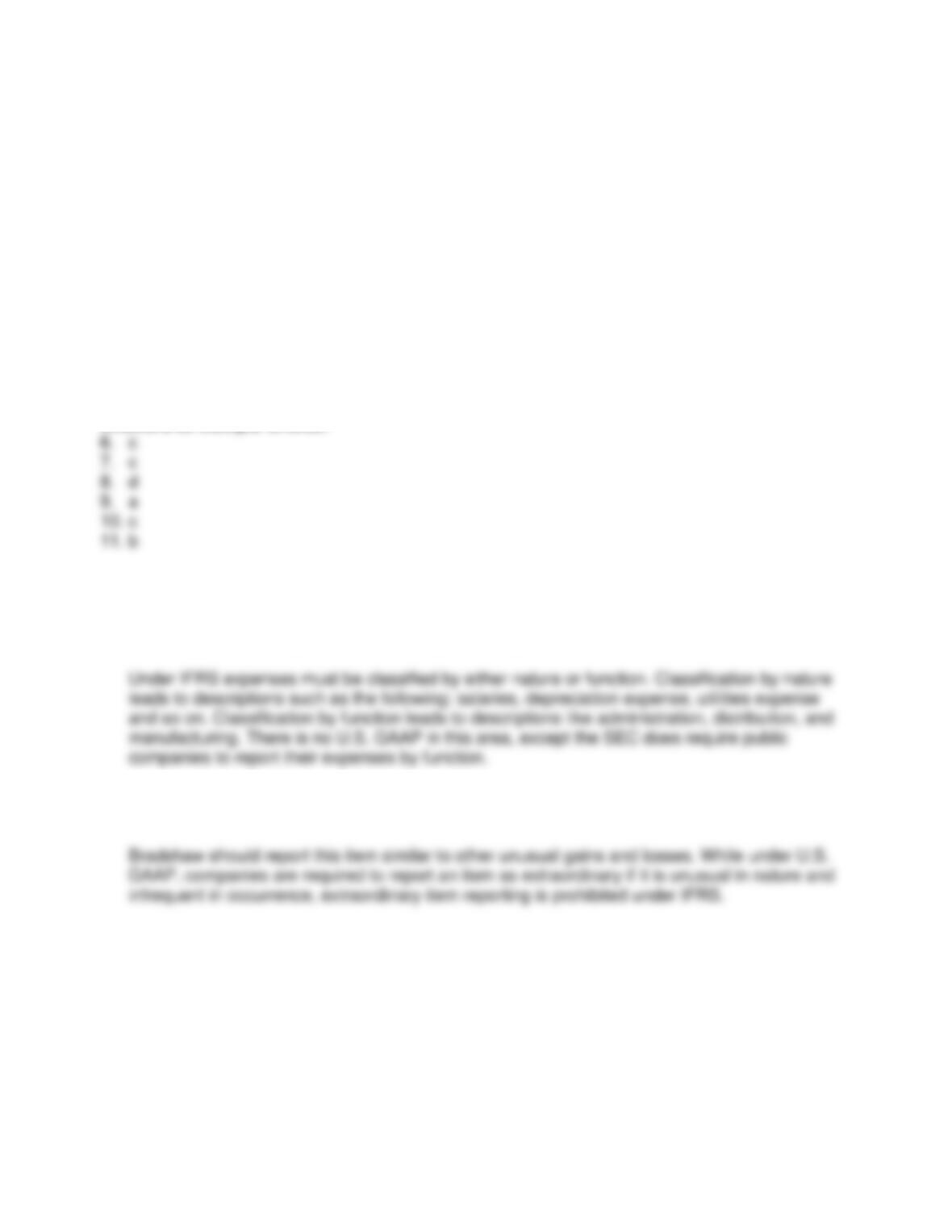
12. What are the IFRS requirements with respect to expense classification?
13. Bradshaw Company experienced a loss that was deemed to be both unusual in nature and
infrequent in occurrence. How should Bradshaw report this item in accordance with IFRS?