172) On March 12, Klein Company sold merchandise in the amount of $7,800 to Babson
Company, with credit terms of 2/10, n/30. The cost of the items sold is $4,500. Klein uses the
perpetual inventory system and the net method of accounting for sales. On March 15, Babson
returns some of the merchandise, which is not defective. The selling price of the returned
merchandise is $600 and the cost of the merchandise returned is $350. The entry or entries that
Klein must make on March 15 is (are):
A)
Sales returns and allowances
588
Accounts receivable
588
Merchandise inventory
350
Cost of goods sold
350
B)
Sales returns and allowances
588
Accounts receivable
588
Merchandise inventory
343
Cost of goods sold
343
C)
Accounts receivable
600
Sales returns and allowances
600
D)
Accounts receivable
600
Sales returns and allowances
600
Cost of Goods Sold
350
Merchandise inventory
350
E)
Sales returns and allowances
350
Accounts receivable
350
173) On September 12, Ryan Company sold merchandise in the amount of $5,800 to Johnson
Company, with credit terms of 2/10, n/30. The cost of the items sold is $4,000. Ryan uses the
periodic inventory system and the net method of accounting for sales. The journal entry or
entries that Ryan will make on September 12 is (are):
A)
Sales
5,800
Accounts receivable
5,800
B)
Accounts receivable
5,684
Sales
5,684
Cost of goods sold
4,000
Merchandise Inventory
4,000
C)
Accounts receivable
5,800
Sales
5,800
D)
Accounts receivable
5,800
Sales
5,800
Cost of Goods Sold
4,000
Merchandise inventory
4,000
E)
Accounts receivable
5,684
Sales
5,684
174) On September 12, Ryan Company sold merchandise in the amount of $5,800 to Johnson
Company, with credit terms of 2/10, n/30. The cost of the items sold is $4,000. Johnson uses the
periodic inventory system and the net method of accounting for purchases. The journal entry that
Johnson will make on September 12 is:
A)
Purchases
5,800
Accounts payable
5,800
B)
Purchases
5,684
Accounts payable
5,684
C)
Merchandise inventory
5,684
Accounts payable
5,684
D)
Merchandise inventory
5,800
Accounts payable
5,800
E)
Accounts payable
4,000
Merchandise inventory
4,000
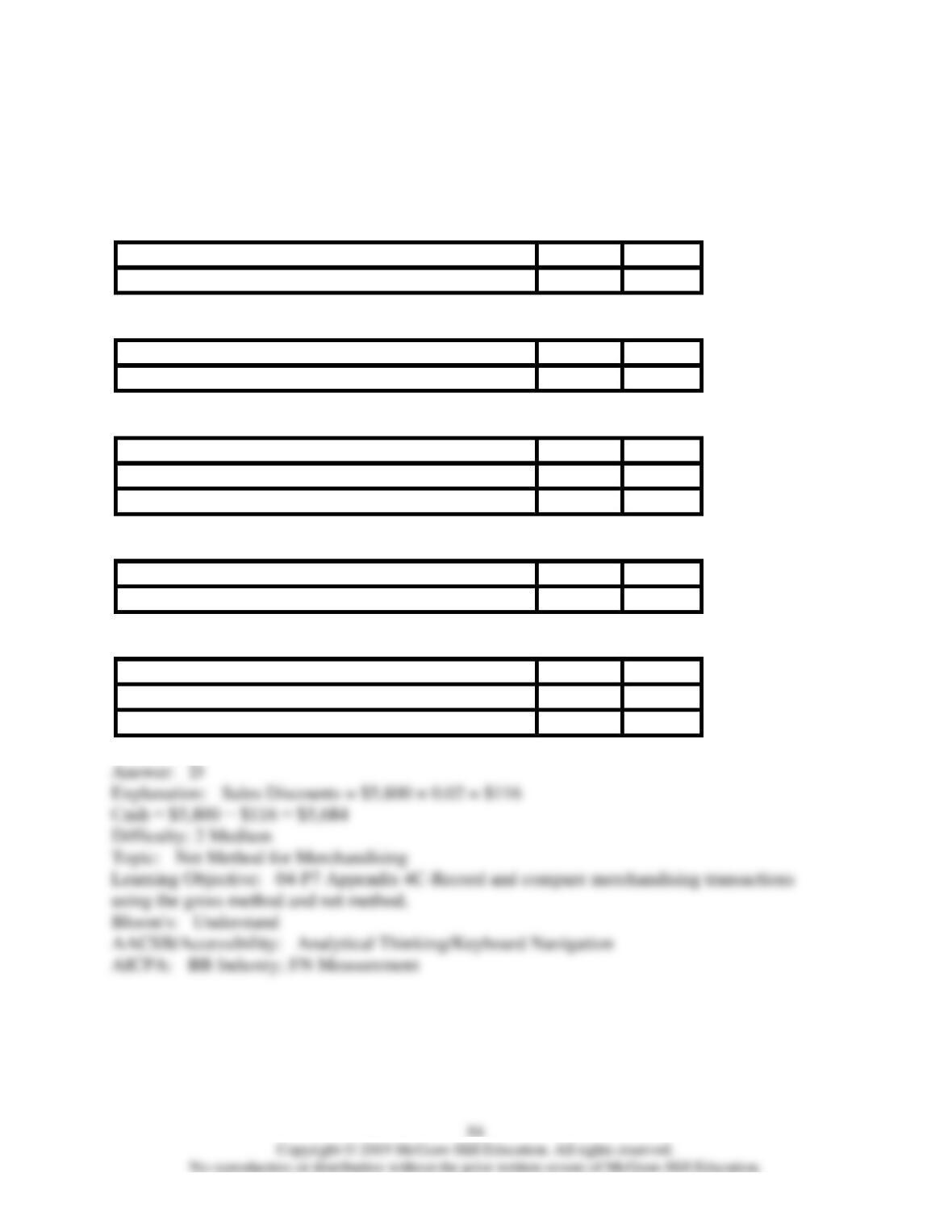
175) On September 12, Ryan Company sold merchandise in the amount of $5,800 to Johnson
Company, with credit terms of 2/10, n/30. The cost of the items sold is $4,000. Ryan uses the
periodic inventory system and the net method of accounting for sales. Johnson pays the invoice
on September 18, and takes the appropriate discount. The journal entry that Ryan makes on
September 18 is:
A)
Cash
5,800
Accounts receivable
5,800
B)
Cash
4,000
Accounts receivable
4,000
C)
Cash
3,920
Sales discounts
80
Accounts receivable
4,000
D)
Cash
5,684
Accounts receivable
5,684
E)
Cash
5,684
Sales discounts
116
Accounts receivable
5,800
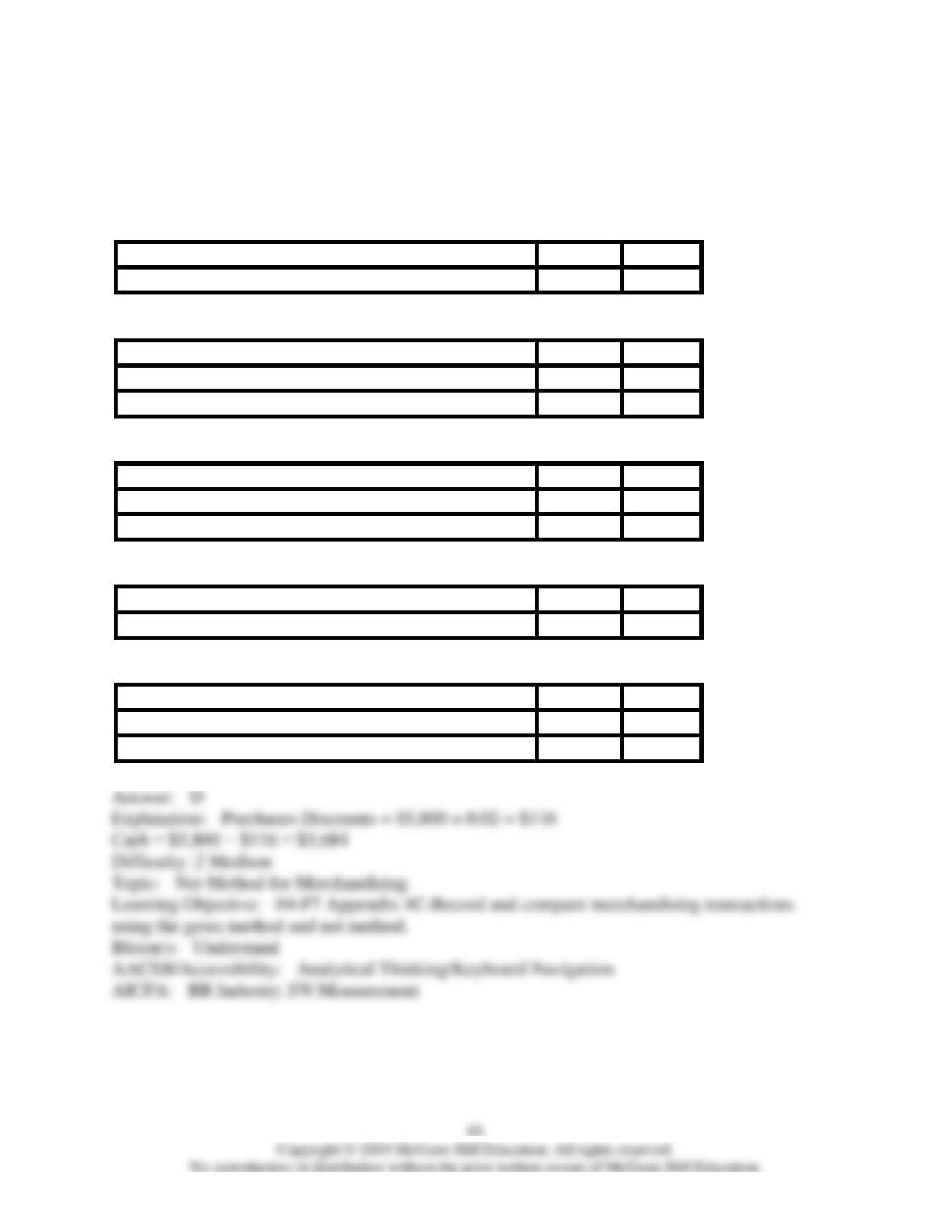
176) On September 12, Ryan Company sold merchandise in the amount of $5,800 to Johnson
Company, with credit terms of 2/10, n/30. The cost of the items sold is $4,000. Johnson uses the
periodic inventory system and the net method of accounting for purchases. Johnson pays the
invoice on September 18, and takes the appropriate discount. The journal entry that Johnson
makes on September 18 is:
A)
Purchases
5,684
Cash
5,684
B)
Accounts payable
4,000
Merchandise inventory
80
Cash
3,920
C)
Accounts payable
5,800
Purchases discounts
116
Cash
5,684
D)
Accounts payable
5,684
Cash
5,684
E)
Cash
5,684
Purchases discounts
116
Accounts payable
5,800
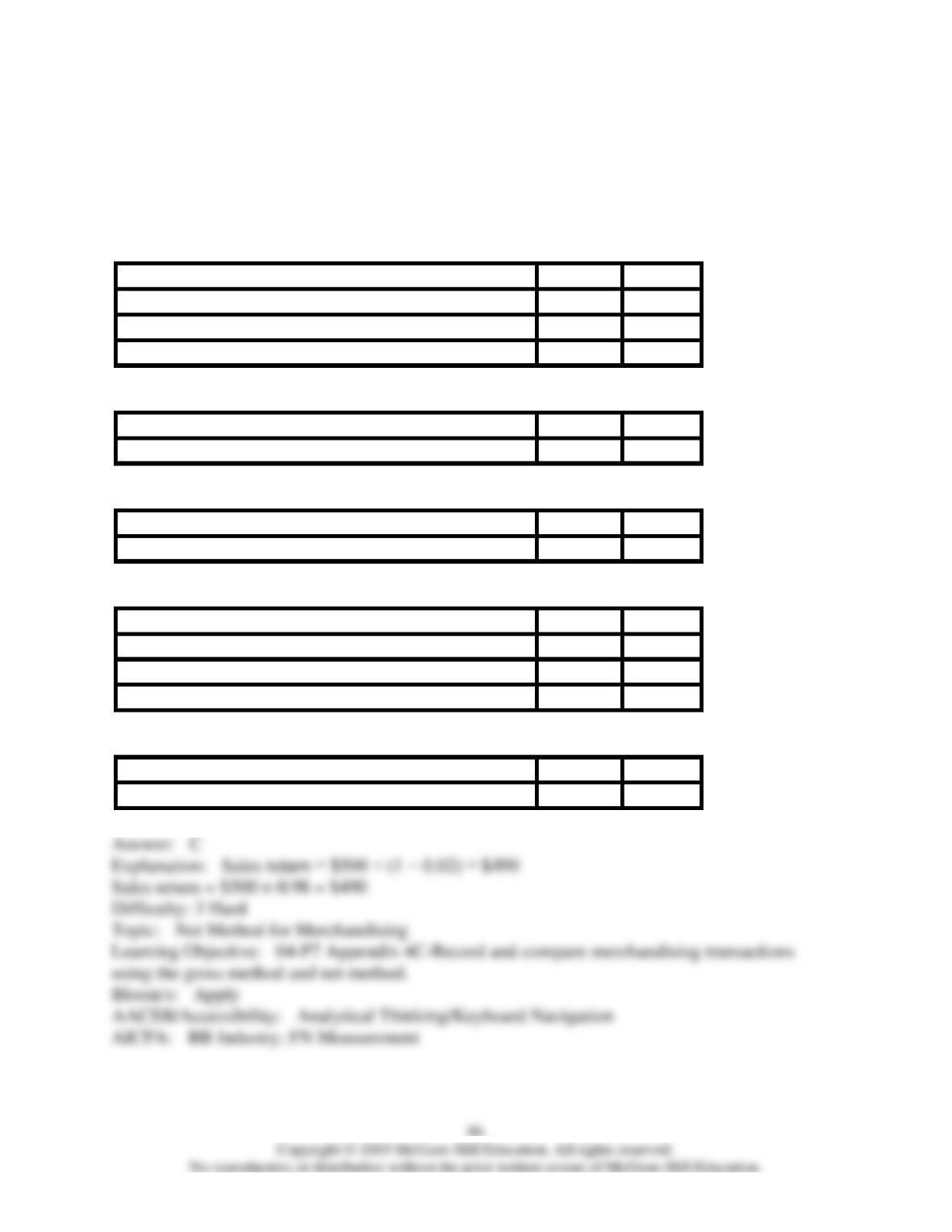
177) On September 12, Ryan Company sold merchandise in the amount of $5,800 to Johnson
Company, with credit terms of 2/10, n/30. The cost of the items sold is $4,000. Ryan uses the
periodic inventory system and the net method of accounting for sales. On September 14, Johnson
returns some of the non-defective merchandise, which is restored to inventory. The selling price
of the returned merchandise is $500 and the cost of the merchandise returned is $350. The entry
or entries that Ryan must make on September 14 is (are):
A)
Sales returns and allowances
490
Accounts receivable
490
Merchandise inventory
350
Cost of goods sold
350
B)
Sales returns and allowances
500
Accounts receivable
500
C)
Sales returns and allowances
490
Accounts receivable
490
D)
Sales returns and allowances
490
Accounts receivable
490
Merchandise inventory
343
Cost of goods sold
343
E)
Sales returns and allowances
350
Accounts receivable
350
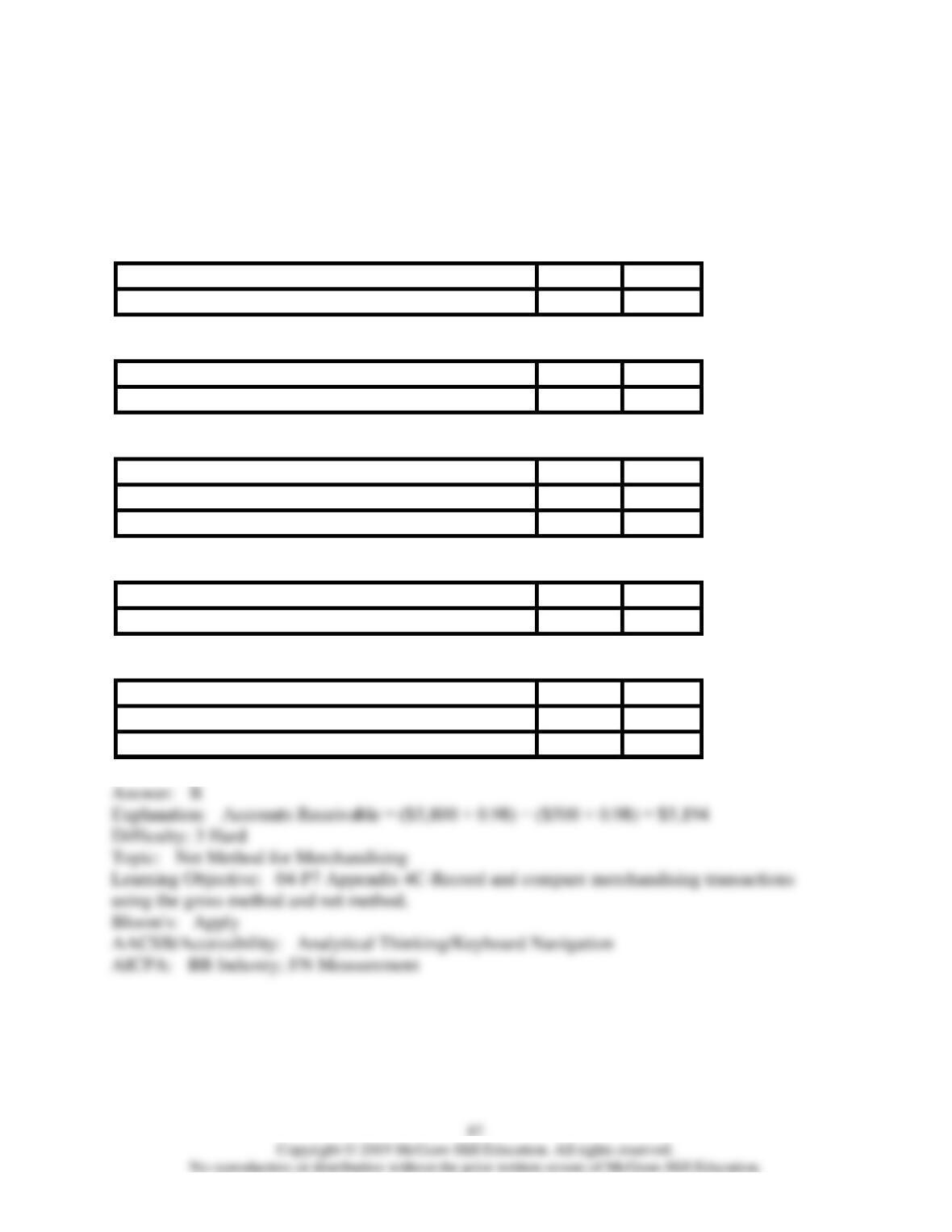
178) On September 12, Ryan Company sold merchandise in the amount of $5,800 to Johnson
Company, with credit terms of 2/10, n/30. The cost of the items sold is $4,000. Ryan uses the
periodic inventory system and the net method of accounting for sales. On September 14, Johnson
returns some of the merchandise. The selling price of the merchandise is $500 and the cost of the
merchandise returned is $350. Johnson pays the invoice on September 18, and takes the
appropriate discount. The journal entry that Ryan makes on September 18 is:
A)
Cash
5,800
Accounts receivable
5,800
B)
Cash
5,194
Accounts receivable
5,194
C)
Cash
5,194
Sales discounts
106
Accounts receivable
5,300
D)
Cash
5,684
Accounts receivable
5,684
E)
Cash
5,684
Sales discounts
116
Accounts receivable
5,800
179) Match the following definitions and terms by placing the letter for the terms A through J in
the blank space next to the best definition.
A. Trade discount F. Acid-test ratio
B. General and administrative expenses G. Merchandise inventory
C. FOB shipping point H. Selling expenses
D. Single-step income statement I. Multiple-step income statement
E. FOB destination J. Inventory shrinkage
___
1. A measure of a company’s ability to pay its current liabilities that excludes less
liquid current assets such as inventory and prepaid expenses.
___
2. An income statement format that lists cost of goods sold as another expense
and shows only one subtotal for total expenses.
___
3. The point of ownership transfer from seller to buyer that takes place when the
goods arrive at the buyer’s place of business.
___
4. Products a company owns and intends to sell.
___
5. The expenses that support a company’s overall operations and include costs
related to accounting, human resources and finance.
___
6. The point of ownership transfer from seller to buyer that takes place when the
goods depart the seller’s place of business.
___
7. Inventory losses that require an adjusting entry to account for losses from theft
or deterioration.
___
8. An income statement format that shows detailed computations of net sales and
other costs and expenses, and reports subtotals for various classes of items.
___
9. A given percent deducted from a list price often granted to customers
purchasing large quantities of merchandise.
___
10. The expenses of advertising merchandise, making sales, and delivering goods
to customers.
180) Match the following terms with the appropriate definition.
A. Shrinkage
B. Credit period
C. Credit terms
D. Purchase allowance
E. Discount period
F. Gross profit
G. Periodic inventory system
H. Perpetual inventory system
I. Sales discount
J. Purchases discounts
__
1. An inventory accounting method that updates accounting records for each
purchase and each sale of inventory.
__
2. An inventory accounting method that updates the accounting records for
purchases and sales of inventory only at the end of a period.
__
3. The time period in which reduced payment can be made by the buyer because
of a cash discount offered by a seller of goods on credit.
__
4. The loss of inventory from theft and deterioration.
__
5. A cash discount granted, from the view of the purchaser intended to encourage
buyers to pay amounts owed earlier.
__
6. Price reduction granted by the seller to a buyer of defective or unacceptable
merchandise.
__
7. A cash discount granted from the view of the seller, indicated in the credit
terms on the invoice.
__
8. The calculation of net sales minus cost of goods sold.
__
9. The description of the amounts and timing of payments from a buyer to a seller
for a purchase.
__
10. The amount of time allowed before full payment is due.
181) Identify and explain the key components of a merchandiser’s net income.
182) Describe the difference between wholesalers and retailers.
183) Define inventory for a merchandising company and describe how inventory is valued and
reported.
184) What are the steps of the operating cycle for a merchandiser with credit sales?
185) Describe the difference between the periodic and perpetual inventory accounting systems.
186) Explain the way in which costs flow through the merchandise inventory account to a
merchandiser’s income statement.
187) What is the acid-test ratio? How does it measure a company’s liquidity?
188) What is gross margin ratio? How is it used as an indicator of profitability?
189) Describe the differences between FOB shipping point and FOB destination.
190) Describe the recording process (including costs) for the types of transactions involved in
purchasing merchandise inventory when a perpetual inventory system is used.
191) Describe the recording process (including costs) for the types of transactions associated
with sales of merchandise inventory using a perpetual inventory system.
94
192) What is inventory shrinkage? How do managers account for shrinkage?
193) How do closing entries for a merchandising company that uses the perpetual inventory
system differ from the closing entries for a service company?
194) Explain the difference between the single-step and multiple-step income statements.
195) Distinguish between selling expenses and general and administrative expenses.
196) Describe the difference(s) between the periodic and the perpetual inventory accounting
systems.
197) Describe why tracking inventory activities are necessary for a merchandising company.
198) Discuss the period-end adjusting entries that are required in the new revenue recognition
standards for estimating sales discounts and sales returns and allowances.
199) Farmen Company had net sales of $600,000 and cost of goods sold of $450,000. Calculate
Farmen’s gross profit.
200) National Storage Company had sales of $1,000,000, sales discounts of $2,500, sales returns
and allowances of $15,000, and cost of goods sold of $525,000. Calculate National’s gross profit.
201) Harley’s Antique Shop had net sales of $772,000. The gross profit was $415,000. Calculate
Harley’s cost of goods sold.
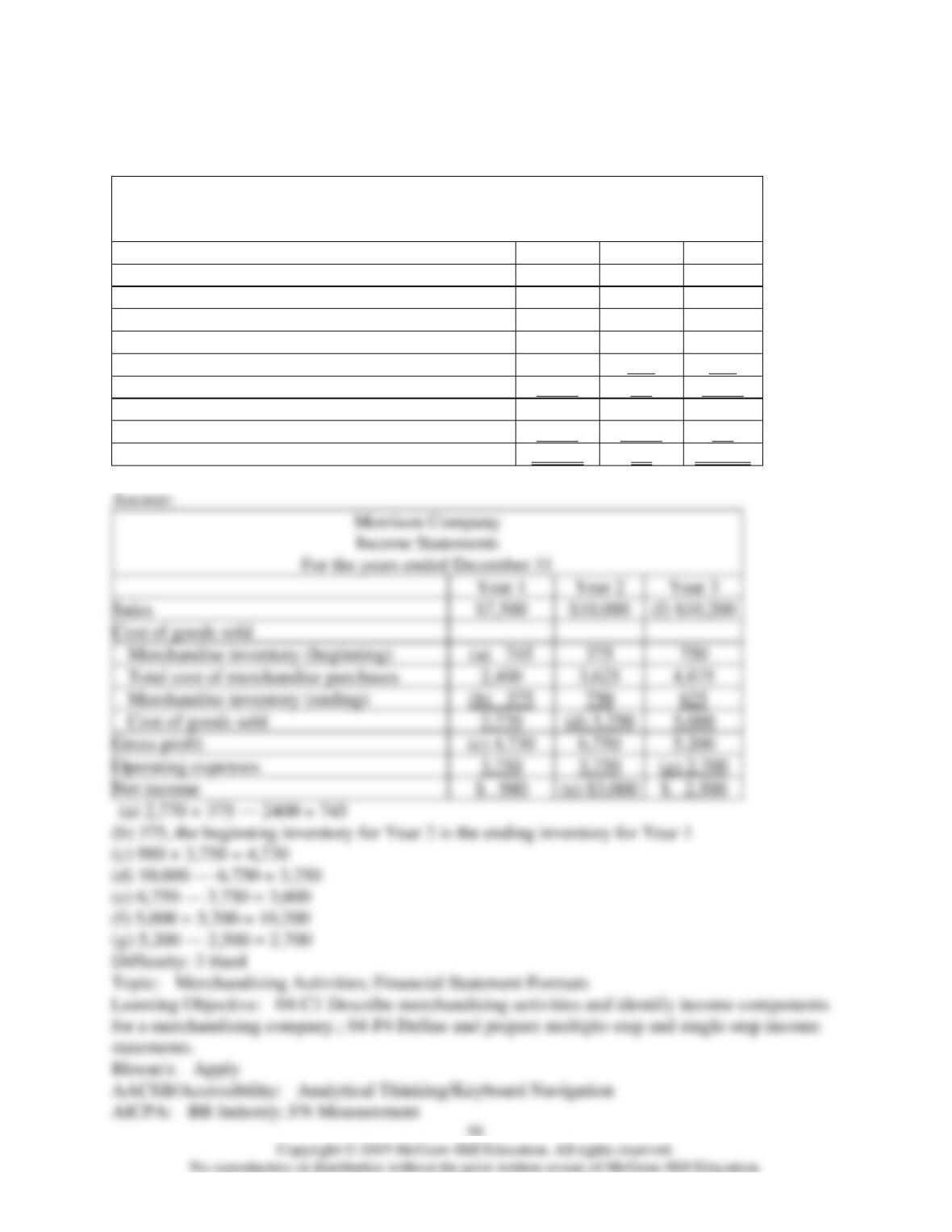
202) Fill in the blanks (a) through (g) for the Morrison Company for each of the income
statements for years 1, 2, and 3.
Morrison Company
Income Statements
For the years ended December 31
Year 1
Year 2
Year 3
Sales
$7,500
$10,000
(f)
Cost of goods sold
Merchandise inventory (beginning)
(a)
375
750
Total cost of merchandise purchases
2,400
3,625
4,875
Merchandise inventory (ending)
(b)
750
625
Cost of goods sold
2,770
(d)
5,000
Gross profit
(c)
6,750
5,200
Operating expenses
3,750
3,750
(g)
Net income
$ 980
(e)
$ 2,500
Year 1
Sales
$10,000
Cost of goods sold
Merchandise inventory (beginning)
(a) 745
375
Total cost of merchandise purchases
2,400
4,875
Merchandise inventory (ending)
750
Cost of goods sold
2,770
(d) 3,250
5,000
Gross profit
(c) 4,730
5,200
Operating expenses
3,750
(g) 2,700
Net income
$ 2,500
99
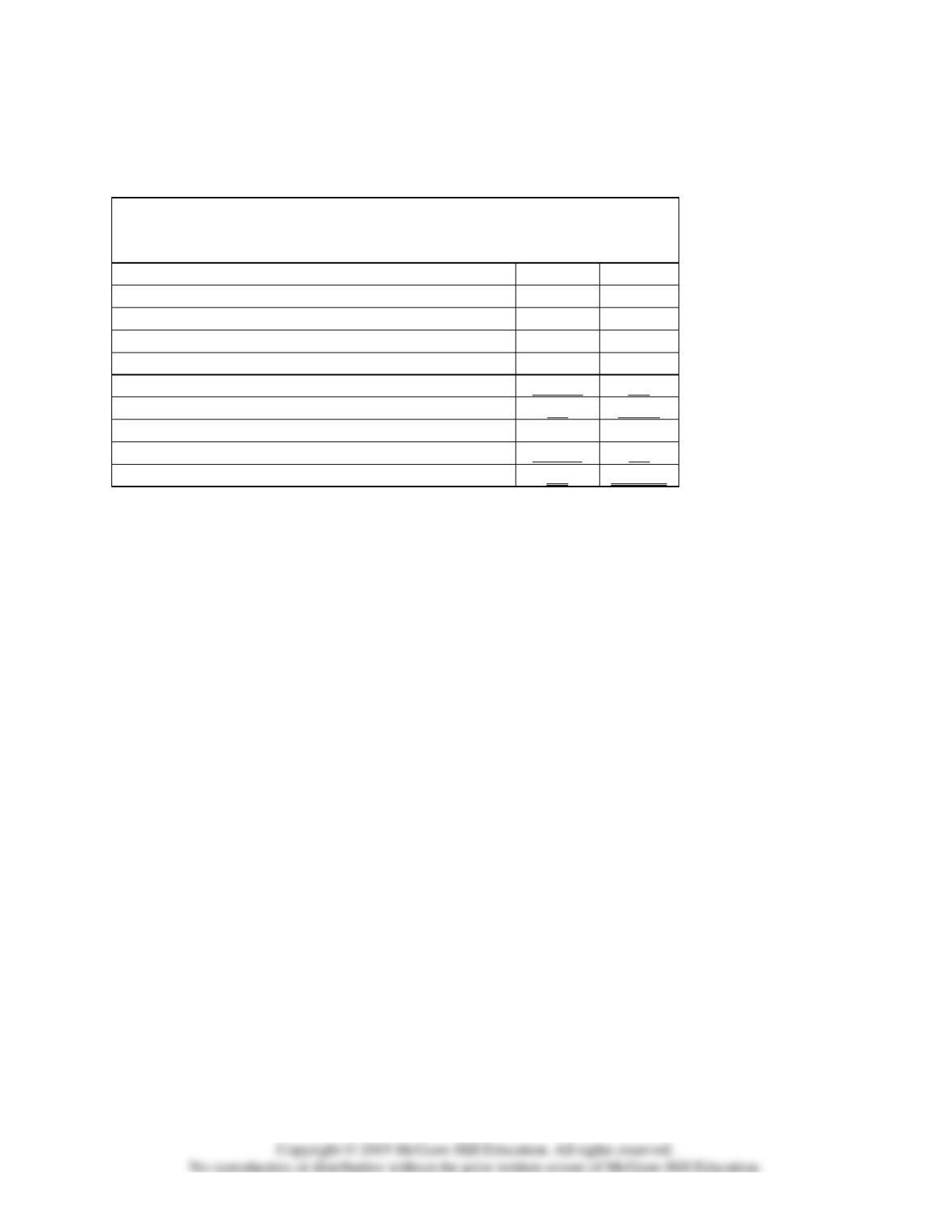
203) Fill in the blanks (a) through (g) for the Corman Company for each of the income
statements for years 1 and 2
Corman Company
Income Statements
For the years ended December 31
Year 1
Year 2
Sales
$10,000
(e)
Cost of goods sold
Merchandise inventory (beginning)
375
750
Total cost of merchandise purchases
3,625
4,875
Merchandise inventory (ending)
750
(d)
Cost of goods sold
(a)
5,000
Gross profit
6,750
5,200
Operating expenses
3,750
(c)
Net income
(b)
$ 2,500