75) Either the gross method or net method may be used to record sales with cash discounts, but
the net method requires a period-end adjusting entry to estimate expected future sales discounts
taken.
76) Under the net method of recording purchases, the Discounts Lost account is used when the
purchaser fails to take a discount offered by the seller.
77) A merchandiser:
A) Earns net income by buying and selling merchandise.
B) Receives fees only in exchange for services.
C) Earns profit from commissions only.
D) Earns profit from fares only.
E) Buys products from consumers.
78) Cost of goods sold:
A) Is another term for merchandise sales.
B) Is the term used for the expense of buying and preparing merchandise for sale.
C) Is another term for revenue.
D) Is also called gross margin.
E) Is a term only used by service firms.
79) A company has sales of $695,000 and cost of goods sold of $278,000. Its gross profit equals:
A) $(417,000).
B) $695,000.
C) $278,000.
D) $417,000.
E) $973,000.
80) A company has sales of $375,000 and its gross profit is $157,500. Its cost of goods sold
equals:
A) $(217,000).
B) $375,000.
C) $157,500.
D) $217,500.
E) $532,500.
81) Which of the following statements regarding gross profit is not true?
A) Gross profit is also called gross margin.
B) Gross profit less other operating expenses equals income from operations.
C) Gross profit is not calculated on the multiple-step income statement.
D) Gross profit must cover all operating expenses to yield a return for the owner(s) of the
business.
E) Gross profit equals net sales less cost of goods sold.
82) Which of the following statements regarding merchandise inventory is not true?
A) Merchandise inventory is reported on the balance sheet as a current asset.
B) Merchandise inventory refers to products a company owns and intends to sell.
C) Merchandise inventory may include the costs of freight-in and making them ready for sale.
D) Merchandise inventory appears on the balance sheet of a service company.
E) Purchasing merchandise inventory is part of the operating cycle for a business.
83) Which of the following statements regarding the operating cycle of a merchandising
company is not true?
A) The operating cycle begins with the purchase of merchandise.
B) The operating cycle is shortened by credit sales.
C) The operating cycle ends with the collection of cash from the sale of merchandise.
D) The operating cycle can vary in length among different merchandising companies.
E) The operating cycle sometimes involves accounts receivable.
84) Merchandise inventory:
A) Is a long-term asset.
B) Is a current asset.
C) Includes supplies the company will use in future periods.
D) Is classified with investments on the balance sheet.
E) Must be sold within one month.
85) The operating cycle for a merchandiser that sells only for cash moves from:
A) Purchases of merchandise to inventory to cash sales.
B) Purchases of merchandise to inventory to accounts receivable to cash sales.
C) Inventory to purchases of merchandise to cash sales.
D) Accounts receivable to purchases of merchandise to inventory to cash sales.
E) Accounts receivable to inventory to cash sales.
86) The current period’s ending inventory is:
A) The next period’s beginning inventory.
B) The current period’s cost of goods sold.
C) The prior period’s beginning inventory.
D) The current period’s net purchases.
E) The current period’s beginning inventory.
87) Beginning inventory plus net purchases is:
A) Cost of goods sold.
B) Merchandise (goods) available for sale.
C) Ending inventory.
D) Sales.
E) Shown on the balance sheet.
88) The acid-test ratio:
A) Is also called the quick ratio.
B) Measures profitability.
C) Measures inventory turnover.
D) Is generally greater than the current ratio.
E) Measures return on assets.
89) Quick assets are defined as:
A) Cash, short-term investments, and inventory.
B) Cash, short-term investments, and current receivables.
C) Cash, inventory, and current receivables.
D) Cash, noncurrent receivables, and prepaid expenses.
E) Accounts receivable, inventory, and prepaid expenses.
90) KLM Corporation’s quick assets are $5,888,000, its current assets are $11,700,000 and its
current liabilities are $8,000,000. Its acid-test ratio equals:
A) 0.50.
B) 0.68.
C) 0.74.
D) 1.50.
E) 2.20.
91) A company’s current assets are $17,980, its quick assets are $11,420 and its current liabilities
are $12,190. Its quick ratio equals:
A) 0.94.
B) 1.07.
C) 1.48.
D) 1.57.
E) 2.40.
92) Liquidity problems are likely to exist when a company’s acid-test ratio:
A) Is less than the current ratio.
B) Equals 1.
C) Is higher than 1.
D) Is substantially lower than 1.
E) Is higher than the current ratio.
93) The acid-test ratio differs from the current ratio in that:
A) Liabilities are divided by current assets.
B) Prepaid expenses and inventory are excluded from the calculation of the acid-test ratio.
C) The acid-test ratio measures profitability and the current ratio does not.
D) The acid-test ratio excludes short-term investments from the calculation.
E) The acid-test ratio is a measure of liquidity but the current ratio is not.
94) Using the following year-end information for Calvin’s Clothing, calculate the current ratio
and acid-test ratio for the business:
Cash
$
52,000
Short-term investments
12,000
Accounts receivable
54,000
Inventory
325,000
Prepaid expenses
17,500
Accounts payable
106,500
Other current payables
25,000
A) 1.80 and 1.00
B) 1.97 and 1.52
C) 2.73 and 1.52
D) 3.50 and 0.90
E) 1.80 and 0.90
95) The gross margin ratio:
A) Is also called the net profit ratio.
B) Indicates the percent of sales revenue remaining after covering the cost of the goods sold.
C) Is also called the profit margin.
D) Is a measure of liquidity and should exceed 2.0 to be acceptable.
E) Should be greater than 1 for merchandising companies.
96) A company’s gross profit (or gross margin) was $83,750 and its net sales were $347,800. Its
gross margin ratio is:
A) 4.2%.
B) 24.1%.
C) 75.9%.
D) $83,750.
E) $264,050.
97) A company’s net sales were $676,600, its cost of goods sold was $236,810 and its net income
was $33,750. Its gross margin ratio equals:
A) 5%.
B) 9.6%.
C) 35%.
D) 65%.
E) 285.7%.
98) A company had net sales of $752,000 and cost of goods sold of $543,000. Its net income was
$17,530. The company’s gross margin ratio equals:
A) 18.9%
B) 24.5%
C) 27.8%
D) 34.7%
E) 35.2%
99) Mega Skateboard Supplier had net sales of $2.8 million, its cost of goods sold was $1.6
million, and its net income was $0.9 million. Its gross margin ratio equals:
A) 32%.
B) 175%.
C) 43%.
D) 57%.
E) 56%.
100) The credit terms 2/10, n/30 are interpreted as:
A) 2% cash discount if the amount is paid within 10 days, or the balance due in 30 days.
B) 10% cash discount if the amount is paid within 2 days, or the balance due in 30 days.
C) 30% discount if paid within 2 days.
D) 30% discount if paid within 10 days.
E) 2% discount if paid within 30 days.
101) A trade discount is:
A) A term used by a purchaser to describe a cash discount given to customers for prompt
payment.
B) A reduction in selling price below the list price.
C) A term used by a seller to describe a cash discount granted to customers for prompt payment.
D) A reduction in price for prompt payment.
E) Also called a rebate.
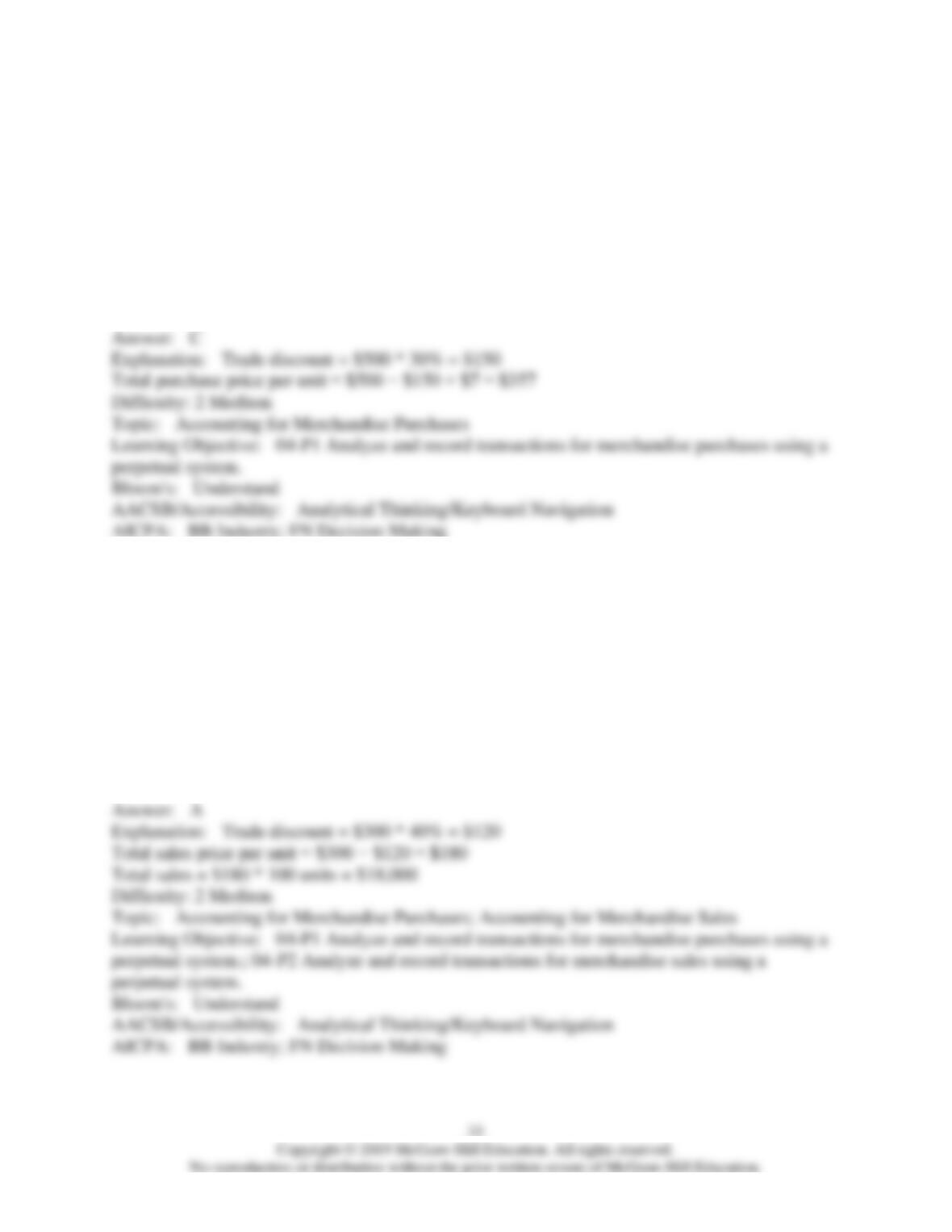
102) Jasper Company is a wholesaler that buys merchandise in large quantities. Its supplier’s
catalog indicates a list price of $500 per unit on merchandise Jasper intends to purchase, and
offers a 30% trade discount for large quantity purchases. The cost of shipping for the
merchandise is $7 per unit. Jasper’s total purchase price per unit will be:
A) $507.
B) $350.
C) $357.
D) $343.
E) $493.
103) Fragment Company is a wholesaler that sells merchandise in large quantities. Its catalog
indicates a list price of $300 per unit on a particular product and a 40% trade discount is offered
for quantity purchases of 50 units or more. The cost of shipping the merchandise is $7 per unit
under terms FOB shipping point. If a customer purchases 100 units of this product, what is the
amount of sales revenue that Fragment will record from this sale?
A) $18,000
B) $30,000
C) $18,700
D) $29,300
E) $30,700
104) The amount recorded for merchandise inventory includes all of the following except:
A) Purchase discounts.
B) Returns and allowances.
C) Freight costs paid by the buyer.
D) Freight costs paid by the seller.
E) Trade discounts.
105) A company uses the perpetual inventory system and recorded the following entry:
Accounts Payable
2,500
Merchandise Inventory
50
Cash
2,450
This entry reflects a:
A) Purchase of merchandise on credit.
B) Return of merchandise.
C) Sale of merchandise on credit.
D) Payment of the account payable less a 2% cash discount taken.
E) Payment of the account payable less a 1% cash discount taken.
106) Which of the following is not included on a purchase invoice?
A) Seller’s name and address.
B) Name and address of the purchaser.
C) Description of items purchased.
D) Arrival date of items ordered.
E) Credit terms.
107) A company purchased $1,800 of merchandise on July 5 with terms 2/10, n/30. On July 7, it
returned $200 worth of merchandise. On July 8, it paid the full amount due. The amount of the
cash paid on July 8 equals:
A) $200.
B) $1,564.
C) $1,568.
D) $1,600.
E) $1,800.
108) A company purchased $1,800 of merchandise on July 5 with terms 2/10, n/30. On July 7, it
returned $200 worth of merchandise. On July 28, it paid the full amount due. The amount of the
cash paid on July 28 equals:
A) $200.
B) $1,564.
C) $1,568.
D) $1,600.
E) $1,800.
109) A company purchased $1,800 of merchandise on July 5 with terms 2/10, n/30. On July 7, it
returned $200 worth of merchandise. On July 28, it paid the full amount due. Assuming the
company uses a perpetual inventory system, and records purchases using the gross method, The
correct journal entry to record the purchase on July 5 is:
A) Debit Merchandise Inventory $1,600; credit Cash $1,600.
B) Debit Merchandise Inventory $1,800; credit Accounts Payable $1,800.
C) Debit Merchandise Inventory $1,800; credit Sales Returns $200; credit Cash $1,600.
D) Debit Accounts Payable $1,800; credit Merchandise Inventory $1,800.
E) Debit Accounts Payable $1,800; credit Purchase Returns $200; credit Merchandise Inventory
$1,600.
110) A company purchased $1,800 of merchandise on July 5 with terms 2/10, n/30. On July 7, it
returned $200 worth of merchandise. On July 28, it paid the full amount due. Assuming the
company uses a perpetual inventory system, and records purchases using the gross method, the
correct journal entry to record the merchandise return on July 7 is:
A) Debit Merchandise Inventory $1,600; credit Cash $1,600.
B) Debit Merchandise Inventory $200; credit Accounts Payable $200.
C) Debit Merchandise Inventory $200; credit Sales Returns $200.
D) Debit Accounts Payable $200; credit Merchandise Inventory $200.
E) Debit Accounts Payable $1,800; credit Purchase Returns $200; credit Merchandise Inventory
$1,600.
111) A company purchased $1,800 of merchandise on July 5 with terms 2/10, n/30. On July 7, it
returned $200 worth of merchandise. On July 28, it paid the full amount due. Assuming the
company uses a perpetual inventory system, and records purchases using the gross method, the
correct journal entry to record the payment on July 28 is:
A) Debit Merchandise Inventory $1,600; credit Cash $1,600.
B) Debit Cash $1,600; credit Accounts Payable $1,600.
C) Debit Accounts Payable $1,600; credit Merchandise Inventory $32; credit Cash $1,568.
D) Debit Accounts Payable $1,800; credit Cash $1,800.
E) Debit Accounts Payable $1,600; credit Cash $1,600.
112) A company purchased $1,800 of merchandise on July 5 with terms 2/10, n/30. On July 7, it
returned $200 worth of merchandise. On July 12, it paid the full amount due. Assuming the
company uses a perpetual inventory system, and records purchases using the gross method, the
correct journal entry to record the payment on July 12 is:
A) Debit Merchandise Inventory $1,600; credit Cash $1,600.
B) Debit Cash $1,600; credit Accounts Payable $1,600.
C) Debit Accounts Payable $1,600; credit Merchandise Inventory $32; credit Cash $1,568.
D) Debit Accounts Payable $1,800; credit Cash $1,800.
E) Debit Accounts Payable $1,600; credit Cash $1,600.
113) A company purchased $4,000 worth of merchandise. Transportation costs were an
additional $350. The company returned $275 worth of merchandise and then paid the invoice
within the 2% cash discount period. The total cost of this merchandise is:
A) $3,725.00.
B) $3,925.00.
C) $3,995.00.
D) $4,000.50.
E) $4,075.00.
114) A buyer of $7,000 in merchandise inventory failed to take advantage of the vendor’s credit
terms of 2/15, n/45, and instead paid the invoice in full at the end of 45 days. By not taking
advantage of the cash discount, the buyer lost the discount of:
A) $70.
B) $1,050.
C) $700.
D) $100.
E) $140.
115) Sales returns:
A) Refer to merchandise that customers return to the seller after the sale.
B) Refer to reductions in the selling price of merchandise sold to customers.
C) Represent cash discounts.
D) Represent trade discounts.
E) Are not recorded under the perpetual inventory system until the end of each accounting
period.
116) Which of the following statements regarding sales returns and allowances is not true?
A) A reduction in the selling price because of damaged merchandise is included in sales returns
and allowances.
B) Sales returns and allowances do not have an impact on gross profit.
C) Sales returns and allowances are recorded in a separate contra-revenue account.
D) Sales returns and allowances are rarely disclosed in published financial statements.
E) Sales returns and allowances are closed to the Income Summary account.
117) A debit to Sales Returns and Allowances and a credit to Accounts Receivable:
A) Reflects an increase in amount due from a customer.
B) Recognizes that a customer returned merchandise and/or received an allowance.
C) Records the cost side of a sales return.
D) Is recorded when a customer takes a discount.
E) Reflects a decrease in amount due to a supplier.