118) Sales less sales discounts, less sales returns and allowances equals:
A) Net purchases.
B) Cost of goods sold.
C) Net sales.
D) Gross profit.
E) Net income.
119) Garza Company had sales of $135,000, sales discounts of $2,000, and sales returns of
$3,200. Garza Company’s net sales equals:
A) $5,200.
B) $129,800.
C) $133,000.
D) $135,000.
E) $140,200.
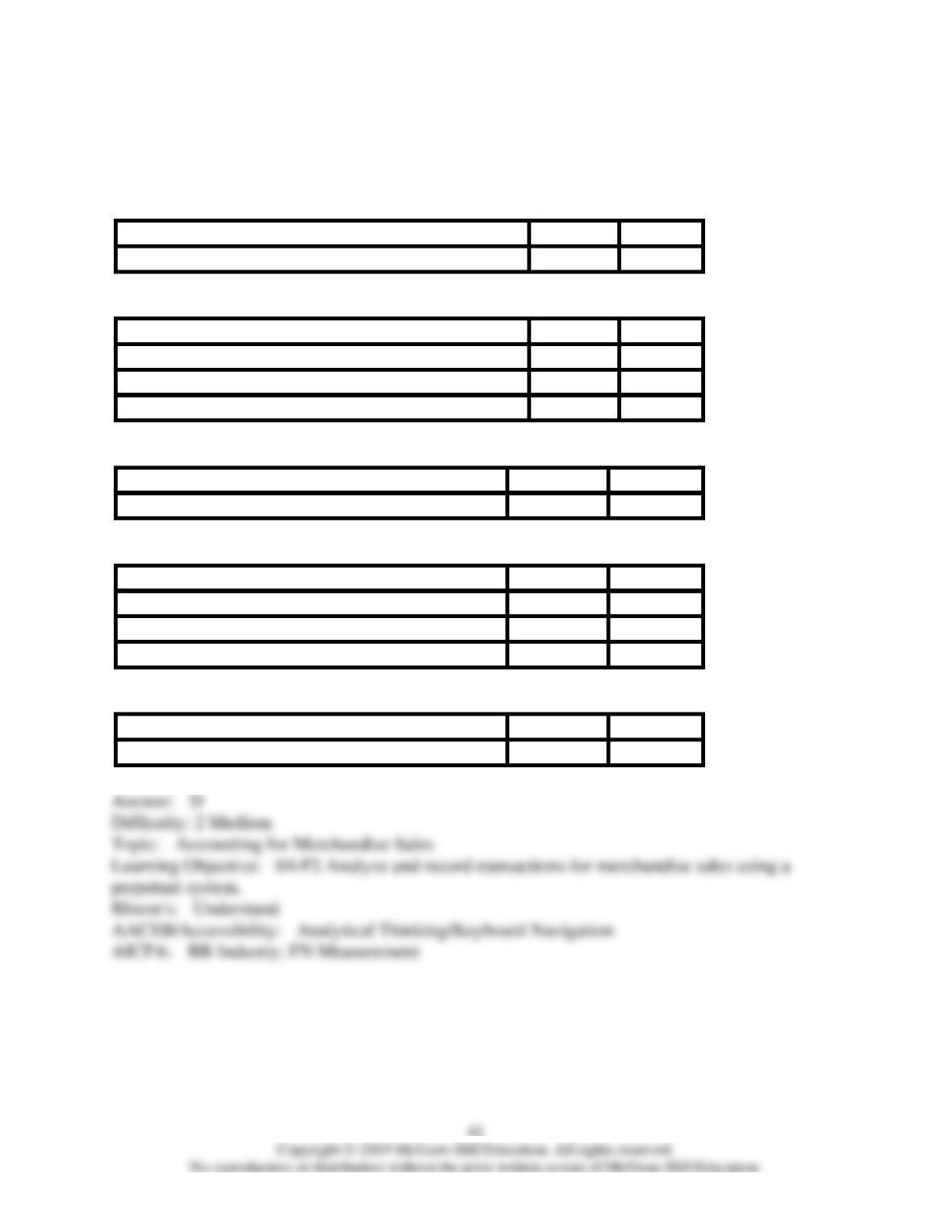
120) On May 1, Shilling Company sold merchandise in the amount of $5,800 to Anders, with
credit terms of 2/10, n/30. The cost of the items sold is $4,000. Shilling uses the perpetual
inventory system and the gross method. The journal entry or entries that Shilling will make on
May 1 is (are):
A)
Sales
5,800
Accounts receivable
5,800
B)
Sales
5,800
Accounts receivable
5,800
Cost of goods sold
4,000
Merchandise Inventory
4,000
C)
Accounts receivable
5,800
Sales
5,800
D)
Accounts receivable
5,800
Sales
5,800
Cost of goods sold
4,000
Merchandise Inventory
4,000
E)
Accounts receivable
4,000
Sales
4,000
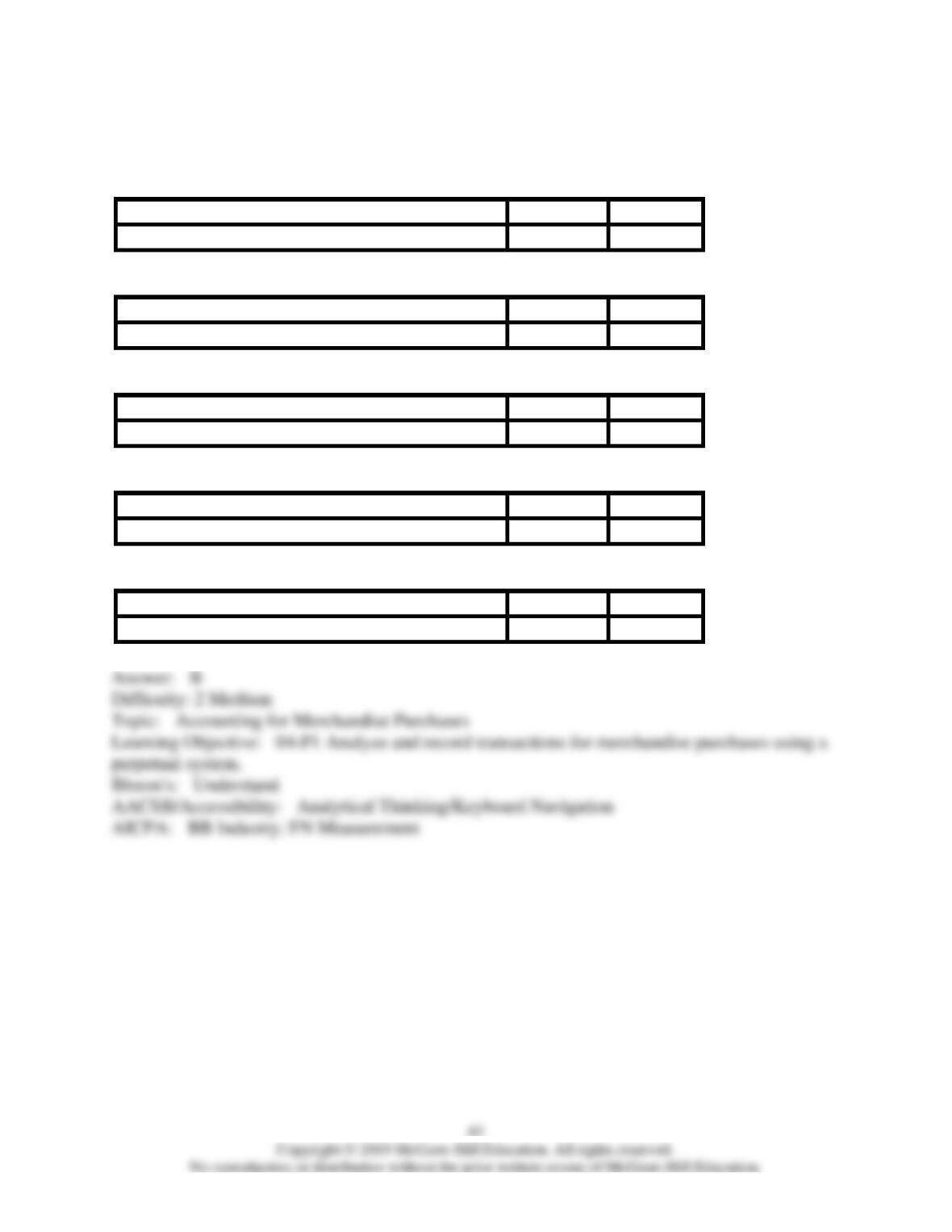
121) On May 1, Anders Company purchased merchandise in the amount of $5,800 from Shilling,
with credit terms of 2/10, n/30. Anders uses the perpetual inventory system and the gross
method. The journal entry that Anders will make on May 1 is:
A)
Sales
5,800
Accounts receivable
5,800
B)
Merchandise Inventory
5,800
Accounts payable
5,800
C)
Accounts payable
5,800
Sales
5,800
D)
Merchandise Inventory
5,800
Cash
5,800
E)
Purchases
5,800
Accounts payable
5,800
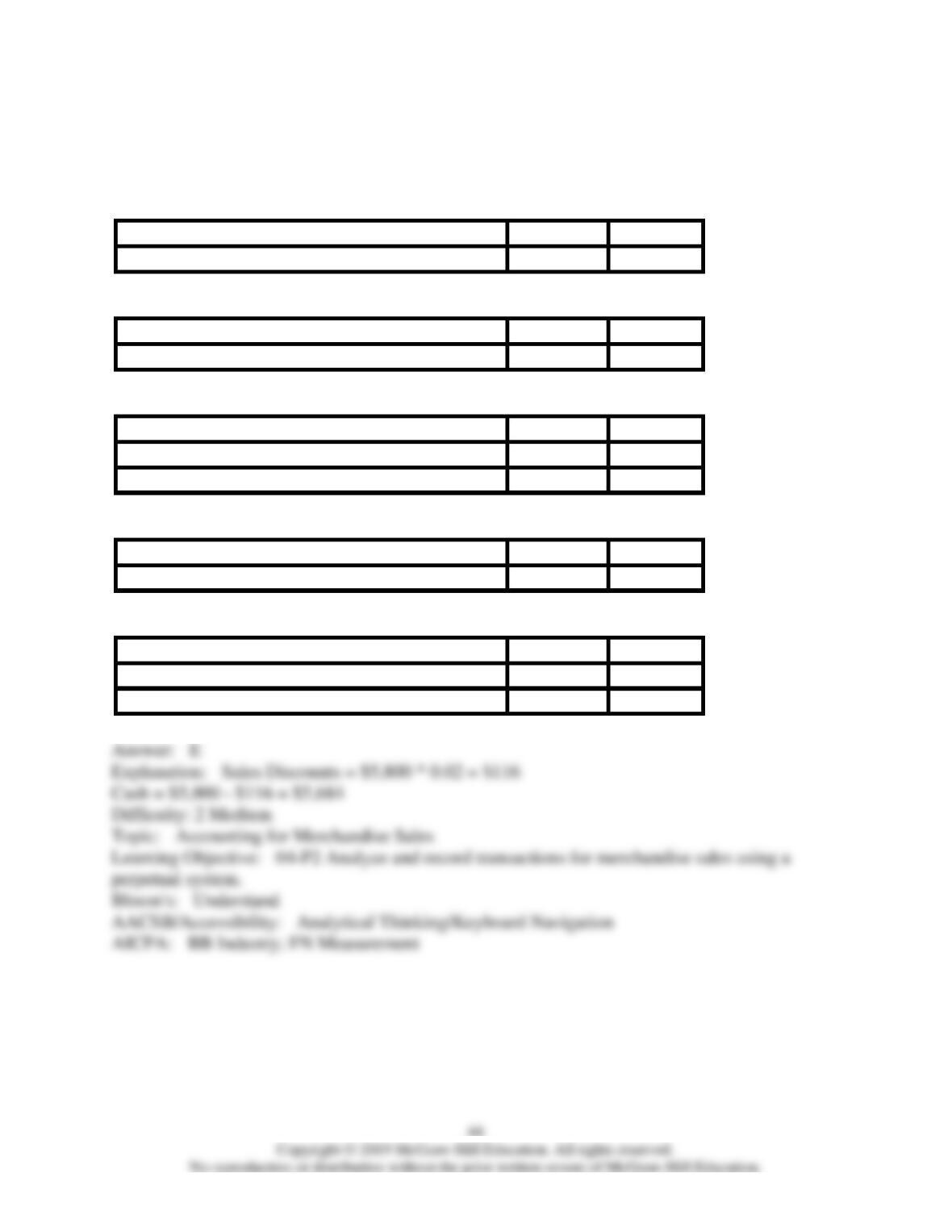
122) On February 3, Smart Company sold merchandise in the amount of $5,800 to Truman
Company, with credit terms of 2/10, n/30. The cost of the items sold is $4,000. Smart uses the
perpetual inventory system and the gross method. Truman pays the invoice on February 8, and
takes the appropriate discount. The journal entry that Smart makes on February 8 is:
A)
Cash
5,800
Accounts receivable
5,800
B)
Cash
4,000
Accounts receivable
4,000
C)
Cash
3,920
Sales discounts
80
Accounts receivable
4,000
D)
Cash
5,684
Accounts receivable
5,684
E)
Cash
5,684
Sales discounts
116
Accounts receivable
5,800
123) On July 1, Ferguson Company sold merchandise in the amount of $5,800 to Tracey
Company, with credit terms of 2/10, n/30. The cost of the items sold is $4,000. Ferguson uses the
perpetual inventory system and the gross method. On July 5, Tracey returns some of the
merchandise. The selling price of the merchandise is $500 and the cost of the merchandise
returned is $350. The entry or entries that Ferguson must make on July 5 is (are):
A)
Sales returns and allowances
500
Accounts receivable
500
Merchandise inventory
350
Cost of goods sold
350
B)
Sales returns and allowances
500
Accounts receivable
500
C)
Accounts receivable
500
Sales returns and allowances
500
D)
Accounts receivable
500
Sales returns and allowances
500
Cost of goods sold
350
Merchandise inventory
350
E)
Sales returns and allowances
350
Accounts receivable
350
124) Juniper Company uses a perpetual inventory system and the gross method of accounting for
purchases. The company purchased $9,750 of merchandise on August 7 with terms 1/10, n/30.
On August 11, it returned $1,500 worth of merchandise. On August 16, it paid the full amount
due. The amount of the cash paid on August 16 equals:
A) $8,167.50.
B) $9,652.50.
C) $9,750.00.
D) $8,250.00.
E) $8,152.50.
125) Juniper Company uses a perpetual inventory system and the gross method of accounting for
purchases. The company purchased $9,750 of merchandise on August 7 with terms 1/10, n/30.
On August 11, it returned $1,500 worth of merchandise. On August 26, it paid the full amount
due. The amount of the cash paid on August 26 equals:
A) $8,167.50.
B) $9,652.50.
C) $9,750.00.
D) $8,250.00.
E) $8,152.50.
126) Juniper Company uses a perpetual inventory system and the gross method of accounting for
purchases. The company purchased $9,750 of merchandise on August 7 with terms 1/10, n/30.
On August 11, it returned $1,500 worth of merchandise. On August 16, it paid the full amount
due. The correct journal entry to record the purchase on August 7 is:
A) Debit Merchandise Inventory $9,750; credit Cash $9,750.
B) Debit Accounts Payable $9,750; credit Merchandise Inventory $9,750.
C) Debit Merchandise Inventory $9,750; credit Sales Returns $1,500; credit Cash $8,250.
D) Debit Merchandise Inventory $9,750; credit Accounts Payable $9,750.
E) Debit Accounts Payable $8,250; debit Purchase Returns $1,500; credit Merchandise Inventory
$9,750.
127) Juniper Company uses a perpetual inventory system and the gross method of accounting for
purchases. The company purchased $9,750 of merchandise on August 7 with terms 1/10, n/30.
On August 11, it returned $1,500 worth of merchandise. On August 26, it paid the full amount
due. The correct journal entry to record the merchandise return on August 11 is:
A) Debit Accounts Payable $1,500; credit Cash $1,500.
B) Debit Accounts Payable $1,500; credit Merchandise Inventory $1,500.
C) Debit Merchandise Inventory $1,500; credit Sales Returns $1,500.
D) Debit Merchandise Inventory $1,500; credit Cash $1,500.
E) Debit Accounts Payable $1,500; credit Purchase Returns $1,500.
128) Juniper Company uses a perpetual inventory system and the gross method of accounting for
purchases. The company purchased $9,750 of merchandise on August 7 with terms 1/10, n/30.
On August 11, it returned $1,500 worth of merchandise. On August 16, it paid the full amount
due. The correct journal entry to record the payment on August 16 is:
A) Debit Merchandise Inventory $8,250; credit Cash $8,250.
B) Debit Cash $8,250; credit Accounts Payable $8,250.
C) Debit Accounts Payable $8,250; credit Merchandise Inventory $82.50; credit Cash $8,167.50.
D) Debit Accounts Payable $9,750; credit Merchandise Inventory $97.50; credit Cash $9,652.50.
E) Debit Accounts Payable $8,167.50; credit Cash $8,167.50.
129) A company records the following journal entry: debit Cash $1,470, debit Sales Discounts
$30, and credit Accounts Receivable $1,500. This means that a customer has taken what
percentage cash discount for early payment?
A) 1%
B) 2%
C) 5%
D) 10%
E) 15%
130) Which of the following statements regarding inventory shrinkage is not true?
A) Inventory shrinkage refers to the loss of inventory.
B) Inventory shrinkage is determined by comparing a physical count of inventory with recorded
inventory amounts.
C) Inventory shrinkage is recognized by debiting an operating expense.
D) Inventory shrinkage is recognized by debiting Cost of Goods Sold.
E) Inventory shrinkage can be caused by theft or deterioration.
131) Frisco Company’s Merchandise Inventory account at year-end has a balance of $62,115, but
a physical count reveals that only $61,900 of inventory exists. The adjusting entry to record this
$215 of inventory shrinkage is:
A)
Merchandise Inventory
215
Inventory shrinkage expense
215
B)
Purchases discounts
215
Cost of goods sold
215
C)
Cost of goods sold
215
Purchases discounts
215
D)
Inventory shrinkage expense
215
Cost of goods sold
215
E)
Cost of goods sold
215
Merchandise Inventory
215
132) Which of the following accounts would be closed at the end of the accounting period with a
debit?
A) Sales Discounts.
B) Sales Returns and Allowances.
C) Cost of Goods Sold.
D) Operating Expenses.
E) Sales.
133) An income statement that includes cost of goods sold as another expense and shows only
one subtotal for total expenses is a:
A) Balanced income statement.
B) Single-step income statement.
C) Multiple-step income statement.
D) Combined income statement.
E) Simplified income statement.
134) Expenses that support the overall operations of a business and include the expenses relating
to accounting, human resource management, and financial management are called:
A) Cost of goods sold.
B) Selling expenses.
C) Purchasing expenses.
D) General and administrative expenses.
E) Non-operating activities.
135) Prentice Company had cash sales of $94,275, credit sales of $83,450, sales returns and
allowances of $1,700, and sales discounts of $3,475. Prentice’s net sales for this period equal:
A) $94,275.
B) $172,550.
C) $174,250.
D) $176,025.
E) $177,725.
136) Multiple-step income statements:
A) Are required by the FASB and IASB.
B) Contain more detail than a simple listing of revenues and expenses.
C) Are required for the periodic inventory system.
D) List cost of goods sold as an operating expense.
E) Are only used in perpetual inventory systems.
137) Expenses to promote sales by displaying and advertising merchandise, make sales, and
deliver goods to customers are known as:
A) General and administrative expenses.
B) Cost of goods sold.
C) Selling expenses.
D) Purchasing expenses.
E) Non-operating activities.
138) A company has net sales of $752,000 and cost of goods sold of $543,000. Its net income is
$17,530. The company’s gross margin and operating expenses, respectively, are:
A) $209,000 and $191,470.
B) $191,470 and $209,000.
C) $525,470 and $227,000.
D) $227,000 and $525,470.
E) $734,000 and $191,470.
139) Which of the following accounts is used in the periodic inventory system but not used in
the perpetual inventory system?
A) Merchandise Inventory
B) Sales
C) Sales Returns and Allowances
D) Accounts Payable
E) Purchases
140) When preparing an unadjusted trial balance using a periodic inventory system, the amount
shown for Merchandise Inventory is:
A) The ending inventory amount.
B) The beginning inventory amount.
C) Equal to the cost of goods sold.
D) Equal to the cost of goods purchased.
E) Equal to the gross profit.
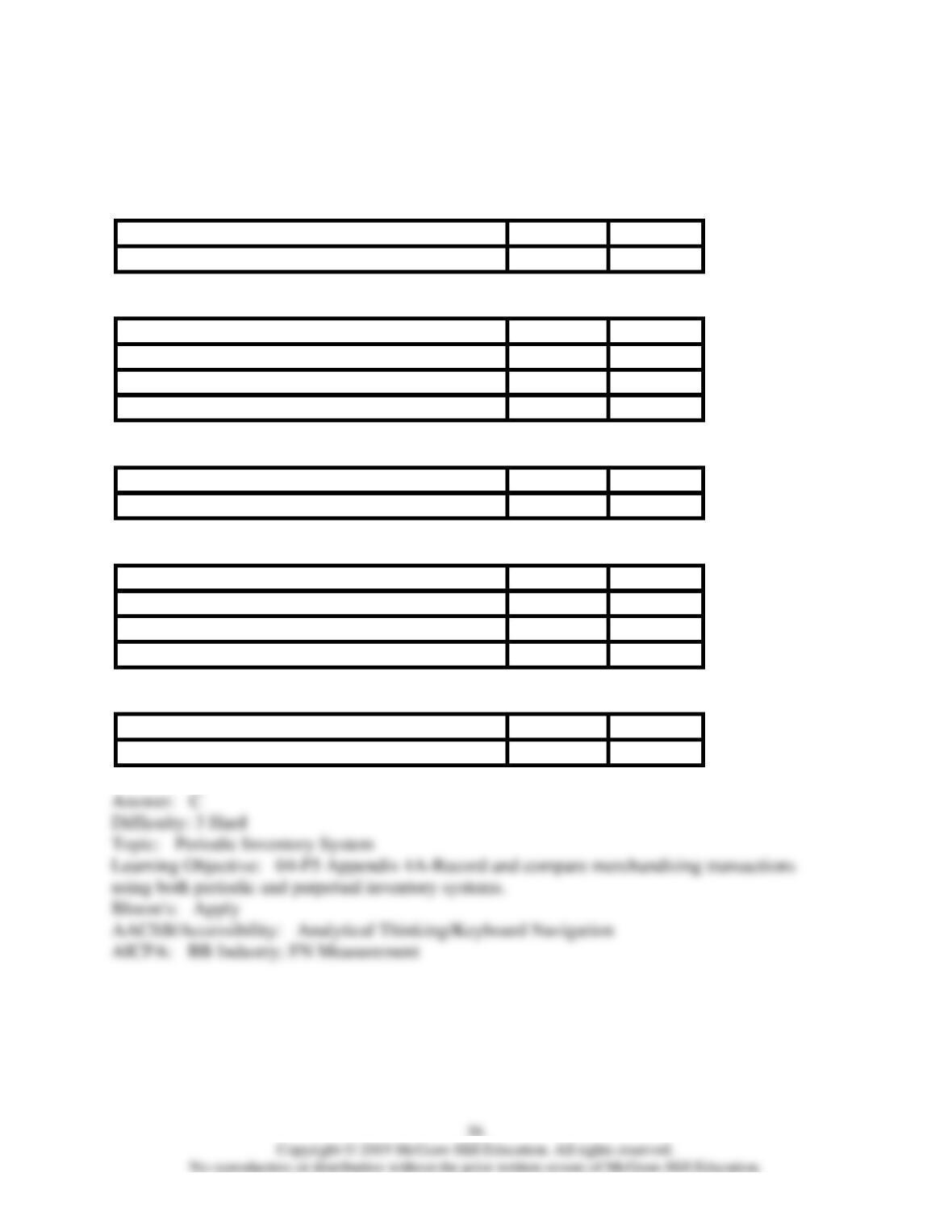
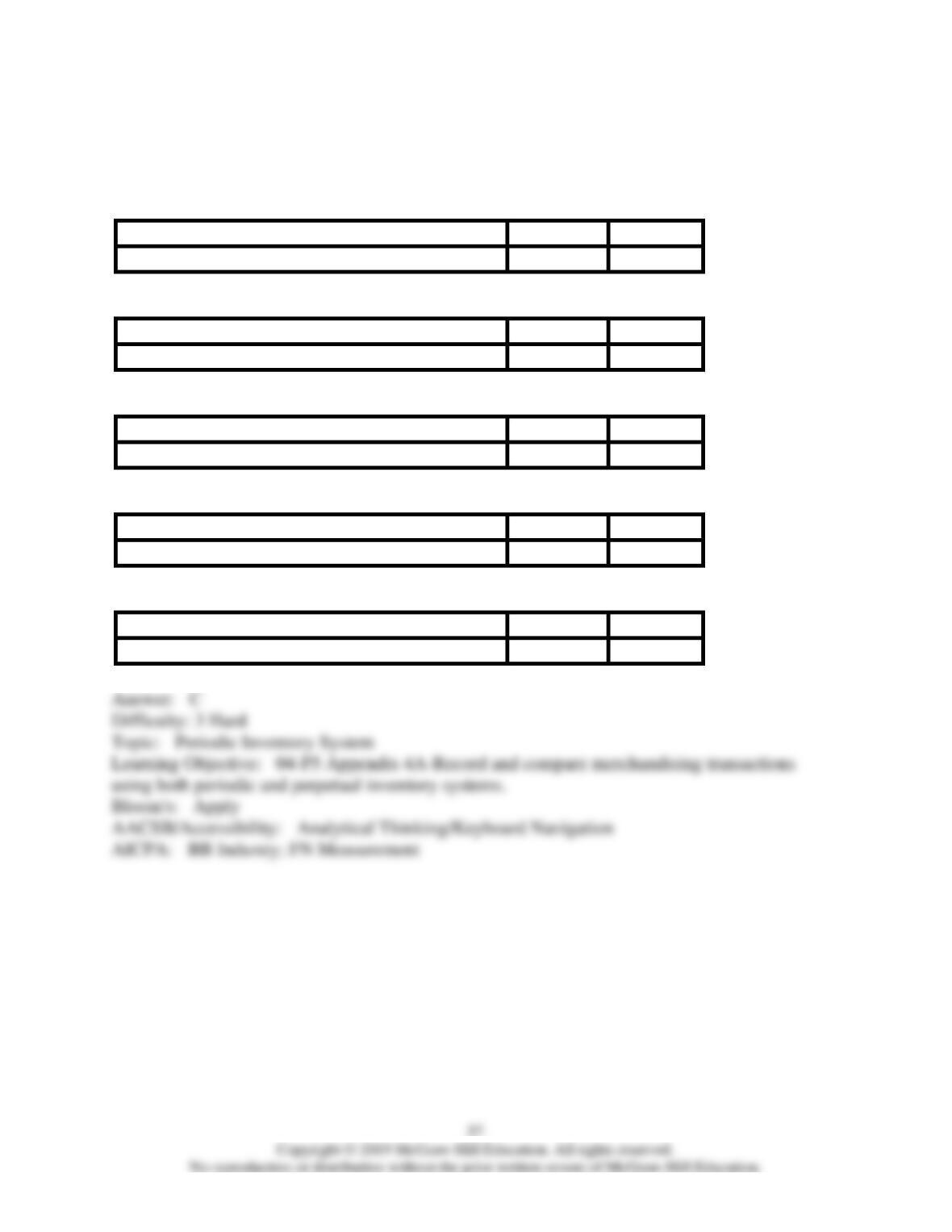
141) On September 12, Vander Company sold merchandise in the amount of $5,800 to Jepson
Company, with credit terms of 2/10, n/30. The cost of the items sold is $4,000. Vander uses the
periodic inventory system and the gross method of accounting for sales. The journal entry or
entries that Vander will make on September 12 is (are):
A)
Sales
5,800
Accounts receivable
5,800
B)
Sales
5,800
Accounts receivable
5,800
Cost of goods sold
4,000
Merchandise Inventory
4,000
C)
Accounts receivable
5,800
Sales
5,800
D)
Accounts receivable
5,800
Sales
5,800
Cost of goods sold
4,000
Merchandise Inventory
4,000
E)
Accounts receivable
4,000
Sales
4,000
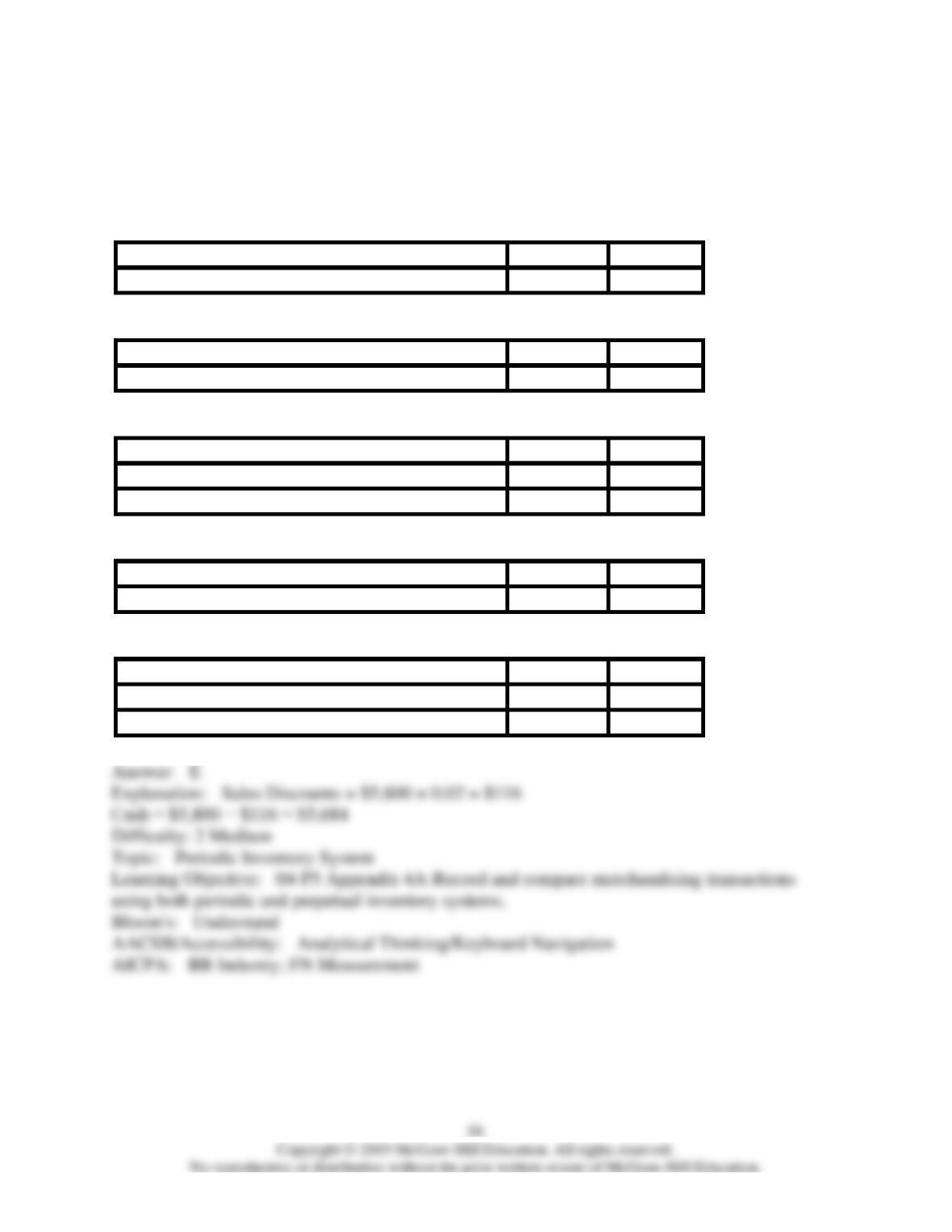
142) On September 12, Vander Company sold merchandise in the amount of $5,800 to Jepson
Company, with credit terms of 2/10, n/30. The cost of the items sold is $4,000. Jepson uses the
periodic inventory system and the gross method of accounting for purchases. The journal entry
that Jepson will make on September 12 is:
A)
Purchases
5,800
Accounts receivable
5,800
B)
Purchases
4,000
Accounts receivable
4,000
C)
Purchases
5,800
Accounts payable
5,800
D)
Merchandise inventory
5,800
Accounts payable
5,800
E)
Accounts payable
4,000
Merchandise inventory
4,000
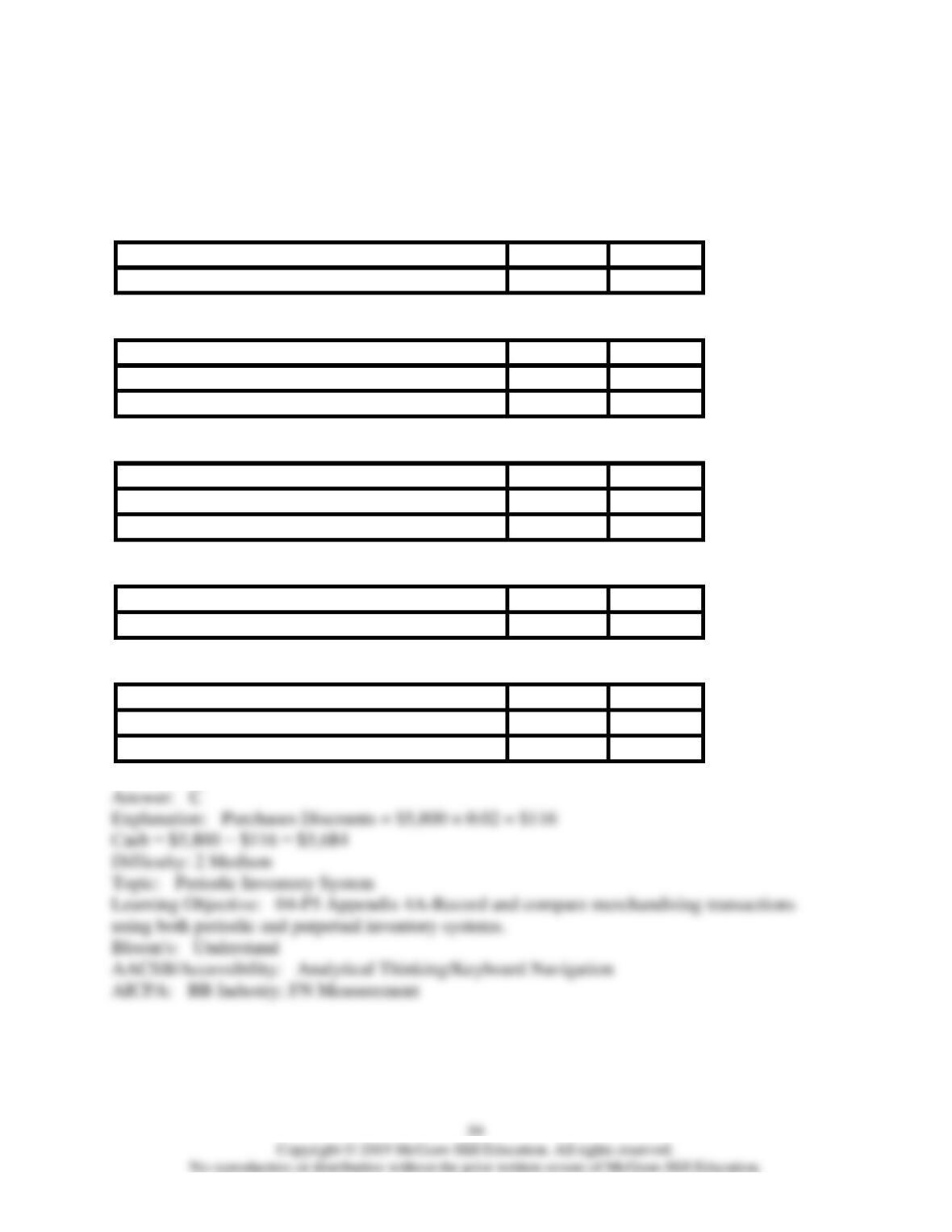
143) On September 12, Vander Company sold merchandise in the amount of $5,800 to Jepson
Company, with credit terms of 2/10, n/30. The cost of the items sold is $4,000. Vander uses the
periodic inventory system and the gross method of accounting for sales. Jepson pays the invoice
on September 18, and takes the appropriate discount. The journal entry that Vander makes on
September 18 is:
A)
Cash
5,800
Accounts receivable
5,800
B)
Cash
4,000
Accounts receivable
4,000
C)
Cash
3,920
Sales discounts
80
Accounts receivable
4,000
D)
Cash
5,684
Accounts receivable
5,684
E)
Cash
5,684
Sales discounts
116
Accounts receivable
5,800
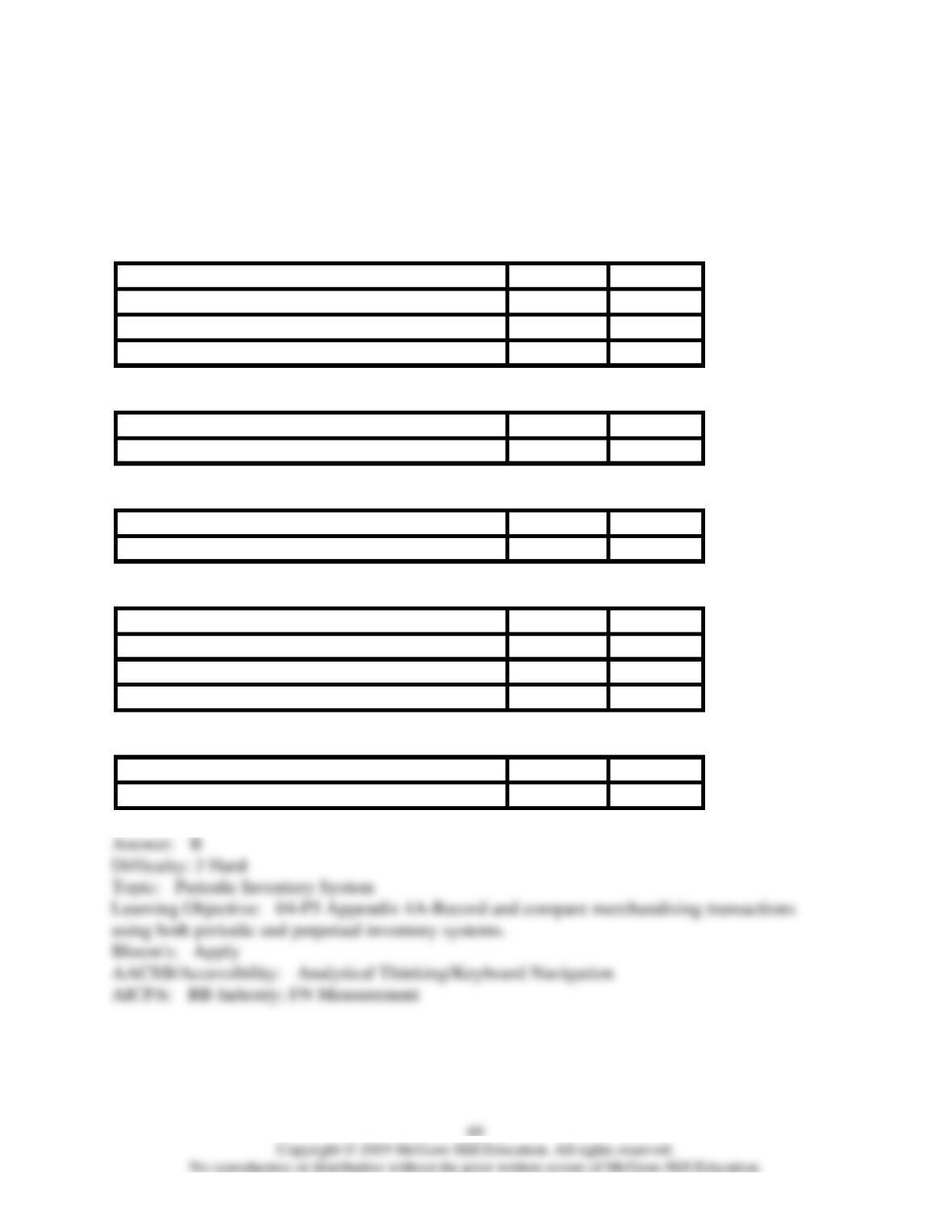
144) On September 12, Vander Company sold merchandise in the amount of $5,800 to Jepson
Company, with credit terms of 2/10, n/30. The cost of the items sold is $4,000. Jepson uses the
periodic inventory system and the gross method of accounting for purchases. Jepson pays the
invoice on September 18, and takes the appropriate discount. The journal entry that Jepson
makes on September 18 is:
A)
Purchases
5,684
Cash
5,684
B)
Accounts payable
5,800
Merchandise inventory
116
Cash
5,684
C)
Accounts payable
5,800
Purchases discounts
116
Cash
5,684
D)
Cash
5,684
Accounts receivable
5,684
E)
Cash
5,684
Purchases discounts
116
Accounts payable
5,800
145) On September 12, Vander Company sold merchandise in the amount of $5,800 to Jepson
Company, with credit terms of 2/10, n/30. The cost of the items sold is $4,000. Vander uses the
periodic inventory system and the gross method of accounting for sales. On September 14,
Jepson returns some of the non-defective merchandise, which is restored to inventory. The
selling price of the returned merchandise is $500 and the cost of the merchandise returned is
$350. The entry or entries that Vander must make on September 14 is (are):
A)
Sales returns and allowances
500
Accounts receivable
500
Merchandise inventory
350
Cost of goods sold
350
B)
Sales returns and allowances
500
Accounts receivable
500
C)
Accounts receivable
500
Sales returns and allowances
500
D)
Accounts receivable
500
Sales returns and allowances
500
Cost of goods sold
350
Merchandise inventory
350
E)
Sales returns and allowances
350
Accounts receivable
350