57) On May 1, Foxtrot Co. agreed to sell the assets of its Footwear Division to Albanese Inc. for
$80 million. The sale was completed on December 31, 2018.
The following additional facts pertain to the transaction:
• The Footwear Division qualifies as a component of the entity according to GAAP
regarding discontinued operations.
• The book value of Footwear’s assets totaled $48 million on the date of the sale.
• Footwear’s operating income was a pre-tax loss of $10 million in 2018.
• Foxtrot’s income tax rate is 40%.
Suppose that the Footwear Division’s assets had not been sold by December 31, 2018, but were
considered held for sale. Assume that the fair value of these assets was $40 million at December
31, 2018. In the income statement for the year ended December 31, 2018, Foxtrot Co. would
report discontinued operations of a:
A) $3 million loss.
B) $10 million loss.
C) $10.8 million loss.
D) $18 million loss.
58) On May 1, Foxtrot Co. agreed to sell the assets of its Footwear Division to Albanese Inc. for
$80 million. The sale was completed on December 31, 2018.
The following additional facts pertain to the transaction:
• The Footwear Division qualifies as a component of the entity according to GAAP
regarding discontinued operations.
• The book value of Footwear’s assets totaled $48 million on the date of the sale.
• Footwear’s operating income was a pre-tax loss of $10 million in 2018.
• Foxtrot’s income tax rate is 40%.
Suppose that the Footwear Division’s assets had not been sold by December 31, 2018, but were
considered held for sale. Assume that the fair value of these assets was $80 million at December
31, 2018. In the income statement for the year ended December 31, 2018, Foxtrot Co., would
report discontinued operations of a:
A) $6 million loss.
B) $10 million loss.
C) $13.2 million income.
D) None of these answer choices are correct.
59) Major Co. reported 2018 income of $300,000 from continuing operations before income
taxes and a before-tax loss on discontinued operations of $80,000. All income is subject to a 30%
tax rate. In the income statement for the year ended December 31, 2018, Major Co. would show
the following line-item amounts for income tax expense and net income:
A) $66,000 and $210,000 respectively.
B) $90,000 and $154,000 respectively.
C) $90,000 and $276,000 respectively.
D) $66,000 and $220,000 respectively.
60) Howard Co.’s 2018 income from continuing operations before income taxes was $280,000.
Howard Co. reported before-tax income on discontinued operations of $50,000. All tax items are
subject to a 40% tax rate. In its income statement for 2018, Howard Co. would show the
following line-item amounts for income tax expense and net income:
A) $112,000 and $198,000 respectively.
B) $92,000 and $230,000 respectively.
C) $132,000 and $330,000 respectively.
D) $79,000 and $198,000 respectively.
Income from continuing operations before income taxes
$
280,000
Income from continuing operations
$
168,000
expense)
Net income
$
198,000
61) Misty Company reported the following before-tax items during the current year:
Sales revenue
$
600
Selling and administrative expenses
250
Restructuring charges
20
Loss on discontinued operations
50
Misty’s effective tax rate is 40%.
What is Misty’s income from continuing operations?
A) $198.
B) $210.
C) $330.
D) $360.
62) Misty Company reported the following before-tax items during the current year:
Sales revenue
$
600
Selling and administrative expenses
250
Restructuring charges
20
Loss on discontinued operations
50
Misty’s effective tax rate is 40%.
What is Misty’s net income for the current year?
A) $148.
B) $168.
C) $112.
D) None of these answer choices are correct.
Income from continuing operations before taxes ($600 – 250 – 20)
$
330
Income tax expense ($330 × 40%)
132
Income from continuing operations
$
198
Loss on discontinued operations (net of $20 tax benefit)
)
Net income
$
168
63) Cendant Corporation’s results for the year ended December 31, 2018, include the following
material items:
Sales revenue
$
6,200,000
Cost of goods sold
3,800,000
Selling and administrative expenses
1,300,000
Loss on sale of investments
200,000
Loss on discontinued operations
500,000
Loss on impairment from continuing operations
80,000
Cendant Corporation’s income from continuing operations before income taxes for 2018 is:
A) $900,000.
B) $880,000.
C) $820,000
D) $320,000.
64) A change in accounting principle that is implemented using the retrospective approach
includes:
A) implementing the change in the current period only and not adjusting for the cumulative
effects on prior periods.
B) applying the new standard to the adoption period only and recording the cumulative
adjustment for prior periods to the beginning balance of retained earnings.
C) restating financial statements of all periods presented as if the new standard had been used in
those periods.
D) not accounting for the change in the current period or prior periods.
65) A change in accounting principle that is implemented using the modified retrospective
approach includes:
A) implementing the change in the current period only and not adjusting for the cumulative
effects on prior periods.
B) applying the new standard to the adoption period only, and recording the cumulative
adjustment for prior periods to the current period’s beginning balance of retained earnings.
C) restating financial statements of all periods presented as if the new standard had been used in
those periods.
D) not accounting for the change in the current period or prior periods.
66) Changes in estimates are accounted for using which approach?
A) Prospective.
B) Retrospective.
C) Modified retrospective.
D) Modified prospective.
67) When a material error is discovered in prior financial statements:
A) prior financial statements are restated to their correct amounts.
B) assets and liabilities in the current period are restated to their appropriate levels.
C) prior income effects are adjusted to the current period’s beginning balance of retained
earnings.
D) all of these answer choices are correct.
68) Which of the following is not true about EPS?
A) It must be reported by all corporations whose stock is publicly traded.
B) It must be reported separately for discontinued operations.
C) It must be reported on operating income.
D) None of these answer choices are correct.
69) The Maytag Corporation’s income statement includes income from continuing operations and
a loss on discontinued operations. Earnings per share information would be provided for:
A) net income only.
B) income from continuing operations and net income only.
C) income from continuing operations, loss on discontinued operations, and net income only.
D) none of these answer choices are correct.
70) Each of the following would be reported as items of other comprehensive income except:
A) foreign currency translation adjustments.
B) net unrealized holding gains on investments.
C) deferred gains from derivatives.
D) gains from the sale of equipment.
71) Reporting comprehensive income can be accomplished by each of the following methods
except:
A) in the statement of shareholders’ equity.
B) a single, continuous statement of comprehensive income.
C) in two separate, but consecutive statements.
D) all of these answer choices are acceptable methods.
72) Reporting comprehensive income according to International Financial Reporting Standards
(IFRS) can be accomplished by each of the following methods except:
A) in the statement of shareholders’ equity.
B) a combined statement of income and comprehensive income.
C) in two separate statements.
D) the entity may choose either a combined statement of income and comprehensive income or
two separate statements.
73) Comprehensive income is the change in equity from:
A) Owner transactions.
B) Nonowner transactions.
C) Owner or nonowner transactions.
D) Capital transactions.
74) Reconciliation between net income and comprehensive income would include:
A) unrealized holding losses but not unrealized holding gains on investments.
B) unrealized holding gains but not unrealized holding losses on investments.
C) unrealized holding losses and unrealized holding gains on investments.
D) neither unrealized holding losses nor unrealized holding gains on investments.
75) Change statements include a:
A) retained earnings statement, balance sheet, and cash flow statement.
B) balance sheet, cash flow statement, and income statement.
C) cash flow statement, income statement, and retained earnings statement.
D) retained earnings statement, balance sheet, and income statement.
76) For the statement of cash flows, short-term Treasury bills would be included as:
A) Operating activities.
B) Investing activities.
C) Financing activities.
D) Cash equivalents.
77) In comparing the direct method with the indirect method of preparing the statement of cash
flows:
A) only operating activities are presented differently.
B) only investing activities are presented differently.
C) only financing activities are presented differently.
D) all activities are presented differently.
78) The statement of cash flows reports cash flows from the activities of:
A) operating, purchasing, and investing.
B) borrowing, paying, and investing.
C) financing, investing, and operating.
D) using, investing, and financing.
79) Operating cash flows would not include:
A) Interest received.
B) Interest paid.
C) Dividends paid.
D) Dividends received.
80) Operating cash outflows would include:
A) Purchase of investments.
B) Purchase of equipment.
C) Payment of cash dividends.
D) Purchases of inventory.
81) Cash flows from investing do not include cash flows from:
A) lending money to another corporation.
B) the sale of equipment.
C) borrowing.
D) the purchase of other corporation’s securities.
82) Cash flows from investing do not include cash flows from:
A) lending money to another corporation.
B) the purchase of equipment.
C) the sale of a building.
D) the purchase of a corporation’s own securities.
83) Cash flows from financing activities include:
A) Interest received.
B) Interest paid.
C) Dividends received.
D) Dividends paid.
84) Cash flows from investing activities do not include:
A) proceeds from issuing bonds.
B) payment for the purchase of equipment.
C) proceeds from the sale of marketable securities.
D) cash outflows from acquiring land.
85) The FASB’s stated preference for reporting operating cash flows is the:
A) Indirect method.
B) Direct method.
C) Working capital method.
D) All financial resources method.
86) In the operating activities section of the statement of cash flows, we start with net income:
A) in the direct method.
B) in the indirect method.
C) in both the direct and the indirect methods.
D) in neither the direct nor the indirect methods.
87) Which of the following is added to net income as an adjustment under the indirect method of
preparing the statement of cash flows?
A) Salaries payable decrease.
B) Gain on the sale of land.
C) Loss on the sale of equipment.
D) Accounts receivable increase.
88) Schneider Inc. had salaries payable of $60,000 and $90,000 at the end of 2017 and 2018,
respectively. During 2018, Schneider recorded $620,000 in salaries expense in its income
statement. Cash outflows for salaries in 2018 were:
A) $590,000.
B) $620,000.
C) $650,000.
D) $530,000.
89) Howard Inc. had prepaid rent of $75,000 and $80,000 at the end of 2017 and 2018,
respectively. During 2018, Howard recorded $240,000 in rent expense in its income statement.
Cash outflows for rent in 2018 were:
A) $235,000.
B) $240,000.
C) $245,000.
D) $250,000.
90) Martel Co. had supplies of $24,000 and $33,000 at the end of 2017 and 2018, respectively.
During 2018, Howard paid $128,000 for supplies. Supplies expense in the 2018 income
statement was:
A) $119,000.
B) $128,000.
C) $137,000.
D) $110,000.
91) Stinley Co. paid utilities of $134,000 during 2018. At the end of 2018, utilities payable
equals $17,000 and utilities expense equals $145,000. What was the balance of utilities payable
at the beginning of 2018?
A) $22,000.
B) $6,000.
C) $17,000.
D) $11,000.
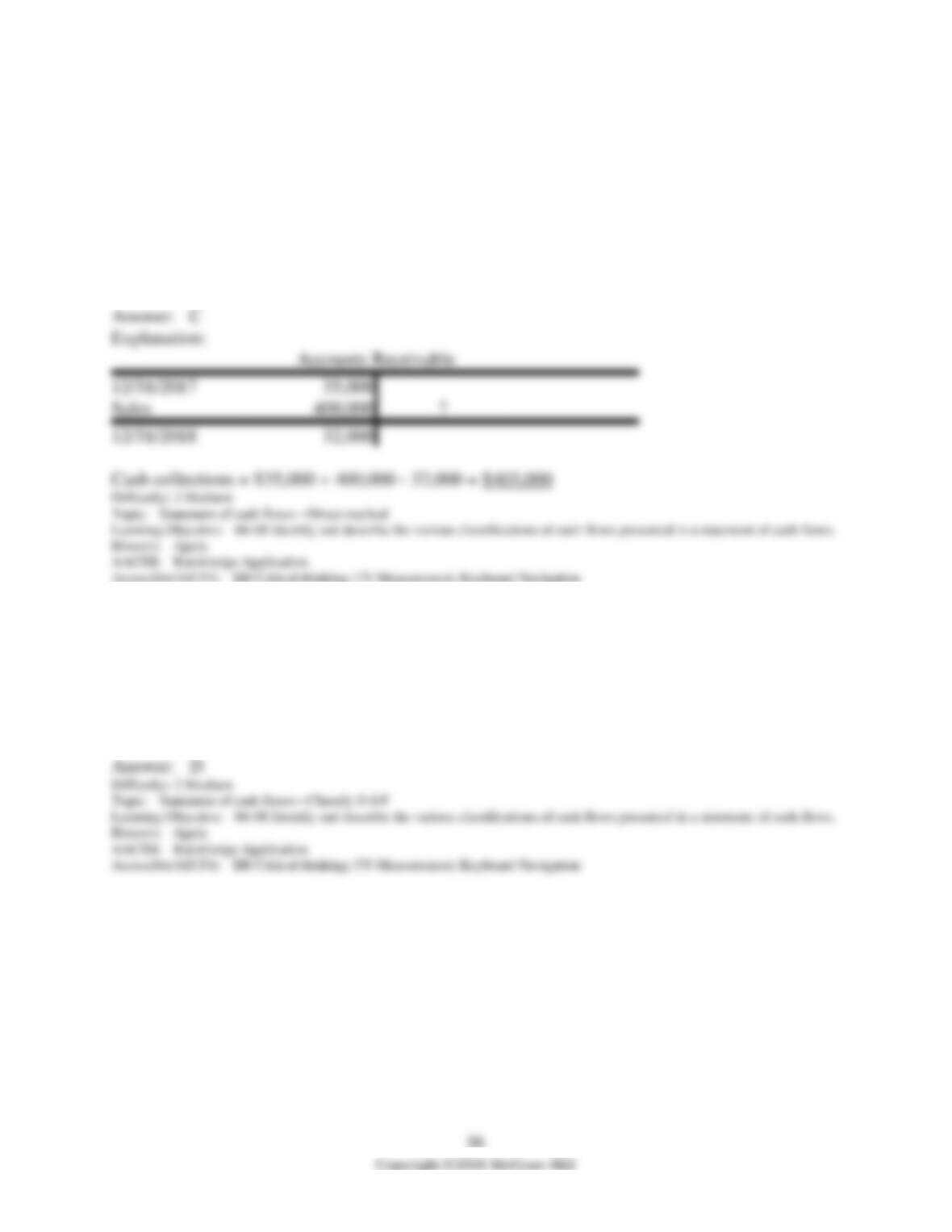
92) Tropical Tours reported revenue of $400,000 for its year ended December 31, 2018.
Accounts receivable at December 31, 2017 and 2018, were $35,000 and $32,000, respectively.
Using the direct method for reporting cash flows from operating activities, Tropical Tours would
report cash collected from customers of:
A) $400,000.
B) $397,000.
C) $403,000.
D) $365,000.
93) Shively Mfg. Co. sold for $18,000 equipment that cost $40,000 and had a book value of
$30,000. Shively would report:
A) Operating cash inflows of $18,000.
B) Operating cash inflows of $8,000.
C) Financing cash inflows of $18,000.
D) Investing cash inflows of $18,000.
94) Arrow Printers paid $2,000 interest on short-term notes payable, $10,000 interest on long-
term bonds, and $6,000 in dividends on its common stock. Arrow would report cash outflows
from activities, as follows:
A) Operating, $2,000; financing, $16,000.
B) Operating, $0; financing, $18,000.
C) Operating, $12,000; financing, $6,000.
D) Operating, $18,000; financing, $0.
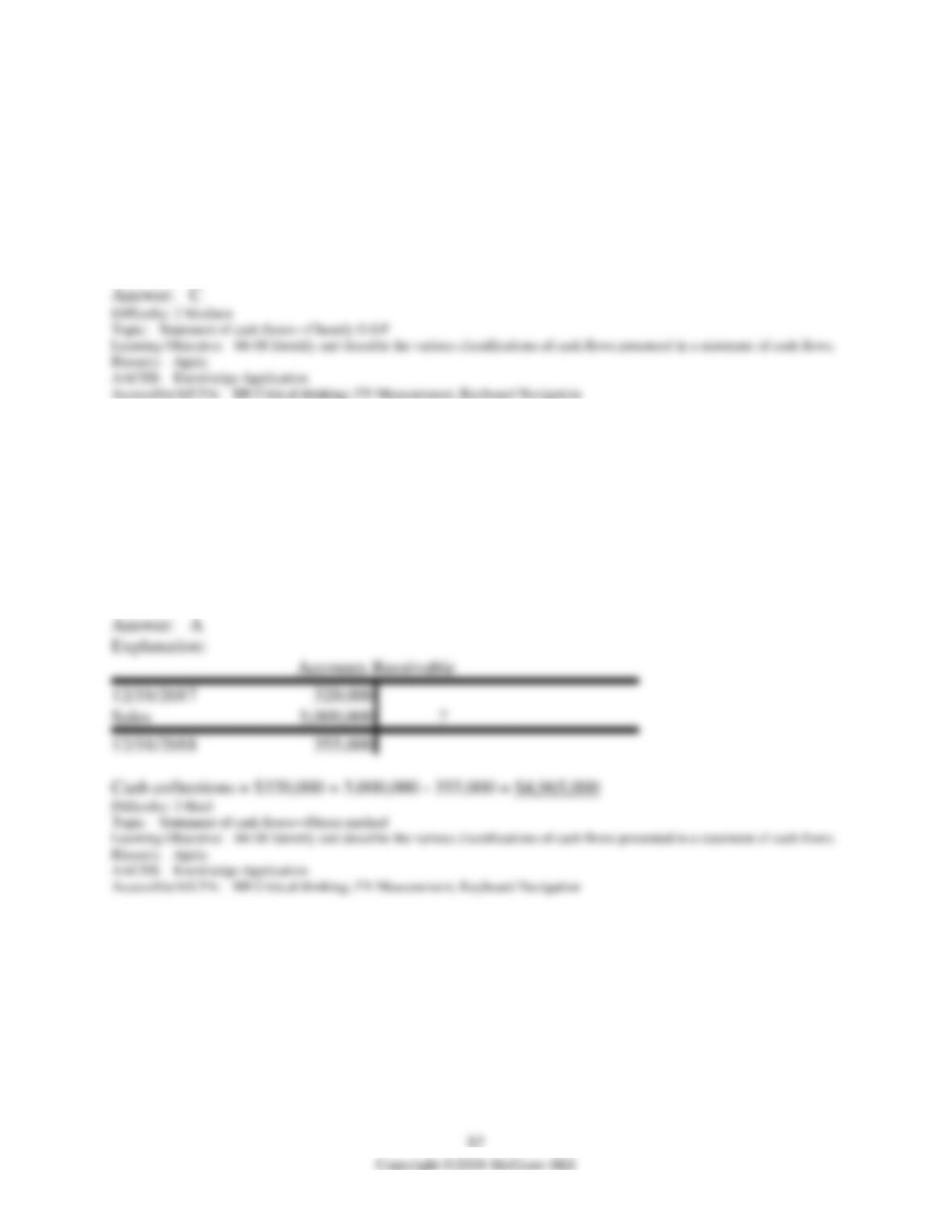
95) Hong Kong Clothiers reported revenue of $5,000,000 for its year ended December 31, 2018.
Accounts receivable at December 31, 2017 and 2018, were $320,000 and $355,000, respectively.
Using the direct method for reporting cash flows from operating activities, Hong Kong Clothiers
would report cash collected from customers of:
A) $4,965,000.
B) $5,000,000.
C) $5,035,000.
D) $5,045,000.
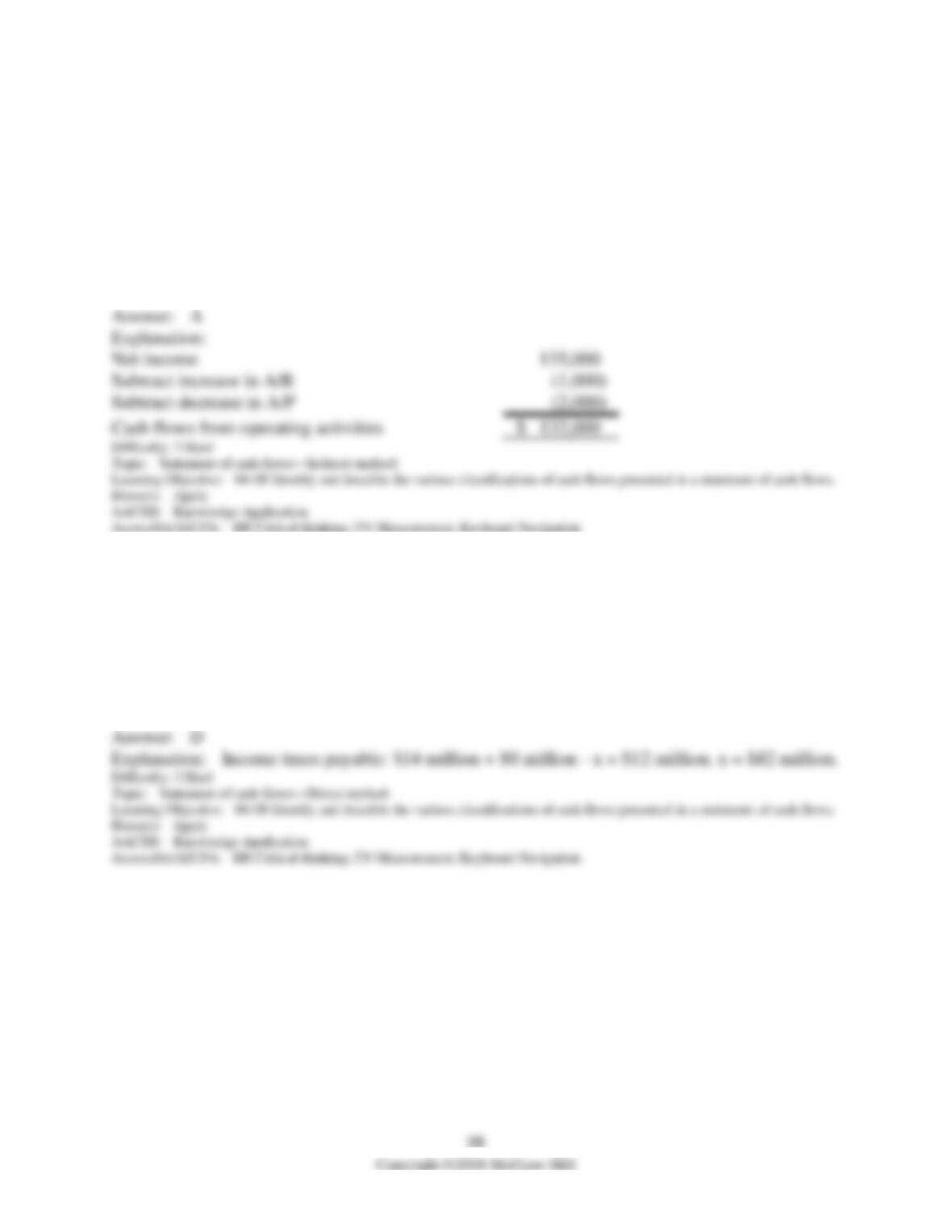
96) Lucia Ltd. reported net income of $135,000 for the year ended December 31, 2018. January
1 balances in accounts receivable and accounts payable were $29,000 and $26,000, respectively.
Year-end balances in these accounts were $30,000 and $24,000, respectively. Assuming that all
relevant information has been presented, Lucia’s cash flows from operating activities would be:
A) $132,000.
B) $134,000.
C) $136,000.
D) $138,000.
97) Shady Lane’s income tax payable account decreased from $14 million to $12 million during
2018. If its income tax expense was $80 million, what was shown as an operating cash flow
under the direct method?
A) A cash outflow of $12 million.
B) A cash outflow of $78 million.
C) A cash outflow of $80 million.
D) A cash outflow of $82 million.
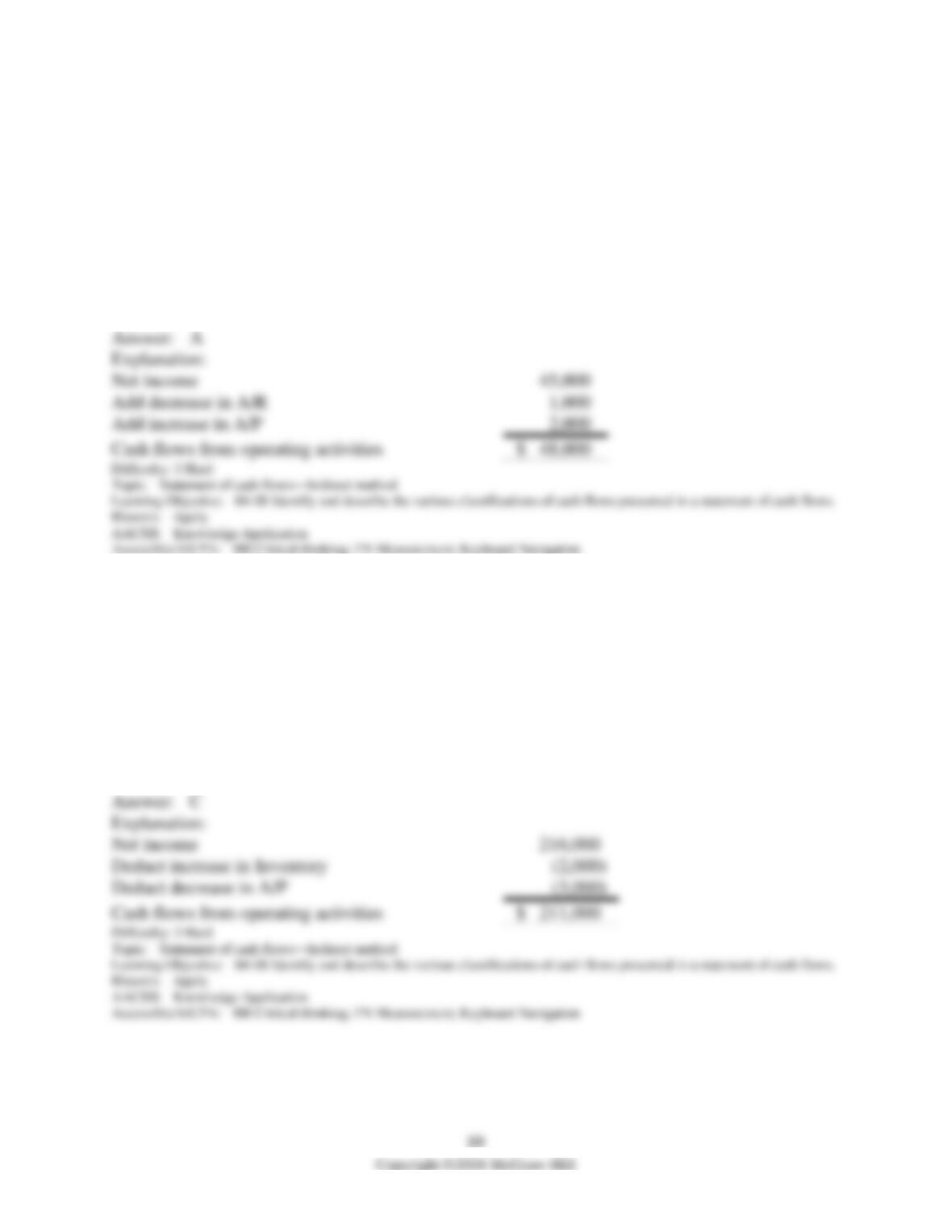
98) Bird Brain Co. reported net income of $45,000 for the year ended December 31, 2018.
January 1 balances in accounts receivable and accounts payable were $23,000 and $26,000
respectively. Year-end balances in these accounts were $22,000 and $28,000, respectively.
Assuming that all relevant information has been presented, Bird Brain’s cash flows from
operating activities would be:
A) $48,000.
B) $44,000.
C) $46,000.
D) $45,000.
99) Nevada Boot Co. reported net income of $216,000 for its year ended December 31, 2018.
Purchases totaled $152,000. Accounts payable balances at the beginning and end of the year
were $36,000 and $33,000, respectively. Beginning and ending inventory balances were $44,000
and $46,000, respectively. Assuming that all relevant information has been presented, Nevada
Boot would report operating cash flows of:
A) $155,000.
B) $221,000.
C) $211,000.
D) $151,000.
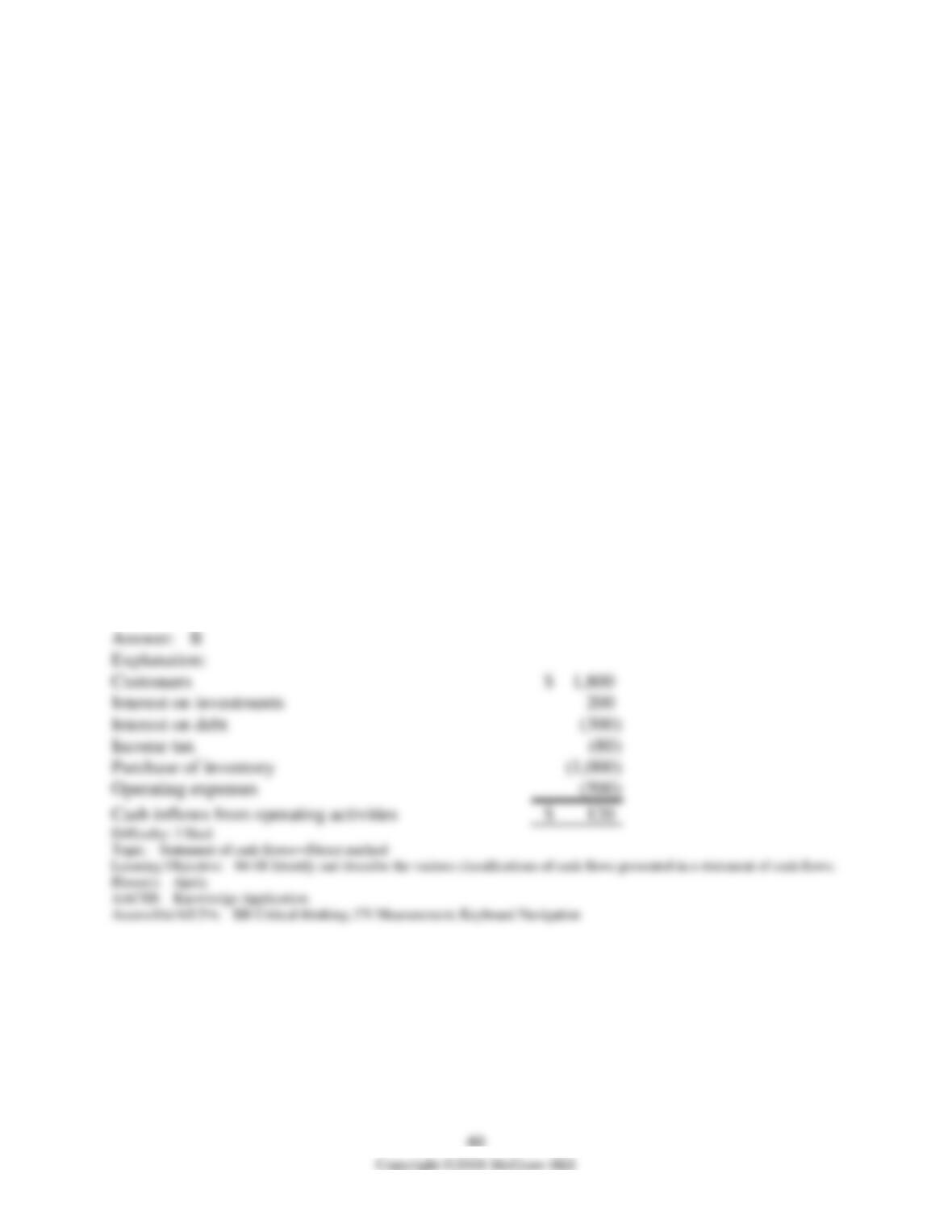
100) Rowdy’s Restaurants Cash Flow ($ in millions)
Cash received from:
Customers
$
1,800
Interest on investments
200
Sale of land
100
Sale of Rowdy’s capital stock
600
Issuance of debt securities
2,000
Cash paid for:
Interest on debt
$
300
Income tax
80
Debt principal reduction
1,500
Purchase of equipment
4,000
Purchase of inventory
1,000
Dividends on capital stock
200
Operating expenses
500
Rowdy’s would report net cash inflows (outflows) from operating activities in the amount of:
A) ($80) millions.
B) $120 millions.
C) $200 millions.
D) $420 millions.
Customers
$
Interest on investments
Interest on debt
Income tax
Purchase of inventory
(1,000
Operating expenses
Cash inflows from operating activities
$