101) Rowdy’s Restaurants Cash Flow ($ in millions)
Cash received from:
Customers
$
1,800
Interest on investments
200
Sale of land
100
Sale of Rowdy’s capital stock
600
Issuance of debt securities
2,000
Cash paid for:
Interest on debt
$
300
Income tax
80
Debt principal reduction
1,500
Purchase of equipment
4,000
Purchase of inventory
1,000
Dividends on capital stock
200
Operating expenses
500
Rowdy’s would report net cash inflows (outflows) from investing activities in the amount of:
A) ($4,000) millions.
B) $100 millions.
C) ($3,900) millions.
D) ($1,900) millions.
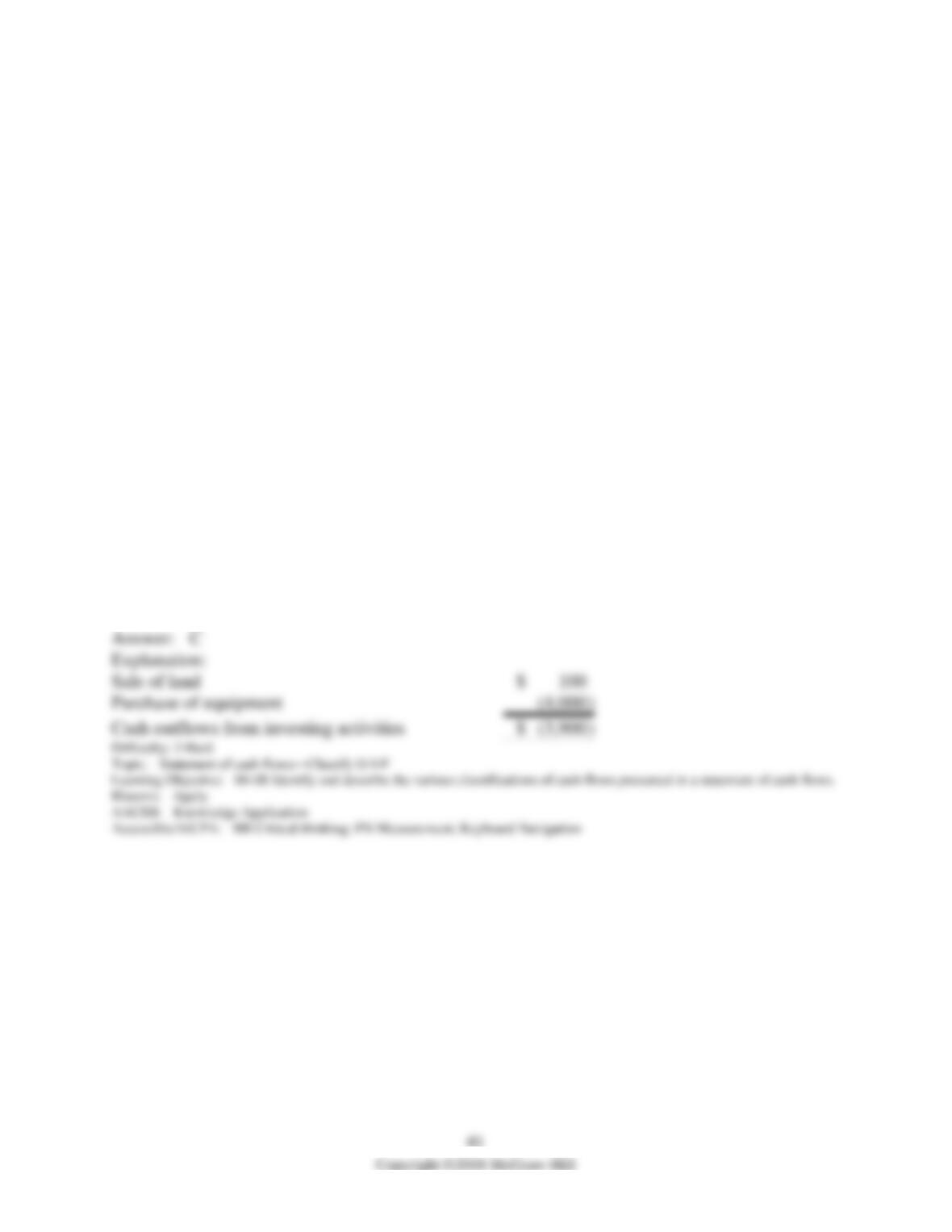
Sale of land
$
Purchase of equipment
(4,000
Cash outflows from investing activities
$
(3,900
102) Rowdy’s Restaurants Cash Flow ($ in millions)
Cash received from:
Customers
$
1,800
Interest on investments
200
Sale of land
100
Sale of Rowdy’s capital stock
600
Issuance of debt securities
2,000
Cash paid for:
Interest on debt
$
300
Income tax
80
Debt principal reduction
1,500
Purchase of equipment
4,000
Purchase of inventory
1,000
Dividends on capital stock
200
Operating expenses
500
Rowdy’s would report net cash inflows (outflows) from financing activities in the amount of:
A) $1,100 millions.
B) ($1,100) millions.
C) $820 millions.
D) $900 millions.
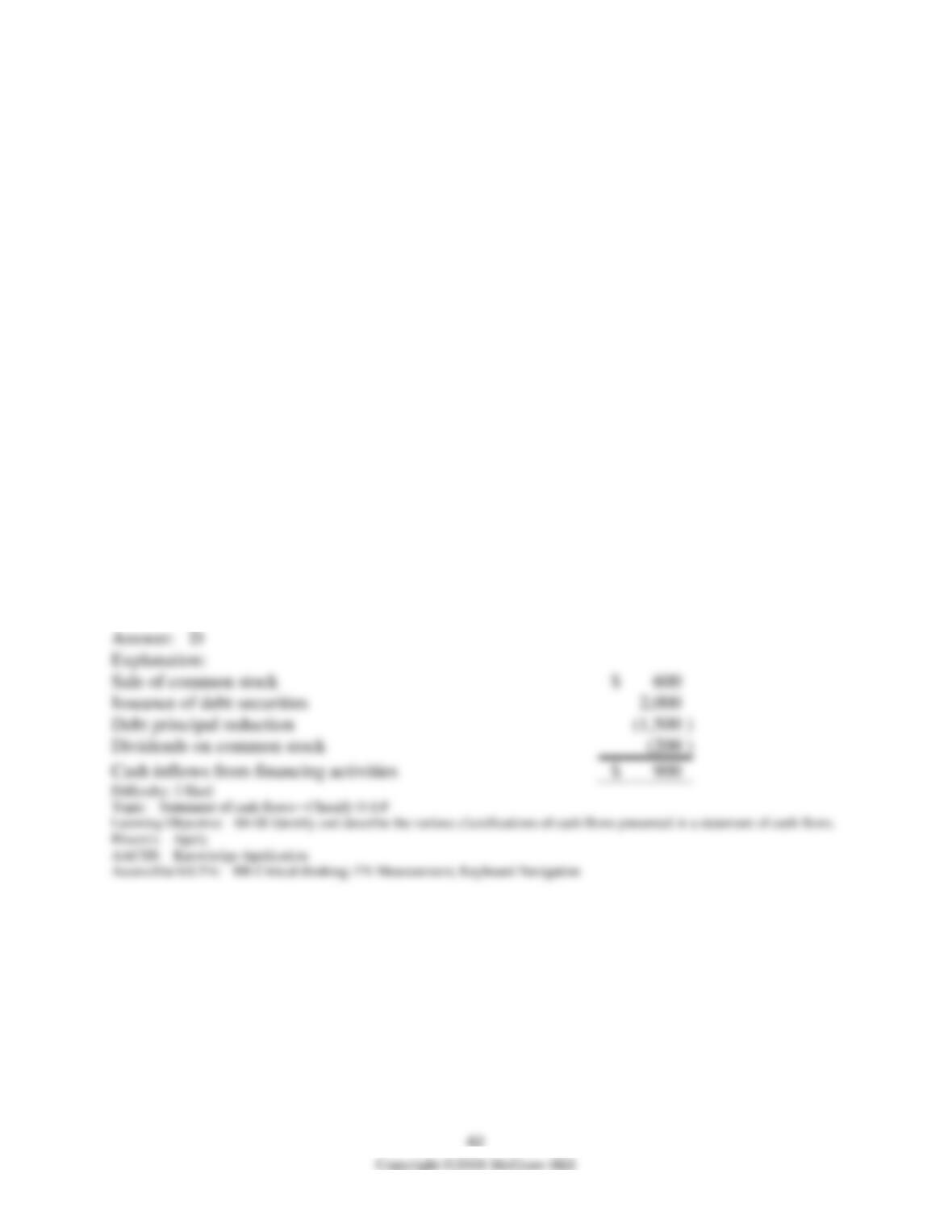
Sale of common stock
$
Issuance of debt securities
Debt principal reduction
(1,500
Dividends on common stock
Cash inflows from financing activities
$
103) Expenses in an income statement prepared under International Financial Reporting
Standards (IFRS):
A) Must be classified by function.
B) Must be classified by natural description.
C) Can be classified either by function or by natural description.
D) None of these answer choices are correct.
104) In a statement of cash flows prepared under International Financial Reporting Standards
(IFRS), each of the following items is typically classified as a financing cash flow except:
A) Interest paid.
B) Dividends paid.
C) Proceeds from the issuance of long-term debt.
D) Dividends received.
105) During its 2018 fiscal year, Jacobsen Corporation reported before-tax income of $620,000.
This amount does not include the following two items, both of which are considered to be
material in amount:
Unusual gain
$
200,000
Loss on discontinued operations
(
300,000
)
The company’s income tax rate is 40%.
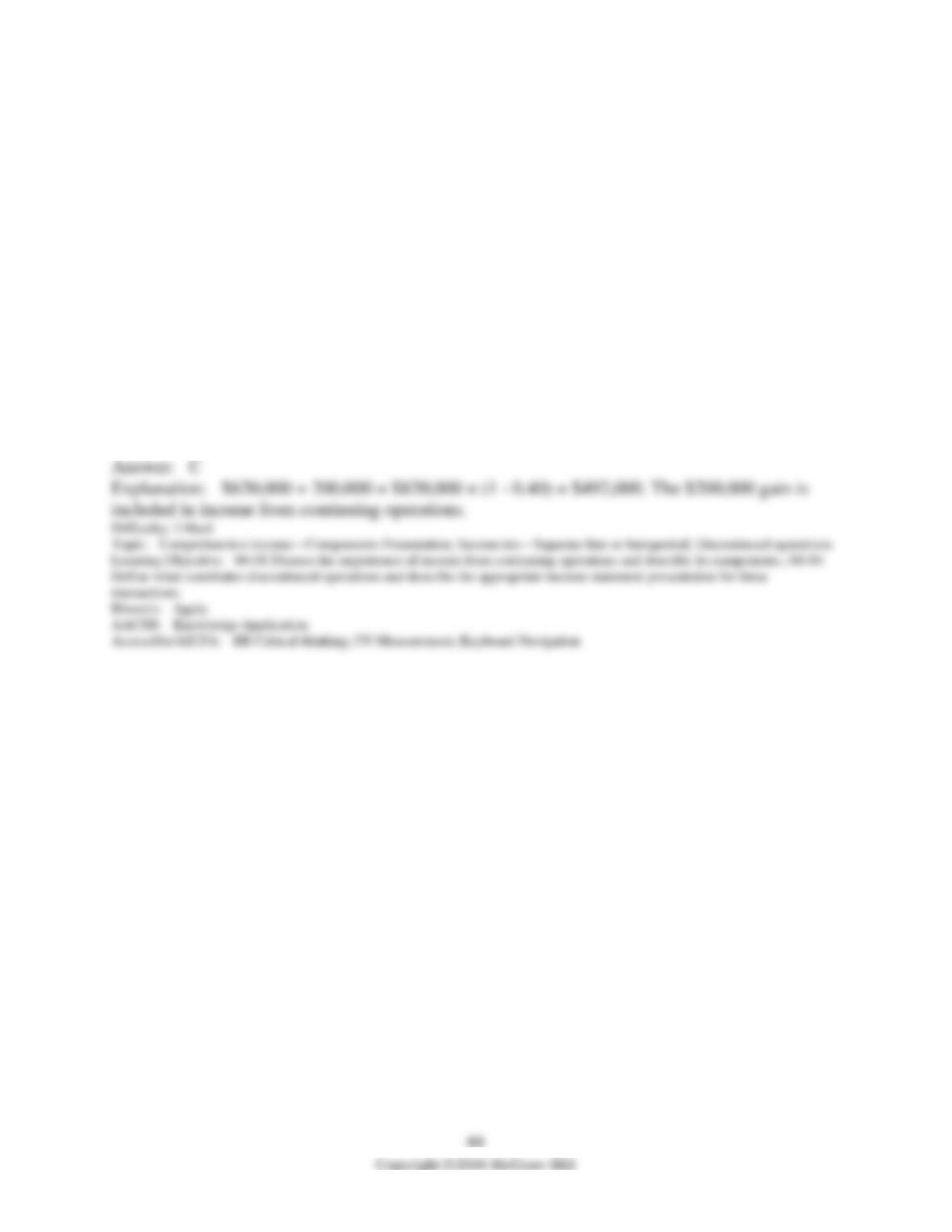
Jacobsen Corporation prepares its financial statements applying U.S. GAAP. In its 2018 income
statement, Jacobsen would report income from continuing operations of:
A) $312,000.
B) $372,000.
C) $492,000.
D) $620,000.
106) During its 2018 fiscal year, Jacobsen Corporation reported before-tax income of $620,000.
This amount does not include the following two items, both of which are considered to be
material in amount:
Unusual gain
$
200,000
Loss on discontinued operations
(
300,000
)
The company’s income tax rate is 40%.
Jacobsen Corporation prepares its financial statement applying International Financial Reporting
Standards (IFRS). In its 2018 income statement, Jacobsen would report income from continuing
operations of:
A) $312,000.
B) $372,000.
C) $492,000.
D) $620,000.
107) In the DuPont formula, return on assets equals:
A) Gross margin on sales × Inventory turnover.
B) Profit margin on sales × Inventory turnover.
C) Gross margin on sales × Asset turnover.
D) Profit margin on sales × Asset turnover.
108) A company is effectively leveraging when:
A) the return on assets exceeds the return on shareholders’ equity.
B) the return on shareholders’ equity exceeds the return on assets.
C) the return on shareholders’ equity is increasing.
D) the return on assets is increasing.
109) Excerpts from Dowling Company’s December 31, 2018 and 2017, financial statements and
key ratios are presented below (all numbers are in millions):
Accounts receivable (net)
$
20
$
16
Net sales
$
115
$
100
Cost of goods sold
$
60
$
55
Net income
$
20
$
17
Inventory turnover
5.22
Return on assets
10.3
%
Equity Multiple
2.36
Dowling’s 2018 profit margin is (rounded):
A) 17.4%.
B) 18.5%.
C) 18.0%.
D) 16.5%.
110) Excerpts from Dowling Company’s December 31, 2018 and 2017, financial statements and
key ratios are presented below (all numbers are in millions):
2018
2017
Accounts receivable (net
$
20
$
16
Net sales
$
115
$
100
Cost of goods sold
$
60
$
55
Net income
$
20
$
17
Inventory turnover
5.22
Return on assets
10.3
%
Equity Multiple
2.36
Dowling’s 2018 average collection period is (rounded):
A) 50 days.
B) 63 days.
C) 57 days.
D) 51 days.
Avg. collection period
365 / (accounts receivable turnover)
365 / (net sales / {avg A/R})
365 / (115 /{20 + 16} /2)
57.13 days
57 days rounded
111) Excerpts from Dowling Company’s December 31, 2018 and 2017, financial statements and
key ratios are presented below (all numbers are in millions):
2018
2017
Accounts receivable (net)
$
20
$
16
Net sales
$
115
100
Cost of goods sold
$
60
55
Net income
$
20
17
Inventory turnover
5.22
Return on assets
10.3
%
Equity Multiple
2.36
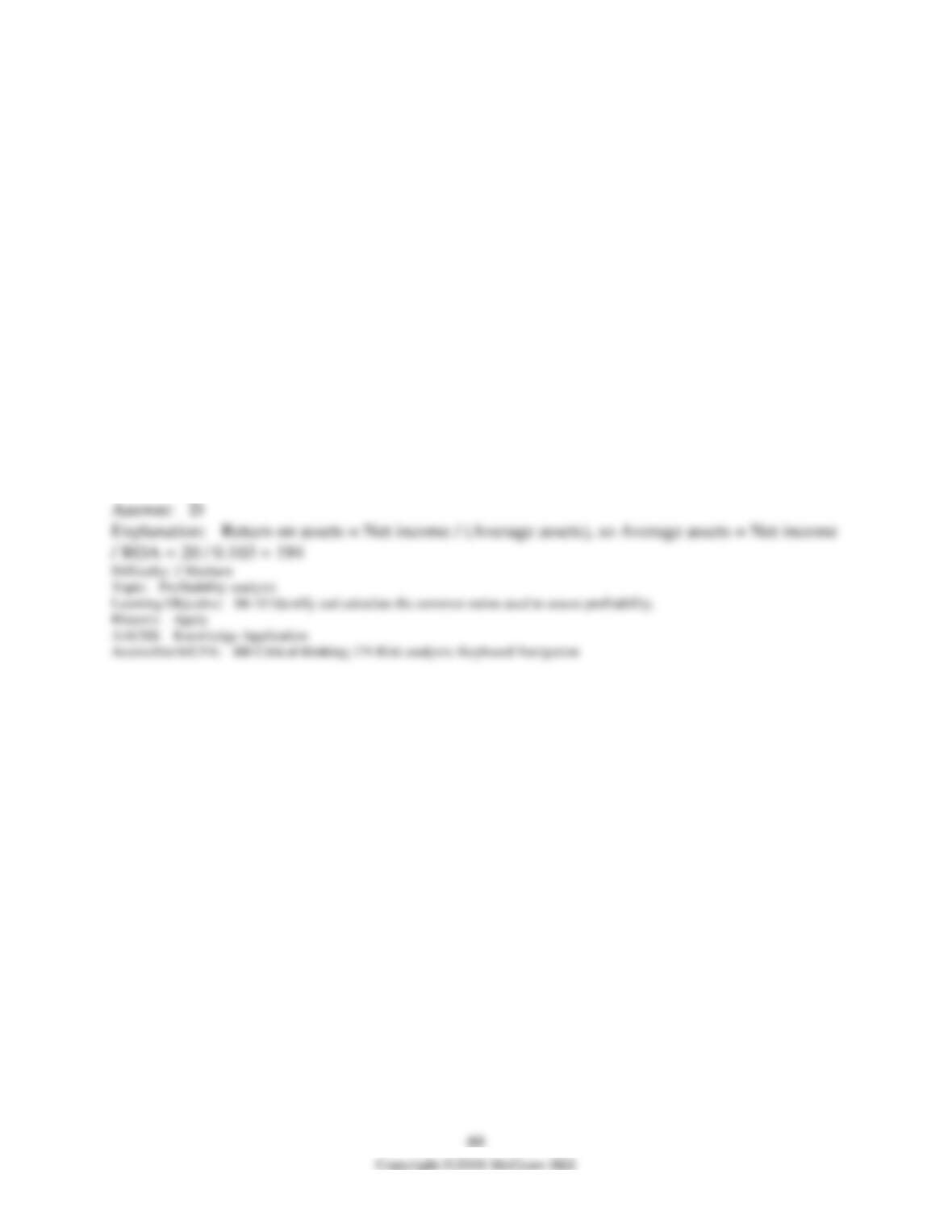
Dowling’s return on equity for 2018 is (rounded):
A) 22%.
B) 24.3%.
C) 17.4%.
D) 9%.
112) Excerpts from Dowling Company’s December 31, 2018 and 2017, financial statements and
key ratios are presented below (all numbers are in millions):
2018
2017
Accounts receivable (net)
$
20
$
16
Net sales
$
115
100
Cost of goods sold
$
60
55
Net income
$
20
17
Inventory turnover
5.22
Return on assets
10.3
%
Equity Multiple
2.36
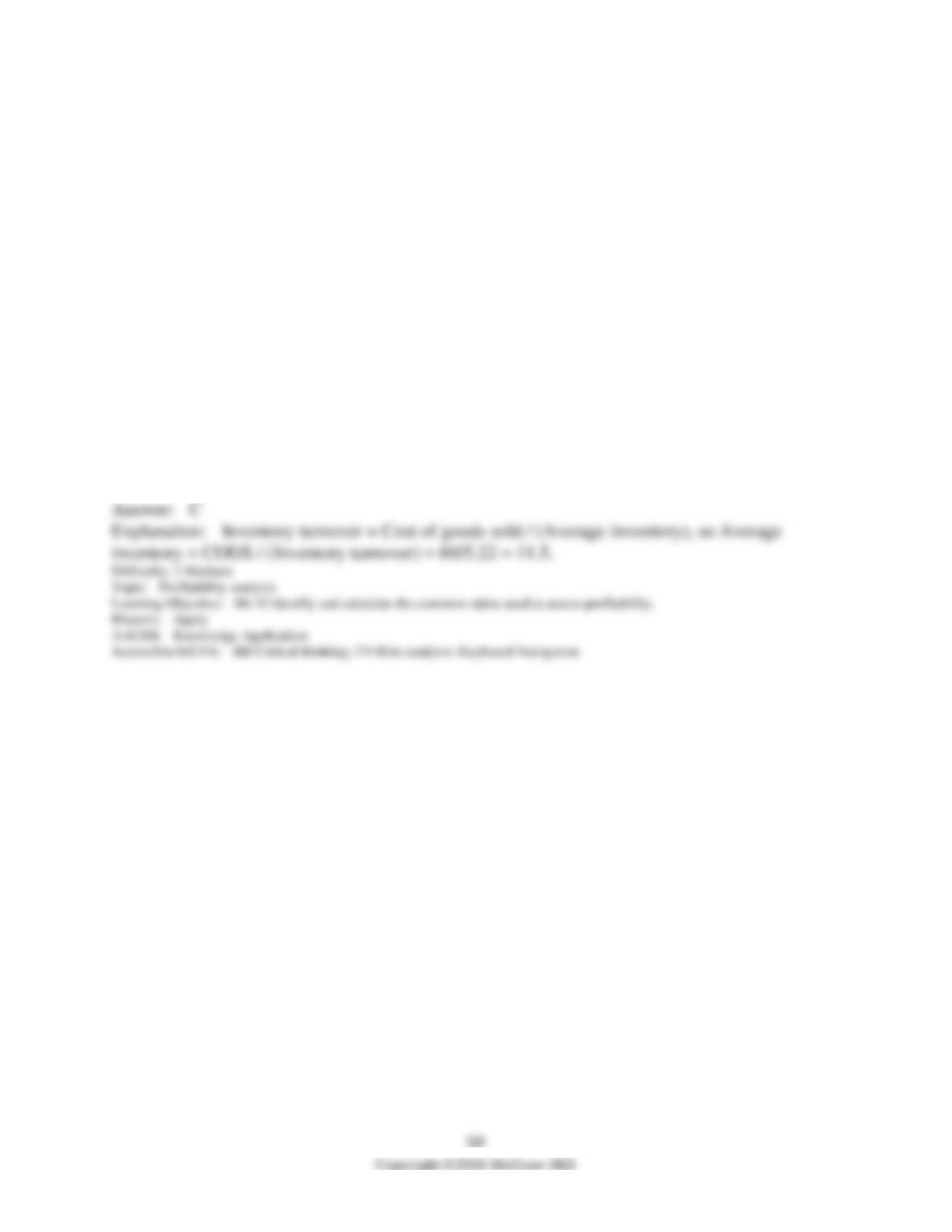
Dowling’s average total assets for 2018 is (rounded):
A) 32.
B) 210.
C) 115.
D) 194.
113) Excerpts from Dowling Company’s December 31, 2018 and 2017, financial statements and
key ratios are presented below (all numbers are in millions):
2018
2017
Accounts receivable (net)
$
20
$
16
Net sales
$
115
100
Cost of goods sold
60
55
Net income
20
17
Inventory turnover
5.22
Return on assets
10.3
%
Equity Multiple
2.36
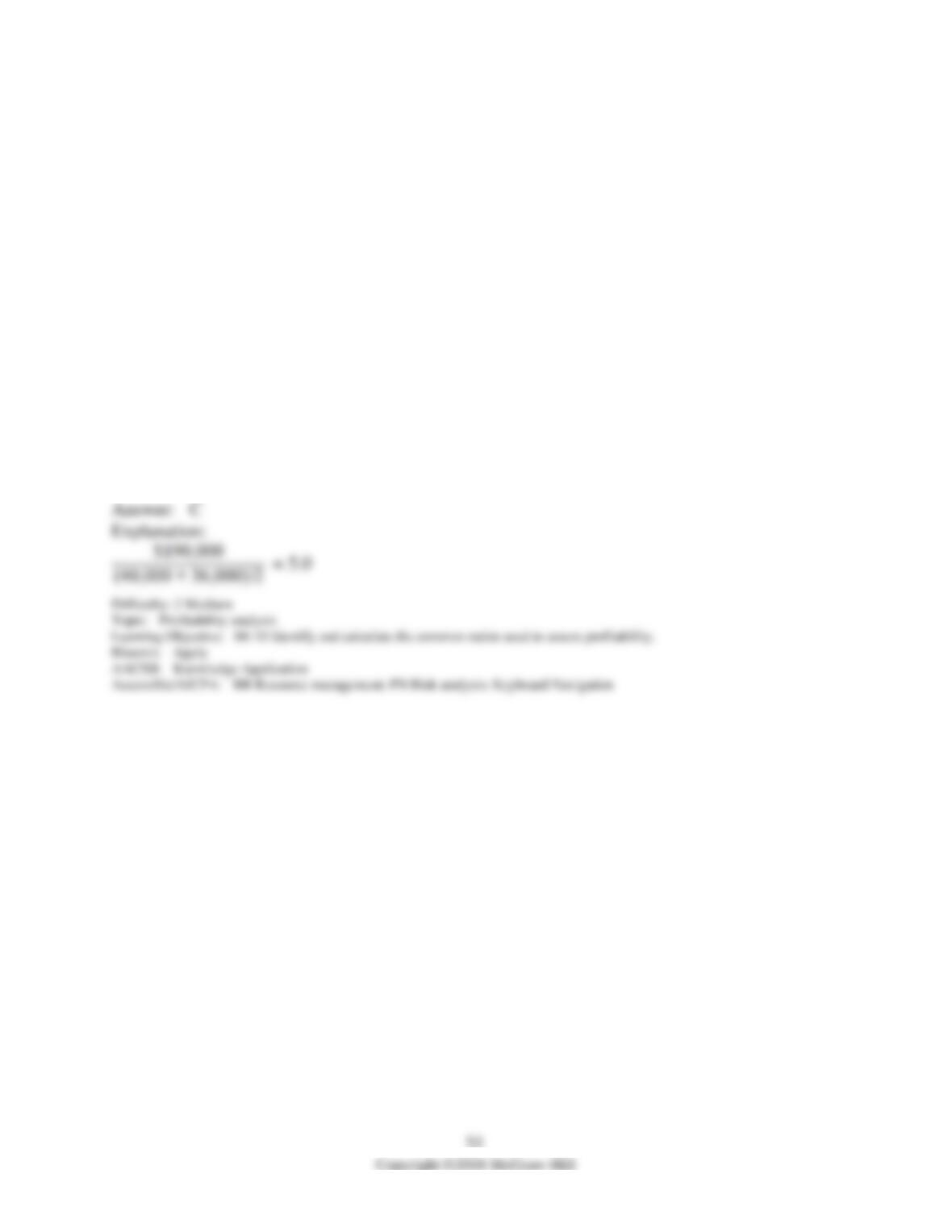
Dowling’s average inventory balance for 2018 is (rounded):
A) 11.
B) 12.
C) 11.5.
D) 12.5.
114) Excerpts from Hulkster Company’s December 31, 2018 and 2017, financial statements are
presented below:
2018
2017
Accounts receivable
$
40,000
$
36,000
Merchandise inventory
$
28,000
35,000
Net sales
190,000
186,000
Cost of goods sold
114,000
108,000
Total assets
425,000
405,000
Total shareholders’ equity
240,000
225,000
Net income
32,500
28,000
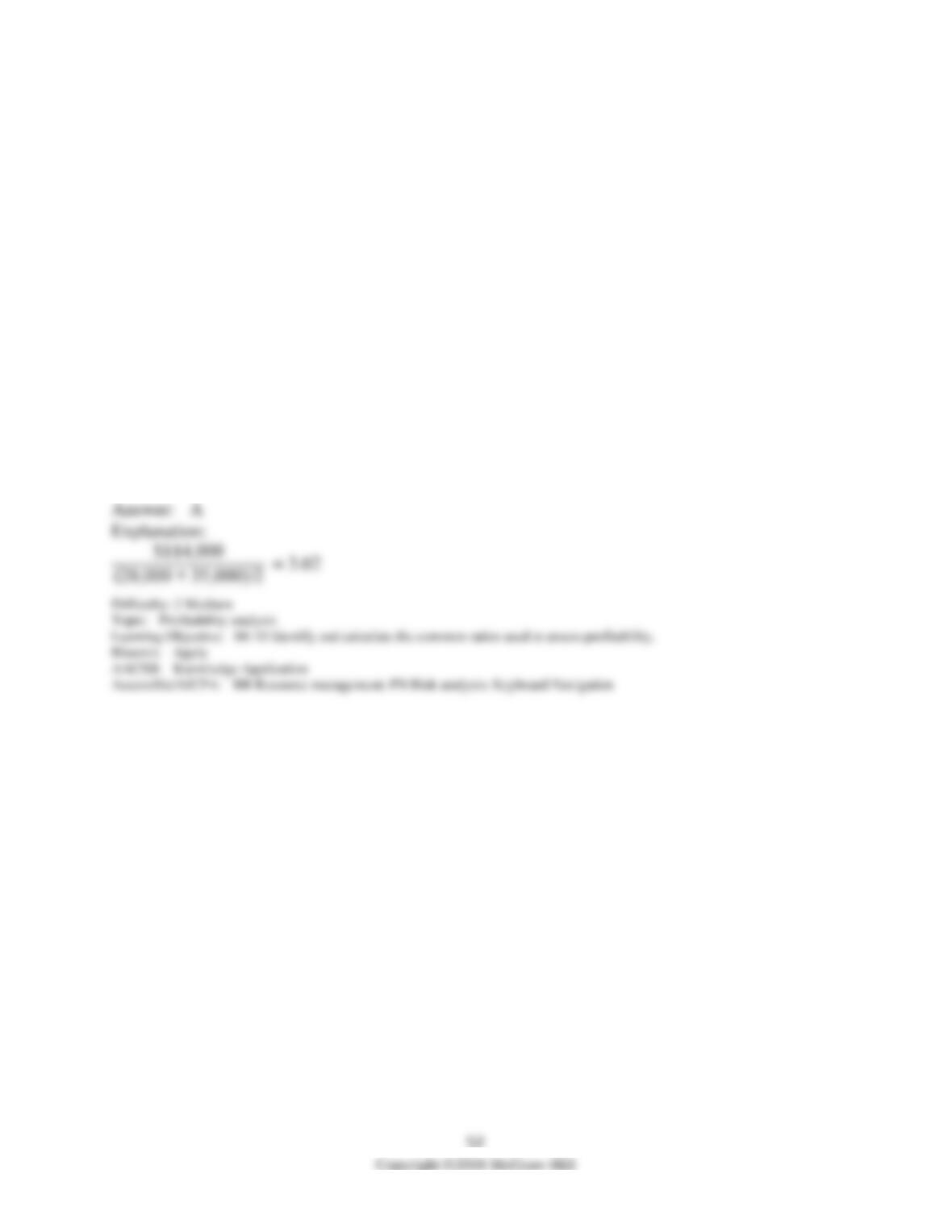
Hulkster’s 2018 receivables turnover is:
A) 2.85.
B) 4.70.
C) 5.00.
D) 10.63.
115) Excerpts from Hulkster Company’s December 31, 2018 and 2017, financial statements are
presented below:
2018
2017
Accounts receivable
$
40,000
$
36,000
Merchandise inventory
$
28,000
35,000
Net sales
190,000
186,000
Cost of goods sold
114,000
108,000
Total assets
425,000
405,000
Total shareholders’ equity
240,000
225,000
Net income
32,500
28,000
Hulkster’s 2018 inventory turnover is (rounded):
A) 3.62.
B) 3.96.
C) 4.07.
D) 6.03.
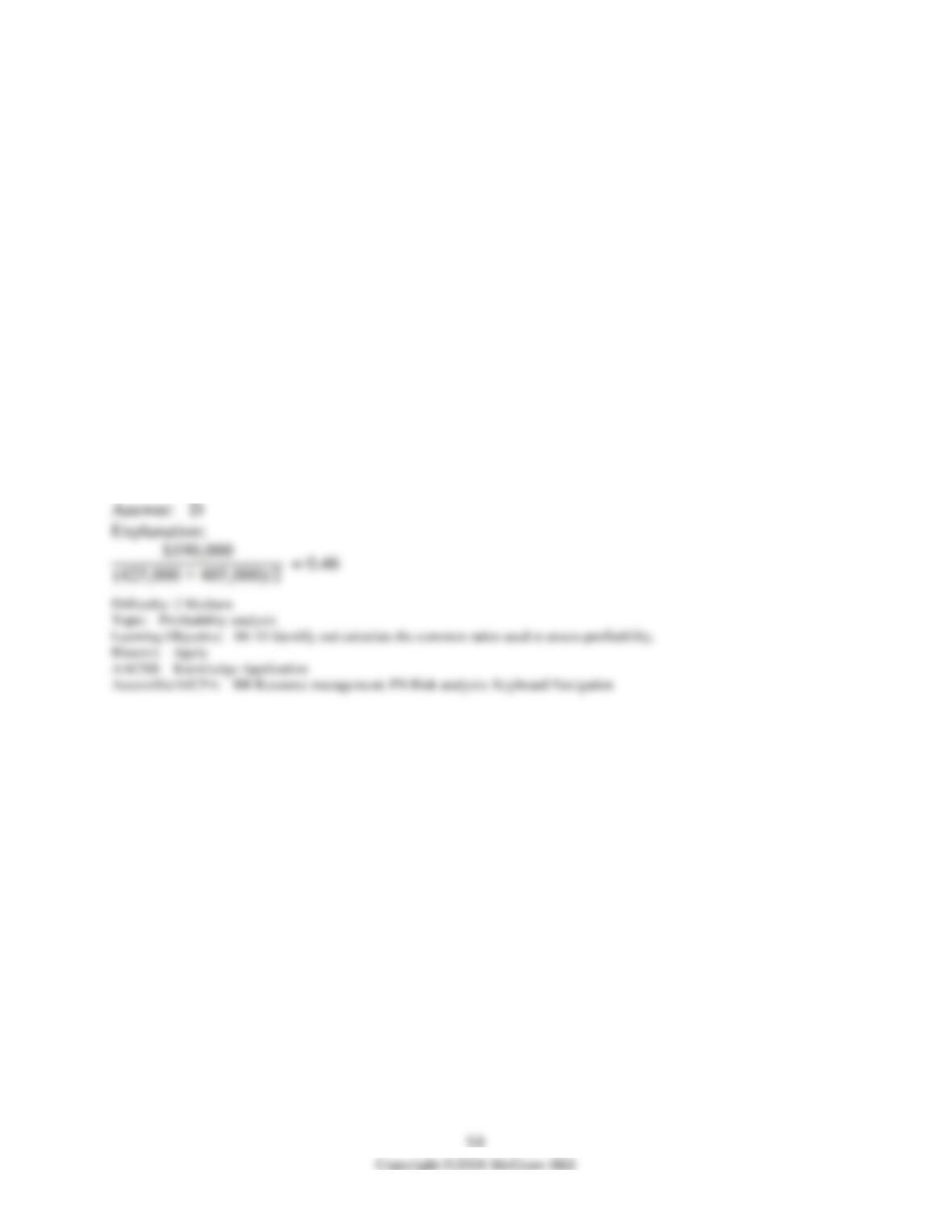
116) Excerpts from Hulkster Company’s December 31, 2018 and 2017, financial statements are
presented below:
2018
2017
Accounts receivable
$
40,000
$
36,000
Merchandise inventory
$
28,000
35,000
Net sales
190,000
186,000
Cost of goods sold
114,000
108,000
Total assets
425,000
405,000
Total shareholders’ equity
240,000
225,000
Net income
32,500
28,000
Hulkster’s 2018 asset turnover is (rounded):
A) 3.73.
B) 2.79.
C) 2.24.
D) 0.46.
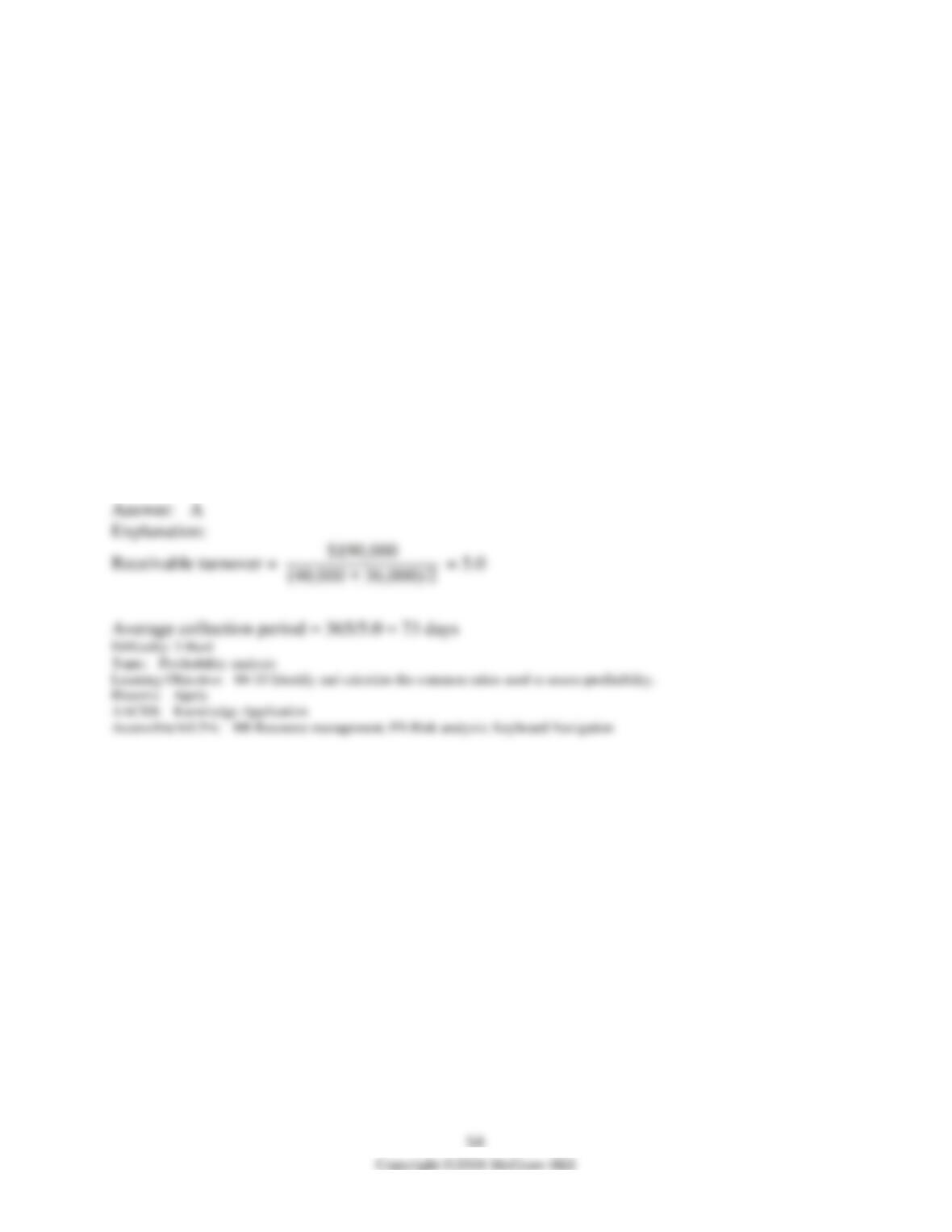
117) Excerpts from Hulkster Company’s December 31, 2018 and 2017, financial statements are
presented below:
2018
2017
Accounts receivable
$
40,000
$
36,000
Merchandise inventory
$
28,000
35,000
Net sales
190,000
186,000
Cost of goods sold
114,000
108,000
Total assets
425,000
405,000
Total shareholders’ equity
240,000
225,000
Net income
32,500
28,000
Hulkster’s 2018 average collection period is:
A) 73 days.
B) 104 days.
C) 109 days.
D) 128 days.
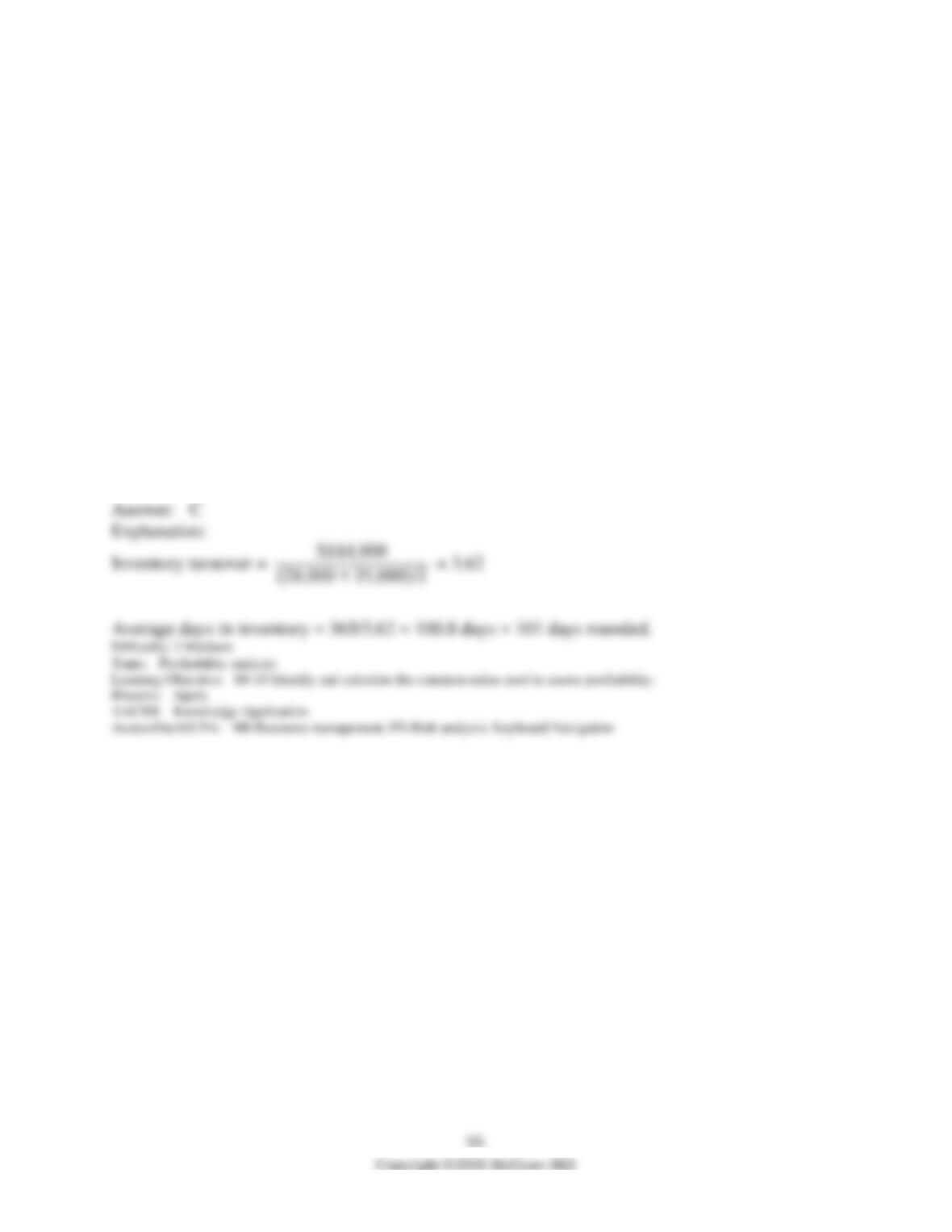
118) Excerpts from Hulkster Company’s December 31, 2018 and 2017, financial statements are
presented below:
2018
2017
Accounts receivable
$
40,000
$
36,000
Merchandise inventory
$
28,000
35,000
Net sales
190,000
186,000
Cost of goods sold
114,000
108,000
Total assets
425,000
405,000
Total shareholders’ equity
240,000
225,000
Net income
32,500
28,000
Hulkster’s 2018 average days in inventory is (rounded):
A) 61 days.
B) 92 days.
C) 101 days.
D) 90 days.
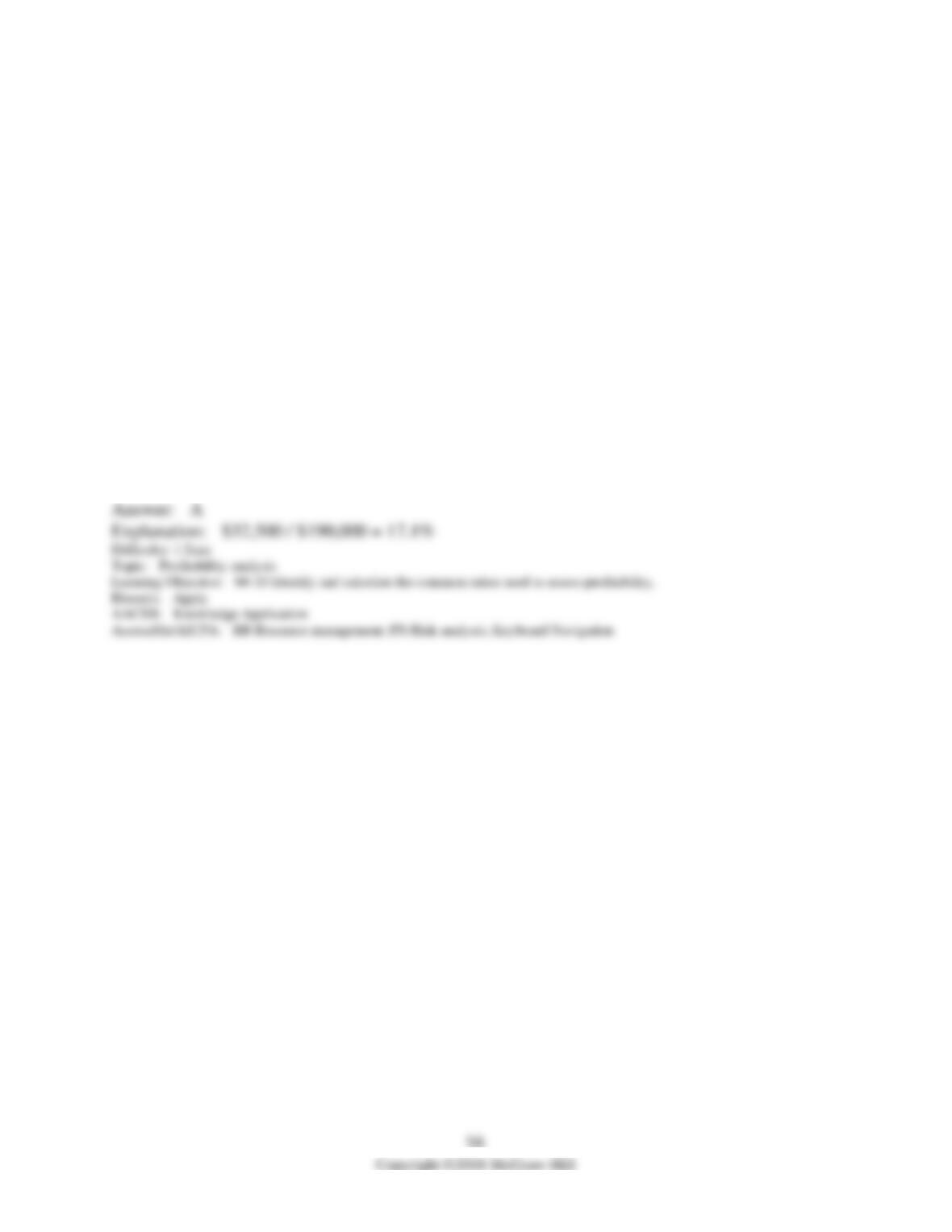
119) Excerpts from Hulkster Company’s December 31, 2018 and 2017, financial statements are
presented below:
2018
2017
Accounts receivable
$
40,000
$
36,000
Merchandise inventory
$
28,000
35,000
Net sales
190,000
186,000
Cost of goods sold
114,000
108,000
Total assets
425,000
405,000
Total shareholders’ equity
240,000
225,000
Net income
32,500
28,000
Hulkster’s 2018 profit margin is (rounded):
A) 17.1%.
B) 13.5%.
C) 7.6%.
D) 4.5%.
120) Excerpts from Hulkster Company’s December 31, 2018 and 2017, financial statements are
presented below:
2018
2017
Accounts receivable
$
40,000
$
36,000
Merchandise inventory
$
28,000
35,000
Net sales
190,000
186,000
Cost of goods sold
114,000
108,000
Total assets
425,000
405,000
Total shareholders’ equity
240,000
225,000
Net income
32,500
28,000
Hulkster’s 2018 return on assets is (rounded):
A) 7.1%.
B) 7.8%.
C) 13.5%.
D) 47.7%.
121) Excerpts from Hulkster Company’s December 31, 2018 and 2017, financial statements are
presented below:
2018
2017
Accounts receivable
$
40,000
$
36,000
Merchandise inventory
$
28,000
35,000
Net sales
190,000
186,000
Cost of goods sold
114,000
108,000
Total assets
425,000
405,000
Total shareholders’ equity
240,000
225,000
Net income
32,500
28,000
Hulkster’s 2018 return on shareholders’ equity is (rounded):
A) 17.1%.
B) 14.0%.
C) 12.6%.
D) 7.1%.
Listed below are five terms followed by a list of phrases that describe or characterize each of the
terms. Match each phrase with the correct term.
A) Also known as income tax expense.
B) Made to correct a material error.
C) From transactions or events that are not likely to occur in the foreseeable future.
D) Used as the base for computing taxes currently payable.
E) Associates tax with income statement items.
122) Taxable income
123) Intraperiod tax allocation
124) Prior period adjustment
125) Provision for income tax
126) Temporary earnings
Listed below are five terms followed by a list of phrases that describe or characterize each of the
terms. Match each phrase with the correct term.
A) More useful to analysts in predicting future income than current net income.
B) Requires note disclosure, if material.
C) Income from an identifiable component will cease.
D) Is directly related to the principal revenue-generating activities.
E) Expenses are recognized in the same period as the related revenues.
127) Operating activities (income statement)
128) Matching principle
129) Income from continuing operations
130) Income from discontinued operations
131) Change in accounting estimate