
Name:
Class:
Date:
chapter 4
a.
True
Indicate whether the statement is true or false.
1. Activity cost pools are factory overhead costs initially budgeted for activities, such as machine usage, inspections,
moving, production setups, and engineering activities.
a.
True
b.
False
2. Activity-based costing is much easier to apply than single plantwide factory overhead allocation.
a.
True
b.
False
3. The use of a plantwide factory overhead rate assumes that the activities causing overhead costs are different across
different departments and products.
a.
True
b.
False
4. Managers depend on accurate factory overhead allocation to make decisions regarding product mix and product price.
a.
True
b.
False
5. A single plantwide factory overhead rate assumes that all overhead is directly related to one activity representing the
entire plant.
a.
True
b.
False
6. Managers depend on the accuracy of product costing to make decisions regarding continuing operations and product
mix.
a.
True
b.
False
7. Multiple production department factory overhead rates are most useful when production departments significantly
differ in their manufacturing processes.
a.
True
b.
False
8. Multiple production department factory overhead rates are less accurate than are plantwide factory overhead rates.
a.
True
b.
False
9. When production departments differ significantly in their manufacturing processes, it is recommended that the single
plantwide factory overhead rate be used for allocating factory overhead.
a.
True
b.
False
10. The use of a single plantwide factory overhead rate assumes that the activities causing overhead costs are the same
across all departments and products.

Name:
Class:
Date:
chapter 4
b.
False
11. Activity cost pools are assigned to products, using factory overhead rates for each activity.
a.
True
b.
False
12. If the budgeted factory overhead cost is $460,000, the budgeted direct labor hours are 80,000, and the actual direct
labor hours are 6,700 for the month, the factory overhead rate for the month is $68.65 (if the allocation is based on direct
labor hours).
a.
True
b.
False
13. If the budgeted factory overhead cost is $460,000, the budgeted direct labor hours are 80,000, and the actual direct
labor hours are 6,700 for the month, the amount of factory overhead to be allocated is $38,525 (if the allocation is based
on direct labor hours).
a.
True
b.
False
14. Activity rates are computed by dividing the cost budgeted for each activity pool by the estimated activity base for that
pool.
a.
True
b.
False
15. Bob’s Biscuit Corporation budgeted $1,200,000 of factory overhead cost for the coming year. Its plantwide allocation
base, machine hours, is budgeted at 100,000 hours. Budgeted units to be produced are 200,000 units. Bob’s plantwide
factory overhead rate is $12 per machine hour.
a.
True
b.
False
16. The selection of the factory overhead allocation method is important because the method selected determines the
accuracy of the product cost.
a.
True
b.
False
17. Use of a plantwide factory overhead rate does not distort product costs when there are differences in the factory
overhead rates across different production departments.
a.
True
b.
False
18. In an effort to simplify the multiple production department factory overhead rate method, the same rate can be used
for all departments.
a.
True
b.
False
19. When activity-based costing is used, the estimated total factory overhead cost for a product is the sum of the product’s
individual activity allocations.
a.
True

Name:
Class:
Date:
chapter 4
b.
False
20. In a service organization, the multiple department overhead rate method is the most effective in providing accurate
information about the cost of services.
a.
True
b.
False
21. Activity-based costing can only be used to allocate manufacturing factory overhead.
a.
True
b.
False
22. Service companies can effectively use activity-based costing to compute product (service) costs.
a.
True
b.
False
23. Zorn Co. budgeted $600,000 of factory overhead cost for the coming year. Its plantwide allocation base, machine
hours, is budgeted at 100,000 hours. Budgeted units to be produced are 200,000 units. Zorn’s plantwide factory overhead
rate is $3 per hour.
a.
True
b.
False
24. When a plantwide factory overhead rate is used, the amount of overhead costs allocated to each product is the same.
a.
True
b.
False
25. Use of a plantwide factory overhead rate distorts product costs when there are differences in the factory overhead rates
across different production departments and when products require different ratios of allocation-base usage in each
production department.
a.
True
b.
False
26. Activity-based costing can be used to allocate period costs to various products that the company sells.
a.
True
b.
False
27. ABC is used to allocate selling and administrative expenses to each product based on the product’s individual
differences in consuming these activities.
a.
True
b.
False
28. Multiple production department factory overhead rates are most useful when production departments are very similar
in their manufacturing processes.
a.
True
b.
False
29. When activity-based costing is used, the number of activities will generally be the same as the number of production
departments.

Name:
Class:
Date:
chapter 4
a.
True
b.
False
30. Multiple production department factory overhead rates are more accurate than are plantwide factory overhead rates.
a.
True
b.
False
31. A single plantwide factory overhead rate is computed by dividing total budgeted factory overhead by the total
budgeted plantwide allocation base.
a.
True
b.
False
32. The activity information from an ABC product costing system can be used to isolate cost improvement opportunities.
a.
True
b.
False
33. If the activities causing overhead costs are different across different departments and products, use of a plantwide
factory overhead rate will cause distorted product costs.
a.
True
b.
False
34. When applied by service companies, the use of the single and multiple department overhead rate methods will not
lead to the same kinds of cost distortions often faced by manufacturing companies with those methods.
a.
True
b.
False
35. Product costs consist of only direct materials and direct labor.
a.
True
b.
False
36. Service organizations can use activity-based costing to allocate selling and administrative costs to services provided.
a.
True
b.
False
37. The single plantwide overhead rate method is very expensive to apply.
a.
True
b.
False
38. Use of a plantwide factory overhead rate does not distort product costs when products require different ratios of
allocation-base usage in each production department.
a.
True
b.
False
Indicate the answer choice that best completes the statement or answers the question.
39. Everest Co. uses a single plantwide factory overhead rate based on direct labor hours. Overhead costs would be

Name:
Class:
Date:
chapter 4
overcharged to which of the following departments?
a.
a labor-intensive department
b.
a capital-intensive department
c.
a materials-intensive department
d.
all of these choices
40. Activity rates are determined by
a.
dividing the actual cost for each activity pool by the actual activity base for that pool
b.
dividing the cost budgeted for each activity pool by the estimated activity base for that pool
c.
dividing the actual cost for each activity pool by the estimated activity base for that pool
d.
dividing the cost budgeted for each activity pool by the actual activity base for that pool
41. Which of the following is not a way to accomplish an activity cost reduction?
a.
improve operations so that the activity-base usage per unit is reduced
b.
change the classification of employees doing an activity so as to decrease the activity rate
c.
use lower-cost materials
d.
none of these choices
Panamint Systems Corporation is estimating activity costs associated with producing disk drives, tapes drives, and wire
drives. The indirect labor can be traced to five separate activity pools. The budgeted activity cost and activity base data by
product are provided below.
Activity
Cost
Activity Base
Procurement
$ 370,000
Number of purchase orders
Scheduling
250,000
Number of production orders
Materials handling
500,000
Number of moves
Product development
730,000
Number of engineering changes
Production
1,500,000
Machine hours
Number of
Purchase
Orders
Number
of
Production
Orders
Number
of
Moves
Number of
Engineering
Changes
Machine
Hours
Number
of
Units
Disk
drives
4,000
300
1,400
10
2,000
2,000
Tape
drives
4,000
150
800
10
8,000
4,000
Wire
drives
12,000
800
4,000
25
10,000
2,500
42. The activity rate for the materials handling cost pool is
a.
$58.82 per move
b.
$50.00 per move
c.
$20.83 per move
d.
$80.65 per move
Name:
Class:
Date:
chapter 4
Challenger Factory produces two similar products: regular widgets and deluxe widgets. The total factory overhead budget
is $675,000 with 300,000 estimated direct labor hours. Deluxe widget production requires 3 direct labor hours for each
unit, and regular widget production requires 2 direct labor hours for each unit.
43. Using a single plantwide factory overhead rate with an allocation base of direct labor hours, the factory overhead that
Challenger Factory will allocate to deluxe widget production if budgeted production for the period for deluxe widgets is
50,000 units and actual production of deluxe widgets for the period is 58,000 units would be
a.
$391,500
b.
$225,000
c.
$261,000
d.
$337,500
Panamint Systems Corporation is estimating activity costs associated with producing disk drives, tapes drives, and wire
drives. The indirect labor can be traced to five separate activity pools. The budgeted activity cost and activity base data by
product are provided below.
Activity
Cost
Activity Base
Procurement
$ 370,000
Number of purchase orders
Scheduling
250,000
Number of production orders
Materials handling
500,000
Number of moves
Product development
730,000
Number of engineering changes
Production
1,500,000
Machine hours
Number of
Purchase
Orders
Number
of
Production
Orders
Number
of
Moves
Number of
Engineering
Changes
Machine
Hours
Number
of
Units
Disk
drives
4,000
300
1,400
10
2,000
2,000
Tape
drives
4,000
150
800
10
8,000
4,000
Wire
drives
12,000
800
4,000
25
10,000
2,500
44. The activity-based cost for each wire drive unit is
a.
$204.13
b.
$173.51
c.
$744.06
d.
$394.12
45. Given the following information, determine the activity rate for setups.
Activity
Total Activity-Base Usage
Budgeted Activity Cost
Setups
10,000
$180,000
Inspections
24,000
$120,000
Assembly (dlh)
80,000
$400,000
a.
$58.00

Name:
Class:
Date:
chapter 4
b.
$18.00
c.
$0.75
d.
$5.09
Panamint Systems Corporation is estimating activity costs associated with producing disk drives, tapes drives, and wire
drives. The indirect labor can be traced to five separate activity pools. The budgeted activity cost and activity base data by
product are provided below.
Activity
Cost
Activity Base
Procurement
$ 370,000
Number of purchase orders
Scheduling
250,000
Number of production orders
Materials handling
500,000
Number of moves
Product development
730,000
Number of engineering changes
Production
1,500,000
Machine hours
Number of
Purchase
Orders
Number
of
Production
Orders
Number
of
Moves
Number of
Engineering
Changes
Machine
Hours
Number
of
Units
Disk
drives
4,000
300
1,400
10
2,000
2,000
Tape
drives
4,000
150
800
10
8,000
4,000
Wire
drives
12,000
800
4,000
25
10,000
2,500
46. The activity rate for the procurement activity cost pool is
a.
$43.53 per purchase order
b.
$18.50 per purchase order
c.
$15.42 per purchase order
d.
$37.00 per purchase order
47. If selling and administrative expenses are allocated to different products, they should be reported as a
a.
cost of goods manufactured
b.
factory overhead cost
c.
period cost
d.
cost of goods sold
48. Graham Company wants to reduce activity costs by $0.30 per unit. The setup activity for a batch of 100 units of Part
RR110 currently costs $80 per setup. A process engineer proposes reengineering the setup activity so that it takes 60% of
the original cost per setup. By how much will this reduce activity costs per unit? Will more cost savings need to be found?
a.
$0.53; no
b.
$0.48; no
c.
$0.32; no
d.
$0.22; yes
Aleutian Company produces two products: Rings and Dings. They are manufactured in two departments: Fabrication and
Name:
Class:
Date:
chapter 4
Assembly. Data for the products and departments are listed below.
Product
Number of Units
Direct Labor Hours
per Unit
Machine Hours
per Unit
Rings
1,000
4
6
Dings
2,000
3
9
All of the machine hours take place in the Fabrication Department, which has estimated total factory overhead of $90,000.
All of the labor hours take place in the Assembly Department, which has estimated total factory overhead of $105,000.
Aleutian Company uses the multiple production department factory overhead rate method. The Fabrication Department
uses machine hours as an allocation base, and the Assembly Department uses direct labor hours.
49. The total factory overhead allocated per unit of Rings is
a.
$65.25
b.
$23.25
c.
$44.10
d.
$64.50
Beauty Beyond Words Salon uses an activity-based costing system to determine the cost of services. The salon has
determined the costs of services by activity and activity usage as follows:
Activity
Activity Rate
Hair washing
$ 4.00
Conditioning
3.50
Chemical treatment
25.00
Styling
10.00
Hair Washing
Conditioning
Chemical
Treatment
Styling
Haircut
1
1
0
0
Complete style
1
1
0
1
Perm
2
3
1
1
Highlights
3
4
2
1
50. The cost of services for a haircut is
a.
$4.00
b.
$7.50
c.
$3.50
d.
$11.50
Ramapo Company produces two products, Blinks and Dinks. They are manufactured in two departments, Fabrication and
Assembly. Data for the products and departments are listed below.
Product
Number of
Units
Direct Labor Hours
per Unit
Machine Hours
per Unit
Blinks
1,000
4
5
Dinks
2,000
2
8

Name:
Class:
Date:
chapter 4
All of the machine hours take place in the Fabrication Department, which has an estimated overhead of $84,000. All of
the labor hours take place in the Assembly Department, which has an estimated total overhead of $72,000.
51. Ramapo Company uses a single plantwide overhead rate to apply all factory overhead costs based on direct labor
hours. The factory overhead allocated per unit of Blinks is
a.
$78.00
b.
$19.50
c.
$37.45
d.
$56.00
52. Using multiple department factory overhead rates instead of a single plantwide factory overhead rate
a.
results in more accurate product costs
b.
results in distorted product costs
c.
is simpler and less expensive to compute than a plantwide rate
d.
applies overhead costs to all departments equally
Challenger Factory produces two similar products: regular widgets and deluxe widgets. The total factory overhead budget
is $675,000 with 300,000 estimated direct labor hours. Deluxe widget production requires 3 direct labor hours for each
unit, and regular widget production requires 2 direct labor hours for each unit.
53. Using a single plantwide factory overhead rate with an allocation base of direct labor hours, the factory overhead that
Challenger Factory will allocate to regular widget production if budgeted production of regular widgets for the period is
75,000 units and actual production of regular widgets for the period is 72,000 units would be
a.
$168,750
b.
$324,000
c.
$162,000
d.
$337,500
54. All of the following can be used as an allocation base for calculating factory overhead rates except
a.
direct labor dollars
b.
direct labor hours
c.
machine hours
d.
total units produced
Kaumajet Factory produces two products: table lamps and desk lamps. It has two separate departments: Fabrication and
Assembly. The factory overhead budget for the Fabrication Department is $550,000, using 500,000 direct labor hours.
The factory overhead budget for the Assembly Department is $400,000, using 80,000 direct labor hours.
55. If a table lamp requires 2 hours of fabrication and 1 hour of assembly, the amount of factory overhead that Kaumajet
Factory will allocate to each unit of table lamp using the multiple production department factory overhead rate method
with an allocation base of direct labor hours is
a.
$6.33
b.
$4.91
c.
$5.00
d.
$7.20

Name:
Class:
Date:
chapter 4
Blue Ridge Marketing Inc. manufactures two products, A and B. Presently, the company uses a single plantwide factory
overhead rate for allocating overhead to products. However, management is considering moving to a multiple department
rate system for allocating overhead. The following table presents information about estimated overhead and direct labor
hours.
Overhead
Direct Labor
Hours (dlh)
Product
A
B
Painting Dept.
$248,000
10,000 dlh
16 dlh
4 dlh
Finishing Dept.
72,000
10,000
4
16
Totals
$320,000
20,000 dlh
20 dlh
20 dlh
56. The factory overhead allocated per unit of Product B in the Painting Department if Blue Ridge Marketing Inc. uses the
multiple production department factory overhead rate method is
a.
$49.60 per unit
b.
$99.20 per unit
c.
$28.80 per unit
d.
$64.00 per unit
57. WeeBee Company has three assembly labor classifications: S-1, S-2, and S-3. The three classifications are paid $16,
$19, and $22 per hour, respectively. The assembly activity for a product uses an S-2 employee who performs that task in
24 minutes. To reduce the activity cost per unit, a product engineer proposes using a higher-rated employee who can
perform the assembly in 21 minutes. A manager proposes using a lower-rated employee who can perform the assembly in
30 minutes. Which of the following provides the most cost-effective solution?
a.
use the S-1 employee
b.
use the S-2 employee
c.
use the S-3 employee
d.
use either the S-1 or S-3 employee
Kaumajet Factory produces two products: table lamps and desk lamps. It has two separate departments: Fabrication and
Assembly. The factory overhead budget for the Fabrication Department is $550,000, using 500,000 direct labor hours.
The factory overhead budget for the Assembly Department is $400,000, using 80,000 direct labor hours.
58. If a desk lamp requires 1 hour of fabrication and 2 hours of assembly, the total amount of factory overhead that
Kaumajet Factory will allocate to desk lamps using the multiple production department factory overhead rate method with
an allocation base of direct labor hours if 26,000 units are produced is
a.
$540,000
b.
$187,200
c.
$475,000
d.
$288,600
59. Pinnacle Corp. budgeted $700,000 of overhead cost for the current year. Actual overhead costs for the year were
$650,000. Pinnacle’s plantwide allocation base, machine hours, was budgeted at 100,000 hours. Actual machine hours
were 80,000. A total of 100,000 units was budgeted to be produced and 98,000 units were actually produced. Pinnacle’s
plantwide factory overhead rate for the current year is
a.
$8.13 per machine hour
b.
$7.00 per machine hour
Name:
Class:
Date:
chapter 4
c.
$6.50 per machine hour
d.
$8.75 per machine hour
Dawson Company manufactures small table lamps and desk lamps. The following shows the activities per product and the
total overhead information:
Units
Setups
Inspections
Assembly
(dlh)
Small table lamps
3,000
8,000
9,000
16,000
Desk lamps
6,000
16,000
15,000
12,000
Activity
Total Activity-Base Usage
Budgeted Activity Cost
Setups
24,000
$ 60,000
Inspections
24,000
120,000
Assembly (dlh)
28,000
280,000
60. The total factory overhead to be allocated to each unit of small table lamps is
a.
$75.00
b.
$39.17
c.
$38.33
d.
$17.50
61. The activity-based cost for each tape drive unit is
a.
$97.73
b.
$232.69
c.
$394.12
d.
$103.84
Skagit Company manufactures Hooks and Nooks. The following shows the activities per product and total activity
information:
Units
Setups
Inspections
Assembly (dlh)
Hooks
4,000
1
3
1
Nooks
8,000
2
2
3
Activity
Total Activity-Base Usage
Budgeted Activity Cost
Setups
20,000
$ 60,000
Inspections
24,000
120,000
Assembly (dlh)
28,000
420,000
62. The total factory overhead to be allocated to each unit of Hooks is
a.
$33
b.
$50
c.
$11

Name:
Class:
Date:
chapter 4
66. Using a single plantwide factory overhead rate with an allocation base of direct labor hours, the factory overhead that
d.
$61
Panamint Systems Corporation is estimating activity costs associated with producing disk drives, tapes drives, and wire
drives. The indirect labor can be traced to five separate activity pools. The budgeted activity cost and activity base data by
product are provided below.
Activity
Cost
Activity Base
Procurement
$ 370,000
Number of purchase orders
Scheduling
250,000
Number of production orders
Materials handling
500,000
Number of moves
Product development
730,000
Number of engineering changes
Production
1,500,000
Machine hours
Number of
Purchase
Orders
Number
of
Production
Orders
Number
of
Moves
Number of
Engineering
Changes
Machine
Hours
Number
of
Units
Disk
drives
4,000
300
1,400
10
2,000
2,000
Tape
drives
4,000
150
800
10
8,000
4,000
Wire
drives
12,000
800
4,000
25
10,000
2,500
63. The activity-based cost for each disk drive unit is
a.
$92.25
b.
$130.69
c.
$394.12
d.
$279.57
64. The activity rate for the production cost pool is
a.
$62.50 per machine hour
b.
$150.00 per machine hour
c.
$75.00 per machine hour
d.
$176.47 per machine hour
65. Common allocation bases are
a.
direct labor dollars, direct labor hours, and direct material dollars
b.
direct labor dollars, direct labor hours, and machine hours
c.
direct labor dollars, direct labor hours, and machine dollars
d.
machine dollars, direct labor dollars, and direct labor hours
Blackwelder Factory produces two similar products: small table lamps and desk lamps. The total factory overhead budget
is $640,000 with 400,000 estimated direct labor hours. It is further estimated that small table lamp production will require
275,000 direct labor hours, and desk lamp production will need 125,000 direct labor hours.
Name:
Class:
Date:
chapter 4
Blackwelder Factory will allocate to small table lamp production if actual direct labor hours for the period for small table
lamp production is 285,000 would be
a.
$275,000
b.
$285,000
c.
$440,000
d.
$456,000
Ramapo Company produces two products, Blinks and Dinks. They are manufactured in two departments, Fabrication and
Assembly. Data for the products and departments are listed below.
Product
Number of
Units
Direct Labor Hours
per Unit
Machine Hours
per Unit
Blinks
1,000
4
5
Dinks
2,000
2
8
All of the machine hours take place in the Fabrication Department, which has an estimated overhead of $84,000. All of
the labor hours take place in the Assembly Department, which has an estimated total overhead of $72,000.
67. Ramapo Company uses a single plantwide overhead rate to apply all factory overhead costs based on direct labor
hours. The factory overhead allocated per unit of Dinks is
a.
$77.00
b.
$39.00
c.
$19.50
d.
$59.92
Dawson Company manufactures small table lamps and desk lamps. The following shows the activities per product and the
total overhead information:
Units
Setups
Inspections
Assembly
(dlh)
Small table lamps
3,000
8,000
9,000
16,000
Desk lamps
6,000
16,000
15,000
12,000
Activity
Total Activity-Base Usage
Budgeted Activity Cost
Setups
24,000
$ 60,000
Inspections
24,000
120,000
Assembly (dlh)
28,000
280,000
68. The total factory overhead to be allocated to desk lamps is
a.
$306,667
b.
$235,000
c.
$230,000
d.
$225,000
69. Shubelik Company is changing to an activity-based costing method. It has determined that it will use three cost pools:
setups, inspections, and assembly. Which of the following would not be used as the activity base for any of these three

Name:
Class:
Date:
chapter 4
activities?
a.
number of units to be produced
b.
number of setups
c.
number of inspections
d.
number of direct labor hours
Aleutian Company produces two products: Rings and Dings. They are manufactured in two departments: Fabrication and
Assembly. Data for the products and departments are listed below.
Product
Number of Units
Direct Labor Hours
per Unit
Machine Hours
per Unit
Rings
1,000
4
6
Dings
2,000
3
9
All of the machine hours take place in the Fabrication Department, which has estimated total factory overhead of $90,000.
All of the labor hours take place in the Assembly Department, which has estimated total factory overhead of $105,000.
Aleutian Company uses the multiple production department factory overhead rate method. The Fabrication Department
uses machine hours as an allocation base, and the Assembly Department uses direct labor hours.
70. The Assembly Department’s factory overhead rate is
a.
$10.50 per direct labor hour
b.
$19.50 per direct labor hour
c.
$3.75 per machine hour
d.
$4.38 per machine hour
Blackwelder Factory produces two similar products: small table lamps and desk lamps. The total factory overhead budget
is $640,000 with 400,000 estimated direct labor hours. It is further estimated that small table lamp production will require
275,000 direct labor hours, and desk lamp production will need 125,000 direct labor hours.
71. Using a single plantwide factory overhead rate with an allocation base of direct labor hours, the factory overhead that
Blackwelder Factory will allocate to desk lamp production if actual direct labor hours for the period for desk lamps is
118,000 would be
a.
$118,000
b.
$200,000
c.
$188,800
d.
$125,000
Panamint Systems Corporation is estimating activity costs associated with producing disk drives, tapes drives, and wire
drives. The indirect labor can be traced to five separate activity pools. The budgeted activity cost and activity base data by
product are provided below.
Activity
Cost
Activity Base
Procurement
$ 370,000
Number of purchase orders
Scheduling
250,000
Number of production orders
Materials handling
500,000
Number of moves
Product development
730,000
Number of engineering changes

Name:
Class:
Date:
chapter 4
the multiple production department factory overhead rate method is
Production
1,500,000
Machine hours
Number of
Purchase
Orders
Number
of
Production
Orders
Number
of
Moves
Number of
Engineering
Changes
Machine
Hours
Number
of
Units
Disk
drives
4,000
300
1,400
10
2,000
2,000
Tape
drives
4,000
150
800
10
8,000
4,000
Wire
drives
12,000
800
4,000
25
10,000
2,500
72. The activity rate for the scheduling activity cost pool is
a.
$200.00 per production order
b.
$20.00 per production order
c.
$29.41 per production order
d.
$10.42 per production order
Adirondack Marketing Inc. manufactures two products, A and B. Presently, the company uses a single plantwide factory
overhead rate for allocating overhead to products. However, management is considering moving to a multiple department
rate system for allocating overhead.
Overhead
Total
Direct
Labor Hours
DLH per Product
A
B
Painting Dept.
$250,000
10,000
16
4
Finishing Dept.
75,000
12,000
4
16
Totals
$325,000
22,000
20
20
73. Using a single plantwide rate, the factory overhead allocated per unit of Product A in the Painting Department is
a.
$236.32 per unit
b.
$325.00 per unit
c.
$147.70 per unit
d.
$161.00 per unit
Blue Ridge Marketing Inc. manufactures two products, A and B. Presently, the company uses a single plantwide factory
overhead rate for allocating overhead to products. However, management is considering moving to a multiple department
rate system for allocating overhead. The following table presents information about estimated overhead and direct labor
hours.
Overhead
Direct Labor
Hours (dlh)
Product
A
B
Painting Dept.
$248,000
10,000 dlh
16 dlh
4 dlh
Finishing Dept.
72,000
10,000
4
16
Totals
$320,000
20,000 dlh
20 dlh
20 dlh
74. The factory overhead allocated per unit of Product A in the Finishing Department if Blue Ridge Marketing Inc. uses

Name:
Class:
Date:
chapter 4
a.
$99.20 per unit
b.
$49.60 per unit
c.
$64.00 per unit
d.
$28.80 per unit
75. The overhead from both production departments allocated to each unit of Product A if Blue Ridge Marketing Inc. uses
the multiple production department factory overhead rate method is
a.
$396.80 per unit
b.
$425.60 per unit
c.
$320.00 per unit
d.
$214.40 per unit
Aleutian Company produces two products: Rings and Dings. They are manufactured in two departments: Fabrication and
Assembly. Data for the products and departments are listed below.
Product
Number of Units
Direct Labor Hours
per Unit
Machine Hours
per Unit
Rings
1,000
4
6
Dings
2,000
3
9
All of the machine hours take place in the Fabrication Department, which has estimated total factory overhead of $90,000.
All of the labor hours take place in the Assembly Department, which has estimated total factory overhead of $105,000.
Aleutian Company uses the multiple production department factory overhead rate method. The Fabrication Department
uses machine hours as an allocation base, and the Assembly Department uses direct labor hours.
76. The total factory overhead allocated per unit of Dings is
a.
$65.25
b.
$56.75
c.
$23.25
d.
$64.50
Ramapo Company produces two products, Blinks and Dinks. They are manufactured in two departments, Fabrication and
Assembly. Data for the products and departments are listed below.
Product
Number of
Units
Direct Labor Hours
per Unit
Machine Hours
per Unit
Blinks
1,000
4
5
Dinks
2,000
2
8
All of the machine hours take place in the Fabrication Department, which has an estimated overhead of $84,000. All of
the labor hours take place in the Assembly Department, which has an estimated total overhead of $72,000.
77. Ramapo Company uses a single plantwide overhead rate to apply all factory overhead costs. The single plantwide
rate, if it is based on machine hours instead of labor hours, is
a.
$9.00 per machine hour
b.
$19.50 per machine hour

Name:
Class:
Date:
chapter 4
c.
$7.43 per machine hour
d.
$4.00 per machine hour
78. Botosan Factory has budgeted factory overhead for the year at $13,500,000, and budgeted direct labor hours for the
year are 10,000,000. If the actual direct labor hours for the month of May are 350,000, the overhead allocated for May is
a.
$675,000
b.
$470,630
c.
$472,500
d.
$236,250
79. Roget Factory has budgeted factory overhead for the year at $15,500,000. It plans to produce 2,000,000 units of
product. Budgeted direct labor hours are 1,050,000, and budgeted machine hours are 750,000. Using a single plantwide
factory overhead rate based on direct labor hours, the factory overhead rate for the year is
a.
$14.76
b.
$20.67
c.
$7.75
d.
$77.50
80. Activity-based costing can be beneficial in allocating selling and administrative expenses to various products for
managerial decision making. Which of the following would be the best allocation base for help desk costs?
a.
number of calls
b.
square footage of the help desk office
c.
number of products sold
d.
number of sales employees
Kaumajet Factory produces two products: table lamps and desk lamps. It has two separate departments: Fabrication and
Assembly. The factory overhead budget for the Fabrication Department is $550,000, using 500,000 direct labor hours.
The factory overhead budget for the Assembly Department is $400,000, using 80,000 direct labor hours.
81. If a table lamp requires 2 hours of fabrication and 1 hour of assembly, the total amount of factory overhead that
Kaumajet Factory will allocate to table lamps using the multiple production department factory overhead rate method with
an allocation base of direct labor hours if 75,000 units are produced is
a.
$368,250
b.
$540,000
c.
$832,500
d.
$475,000
Blue Ridge Marketing Inc. manufactures two products, A and B. Presently, the company uses a single plantwide factory
overhead rate for allocating overhead to products. However, management is considering moving to a multiple department
rate system for allocating overhead. The following table presents information about estimated overhead and direct labor
hours.
Overhead
Direct Labor
Hours (dlh)
Product
A
B
Painting Dept.
$248,000
10,000 dlh
16 dlh
4 dlh
Finishing Dept.
72,000
10,000
4
16
Totals
$320,000
20,000 dlh
20 dlh
20 dlh
Name:
Class:
Date:
chapter 4
82. The overhead from both production departments allocated to each unit of Product B if Blue Ridge Marketing Inc. uses
the multiple production department factory overhead rate method is
a.
$425.60 per unit
b.
$115.20 per unit
c.
$214.40 per unit
d.
$320.00 per unit
83. Which of the following is not a factory overhead allocation method?
a.
single plantwide rate
b.
multiple production department rates
c.
factory costing
d.
activity-based costing
Adirondack Marketing Inc. manufactures two products, A and B. Presently, the company uses a single plantwide factory
overhead rate for allocating overhead to products. However, management is considering moving to a multiple department
rate system for allocating overhead.
Overhead
Total
Direct
Labor Hours
DLH per Product
A
B
Painting Dept.
$250,000
10,000
16
4
Finishing Dept.
75,000
12,000
4
16
Totals
$325,000
22,000
20
20
84. The single plantwide factory overhead rate for Adirondack Marketing Inc. is
a.
$25.00 per dlh
b.
$0.07 per dlh
c.
$14.77 per dlh
d.
$ 6.25 per dlh
Skagit Company manufactures Hooks and Nooks. The following shows the activities per product and total activity
information:
Units
Setups
Inspections
Assembly (dlh)
Hooks
4,000
1
3
1
Nooks
8,000
2
2
3
Activity
Total Activity-Base Usage
Budgeted Activity Cost
Setups
20,000
$ 60,000
Inspections
24,000
120,000
Assembly (dlh)
28,000
420,000
85. The total factory overhead to be allocated to Nooks is
a.
$300,000
b.
$400,000
Name:
Class:
Date:
chapter 4
c.
$488,000
d.
$600,000
Panamint Systems Corporation is estimating activity costs associated with producing disk drives, tapes drives, and wire
drives. The indirect labor can be traced to five separate activity pools. The budgeted activity cost and activity base data by
product are provided below.
Activity
Cost
Activity Base
Procurement
$ 370,000
Number of purchase orders
Scheduling
250,000
Number of production orders
Materials handling
500,000
Number of moves
Product development
730,000
Number of engineering changes
Production
1,500,000
Machine hours
Number of
Purchase
Orders
Number
of
Production
Orders
Number
of
Moves
Number of
Engineering
Changes
Machine
Hours
Number
of
Units
Disk
drives
4,000
300
1,400
10
2,000
2,000
Tape
drives
4,000
150
800
10
8,000
4,000
Wire
drives
12,000
800
4,000
25
10,000
2,500
86. The activity rate for the product development cost pool is
a.
$73,000 per engineering change
b.
$8,588 per engineering change
c.
$30,417 per engineering change
d.
$16,222 per engineering change
87. Bonnington Company manufactures small table lamps and desk lamps. The following shows the activities per product:
Units
Setups
Inspections
Assembly
(dlh)
Small table lamps
4,000
4,000
15,000
6,000
Desk lamps
8,000
16,000
7,000
20,000
Using the following information prepared by Bonnington Company, the total factory overhead to be allocated to small
table lamps is
Activity
Total Activity-Base Usage
Budgeted Activity Cost
Setups
20,000
$ 80,000
Inspections
22,000
132,000
Assembly (dlh)
26,000
416,000
a.
$314,000
b.
$209,333
c.
$202,000

Name:
Class:
Date:
chapter 4
d.
$104,000
Aleutian Company produces two products: Rings and Dings. They are manufactured in two departments: Fabrication and
Assembly. Data for the products and departments are listed below.
Product
Number of Units
Direct Labor Hours
per Unit
Machine Hours
per Unit
Rings
1,000
4
6
Dings
2,000
3
9
All of the machine hours take place in the Fabrication Department, which has estimated total factory overhead of $90,000.
All of the labor hours take place in the Assembly Department, which has estimated total factory overhead of $105,000.
Aleutian Company uses the multiple production department factory overhead rate method. The Fabrication Department
uses machine hours as an allocation base, and the Assembly Department uses direct labor hours.
88. The Fabrication Department’s factory overhead rate is
a.
$10.50 per direct labor hour
b.
$9.00 per direct labor hour
c.
$8.12 per machine hour
d.
$3.75 per machine hour
Blue Ridge Marketing Inc. manufactures two products, A and B. Presently, the company uses a single plantwide factory
overhead rate for allocating overhead to products. However, management is considering moving to a multiple department
rate system for allocating overhead. The following table presents information about estimated overhead and direct labor
hours.
Overhead
Direct Labor
Hours (dlh)
Product
A
B
Painting Dept.
$248,000
10,000 dlh
16 dlh
4 dlh
Finishing Dept.
72,000
10,000
4
16
Totals
$320,000
20,000 dlh
20 dlh
20 dlh
89. Using a single plantwide rate, the factory overhead allocated per unit of Product B is
a.
$496
b.
$144
c.
$640
d.
$320
90. Which of the following is a cost pool used with the activity-based costing method?
a.
total selling and administrative expenses
b.
direct materials dollars
c.
total factory overhead
d.
production setups
Kaumajet Factory produces two products: table lamps and desk lamps. It has two separate departments: Fabrication and
Assembly. The factory overhead budget for the Fabrication Department is $550,000, using 500,000 direct labor hours.
The factory overhead budget for the Assembly Department is $400,000, using 80,000 direct labor hours.
Name:
Class:
Date:
chapter 4
91. If a desk lamp requires 1 hour of fabrication and 2 hours of assembly, the amount of factory overhead that Kaumajet
Factory will allocate to each unit of desk lamp using the multiple production department factory overhead rate method
with an allocation base of direct labor hours is
a.
$11.10
b.
$4.91
c.
$5.00
d.
$7.20
92. Which of the following is not a reason for banks to use activity-based costing?
a.
to determine the amounts charged to customers for services provided
b.
to determine service quality
c.
to determine profitability of services provided
d.
all of these choices
93. Scoresby Co. uses 6 machine hours and 2 direct labor hours to produce Product X. It uses 8 machine hours and 16
direct labor hours to produce Product Y. Scoresby’s Assembly and Finishing departments have factory overhead rates of
$240 per machine hour and $160 per direct labor hour, respectively. How much total factory overhead will be allocated to
a unit of each of the two products?
a.
Product X, $3,200; Product Y, $9,600
b.
Product X, $800; Product Y, $800
c.
Product X, $1,760; Product Y, $4,480
d.
Product X, $1,440; Product Y, $2,560
94. Which of the following does not rely on managerial decisions involving accurate product costing?
a.
product constraints
b.
emphasis of a product line
c.
product mix
d.
product price
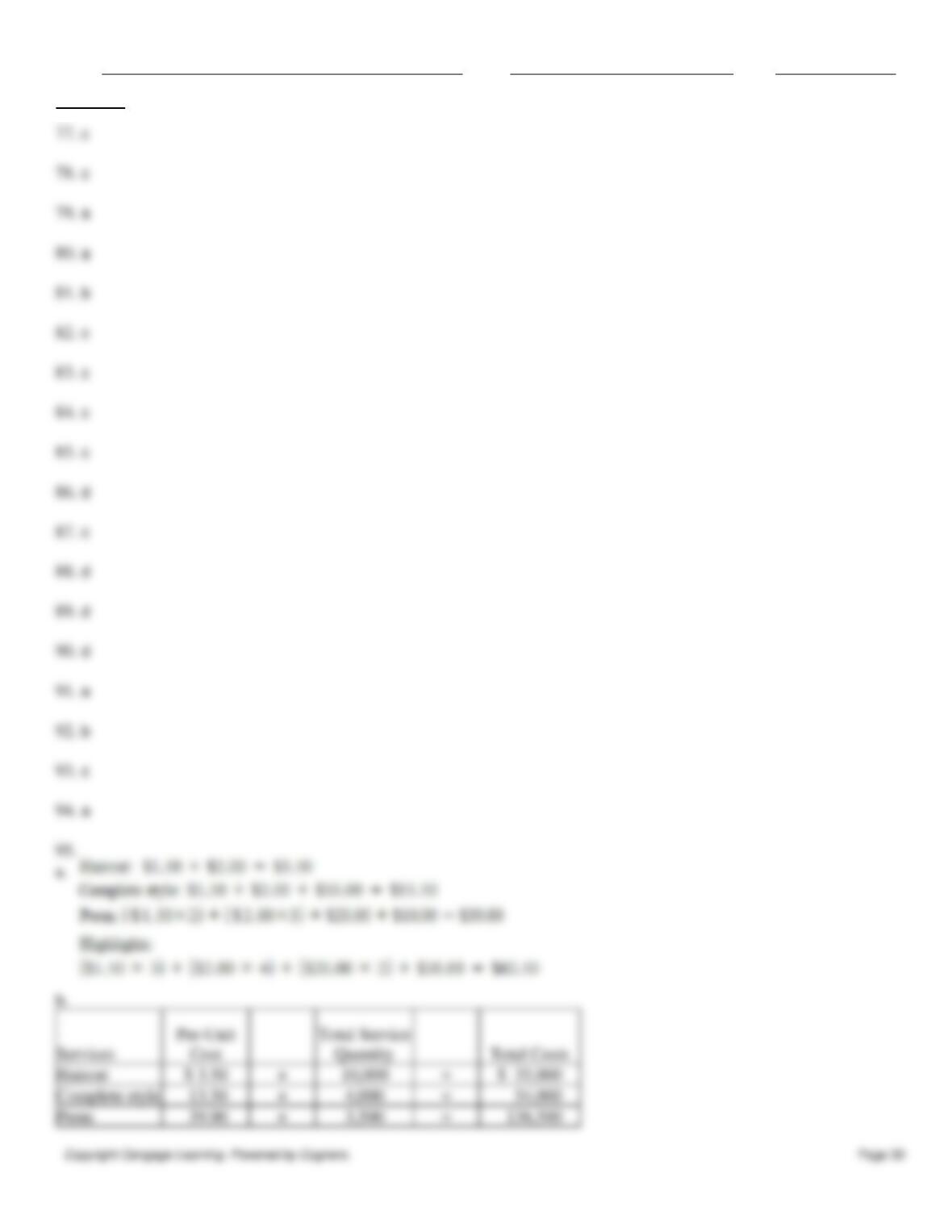
95. Transformations Hair Salon uses an activity-based costing system to determine the cost of services. The salon has
determined the costs of services by activity as follows:
Activity
Activity Rate
Hair washing
$ 1.50
Conditioning
2.00
Chemical treatment
20.00
Styling
10.00
a.
Using the information provided, determine the cost of services for each of the following services provided by the salon:
Hair Washing
Conditioning
Chemical
Treatment
Styling
Haircut
1
1
0
0
Complete style
1
1
0
1
Perm
2
3
1
1
Name:
Class:
Date:
chapter 4
Highlights
3
4
2
1
b..
If the company budgets 10,000 haircuts, 4,000 complete styles, 3,500 perms, and 5,500 highlights, determine the budget for
cost of services.
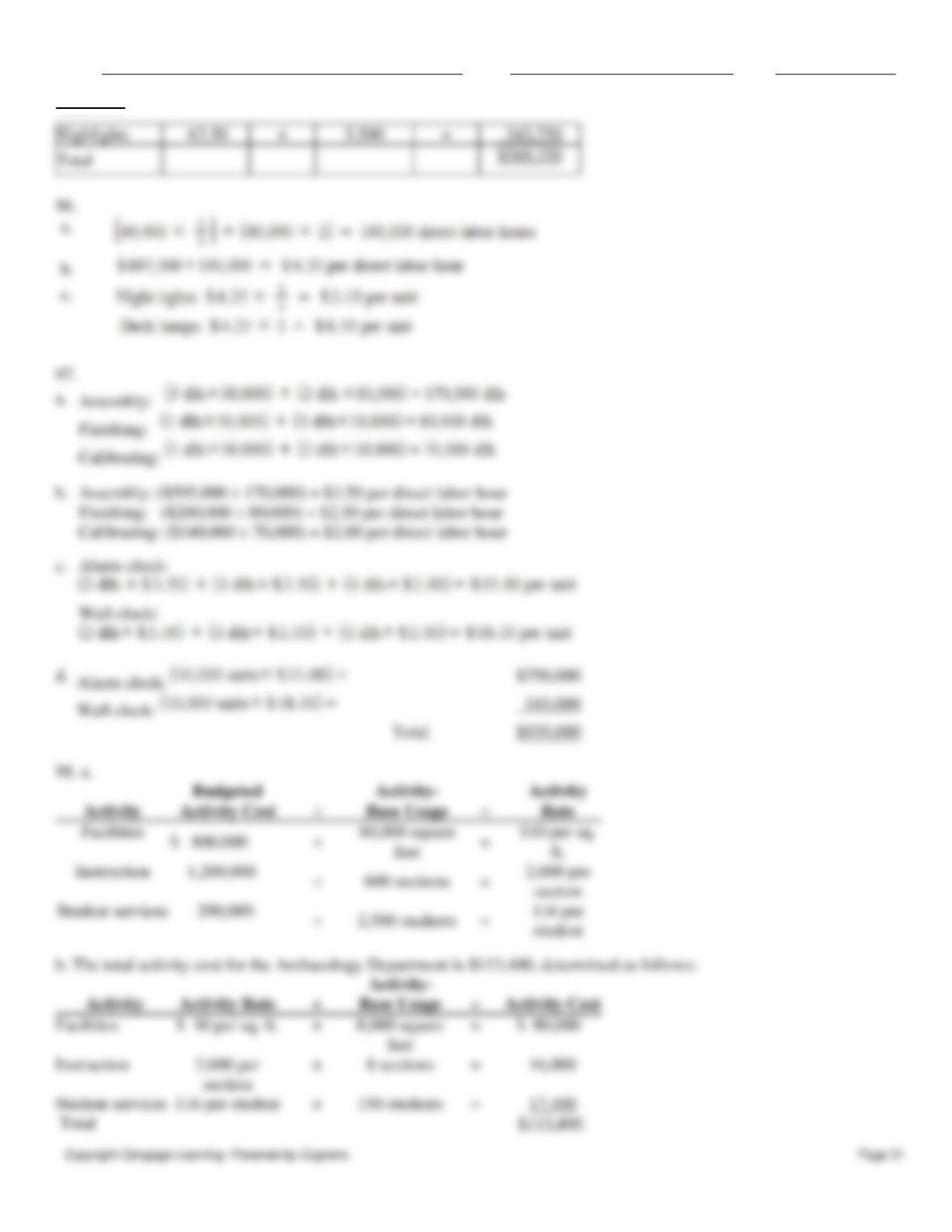
96. The total factory overhead for Big Light Company is budgeted for the year at $807,500. Big Light manufactures two
different products: night lights and desk lamps. Night lights are budgeted for 60,000 units. Each night light requires 1/2
hour of direct labor. Desk lamps are budgeted for 80,000 units. Each desk lamp requires 2 hours of direct labor.
Determine (a) the total number of budgeted direct labor hours for the year, (b) the single plantwide factory overhead rate
using direct labor hours as the allocation base, and (c) the factory overhead allocated per unit for each product using the
single plantwide factory overhead rate determined in (b).
97. Ratchford Clocks manufactures alarm clocks and wall clocks and allocates overhead based on direct labor hours. The
production process is set up in three departments: Assembly, Finishing, and Calibrating. The following is information
regarding the direct labor used to produce one unit of the two clocks:
Per-Unit Hours
Assembly
Finishing
Calibrating
Alarm clocks
3
1
1
Wall clocks
2
3
2
Total direct labor
hours
5
4
3
Factory overhead is budgeted for the year as follows:
Assembly Department
$595,000
Finishing Department
200,000
Calibrating Department
140,000
Total factory overhead
$935,000
Ratchford Clocks is planning to manufacture 50,000 alarm clocks and 10,000 wall clocks during the year.
a.
Determine the total number of direct labor hours that will be needed by each department.
b.
Determine the factory overhead rate by department using the multiple production department factory overhead rate
method.
c.
Determine the amount of factory overhead to be allocated to each unit of alarm clocks and wall clocks.
d.
Determine the amount of total factory overhead to be allocated to the alarm clocks and wall clocks.
98. Troglodyte University uses activity-based costing to assign indirect costs to academic departments, using three
activities. The activity base, budgeted activity cost, and estimated activity-base usage for each activity are identified as
follows:
Activity
Activity Base
Budgeted
Activity Cost
Activity-Base
Usage
Facilities
Square feet
$ 800,000
80,000 square feet
Instruction
Number of course
sections
1,200,000
600 sections
Student services
Number of students
290,000
2,500 students
The activity-base usage associated with the Archaeology and Geology departments is as follows:
Department
Facilities
Instruction
Student Services
Archaeology
8,000 square feet
8 sections
150 students
Geology
5,200 square feet
15 sections
200 students

Name:
Class:
Date:
chapter 4
Determine the:
a. Activity rate for each activity.
b. The total activity cost for the Archaeology Department.
99. Tulip Company produces two products, T and U. The indirect labor costs include the following two items:
Plant supervision
$ 700,000
Setup labor (indirect)
300,000
Total indirect labor
$1,000,000
The following activity-base usage and unit production information is available for the two products:
Number of
Setups
Direct Labor
Hours
Units
Product T
200
20,000
900
Product U
200
30,000
1,100
Totals
400
50,000
2,000
a.
Determine the single plantwide factory overhead rate, using direct labor hours as the activity base.
b.
Determine the factory overhead allocated per unit for Products T and U, using the single plantwide factory overhead rate.
c.
Determine the activity rate for plant supervision and setup labor, assuming that the activity base for supervision is direct labor
hours and the activity base for setup labor is number of setups.
d.
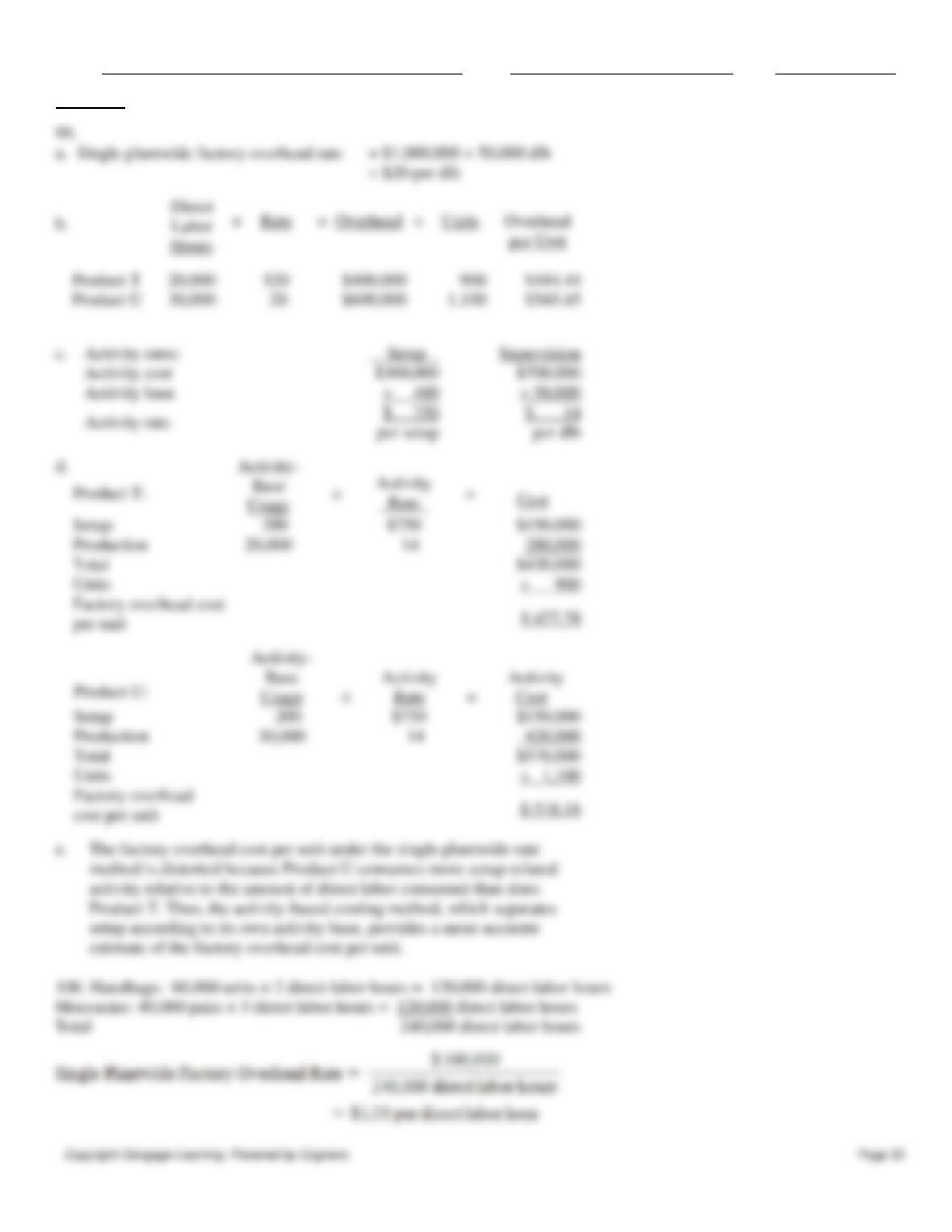
Determine the factory overhead allocated per unit for Products T and U, using the activity-based costing method.
e.
Why is the factory overhead allocated per unit different for the two products under the two methods?
100. Sawtooth Leather Company manufactures leather handbags and moccasins. Total factory overhead is budgeted for
$360,000. For simplicity, the company has decided to use a single plantwide factory overhead rate to allocate factory
overhead based on direct labor hours. Handbags are budgeted for 60,000 units. Each handbag requires 2 hours of direct
labor. Moccasins are budgeted for 40,000 pairs. Each pair of moccasins requires 3 hours of direct labor. Determine the
amount of factory overhead to be allocated per unit(pair) for each product.
101. Shanghai Company sells glasses, fine china, and everyday dinnerware. It uses activity-based costing to determine the
cost of the shipping and handling activity. The shipping and handling activity has an activity rate of $14 per pound. A box
of glasses weighs 2 pounds, a box of fine china weighs 4 pounds, and a box of everyday dinnerware weighs 6 pounds.
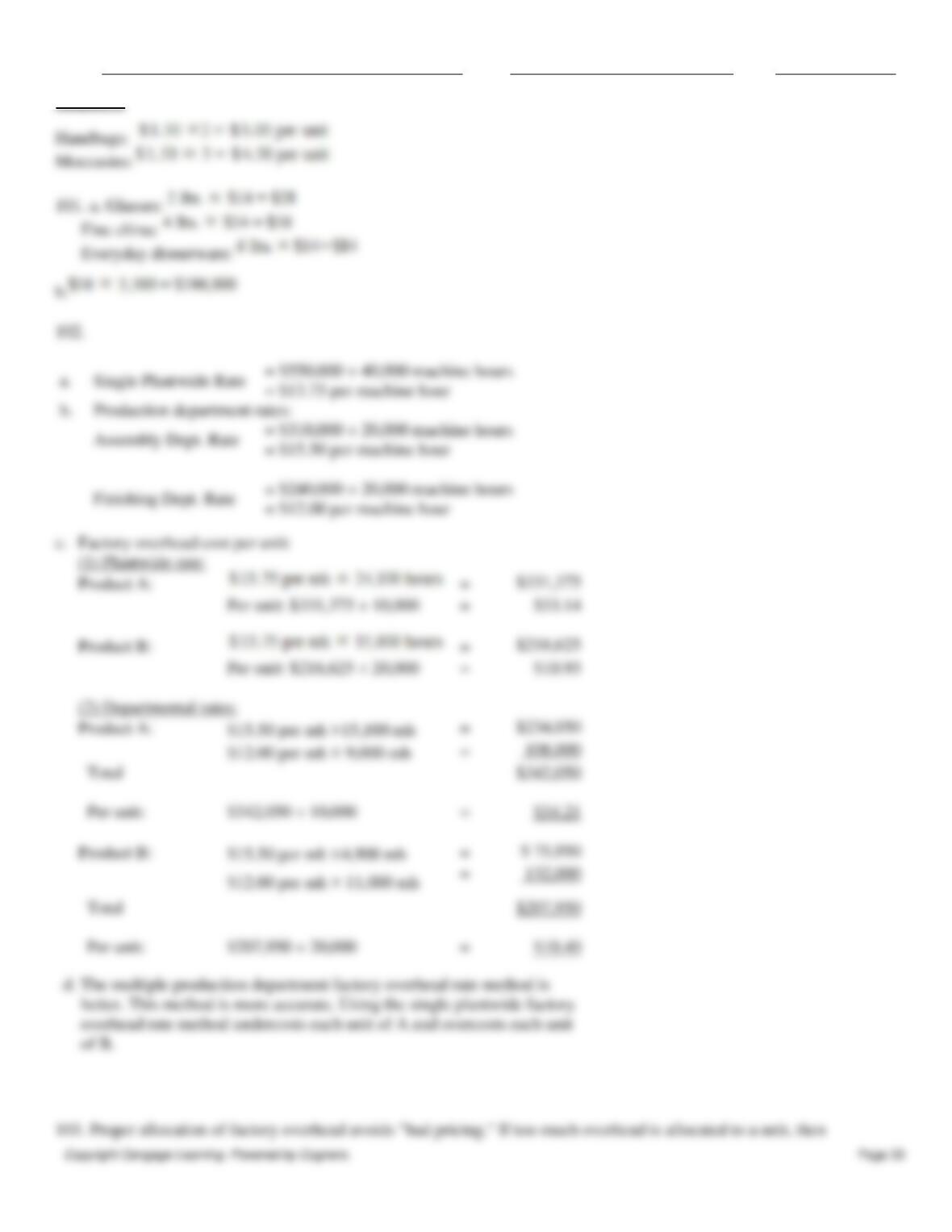
a. Determine the shipping and handling activity cost to be allocated to each unit of product.
b. Determine the total shipping and receiving costs to be allocated to the fine china if 3,500 boxes are shipped.
102. Condoleezza Co. manufactures two products, A and B, in two production departments, Assembly and Finishing.
Condoleezza Co. expects to produce 10,000 units of Product A and 20,000 units of Product B in the coming year.
Budgeted factory overhead costs for the coming year are:
Assembly
$310,000
Finishing
240,000
Total
$550,000
The machine hours expected to be used in the coming year are as follows:
Assembly
Department
Finishing
Department
Product A
15,100
9,000
Product B
4,900
11,000
Total
20,000
20,000
Name:
Class:
Date:
chapter 4
a.
Compute the plantwide factory overhead rate, assuming the single plantwide factory overhead rate method is used.
b.
Compute the production department factory overhead rates, assuming the multiple production department factory overhead
rate method is used.
c.
Compute the factory overhead allocated per unit for each product using (1) the single plantwide rate and (2) production
department factory overhead rates.
d.
Which method is better (single or multiple)? Why?
103. Explain why it is imperative that proper factory overhead be allocated in factories that produce multiple products.
104. Klamath Corp. produces two products: saws and drills. Three activities are used in their manufacture. These activities
and their associated costs and bases are as follows:
Activity
Budgeted Costs
Activity Base
Stamping
$200,000
Machine hours
Assembly
400,000
Labor hours
Setup
30,000
Number of setups
Activity Base
Saws
Drills
Total
Machine hours
4,000
6,000
10,000
Labor hours
7,000
13,000
20,000
Number of setups
3
12
15
Units produced
500
600
a. Determine the activity rate for each activity.
b. Determine the factory overhead to be allocated to each unit of product.
105. Pikes Peak Leather Company manufactures leather handbags and moccasins. The company has been using the single
plantwide factory overhead rate method but has decided to evaluate the activity-based costing method to allocate factory
overhead. The factory overhead estimated per unit together with direct materials and direct labor will help determine
selling prices.
The total budgeted factory overhead cost is $360,000, broken down as follows:
Products
Cutting—
Direct Labor
Hours
Sewing—
Direct Labor
Hours
Setups
QC—
Inspections
Purchase
Orders
Handbags
60,000
60,000
500
200
100
Moccasins
40,000
80,000
300
800
300
Total
100,000
140,000
800
1,000
400
Budget
$40,000
$210,000
$80,000
$20,000
$10,000
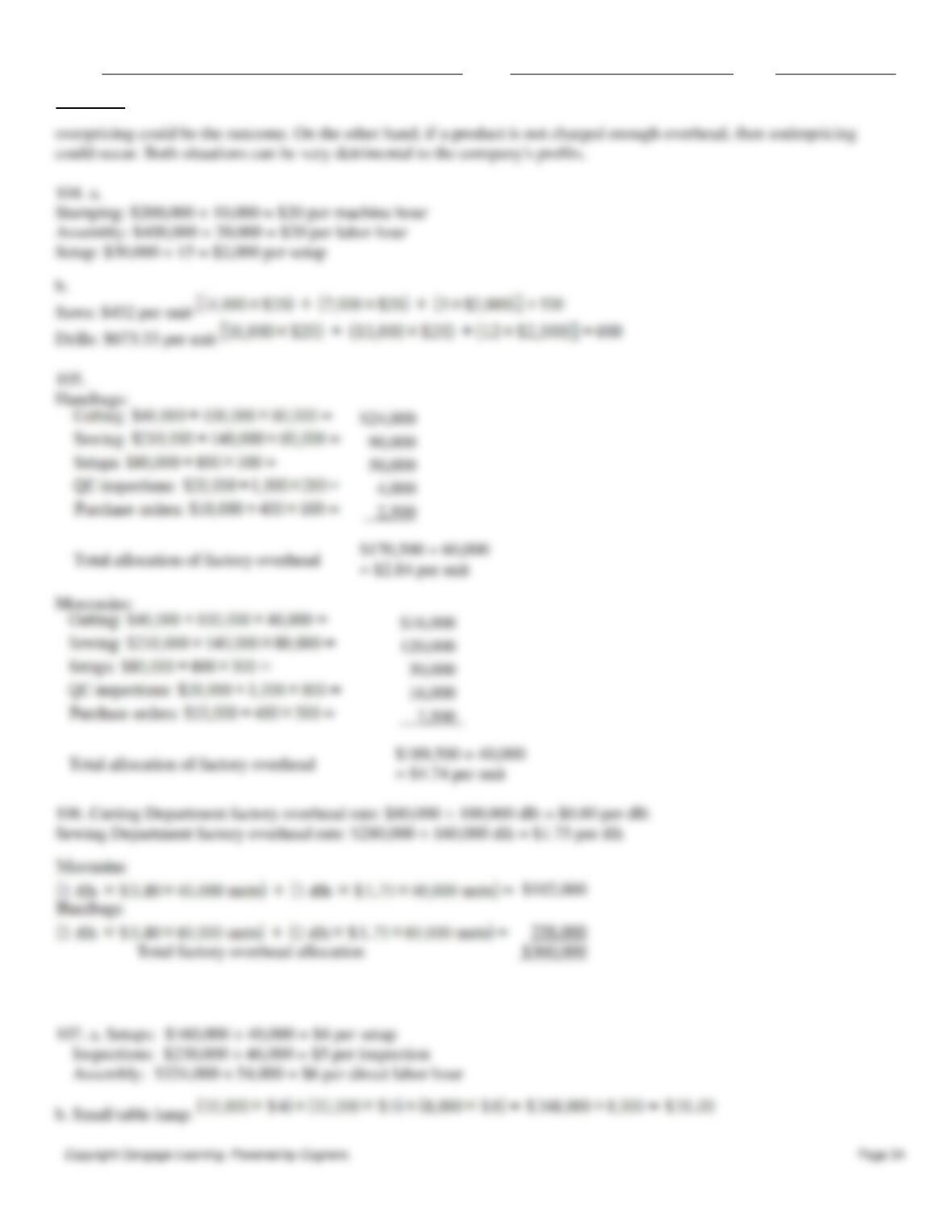
Determine the amount of factory overhead to be allocated to each unit using activity-based costing. The company plans to
produce 60,000 handbags and 40,000 moccasins.
106. Anazi Leather Company manufactures leather handbags and moccasins. The company has been using the single
plantwide factory overhead rate method but has decided to evaluate the multiple production department factory overhead
rate method to allocate factory overhead. The factory overhead estimated per unit together with direct materials and direct
labor will help determine selling prices.
Handbags = 60,000 units, 3 hours of direct labor
Moccasins= 40,000 units, 2 hours of direct labor
Name:
Class:
Date:
chapter 4
Total budgeted factory overhead cost = $360,000
The company has two different production departments: Cutting and Sewing. The Cutting Department has a factory
overhead budget of $80,000. Each unit will require 1 direct labor hour or a total of 100,000 direct labor hours.
The Sewing Department estimates factory overhead in the amount of $280,000. Handbags require 2 hours of sewing time,
and Moccasins require 1 hour for a total of 160,000 direct labor hours.
Using the multiple production department factory overhead rate method, compute the total factory overhead to be
allocated to each product using direct labor hours as the allocation base.
107. Valhalla Company manufactures small table lamps and desk lamps. The following shows the activities per product:
Units
Setups
Inspections
Assembly (dlh)
Small table lamps
8,000
10,000
32,000
8,000
Desk lamps
16,000
30,000
14,000
46,000
Using the following information prepared by Valhalla Company, determine (a) the activity rates for each activity and (b)
the activity-based factory overhead per unit for each product.
Activity
Total Activity-Base
Usage
Budgeted Activity Cost
Setups
40,000
$160,000
Inspections
46,000
230,000
Assembly (dlh)
54,000
324,000
108. Kettle Factory produces two similar products: gloves and mittens. The total factory overhead budget is $1,050,000
with 600,000 estimated direct labor hours. It is further estimated that glove production will require 375,000 direct labor
hours and mitten production will require 225,000 direct labor hours.
a.
Determine the single plantwide factory overhead rate based on direct labor hours.
b.
How much is the factory overhead cost per pair of gloves if each pair requires 2 hours to produce?
c.
How much is the factory overhead cost per pair of mittens if each pair takes 1.5 hours to produce?
d.
How much total factory overhead will be allocated to glove production if 187,500 pairs are budgeted and 190,000 pairs are
actually produced during the period?
e.
How much total factory overhead will be allocated to mitten production if 150,000 pairs are budgeted and 140,000 pairs are
actually produced during the period?
109. Camper’s Edge Factory produces two products: canopies and tents. The total factory overhead is budgeted at
$750,000 for the year, divided between two departments: Cutting, $350,000, and Sewing, $400,000. Each canopy requires
2 direct labor hours in Cutting and 1 direct labor hour in Sewing. Each tent requires 1 direct labor hour in Cutting and 6
direct labor hours in Sewing. Production for the year is budgeted for 20,000 canopies and 10,000 tents. Determine the:
a. Total number of budgeted direct labor hours for the year in each department.
b. Departmental factory overhead rate for each department.
c. Factory overhead allocated per unit of each product, using the departmental factory overhead rates determined in (b).
110. Bugaboo Co. manufactures three types of cookies: Fluffs, Crinkles, and Snaps. The production process is relatively
simple, and factory overhead costs are allocated to products using a single plantwide factory overhead rate based on direct
labor hours. Information for the month of May, Bugaboo’s first month of operations, follows:
Budgeted
Unit Volume
Direct Labor
Hours per Unit
Name:
Class:
Date:
chapter 4
Fluffs
80,000 boxes
0.10
Crinkles
60,000 boxes
0.20
Snaps
20,000 boxes
0.50
Bugaboo has budgeted direct labor costs for May at $8.50 per hour. Budgeted direct materials costs for May are: Fluffs,
$0.75/unit; Crinkles $0.40/unit; and Snaps $0.30/unit.
Bugaboo’s budgeted overhead costs for May are:
Indirect labor
$280,000
Utilities
65,000
Supplies
45,000
Depreciation
30,000
Total
$420,000
a.
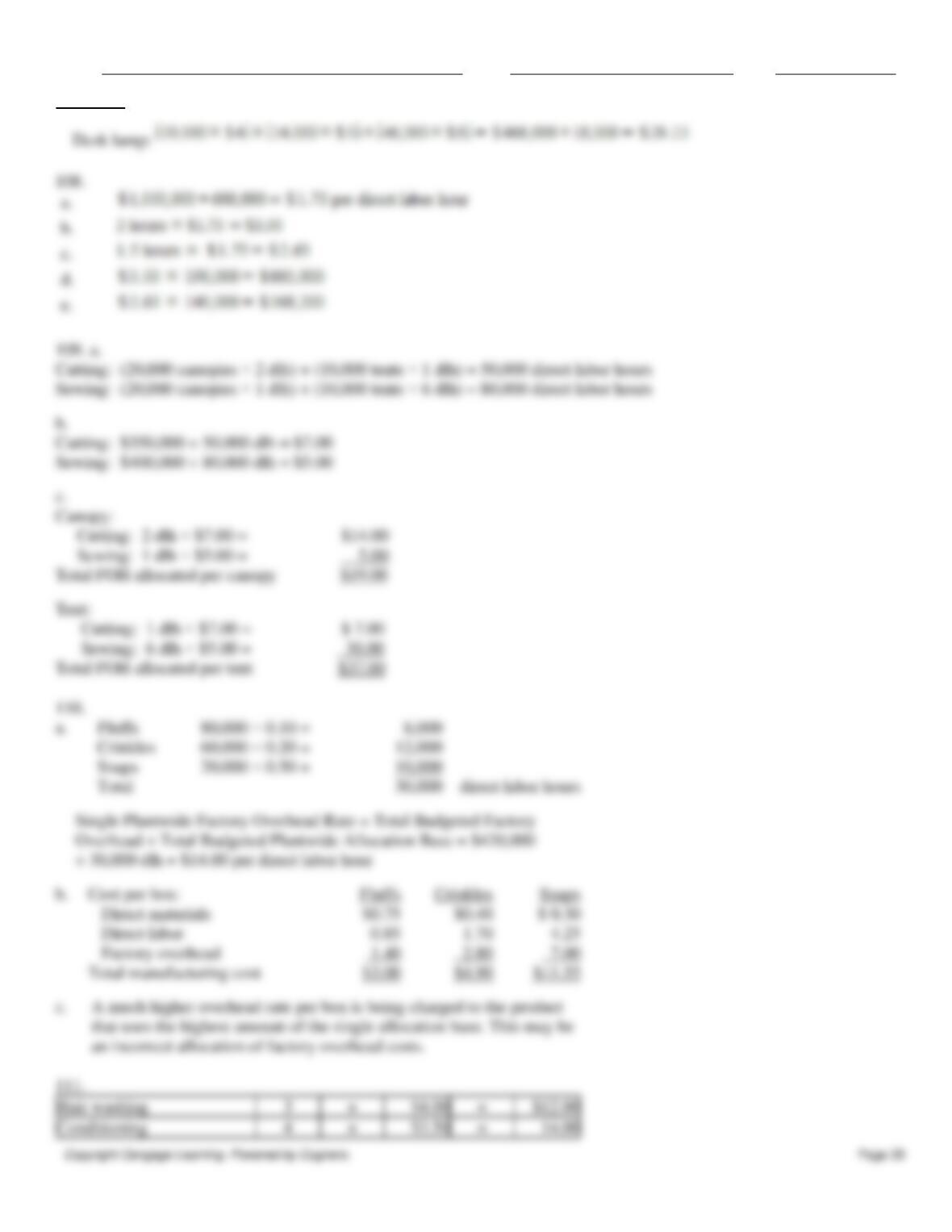
Compute Bugaboo’s plantwide factory overhead rate for May.
b.
Compute the product cost in May for each type of cookie.
c.
Does Bugaboo’s use of a plantwide factory overhead rate in any way distort the
product costs for May?
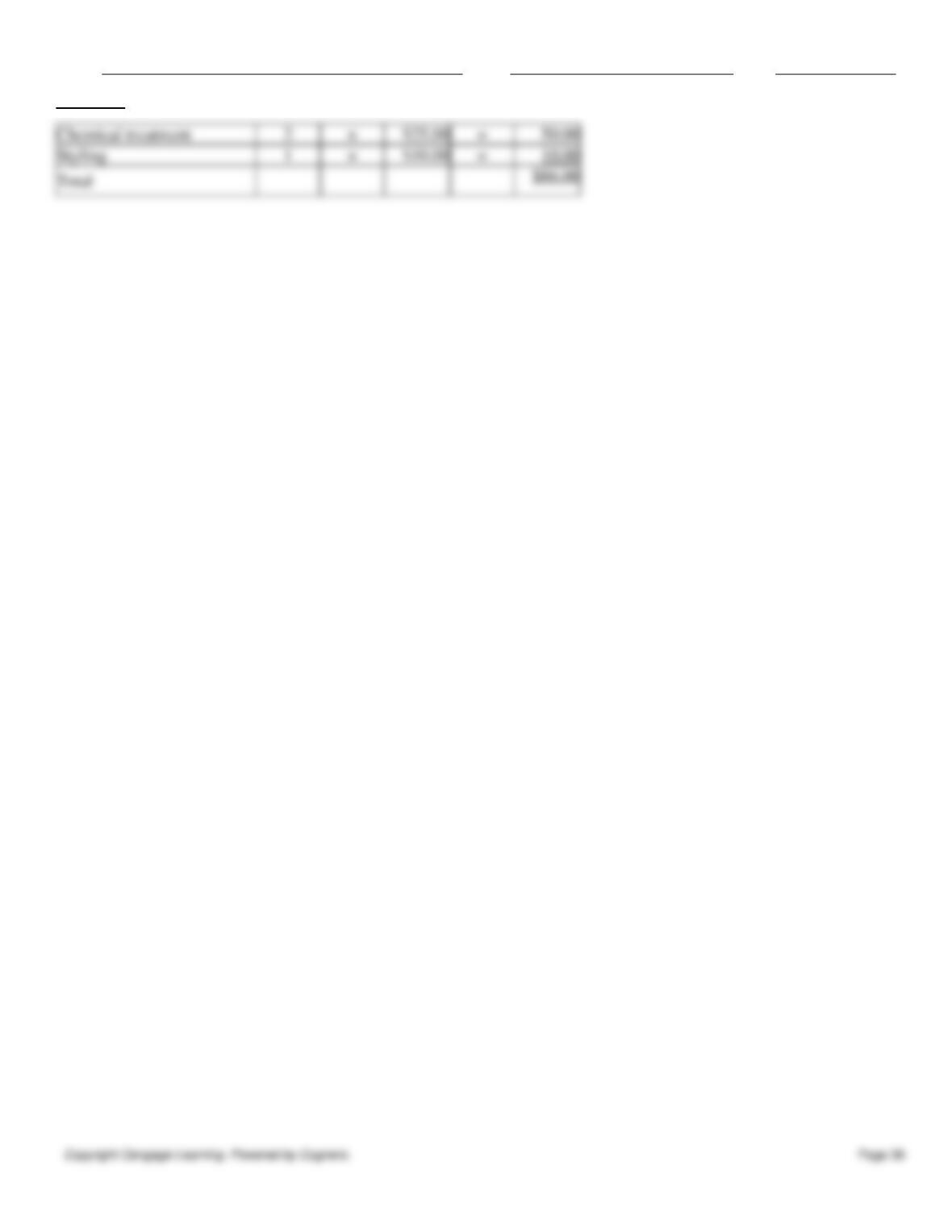
Beauty Beyond Words Salon uses an activity-based costing system to determine the cost of services. The salon has
determined the costs of services by activity and activity usage as follows:
Activity
Activity Rate
Hair washing
$ 4.00
Conditioning
3.50
Chemical treatment
25.00
Styling
10.00
Hair Washing
Conditioning
Chemical
Treatment
Styling
Haircut
1
1
0
0
Complete style
1
1
0
1
Perm
2
3
1
1
Highlights
3
4
2
1
111. Determine the cost of services for a highlight.
Name:
Class:
Date:
chapter 4
Answer Key
Name:
Class:
Date:
chapter 4
Name:
Class:
Date:
chapter 4
Name:
Class:
Date:
chapter 4
Name:
Class:
Date:
chapter 4
Name:
Class:
Date:
chapter 4
Name:
Class:
Date:
chapter 4
Name:
Class:
Date:
chapter 4
Name:
Class:
Date:
chapter 4
Name:
Class:
Date:
chapter 4