146) On September 12, Vander Company sold merchandise in the amount of $5,800 to Jepson
Company, with credit terms of 2/10, n/30. The cost of the items sold is $4,000. Vander uses the
periodic inventory system and the gross method of accounting for sales. On September 14,
Jepson returns some of the merchandise. The selling price of the merchandise is $500 and the
cost of the merchandise returned is $350. Jepson pays the invoice on September 18, and takes the
appropriate discount. The journal entry that Vander makes on September 18 is:
A)
Cash
5,800
Accounts receivable
5,800
B)
Cash
4,000
Accounts receivable
4,000
C)
Cash
5,194
Sales discounts
106
Accounts receivable
5,300
D)
Cash
5,684
Accounts receivable
5,684
E)
Cash
5,684
Sales discounts
116
Accounts receivable
5,800
147) Cushman Company had $800,000 in net sales, $350,000 in gross profit, and $200,000 in
operating expenses. Cost of goods sold equals:
A) $150,000.
B) $450,000.
C) $800,000.
D) $350,000.
E) $200,000.
148) Cushman Company had $800,000 in sales, sales discounts of $12,000, sales returns and
allowances of $18,000, cost of goods sold of $380,000, and $275,000 in operating expenses.
Gross profit equals:
A) $770,000.
B) $115,000.
C) $390,000.
D) $402,000.
E) $408,000.
149) Cushman Company had $800,000 in sales, sales discounts of $12,000, sales returns and
allowances of $18,000, cost of goods sold of $380,000, and $275,000 in operating expenses. Net
income equals:
A) $770,000.
B) $402,000.
C) $390,000.
D) $115,000.
E) $408,000.
150) A company purchased $10,000 of merchandise on June 15 with terms of 3/10, n/45. On
June 20, it returned $800 of that merchandise. On June 24, it paid the balance owed for the
merchandise taking any discount it was entitled to. The cash paid on June 24 equals:
A) $8,924.
B) $9,700.
C) $10,000.
D) $9,800.
E) $8,724.
151) A company purchased $10,000 of merchandise on June 15 with terms of 3/10, n/45, and
FOB shipping point. The freight charge, $500, was added to the invoice amount. On June 20, it
returned $800 of that merchandise. On June 24, it paid the balance owed for the merchandise
taking any discount it is entitled to. The cash paid on June 24 equals:
A) $9,224.
B) $10,200.
C) $10,500.
D) $10,300.
E) $9,424.
152) A company’s current assets are $23,420, its quick assets are $13,890 and its current
liabilities are $12,220. Its acid-test ratio equals:
A) 0.88.
B) 1.91.
C) 1.14.
D) 0.52.
E) 1.41.
153) Using the following year-end information for Bauman, LLC, calculate the current ratio and
acid-test ratio:
Cash
$
48,000
Short-term investments
12,000
Accounts receivable
45,000
Inventory
225,000
Prepaid expenses
12,500
Accounts payable
86,500
Other current payables
22,000
A) 3.01 and 1.21
B) 3.16 and 0.97
C) 3.04 and 1.21
D) 1.09 and 4.77
E) 3.16 and 1.21
154) A company’s net sales are $775,420, its costs of goods sold are $413,890, and its net
income is $117,220. Its gross margin ratio equals:
A) 46.6%.
B) 53.4%.
C) 28.3%.
D) 31.5%.
E) 40.5%.
155) Which of the following statements related to the multiple-step income statement is not true?
A) Subtotals for total selling expenses and general and administrative expenses are reported.
B) Interest revenue is included with other revenue and gains.
C) The first section of the statement reports gross profit.
D) Shows only one total for expenses.
E) Nonoperating items are reported separately from operations.
156) A company purchases merchandise with a catalog price of $20,000. The company receives
a 35% trade discount from the seller. The seller also offers credit terms of 2/10, n/30. Assuming
no returns were made and that payment was made within the discount period, what is the net cost
of the merchandise?
A) $13,720.
B) $19,600.
C) $6,860.
D) $13,000.
E) $12,740.
157) A company has net sales of $825,000 and cost of goods sold of $547,000. Its net income is
$98,500. The company’s gross margin and operating expenses, respectively, are:
A) $209,000 and $191,470.
B) $278,000 and $179,500.
C) $278,000 and $98,500.
D) $179,500 and $98,500.
E) $645,500 and $179,500.
158) On March 12, Klein Company sold merchandise in the amount of $7,800 to Babson
Company, with credit terms of 2/10, n/30. The cost of the items sold is $4,500. Klein uses the
perpetual inventory system and the gross method of accounting for sales. The journal entry or
entries that Klein will make on March 12 is (are):
A)
Sales
7,800
Accounts receivable
7,800
B)
Sales
7,800
Accounts receivable
7,800
Cost of goods sold
4,500
Merchandise Inventory
4,500
C)
Accounts receivable
7,800
Sales
7,800
D)
Accounts receivable
7,800
Sales
7,800
Cost of goods sold
4,500
Merchandise Inventory
4,500
E)
Accounts receivable
4,500
Sales
4,500
159) On March 12, Klein Company sold merchandise in the amount of $7,800 to Babson
Company, with credit terms of 2/10, n/30. The cost of the items sold is $4,500. Klein uses the
perpetual inventory system and the gross method of accounting for sales. Babson pays the
invoice on March 17, and takes the appropriate discount. The journal entry that Klein makes on
March 17 is:
A)
Cash
7,800
Accounts receivable
7,800
B)
Cash
4,500
Accounts receivable
4,500
C)
Cash
7,644
Sales discounts
156
Accounts receivable
7,800
D)
Cash
7,644
Accounts receivable
7,644
E)
Cash
4,410
Sales discounts
90
Accounts receivable
4,500
160) On March 12, Klein Company sold merchandise in the amount of $7,800 to Babson
Company, with credit terms of 2/10, n/30. The cost of the items sold is $4,500. Klein uses the
perpetual inventory system and the gross method of accounting for sales. On March 15, Babson
returns some of the merchandise, which is not defective. The selling price of the returned
merchandise is $600 and the cost of the merchandise returned is $350. The entry or entries that
Klein must make on March 15 is (are):
A)
Sales returns and allowances
600
Accounts receivable
600
Merchandise inventory
350
Cost of goods sold
350
B)
Sales returns and allowances
600
Accounts receivable
600
C)
Accounts receivable
600
Sales returns and allowances
600
D)
Accounts receivable
600
Sales returns and allowances
600
Cost of goods sold
350
Merchandise inventory
350
E)
Sales returns and allowances
350
Accounts receivable
350
161) On March 12, Klein Company sold merchandise in the amount of $7,800 to Babson
Company, with credit terms of 2/10, n/30. The cost of the items sold is $4,500. Klein uses the
perpetual inventory system and the gross method of accounting for sales. On March 15, Babson
returns some of the merchandise. The selling price of the merchandise is $600 and the cost of the
merchandise returned is $350. Babson pays the invoice on March 20, and takes the appropriate
discount. The amount that Klein receives from Babson on March 20 is:
A) $7,800.
B) $7,644.
C) $7,044.
D) $7,056.
E) $7,200.
162) On March 12, Klein Company sold merchandise in the amount of $7,800 to Babson
Company, with credit terms of 2/10, n/30. The cost of the items sold is $4,500. Klein uses the
perpetual inventory system and the gross method of accounting for sales. On March 15, Babson
returns some of the merchandise. The selling price of the merchandise is $600 and the cost of the
merchandise returned is $350. Babson pays the invoice on March 20, and takes the appropriate
discount. The journal entry that Klein makes on March 20 is:
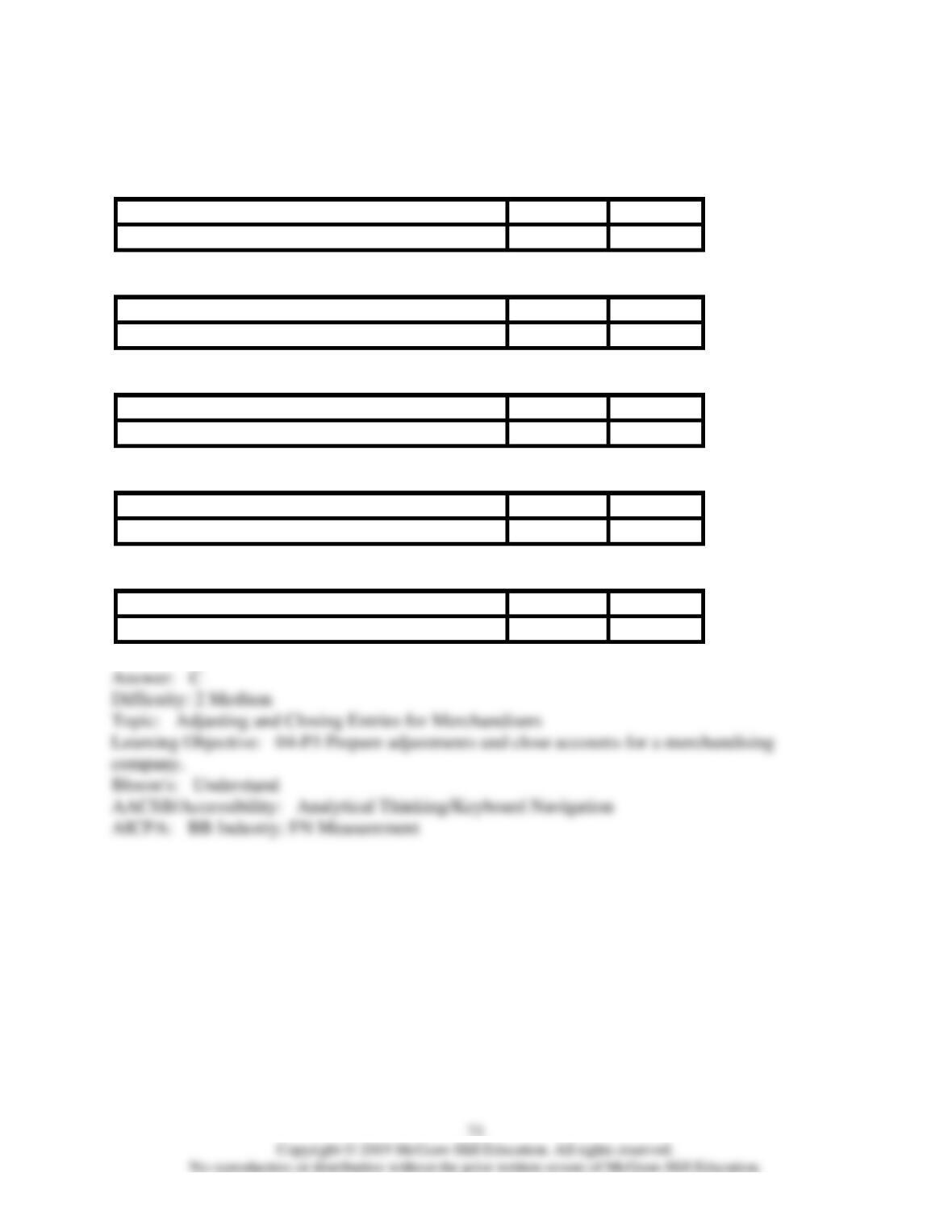
A)
Cash
7,800
Accounts receivable
7,800
B)
Cash
4,500
Accounts receivable
4,500
C)
Cash
7,056
Sales discounts
144
Accounts receivable
7,200
D)
Cash
7,056
Accounts receivable
7,056
E)
Cash
7,644
Sales discounts
156
Accounts receivable
7,800
163) Zenith Company’s Merchandise Inventory account at year-end has a balance of $91,820, but
a physical count reveals that only $90,450 of inventory exists. The adjusting entry to record this
$1,370 of inventory shrinkage is:
A)
Merchandise inventory
1,370
Inventory shrinkage expense
1,370
B)
Purchases discounts
1,370
Cost of goods sold
1,370
C)
Cost of goods sold
1,370
Merchandise inventory
1,370
D)
Inventory shrinkage expense
1,370
Cost of goods sold
1,370
E)
Cost of goods sold
90,450
Merchandise inventory
90,450
164) Which of the following statements regarding sales returns and allowances is not true?
A) New revenue recognition rules require sellers to report sales net of expected returns and
allowances for annual periods.
B) The Inventory Returns Estimated account is a current liability account.
C) Sales returns and allowances estimates are typically made as period-end adjustments.
D) When sales returns and allowances adjustments are made to sales, an estimate must also be
made for the cost side.
E) Sales Refund Payable is a current liability account.
165) In its first year of business, Borden Corporation had sales of $2,000,000 and cost of goods
sold of $1,200,000. Borden expects returns in the following year to equal 8% of sales. The
adjusting entry or entries to record the expected sales returns is (are):
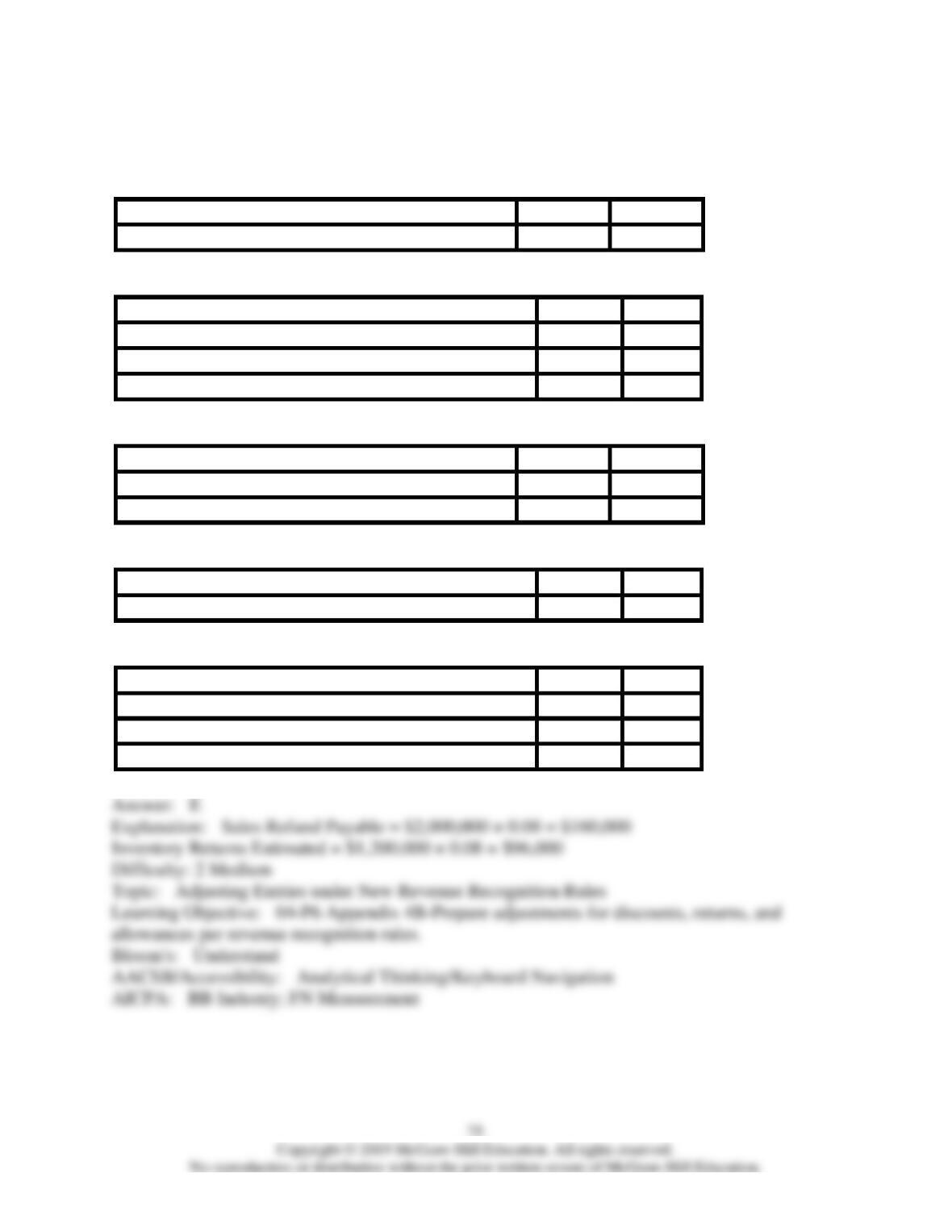
A)
Accounts Receivable
2,000,000
Sales
2,000,000
B)
Sales returns and allowances
160,000
Sales
160,000
Cost of Goods Sold
96,000
Inventory Returns Estimated
96,000
C)
Sales
2,000,000
Sales Refund Payable
160,000
Accounts receivable
1,840,000
D)
Sales Refund Payable
160,000
Accounts receivable
160,000
E)
Sales Returns and Allowances
160,000
Sales Refund Payable
160,000
Inventory Returns Estimated
96,000
Cost of goods sold
96,000
166) In the current year, Borden Corporation had sales of $2,000,000 and cost of goods sold of
$1,200,000. Borden expects returns in the following year to equal 8% of sales. The unadjusted
balance in Inventory Returns Estimated is a debit of $6,000, and the unadjusted balance in Sales
Refund Payable is a credit of $10,000. The adjusting entry or entries to record the expected sales
returns is (are):
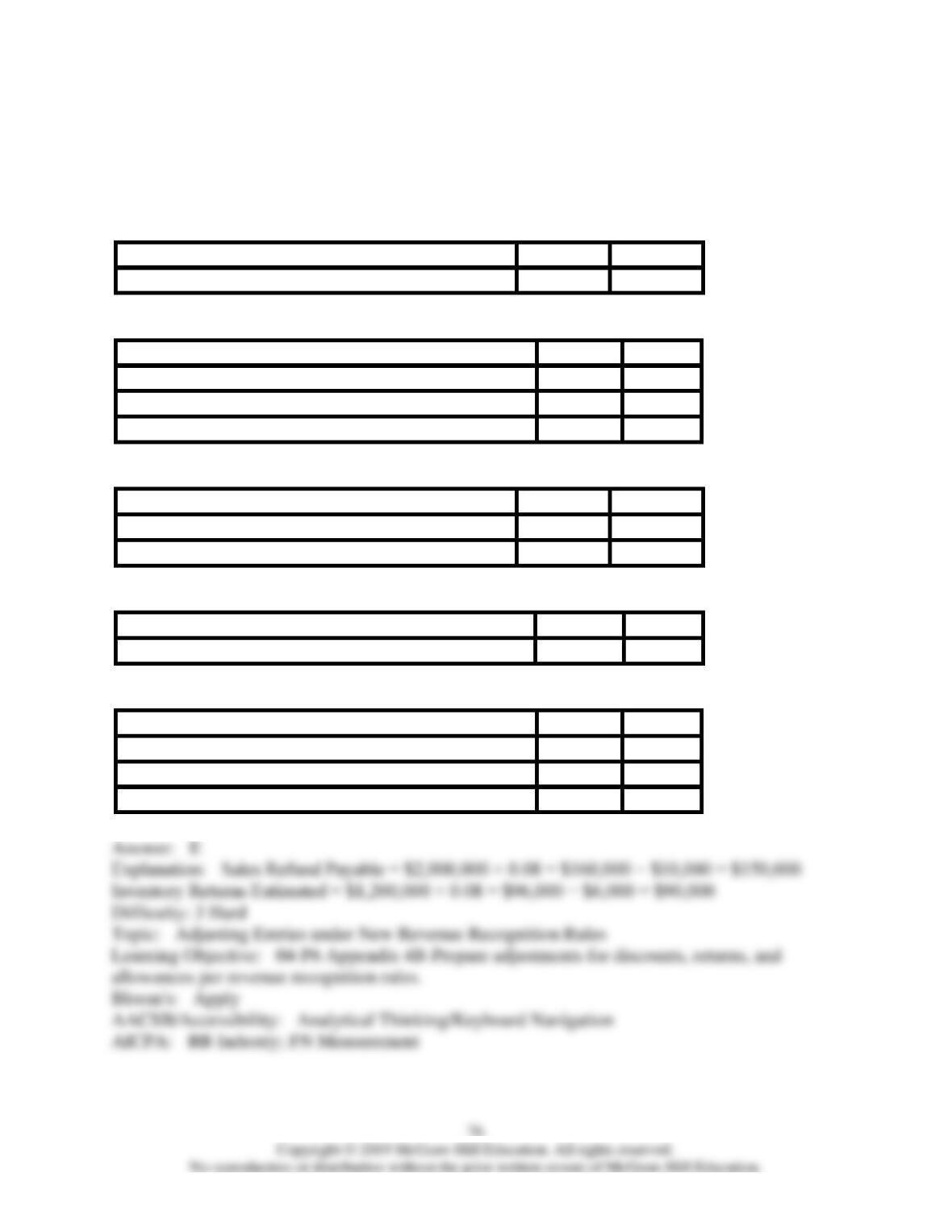
A)
Accounts Receivable
2,000,000
Sales
2,000,000
B)
Sales returns and allowances
150,000
Sales
150,000
Cost of Goods Sold
90,000
Inventory Returns Estimated
90,000
C)
Sales
2,000,000
Sales Refund Payable
160,000
Accounts receivable
1,840,000
D)
Sales Refund Payable
150,0000
Accounts receivable
150,000
E)
Sales Returns and Allowances
150,000
Sales Refund Payable
150,000
Inventory Returns Estimated
90,000
Cost of goods sold
90,000
167) Netherland Corporation has the following unadjusted balances: Accounts Receivable,
$80,000 (debit), and Allowance for Sales Discounts $300 (credit). Of the receivables, $50,000 of
them are within the 2% discount period, and Netherland expects buyers to take $1,000 in future-
period discounts ($50,000 × 2%) arising from this period’s sales. The adjusting entry or entries to
estimate sales discounts is (are):
A)
Accounts Receivable
80,000
Sales
80,000
B)
Sales Discounts
50,000
Sales
50,000
Cost of Goods Sold
1,000
Inventory Returns Estimated
1,000
C)
Sales Discounts
700
Allowance for Sales Discounts
700
D)
Sales Discounts
1,000
Accounts receivable
1,000
E)
Sales Discounts
1,000
Allowance for Sales Discounts
1,000
168) An expense resulting from failing to take advantage of cash discounts when using the net
method of recording purchases is called:
A) Sales discounts.
B) Trade discounts.
C) Purchases discounts.
D) Discounts lost.
E) Discounts earned.
169) A company that uses the net method of recording purchases and a perpetual inventory
system purchased $1,800 of merchandise on July 5 with terms 2/10, n/30. On July 7, it returned
$200 worth of merchandise. On July 28, it paid the full amount due. The correct journal entry to
record the payment on July 28 is:
A) Debit Merchandise Inventory $1,600; credit Cash $1,600.
B) Debit Cash $1,600; credit Accounts Payable $1,600.
C) Debit Accounts Payable $1,600; credit Merchandise Inventory $32; credit Cash $1,568.
D) Debit Accounts Payable $1,800; credit Cash $1,800.
E) Debit Accounts Payable $1,568; debit Discounts Lost $32; credit Cash $1,600.
170) Morgan, Inc. uses a perpetual inventory system and the net method of recording purchases.
On May 12, a merchandise purchase of $15,000 was made on credit, 2/10, n/30. The journal
entry to record this purchase is:
A)
Merchandise Inventory
15,000
Accounts Payable
15,000
B)
Accounts Payable
15,000
Merchandise Inventory
15,000
C)
Purchases
15,000
Accounts Payable
15,000
D)
Purchases
14,700
Accounts Payable
14,700
E)
Merchandise Inventory
14,700
Accounts Payable
14,700
171) The net method of recording purchases refers to recording:
A) Purchases at the invoice price less any cash discounts.
B) Specified amounts and timing of payments that a buyer agrees to in return for being granted
credit.
C) Purchases at the full invoice price, without deducting any cash discounts.
D) Inventory at its selling price.
E) Inventory at the lower of cost or market.