Chapter 4
77. The predetermined overhead rate is usually calculated
a. at the end of each month.
b. at the beginning of each month.
c. at the beginning of the year.
d. at the end of the year.
78. A normal job-order costing system is a system that uses:
a. actual costs for direct materials and estimated costs for direct labor and overhead.
b. estimated costs for direct materials, direct labor, and overhead.
c. actual costs for direct materials and direct labor and estimated costs for overhead.
d. actual costs for direct materials and overhead, estimated costs for direct labor.
Chapter 4
79. The Kraig Corporation manufactures custom-made purses. The following data pertains to Job XY5:
Direct materials placed into production $4,000
Direct labor hours worked 50 hours
Direct labor rate per hour $15
Machine hours worked 100 hours
Plantwide overhead is applied using a plant-wide rate based on direct labor hours. Plantwide overhead was budgeted at
$60,000 for the year and the direct labor hours were estimated to be 15,000. Job XY5 consists of 50 units. What is
overhead cost assigned to Job XY5?
a. $200
b. $400
c. $750
d. $1,500
80. Carlson Company uses a predetermined rate to apply overhead. At the beginning of the year, Carlson estimated its
overhead costs at $240,000, direct labor hours at 40,000, and machine hours at 10,000. Actual overhead costs incurred
were $249,280, actual direct labor hours were 41,000, and actual machine hours were 11,000.
If the predetermined overhead rate is based on machine hours, what is the total amount credited to the plantwide overhead
account for the year for Carlson?
a. $249,280
b. $246,000
c. $240,000
d. $264,000
Chapter 4
81. A _____ is subsidiary to the work-in-process account and is the primary document for accumulating all costs related
to a particular task.
a. job-order cost sheet
b. labor details form
c. time ticket
d. materials requisition form
e. None of these are correct.
82. Which of the following is true about the job-order cost sheet?
a. It is prepared for every job.
b. It is subsidiary to the work-in–process account.
c. It is the primary document for accumulating all costs related to a particular job.
d. It contains all information pertinent to a job.
Chapter 4
e. All of these are correct.
83. A time ticket does not include the _____.
a. signature of the department supervisor
b. wage rate of an employee
c. hours worked on each job
d. cost of materials used for a job
e. number of the job
84. The cost of direct materials is assigned to a job by the use of a source document known as a _____.
a. time ticket
b. materials requisition form
Chapter 4
c. schedule of cost of goods manufactured
d. sales receipt
e. All of these are correct.
85. A source document that would not be used to help decide the cost of a job when using normal costing is (are)
a. a material requisition form.
b. a time ticket for direct labor.
c. a time ticket for indirect labor.
d. a material requisition form and a time ticket for direct labor.
e. all items listed are helpful to decide the cost of a job.
86. Which of the following costs is not included on a job-order cost sheet?
Chapter 4
a. direct material costs
b. applied plantwide overhead costs
c. direct labor costs
d. actual plantwide overhead costs
87. What items may be on a materials requisition form to maintain proper control over a firm’s inventory of direct
materials?
a. cost of supplies
b. cost of lubricants for production machinery
c. the date and a signature
d. All of these are correct.
e. None of these are correct.
Chapter 4
88. Which of the following is only filled by direct laborers?
a. A time ticket
b. A materials requisition form
c. An activity card
d. A sales receipt
e. A cost slip
89. All completed job-order cost sheets of a firm can serve as a subsidiary ledger for the:
a. raw materials.
b. purchase orders.
c. work-in-process inventory.
d. finished goods inventory.
e. damaged inventory.
Chapter 4
90. Which of the following statements is true?
a. There will be many different jobs on a job-order cost sheet.
b. Direct labor is allocated to jobs along with overhead using a cost driver.
c. Work-in-process consists of all complete work.
d. Time tickets are used to post the cost of direct labor to individual jobs.
e. None of these.
91. Which of the following is reflected in the labor cost flows of a company?
a. Direct labor cost
b. Overtime labor cost
c. Administration cost
d. Both indirect and direct labor cost
e. Administration cost and indirect cost
Chapter 4
92. Sanders Manufacturing has the following amounts listed before reconciling the overhead variance.
Estimated overhead $760,000
Applied overhead 756,000
Actual overhead 740,000
Cost of goods sold 935,000
Assuming that any overhead variance is immaterial, calculate the adjusted Cost of Goods Sold after adjusting for the
overhead variance.
a. $919,000
b. $951,000
c. $939,000
d. $955,000
e. $915,000
93. Which of the following is true about normal costing?
a. Actual overhead costs are not assigned directly to jobs in normal costing.
b. Normal costing does not solve the problems associated with actual costing.
c. The applied overhead is not calculated on a job specific basis in normal costing.
d. Normal costing uses only the indirect costs of direct materials.
e. All of these are correct.
Chapter 4
94. Using normal costing, which costs never enter the work-in-process account?
a. applied overhead
b. actual overhead
c. direct materials
d. direct labor
e. None of these.
95. Which of the following is false about actual overhead while using normal costing?
a. Actual overhead is recorded to the overhead control account during the period.
b. If the actual overhead is greater than the applied overhead then the overhead is underapplied
c. Overhead variance is the difference between actual overhead and applied overhead.
Chapter 4
d. It is divided into many smaller accounts such as indirect labor, supplies, etc.
e. None of these.
96. When a job is completed but not sold, the accounts affected are
a. Raw Materials and Work-in-Process.
b. Work-in-Process and Finished Goods.
c. Work-in-Process and Cost of Goods Sold.
d. Finished Goods and Cost of Goods Sold.
e. Finished Goods and Overhead Control.
97. Which of the following schedules is prepared to maintain accuracy in computing product costs?
a. The schedule of the cost of goods manufactured
Chapter 4
b. The schedule of the finished goods
c. The schedule of the goods under production
d. The schedule of overhead
e. None of the schedules listed here.
98. Which account can sometimes be skipped when a good is produced for a particular customer?
a. raw materials
b. work-in-process
c. finished goods
d. cost of goods sold
e. accounts can never be skipped
Chapter 4
99. Which of the following is the order in which cost elements flow through accounts until they are recognized as an
expense?
a. Work-in-Process, Finished Goods, Cost of Goods Sold
b. Raw Materials, Work-in-Process, Purchase Returns
c. Finished Goods, Cost of Goods Sold, Work-in–Process
d. Work-in-Process, Unsold Goods, Finished Goods
100. Which of the following is not a manufacturing cost element?
a. direct materials
b. direct labor
c. advertising expense
d. overhead
e. All of these are correct.
Chapter 4
101. Which of the following statements is false?
a. Actual overhead costs always enter the Work-in-Process account.
b. The cost of a job includes direct materials, direct labor, and applied overhead.
c. The use of normal costing means that overhead is applied to each job using a predetermined rate.
d. Indirect labor is assigned as a part of overhead.
e. None of these are correct.
102. Which of the following is true?
a. The adjusted cost of goods sold is equal to normal cost of goods sold plus or minus the overhead variance.
b. If the overhead variance shows overapplied overhead, then that amount would be subtracted from normal cost of
goods sold.
c. Variances in overhead are expected every month.
d. All of these.
e. None of these.
Chapter 4
103. Which of the following costs is not related to selling and general administrative activities?
a. Advertising costs
b. Legal costs
c. Manufacturing costs
d. Period costs
e. Any of these
104. Ring Company designs and builds jewelry. During June it had applied overhead of $120,000. Overhead is applied at
the rate of 75% of direct labor cost. Direct labor wages average $20 per hour.
How many direct labor hours did Ring Company have for the month of June?
a. 12,000
b. 6,000
c. 10,000
d. 8,000
e. 9,000
Chapter 4
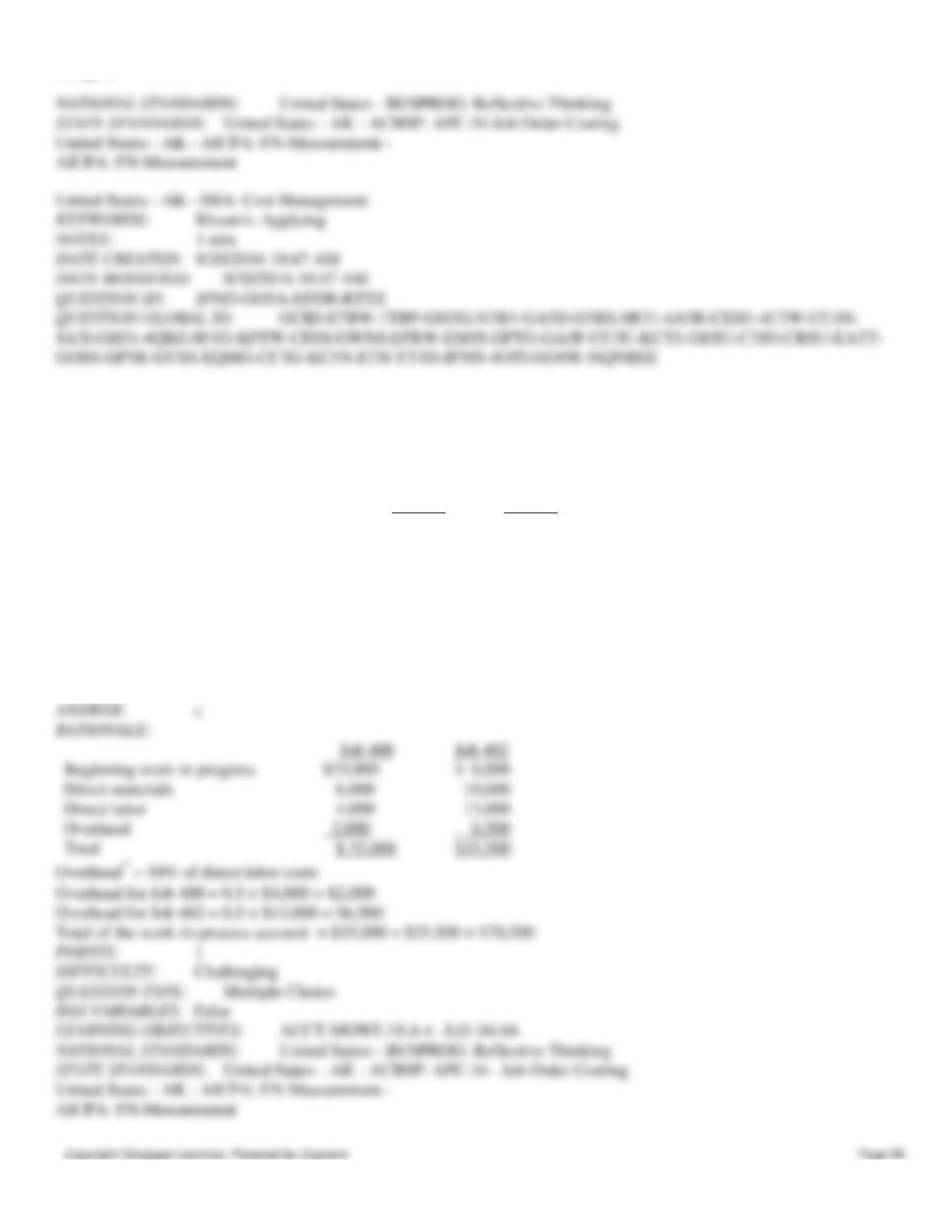
105. Redwoods Company designs and builds exotic furniture for individual customers. On March 1, there were two jobs
in process: Job 400 with a beginning balance of $23,000 and Job 402 with a beginning balance of $6,000. Overhead costs
are applied by using a rate of 50% of direct labor costs. Both jobs are unfinished on March 31. Data on March costs for
both the jobs are as follows:
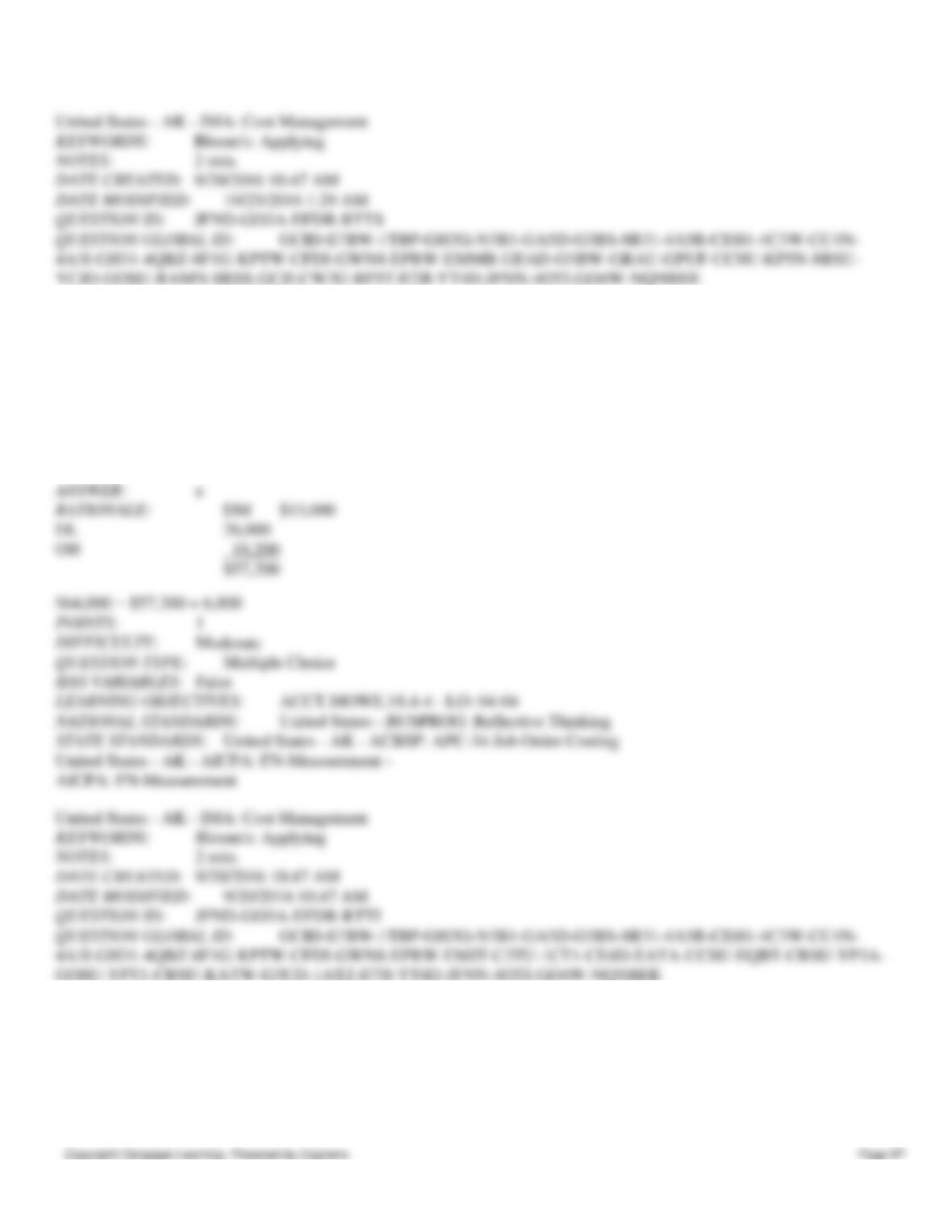
Job 400 Job 402
Direct materials $6,000 $ 10,000
Direct labor cost 4,000 13,000
What is the total of the work-in-process account on March 31?
a. $45,000
b. $58,490
c. $70,500
d. $38,00
e. None of these
Chapter 4
106. Ending Work-in-Process for Lee’s Carpentry was $64,000 for January. Direct labor and direct materials together for
the month were $39,000. Direct labor was twice as much as direct materials. The overhead rate is 70% of direct labor. No
jobs were finished during the month. What was beginning Work-in-Process?
a. $6,800
b. $25,000
c. $4,250
d. $15,250
e. $0
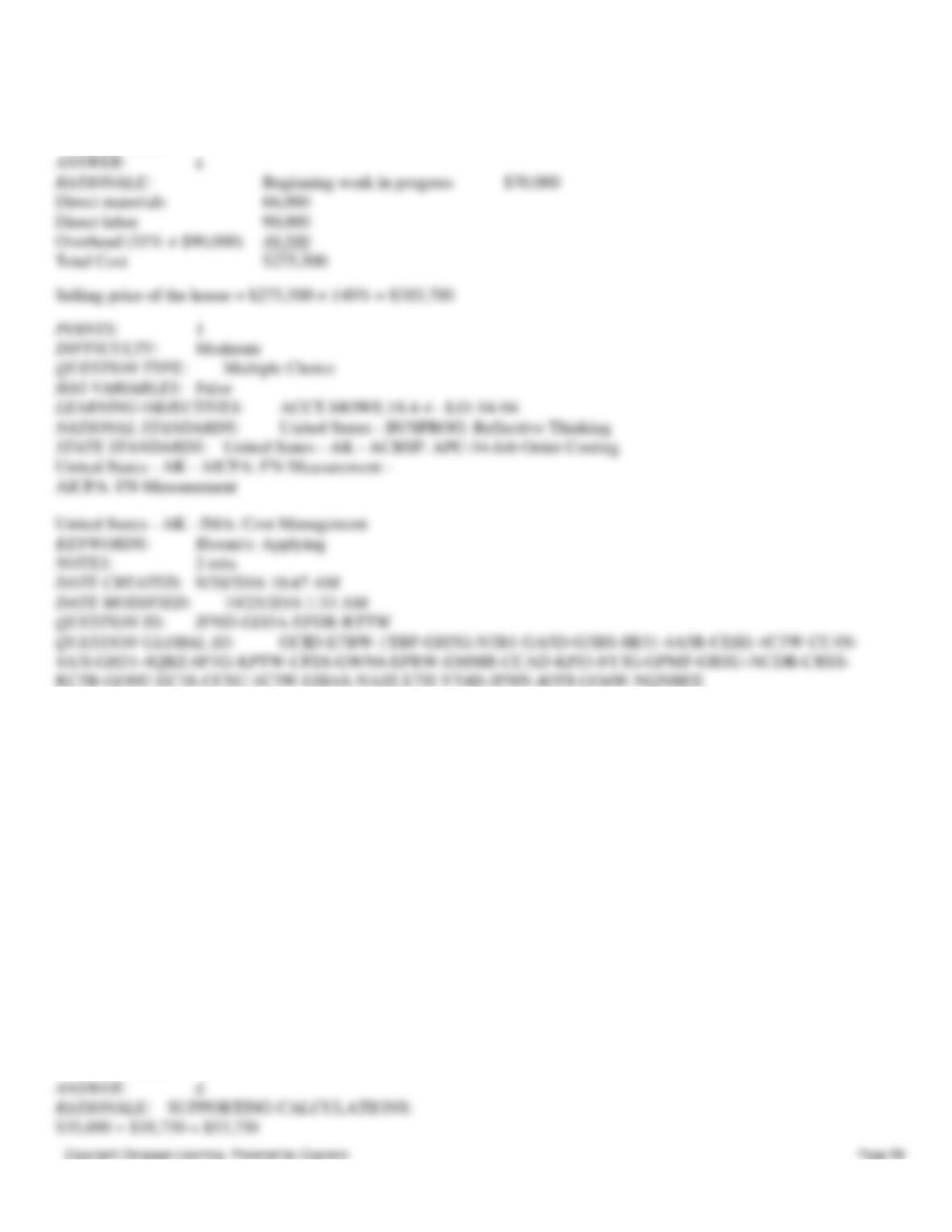
107. Trust Construction builds custom houses for individual buyers. On April 1, it had one job, started with a beginning
Work-in-Process of $70,000. During April the job was finished and sold. Direct labor for the job in April was $90,000 and
direct materials used were $66,000. Overhead is computed at a rate of 55% of direct labor. There is a markup of 40% on
all sales. What was the selling price of the house?
a. $385,700
b. $200,750
Chapter 4
c. $98,862
d. $272,600
e. $340,087
108. Wright Corporation had the following information available for December of the current year:
Work in process, December 1 $20,000
Materials placed into production, December 27,500
Direct labor, December 37,500
Plantwide overhead rate is 150% of direct labor costs. Job cost sheets had the following balances:
Job Z1 $32,500
Job Z2 55,000
Job Z3 35,000
Job Z4 18,750
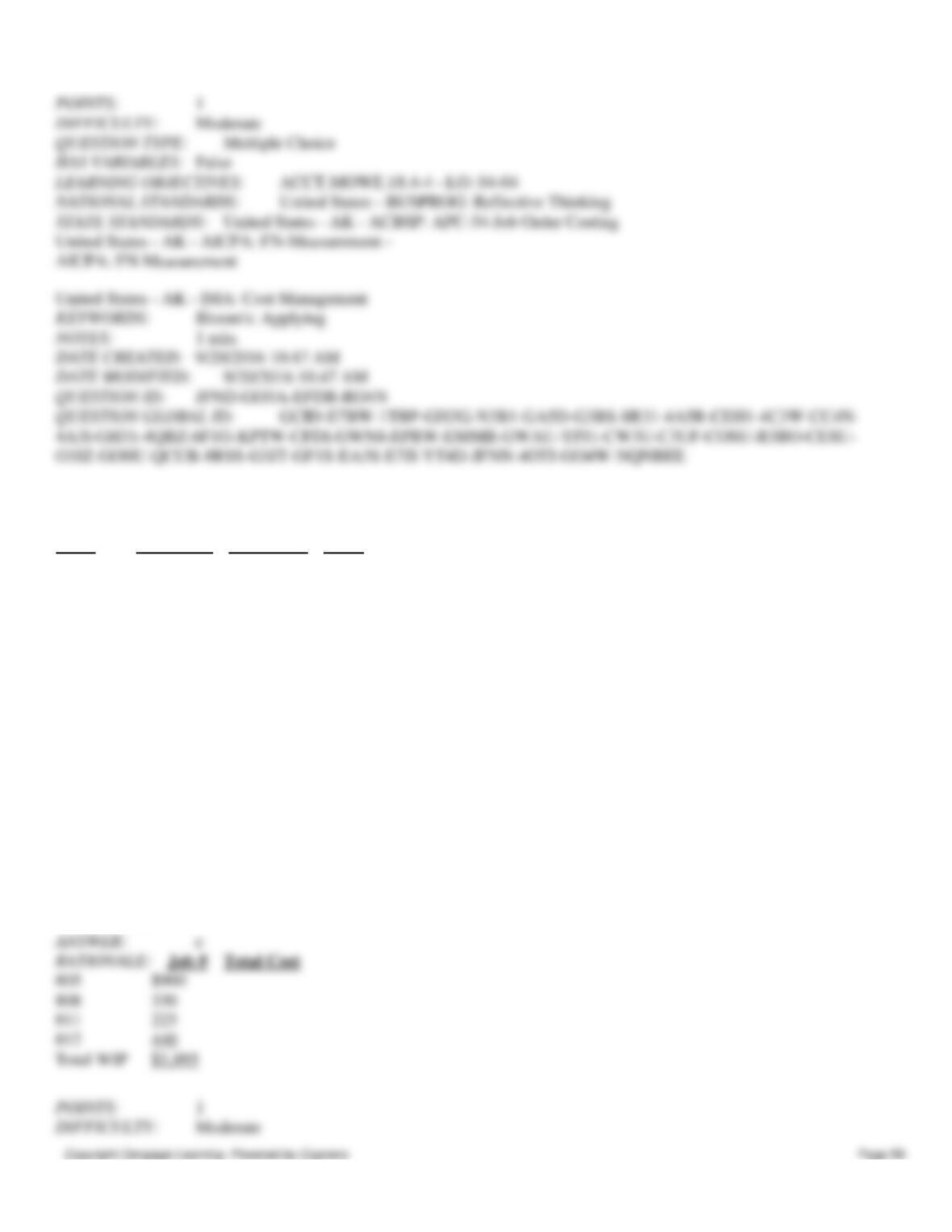
Jobs Z3 and Z4 were not completed at the end of December. What is the balance in work-in process for Wright at the end
of December?
a. $85,000
b. $87,500
c. $56,250
d. $53,750
Chapter 4
109. Megan Company uses job-order costing. At the end of the month, the following data was gathered:
Job # Total Cost Complete? Sold?
803 $500 yes yes
804 200 yes no
805 900 no no
806 600 yes yes
807 400 yes no
808 330 no no
809 600 yes yes
810 680 yes no
811 225 no no
812 440 no no
Megan’s selling price is cost plus 40% for each of its products.
What is the total in the work-in–process (WIP) account?
a. $1,700
b. $2,500
c. $1,895
d. $1,840
e. $1,170
Chapter 4
110. Hill Company uses job-order costing. At the end of the month, the following data was gathered:
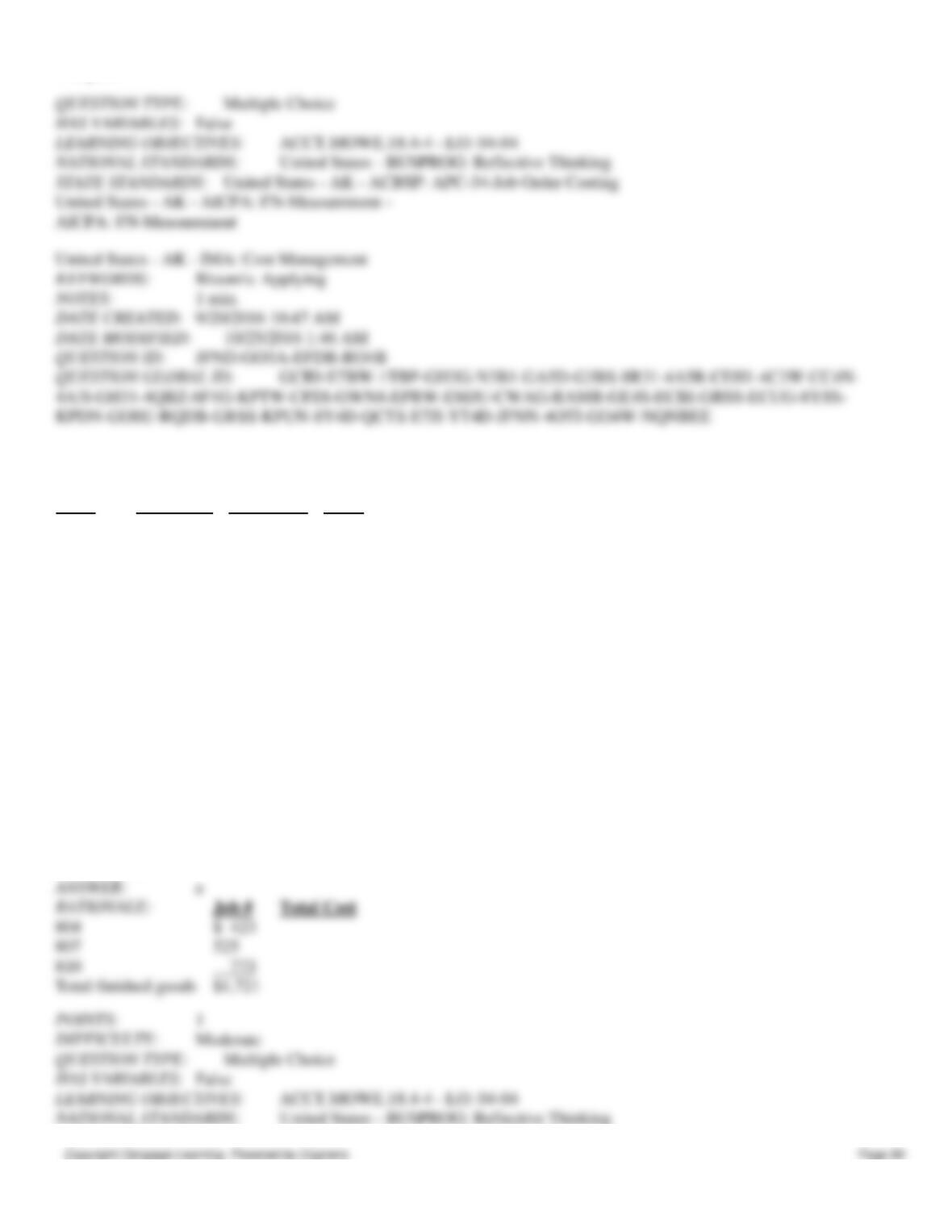
Job # Total Cost Complete? Sold?
803 $611 yes yes
804 423 yes no
805 805 no no
806 682 yes yes
807 525 yes no
808 250 no no
809 440 yes yes
810 773 yes no
811 267 no no
812 341 no no
Hill’s selling price is cost plus 50% for each of its products.
What is the total in Finished Goods?
a. $1,721
b. $2,230
c. $1,700
d. $1,860
e. $2,163