Chapter 4 Cost-Volume-Profit Analysis
4-21
135. Brewster Café has estimated that fixed costs per month are $114,840 and variable cost per
dollar of sales is 42%. Sales during June totaled $220,000. What is the break-even point per
month in sales?
A. $273,429
B. $198,000
C. $22,000
D. None of these answer choices are correct.
136. Brewster Café has estimated that fixed costs per month are $114,840 and variable cost per
dollar of sales is 42%. Sales during June totaled $220,000. What level of sales is needed for a
monthly profit of $31,900?
A. $253,000
B. $198,000
C. $239,140
D. $349,381
137. Brewster Café has estimated that fixed costs per month are $114,840 and variable cost per
dollar of sales is 42%. For the month of July, the cafe anticipates sales of $300,000. What is
the expected level of profit?
A. $126,000
B. $59,160
C. $174,000
D. $11,160
138. If a company sells many different types of products,
A. it will have high operating leverage.
B. the contribution margin ratio approach may be used to calculate the break-even point.
C. it cannot use cost-volume-profit analysis.
D. its margin of safety will be negative.
139. A company that sells many different types of products should approach CVP analysis by
assuming that
A. all products will have the same contribution margin ratio.
B. products will be sold in a constant mix.
C. fixed costs per unit will remain constant over the relevant range..
D. the company will sell equal amounts of each product each period.
140. Tonto Rain Shields sells 3 types of umbrellas. Umbrella A sells for $20 and has variable cost
of $9.00 per unit. Umbrella B sells for $17.00 and has variable cost of $12.00 per unit.
Umbrella C sells for $9.00 and has variable costs of $6.00 per unit. The company sells in a mix
of 2 units of A, 3 units of B, and 5 units of C. What is the weighted average contribution margin
per unit for Tonto?
A. $5.20
B. $13.60
C. $10.00
D. $6.33

Test Bank to accompany Jiambalvo Managerial Accounting, 6th Edition
4-22
141. Mexi-Foods produces tacos and burritos. Its financial information follows for the month of
June:
Tacos Burritos
Sales revenue $40,000 $160,000
Fixed costs 8,000 40,000
Variable costs 15,000 75,000
Profit $17,000 $45,000
How much is the break-even point in total sales dollars for Mexi-Foods assuming the sales mix
is stable?
A. $120,000
B. $87,273
C. $83,027
D. None of these answer choices are correct..
142. Beach Time produces two models of beach chairs, Lay Back and Easy Rest. Information
regarding these products for May follows:
Lay Back Easy Rest
Number of units 6,000 14,000
Sales revenue $120,000 $140,000
Fixed costs 24,000 50,000
Variable costs 60,000 42,000
Profit $ 36,000 $ 48,000
Selling price per unit $20 $10
How much is Beach Time’s weighted average contribution margin ratio?
A. 60.00%
B. 32.31%
C. 60.77%
D. 71.53%
143. Idol Creations produces two models of keyboards, compact and deluxe. Information regarding
the products is summarized for the month of April in the following table:
Compact Deluxe Total
Number of units 600 400 1,000
Sales $48,000 $36,000 $84,000
Variable costs 15,000 12,000 27,000
Fixed costs 21,000 20,000 41,000
Profit $12,000 $ 4,000 $16,000
Profit per unit $20.00 $10.00
If the company’s weighted average contribution margin ratio is 67.86%, and the weighted
average contribution margin per unit is $57.00, how much will Idol Creation’s total sales be at
break-even?
A. $60,419
B. $122,281
C. $68,000
D. $60,552

Chapter 4 Cost-Volume-Profit Analysis
4-23
144. Briggs Tools makes 2 products, snips and cutters. Snips have a contribution margin per unit of
$8.00 and cutters have a contribution margin per unit of $12.00. Briggs has annual fixed costs
of $117,600. Briggs’ historical sales data indicates that snips and cutters are sold in a 2 to 1
sale mix. How many snips will be sold at break-even?
A. 4,200 snips
B. 8,400 snips
C. 14,700 snips
D. 12,600 snips
145. Briggs Tools makes 2 products, snips and cutters. Snips have a contribution margin per unit of
$8.00 and cutters have a contribution margin per unit of $12.00. Briggs has annual fixed costs
of $117,600. Briggs’ historical sales data indicates that snips and cutters are sold in a 2 to 1
sale mix. Each snip takes 2 machine hours and each cutter takes 4 machine hours. Demand
for both products is unlimited but the company must produce at least 1,000 units of each to
stay competitive. Briggs is limited to 24,000 machine hours per month. How many units of
each product should be produced each month?
A. 20,000 snips, 1,000 cutters
B. 10,000 snips, 4,000 cutters
C. 12,000 snips, 6,000 cutters
D. 10,000 snips, 1,000 cutters
146. Yogurt Palace produces two flavors of low-fat frozen yogurt: Blueberry and Raspberry.
Information regarding the products is summarized for the month of January in the following
table:
Blueberry Raspberry
Number of units 6,000 2,000
Sales revenue $90,000 $20,000
Fixed costs 20,000 9,000
Variable costs 36,000 5,000
Profit $34,000 $ 6,000
Amount of processing time per unit 1.4 hours 1.1 hours
Contribution margin per unit $9.00 $7.50
Profit per unit $5.67 $3.00
Yogurt Palace determined it will have only 9,040 hours of processing time during February for
which it can produce yogurt, and it must produce a minimum number of each flavor to remain
competitive. Of which flavor should Yogurt Palace produce the most units and why?
A. Raspberry. It will contribute a larger amount towards profit for each unit of resource
available.
B. Blueberry. It will contribute a larger amount towards profit for each unit of resource
available.
C. Blueberry. It generates a higher contribution margin per unit.
D. Raspberry. Fewer units will need to be produced using fewer hours, allowing excess hours
for other products.
147. Which of the following is not an assumption underlying CVP analysis?
A. Costs can be accurately separated into their fixed and variable components.
B. Fixed costs remain constant over the relevant range.
C. Variable costs per unit change over the relevant range.
D. The sales mix remains constant.
Test Bank to accompany Jiambalvo Managerial Accounting, 6th Edition
4-24
148. Yogurt Palace produces two flavors of low-fat frozen yogurt: Blueberry and Raspberry.
Information regarding the products is summarized for the month of January in the following
table:
Blueberry Raspberry
Number of units 6,000 2,000
Sales revenue $90,000 $20,000
Fixed costs 20,000 9,000
Variable costs 36,000 5,000
Profit $34,000 $ 6,000
Amount of processing time per unit 1.4 hours 1.1 hours
Contribution margin per unit $9.00 $7.50
Profit per unit $5.67 $3.00
Yogurt Palace determined it will have only 5,950 hours of processing time during March for
which it can produce yogurt. Yogurt Palace determines that it should produce a minimum of
1,500 units of each flavor to stay competitive, and that it should produce more raspberry
flavored yogurt than blueberry yogurt. How many raspberry yogurt should the company
produce in February considering the processing constraint?
A. 3,500 units
B. 3,850 units
C. 5,409 units
D. 4,250 units
149. Garden Duty produces shovels and rakes. Sales and costs for the most recent year are
indicated below:
Shovels Rakes Total
Units 8,000 20,000 28,000
Sales revenue $160,000 $40,000 $200,000
Variable costs 98,000 18,000 116,000
Fixed costs 28,000 12,000 40,000
Profit $ 34,000 $10,000 $ 44,000
The number of units and selling price per unit of both products appears to be stable for the
foreseeable future. How much total revenue will Garden Duty have at break-even?
A. $95,238
B. $13,333
C. $146,663
D. $156,000
150. Garden Duty produces shovels and rakes. Sales and costs for the most recent year are
indicated below:
Shovels Rakes Total
Units 8,000 20,000 28,000
Sales revenue $160,000 $40,000 $200,000
Variable costs 98,000 18,000 116,000
Fixed costs 28,000 12,000 40,000
Profit $ 34,000 $10,000 $ 44,000
The number of units and selling price per unit of both products appears to be stable for the
foreseeable future. How much is the weighted average contribution margin per unit?
A. $4.43
B. $1.57
C. $0.42
D. $3.00
Chapter 4 Cost-Volume-Profit Analysis
4-25
151. Experts on Call provides computer repairs on-site and has a contribution margin ratio of 35%,
a contribution margin per service call of $15, and fixed costs of $12,000 per month. During
March, it made 1,200 service calls. How much will Experts on Call’s profit increase if 200 more
service calls are made?
A. $1,000
B. $350
C. $1,050
D. $3,000
152. Why is the level of operating leverage important?
A. It affects the change in profit when sales change.
B. It predicts how much cost will be incurred at various levels of activity.
C. It is calculated using regression analysis which uses all available data points.
D. None of these answer choices are correct..
153. To which of the following is operating leverage related?
A. Manufacturing costs versus non-manufacturing costs
B. Estimated costs versus actual costs
C. Total revenues versus total costs
D. Fixed costs versus variable costs
154. A company with low operating leverage has lower
A. profit margins.
B. variable costs.
C. fixed costs.
D. selling prices.
155. Operating leverage is important because it associates changes in sales with changes in
A. profits.
B. contribution margins.
C. total costs.
D. total production costs.
156. Which of the following is true for a firm with high operating leverage?
A. It has a relatively high amount of mixed costs.
B. It is generally thought to be riskier than a company with lower operating leverage.
C. It has a zero contribution margin ratio at the break-even point.
D. If sales increase, its profits will increase at a slower rate than a company with lower
operating leverage.
157. If a company has fixed costs and is operating at a level above the break-even point, what
happens to profits when sales increase by 20%?
A. Profits will increase by less than 20%.
B. Profits will increase by 20%.
C. Profits will increase by more than 20%.
D. Profits will decrease by less than 20%.

Test Bank to accompany Jiambalvo Managerial Accounting, 6th Edition
4-26
158. During 2016, Waxley Corporation reported total revenues of $891,640 and profit of $91,486.
Fixed costs were $332,043, and 44,582 units were sold. Costs and prices are expected to stay
the same in 2017. Waxley expects to sell 50,000 units. How much is the company’s budgeted
profit for 2017?
A. $142,957
B. $525,000
C. $667,957
D. $475,000
159. Anniston Gifts makes a product that sell for $40 per unit has and has a unit variable cost of
$18. The contribution margin ratio is 55%. Annual fixed costs are $11,990. The company
expects to sell 2,000 units this year. By how much would profits increase if 140 more units are
sold than expected?
A. $3,080
B. $47,080
C. $5,600
D. $545
160. Firms that have high operating leverage
A. have relatively high levels of fixed costs.
B. have production costs that are mostly variable.
C. will have smaller changes in profit when the activity level changes.
D. are generally thought to be less risky.
161. Total Fitness and Aerobic Town reported the following results for 2017:
Total Fitness Aerobic Town
Sales $5,000,000 $5,000,000
Variable costs 2,200,000 1,000,000
Fixed costs 1,000,000 2,200,000
Due to an economic downturn, it is estimated that sales for both companies will decrease next
year by $300,000. Which company will have the larger percentage decrease in profit next
year?
A. Neither; both companies will have the same profit.
B. Total Fitness will have a higher decrease in profit
C. Aerobic Town will have a higher decrease in profit.
D. There is not enough information provided to determine the answer.
162. Which of the following is a resource constraint?
A. Dollars of profit generated
B. Sales commissions
C. Cost per unit
D. Pounds of materials for production
163. When considering a process that involves a resource constraint, the optimal decision
A. minimizes the break-even point.
B. maximizes the contribution margin per unit of the constraint.
C. minimizes the contribution margin per unit of output.
D. minimizes total fixed costs.
164. Which of following will not be a part of the regression output from Excel?
A. A plot of the data
B. A measure of the R Square
C. The equation of the regression line
D. Total cost at all activity levels
Chapter 4 Cost-Volume-Profit Analysis
4-27
165. Team Production produces two models of tailgating tents containing sports logos: NCAA and
NFL. Information regarding these products for May follows:
NCAA NFL
Number of units 3,000 7,000
Sales revenue $120,000 $140,000
Variable costs 60,000 42,000
Fixed costs 24,000 50,000
Profit $ 36,000 $ 48,000
Yards of canvas per tent 22 14
Contribution margin per unit $20 $14
Due to increased demand of canvas in the market, Team Productions can obtain only 42,000
yards of canvas per month. The company can sell as many tents as it can produce of either
model. How many NFL tents should the company produce in May considering the constraint?
A. 0 NFL tents
B. 3,000 NFL tents
C. 1,909 NFL tents
D. 1,500 NFL tents
166. Handson Yacht Rentals generated the following regression based on the number and cost of
daily rentals of its yachts during May:
SUMMARY OUTPUT
Regression Statistics
Multiple R 0.825358
R Square 0.681216
Adj RSquare 0.656695
Stand.Error 39.35892
Observations 15
ANOVA
df SS MS F Sig F
Regression 1 43,034.7 43,034.71 27.780017 0.000151
Residual 13 20,138.6 1,549.12
Total 14 63,173.3
Lower Upper Lower Upper
Coefficients Std Error t Stat P-value 95% 95% 95% 95%
Intercept 2621.21 101.8073 2.626725 0.020917 47.478460 487.3612 47.478460 487.3612
X Variable 1 35.58 6.1023 5.270675 0.000151 18.980154 45.3467 18.980154 45.3467
If Handson Yacht Rentals provides 45 yacht rentals during June, how much is its total cost for
rentals?
A. $1,601
B. $4,222
C. $4,581
D. $63,173

Test Bank to accompany Jiambalvo Managerial Accounting, 6th Edition
4-28
167. Castillo Pens produces two models of titanium pens—Grande and Petite. Operations
information appears below for the current year:
Grande Petite
Units 2,500 4,500
Sales revenue $160,000 $96,000
Variable cost 64,000 42,000
Fixed costs 40,000 16,000
Profit $ 56,000 $ 38,000
Profit per pen $22.40 $8.44
Contribution margin per pen $38.40 $12.00
Ounces of titanium per pen 8.50 2.50
Due to a supplier problem, only 1,400 pounds (22,400 ounces) of titanium will be available
during each of the next few months. Each ounce of titanium costs $0.80. Castillo needs to
produce at least 900 of each model to stay competitive and can sell all it produces. Given the
limited resource, how many Petite’s should Castillo produce to maximize profits?
A. 5,900 units
B. 900 units
C. 8,960 units
D. 5,625 units

Chapter 4 Cost-Volume-Profit Analysis
4-29
MATCHING
168. Match each of the following terms with the phrase that most closely describes it. Each answer
may be used only once.
_____ 1. Break-even point
_____ 2. Contribution margin
_____ 3. Fixed costs
_____ 4. Margin of safety
_____ 5. Mixed costs
_____ 6. Operating leverage
_____ 7. Regression analysis
_____ 8. Relevant range
_____ 9. Scattergraph
_____ 10. Variable costs
A. Difference between the expected level of sales and the break-even sales
B. A plot of activity levels and the corresponding costs
C. Number of units that must be sold for a company to have a net income of $0
D. Uses all available historical data to estimate the slope and intercept of the total cost
line
E. Levels of activity for which estimates and predictions are likely to be accurate
F. Costs that change in total in proportion to changes in volume or activity
G. Level of fixed versus variable costs in a firm’s cost structure
H. Costs that do not change in total in response to changes in activity levels within the
relevant range
I. Difference between selling price and variable cost per unit
J. Costs that contain both a variable cost element and a fixed cost element
Answers to Matching
Test Bank to accompany Jiambalvo Managerial Accounting, 6th Edition
4-30
EXERCISES
169. Information for three costs incurred at Loranz, Inc. in the first quarter follows:
Month Cost Activity
Auto expense January $17,600 32,000 miles driven
February $16,225 29,500 miles driven
March $17,105 31,100 miles driven
Internet access January $2,350 12,800 gigs of data
February $2,820 13,400 gigs of data
March $2,390 11,000 gigs of data
Monitoring expense January $2,100 1,600 calls
February $2,100 1,200 calls
March $2,100 2,700 calls
Classify each cost and support your choice with justification of why your choice is considered
as either fixed, variable, or mixed.
Answer
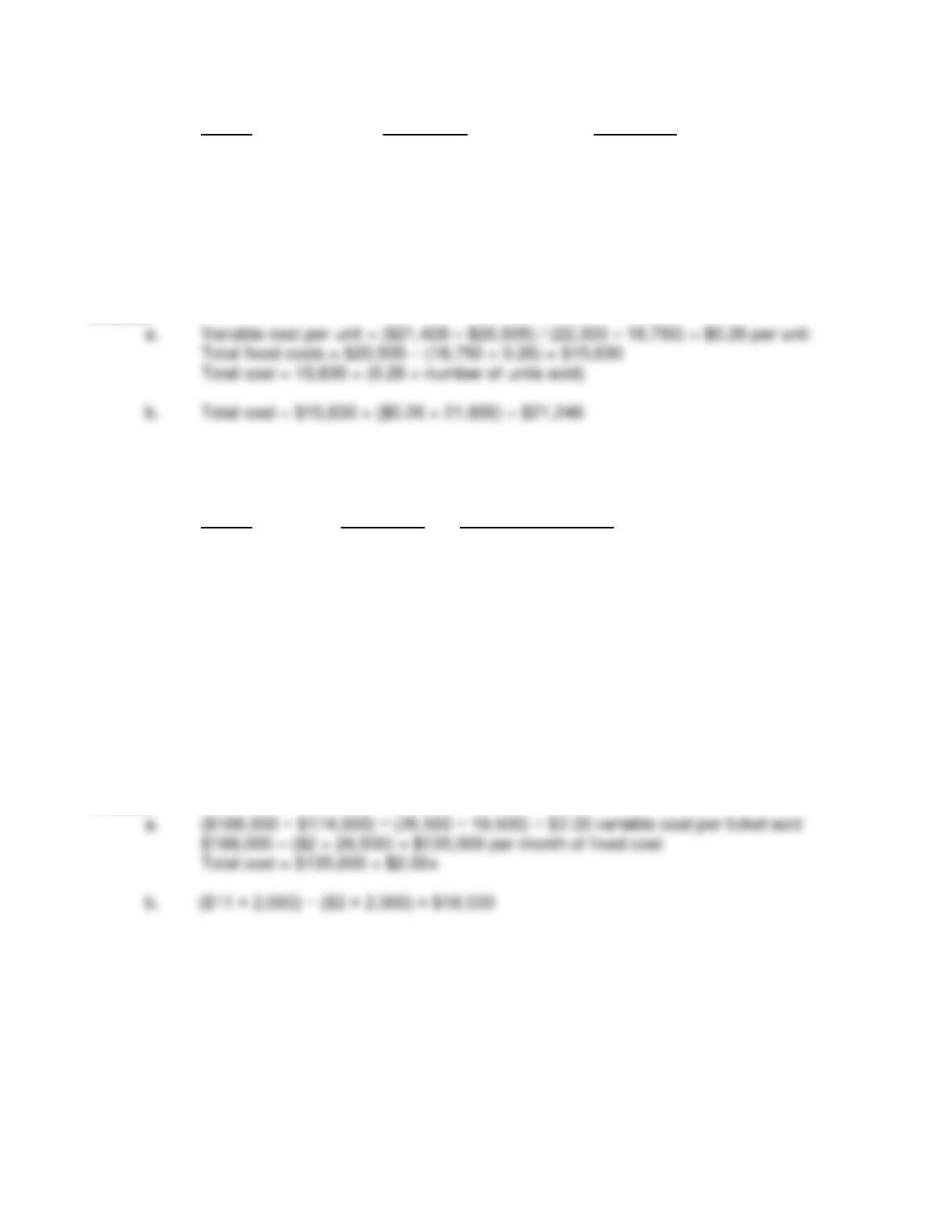
170. Harrell & Harrell wants to predict cell phone expense for the firm’s two partners at different
levels of minutes used per month. The following data have been gathered for the past 6
months:
Month Cell Phone Expense Minutes Used
May $330 1,650
June $320 1,450
July $502 2,450
August $456 2,100
September $470 2,340
October $536 2,800
Determine the fixed and variable components of cell phone expense using the high-low
method.
Answer
Chapter 4 Cost-Volume-Profit Analysis
4-31
171. Winston Company has collected the following sales data for recent months:
Month Units Sold Total Cost
June 20,500 $20,960
July 22,300 21,428
August 18,750 20,505
September 21,200 21,395
a. Using the high-low method, find variable cost per unit, total fixed costs, and the total
cost equation.
b. What is the estimated cost for a month in which 21,600 units sold?
Answer
172. The Ritz Theater is interested in estimating fixed and variable costs. The following data are
available:
Month Total Cost No. of Tickets Sold
January $172,000 20,000
February $174,000 19,500
March $180,500 25,500
April $170,500 21,500
May $190,000 25,000
June $188,000 26,500
a. Use the high-low method to estimate fixed cost per month and variable costs per ticket
sold.
b. The Ritz Theater is considering an advertising campaign that is expected to increase
annual sales by 2,000 tickets. Tickets are sold for $11 each. Ignoring the cost of the
advertising campaign, what is the expected increase in profit associated with the
advertising campaign?
Answer
Test Bank to accompany Jiambalvo Managerial Accounting, 6th Edition
4-32
173. Safe Ridge Foods is interested in estimating the cost involved in hiring new employees for its
retail stores. The following information is available regarding the additional costs of operating
the company’s Human Resource Department in May when there were 6 new hires.
Human Resource Department
Manager salaries $ 3,400
Staff hourly wages 21,600
Supplies 600
Equipment depreciation 1,100
Office rental space 1,800
Total $28,500
a. Use account analysis to determine total fixed cost per month and the variable cost per
new hire.
b. The company is planning to hire 4 employees in June. Estimate the total cost of the
Human Resources Department for June.
c. What is the expected incremental cost associated with hiring 3 more employee in June
than were hired in May?
Answer
174. The following monthly data are available for Beach Nail Salon which provides manicures for
nursing home patients who are charged $22 per manicure. Its unit variable costs are $16 and
its total fixed expenses are $5,400. Revenue during April totaled 1,600 units.
a. How much is the break-even point in sales dollars for Beach Nail Salon?
b. How many manicures must the company provide in order to earn a profit of $3,180?
c. A new employee suggests that Beach Nail Salon sponsor a company softball team as
a form of advertising. The cost to sponsor the team is $1,320. How many more
manicures must be provided to cover this cost?
Answer
Chapter 4 Cost-Volume-Profit Analysis
4-33
175. Dave’s Dogs sells steamed hot dogs for $2.50 each. The company provided the following units
and total cost data concerning its hotdog sales for the last six months of 2017:
.
Cost Units
July $3,020 2,400
August 2,795 2,150
September 3,040 2,300
October 2,700 2,250
November 2,750 2,160
December 3,085 2,340
a. Use the high-low method to estimate fixed and variable costs.
b. Estimate total profit in a month when 2,200 hotdogs are sold.
c. Based on these estimates, calculate the number of hotdogs that must be sold to break–
even.
d. How does linear regression differ from the high-low method in estimating fixed and
variable costs?
Answer
176. Mango Enterprises produces mango–flavored tea bags. March’s budget indicated that sales of
500 boxes of tea bags would incur fixed costs of $2,380. The company’s contribution margin
ratio is 35%, and its contribution margin per box of tea bags is $4. How much sales revenue
must Mango Enterprises generate to break-even?
Answer