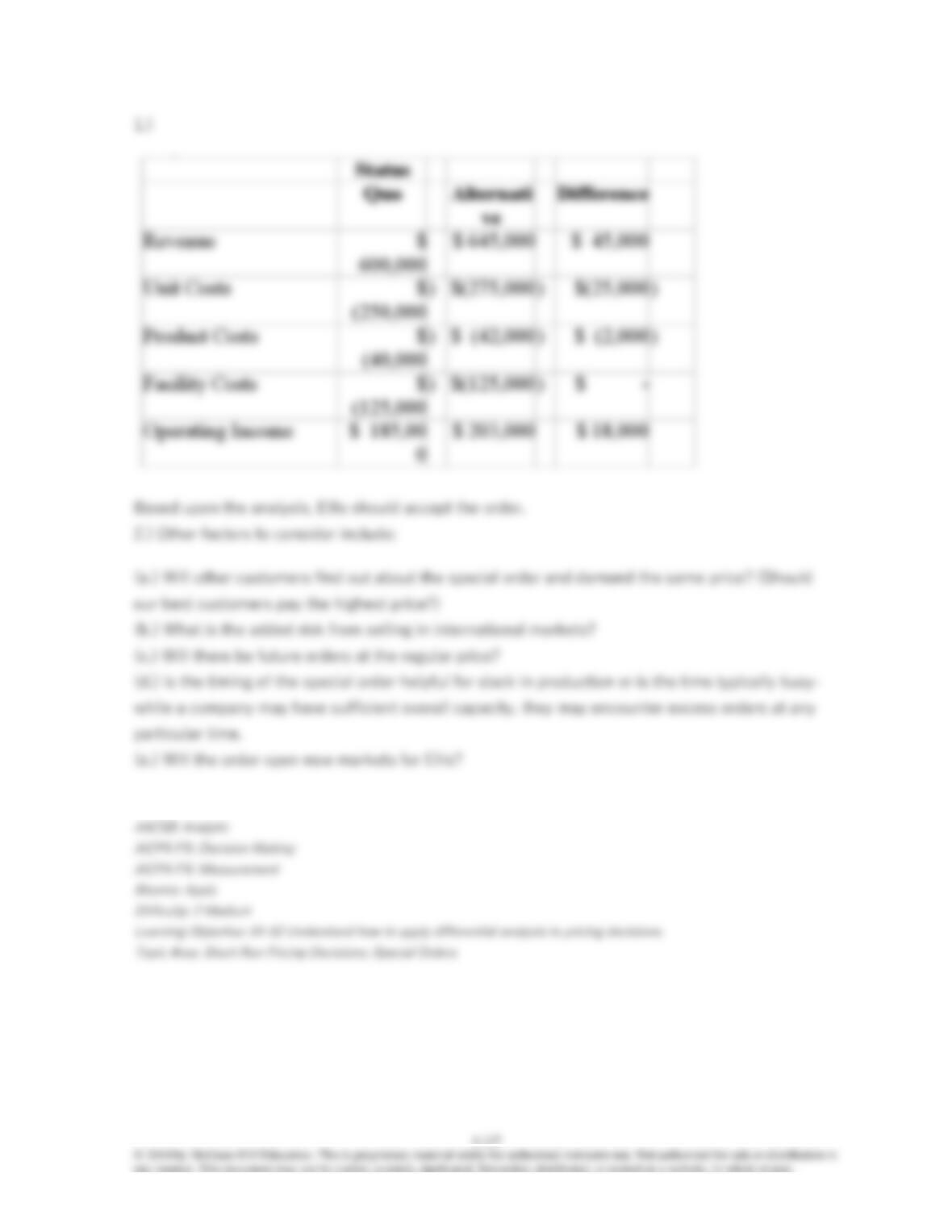
139. Explain the differences between life-cycle product costing and target costing.
140. Explain the distinction between predatory pricing and peak-load pricing.
141. Why is it important to consider opportunity costs in a make–or-buy decision?
4-122
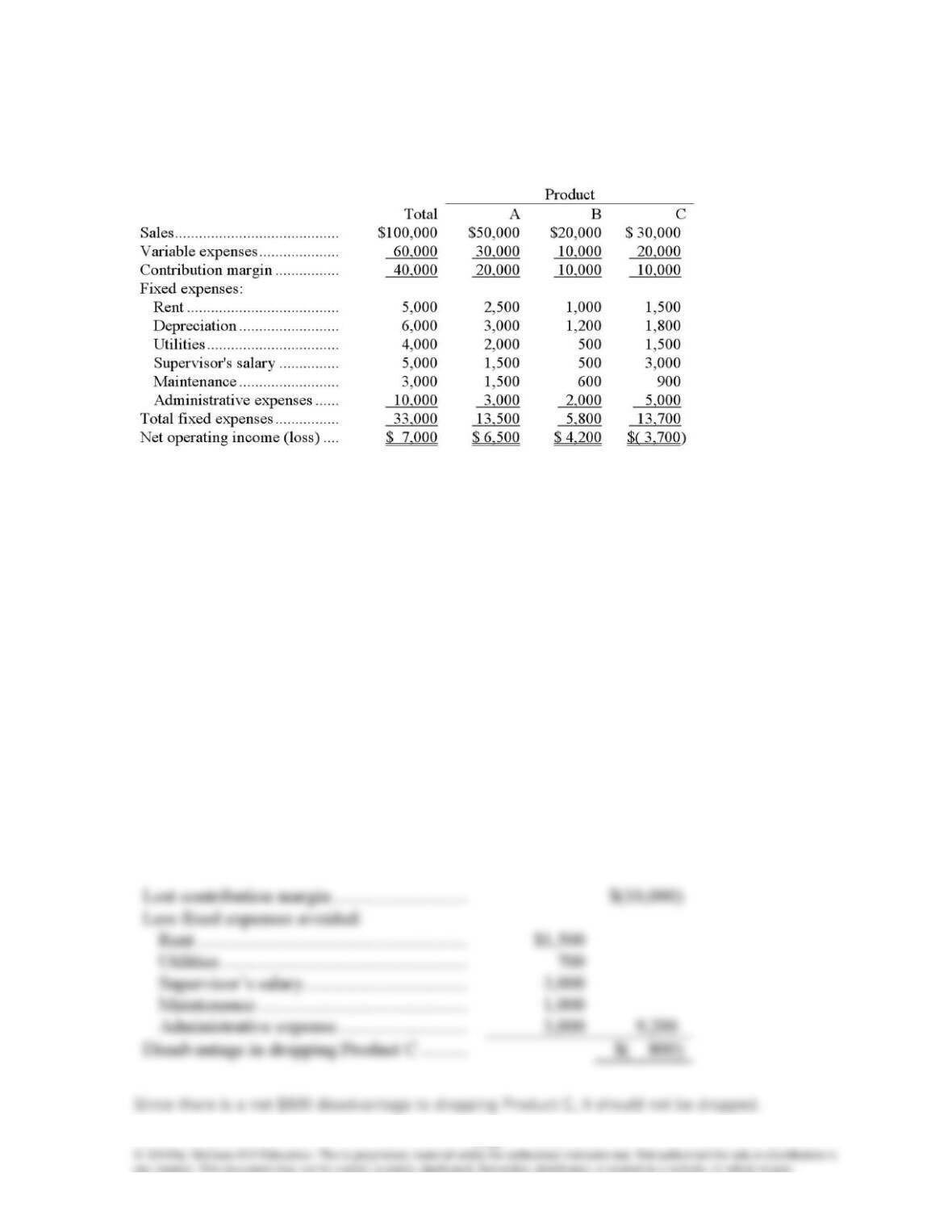
142. Mr. Earl Pearl, accountant for Margie Knall Co., Inc., has prepared the following product–
line income data:
The following additional information is available:
* The factory rent of $1,500 assigned to Product C is avoidable if the product were dropped.
* The company’s total depreciation would not be affected by dropping C.
* Eliminating Product C will reduce the monthly utility bill from $1,500 to $800.
* The supervisor’s salary is avoidable.
* If Product C is discontinued, the maintenance department will be able to reduce monthly
expenses from $3,000 to $2,000.
* Elimination of Product C will make it possible to cut two persons from the administrative staff;
their combined salaries total $3,000.
Required:
Prepare an analysis showing whether Product C should be eliminated.
4-123
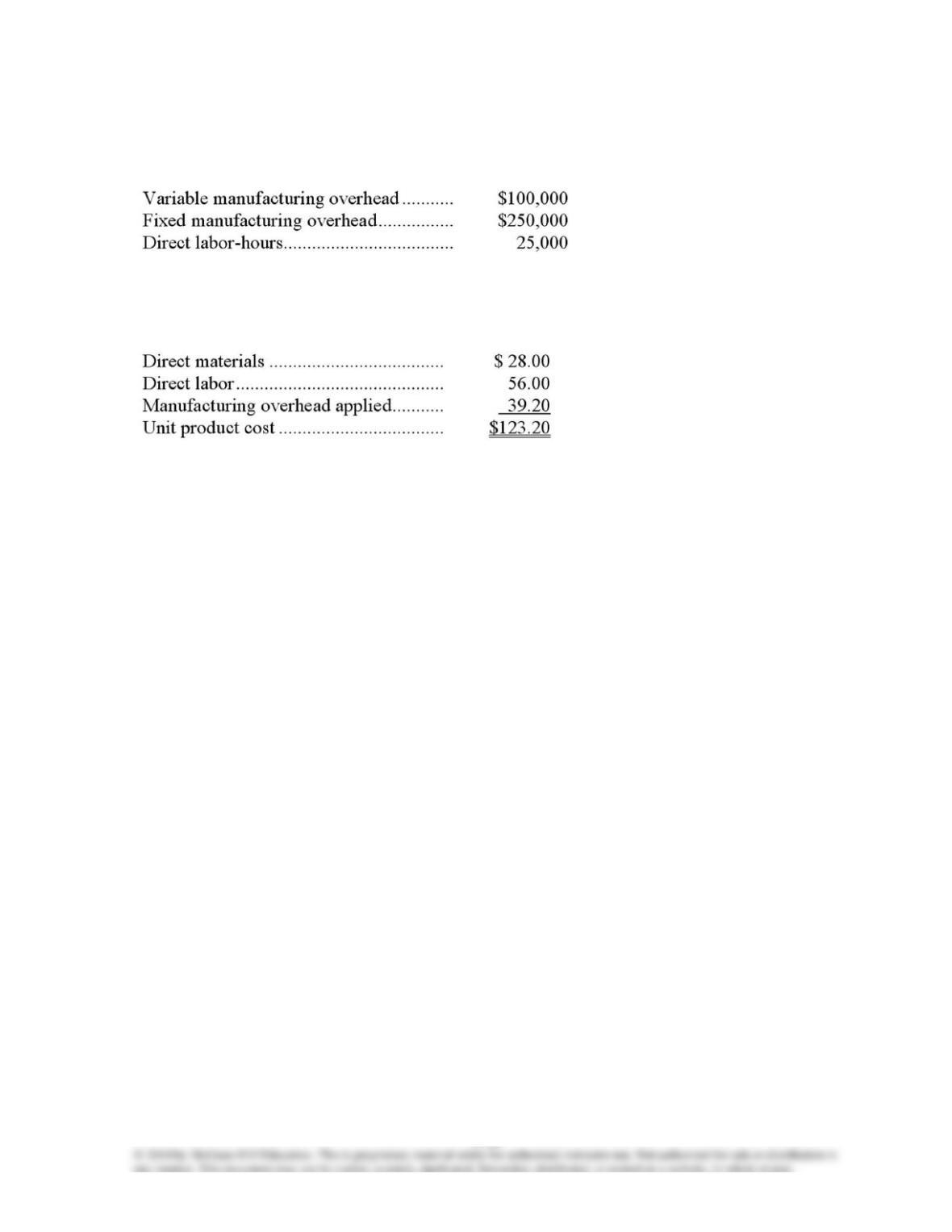
143. Bady Inc. makes a range of products. The company’s predetermined overhead rate is $14
per direct labor-hour, which was calculated using the following budgeted data:
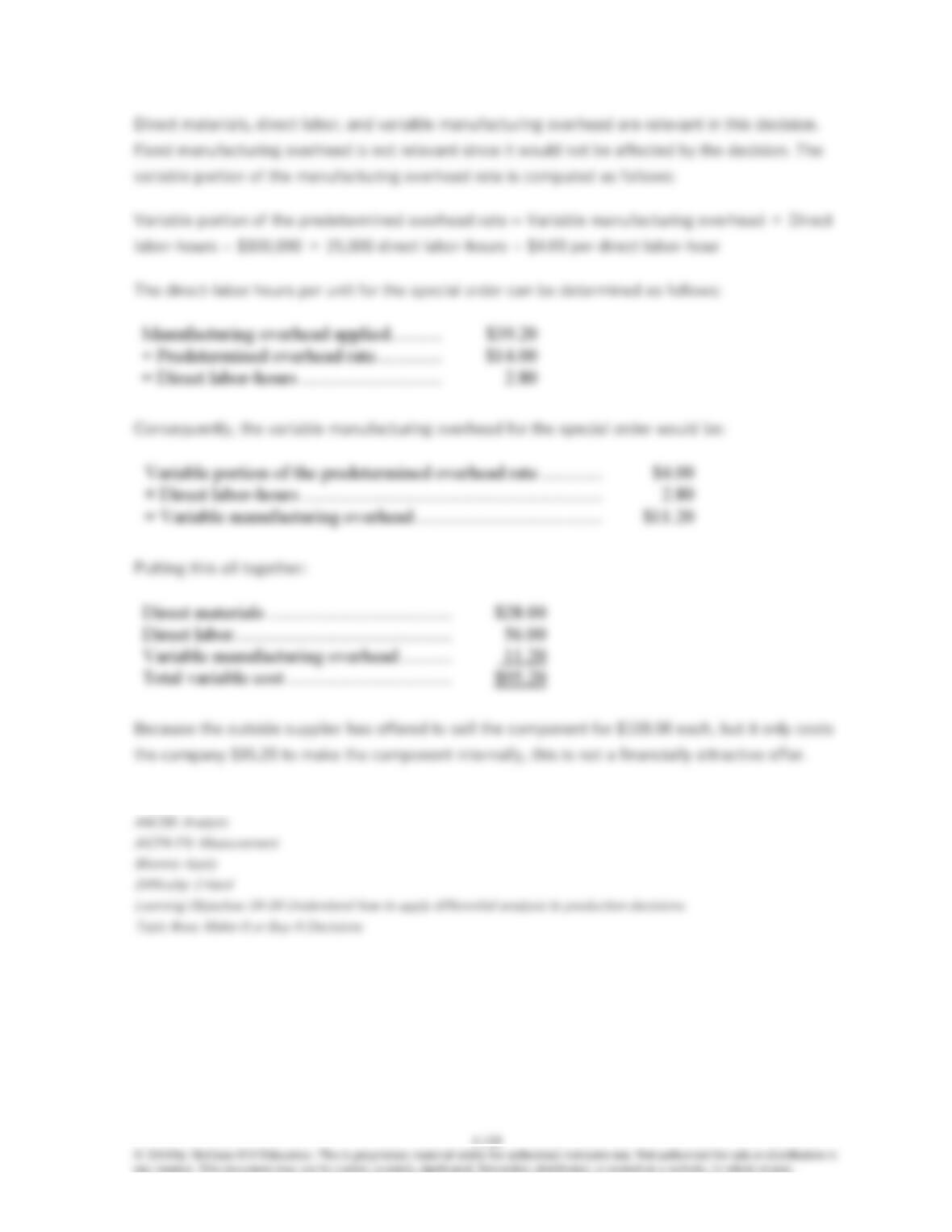
Component M3 is used in one of the company’s products. The unit cost of the component
according to the company’s cost accounting system is determined as follows:
An outside supplier has offered to supply component M3 for $108 each. The outside supplier is
known for quality and reliability. Assume that direct labor is a variable cost, variable
manufacturing overhead is really driven by direct labor-hours, and total fixed manufacturing
overhead would not be affected by this decision. Bady chronically has idle capacity. (CIMA
adapted)
Required:
Is the offer from the outside supplier financially attractive? Why?
4-125
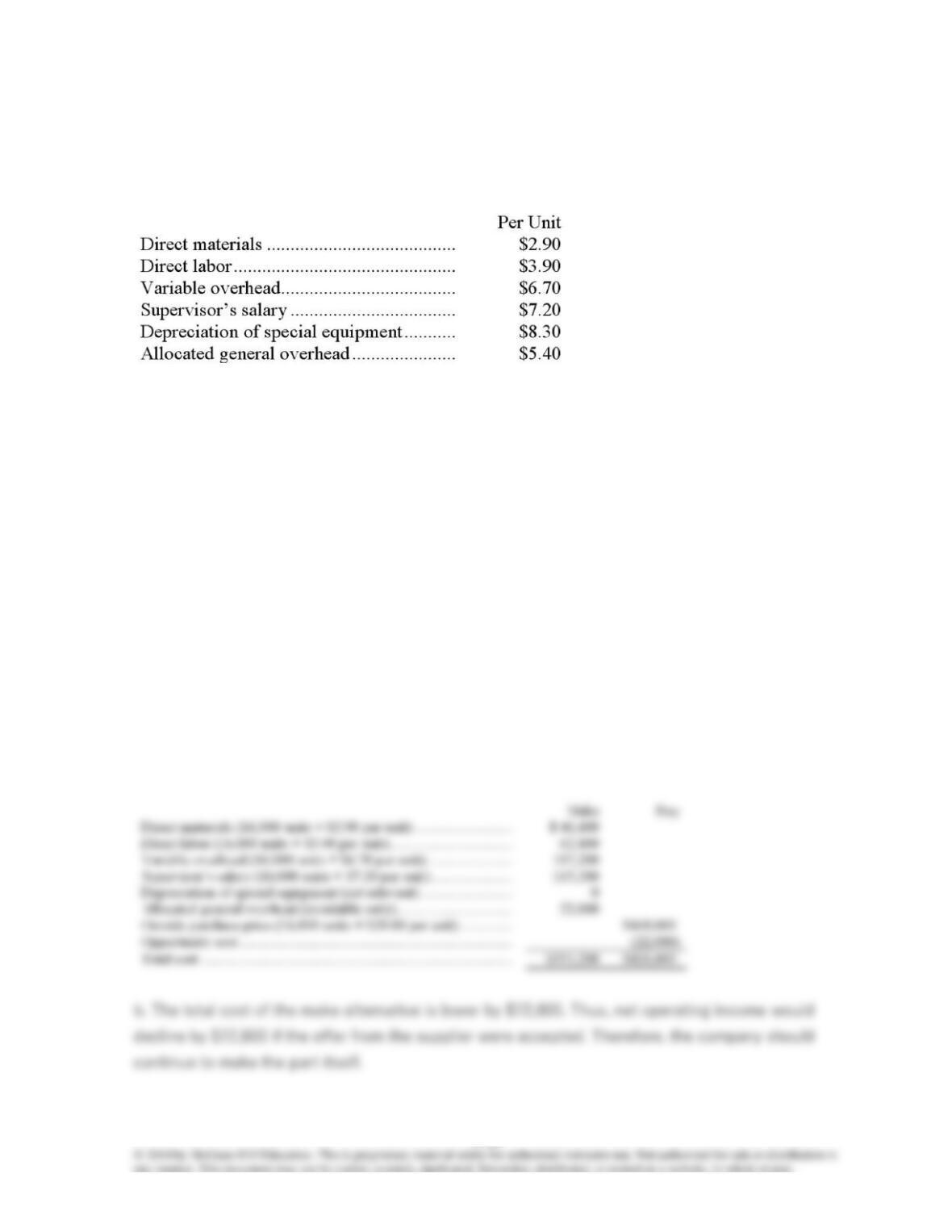
144. Masse Corporation uses part G18 in one of its products. The company’s Accounting
Department reports the following costs of producing the 16,000 units of the part that are needed
every year.
An outside supplier has offered to make the part and sell it to the company for $28.00 each. If this
offer is accepted, the supervisor’s salary and all of the variable costs, including direct labor, can
be avoided. The special equipment used to make the part was purchased many years ago and has
no salvage value or other use. The allocated general overhead represents fixed costs of the entire
company. If the outside supplier’s offer were accepted, only $22,000 of these allocated general
overhead costs would be avoided. In addition, the space used to produce part G18 could be used
to make more of one of the company’s other products, generating an additional segment margin of
$22,000 per year for that product.
Required:
a. Prepare a report that shows the effect on the company’s total net operating income of buying
part G18 from the supplier rather than continuing to make it inside the company.
b. Which alternative should the company choose?
4-126
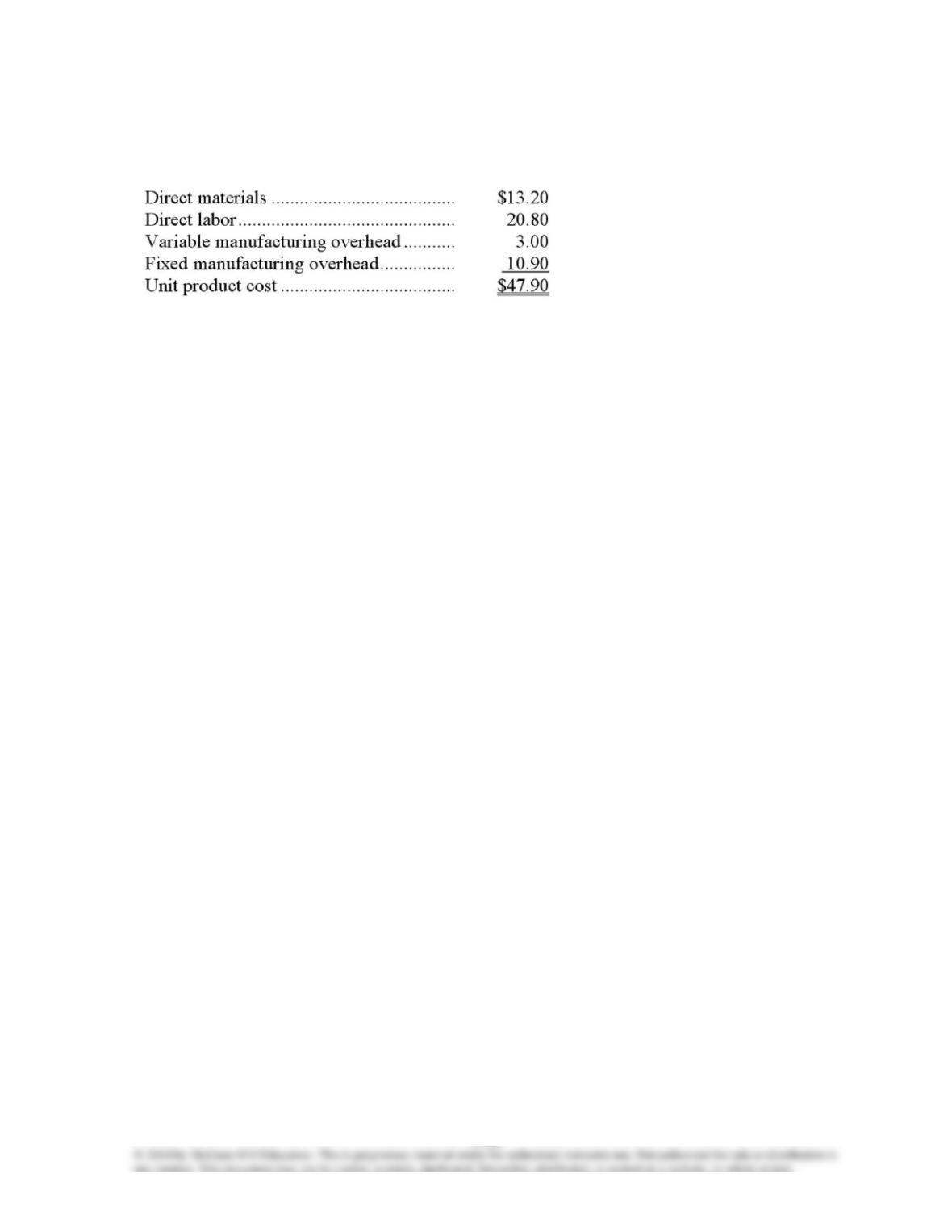
145. Foulds Company makes 10,000 units per year of a part it uses in the products it
manufactures. The unit product cost of this part is computed as follows:
An outside supplier has offered to sell the company all of these parts it needs for $42.30 a unit. If
the company accepts this offer, the facilities now being used to make the part could be used to
make more units of a product that is in high demand. The additional contribution margin on this
other product would be $39,000 per year.
If the part were purchased from the outside supplier, all of the direct labor cost of the part would
be avoided. However, $6.40 of the fixed manufacturing overhead cost being applied to the part
would continue even if the part were purchased from the outside supplier. This fixed
manufacturing overhead cost would be applied to the company’s remaining products.
Required:
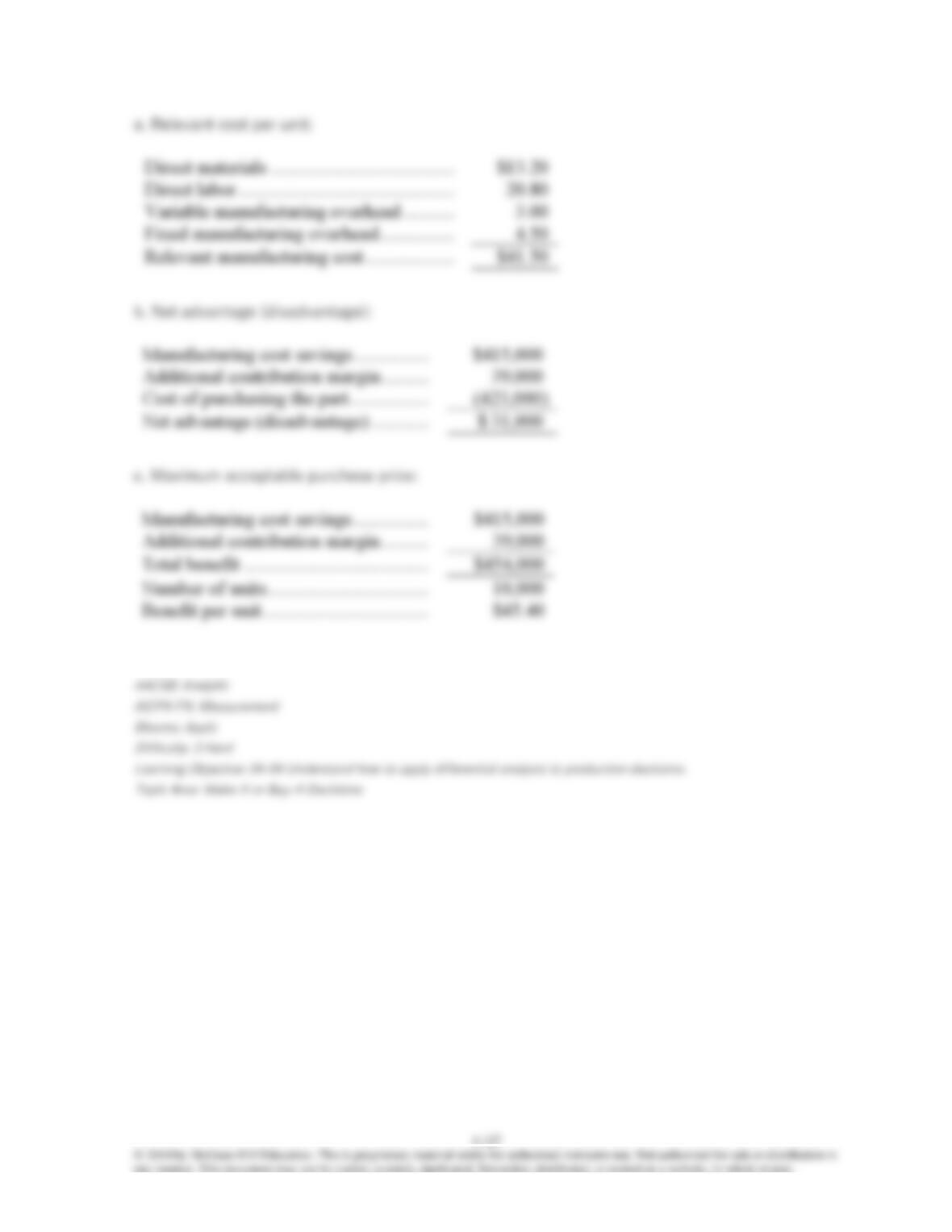
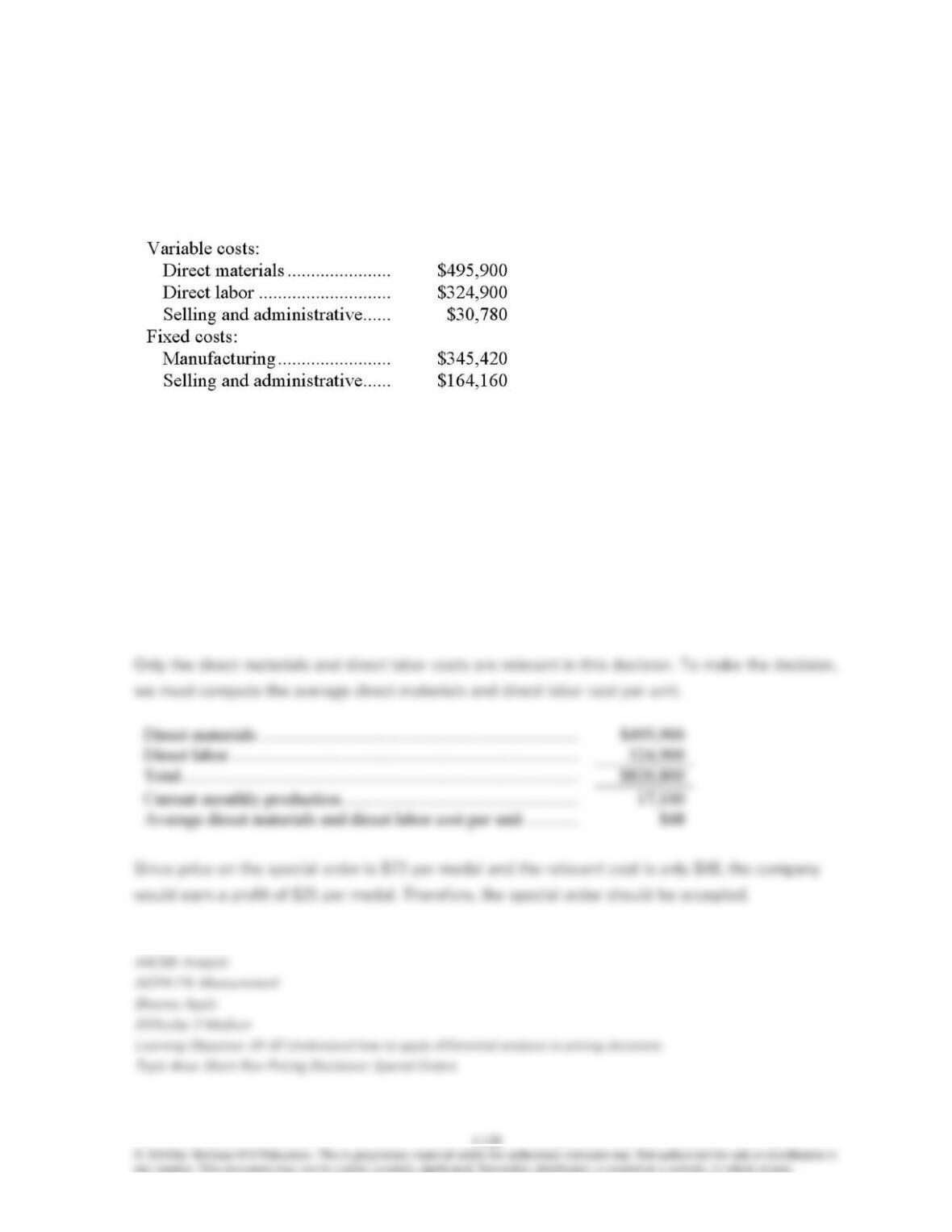
a. How much of the unit product cost of $47.90 is relevant in the decision of whether to make or
buy the part?
b. What is the net total dollar advantage (disadvantage) of purchasing the part rather than making
it?
c. What is the maximum amount the company should be willing to pay an outside supplier per unit
for the part if the supplier commits to supplying all 10,000 units required each year?
146. Rothery Co. manufactures and sells medals for winners of athletic and other events. Its
manufacturing plant has the capacity to produce 18,000 medals each month; current monthly
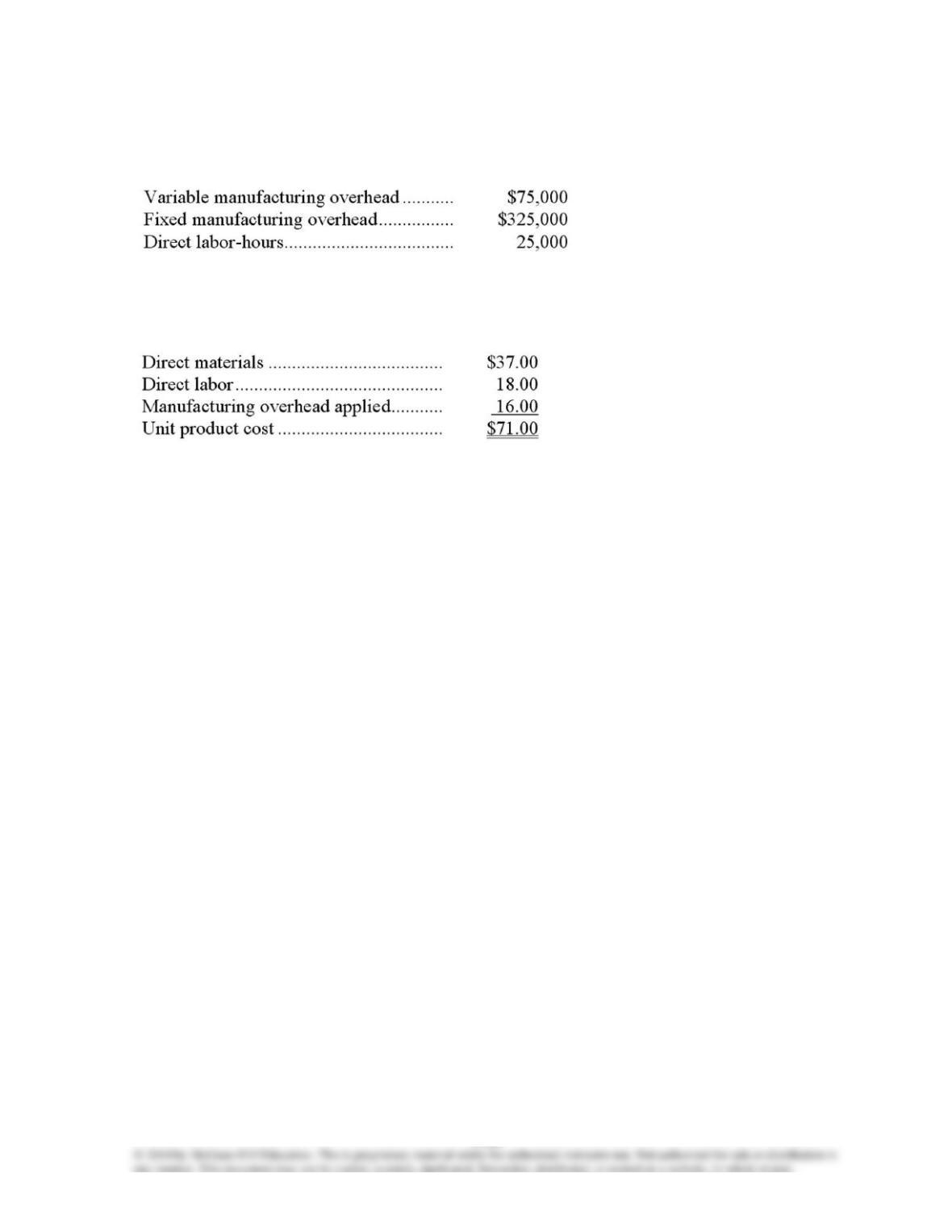
production is 17,100 medals. The company normally charges $88 per medal. Cost data for the
current level of production are shown below:
The company has just received a special one-time order for 600 medals at $73 each. For this
particular order, no variable selling and administrative costs would be incurred. This order would
also have no effect on fixed costs.
Required:
Should the company accept this special order? Why? (CMA adapted)
4-129
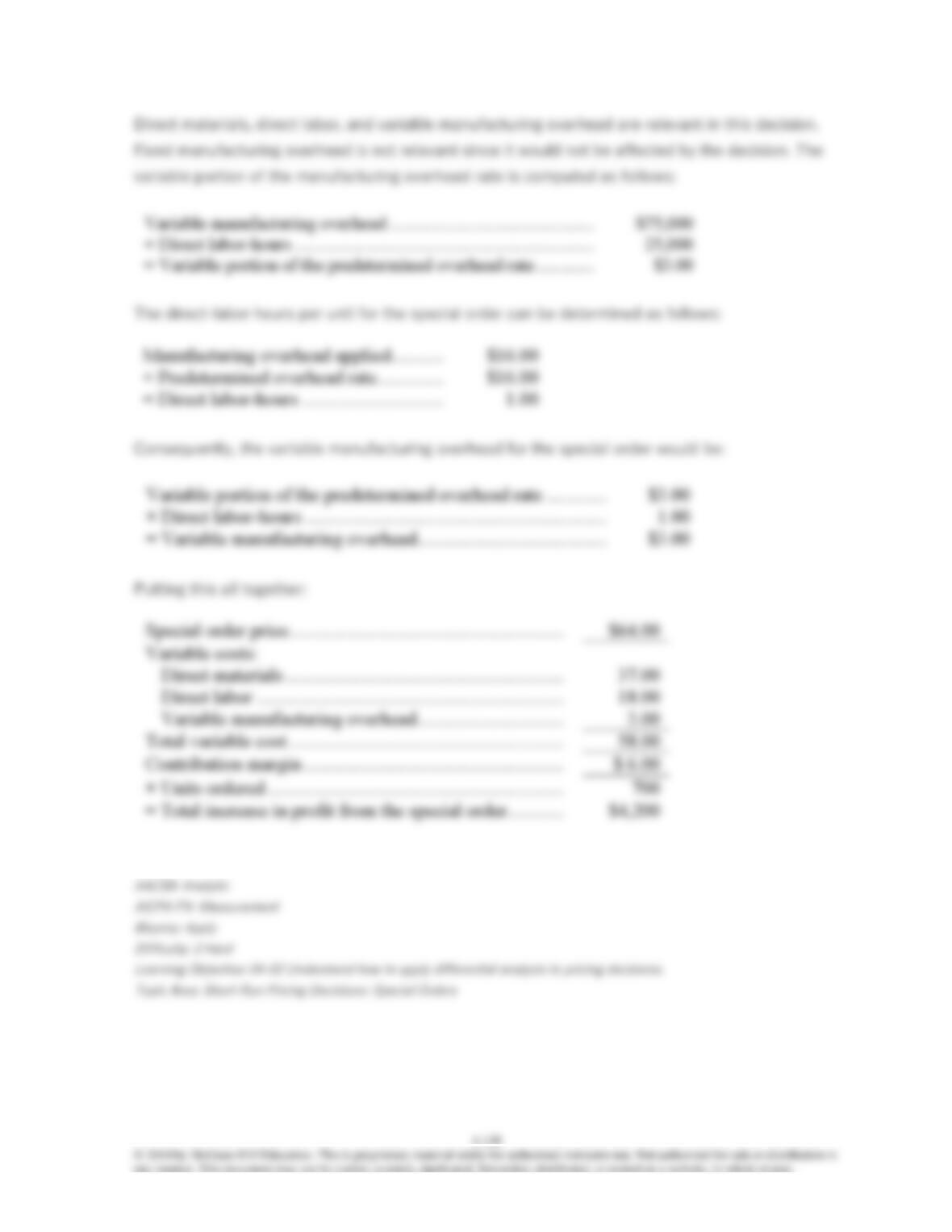
147. Humes Corporation makes a range of products. The company’s predetermined overhead
rate is $16 per direct labor-hour, which was calculated using the following budgeted data:
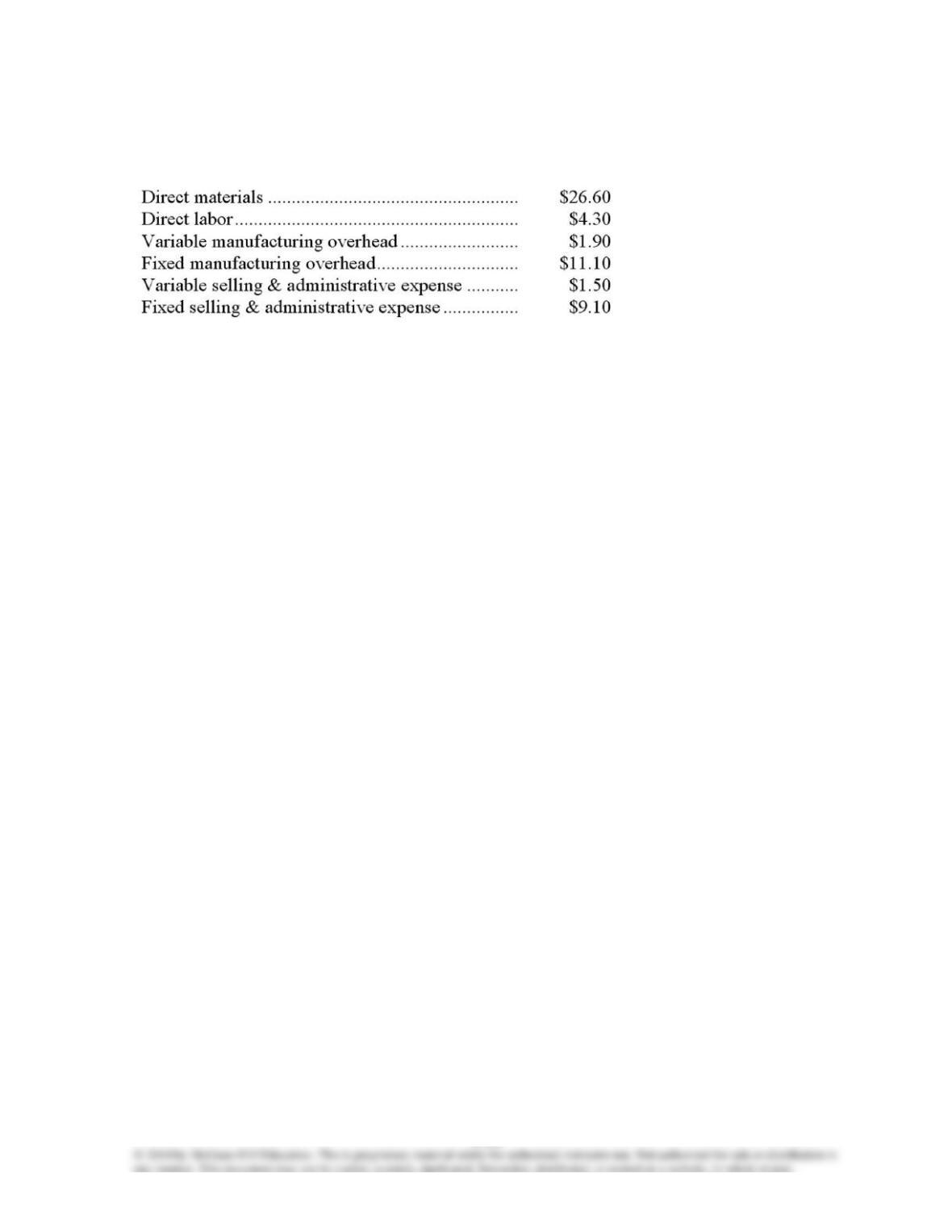
Management is considering a special order for 700 units of product J45K at $64 each. The normal
selling price of product J45K is $75 and the unit product cost is determined as follows:
If the special order were accepted, normal sales of this and other products would not be affected.
The company has ample excess capacity to produce the additional units. Assume that direct labor
is a variable cost, variable manufacturing overhead is really driven by direct labor-hours, and total
fixed manufacturing overhead would not be affected by the special order.
Required:
If the special order were accepted, what would be the impact on the company’s overall profit?
(CIMA adapted)
4-131
148. Jumonville Company produces a single product. The cost of producing and selling a single
unit of this product at the company’s normal activity level of 70,000 units per month is as follows:
The normal selling price of the product is $56.70 per unit.
An order has been received from an overseas customer for 2,000 units to be delivered this month
at a special discounted price. This order would have no effect on the company’s normal sales and
would not change the total amount of the company’s fixed costs. The variable selling and
administrative expense would be $0.70 less per unit on this order than on normal sales.
Direct labor is a variable cost in this company.
Required:
a. Suppose there is ample idle capacity to produce the units required by the overseas customer
and the special discounted price on the special order is $51.20 per unit. By how much would this
special order increase (decrease) the company’s net operating income for the month?
b. Suppose the company is already operating at capacity when the special order is received from
the overseas customer. What would be the opportunity cost of each unit delivered to the overseas
customer?
c. Suppose there is not enough idle capacity to produce all of the units for the overseas customer
and accepting the special order would require cutting back on production of 700 units for regular
customers. What would be the minimum acceptable price per unit for the special order?
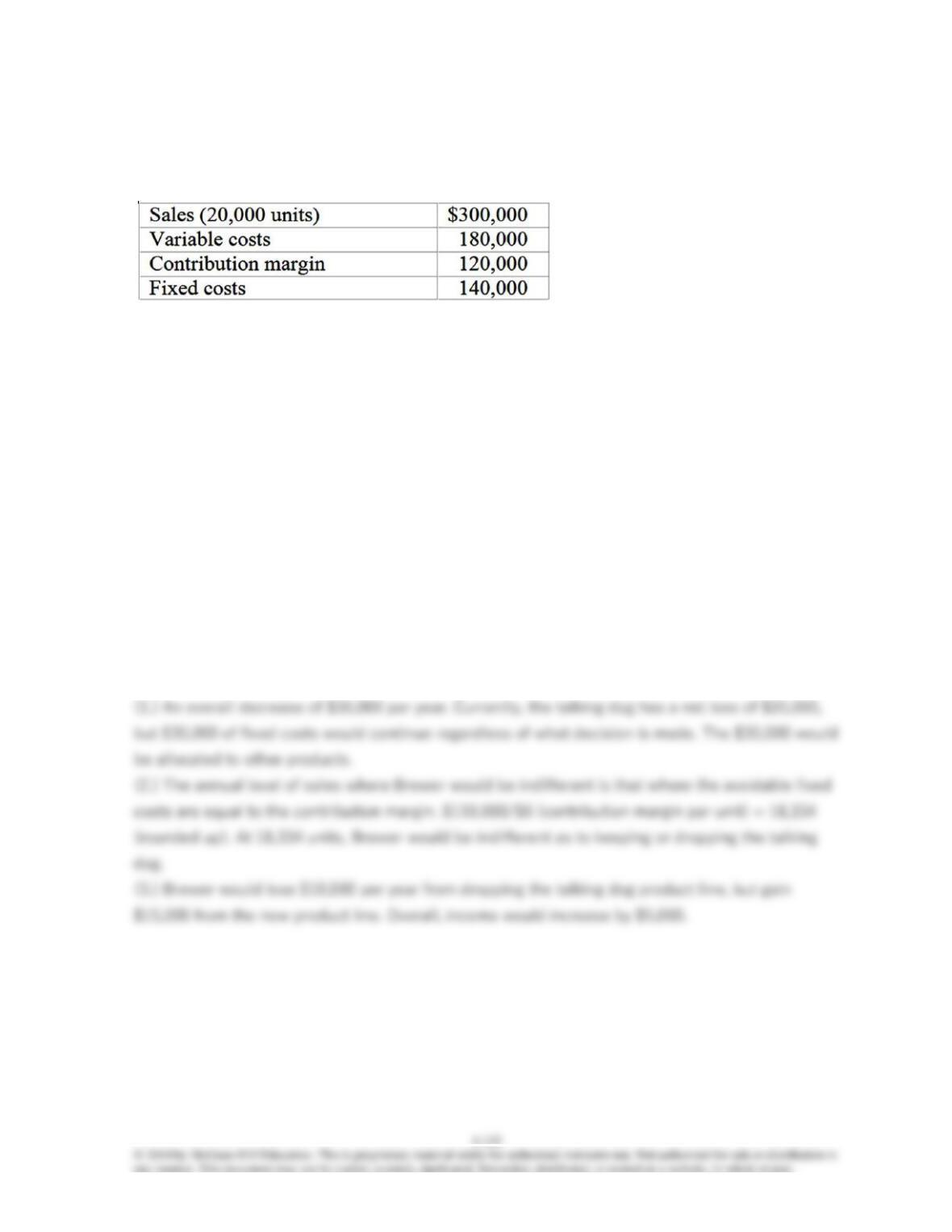
149. Brewer Corp. is considering dropping its talking dog product line due to continuing losses.
Revenue and cost data for the talking dog line for the past year follow:
If the talking dog is discontinued, then Brewer could avoid $110,000 per year in fixed costs.
Required:
(1.) What is the change in annual operating income from discontinuing the talking dog product
line?
(2.) Assuming all other conditions stay the same, at what level of annual sales of the talking dog
(in units) should Brewer be indifferent to discontinuing or continuing the product line?
(3.) Suppose that if the talking dog is dropped, the production and sale of other products would
increase so as to generate a $15,000 increase in the contribution margin received from the other
products. If all other conditions are the same, what is the change in annual operating income from
dropping the talking dog? _____
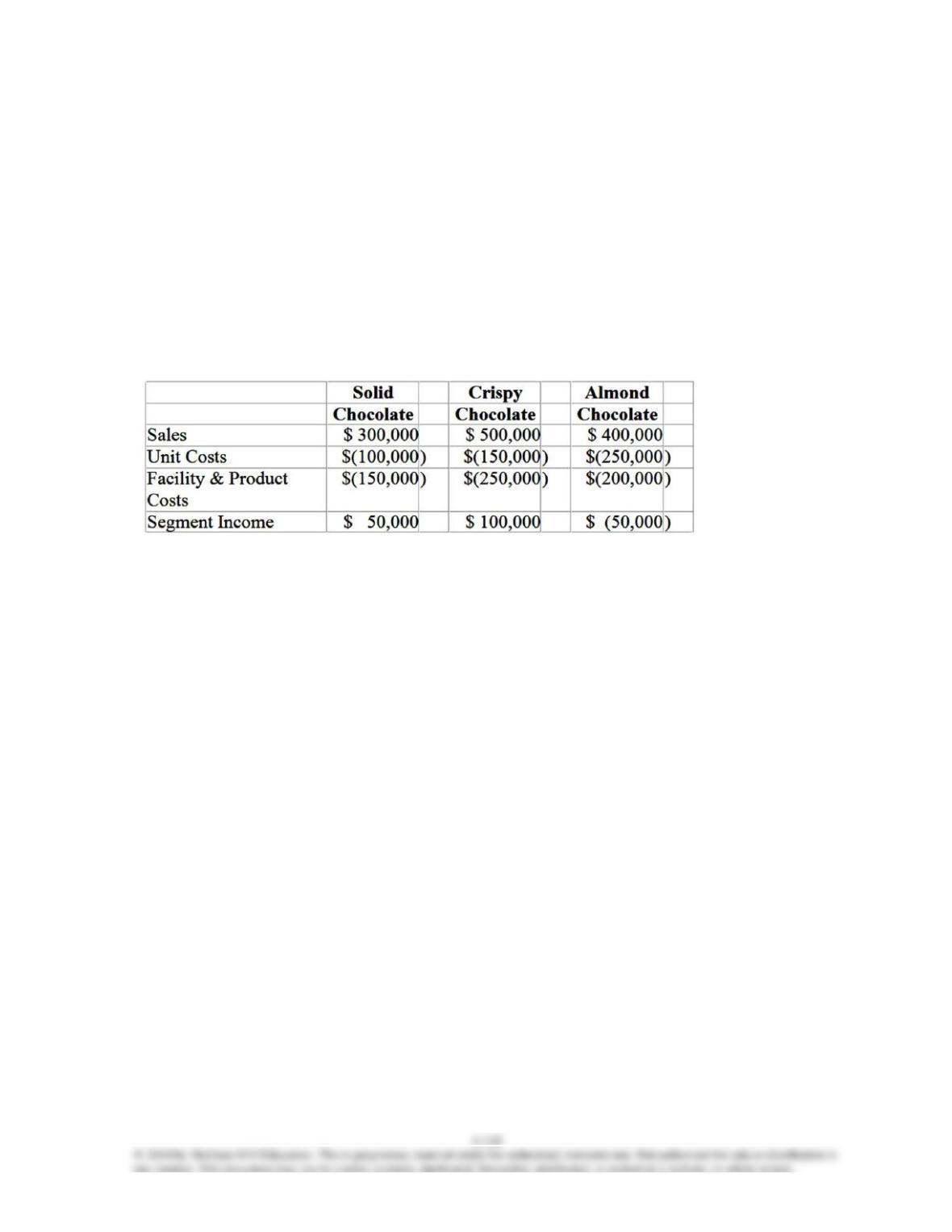
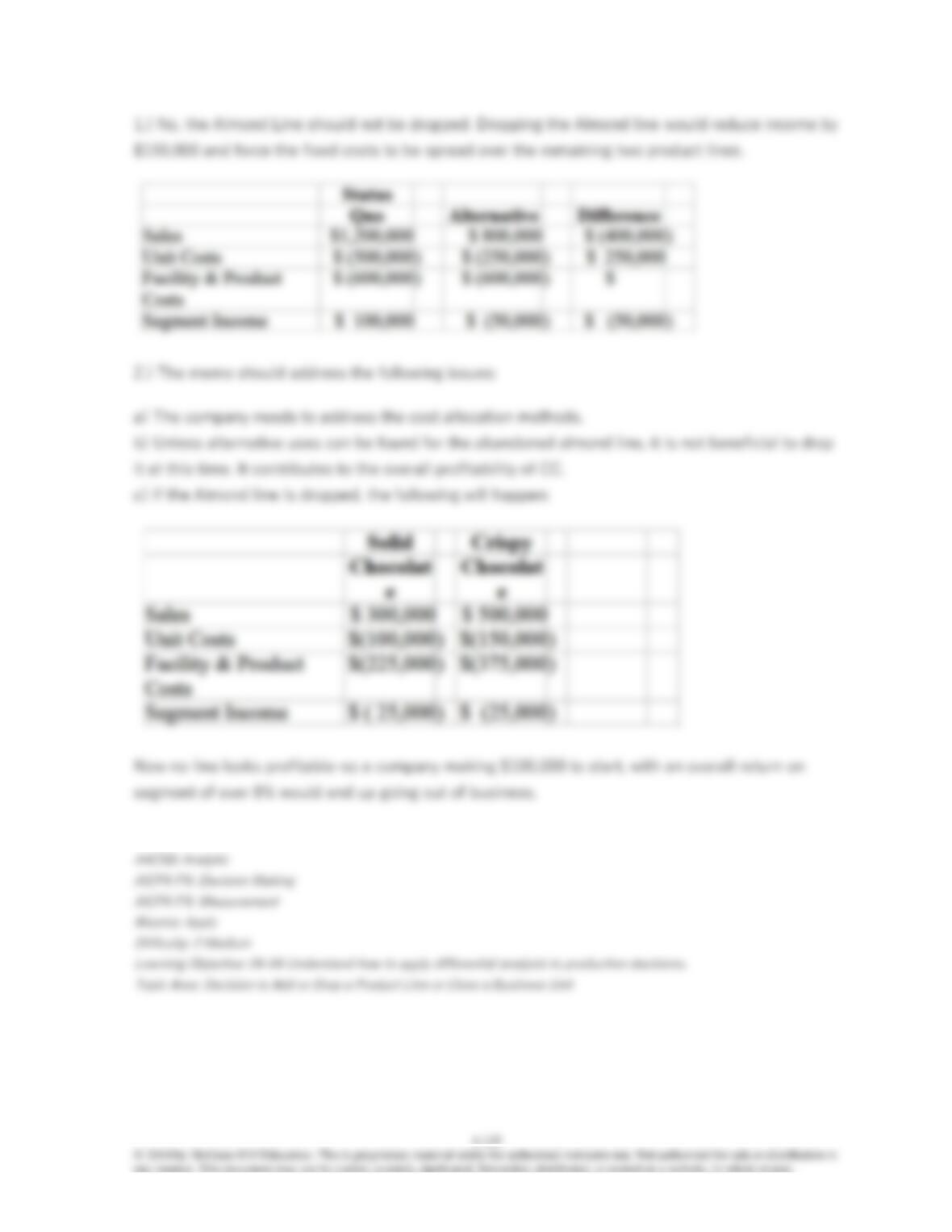
150. Conwell Candies (CC) makes three types of chocolate candy bars. The head of marketing,
Grant Wistrom found the chart below and believes CC should drop the Almond line. He asks
controller Vivian King to review the situation and determine the fate of the Almond Line.
Required:
1.) Review the information below and determine the fate of the Almond Line. Prepare your answer
in good form. Note-facility and product level costs are fixed and will not change; they are allocated
based upon sales.
2.) Prepare a memo defending your position on this important issue.
151. Ellis Enterprises produces high quality blankets sold to hotels and resorts. Blankets must
be well made because of frequent washings. Currently, Holt sells 10,000 blankets at $60 each with
the capacity to produce 12,000 blankets. Ellis is considering a special order from a hotel chain in
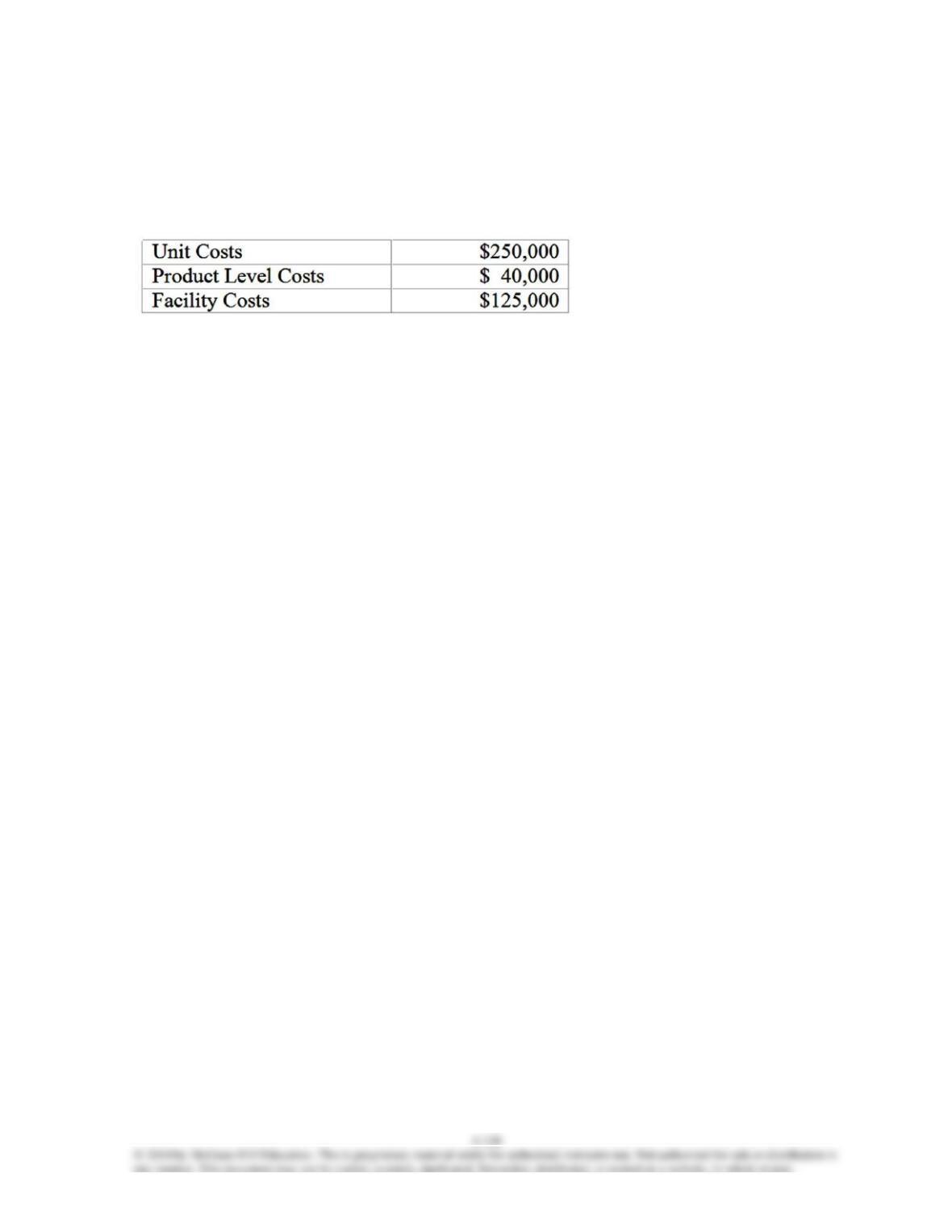
Kenya for 1,000 blankets at a price of $45. Currently, Ellis has the following costs:
If Ellis accepts the special order, it will incur an additional $2 per blanket in foreign currency
transaction costs. No other product or facility costs will change.
Required:
1.) Determine the impact of the special order on Ellis. Prepare your analysis in good form.
2.) What other factors should Ellis consider in taking the special order?