93. Frankoff Company had a beginning work-in-process inventory of 30,000 units on June 1.
These units contained $120,000 of direct materials and $272,000 of conversion cost. The
following data relate to activity during June:
Production completed (units)
70,000
Ending work in process, 60% complete (units)
20,000
Direct materials used
$258,000
Conversion cost
$695,600
Frankoff uses a weighted-average process-costing system. All materials are added at the start
of manufacturing; in contrast, conversion cost is incurred evenly throughout production.
Required:
A. Compute the total equivalent units for direct material and conversion cost.
B. Compute the cost per equivalent unit of direct material and conversion cost.
C. Determine the cost of completed production.
D. Determine the cost of the June 30 work in process.
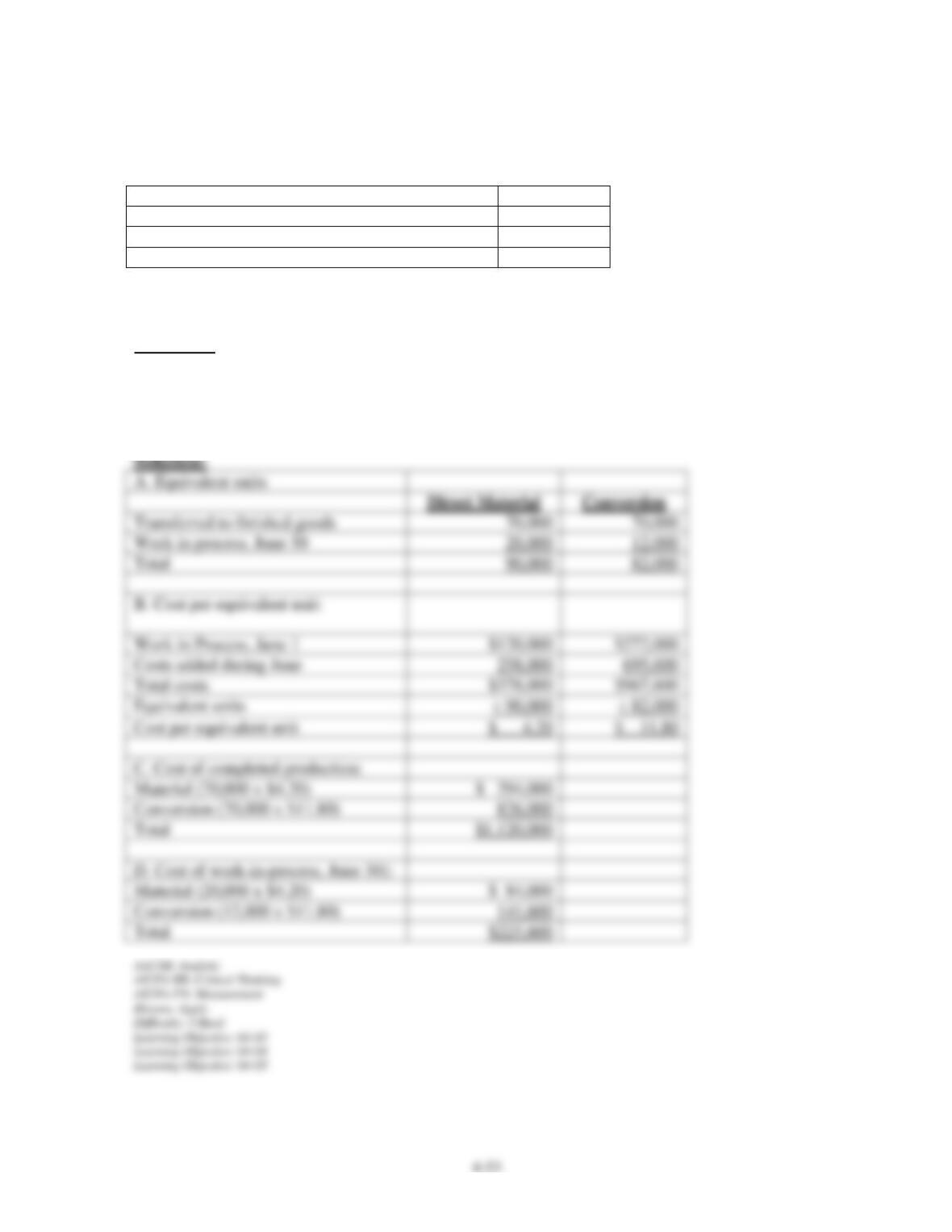
Transferred to finished goods
Work in process, June 30
Total
Total costs
Cost per equivalent unit
Material (70,000 x $4.20)
D. Cost of work-in–process, June 301:
Conversion (12,000 x $11.80)
94. On May 1, Diggton Company had a work-in-process inventory of 10,000 units. The units
were 100% complete for material and 30% complete for conversion, with respective costs of
$30,000 and $1,850.
During the month, 150,000 units were completed and transferred to finished goods. The May
31 ending work-in-process inventory consisted of 10,000 units that were 100% complete with
respect to materials and 80% complete with respect to conversion.
Costs added during the month were $330,000 for materials and $503,750 for conversion.
Required:
Using the weighted-average method, calculate:
A. total equivalent units for material and conversion.
B. the cost per equivalent unit for material and conversion.
C. the cost transferred to finished goods.
D. the cost of ending work in process.
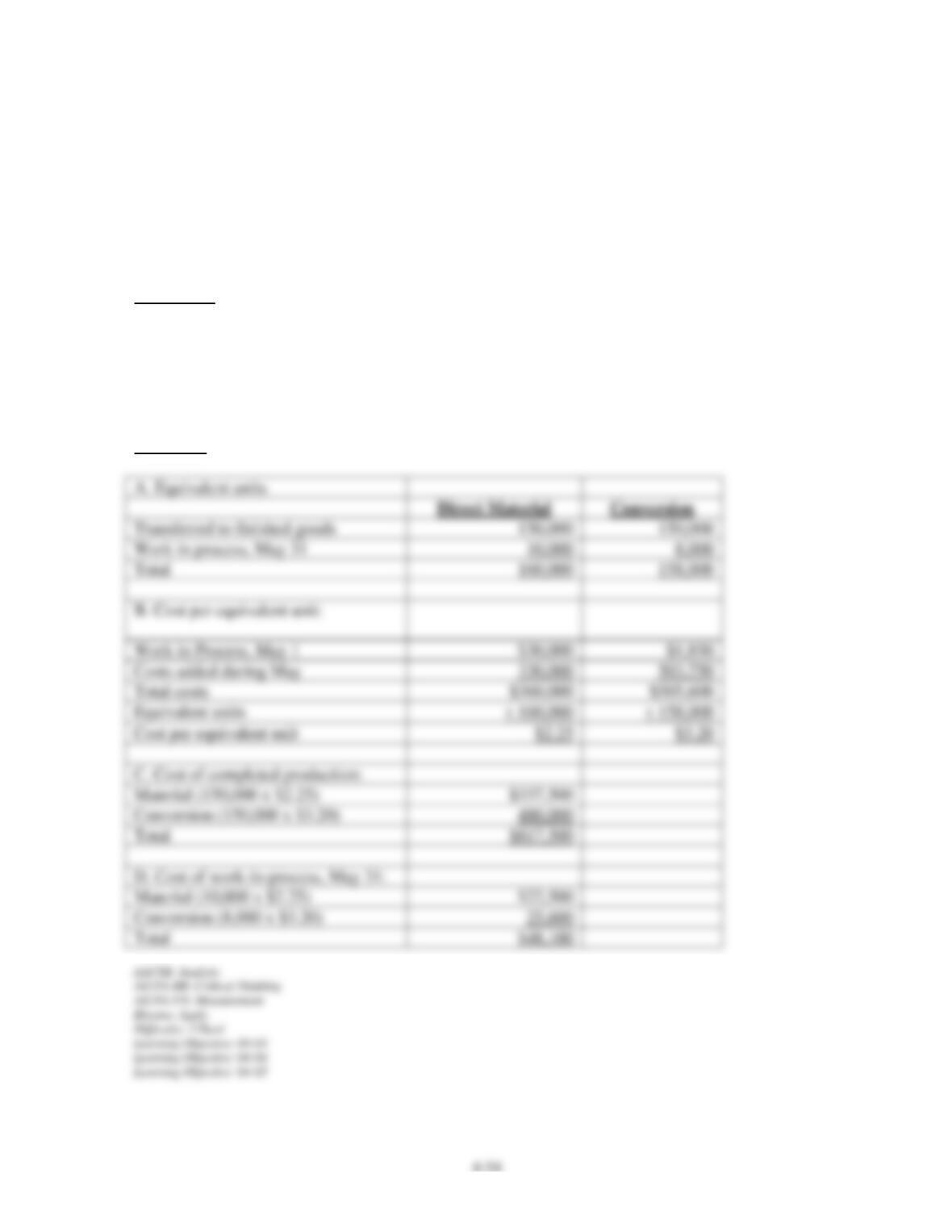
Solution:

4-55
95. Baxter Products manufactures office furniture by using an assembly-line process. All
direct materials are introduced at the start of the process, and conversion cost is incurred
evenly throughout manufacturing. An examination of the company’s Work-in-Process account
for August revealed the following selected information:
Debit side—
August 1 balance: 600 units, 40% complete; cost, $44,600*
Production started: 1,800 units
Direct materials used during August: $90,000
August conversion cost: $51,400
Credit side—
Production completed: 1,400 units
*Supplementary records disclosed direct material cost of $30,000 and conversion cost of
$14,600.
Conversations with manufacturing personnel revealed that the ending work in process was
80% complete.
Required:
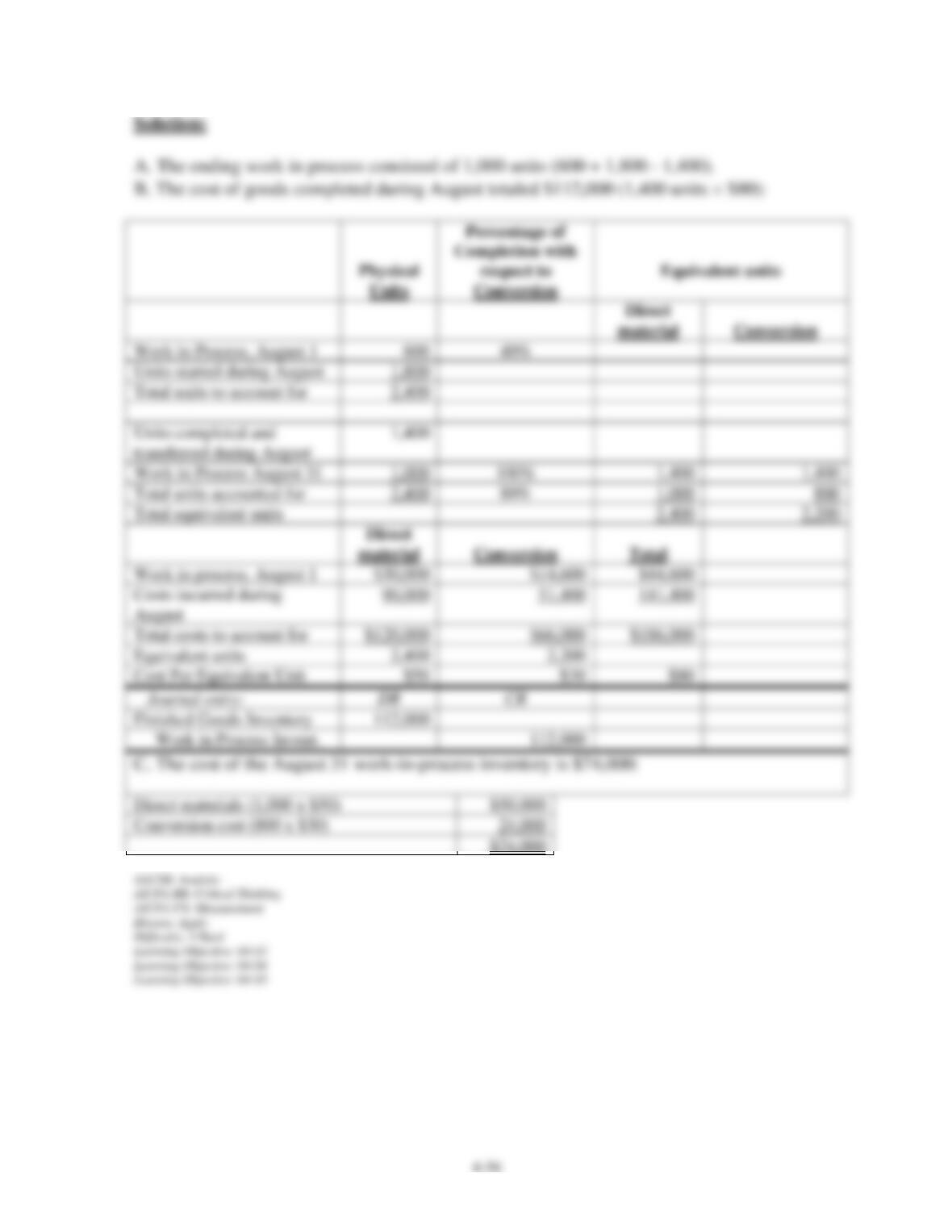
A. Determine the number of units in the August 31 work-in-process inventory.
B. Calculate the cost of goods completed during August, and prepare the appropriate journal
entry to record completed production.
C. Determine the cost of the August 31 work-in-process inventory.
4-57
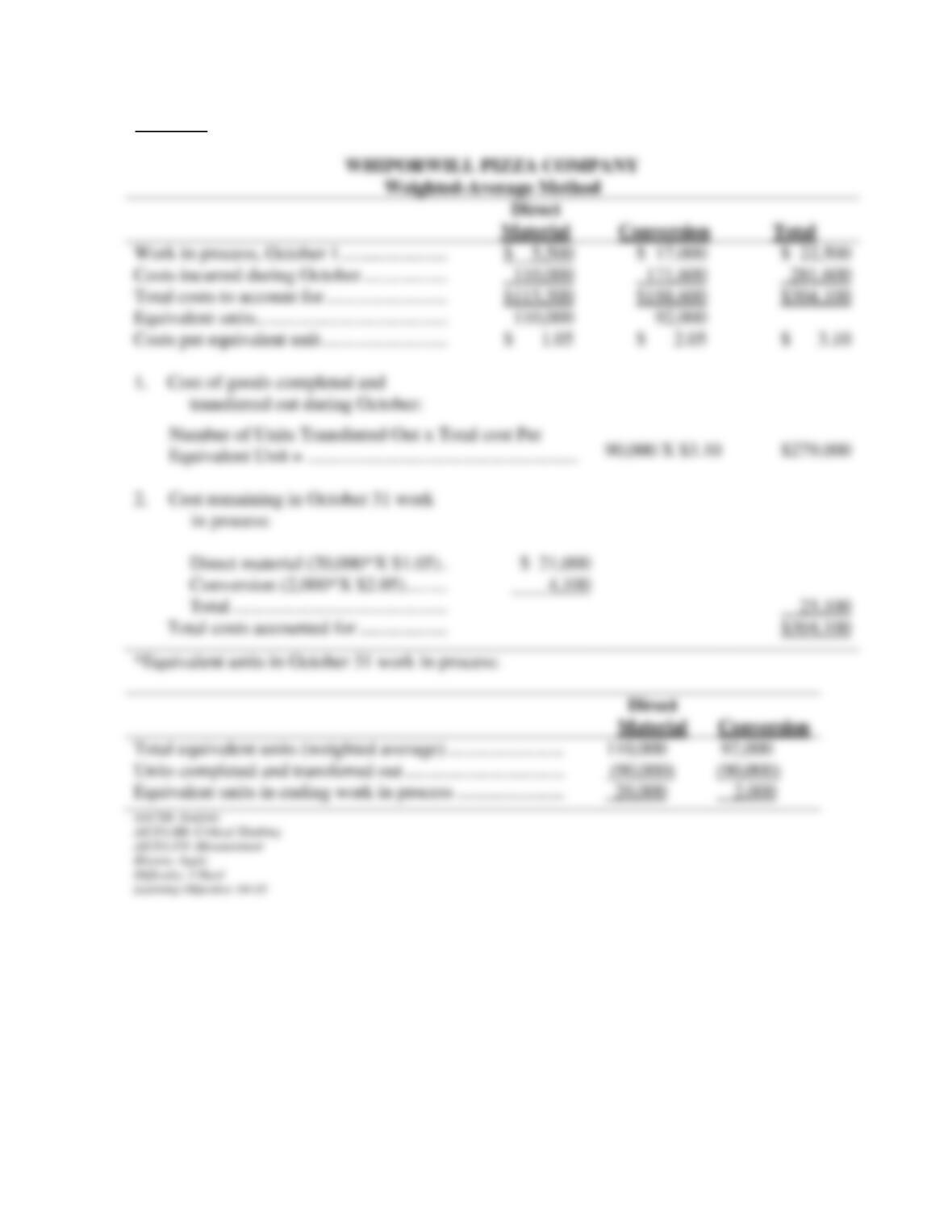
96. Whiporwill Pizza, a manufacturer of frozen pizzas, has the following data:
Work in Process, October 1
10,000 units*
Direct material
$5,500
Conversion
17,000
Costs incurred during October
Direct material
$110,000
Conversion
171,600
* Complete as to direct material; 40% complete as to conversion
The equivalent units of activity for October are:
Direct material (weighted-average method)
110,000
Conversion (weighted-average method)
92,000
Completed and transferred out
90,000
Required:
Compute the following amounts using weighted-average process costing.
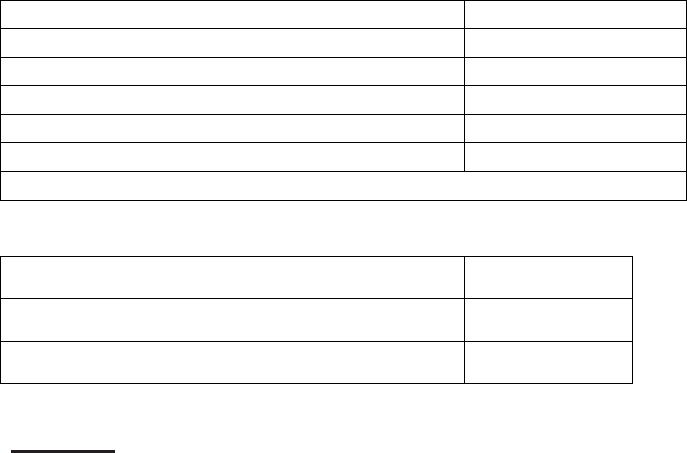
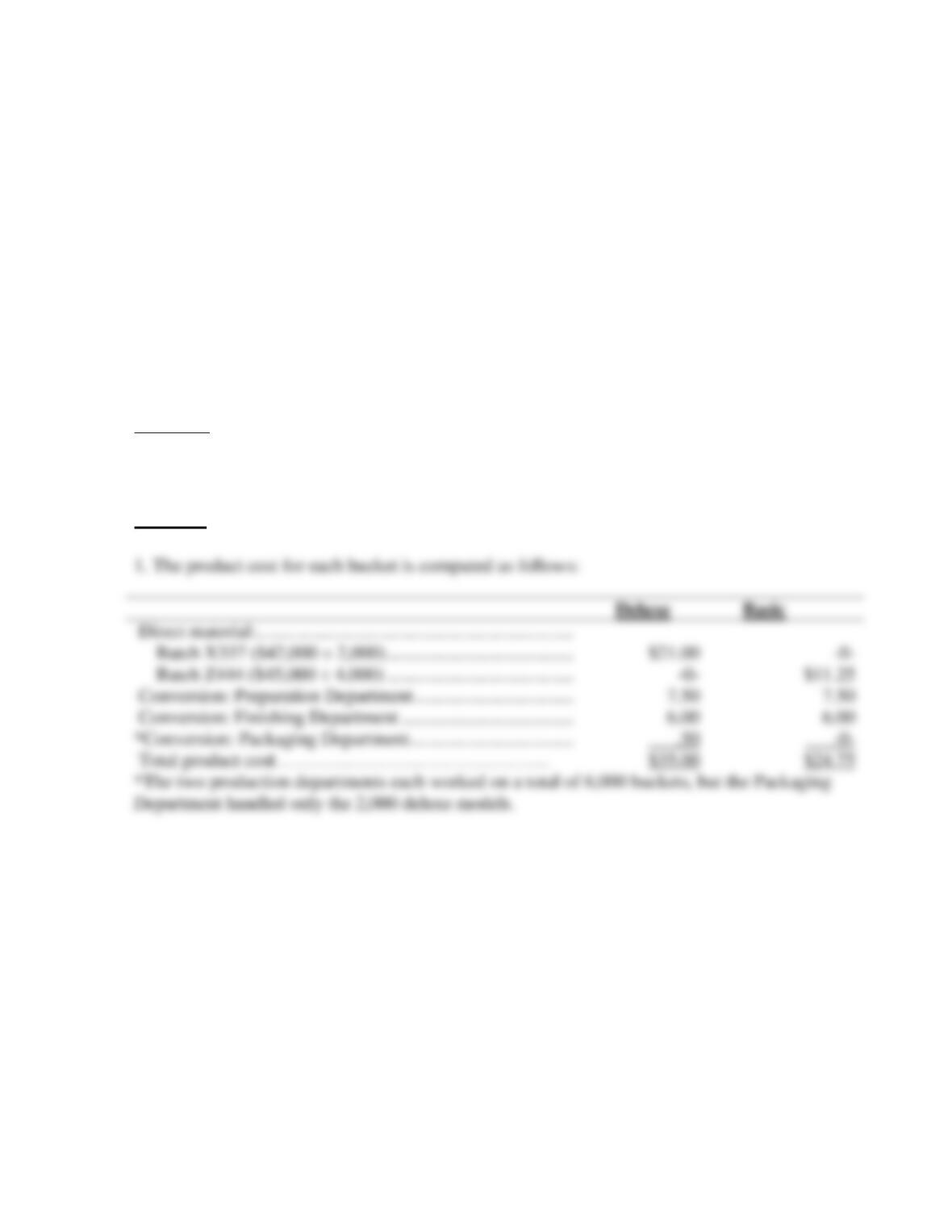
1. Cost of goods completed and transferred out during October.
2. Cost of the October 31 work-in-process inventory.
4-58
Solution:
4-59
97. The July production of Bait Buckets for Flying Angler’s Supply Division consisted of batch
X337 (2,000 deluxe) and batch Z444 (4,000 basic). Each batch was started and finished
during July, and there was no beginning or ending work in process. Costs incurred were as
follows:
Direct Material:
Batch X337, $42,000, including $2,500 for packaging material; batch Z444, $45,000.
Conversion Costs:
Preparation Department, predetermined rate of $7.50 per unit; Finishing Department,
predetermined rate of $6.00 per unit; Packaging Department, predetermined rate of $.50 per
unit. (Only the deluxe buckets are packaged.)
Required:
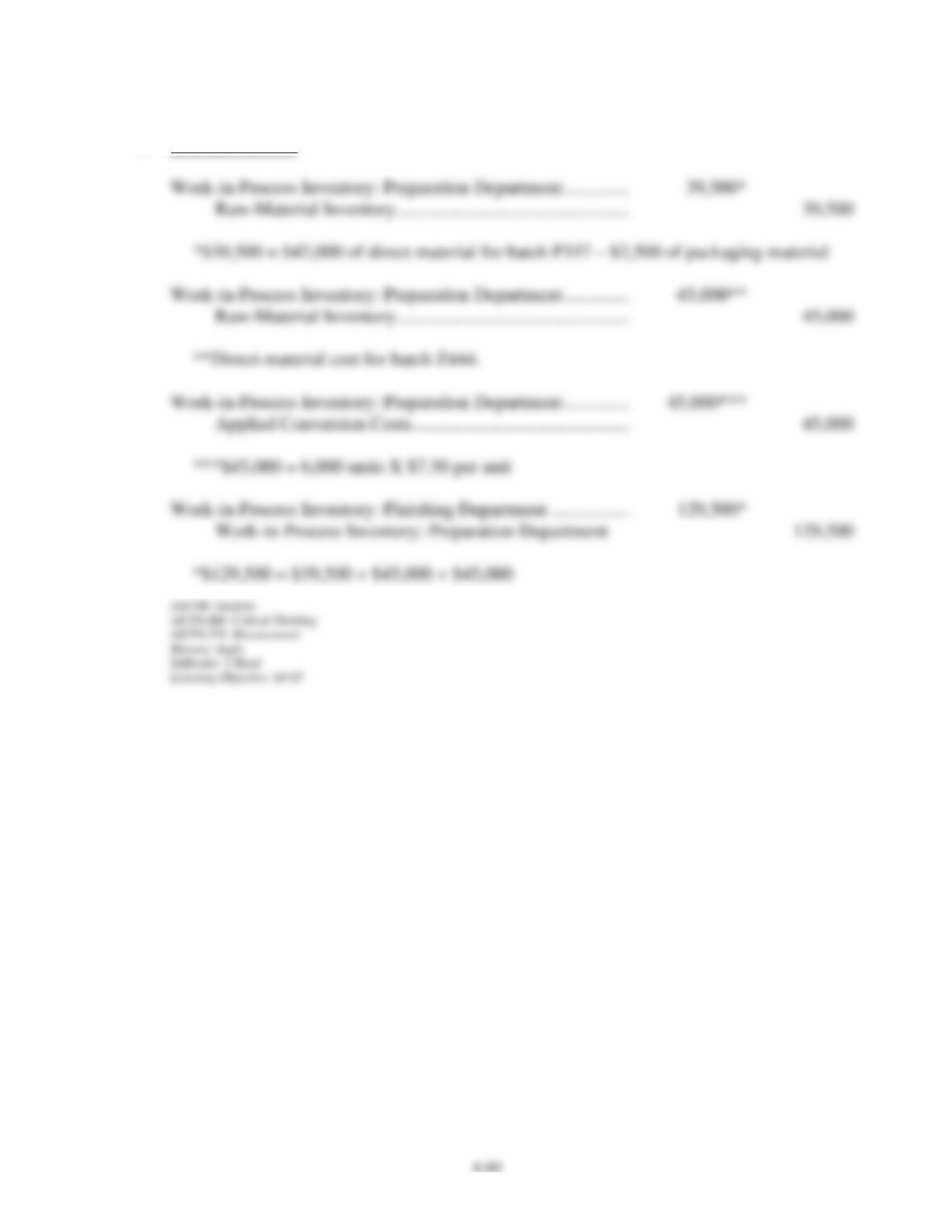
1. Compute the July product cost for each type of bait bucket.
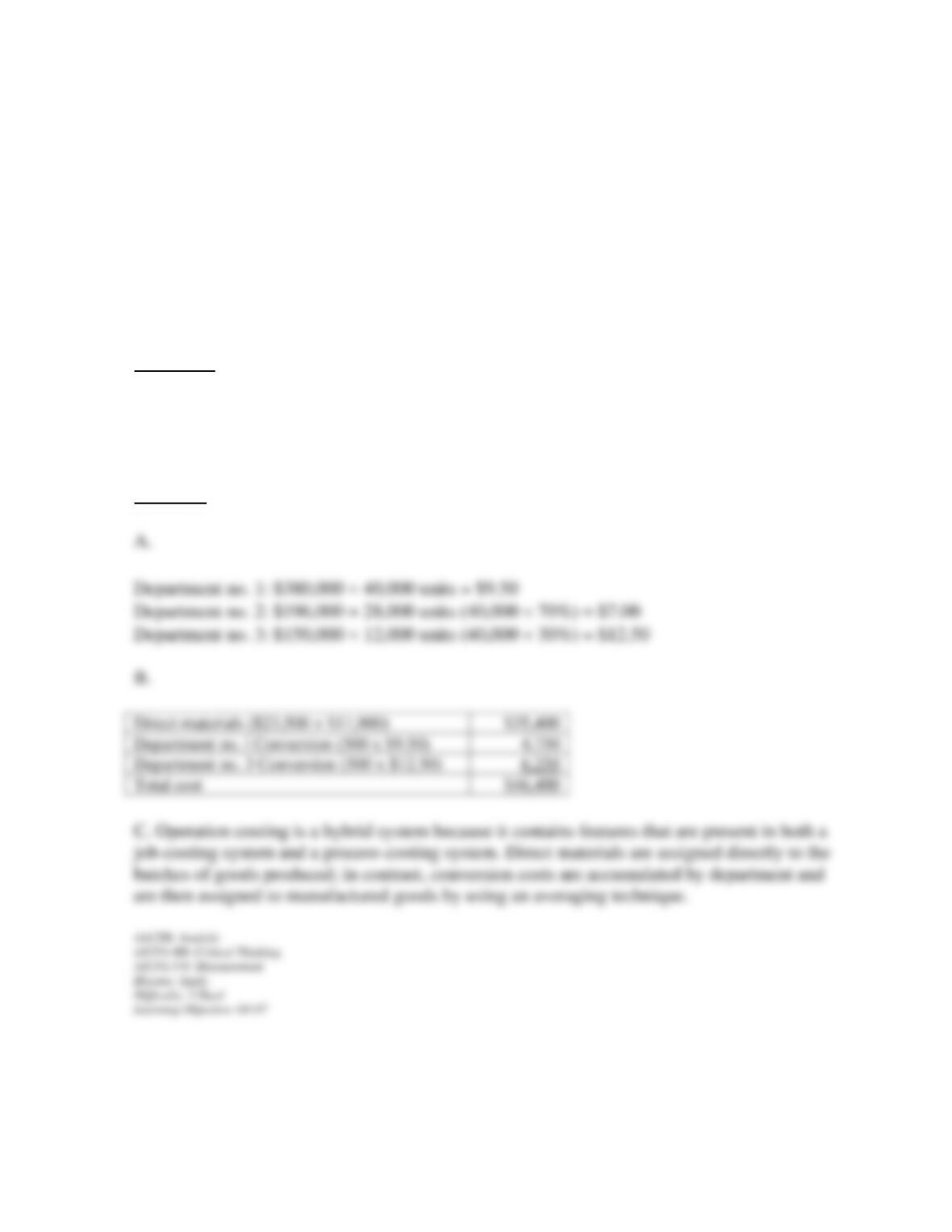
2. Prepare journal entries to record the cost flows during July.
Solution:
2.
Journal entries:
Raw-Material Inventory …………………………………………..
*$39,500 = $42,000 of direct material for batch P337 – $2,500 of packaging material
Raw-Material Inventory …………………………………………..
**Direct-material cost for batch Z444.
Applied Conversion Costs ……………………………………….
***$45,000 = 6,000 units X $7.50 per unit
Work-in-Process Inventory: Preparation Department
^$129,500 = $39,500 + $45,000 + $45,000
4-61
98. Lowery Corporation, which uses an operation-costing system, has three processing
departments. All units pass through Department no. 1; upon completion, 70% of the goods are
sent to Department no. 2 and 30% are sent to Department no. 3. Additional data follow.
· Forty thousand units were manufactured during the year.
· Conversion cost in each department was: No. 1, $380,000; no. 2, $196,000; and no. 3,
$150,000.
· Batch no. 67, which consisted of 500 units, was sent to Department no. 3 for its additional
processing. Direct materials of $23,500 and $11,900 were introduced to this batch in
Department nos. 1 and 3, respectively.
Lowery assigns conversion cost to goods manufactured on the basis of units produced.
Required:
A. Determine the conversion cost per unit in Department no. 1, Department no. 2, and
Department no. 3.
B. Compute the total cost of batch no. 67.
C. Operation costing is sometimes referred to as a hybrid costing system. Briefly explain.
Solution:
99. Upton Knitters manufactures sweaters and uses an operation-costing system. All sweaters
are processed through Department no. 1, with subsequent processing taking place in
Department no. 2 or Department no. 3, depending on the type of fabric used. Twenty thousand
sweaters were produced during the year; there was no beginning or ending work in process.
Sixty percent of the goods were sent to Department no. 2 for manufacturing.
Conversion cost incurred in the three departments totaled $504,000, subdivided as follows:
Department no. 1, $360,000; Department no. 2, $60,000; and Department no. 3, $84,000.
Data pertaining to two representative orders, nos. 545 and 567, were:
No. 545
No. 567
Direct materials
$112,000
$94,000
Number of sweaters
800
1,300
Subsequent processing department
No. 3
No. 2
Required:
A. Explain the nature of operation costing.
B. Determine the cost of order nos. 545 and 567.
Solution:
No. 545
No. 567
Direct materials
$112,000
$94,000
Conversion cost: No. 1
800 sweaters x $18; 1,300 sweaters x $18
Conversion cost: No. 2
1,300 sweaters x $5
6,500
Conversion cost: No. 3
800 sweaters x $10.50
8,400
100. Operation costing is a hybrid type of accounting system that combines features of job-
order and process-cost accounting.
Required:
A. Briefly discuss the similarities and differences of an operation-costing system and a job-
order costing system.
B. Briefly discuss the similarities and differences of an operation-costing system and a
process-costing system.
Solution:
101. Operation costing is a popular type of accounting system, one that combines selected
features of job-order and process-cost accounting.
Required:
A. Briefly discuss the basic features that are associated with an operation-costing system.
B. Explain why a sweater manufacturer may have a need for an operation-costing system.
Solution: