84. For the past five years, the Selin Company has produced and sold frequency meters to
genetics labs throughout the United States. Recently, a strong competitor has entered the market
and Selin is considering whether it should continue to produce and sell the frequency meters. The
following information has been gathered to assist management in its decision:
A) Sales volume (units) is estimated to drop by 25% once the competitor becomes fully
operational.
B) The equipment used to produce the meters was purchased five-years ago for $1,500,000.
C) The space now used to produce the meters would be reallocated to eliminate the need to rent
warehouse space.
D) Three of the employees who produce meters would be reassigned to the oscillator division.
Which of the items listed above is (are) relevant to the decision to continue the production and
sale of the frequency meters?
85. Which of the following statements about the theory of constraints is (are) true?
(A) The theory of constraints focuses on determining the optimal product mix when two or more
resources restrict the attainment of a goal or objective.
(B) The theory of constraints focuses on maximizing the rate of throughput contribution while
maximizing investment and other operating costs.
86. The opportunity cost of making a component part in a factory with no excess capacity is
the: (CMA adapted)
87. When there is a production constraint, a company should emphasize the products with:
88. Scherer Corporation is preparing a bid for a special order that would require 720 liters of
material U48N. The company already has 560 liters of this raw material in stock that originally
cost $6.30 per liter. Material U48N is used in the company’s main product and is replenished on a
periodic basis. The resale value of the existing stock of the material is $5.80 per liter. New stocks
of the material can be readily purchased for $6.65 per liter. What is the relevant cost of the 720
liters of the raw material when deciding how much to bid on the special order? (CIMA adapted)
89. Cung Inc. has some material that originally cost $68,400. The material has a scrap value of
$30,100 as is, but if reworked at a cost of $1,400, it could be sold for $30,800. What would be the
incremental effect on the company’s overall profit of reworking and selling the material rather
than selling it as is as scrap? (CIMA adapted)
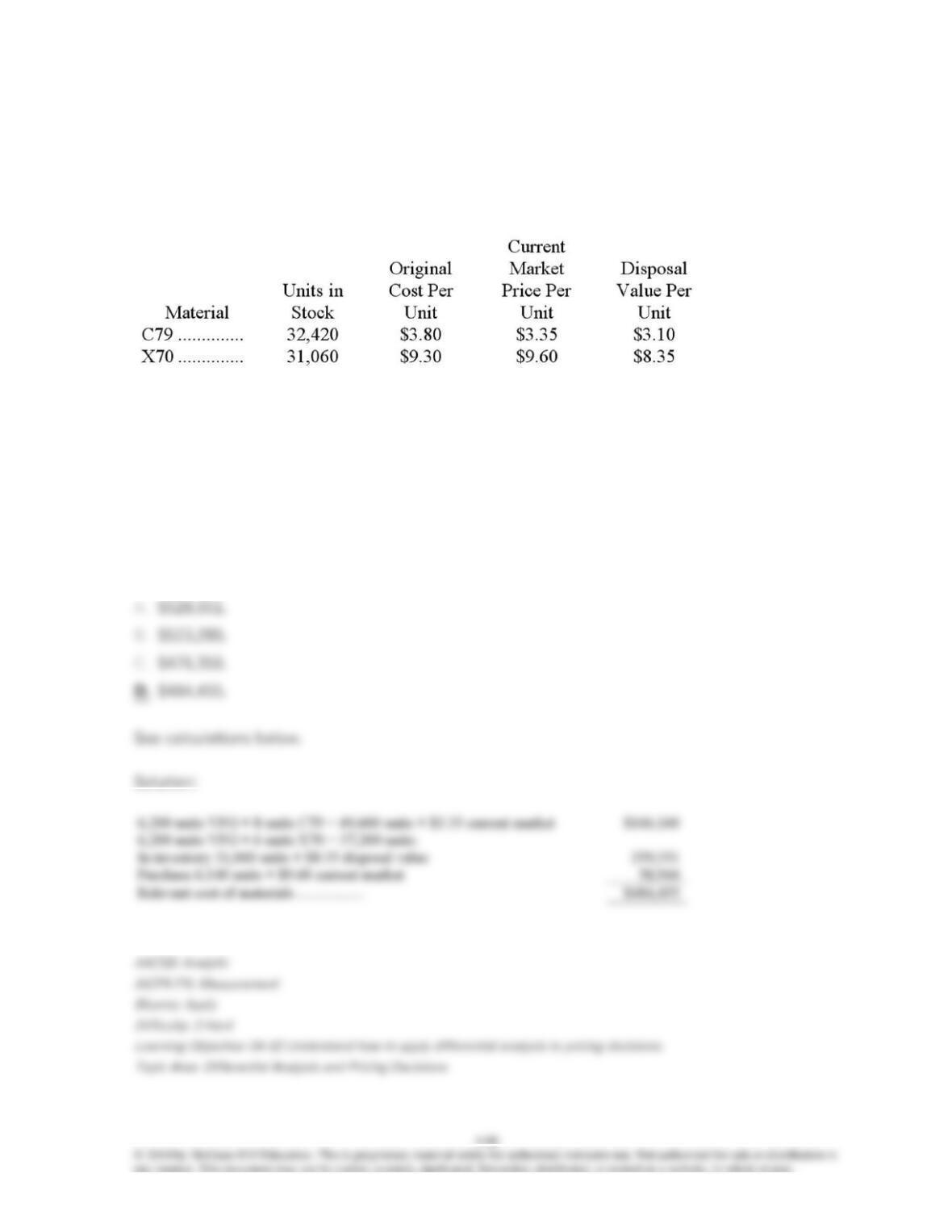
90. Liffick Corporation is a specialty component manufacturer with idle capacity. Management
would like to use its unused capacity to generate additional profits. A potential customer has
offered to buy 6,200 units of component VFG. Each unit of VFG requires 8 units of material C79
and 6 units of material X70. Data concerning these two materials follow:
Material C79 is in use in many of the company’s products and is routinely replenished. Material
X70 is no longer used by the company in any of its normal products and existing stocks would not
be replenished once they are used up.
What would be the relevant cost of the materials, in total, for purposes of determining a minimum
acceptable price for the order for product VFG? (CIMA adapted)
91. Schemm Inc. regularly uses material F04E and currently has in stock 460 liters of the
material for which it paid $2,622 several weeks ago. If this were to be sold as is on the open
market as surplus material, it would fetch $5.25 per liter. New stocks of the material can be
purchased on the open market for $5.85 per liter, but it must be purchased in lots of 1,000 liters.
You have been asked to determine the relevant cost of 800 liters of the material to be used in a
job for a customer. The relevant cost of the 800 liters of material F04E is: (CIMA adapted)
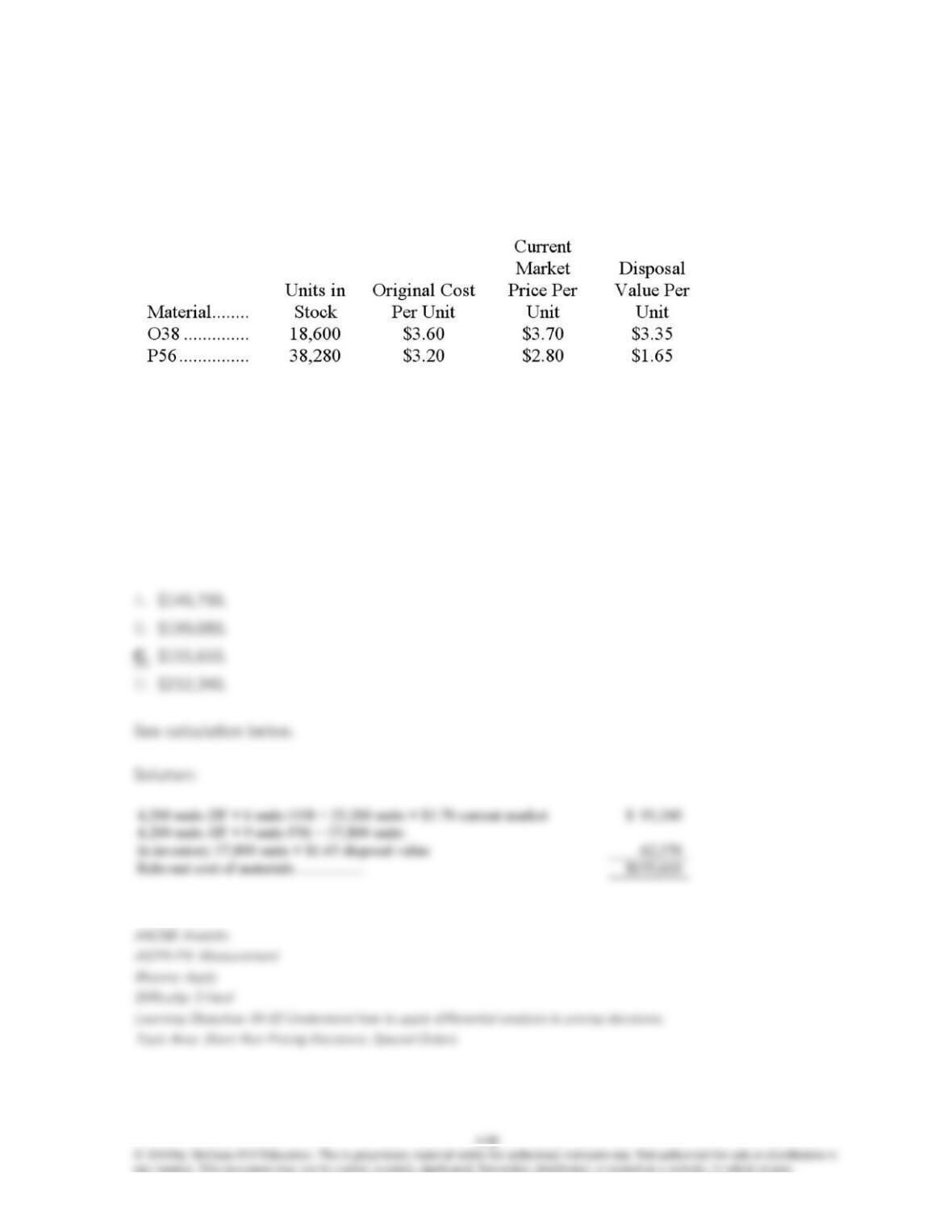
92. Stampka Corporation is a specialty component manufacturer with idle capacity.
Management would like to use its extra capacity to generate additional profits. A potential
customer has offered to buy 4,200 units of component JJF. Each unit of JJF requires 6 units of
material O38 and 9 units of material P56. Data concerning these two materials follow:
Material O38 is in use in many of the company’s products and is routinely replenished. Material
P56 is no longer used by the company in any of its normal products and existing stocks would not
be replenished once they are used up.
What would be the relevant cost of the materials, in total, for purposes of determining a minimum
acceptable price for the order for product JJF? (CIMA adapted)
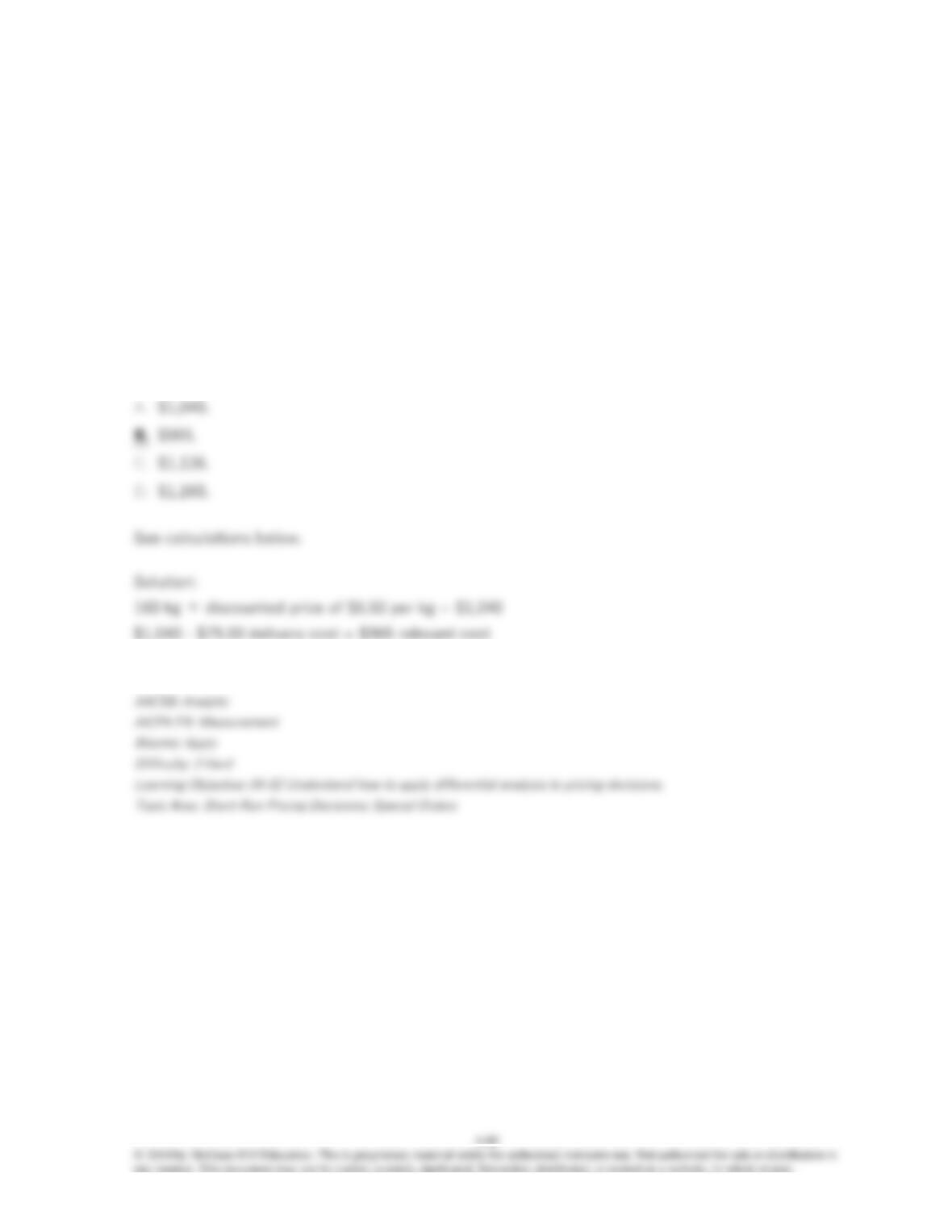
93. Lampshire Inc. is considering using stocks of an old raw material in a special project. The
special project would require all 160 kilograms of the raw material that are in stock and that
originally cost the company $1,136 in total. If the company were to buy new supplies of this raw
material on the open market, it would cost $7.25 per kilogram. However, the company has no
other use for this raw material and would sell it at the discounted price of $6.50 per kilogram if it
were not used in the special project. The sale of the raw material would involve delivery to the
purchaser at a total cost of $75.00 for all 160 kilograms. What is the relevant cost of the 160
kilograms of the raw material when deciding whether to proceed with the special project? (CIMA
adapted)
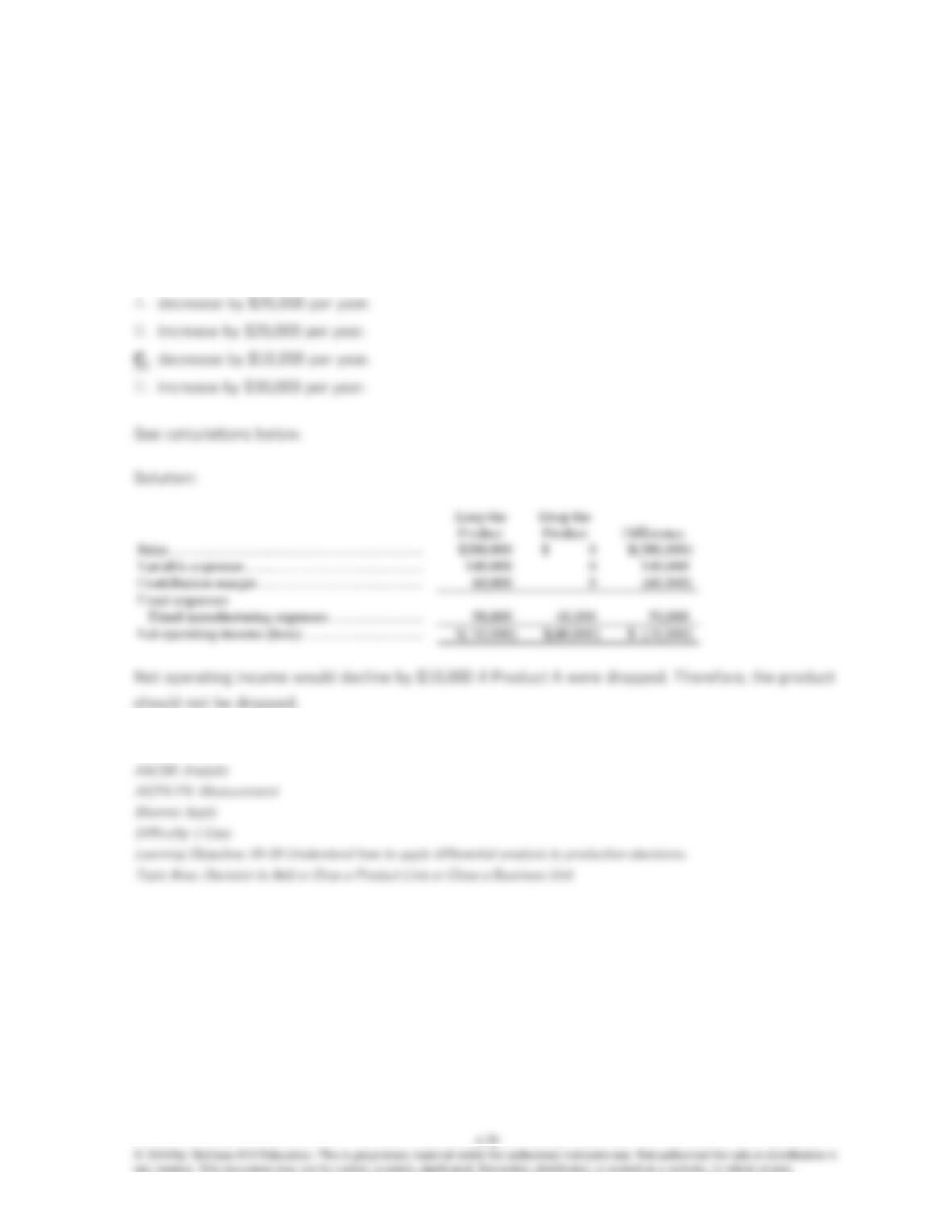
94. A study has been conducted to determine if Product A should be dropped. Sales of the
product total $200,000 per year; variable expenses total $140,000 per year. Fixed expenses
charged to the product total $90,000 per year. The company estimates that $40,000 of these fixed
expenses will continue even if the product is dropped. These data indicate that if Product A is
dropped, the company’s overall net operating income would:
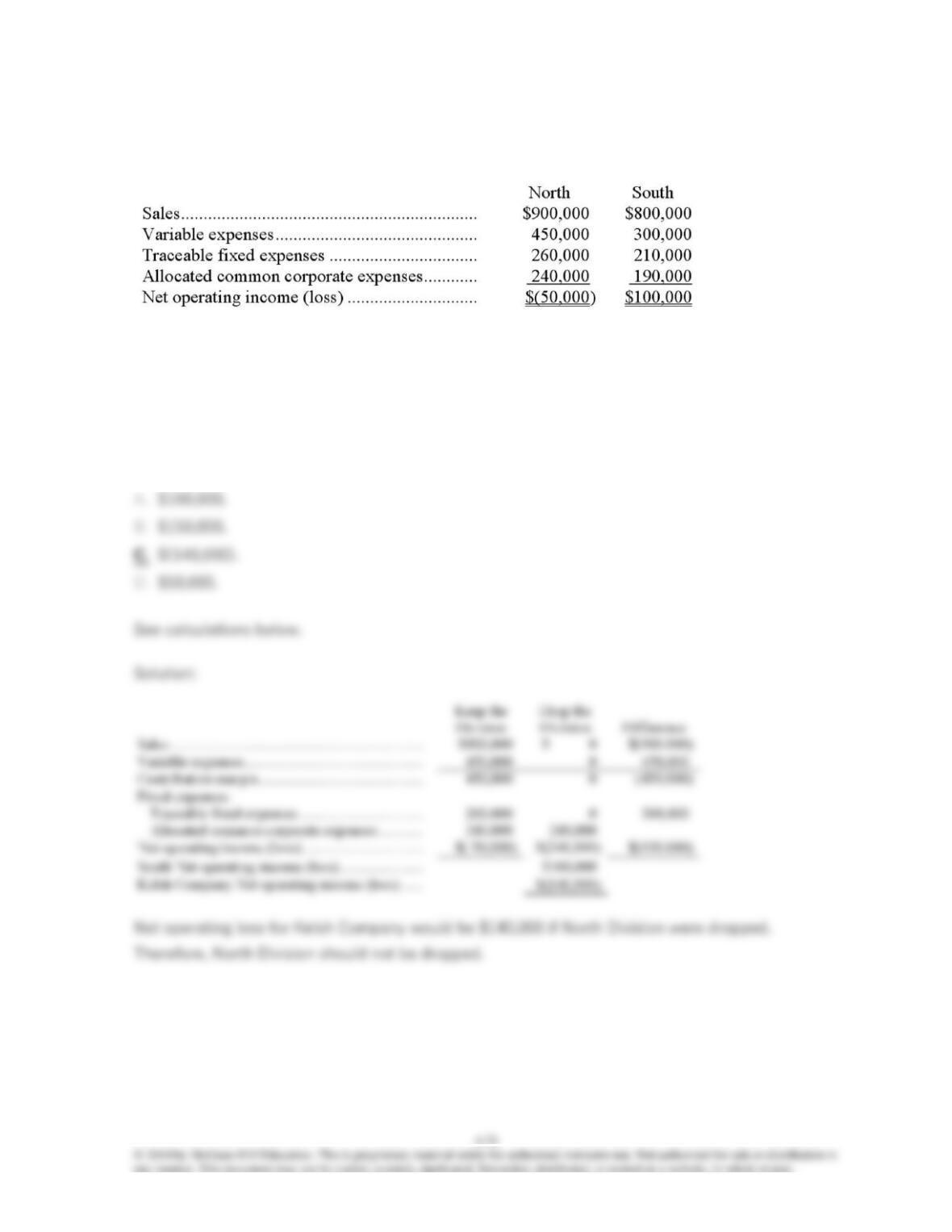
95. The Kelsh Company has two divisions—North and South. The divisions have the following
revenues and expenses:
Management at Kelsh is pondering the elimination of North Division. If North Division were
eliminated, its traceable fixed expenses could be avoided. The total common corporate expenses
would be unaffected. Given these data, the elimination of North Division would result in an overall
company net operating income of:
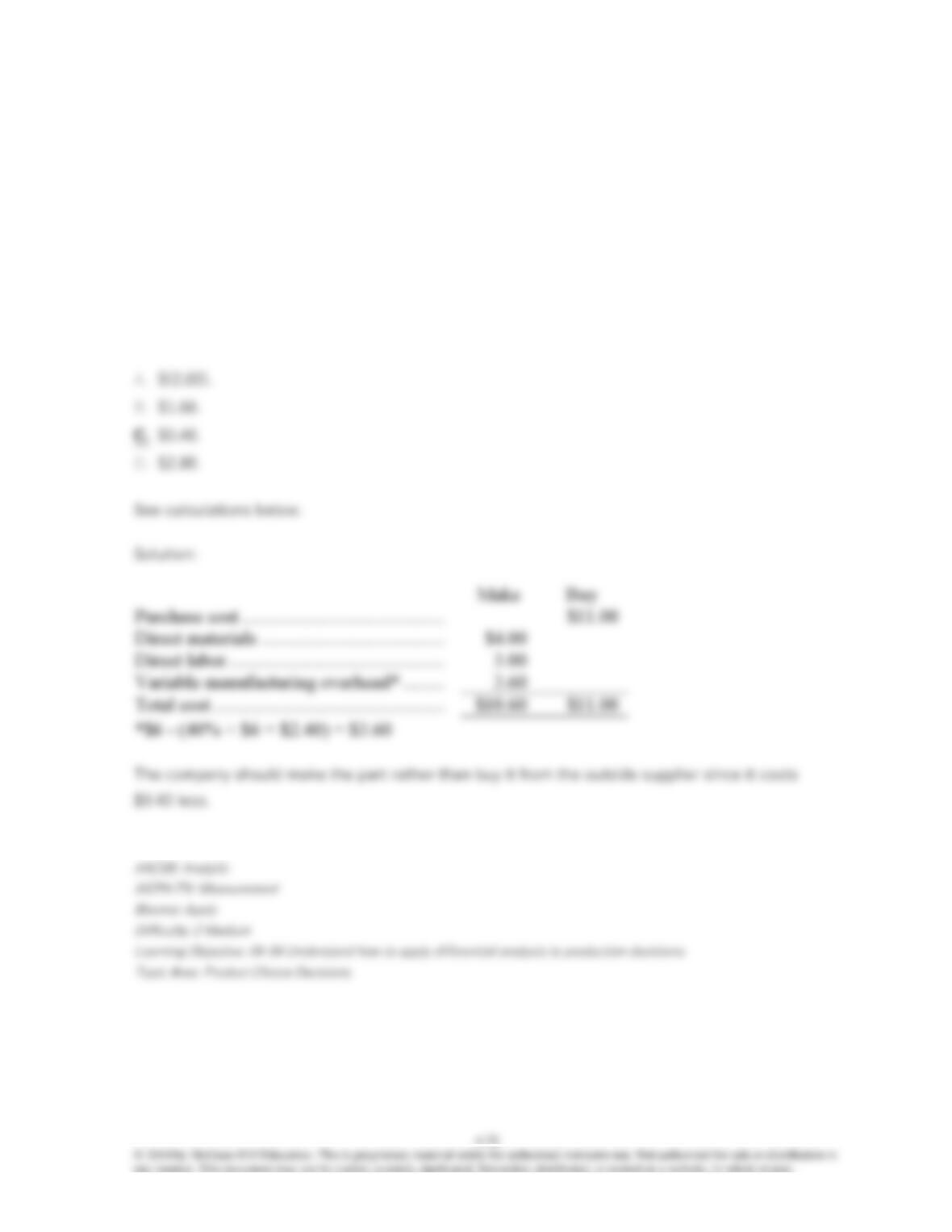
96. Peluso Company, a manufacturer of snowmobiles, is operating at 70% of plant capacity.
Peluso’s plant manager is considering making the headlights now being purchased from an
outside supplier for $11.00 each. The Peluso plant has idle equipment that could be used to
manufacture the headlights. The design engineer estimates that each headlight requires $4.00 of
direct materials, $3.00 of direct labor, and $6.00 of manufacturing overhead. Forty percent of the
manufacturing overhead is a fixed cost that would be unaffected by this decision. A decision by
Peluso Company to manufacture the headlights should result in a net gain (loss) for each
headlight of: (CMA adapted)
4-73
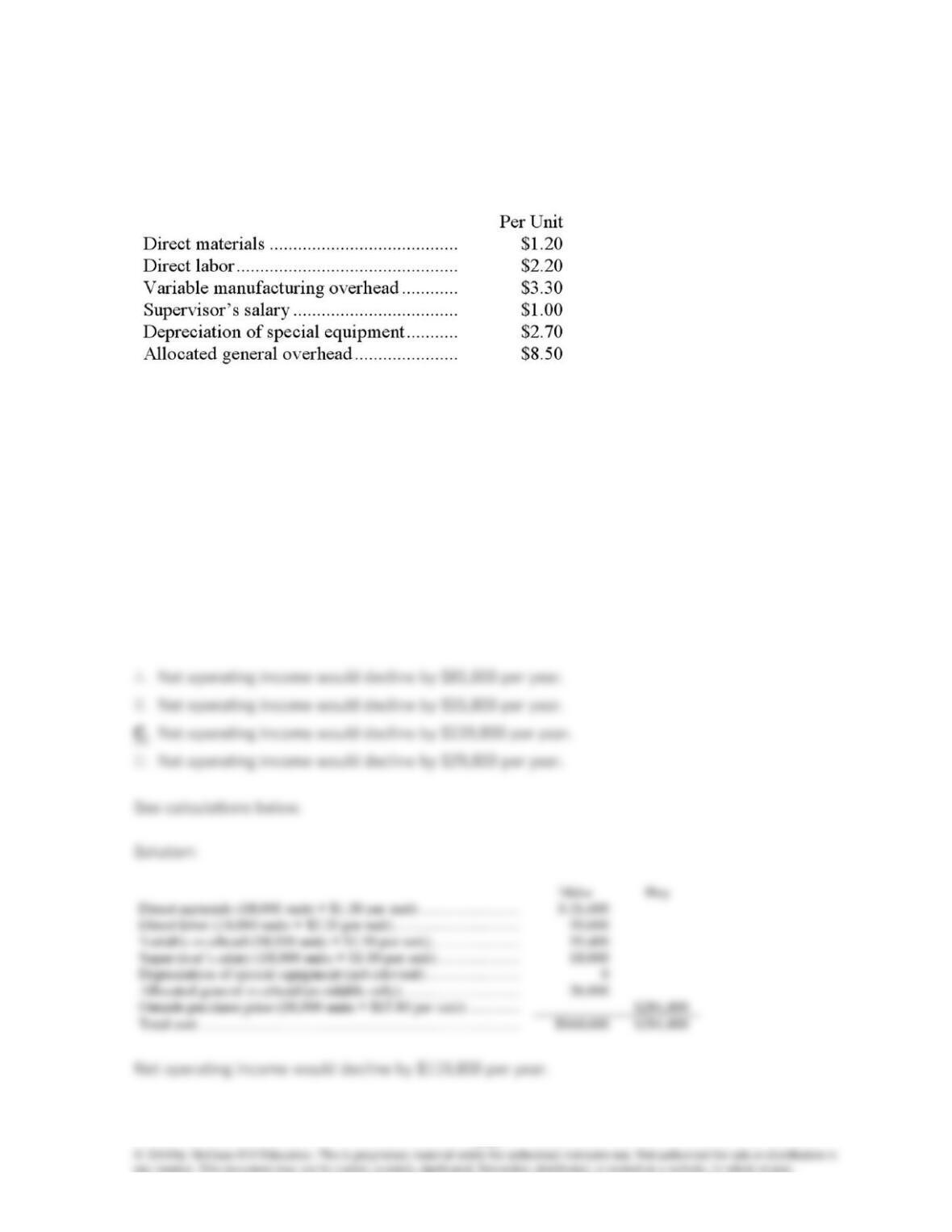
97. Part I51 is used in one of Pries Corporation’s products. The company makes 18,000 units
of this part each year. The company’s Accounting Department reports the following costs of
producing the part at this level of activity:
An outside supplier has offered to produce this part and sell it to the company for $15.80 each. If
this offer is accepted, the supervisor’s salary and all of the variable costs, including direct labor,
can be avoided. The special equipment used to make the part was purchased many years ago and
has no salvage value or other use. The allocated general overhead represents fixed costs of the
entire company. If the outside supplier’s offer were accepted, only $26,000 of these allocated
general overhead costs would be avoided.
If management decides to buy part I51 from the outside supplier rather than to continue making
the part, what would be the annual impact on the company’s overall net operating income?
4-74
98. Iwasaki Inc. is considering whether to continue to make a component or to buy it from an
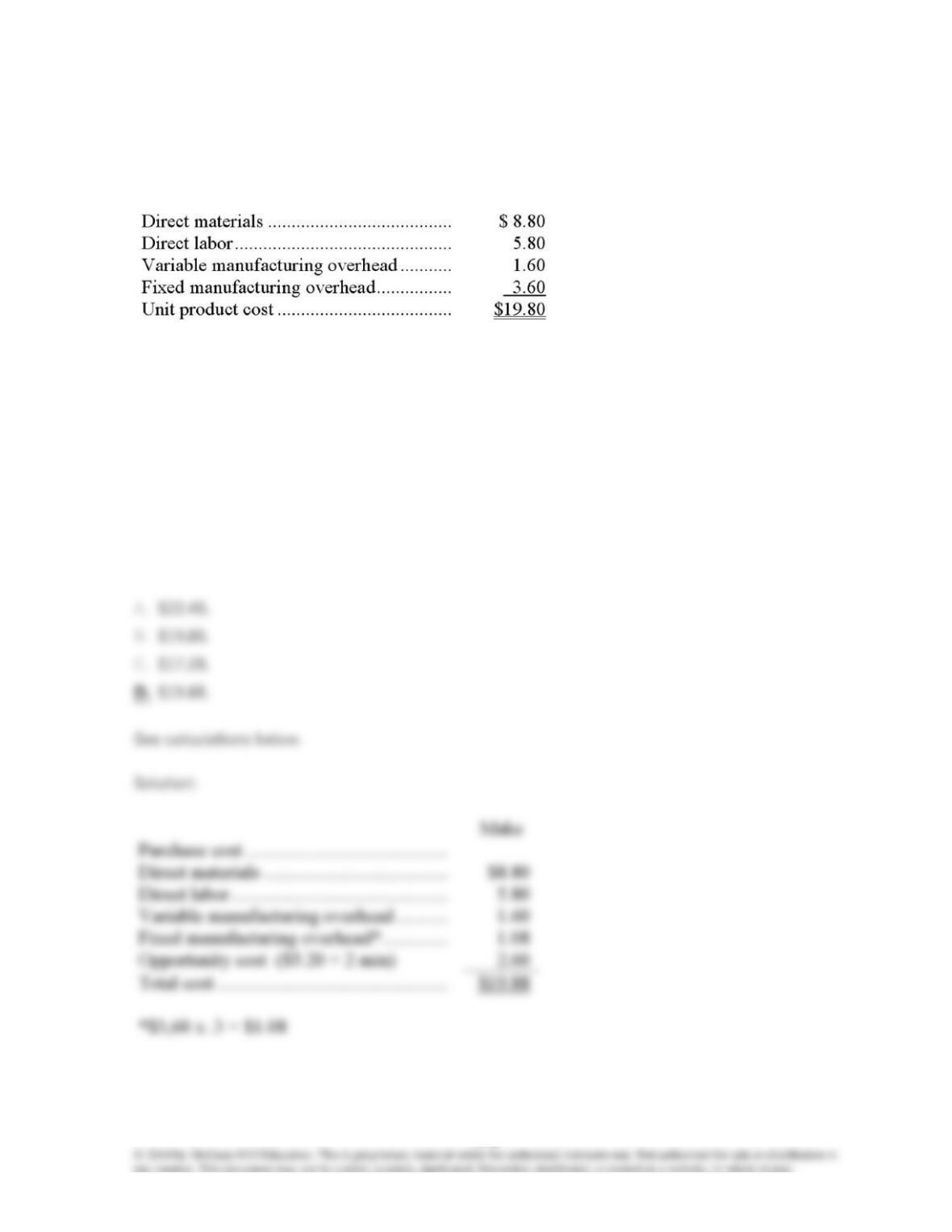
outside supplier. The company uses 13,000 of the components each year. The unit product cost of
the component according to the company’s cost accounting system is given as follows:
Assume that direct labor is a variable cost. Of the fixed manufacturing overhead, 30% is avoidable
if the component were bought from the outside supplier. In addition, making the component uses
1 minute on the machine that is the company’s current constraint. If the component were bought,
this machine time would be freed up for use on another product that requires 2 minutes on the
constraining machine and that has a contribution margin of $5.20 per unit.
When deciding whether to make or buy the component, what cost of making the component
should be compared to the price of buying the component? (CIMA adapted)
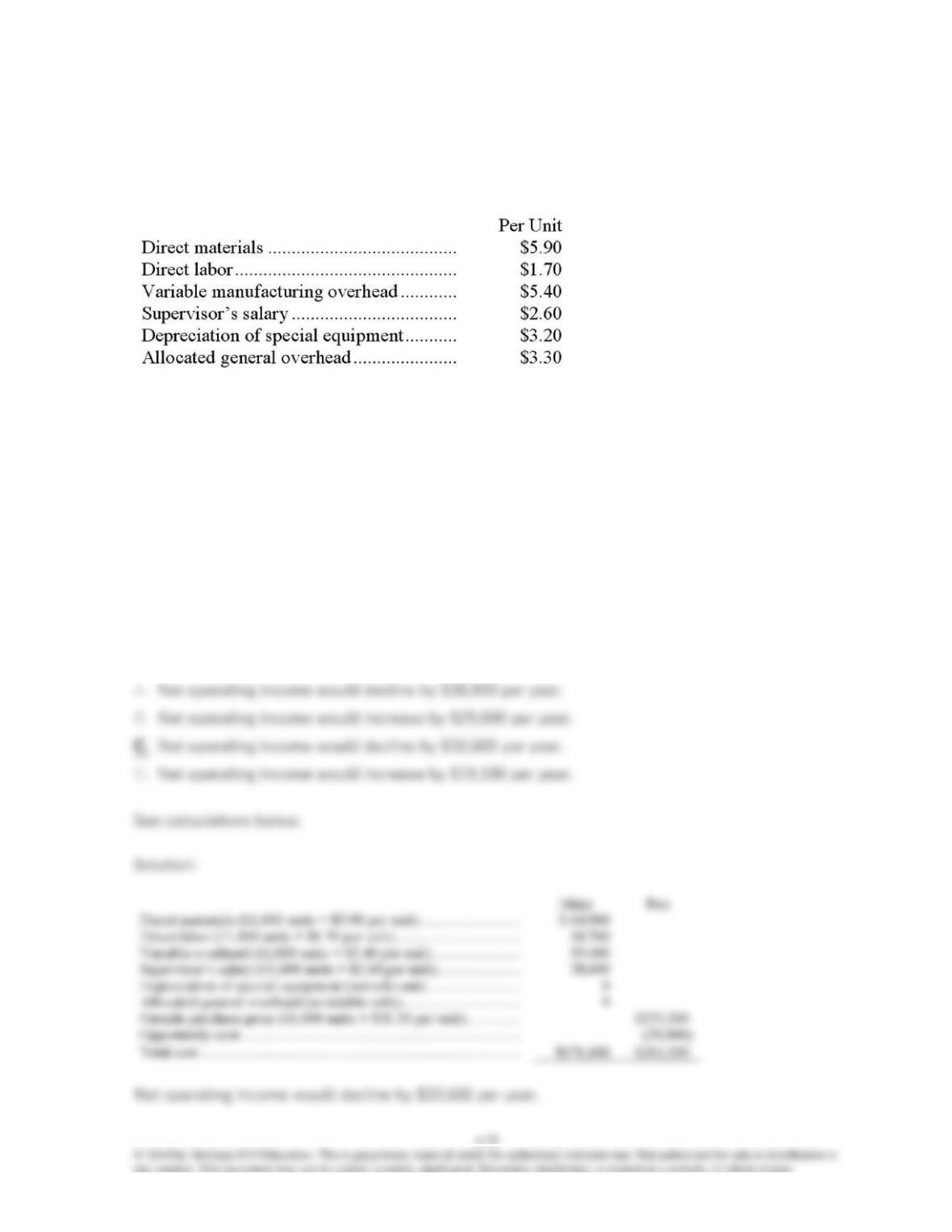
99. Part N29 is used by Farman Corporation to make one of its products. A total of 11,000
units of this part are produced and used every year. The company’s Accounting Department
reports the following costs of producing the part at this level of activity:
An outside supplier has offered to make the part and sell it to the company for $21.20 each. If this
offer is accepted, the supervisor’s salary and all of the variable costs, including the direct labor,
can be avoided. The special equipment used to make the part was purchased many years ago and
has no salvage value or other use. The allocated general overhead represents fixed costs of the
entire company, none of which would be avoided if the part were purchased instead of produced
internally. In addition, the space used to make part N29 could be used to make more of one of the
company’s other products, generating an additional segment margin of $29,000 per year for that
product. What would be the impact on the company’s overall net operating income of buying part
N29 from the outside supplier?
4-76
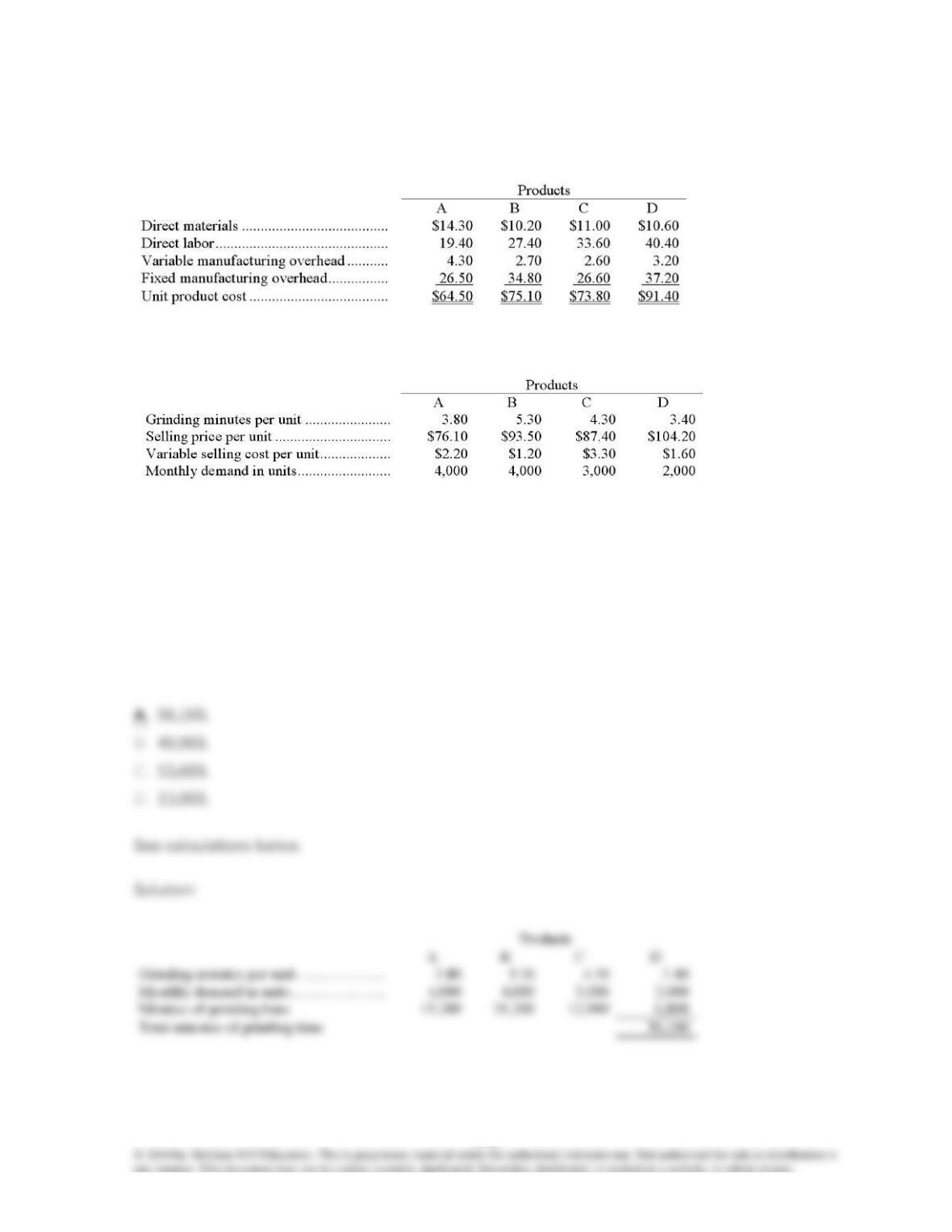
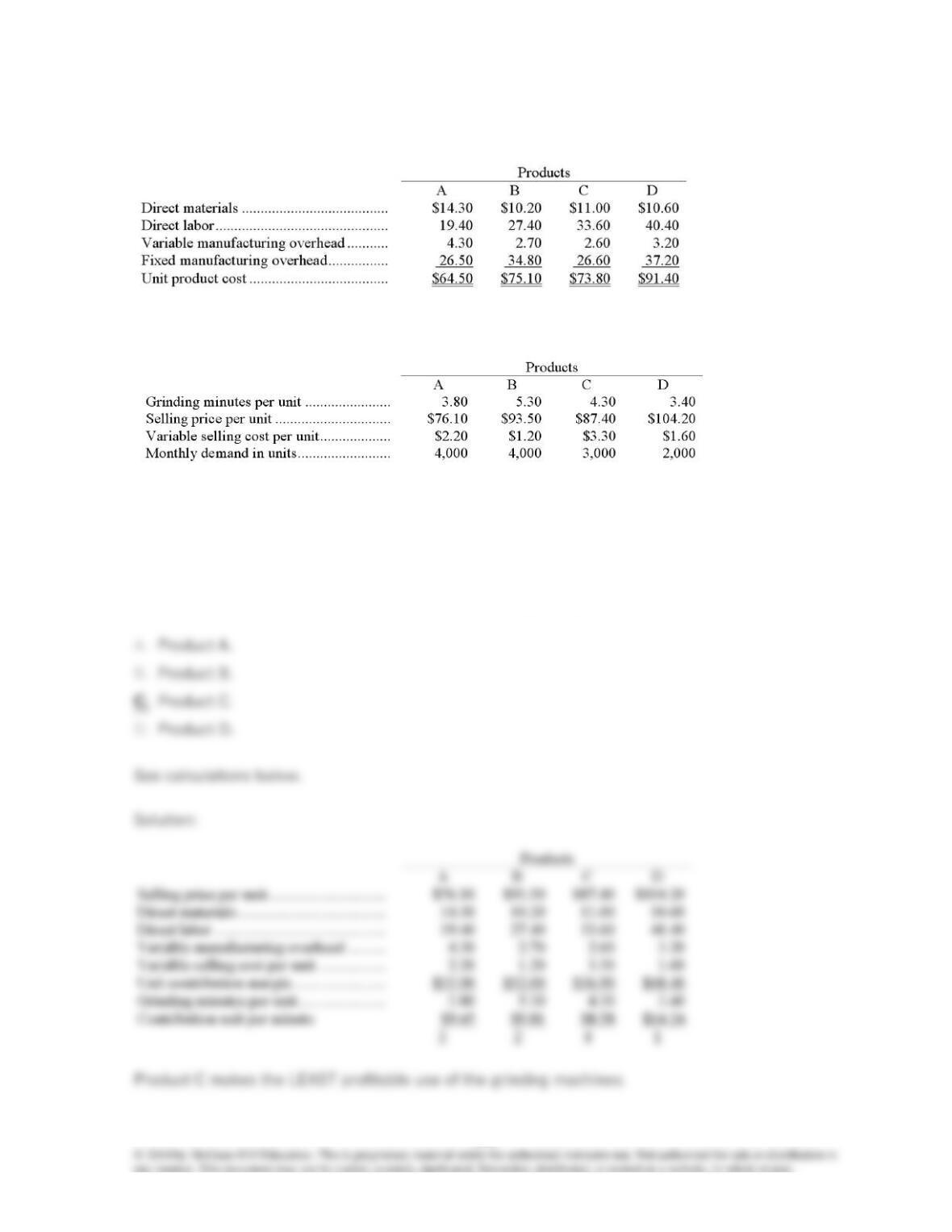
100. Broze Company makes four products in a single facility. These products have the following
unit product costs:
Additional data concerning these products are listed below.
The grinding machines are the constraint in the production facility. A total of 53,600 minutes are
available per month on these machines.
Direct labor is a variable cost in this company.
How many minutes of grinding machine time would be required to satisfy demand for all four
products?
4-77
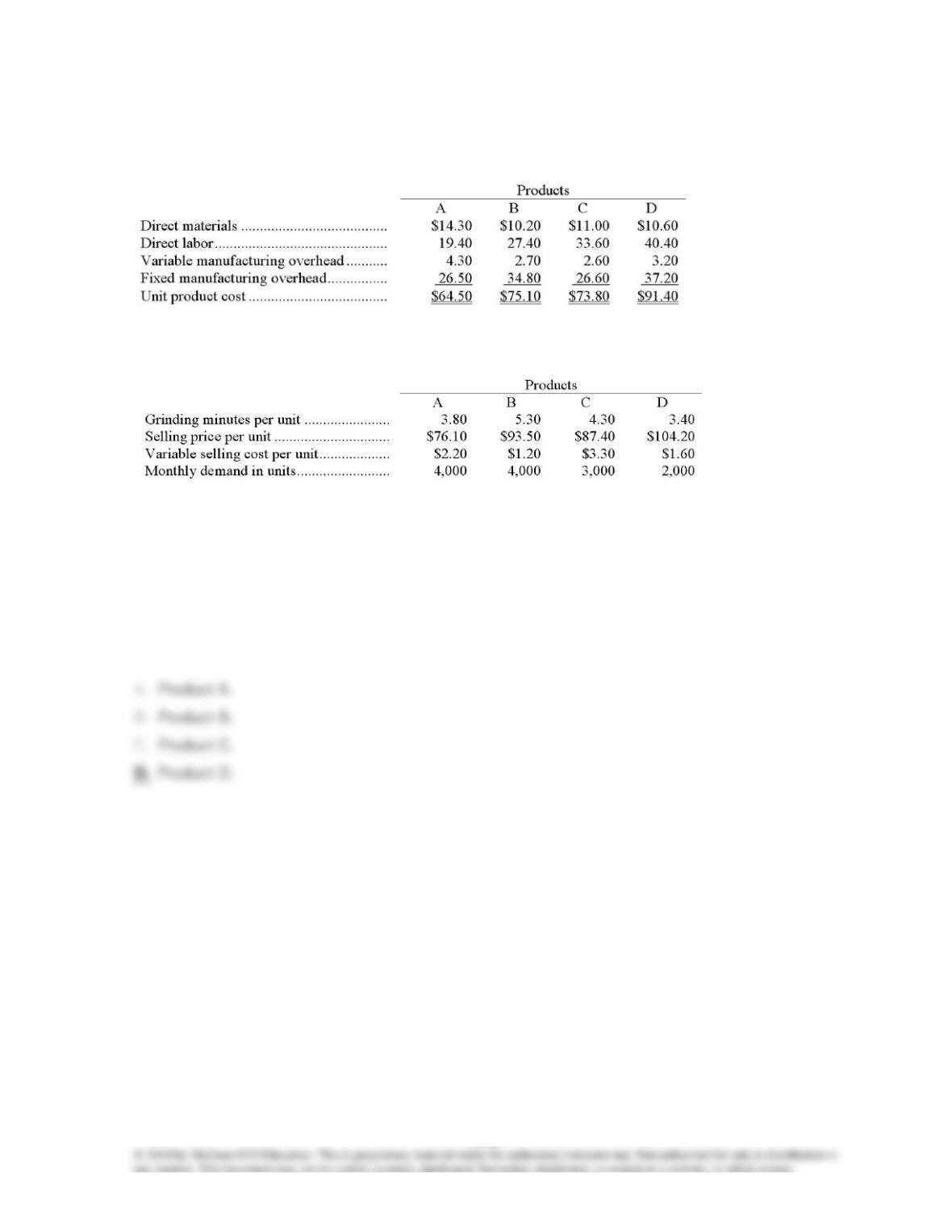
101. Broze Company makes four products in a single facility. These products have the following
unit product costs:
Additional data concerning these products are listed below.
The grinding machines are the constraint in the production facility. A total of 53,600 minutes are
available per month on these machines.
Direct labor is a variable cost in this company.
Which product makes the LEAST profitable use of the grinding machines?
4-78
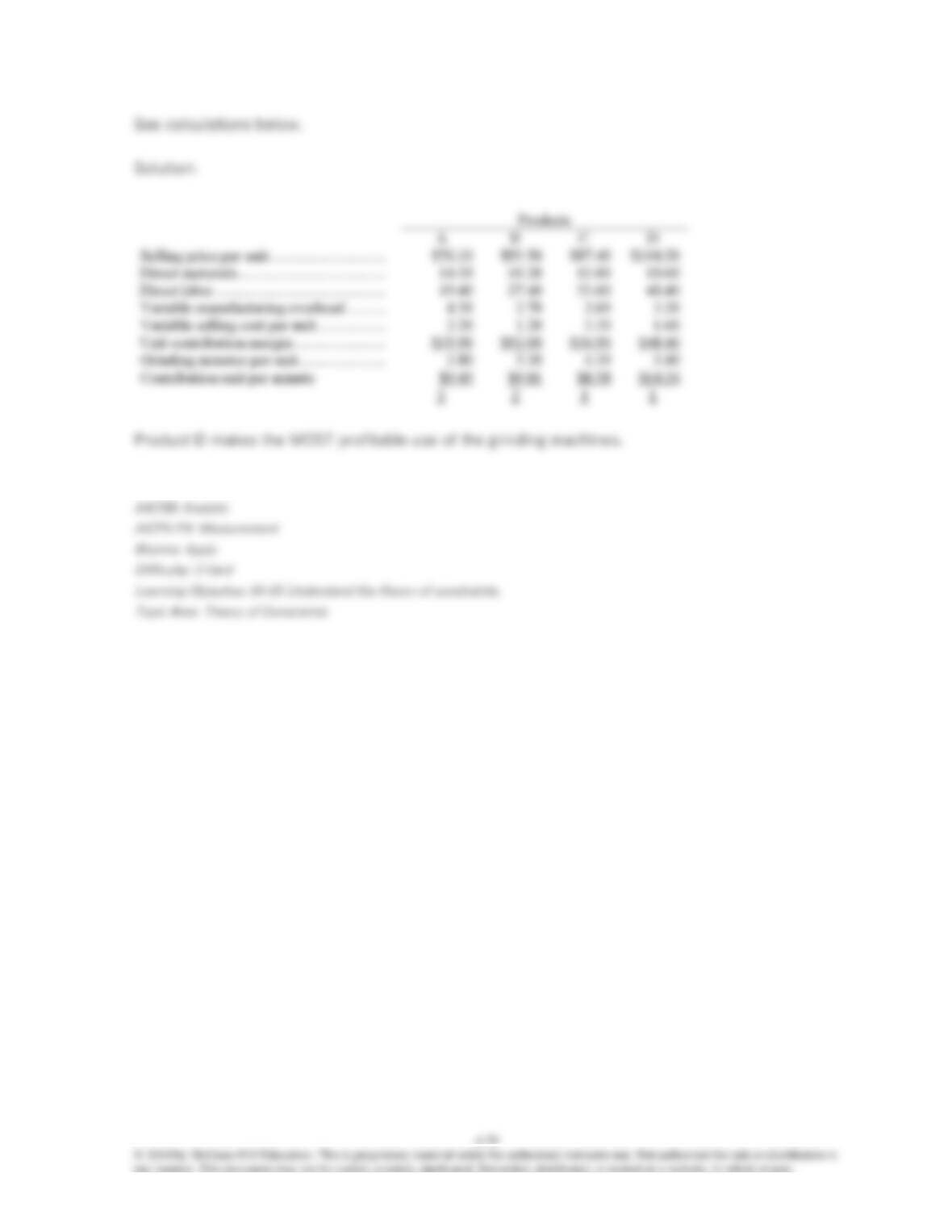
102. Broze Company makes four products in a single facility. These products have the following
unit product costs:
Additional data concerning these products are listed below.
The grinding machines are the constraint in the production facility. A total of 53,600 minutes are
available per month on these machines.
Direct labor is a variable cost in this company.
Which product makes the MOST profitable use of the grinding machines?
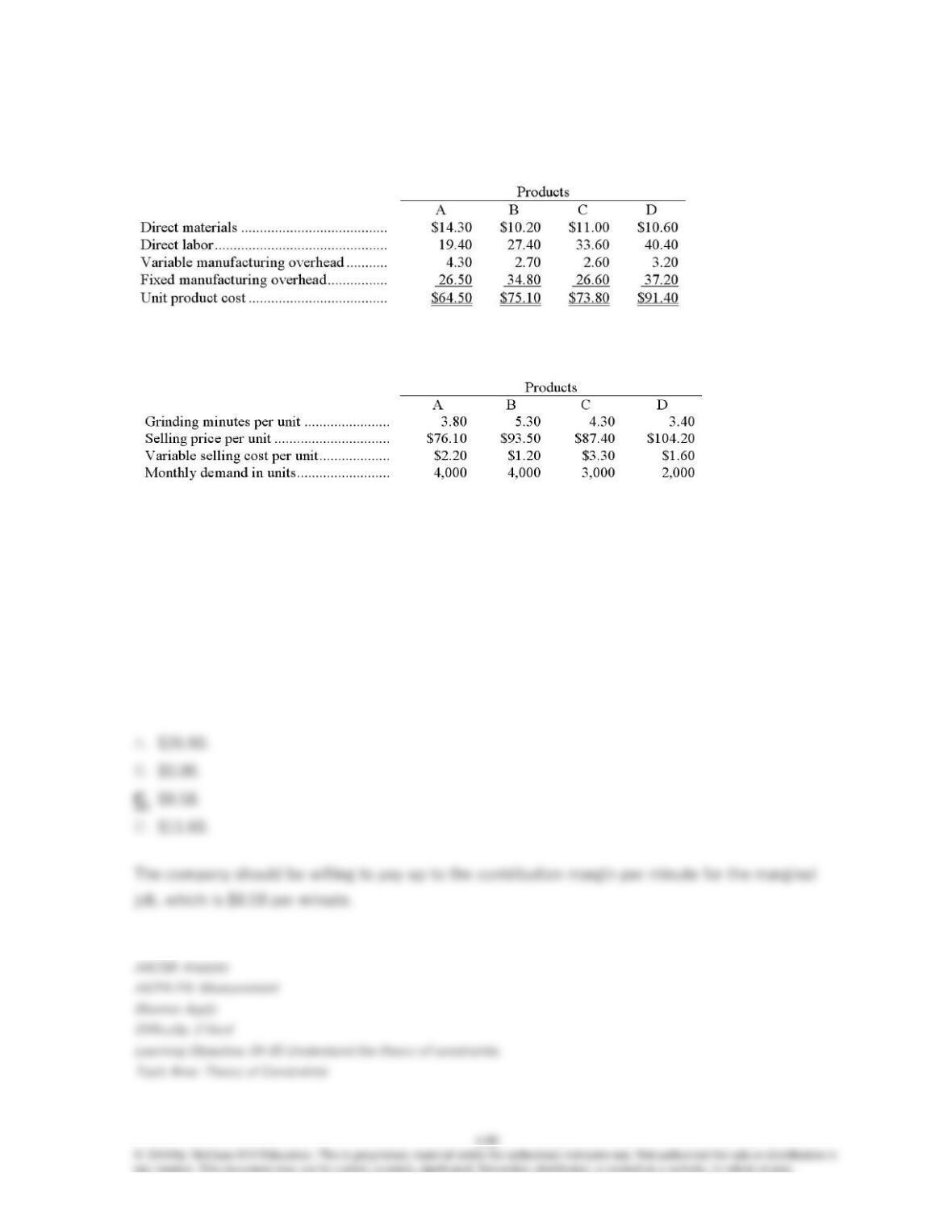
103. Broze Company makes four products in a single facility. These products have the following
unit product costs:
Additional data concerning these products are listed below.
The grinding machines are the constraint in the production facility. A total of 53,600 minutes are
available per month on these machines.
Direct labor is a variable cost in this company.
Up to how much should the company be willing to pay for one additional minute of grinding
machine time if the company has made the best use of the existing grinding machine capacity?
(Round off to the nearest whole cent.)