49) The following is the adjusted trial balance for Tuttle Photography.
Account Debit Credit
Cash $1,700
Accounts receivable 8,500
Supplies 100
Equipment 7,500
Accumulated depreciation $2,000
Accounts payable 1,200
Salary payable 800
Unearned revenue 600
Capital 3,400
Drawing 2,300
Service revenue 40,000
Salary expense 24,000
Supplies expense 2,300
Depreciation expense 1,600
$48,000 $48,000
Using the information from the worksheet above, prepare the closing entry for Expenses.
50) The following is the adjusted trial balance for Tuttle Photography.
Account Debit Credit
Cash $1,700
Accounts receivable 8,500
Supplies 100
Equipment 7,500
Accumulated depreciation $2,000
Accounts payable 1,200
Salary payable 800
Unearned revenue 600
Capital 3,400
Drawing 2,300
Service revenue 40,000
Salary expense 24,000
Supplies expense 2,300
Depreciation expense 1,600
$48,000 $48,000
Using the information from the worksheet above, prepare the closing entry for the Income summary account.
51) The following is the adjusted trial balance for Tuttle Photography.
Account Debit Credit
Cash $1,700
Accounts receivable 8,500
Supplies 100
Equipment 7,500
Accumulated depreciation $2,000
Accounts payable 1,200
Salary payable 800
Unearned revenue 600
Capital 3,400
Drawing 2,300
Service revenue 40,000
Salary expense 24,000
Supplies expense 2,300
Depreciation expense 1,600
$48,000 $48,000
Using the information from the worksheet above, prepare the closing entry for the Drawing account.
1) The post-closing trial balance is an optional step.
2) The post-closing trial balance shows the updated Capital balance.
3) The post-closing trial balance shows the net income for the period just ended.
4) Only permanent accounts appear on the post-closing trial balance.
5) Only temporary accounts appear on the post-closing trial balance.
6) The post-closing trial balance lists the accounts from the general ledger in:
A) alphabetical order.
B) category order, beginning with assets and ending with expenses.
C) numerical order.
D) category order, beginning with assets and ending with owner’s equity.
7) Which of the following do NOT show up on a post-closing trial balance?
A) Assets and liabilities
B) Capital and assets
C) Capital and liabilities
D) Revenues and expenses
8) The ________ is the time span during which cash is paid for goods and services, which are then sold to customers
from whom the business collects cash.
A) operating cycle
B) accounting period
C) calendar year
D) calendar quarter

46
9) The following is the adjusted trial balance for Tuttle Photography.
Accounts Debit Credit
Cash $15,000
Accounts receivable 30,000
Prepaid insurance 7,500
Office supplies 3,200
Land 40,000
Building 160,000
Accumulated depreciation $12,000
Equipment 75,000
Accumulated depreciation 8,500
Accounts payable 12,000
Salaries payable 2,000
Unearned service revenue 25,000
Mortgage payable 100,000
R. Tuttle, capital 21,290
R. Tuttle, drawing 23,000
Service revenue 289,000
Salaries expense 61,000
Depreciation expense 6,150
Supplies expense 14,040
Insurance expense 14,000
Utilities expense 20,900
$469,790 $469,790
Using the information above, prepare a post-closing trial balance for Tuttle Photography (dated December 31,
2012.)
1) Assets and liabilities are classified as either current or long-term to show their relative liquidity.
2) Prepaid rent is usually a long-term asset.
3) A debt due to be paid within one year (or operating cycle, if longer) is a current liability.
4) A balance sheet prepared in the account form lists the assets at the top and the liabilities and owner’s equity
below.
5) Which of the following is the measure of how quickly an item can be converted to cash?
A) Debt ratio
B) Current ratio
C) Liquidity
D) Accounting cycle
6) Which of the following assets is the MOST liquid?
A) Inventory
B) Prepaid expenses
C) Accounts receivable
D) Cash
7) Which of the following is a current asset that is expected to be converted to cash, sold, or consumed during the
next year (or the normal operating cycle, if longer)?
A) Land
B) Equipment
C) Building
D) Accounts receivable
8) Under which of the following categories would Buildings appear?
A) Current assets
B) Long-term liabilities
C) Long-term assets
D) Current liabilities
9) Under which of the following categories would Inventory appear?
A) Current assets
B) Current liabilities
C) Long-term assets
D) Long-term liabilities
10) Under which of the following categories would Land appear?
A) Long-term assets
B) Current assets
C) Long-term liabilities
D) Current liabilities
11) Under which of the following categories would Accounts payable appear?
A) Current liabilities
B) Current assets
C) Long-term liabilities
D) Long-term assets
12) Which of the following is NOT a long-term asset?
A) Equipment
B) Land
C) Buildings
D) Accounts receivable
13) A two-year note payable would be classified as a:
A) current liability.
B) current asset.
C) long-term liability.
D) long-term asset.
14) A balance sheet that has the assets listed above the liabilities and equity sections is a(n):
A) report form balance sheet.
B) classified form balance sheet.
C) account form balance sheet.
D) audited form balance sheet.
15) Buildings, land, and equipment would be classified as:
A) current assets.
B) long-term assets.
C) current liabilities.
D) long-term liabilities.
16) Which of the following would be considered a long–term asset?
A) Accounts receivable
B) Land
C) Inventory
D) Prepaid insurance
17) Which of the following is NOT a current asset?
A) Equipment
B) Prepaid insurance
C) Cash
D) Accounts receivable
18) Below is a list of various balance sheet accounts and their balances.
Debit Credit
Building $100,000
Cash 2,000
Supplies 800
Furniture 2,600
Prepaid insurance 150
Accumulated depreciation-furniture $900
Inventory
Land 25,000
Accumulated depreciation-building 4,800
Accounts receivable 1,500
What are the total current assets that would be shown on the balance sheet?
A) $7,050
B) $32,050
C) $4,450
D) $4,300
19) Below is a list of various balance sheet accounts and their balances.
Debit Credit
Building $100,000
Cash 2,000
Supplies 800
Furniture 2,600
Prepaid insurance 150
Accumulated depreciation-furniture $900
Inventory
Land 25,000
Accumulated depreciation-building 4,800
Accounts receivable 1,500
What are the total long-term assets that would be shown on the balance sheet?
A) $127,600
B) $121,900
C) $128,400
D) $96,900
20) Below is a list of various balance sheet accounts and their balances.
Debit Credit
Notes payable-short term $800
Salary payable 3,600
Notes payable-long term 20,000
Accounts payable 2,200
Unearned revenue 1,000
Interest payable 2,200
What are the total current liabilities that would be shown on the balance sheet?
A) $29,800
B) $9,000
C) $9,800
D) $6,800
21) Below is a list of various balance sheet accounts and their balances.
Debit Credit
Notes payable-short term $800
Salary payable 3,600
Notes payable-long term 20,000
Accounts payable 2,200
Unearned revenue 1,000
Interest payable 2,200
What are the total long-term liabilities that would be shown on the balance sheet?
A) $29,800
B) $9,000
C) $9,800
D) $20,000
22) The definition of liquidity is how:
A) easily an asset may be sold.
B) long an asset can be used.
C) easily an asset can be exchanged for another asset.
D) short an operating cycle is.
23) Which of the following statements MOST precisely describes a classified balance sheet?
A) Accounts are classified by their purchase dates.
B) Account balances are listed from the highest amount to the lowest amount.
C) Assets are listed in their order of liquidity.
D) Assets are listed in alphabetical order.
24) What is the key distinction between current and non-current assets?
A) Current assets will be used up or converted to cash within one year or one operating cycle.
B) Non-current assets are assets which do not lose their value over time.
C) Current assets always have lower balances than non-current assets.
D) Non-current assets will not be used until the future.
25) What is the key distinction between current and non-current liabilities?
A) Current liabilities will be paid off within one year or one operating cycle.
B) Non-current liabilities are permanent debts of the business.
C) Current liabilities always have lower balances than non-current liabilities.
D) Non-current liabilities always increase over time.
26) Assets are listed in order of ________ on the balance sheet.
A) amount
B) date of purchase
C) liquidity
D) durability
Learning Objective 4-6
1) The debt ratio measures a company’s overall ability to pay its employees.
2) The current ratio and the debt ratio are shown on the income statement.
3) Which of the following measures a company’s ability to pay current liabilities with current assets?
A) Net income
B) Debt ratio
C) Current ratio
D) Total assets
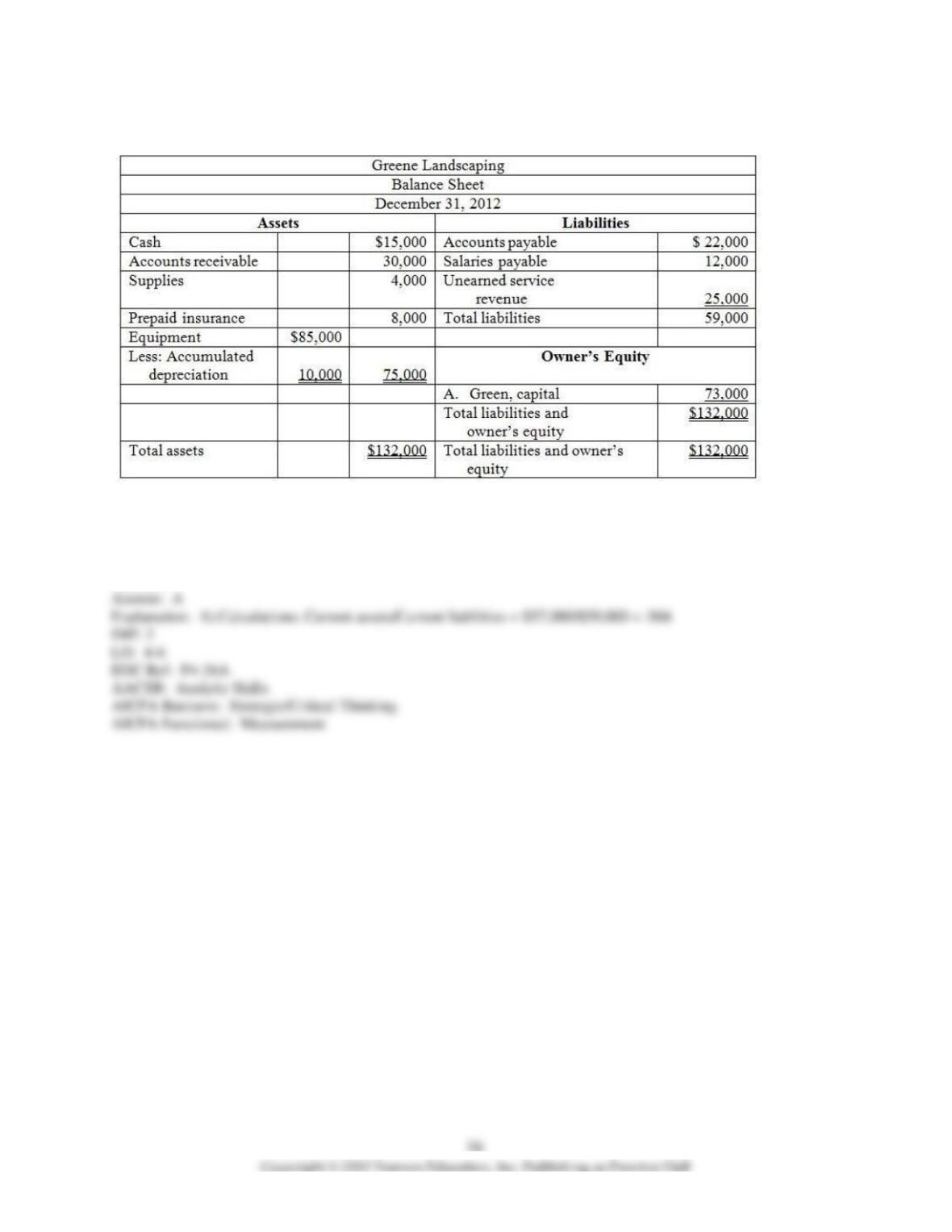
4) The following is the balance sheet for Green Landscaping.
Which of the following is the current ratio? (Round to two decimal places.)
A) .97
B) .68
C) .25
D) 1.27