4-41
Essay Questions
83. A considerable portion of the text’s process-costing presentation illustrated the proper way
to allocate manufacturing costs to the units completed during the period and the ending work-
in-process inventory. For companies that have a single manufacturing department, the journal
entry to recognize completed production involves a debit to Finished-Goods Inventory and a
credit to Work-in-Process Inventory.
Required:
What journal entry, if any, is needed for these same companies to properly account for ending
work in process?
Solution:
4-42
84. Fedora, Inc, uses a weighted-average process-costing system and has one production
department. All materials are introduced at the start of manufacturing; in contrast, conversion
cost is incurred uniformly throughout production. The company had respective work-in–
process inventories on May 1 and May 31 of 62,000 units and 70,000 units, the latter of which
was 40% complete. The production supervisor noted that Fedora completed 100,000 units
during the month.
Costs in the May 1 work-in-process inventory were subdivided as follows: materials, $40,000;
conversion, $90,000. During May, Fedora charged production with $300,000 of material and
$710,000 of conversion, resulting in a material cost per equivalent unit of $2.
Required:
A. Determine the number of units that Fedora started during May.
B. Compute the number of equivalent units with respect to conversion cost.
C. Determine the conversion cost per equivalent unit.
D. Compute the cost of the May 31 work-in-process inventory.
E. What account would have been credited to record Fedora’s completed production?
Solution:
4-43
85. Limited Technology Corp. uses a weighted-average process-costing system. Material A is
added at the start of production; packaging material is introduced at the end. Conversion costs
are incurred evenly throughout manufacturing.
The following selected data were extracted from the company’s production report:
Units completed
15,000
Ending work in process (units)
6,000
Equivalent units: conversion cost
16,800
Equivalent units cost: material A ($)
5
Equivalent units cost: packaging ($)
2
Total conversion cost ($)
134,400
Required:
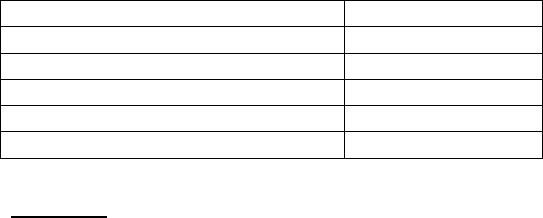
A. Compute the equivalent-unit cost for conversion cost.
B. How far into the manufacturing process is the ending work-in-process inventory?
C. Would the total equivalent units for Material A and the packaging material be the same?
Why?
D. Compute the cost of goods completed during the period.
E. Compute the cost of the ending work-in-process inventory.
F. What account would be debited to record the cost of goods completed during the period?
4-44
4-45
86. California Products employs a process-costing system for its manufacturing operations.
All materials are added at the beginning of the process, and conversion costs are incurred
uniformly throughout production. The information that follows relates to September.
Units
Work in process, September 1 (30% complete as to conversion)
8,900
Units started in September
28,500
Total units to account for
37,400
Units completed during September
29,700
Work in process, September 30 (80% complete as to conversion)
7,700
Total units to account for
37,400
Required:
A. Calculate equivalent units of direct material for September.
B. Calculate equivalent units of conversion activity for September.
Solution:
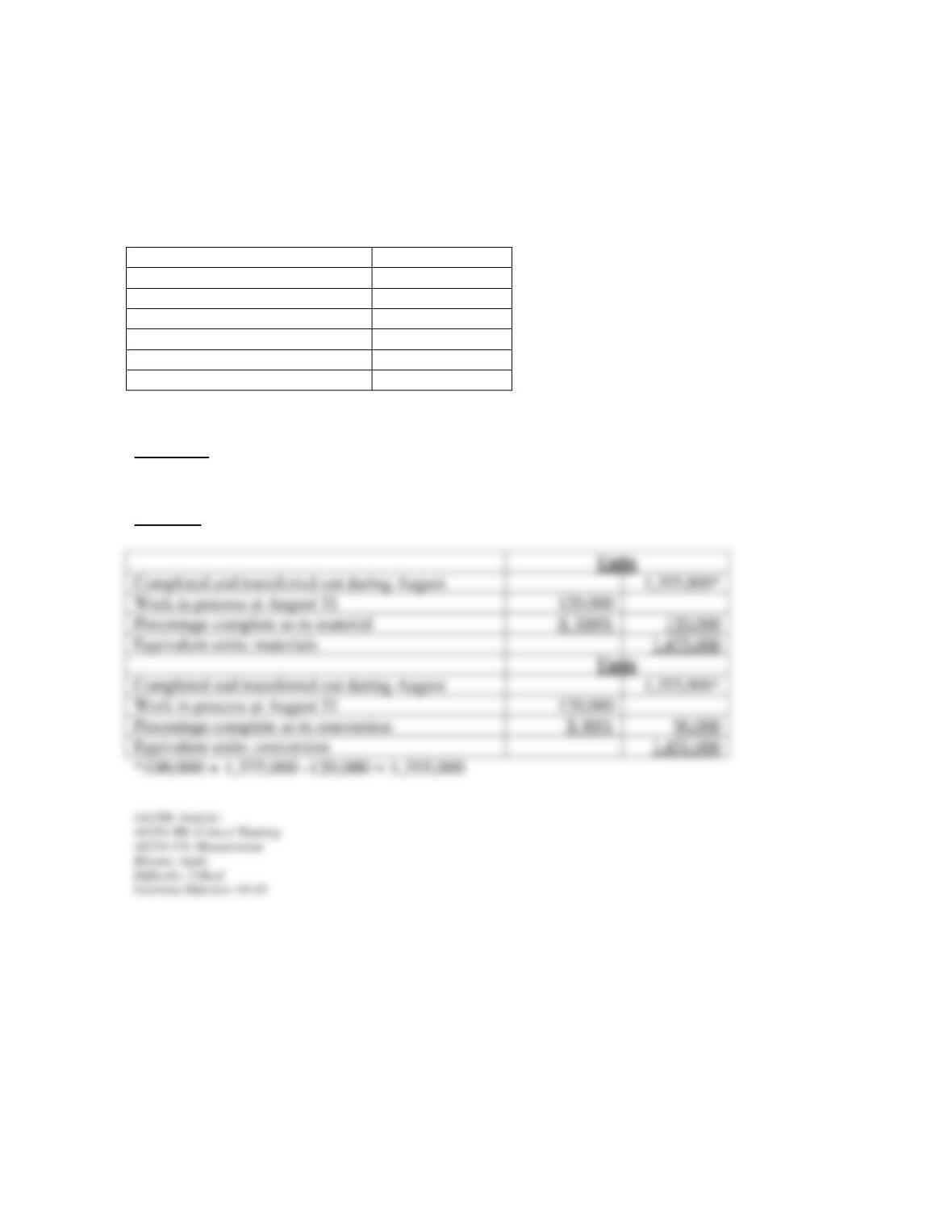
Completed and transferred out during September
Work in process at September 30
Percentage complete as to material
Equivalent units: materials
Completed and transferred out during September
Work in process at September 30
Percentage complete as to conversion
Equivalent units: conversion
4-46
87. Zorbex Company refines a variety of petrochemical products. The following data pertain
to the firm’s Baton Rouge plant:
Work in Process, August 1:
100,000 gallons
Direct Material
100% complete
Conversion
25% complete
Units started into production
1,375,000 gallons
Work in Process, August 31:
120,000 gallons
Direct Material
100% complete
Conversion
80% complete
Required:
Compute the equivalent units of direct materials and conversion for August.
Solution:
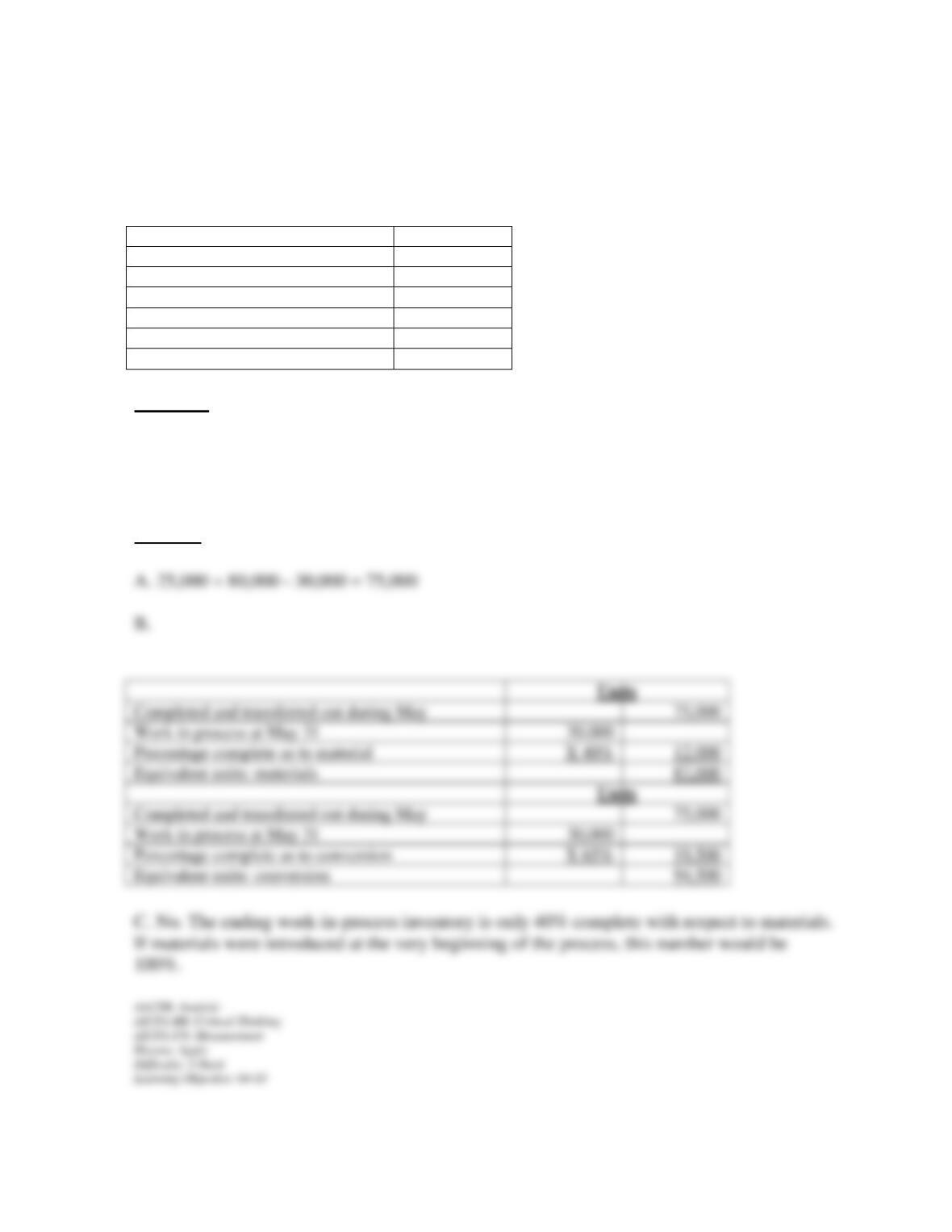
Completed and transferred out during August
1,355,000*
Work in process at August 31
Percentage complete as to material
Completed and transferred out during August
Work in process at August 31
Percentage complete as to conversion
Equivalent units: conversion
4-47
88. Sun Chemicals uses a weighted-average process-costing system. The following data relate
to May:
Work in Process, May 1:
25,000 pounds
Direct Material
70% complete
Conversion
80% complete
Units started into production
80,000 pounds
Work in Process, May 31:
30,000 pounds
Direct Material
40% complete
Conversion
65% complete
Required:
A. Calculate the number of pounds completed during May.
B. Calculate equivalent units of materials and conversion for May.
C. Does Sun introduce all of its direct materials at the very beginning of production? Explain
your answer.
Solution:
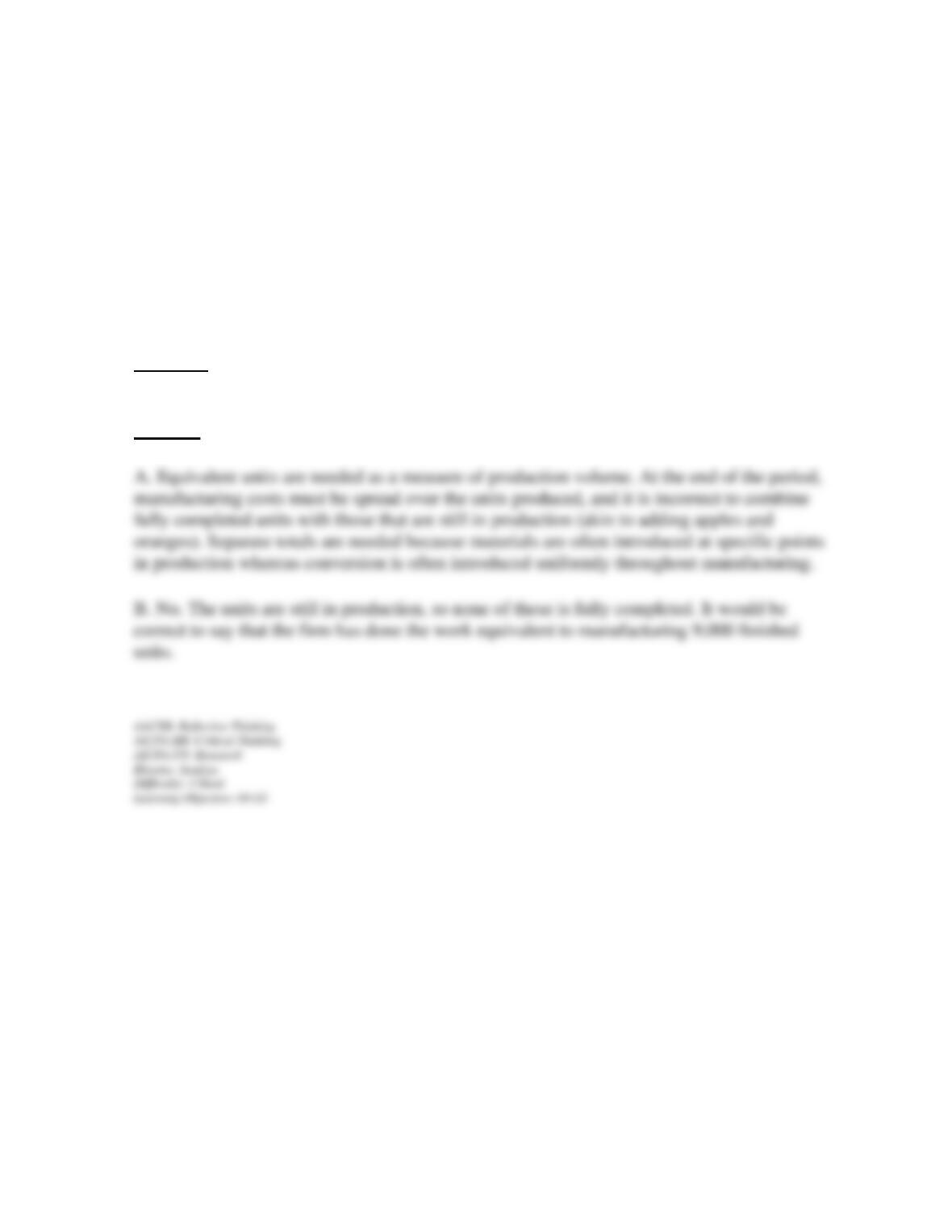
Completed and transferred out during May
Work in process at May 31
Percentage complete as to material
Equivalent units: materials
Completed and transferred out during May
Work in process at May 31
Percentage complete as to conversion
Equivalent units: conversion
4-48
89. Professor Jones is concerned that her students do not understand the concept of equivalent
units. She has therefore prepared the following questions, to appear on an upcoming
examination:
Equivalent units are used in a process-costing accounting system.
A. Explain the need for equivalent units and why separate equivalent-unit totals are calculated
for direct materials and conversion cost.
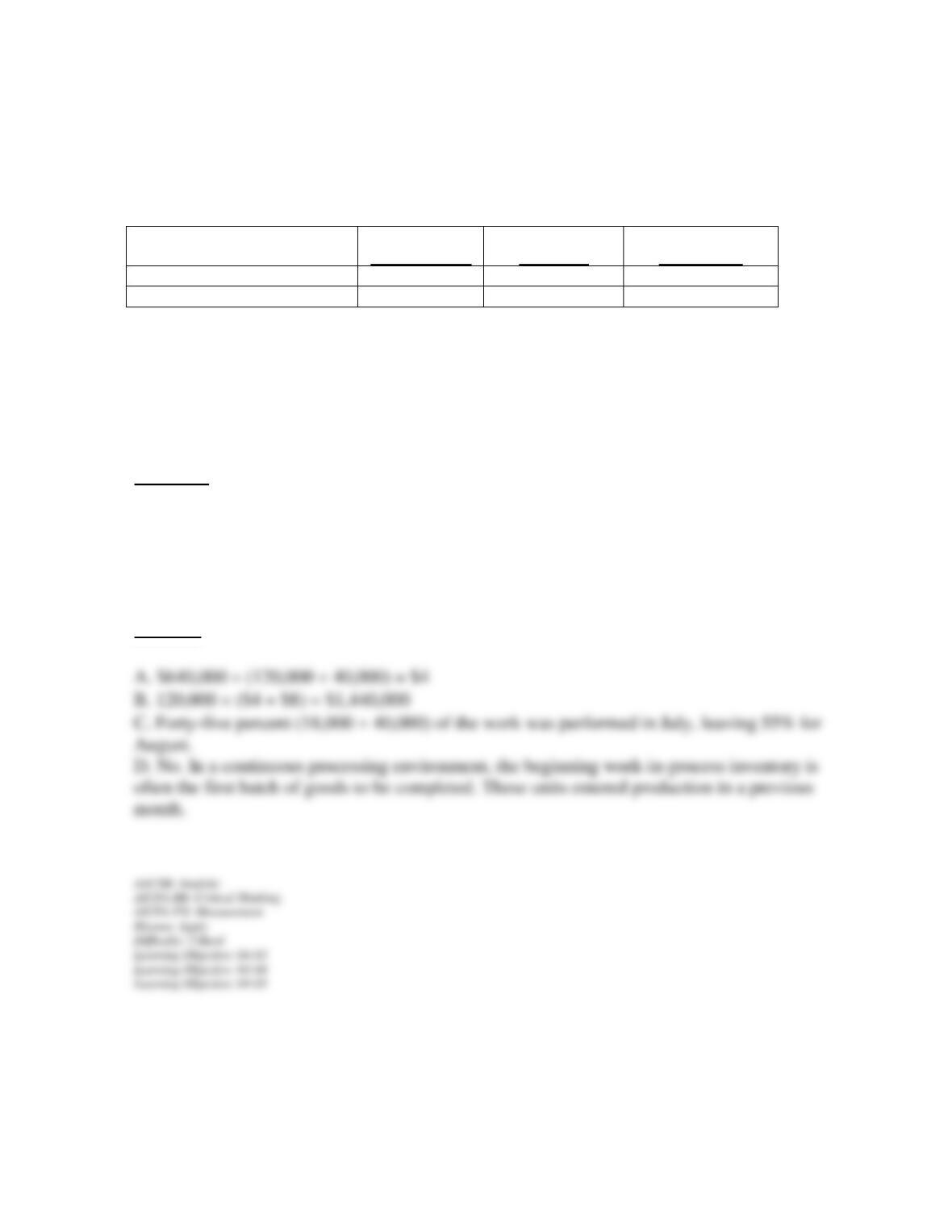
B. If an examination of goods in production at the end of the period revealed 12,000 units that
are, on average, 75% complete, would it be correct to say that 9,000 units were finished
during the period? Why?
Required:
Prepare a complete answer key that can be used in grading the examination questions.
Solution:
4-49
90. Basil Manufacturing uses a weighted-average process-costing system. The following
figures pertain to July:
Physical units
Equivalent units
Materials
Equivalent units
Conversion
Units completed
120,000
120,000
120,000
Ending work in process
40,000
40,000
18,000
All materials are introduced at the start of the process, and conversion cost is incurred evenly
throughout production. The company used direct materials that cost $640,000; conversion
amounted to $8 per equivalent unit.
Required:
A. Calculate the direct materials cost per equivalent unit.
B. Calculate the cost of units completed and transferred.
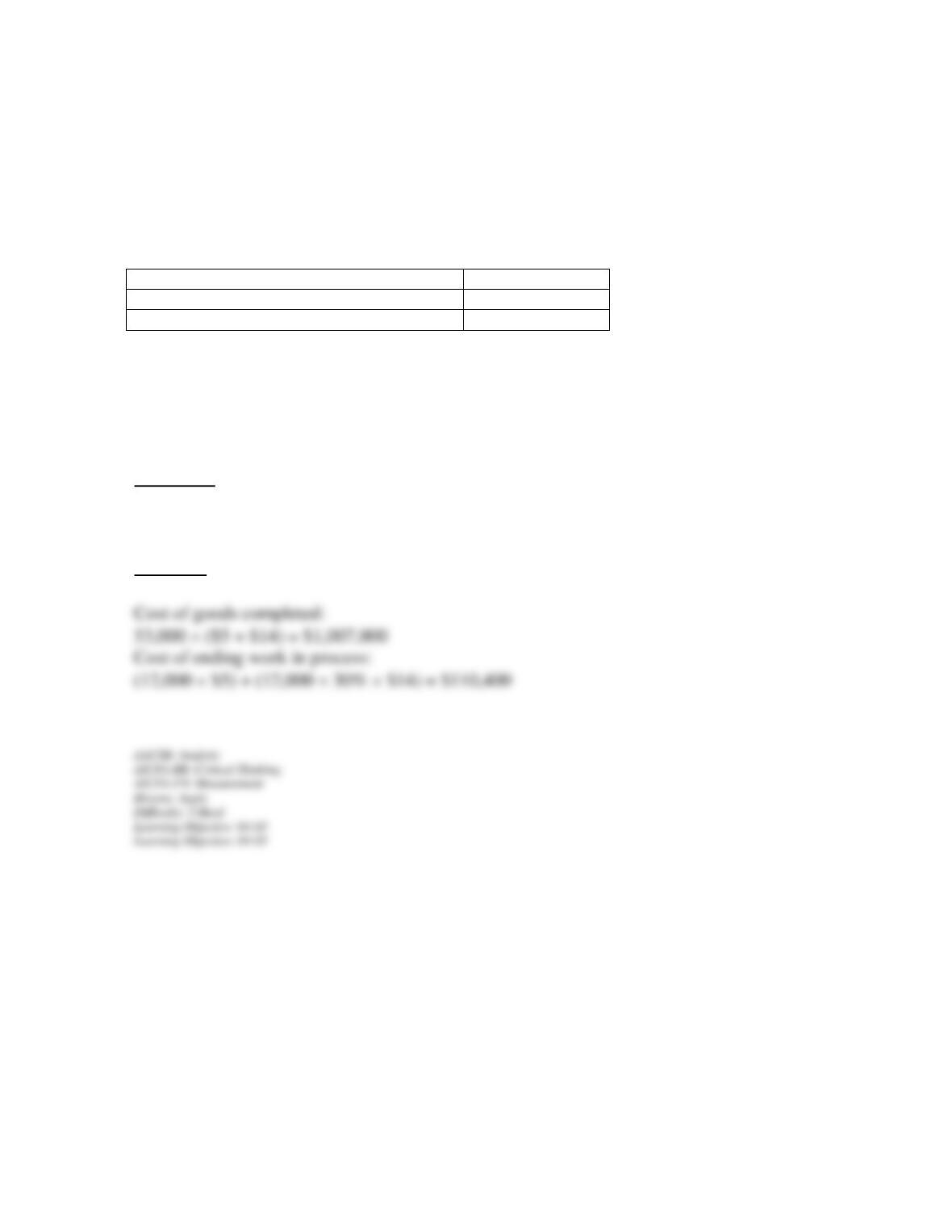
C. What percentage of conversion work will be performed on the 40,000-unit ending work-in–
process inventory during August?
D. In all likelihood, were all of the 120,000 completed units begun in July? Explain.
Solution:
4-50
91. Minnon, Inc., uses a weighted-average process-costing system. All materials are
introduced at the beginning of production; conversion cost is incurred evenly throughout
manufacturing. The following information pertains to April:
Beginning Work in Process (80% complete)
9,000 units
Goods completed during April
53,000 units
Ending work in process (30% complete)
12,000 units
The company’s accountant has already computed the cost per equivalent unit, as follows:
materials, $5; conversion, $14.
Required:
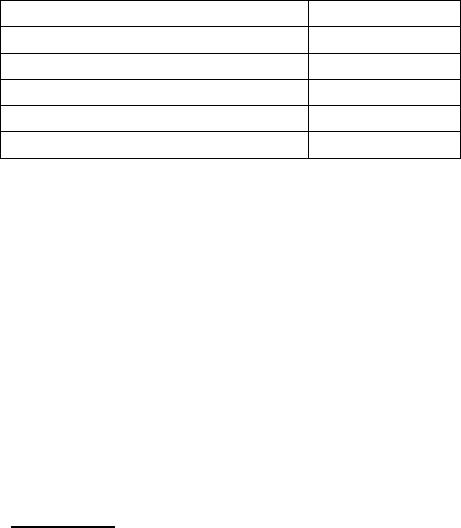
Calculate the cost of goods completed during April and the cost of the ending work-in-process
inventory.
Solution:
4-51
92. Markus Corporation reported the following as of February 1, (weighted-average method).
Conversations with the production supervisor revealed that materials are introduced at the
start of the process and conversion cost is incurred evenly throughout manufacturing. The
company started 29,000 units during the month. Goods in process at the beginning and end of
February totaled 3,000 units and 5,000 units, respectively, the latter batch being 60%
complete.
Just prior to leaving on vacation, a trusted staff assistant was asked to compute the cost of
February’s ending work-in–process inventory. Her calculations showed a huge rise in unit cost
when compared with the February 1 figures, soaring to $250 [($470,000 + $280,000) 3,000
units (5,000 units 60%)].
Required:
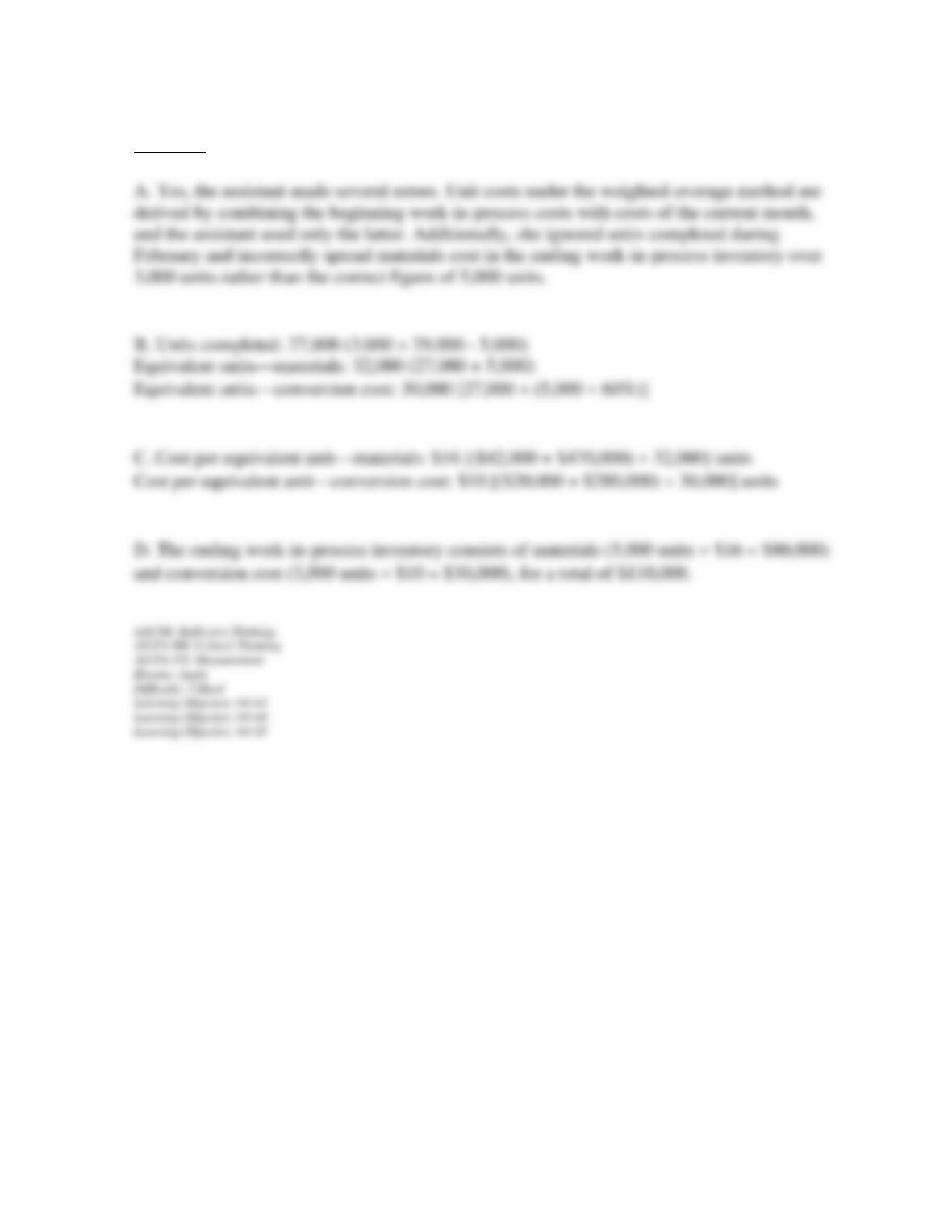
A. Did the staff assistant make any errors in her calculations? Explain.
B. Analyze the company’s production volume and determine the proper equivalent-unit
figures for February.
C. Calculate the proper unit costs for February.
D. Calculate the cost of the February 28 work-in-process inventory.
Work in Process: Feb. 1
Direct material
$42,000
Conversion cost
$20,000
February production costs:
Direct material
470,000
Conversion cost
280,000
4-52
Solution: