16) In a bank reconciliation, an EFT cash payment is:
A) added to the bank balance.
B) added to the book balance.
C) subtracted from the book balance.
D) subtracted from the bank balance.
17) In a bank reconciliation, a bank service charge for printing checks is:
A) added to the bank balance.
B) added to the book balance.
C) subtracted from the book balance.
D) subtracted from the bank balance.
18) All of the following will appear on the book side of the bank reconciliation EXCEPT for:
A) service charges.
B) electronic funds transfers.
C) deposits in transit.
D) book errors.
19) Another term for a “hot check” is:
A) electronic check.
B) outstanding check.
C) nonsufficient funds (NSF) check.
D) cleared checks.
20) In a bank reconciliation, items recorded by the bank, but not yet recorded by the company, include:
A) deposits in transit.
B) bank collections of accounts receivable.
C) outstanding checks.
D) both deposits in transit and outstanding checks.
21) The person who prepares the bank reconciliation:
A) should also be responsible for cash receipts.
B) should also be responsible for cash disbursements.
C) should be responsible for both cash receipts and cash disbursements.
D) should have no other cash duties.
22) The bookkeeper recorded a deposit of $700 as $70. On the bank reconciliation, this will be a(n):
A) addition of $630 to the balance per bank.
B) subtraction of $630 from the balance per bank.
C) addition of $630 to the balance per books.
D) subtraction of $630 to the balance per books.
23) If a bookkeeper mistakenly records a disbursement as $12 instead of the correct amount of $21, the
error should be shown on the bank reconciliation as a:
A) $9 addition to the balance per books.
B) $9 deduction from the balance per books.
C) $33 addition to the balance per books.
D) $33 deduction from the balance per books.
24) A check received from a customer for which there are not sufficient funds in the bank to cover the
amount of the check is a(n):
A) service charge.
B) error.
C) nonsufficient funds check.
D) blank check.
25) If the bank records a deposit of $140 as $1400 , the error should be shown on a bank reconciliation as
a:
A) subtraction from the book balance of $1540.
B) subtraction from the bank balance of $1540.
C) subtraction from the bank balance of $1260.
D) subtraction from the book balance of $1260.
26) Which of the following is a CORRECT statement regarding the bank reconciliation?
A) The bank reconciliation is part of the general ledger.
B) Journal entries need to be made for all transactions on the bank side to get the accounts up–to-date.
C) Journal entries need to be made for all transactions on the book side to get the accounts up–to-date.
D) The bank reconciliation is part of the journal.
27) A bank reconciliation included an outstanding check of $850 for the payment of salaries. The journal
entry to record this reconciling item:
A) should debit Salaries Expense and credit Cash for $850.
B) should debit Cash and credit Salaries Expense for $850.
C) should debit Accounts Payable and credit Cash for $850.
D) is not required.
28) A bank statement included a NSF check from customer Kim Fields for $2,100. The journal entry to
record this reconciling item should:
A) debit NSF and credit Cash for $2,100.
B) debit Cash and credit Accounts Receivable for $2,100.
C) debit Accounts Receivable and credit Cash for $2,100.
D) debit Cash and credit NSF for $2,100.
29) If a bank statement included a bank collection of a note receivable and the related interest revenue,
the journal entry to record this item should include a:
A) debit to Note Receivable and a credit to Cash.
B) debit to Cash and a credit to Note Receivable.
C) debit to Cash, credit to Note Receivable, and credit to Interest Revenue.
D) debit to Note Payable, credit to Cash and credit to Interest Revenue.
30) If a bank statement includes an EFT receipt of $200 for interest, the journal entry to record this
reconciling item should include a:
A) debit to Cash for $200 and a credit to Interest Revenue for $200.
B) debit to Accounts Receivable for $200 and a credit to Interest Revenue for $200.
C) debit to Interest Revenue for $200 and credit to Cash for $200.
D) debit to Interest Expense for $200 and credit to Prepaid Interest for $200.
31) The book side of a bank reconciliation includes:
A) deposits in transit, bank collections and NSF checks.
B) NSF checks, bank collections of notes receivable and interest earned on the checking account.
C) outstanding checks and deposits in transit.
D) outstanding checks, NSF checks and cost of printed checks.
32) Which of the following items from the bank reconciliation require a journal entry?
A) bank errors
B) deposits in transit
C) outstanding checks
D) charge for printing of checks
33) The ending bank statement balance at November 30 is $7550. The bank statement shows a service
charge of $75, electronic funds receipts of $500, and a NSF check for $350. Deposits in transit total $2550
and outstanding checks are $1735. The balance per books at November 30 is $8290. What is the adjusted
bank balance at November 30?
A) $7550
B) $7625
C) $8365
D) $9105
34) The ending bank statement balance at November 30 is $7000. The bank statement shows a service
charge of $85, electronic funds receipts of $600 and a NSF check for $250. Deposits in transit total $2,050
and outstanding checks are $1,835. The balance per books at November 30 is $6950. What is the adjusted
book balance at November 30?
A) $7265
B) $7165
C) $7215
D) $8715
35) Marjorie Company’s cash balance per the books at the end of the month was $9000. After comparing
the company’s records with the monthly bank statement, Marjorie’s accountant identified the following
reconciling items: outstanding checks, $800; deposits in transit, $700; bank service charge, $30; and NSF
check, $100. The bank collection of a note receivable was $1100 plus interest of $180. There also was an
EFT payment of $150. What is the adjusted book balance at the end of the month?
A) $10,150
B) $9970
C) $8900
D) $10,000
36) When preparing the bank reconciliation, if the adjusted book balance and the adjusted bank balance
disagree, this may indicate:
A) an error made in preparing the bank reconciliation.
B) stealing of cash by an employee in the business.
C) fraudulent financial reporting.
D) A and B.
37) New Store has the following information at August 31:
∙ Two deposits made on August 31 were not on the bank statement, totaling $5300.
∙ The bank collected an EFT payment on a note receivable for $2,750. Of this amount, $150 represented
interest on the note.
∙ August 31 balance in Cash was $12,987.
∙ The bookkeeper forgot to record check #1578 for $843 which was cashed by the bank on August 15th.
∙ The balance on the bank statement as of August 31 was $11,800.
∙ A check printing fee of $40 was shown on the bank statement. NSF check $100.
∙ Checks #1572, 1606, and 1548, totaling $2346, were not shown on the bank statement, even though
the company had sent the checks.
What is the adjusted bank balance at August 31?
A) $14,410
B) $15,941
C) $14,754
D) $16,960
38) Olde Shoppe has the following information at August 31:
∙ Two deposits made on August 31 were not on the bank statement, totaling $5,300.
∙ The bank collected an EFT payment on a note receivable for $2780. Of this amount, $250 represented
interest on the note.
∙ August 31 balance in Cash was $11,697.
∙ The bookkeeper forgot to record check #1578 for $543 which was cashed by the bank on August 15th.
∙ The balance on the bank statement as of August 31 was $10,720.
∙ A check printing fee of $70 was shown on the bank statement. NSF check $200.
∙ Checks #1572, 1606, and 1548, totaling $2,356, were not shown on the bank statement, even though
the company had sent the checks.
What is the adjusted book balance at August 31?
A) $11,697
B) $13,664
C) $13,414
D) $8104
39) On a bank reconciliation, electronic fund transfers are:
A) additions or subtractions to the bank balance.
B) additions or subtractions to the book balance.
C) not put on the bank reconciliation.
D) only used for journal entries.
40) Which journal entry is prepared for a NSF check returned by the bank?
A) No entry is prepared.
B) Debit Cash and credit Accounts Payable.
C) Debit Cash and credit Notes Payable.
D) Debit Accounts Receivable and credit Cash.
41) Which of the following transactions requires a journal entry?
A) The bank charged $50 for a stop payment on a check.
B) The bank deducted $50 from your account in error.
C) The bank collected a note receivable with interest on your behalf.
D) A and C
42) The bookkeeper recorded a payment on account as $170 instead of the correct amount of $710. What
journal entry is required?
A) Debit Accounts Payable for $710 and credit Cash for $710.
B) Debit Accounts Receivable for $710 and credit Cash for $710.
C) Debit Accounts Payable for $540 and credit Cash for $540.
D) Debit Cash for $540 and credit Accounts Payable for $540.
43) Dooley Company sent a deposit of $4000 to the bank. The bank credited Dooley Company’s
checking account for a deposit of $400. In reconciling the bank statement, the bookkeeper saw the
deposit of $400. Which journal entry should Dooley Company prepare?
A) Debit Cash for $3600 and credit Deposits fo $3600.
B) Debit Cash for $3600 and credit Revenue for $3600.
C) Debit Cash for $3600 and credit Accounts Receivable for $3600.
D) No journal entry is required.
44) Corbin Company was charged $25 for a check printing fee associated with its checking account.
Which journal entry is required?
A) Debit Miscellaneous Expense for $25 and credit Accounts Payable for $25.
B) Debit Miscellaneous Expense for $25 and credit Accounts Receivable for $25.
C) Debit Miscellaneous Expense for $25 and credit Cash for $25.
D) No journal entry is required.

30
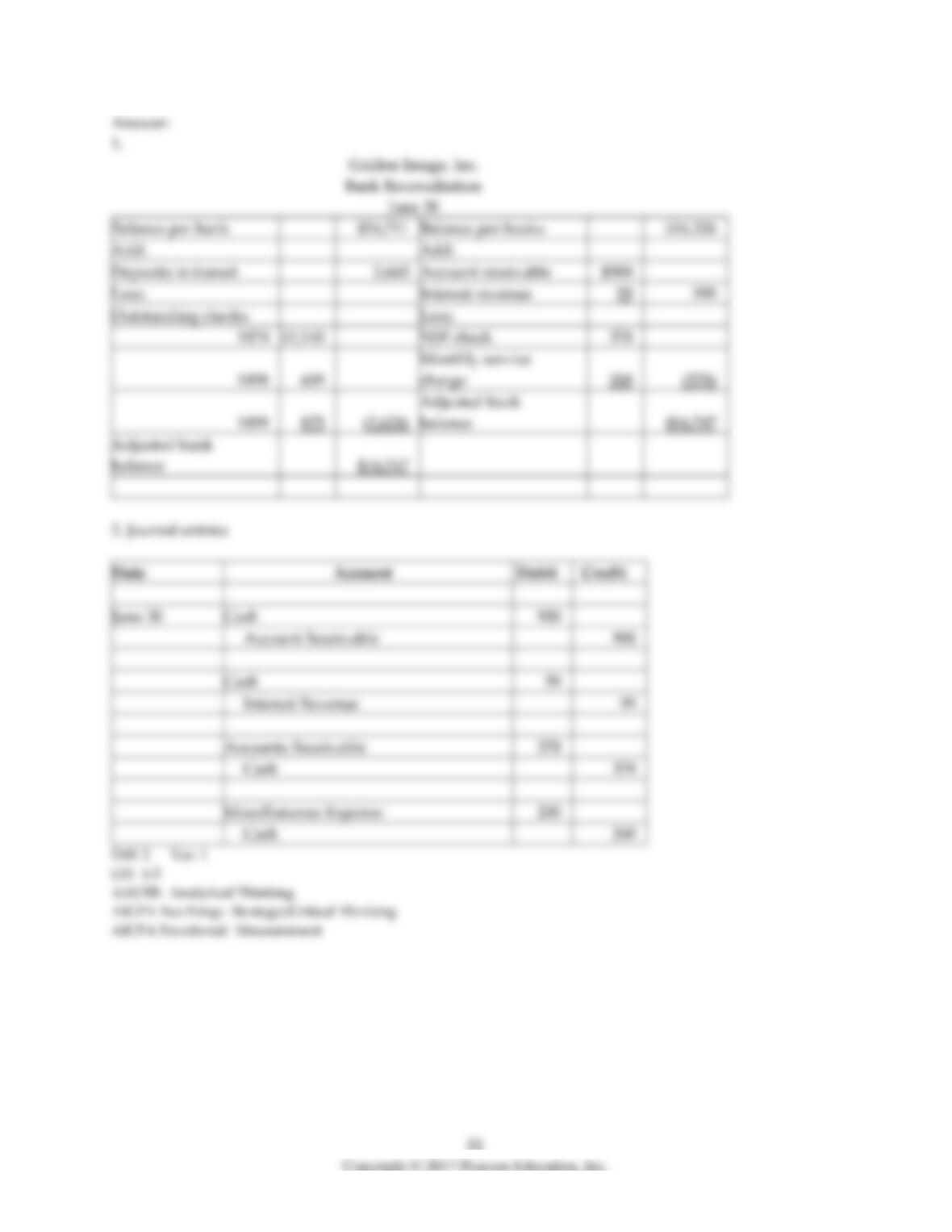
45) The following information is available for Golden Image, Inc.:
∙ The bank statement indicated a monthly service charge of $200.
∙ Golden Image made a deposit of $2,660 on June 30, but this deposit did not appear on the bank
statement until July 6.
∙ The bank collected an account receivable of $900 from one of Golden Image’s customers.
∙ The bank also collected interest revenue for Golden Image of $99.
∙ The bank also returned a nonsufficient funds check for $378 from John Able, one of Golden Image’s
customers.
∙ Checks #1874 for $1,140, #1898 for $609, and #1899 for $875 were written by Golden Image and sent
to the respective companies, but these checks do not appear on the bank statement.
∙ The balance on the bank statement as of June 30 was $16,711.
∙ On June 30, the Cash account from Golden Image‘s books showed an amount of $16,326.
Required:
1. Prepare the bank reconciliation at June 30 for Golden Image, Inc.
2. Prepare the necessary journal entries by Golden Image, Inc., at June 30.
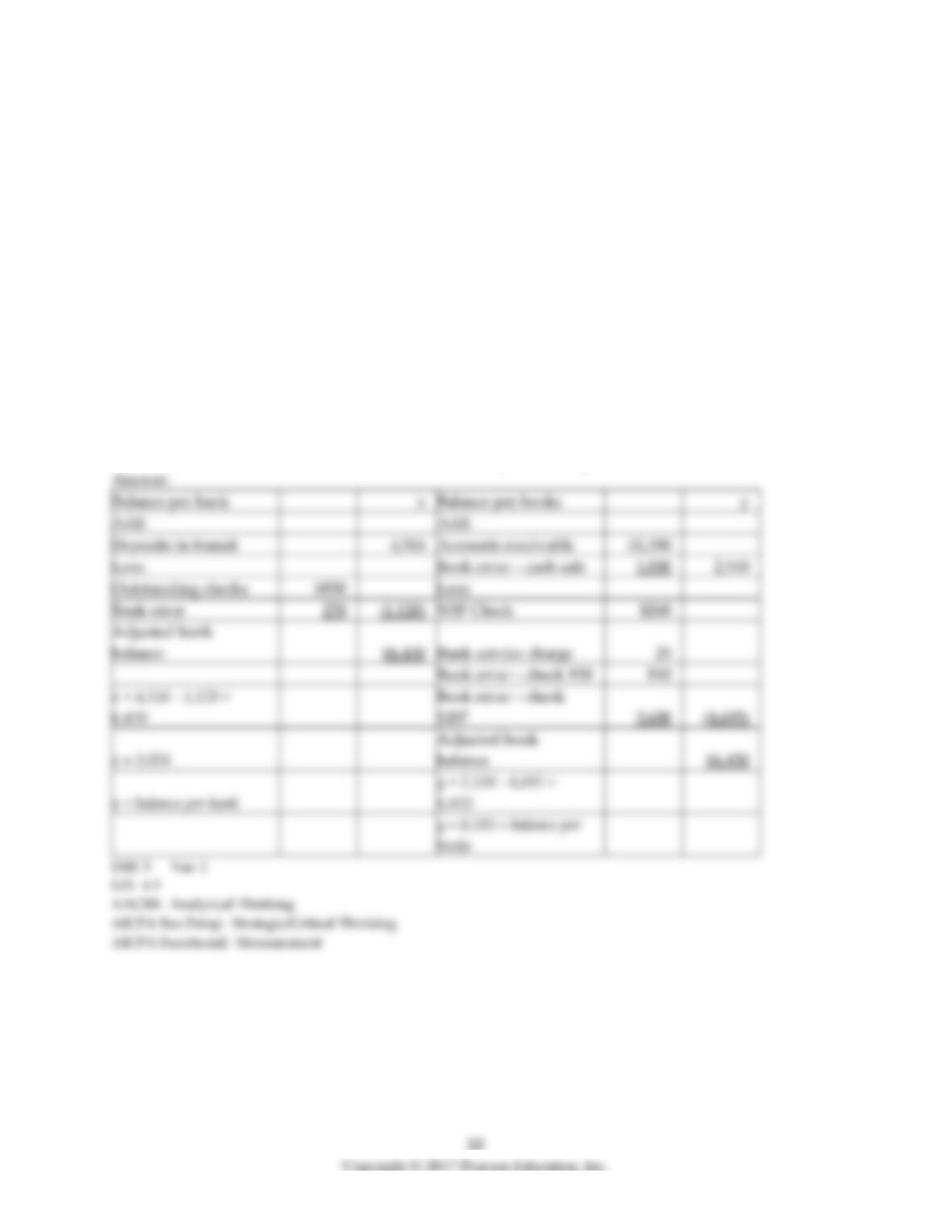
46) The following information is available for George Company at March 31:
∙ Adjusted bank balance as of March 31 was $6,450.
∙ Outstanding checks totaled $850.
∙ A customer’s check for $260 was returned due to nonsufficient funds.
∙ March’s service charge was $25.
∙ The bank collected an account receivable of $1,550.
∙ A new bookkeeper made the following errors:
# 930 for Rent Expense written for $900, recorded as $90
#1207 for Office Equipment written for $8,450, recorded as $4,850.
Forgot to record a cash sale of $1,000.
∙ A deposit was shown on the bank statement as $965, when the deposit ticket was correctly totaled to
be $695.
∙ Deposits made at month-end totaled $4,516; these were not shown on bank statement.
Prepare a bank reconciliation to determine:
(1) the balance per bank at March 31 before any reconciling items,
(2) the balance in the Cash account at March 31 before any reconciling items.

33
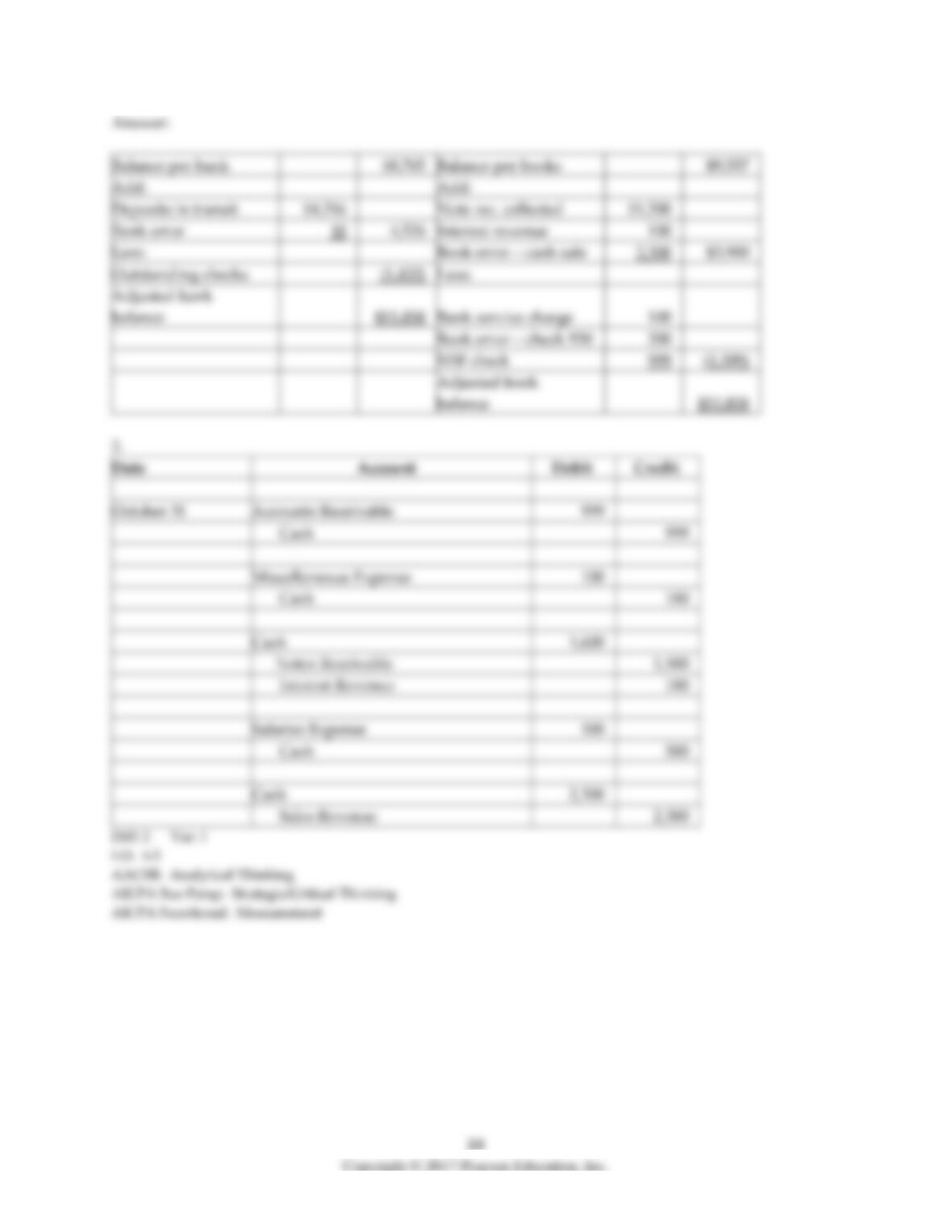
47) The information below was used to prepare a bank reconciliation for Lorena Company at October
31:
∙ According to the bank statement, the bank balance as of October 31 was $8,765. According to the
books, the cash balance as of October 31 is $9,557.
∙ Outstanding checks totaled $1,433.
∙ A customer’s check for $999 was returned for NSF.
∙ October’s service charge was $100.
∙ The bank collected $1,600 from a customer of Lorena Company in payment of a note receivable,
including interest of $100.
∙ A new bookkeeper had errors in posting checks and recording cash receipts:
1. Check #930 for Salaries Expense written for $930, recorded as $430.
2. A cash sale for $2,300 on October 15 was not recorded by the bookkeeper since she was in a hurry
to go to lunch. Ignore Cost of Goods Sold.
∙ A deposit was made by the company for $900. This was the correct amount, however, the bank
made a mistake and recorded the deposit as $890.
∙ Deposits made at month-end totaled $4,516; these were not shown on the bank statement.
Required:
1. Prepare the bank reconciliation at October 31.
2. Prepare the journal entries at October 31.
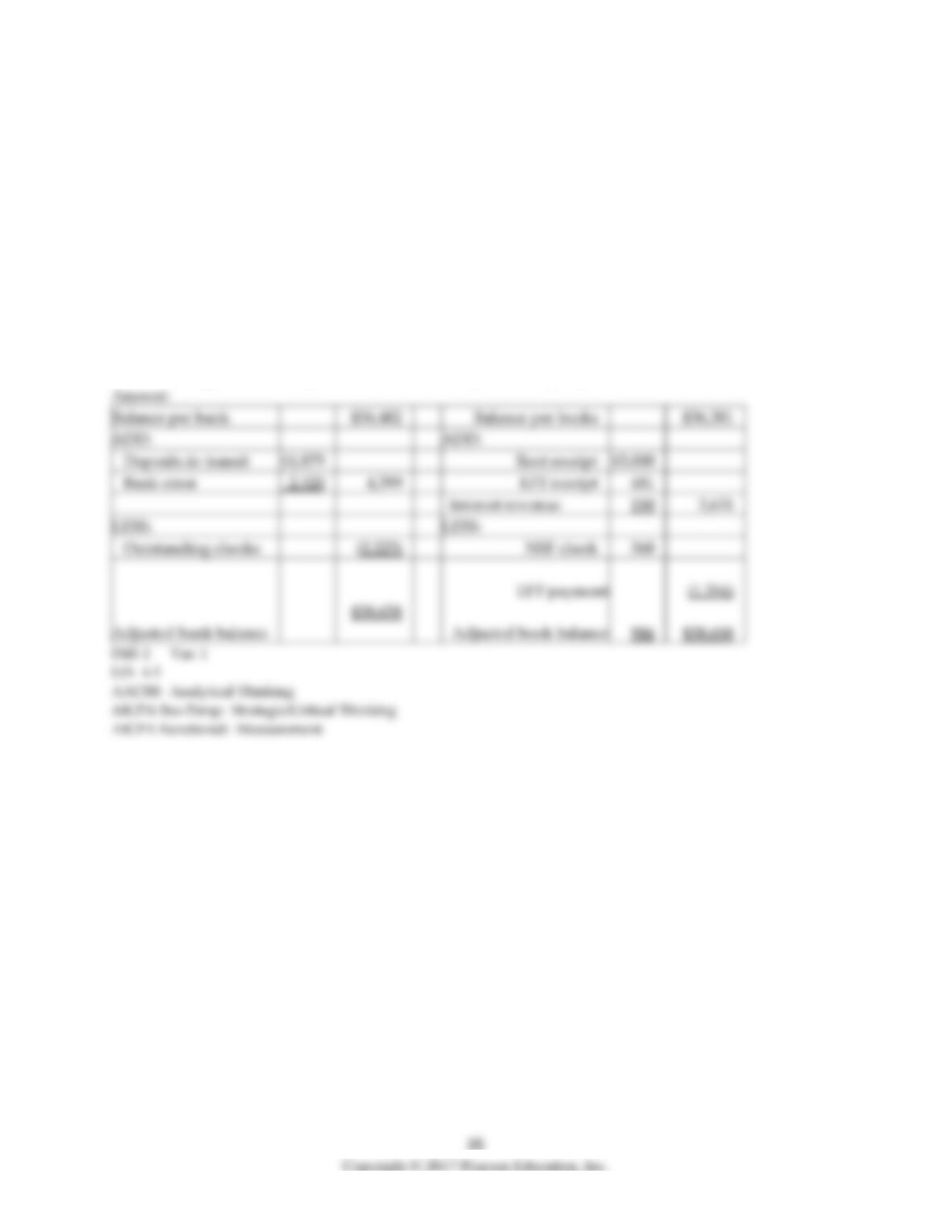
48) Use the information below to prepare a bank reconciliation for Martindale Company for the month
of January.
∙ Outstanding checks as of January 31 amounted to $2,223.
∙ Deposits in transit as of January 31 amounted to $1,879.
∙ The ending balance per the January bank statement is $36,482.
∙ The bank statement shows that Martindale earned $150 of interest on its bank balance for the month
of January.
∙ The bank mistakenly recorded a deposit of $2,800 as $280 on January 15.
∙ The company pays its insurance of $986 by EFT.
∙ The bank collected rent for the company, $3,000. The bank statement shows an EFT receipt from a
Martindale customer of $481.
∙ There was a NSF check on the bank statement for $368.
∙ The ending cash balance per the books for January before any adjustments was $36,381.
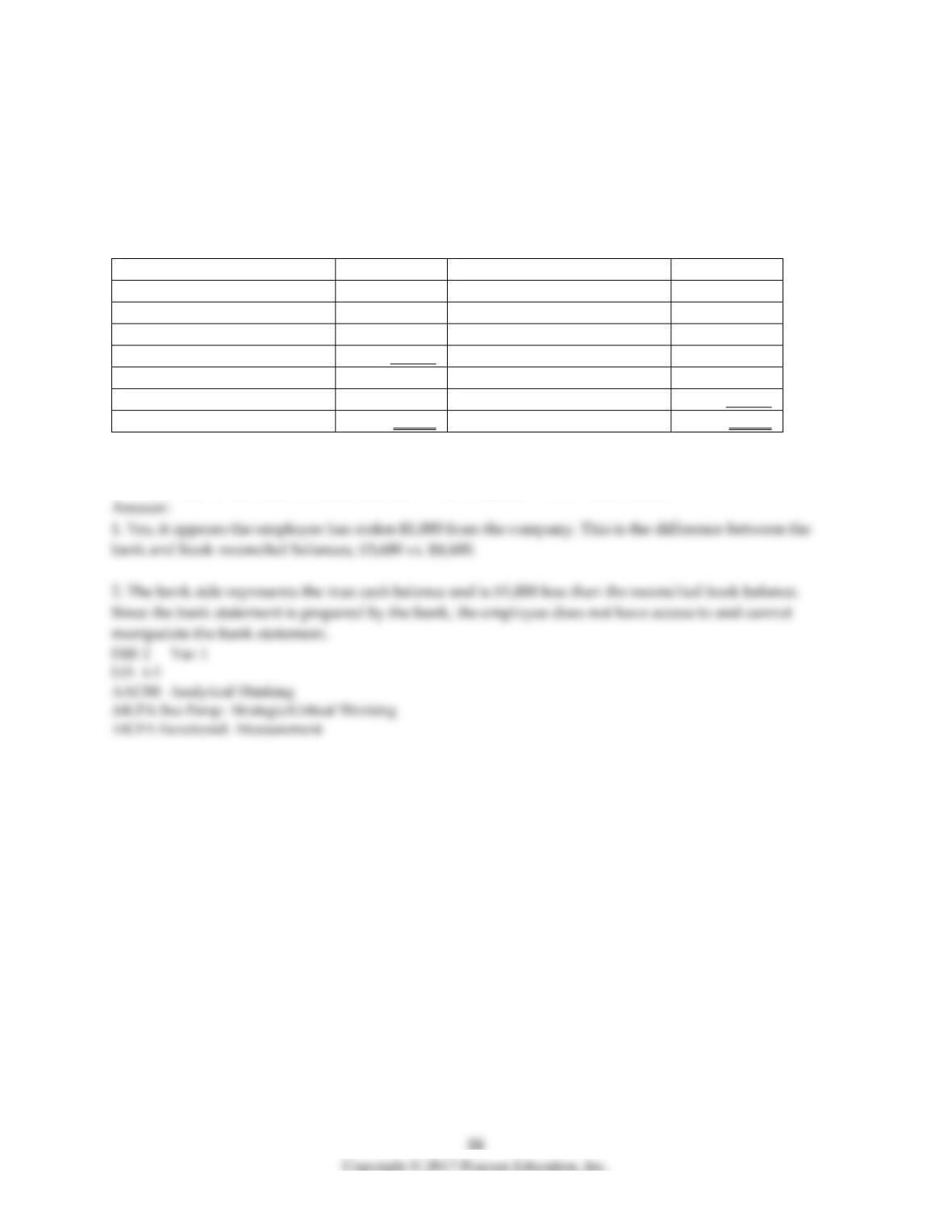
49) The owner of Samuelson Inc. has reason to believe that an employee has been stealing cash from the
company. The employee receives cash from clients, makes the bank deposit, and also prepares the
monthly bank reconciliation. To check up on the employee, the owner prepares the following bank
reconciliation:
Samuelson Inc.
Bank Reconciliation
September 30
Balance per bank
$4,300
Balance per books
$3,820
Add:
Add:
Deposits in transit
1,400
Bank collections
1,800
Less:
Interest revenue
10
Outstanding checks
(2,100)
Less:
Service charge
(30)
NSF check
(1,000)
Adjusted balance per bank
$3,600
Adjusted balance per books
$4,600
1. Does it appear the employee has stolen from the company? If so, how much? Explain your answer.
2. Which side of the bank reconciliation shows the company’s TRUE cash balance?
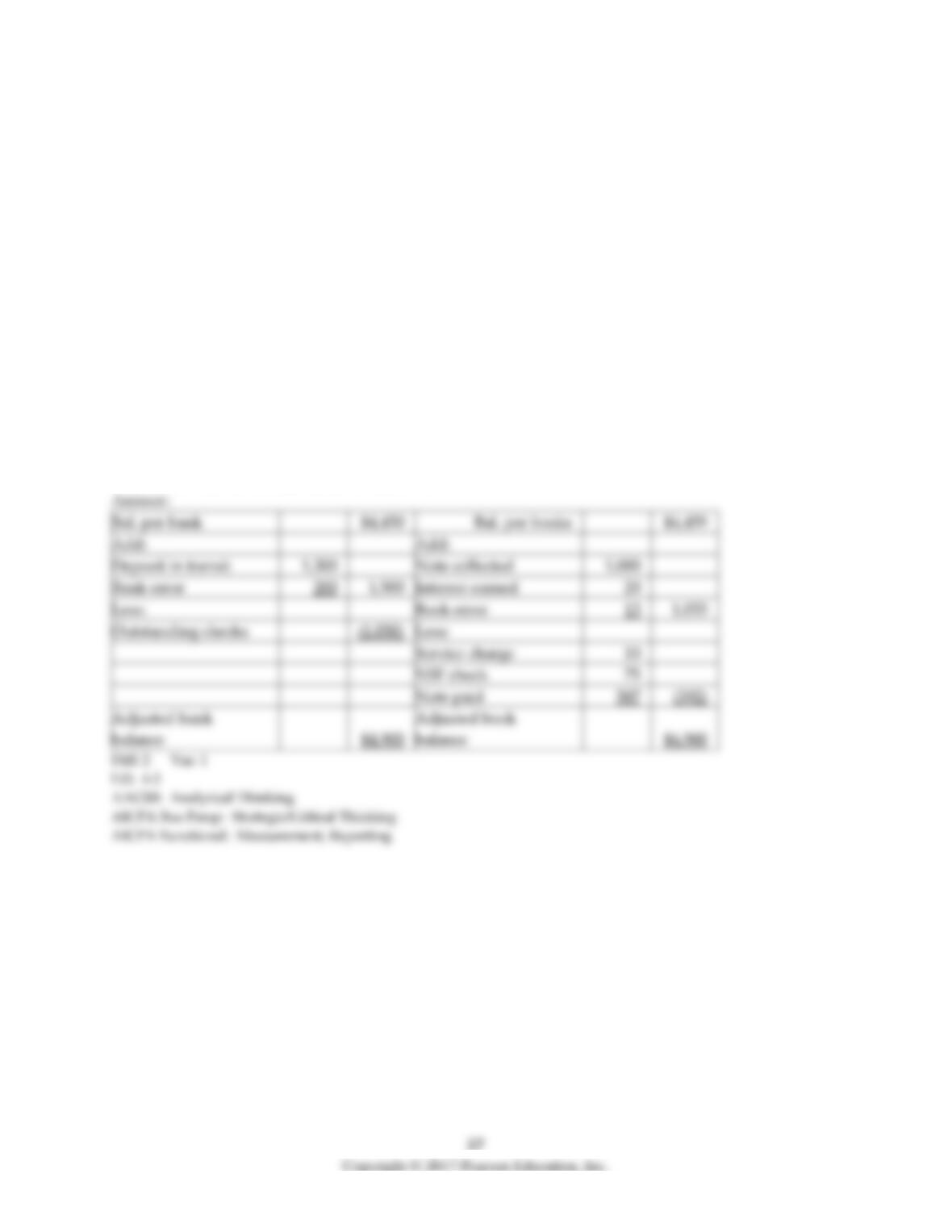
50) The following pertains to Carlisle Company:
1. Balance per bank statement, dated March 31, $4,450.
2. Balance of Cash account on company’s books at March 31, $4,459.
3. The $1,300 deposit of March 31 was not included in the bank statement.
4. Of the checks recorded as cash disbursements in March, checks totaling $1,050 have not cleared the
bank.
5. Service charges for the month, $10.
6. The bank erroneously charged the company’s account for a $200 check of another company with a
similar name.
7. The bank credited the company’s account with the $1,000 proceeds of a noninterest-bearing note that
it collected for the company.
8. NSF check of $75 was returned with the bank statement.
9. The bank paid and charged to the company‘s account a $507 noninterest-bearing note of the company.
The payment has not been recorded by the company.
10. The bookkeeper recorded a customer’s check of $148 as $135.
11. The bank credited the company’s account for $20 interest earned.
Prepare the bank reconciliation as of March 31.
51) The following are examples of items that appear on a bank reconciliation. Classify each item as (a)
an addition to the bank balance, (b) a subtraction from the bank balance, (c) an addition to the book
balance, or (d) a subtraction from the book balance.
1. NSF check
2. Deposits in transit
3. Interest revenue on checking account
4. Bank error – the bank credited the company’s account for a deposit made by another customer
5. EFT rent collection
6. Service charge
7. Book error – the company credited cash for $100 when the correct amount was $1,000
8. Outstanding checks
9. Bank collection of a note receivable on behalf of the company
4 Learning Objective 4-4
1) Internal controls for cash receipts over the counter and for cash receipts by mail are identical.
2) The duties of purchasing goods and receiving the goods should be given to the same employee.
3) A receiving report informs a vendor of the amount of goods received by the purchaser.
4) The treasurer is solely responsible for the petty cash fund.
5) Managers can use records produced by point-of–sale terminals to check inventory levels.
6) The sum of the cash in the petty cash fund and the total of the paid vouchers should equal the
opening balance in the petty cash account at all times.
7) To prevent unauthorized access to cash, as well as to allow for more efficient management of cash,
many chain retail businesses use “depository bank accounts.”
8) The treasurer conducts the final step for the receipt of cash by mail. This step includes comparing
bank deposit amounts from the treasurer and the debit to Cash.
9) When a company uses a bank lock-box system, internal control is tight because company personnel
never touch incoming cash.
10) Debit cards cannot be used to make purchases of relatively small amounts because of the high risk
of fraud.
11) Payments by check or EFT represent an important internal control.
12) When a company receives customers’ checks by mail:
A) all incoming mail containing checks from customers should be opened by the mailroom.
B) the mailroom sends all customer checks to the accounting department.
C) the remittance advices go to the treasurer for deposit.
D) the bank deposit is prepared by the mailroom.
13) When a company receives customers’ checks by mail:
A) the mailroom sends all customer checks to the treasurer, who has the cashier deposit the checks in
the bank.
B) the treasurer prepares the journal entries.
C) the mailroom employee prepares the journal entries.
D) the treasury department cashier prepares the journal entries.