Use this information to answer Questions 45 & 46:
Norton Textile Co. manufactures a variety of fabrics. All materials are introduced at the
beginning of production; conversion cost is incurred evenly through manufacturing. The
Weaving Department had 2,000 units of work in process on April 1 that were 30% complete
as to conversion costs. During April, 9,000 units were completed and on April 30, 4,000 units
remained in production, 40% complete with respect to conversion costs.
45. The equivalent units of direct materials for April total:
46. The equivalent units of conversion for April total:
47. Fulton Corporation adds all materials at the beginning of production and incurs
conversion cost evenly throughout manufacturing. The company completed 70,000 units
during the year and had 12,000 units in process at year end, 20% complete with respect to
conversion cost. Equivalent units for the year total:
48. Gutierrez, which uses a process-costing system, adds all material at the beginning of
production and incurs conversion cost evenly throughout manufacturing. The information that
follows relates to the period just ended:
Units started and completed: 75,000
Units in ending work-in-process inventory: 15,000, 60% complete
Which of the following choices correctly expresses the total equivalent units of production
with respect to material and conversion cost?
49. Domkowski began operations on January 1 of the current year. The company uses a
process-costing system, and conversion cost is incurred evenly throughout manufacturing. By
January 31, the firm had completed 56,000 units. Which of the following statements is true
about the ending work-in-process inventory if equivalent units for conversion cost totaled
59,000 units?
50. Mortensen Industries, which uses a process-costing system, adds material at the beginning
of production and incurs conversion cost evenly throughout manufacturing. The following
selected information was taken from the company’s accounting records:
Total equivalent units of materials: 5,000
Total equivalent units of conversion: 4,400
Units started and completed during the period: 3,500
On the basis of this information, the ending work-in-process inventory’s stage of completion
is:
51. Mohawk Machining, which uses a process-costing system, adds material at the beginning
of production and incurs conversion cost evenly throughout manufacturing. The following
selected information was taken from the company’s accounting records:
Total equivalent units of materials: 8,000
Total equivalent units of conversion: 7,400
Units started and completed during the period: 6,500
On the basis of this information, the ending work-in-process inventory’s stage of completion
52. Corrigan, Inc. overstated the percentage of work completed with respect to conversion
cost on the ending work-in-process inventory. What is the effect of this overstatement on
conversion-cost equivalent units and physical units manufactured, respectively?
4-25
53. St. Onge, Inc. uses a process-costing system. A newly-hired accountant identified the
following procedures that must be performed by the close of business on Friday:
1—Calculation of equivalent units
2—Analysis of physical flows of units
3—Assignment of costs to completed units and units still in process
4—Calculation of unit costs
Which of the following choices correctly expresses the proper order of the preceding tasks?
Use the following information to answer Questions 54-59.
Lakeland Chemical manufactures a product called Zing. Direct materials are added at the
beginning of the process, and conversion activity occurs uniformly throughout production.
The beginning work-in-process inventory is 60% complete with respect to conversion; the
ending work-in-process inventory is 20% complete. The following data pertain to May:
Units
Work in process, May 1
15,000
Units started during May
60,000
Units completed and transferred out
68,000
Work in process, May 31
7,000
Total
Direct
Materials
Conversion
Costs
Costs:
Work in process, May 1
$41,250
$16,500
$24,750
Costs incurred during May
234,630
72,000
162,630
Totals
$275,880
$88,500
$187,380
54. Using the weighted-average method of process costing, the equivalent units of direct
materials total:
55. Using the weighted-average method of process costing, the equivalent units of conversion
activity total:
56. Using the weighted-average method of process costing, the cost per unit of direct
materials is:
57. Using the weighted-average method of process costing, the cost per unit of conversion
activity is:
58. Using the weighted-average method of process costing, the cost of goods completed and
transferred during May is:
59. Using the weighted-average method of process costing, the total costs remaining in work
in process on May 31 are:
60. When calculating unit costs under the weighted-average process-costing method, the unit
cost is based on:
61.When computing the conversion cost per equivalent unit under the weighted-average
method of process costing, all of the following information would be needed except:
62. Barton Corporation, which adds materials at the beginning of production, uses a weighted-
average process-costing system. Consider the data that follow.
Number of Units
Cost of Materials
Beginning work in process
40,000
$80,600
Started in June
60,000
124,400
Production completed
75,000
Ending work in process
25,000
63. Peach Company uses a weighted-average process-costing system. Company records
disclosed that the firm completed 40,000 units during the month and had 10,000 units in
process at month-end, 20% complete. Conversion costs associated with the beginning work-
in-process inventory amounted to $231,000, and amounts that relate to the current month
totaled $966,000. If conversion is incurred uniformly throughout manufacturing, Peach’s
equivalent-unit cost is:
Feedback D: Correct! Conversion Equivalent unit cost = (Beginning WIP conversion costs + Conversion costs for the month) ÷ Completed
equivalent units and in-process equivalent units for conversion = ($231,000 + $966,000) ÷ (40,000 + (10,000 x 20%) = $28.50.
Feedback E: This answer is incorrect, because there is a correct amount listed.
Use the following information to answer Questions 64-65.
Universal Manufacturing uses a weighted-average process-costing system. All materials are
introduced at the start of manufacturing, and conversion costs are incurred evenly throughout
the process. The company’s beginning and ending work-in-process inventories totaled 10,000
units and 15,000 units, respectively, with the latter units being 2/3 complete at the end of the
period. Universal started 30,000 units into production and completed 25,000 units.
Manufacturing costs follow.
Beginning work in process: Materials, $60,000; conversion cost, $150,000
Current costs: Materials, $180,000; conversion cost, $480,000
64. Universal’s equivalent-unit cost for materials is:
65. Universal’s equivalent-unit cost for conversion cost is:
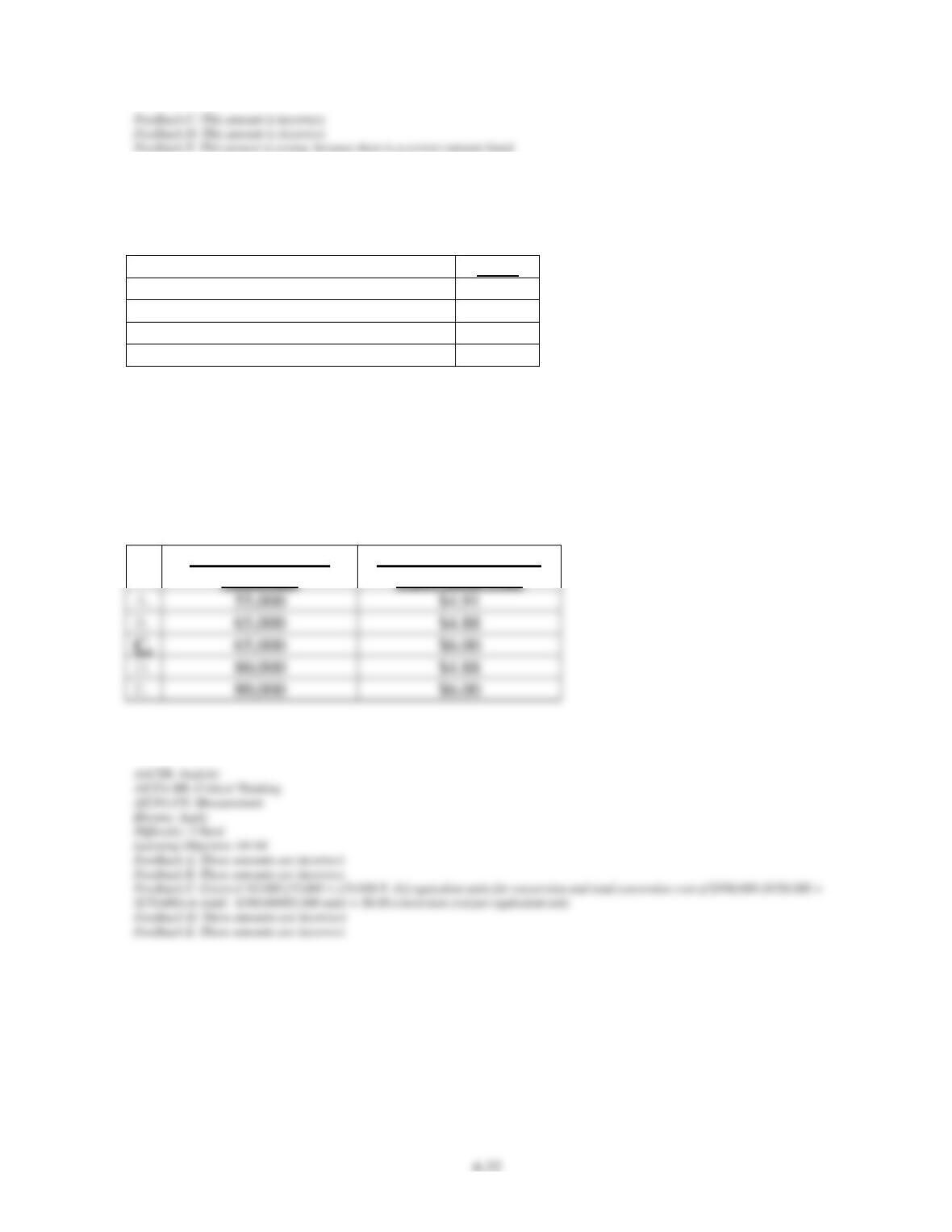
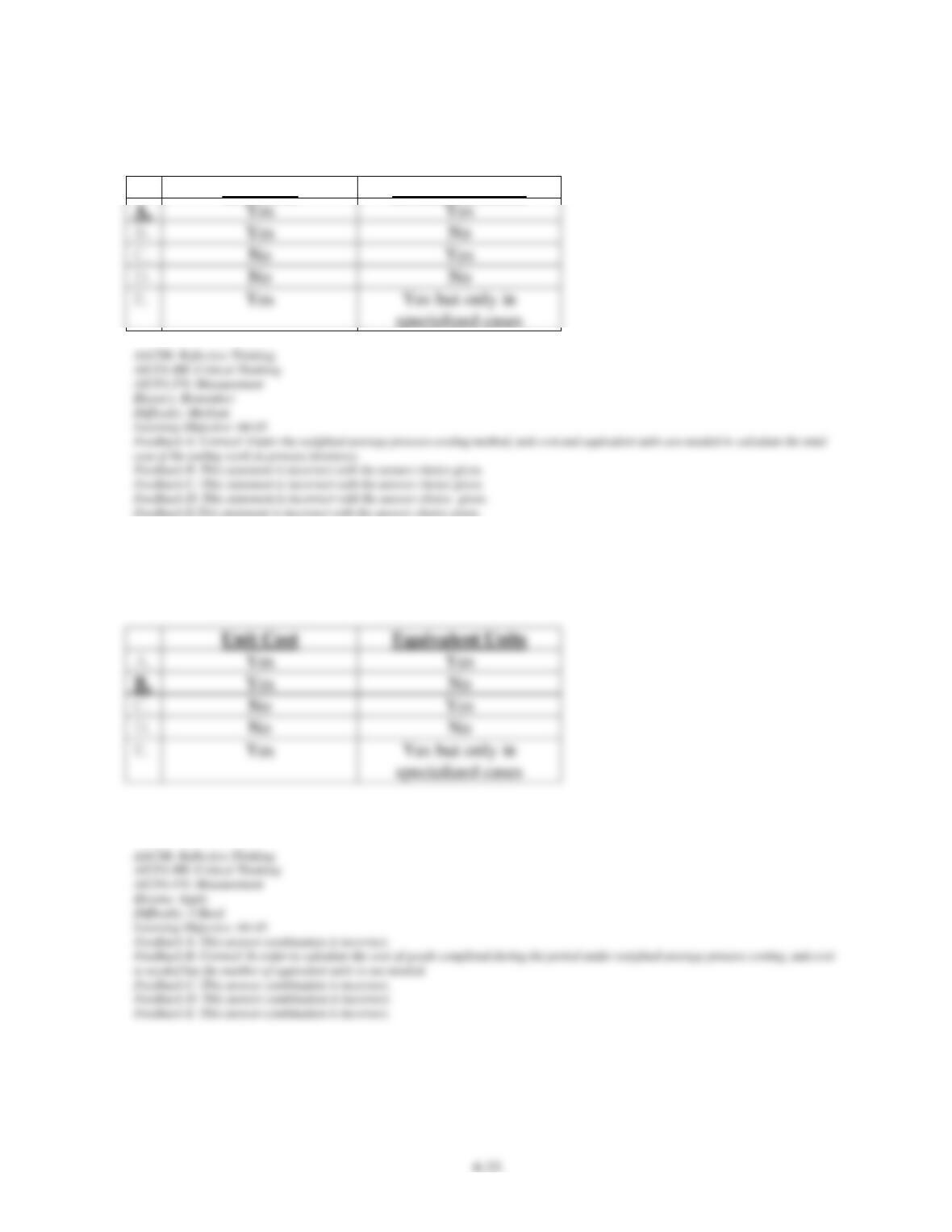
66. Gambino Construction adds materials at the beginning of production and incurs
conversion cost uniformly throughout manufacturing. Consider the data that follow.
Units
Beginning work in process
20,000
Started in August
60,000
Production completed
55,000
Ending work in process, 40% complete
25,000
Conversion cost in the beginning work-in-process inventory totaled $120,000, and August
conversion cost totaled $270,000. Assuming use of the weighted-average method, which of
the following choices correctly depicts the number of equivalent units for materials and the
conversion cost per equivalent unit?
Equivalent Units:
Materials
Conversion Cost Per
Equivalent Unit
67. Which of the following are needed to calculate the total cost of the ending work-in–
process inventory under the weighted-average process-costing method?
Unit Cost
Equivalent Units
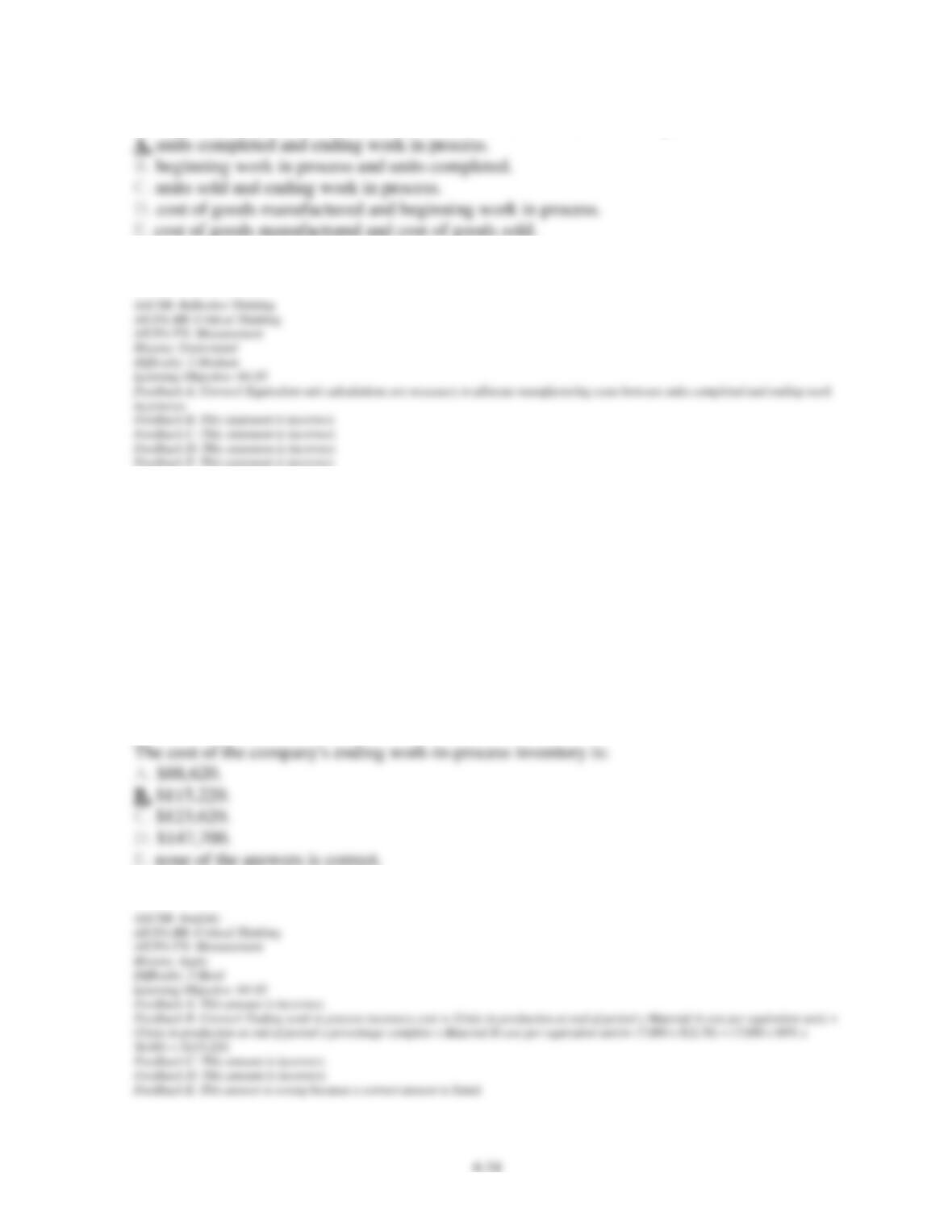
68. Which of the following are needed under weighted-average process costing to calculate
the cost of goods completed during the period?
Unit Cost
Equivalent Units
69. Equivalent-unit calculations are necessary to allocate manufacturing costs between:
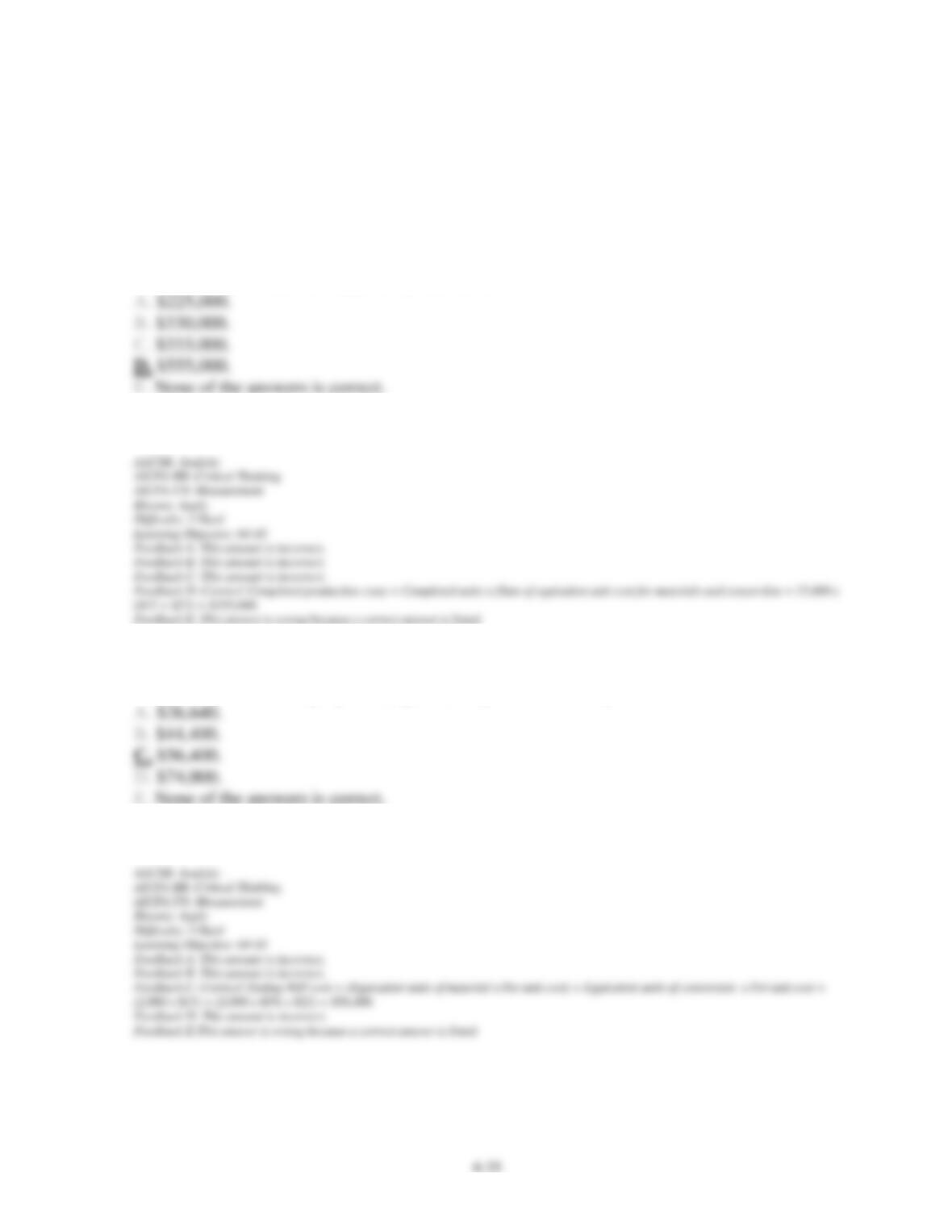
70. Frankenberger Company, which uses a weighted-average process-costing system, had
7,000 units in production at the end of the current period that were 60% complete. Material A
is introduced at the beginning of the process; material B is introduced at the end of the
process; and conversion cost is introduced evenly throughout manufacturing. Equivalent-unit
production costs follow.
Material A: $12.50
Material B: $2.00
Conversion cost: $6.60
Use the following information to answer questions 71 & 72.
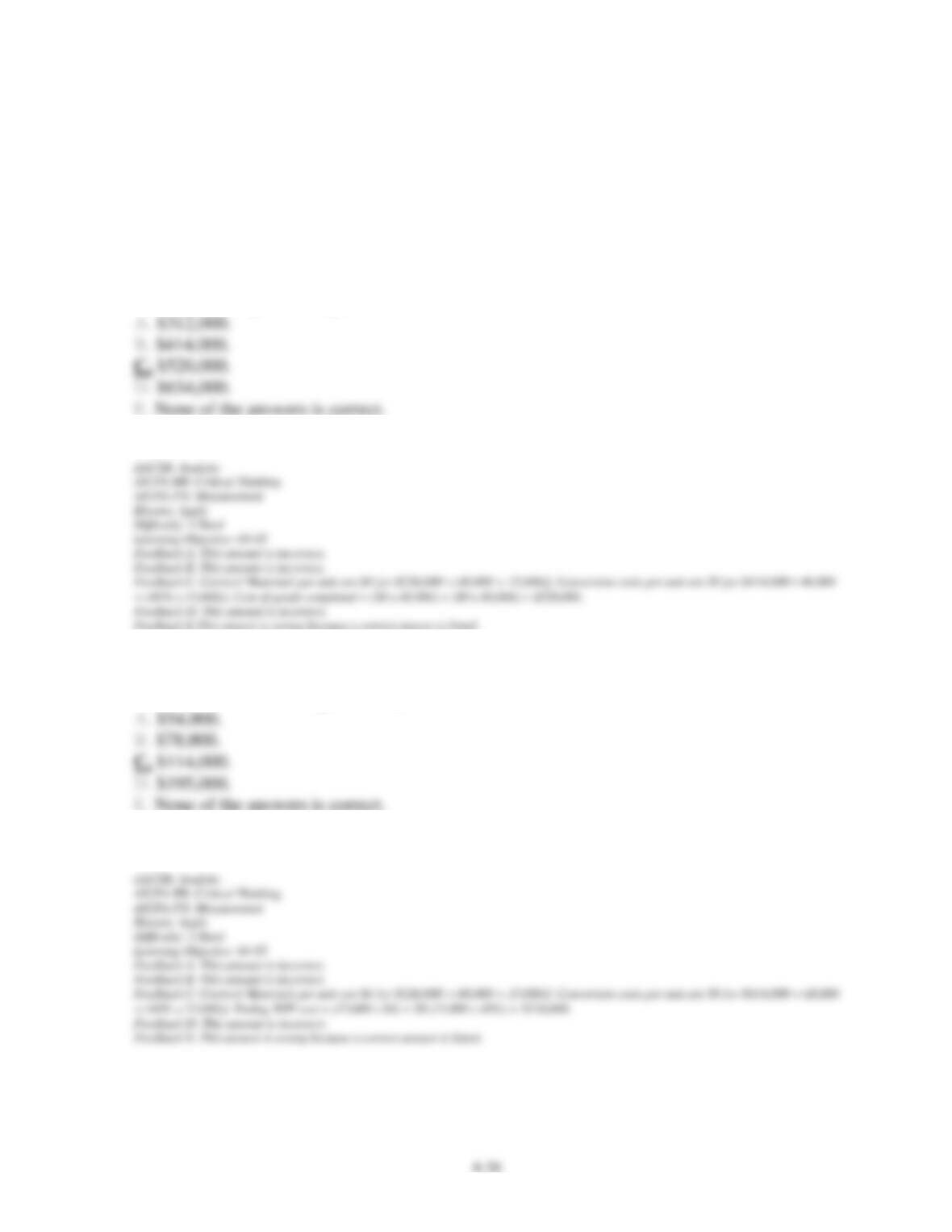
Forrest Corporation, a new company, adds material at the beginning of its production process;
conversion cost, in contrast, is incurred evenly throughout manufacturing. During May, the
firm completed 15,000 units and had ending work in process of 2,000 units, 60% complete.
Equivalent-unit costs were: materials, $15; conversion, $22.
71. The cost of Forrest’s completed production is:
72. The cost of the company’s ending work-in-process inventory is:
Use the following information to answer Questions 73-74.
Claremore Industries uses a weighted-average process-costing system. All materials are added
at the beginning of the process; conversion costs are incurred evenly throughout production.
The company finished 40,000 units during the period and had 15,000 units in progress at year-
end, the latter at the 40% stage of completion. Total material costs amounted to $220,000;
conversion costs were $414,000.
73. The cost of goods completed is:
74. The cost of the ending work in process is:
75. Which of the following is a key document in a typical process-costing system?
76. Which of the following is true concerning cost drivers for the predetermined overhead rate
in a process-costing system?
77. Operation costing might be used to determine the cost of all of the following products
except:
78. Which of the following statements about operation costing is (are) true?
I. Conversion costs are accumulated by department.
II. Direct material costs are accumulated by batch.
III. Operation costing is a hybrid product-costing system.
A. I only.
79. Operation costing:
80. Which of the following best describes the procedures used in operation costing to assign
direct-material and conversion costs to production?
Direct-Material Costs
Conversion Costs
Similar to those in job costing.
Similar to those in job costing.
Similar to those in job costing.
Similar to those in process costing.
Similar to those in process costing.
Similar to those in job costing.
Similar to those in process costing.
Similar to those in process costing.
both job costing and process costing.
81. When determining the cost of a manufactured good under an operation-costing system, a
company would:
82. All of the following statements about an operation-costing system are true except: