
53) Scuz Bootes has been doing custom choppers, piercings, and tattoos for over thirty years. His home
and place of business is a garage in the harbor district of Seattle, Washington. He has meticulous records
of every job he has ever done, carefully handwritten with the customer name and address, a description
of the job, and an attached picture of the bike or body part before and after customization. His unique
style has recently attracted the attention of national media after several celebrities sought him out and
showcased his work. Business is booming. Consequently, Scuz has hired you to construct an accounting
information system, beginning with the historical records. As you read through the records, you notice
that some customer last names have different first names in different records. For example, R.
Framington Farnsworth (custom chopper), Bob Farnsworth (tattoo), and Snake Farnsworth (tattoos and
piercings) all seem to be the same person. You explain to Scuz that every customer must be identified by
a unique customer number in the AIS. You are referring to the
A) entity integrity rule.
B) referential integrity rule.
C) update anomaly.
D) insert anomaly.
54) Scuz Bootes has been doing custom choppers, piercings, and tattoos for over thirty years. His home
and place of business is a garage in the harbor district of Seattle, Washington. He has meticulous records
of every job he has ever done, carefully handwritten with the customer name and address, a description
of the job, and an attached picture of the bike or body part before and after customization. His unique
style has recently attracted the attention of national media after several celebrities sought him out and
showcased his work. Business is booming. Consequently, Scuz has hired you to construct an accounting
information system, beginning with the historical records. You begin development of the relational
database that will form the core of the AIS by envisioning the record stored in a single table with a
column that represents each attribute. You then begin to break this table down into smaller tables. This
process is called
A) integration.
B) optimization.
C) minimization.
D) normalization.
55) Chelsana Washington is a medical equipment sales representative. Her company has provided her
with a laptop computer that uses wireless connectivity to access the accounting information system from
virtually anywhere in the country. She, and the other sales reps, have access to view customer and
product information. They have access that allows them to enter and cancel customer orders. The
permissions for Chelsana define a(an) ________ in the company’s database management system.
A) conceptual-level schema
B) subschema
C) data dictionary
D) physical view
56) Chelsana Washington is a medical equipment sales representative. Her company has provided her
with a laptop computer that uses wireless connectivity to access the accounting information system from
virtually anywhere in the country. She, and the other sales reps, have access to view customer and
product information. They have access that allows them to enter and cancel customer orders. The
permissions for the sales reps define a(an) ________ in the company’s database management system.
A) conceptual-level schema
B) external-level schema
C) data dictionary
D) physical view
57) Shandra Bundawi is a new graduate who has been hired by an old-line, family-owned furniture
manufacturing company in the northeast. She has been asked to analyze the company’s accounting
information system and to recommend cost-effective improvements. After noting that the production
and sales departments use database systems that are entirely separated, she recommends that they be
combined. Implementation of her recommendation would benefit the company by contributing to data
A) independence.
B) integration.
C) redundancy.
D) qualifications.

58) Scuz Bootes has been doing custom choppers, piercings, and tattoos for over thirty years. His home
and place of business is a garage in the harbor district of Seattle, Washington. He has meticulous records
of every job he has ever done. These have been entered into a computerized accounting information
system that his accountant refers to as a “data warehouse.” Scuz is considering an expansion of his
business into scarification, and has asked his accountant to identify past customers who might be likely
candidates for this service. Scuz wants his accountant to engage in
A) customer auditing.
B) customer resource management.
C) data mining.
D) enterprise resource planning.
59) Heidi Holloway is a headhunter with Career Funnel in Boca Raton, Florida. Heidi is proud of the
company’s motto: We funnel workers into jobs. The foundation of CF’s success is its accounting
information system. When a client is placed with an employer, a record is created that identifies the
employment relationship. CF follows up on placements by surveying both employers and clients about
the employment experience and then entering the results into the AIS. Clients are uniquely identified by
social security number. In records that contain client survey data,the social security number number is
likely to be
A) the primary key.
B) a foreign key.
C) combined with other data fields to form a primary key.
D) null.
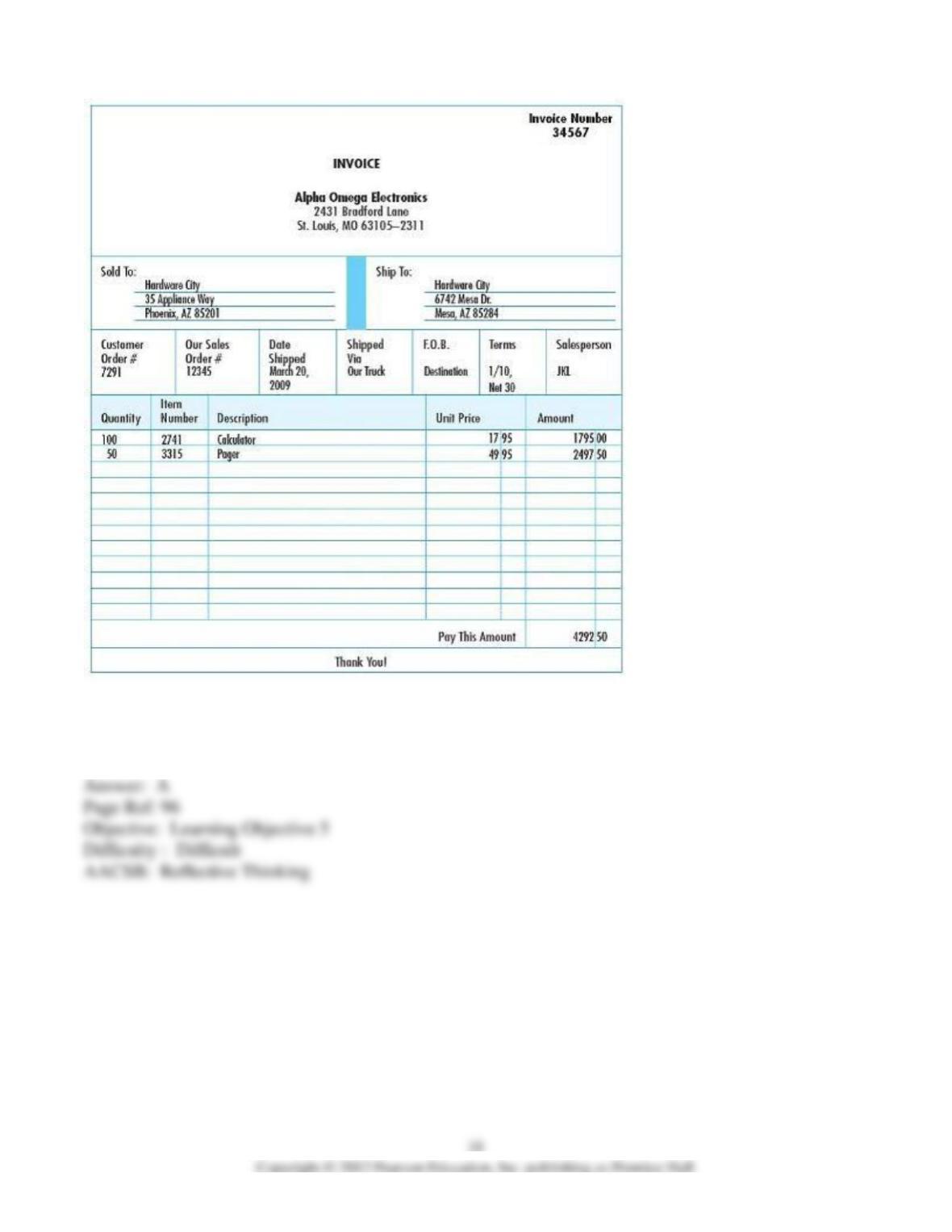
60) The data on this sales invoice would be generated from how many well-structured tables in a well-
designed relational database?
A) 6
B) 5
C) 4
D) 7
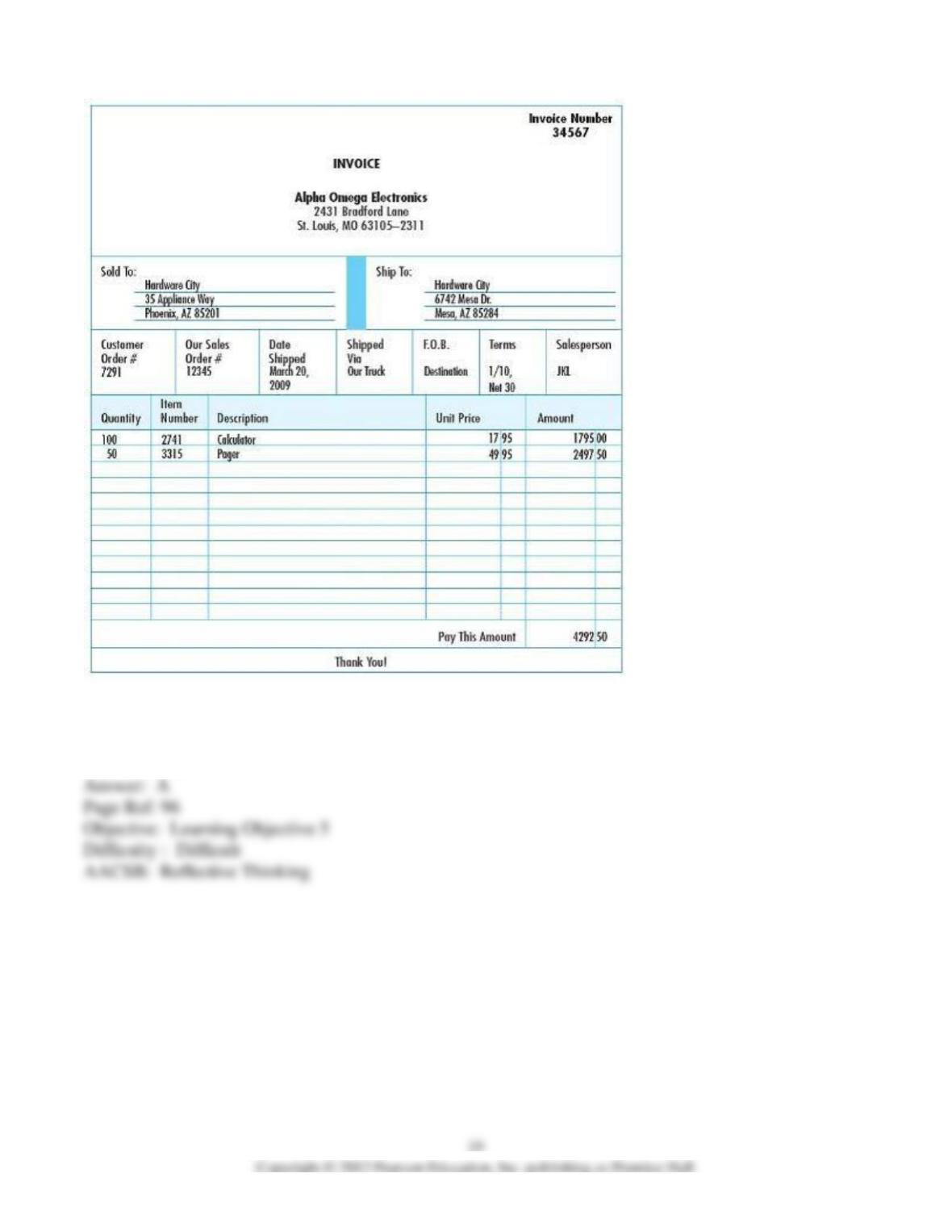
61) Which of the following would not be one of the well-structured tables in a well-designed relational
database used to generate this sales invoice?
A) Customer Order
B) Customer
C) Sales
D) Sales Order
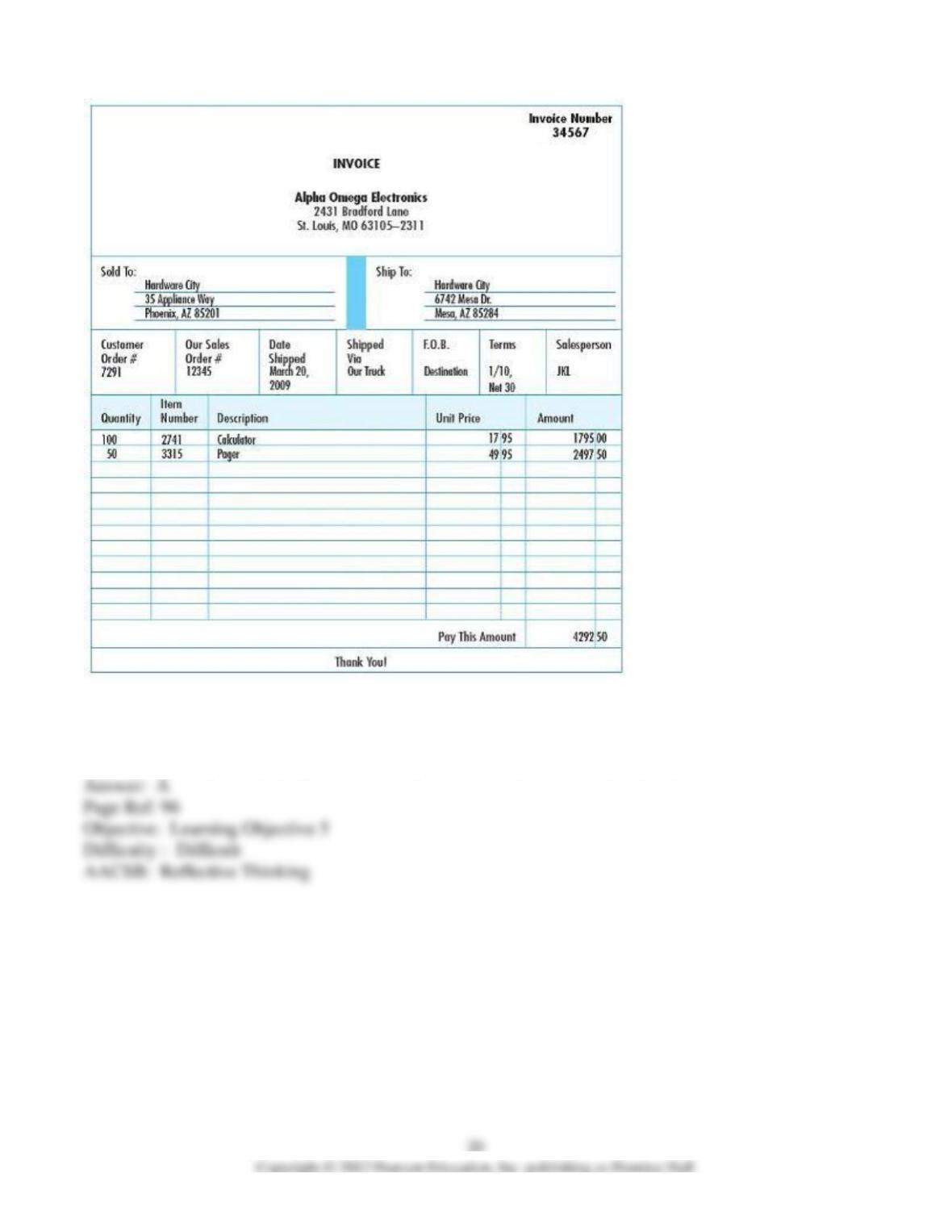
62) Which of the following would not be true about the well-structured tables in a well-designed
relational database used to generate this sales invoice?
A) Quantity would be generated from the Sales table.
B) 34567 would be a primary key in the Sales table.
C) Unit Price would be generated from the Inventory table.
D) Hardware City is an example of a non-key data value in the Customer table.
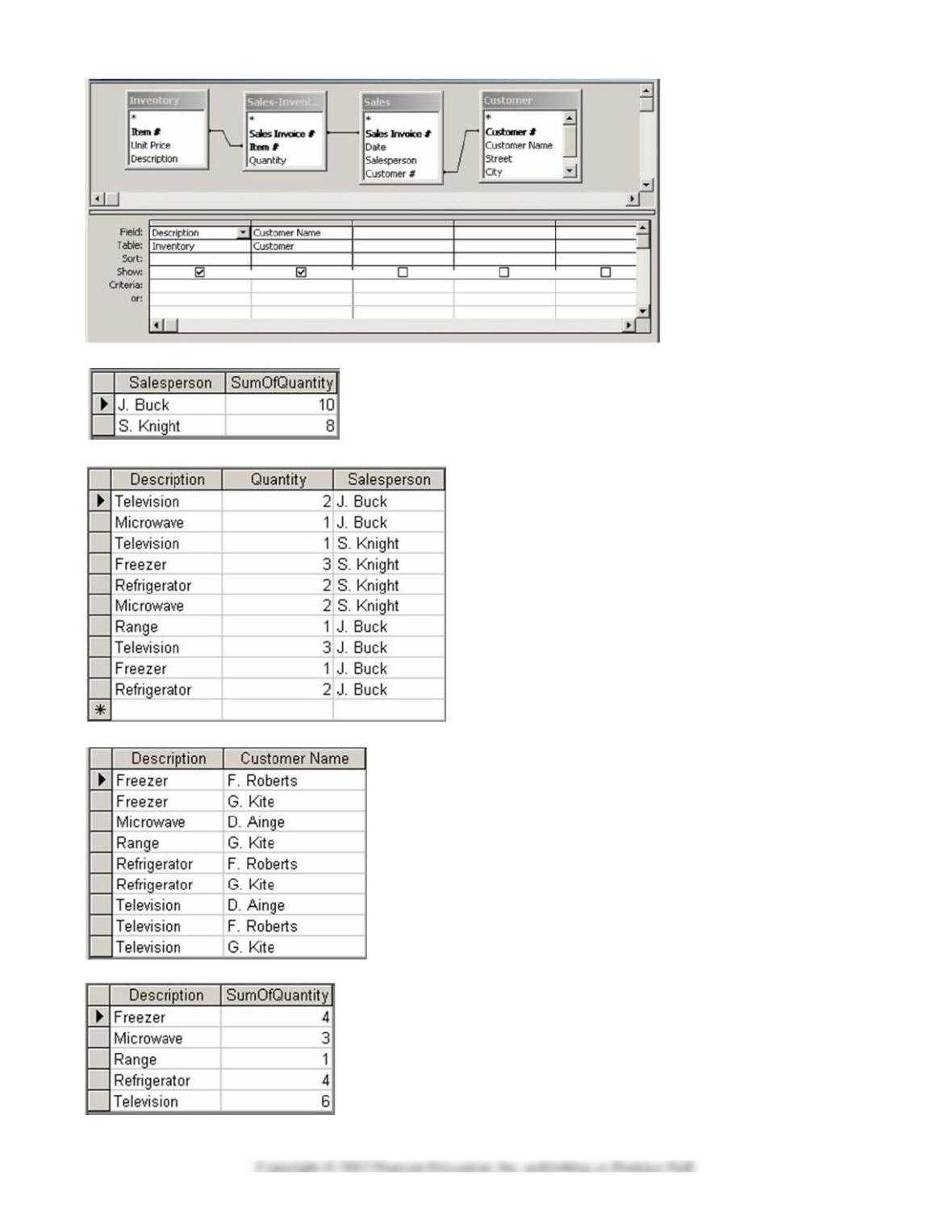
21
63) Which one of the following results corresponds to the query below?
A)
B)
C)
D)
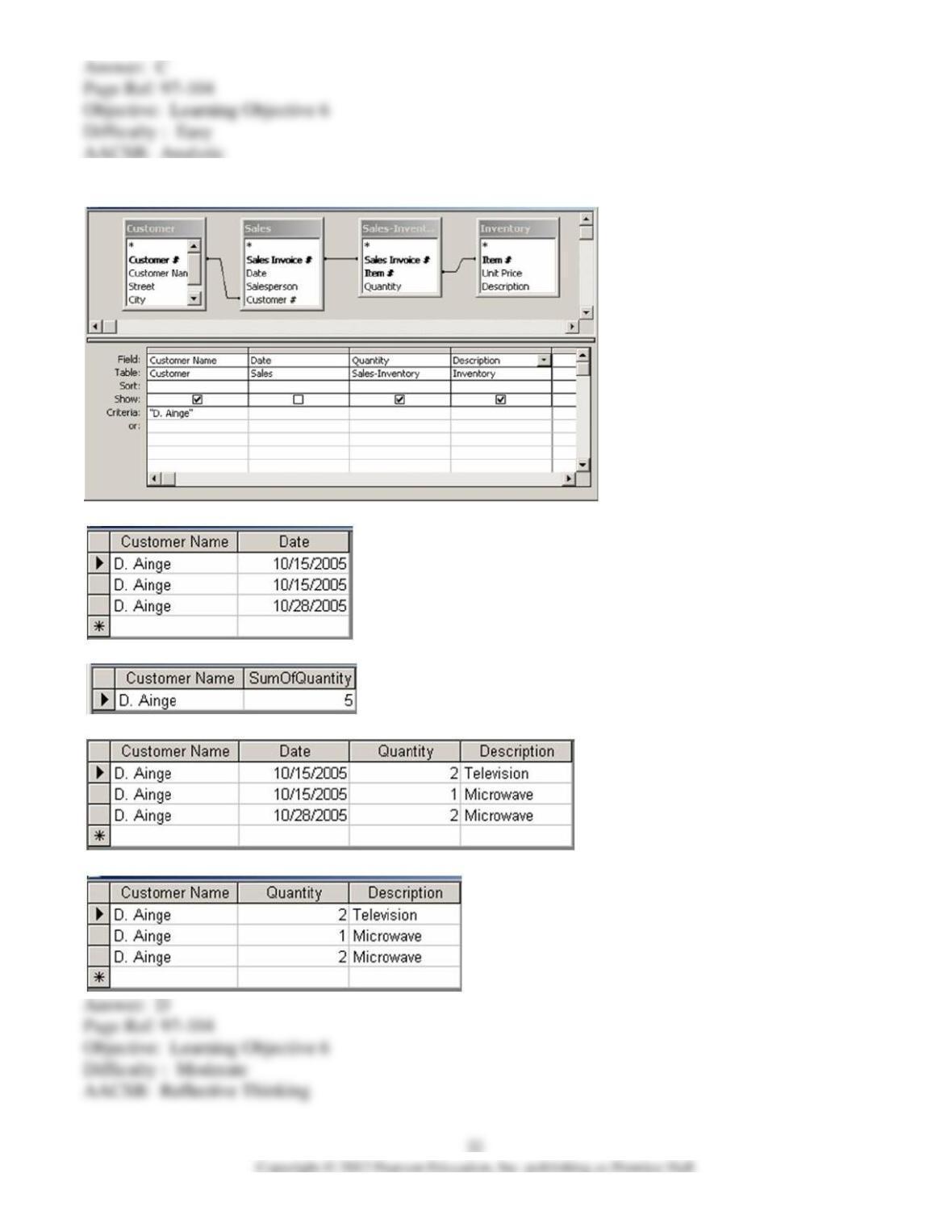
64) Which one of the following results corresponds to the query below?
A)
B)
C)
D)
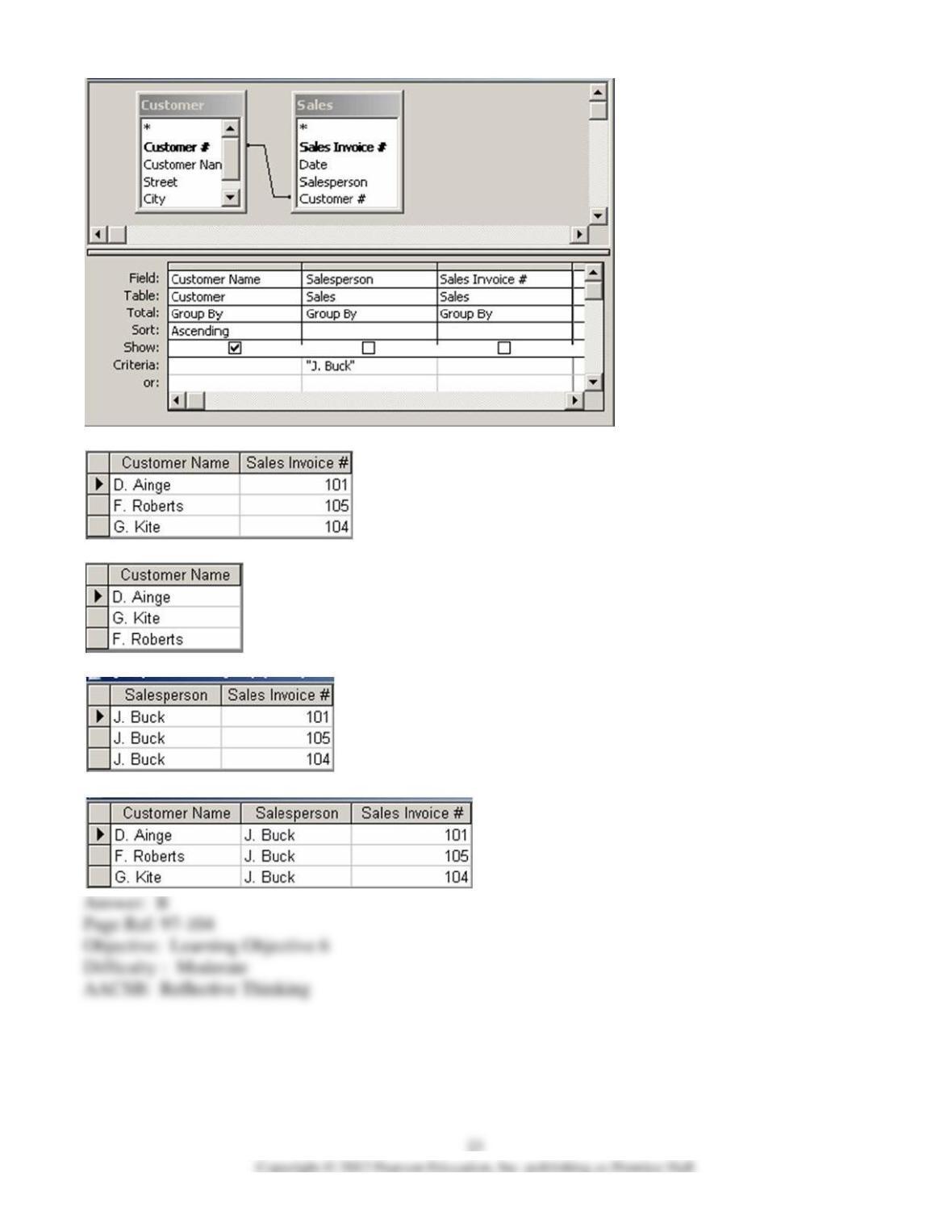
65) Which one of the following results corresponds to the query below?
A)
B)
C)
D)
24
66) Describe a major advantage of database systems over file-oriented transaction processing systems.
67) What is the difference in logical view and physical view?
68) Describe the different schemas involved in a database structure. What is the role of accountants in
development of schemas?
69) Describe a data dictionary.
70) Explain the types of attributes that tables possess in a relational database.
71) Explain the two advantages semantic data modeling has over normalization when designing a
relational database.
72) Explain the difference between file-oriented transaction processing systems and relational database
systems. Discuss the advantages and disadvantages of each system.
73) Discuss redundancy as it applies to database design.
74) Discuss the ways in which a well-designed DBMS will facilitate the three basic functions of
creating, changing, and querying data.
75) List the four DBMS “languages” and describe who uses each and for what purpose.
76) Describe the information that is contained in the data dictionary.
77) Explain the relational database data model.
78) What are the basic requirements when logically designing a relational database model?
79) Describe what you think will be the main impact of database technology in your career.
80) Chagall Curtain Company is changing from a file-oriented system to a relational database system.
Design at least three tables that would be needed to capture data for a sales transaction. Each table
should include a primary key, three non-key attributes, and foreign keys as necessary. Make up data
values for two records within each table.