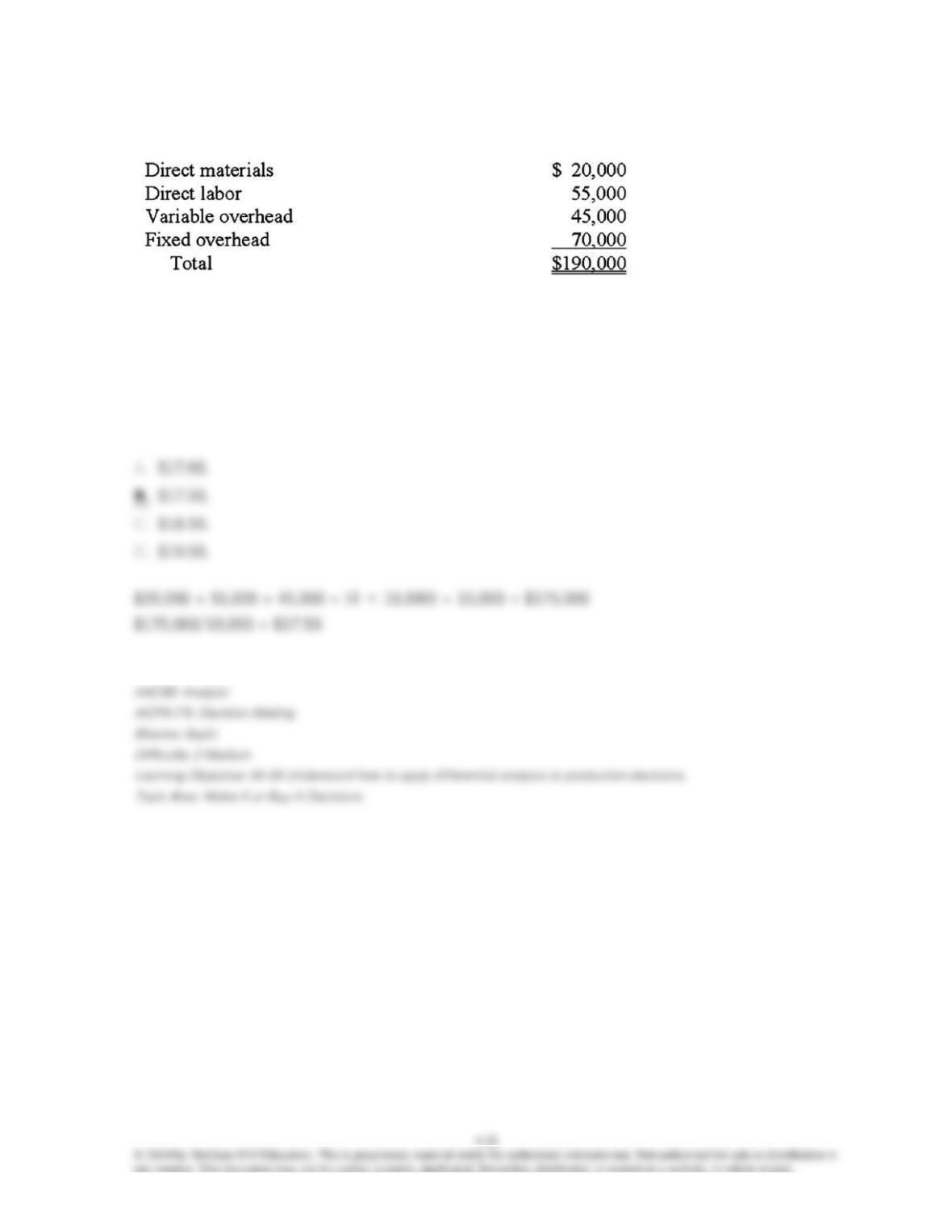
37. The CJP Company produces 10,000 units of item S10 annually at a total cost of $190,000.
The XYZ Company has offered to supply 10,000 units of S10 per year for $18 per unit. If CJP
accepts the offer, $4 per unit of the fixed overhead would be saved. In addition, some of CJP’s
facilities could be rented to a third party for $15,000 per year. At what price would CJP be
indifferent to XYZ’s offer?
38. Differential costs are: (CMA adapted)
39. The period of time over which capacity will be unchanged is:
40. The time from initial research and development to the time that support to the customer
ends is the:
41. The price based on customers’ perceived value for the product and the price that
competitors charge:
42. The practice of setting price below cost with the intent to drive competitors out of
business:
43. The practice of setting prices highest when the quantity demanded for the product
approaches capacity:
44. Agreement among business competitors to set prices at a particular level:
45. Exporting a product to another country at a price below domestic cost:
4-26
46. A target cost is computed as:
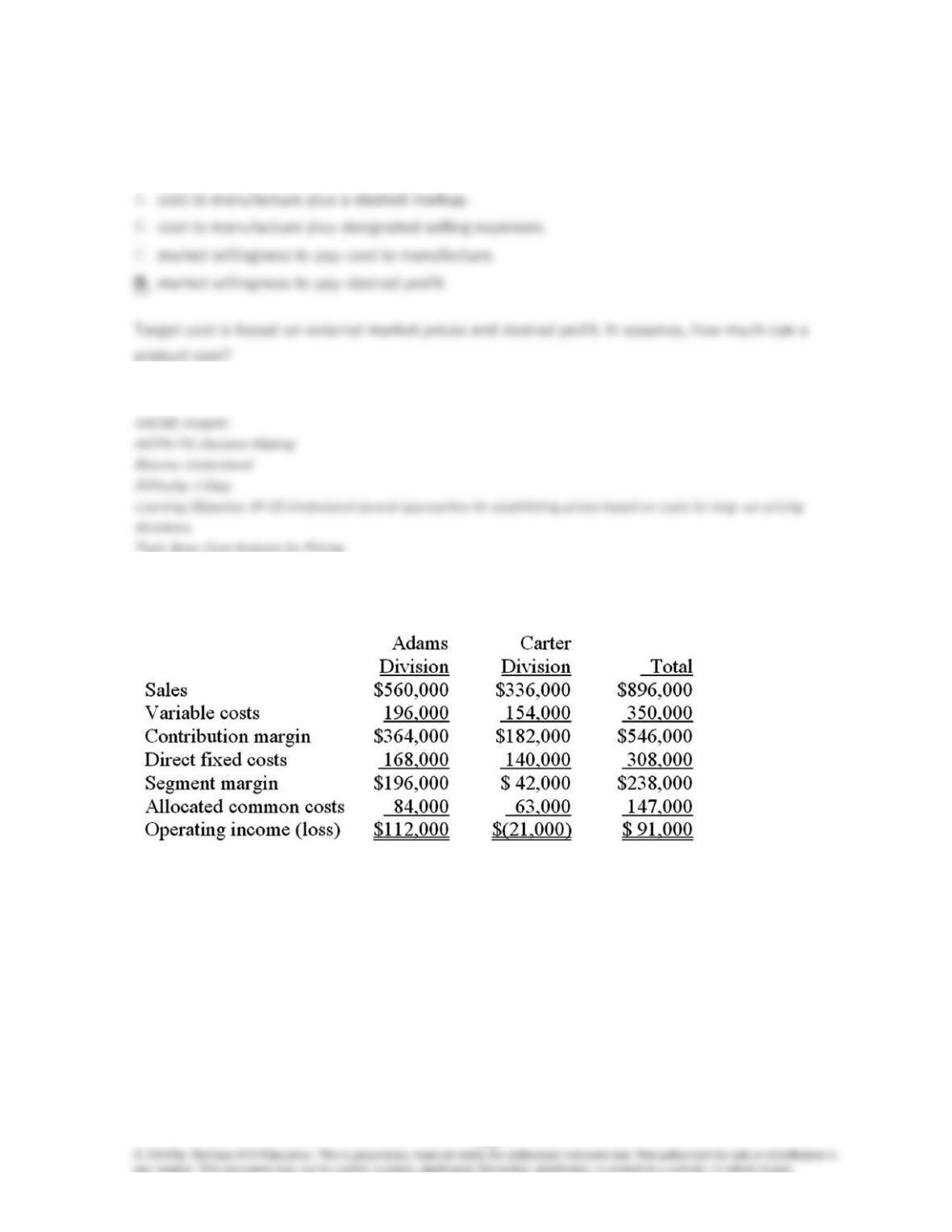
47. The operations of Blink Corporation are divided into the Adams Division and the Carter
Division. Projections for the next year are as follows:
Operating income for Blink Corporation as a whole if the Carter Division were dropped would be:
4-27
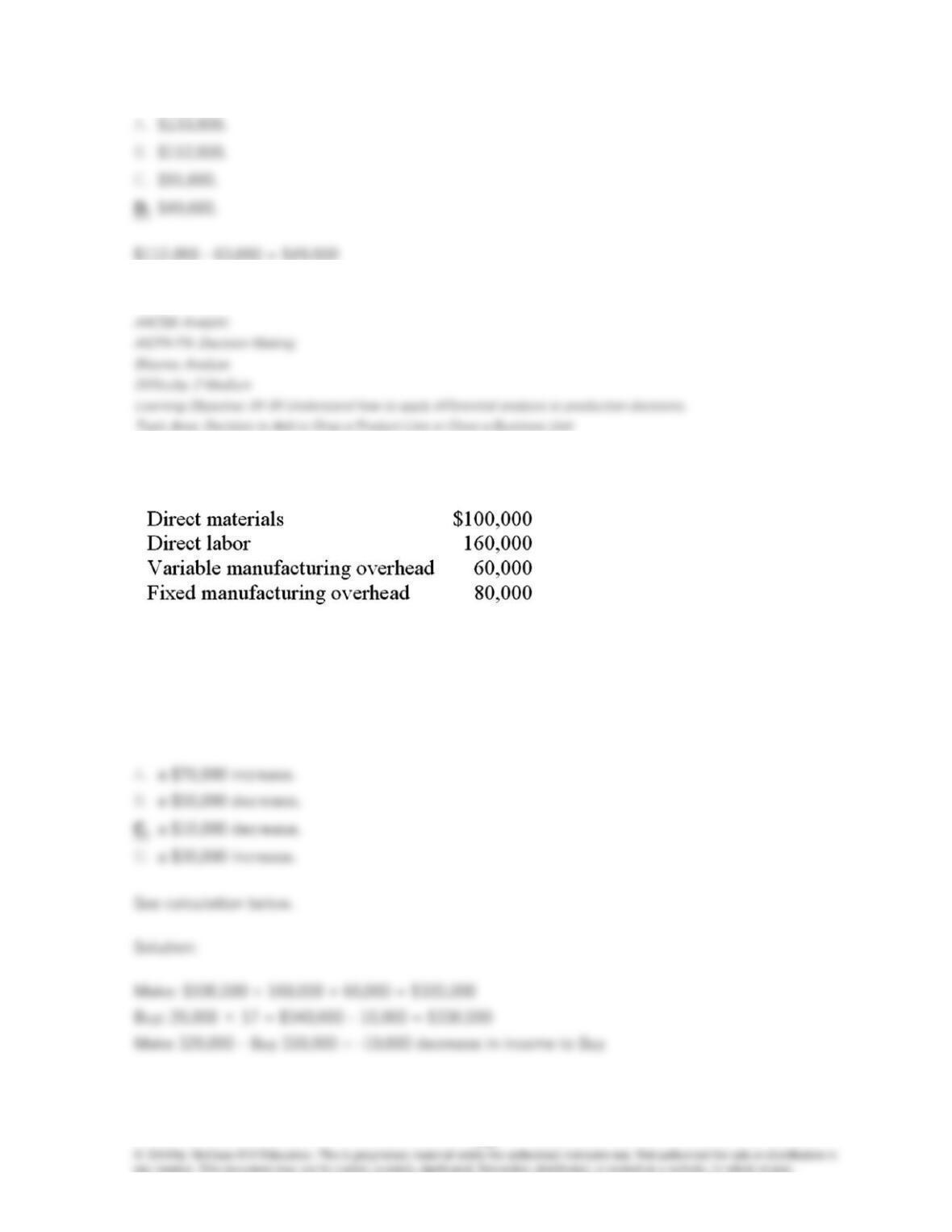
48. Bryon Industries manufactures 20,000 components per year. The manufacturing cost of
the components was determined as follows:
An outside supplier has offered to sell the component for $17. If Bryon purchases the component
from the outside supplier, the manufacturing facilities would be unused and could be rented out
for $10,000. If Bryon purchases the component from the supplier instead of manufacturing it, the
effect on income would be:
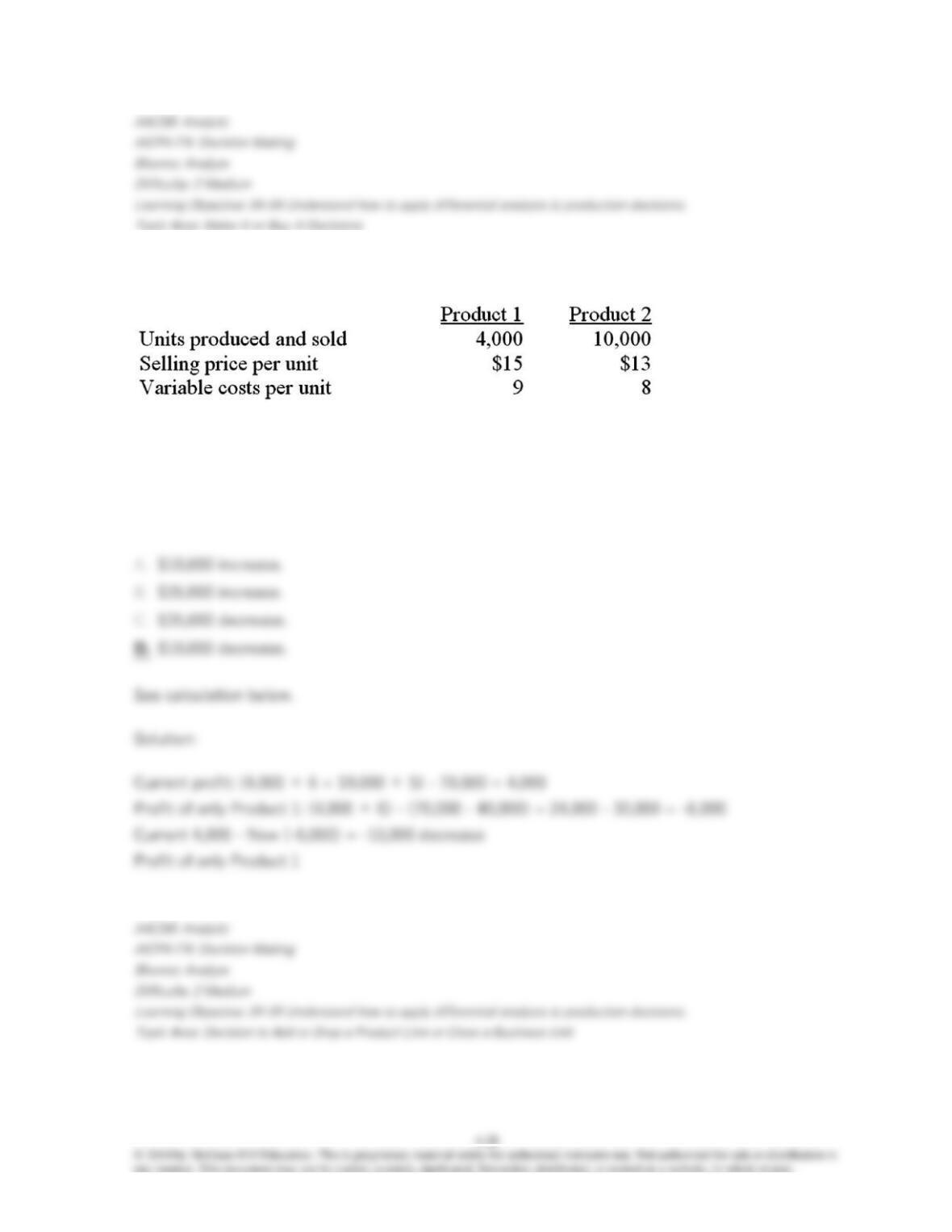
49. Albany Industries produces two products. Information about the products is as follows:
The company’s fixed costs totaled $70,000, of which $15,000 can be directly traced to Product 1
and $40,000 can be directly traced to Product 2. The effect on the firm’s profits if Product 2 is
dropped would be a:
4-29
50. Which of the following costs would continue to be incurred even if a segment is
eliminated?
51. NorWest Shoe Company has two retail stores, one in Albertville and the other in Bloomer.
The Albertville store had sales of $100,000, a contribution margin of 35 percent, and a segment
margin of $14,000. The company’s two stores have total sales of $250,000, contribution margin of
32 percent, and a total segment margin of $31,000. The contribution margin for the Bloomer store
must have been:
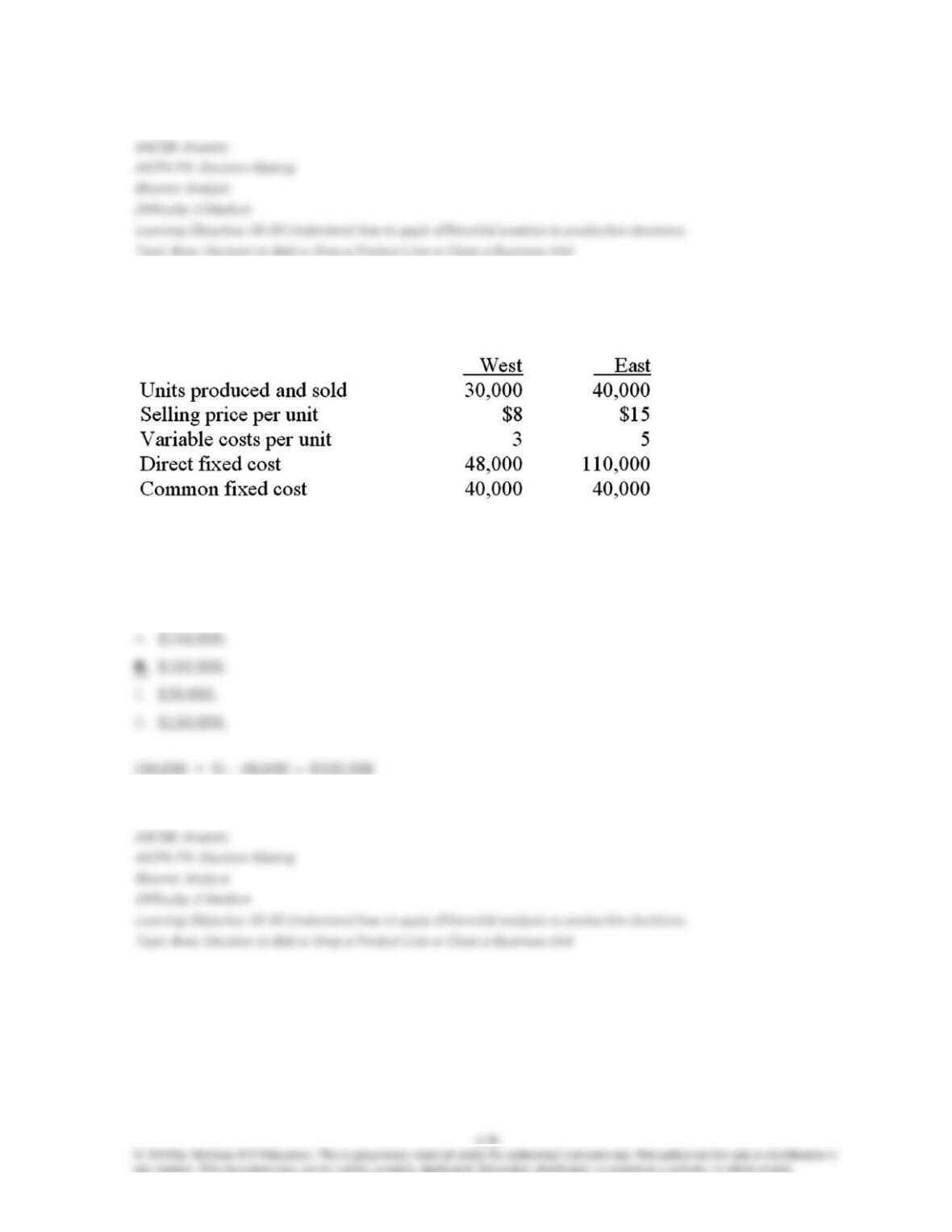
52. Miller Industries has two divisions: the West Division and the East Division. Information
relating to the divisions for the year just ended is as follows:
Common fixed expenses have been allocated equally to each of the two divisions. Miller’s
segment margin for the West Division is:
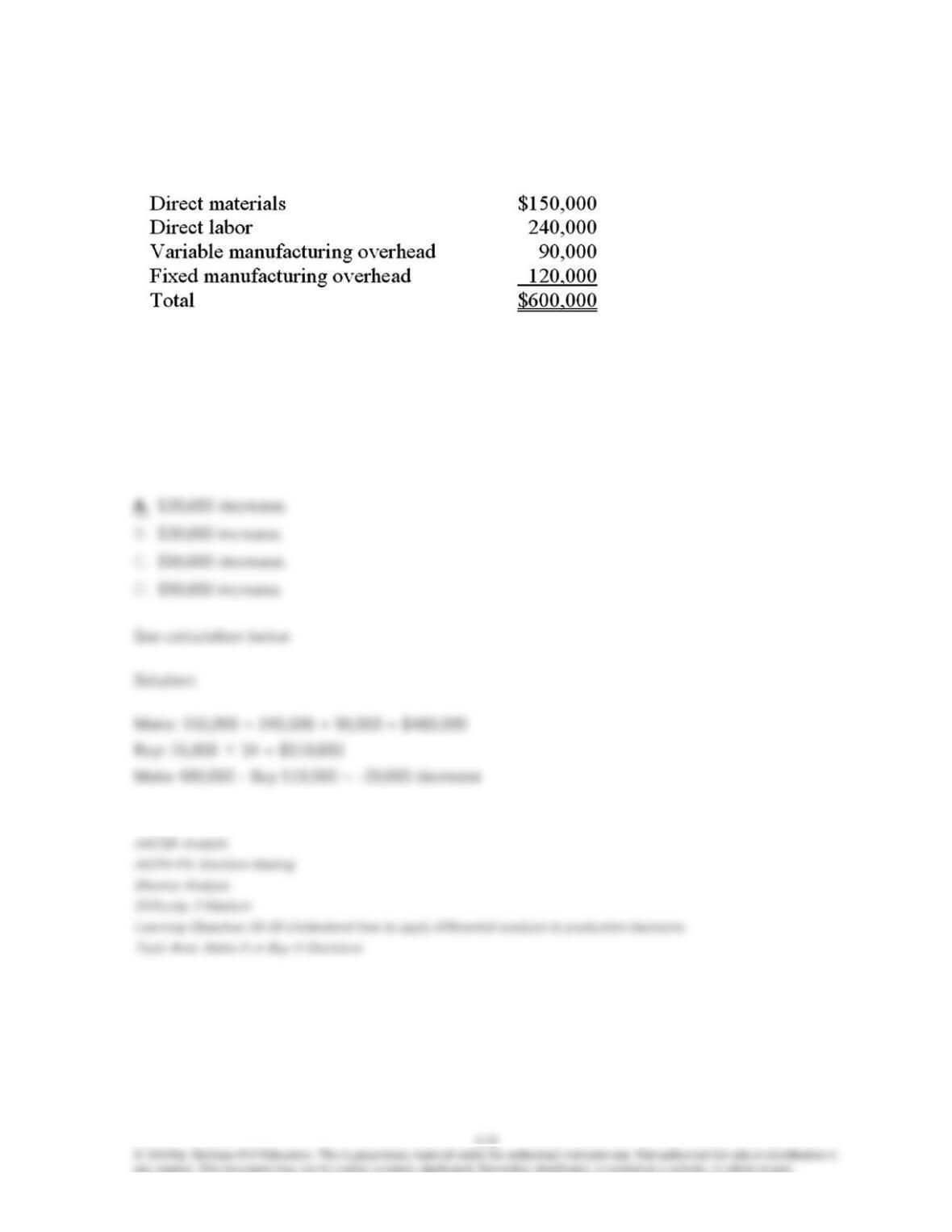
53. Chetek Industries manufactures 15,000 components per year. The manufacturing cost of
the components was determined to be as follows:
Assume that the fixed manufacturing overhead reflects the cost of Chetek’s manufacturing
facility. This facility cannot be used for any other purpose. An outside supplier has offered to sell
the component to Chetek for $34. If Chetek Industries purchases the component from the outside
supplier, the effect on income would be a:
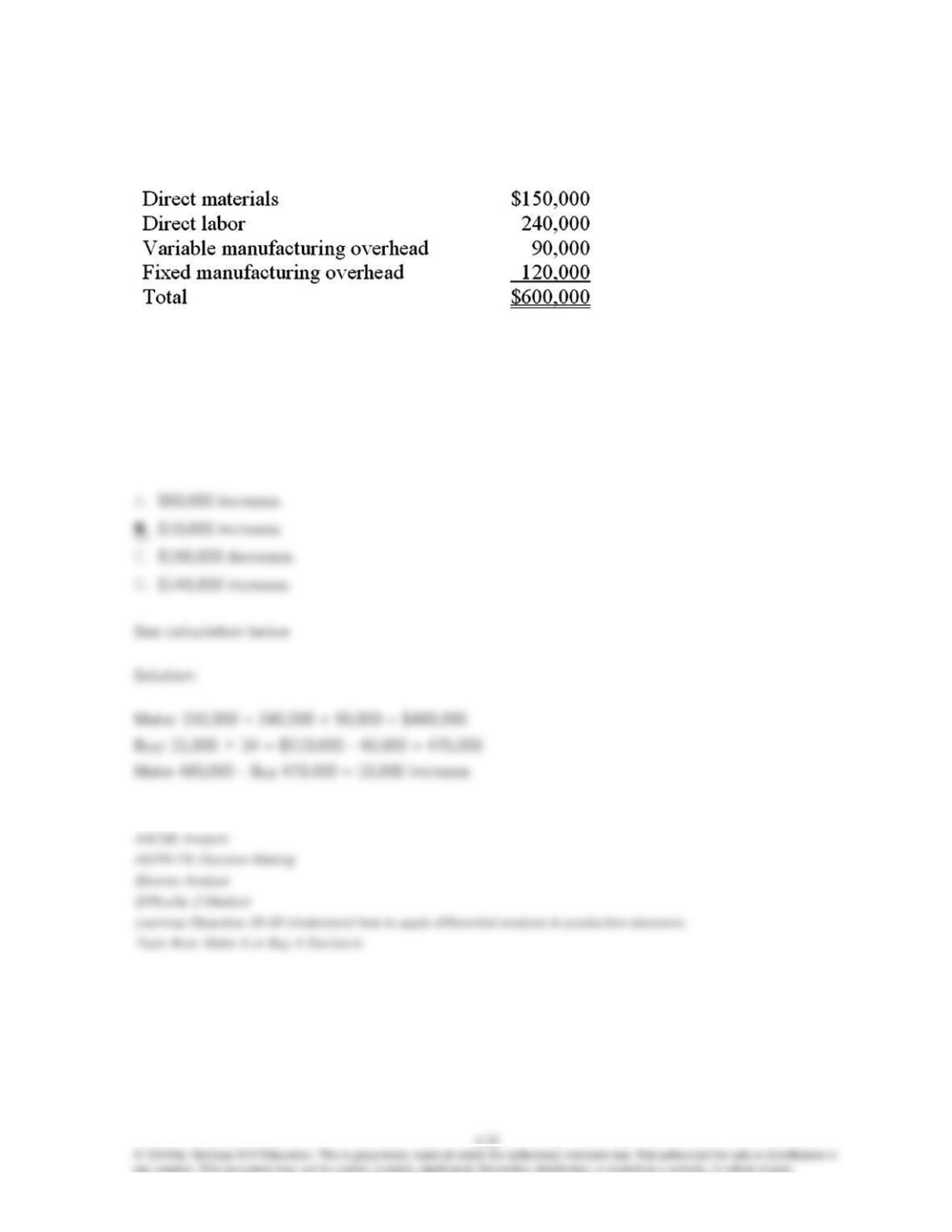
54. Chetek Industries manufactures 15,000 components per year. The manufacturing cost of
the components was determined to be as follows:
Assume Chetek Industries could avoid $40,000 of fixed manufacturing overhead if it purchases the
component from an outside supplier. An outside supplier has offered to sell the component for
$34. If Chetek purchases the component from the supplier instead of manufacturing it, the effect
on income would be a:
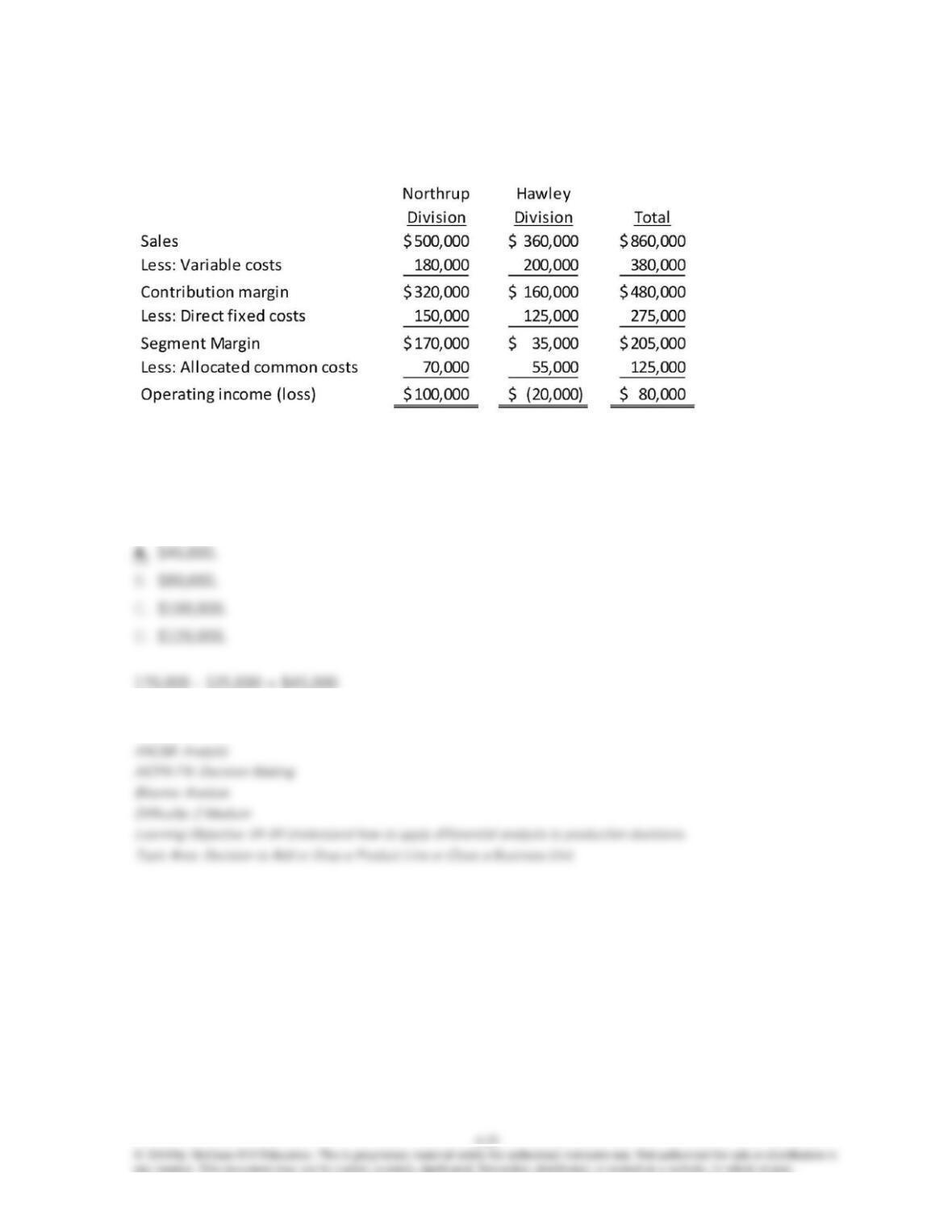
55. The operations of Superior Corporation are divided into the Northrup Division and the
Hawley Division. Projections for the next year are as follows:
Operating income for Superior Corporation, as a whole, if the Hawley Division were dropped would
be
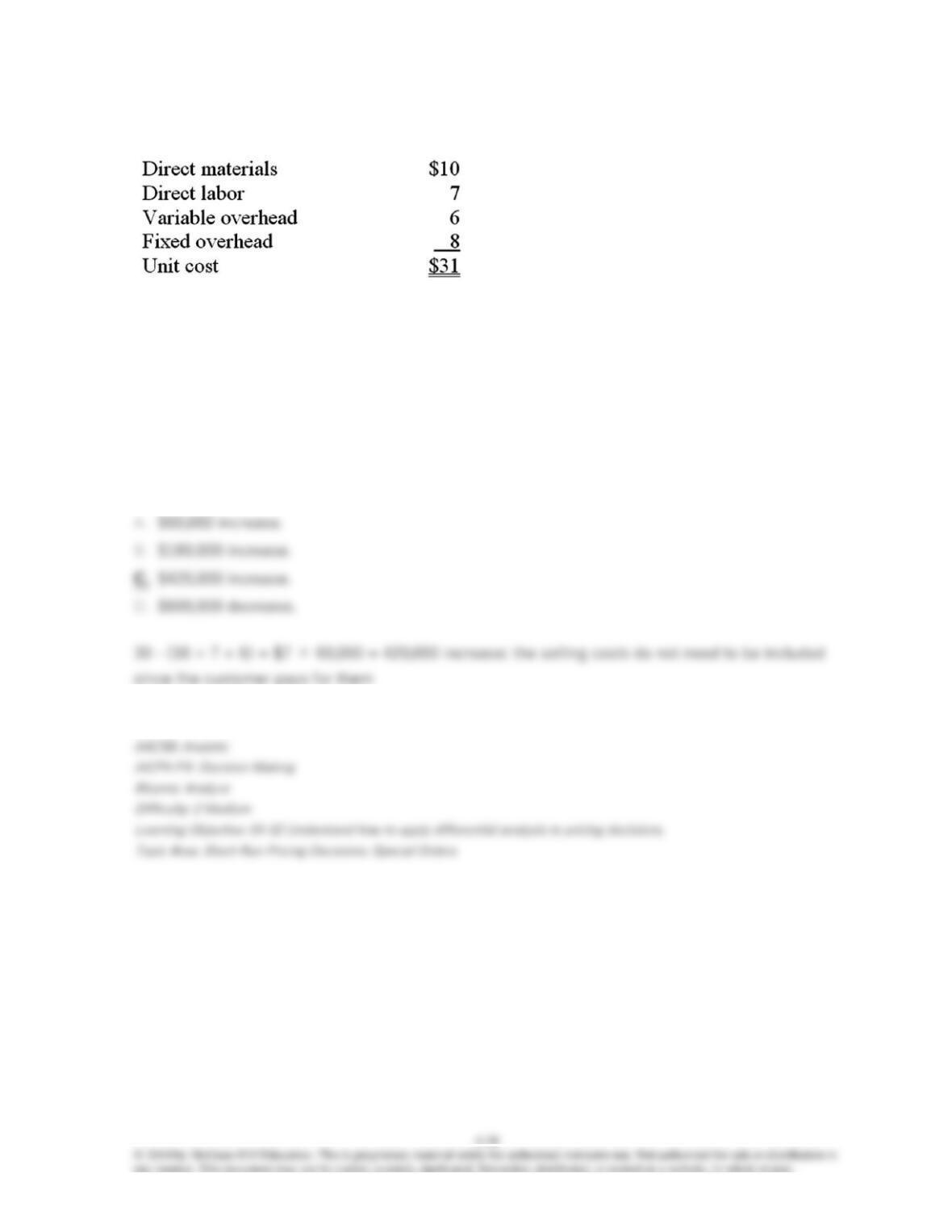
56. The following information relates to a product produced by Ashland Company:
Fixed selling costs are $1,000,000 per year. Variable selling costs of $4 per unit sold are added to
cover the transportation cost. Although production capacity is 500,000 units per year, Ashland
expects to produce only 400,000 units next year. The product normally sells for $40 each. A
customer has offered to buy 60,000 units for $30 each. The customer will pay the transportation
charge on the units purchased. If Ashland accepts the special order, the effect on income would
be a:
4-35
57. If there is excess capacity, the minimum acceptable price for a special order must cover:
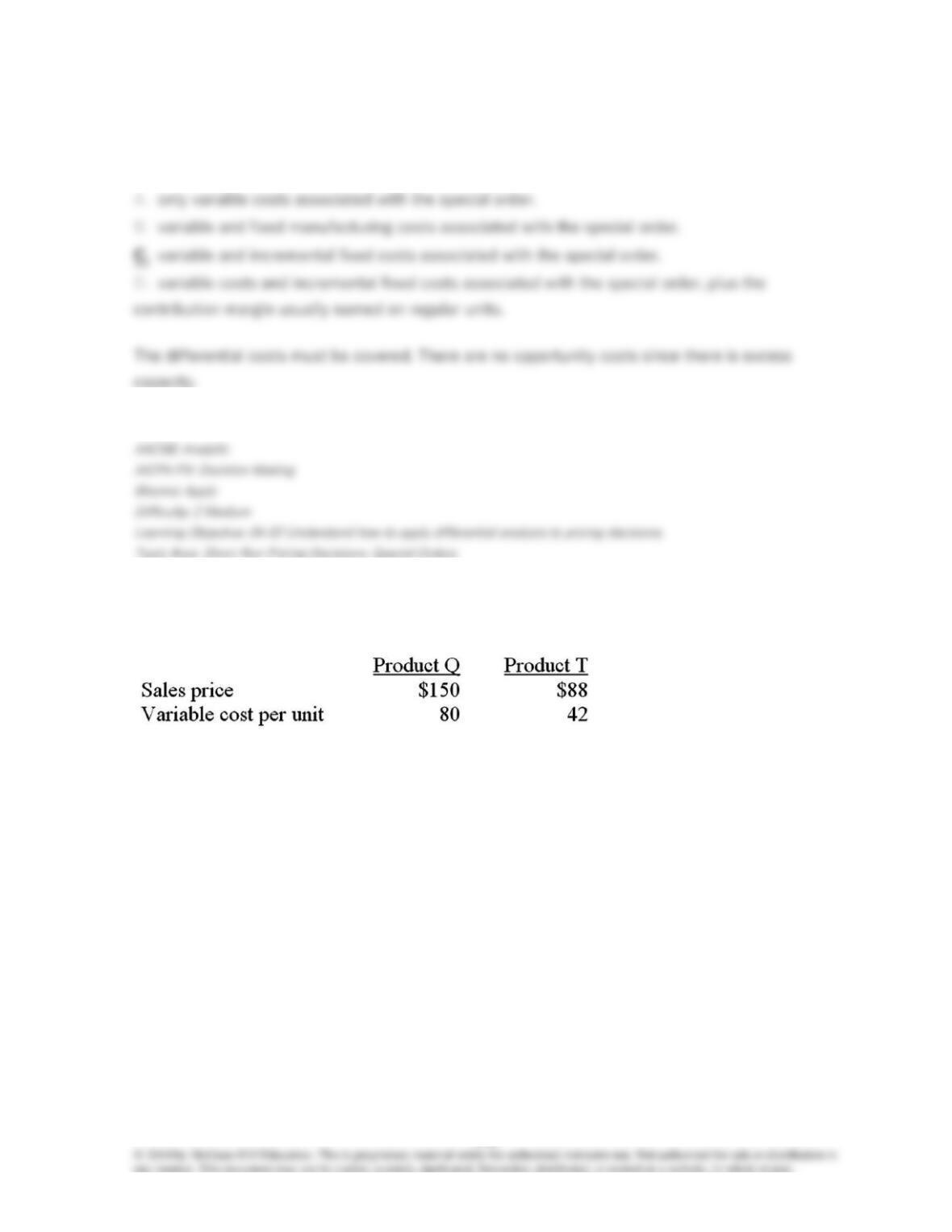
58. The Winwood Company manufactures two products: Q and T. The costs and revenues are
as follows:
Total demand for Product Q is 14,000 units and for Product T is 9,000 units. Machine time is a
scarce resource. During the year, 54,000 machine hours are available. Product Q requires 5
machine hours per unit, while Product T requires 3 machine hours per unit.
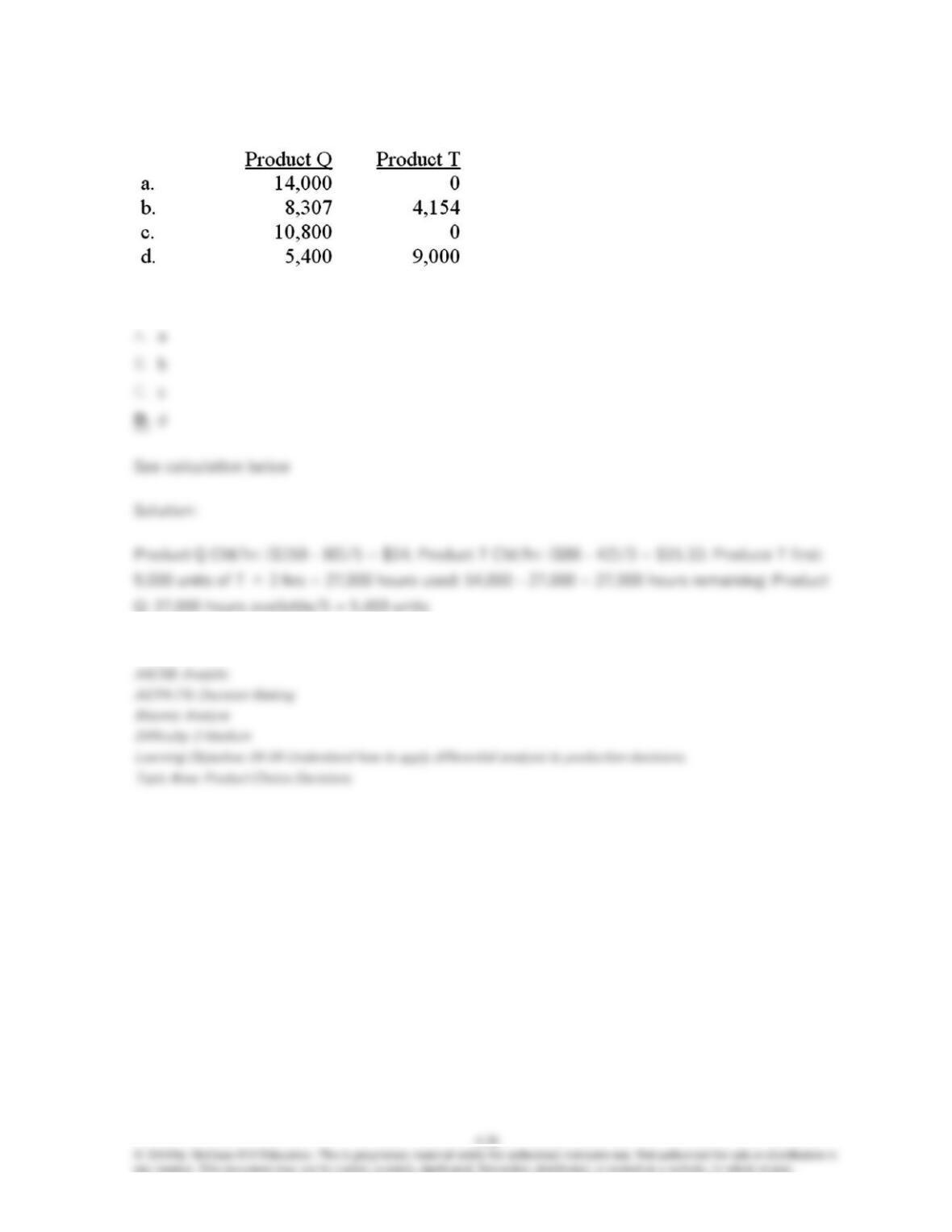
How many units of Products Q and T should Winwood produce?
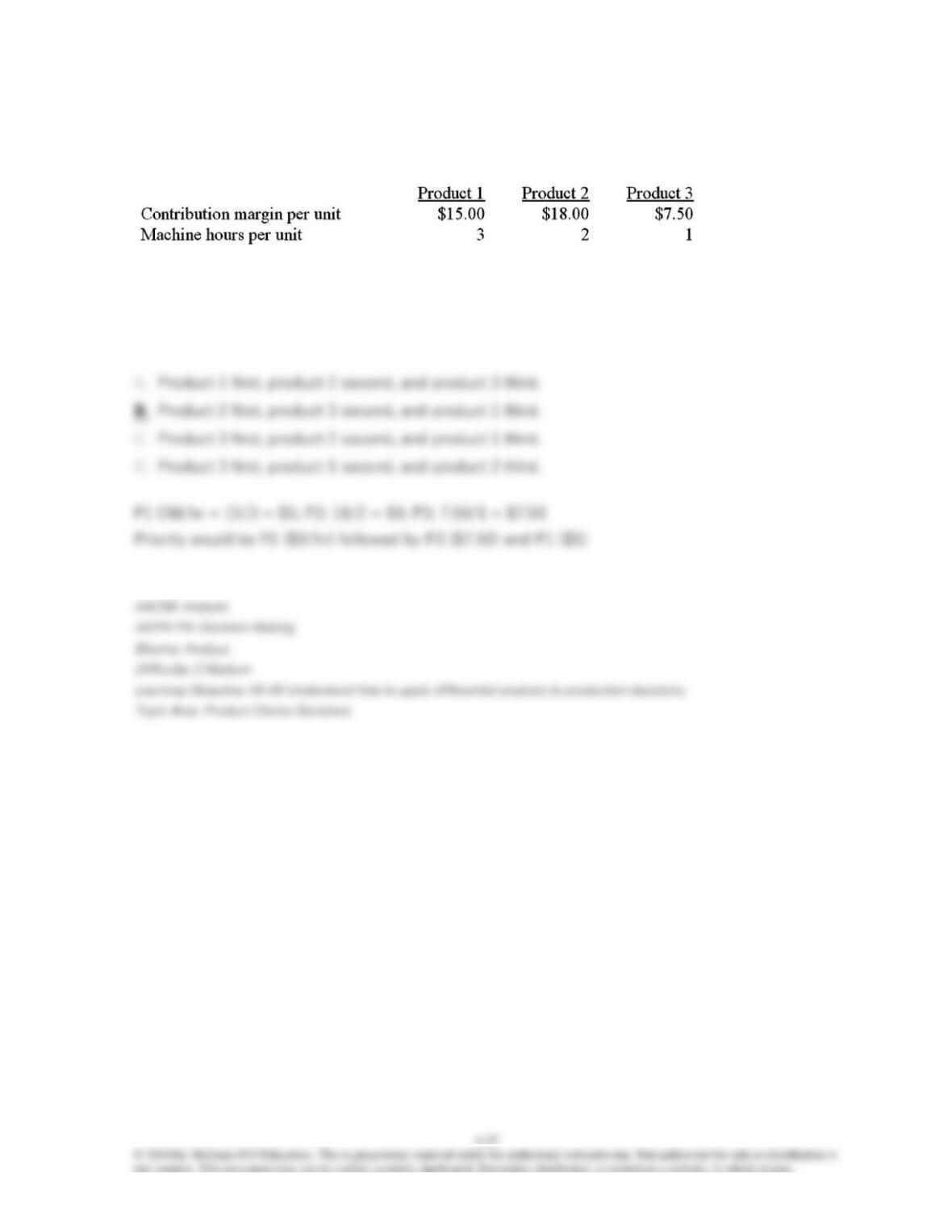
59. Roswell Inc has 5,400 machine hours available each month. The following information on
the company’s three products is available:
If market demand exceeds the available capacity, in what sequence should orders be filled to
maximize the company’s profits?
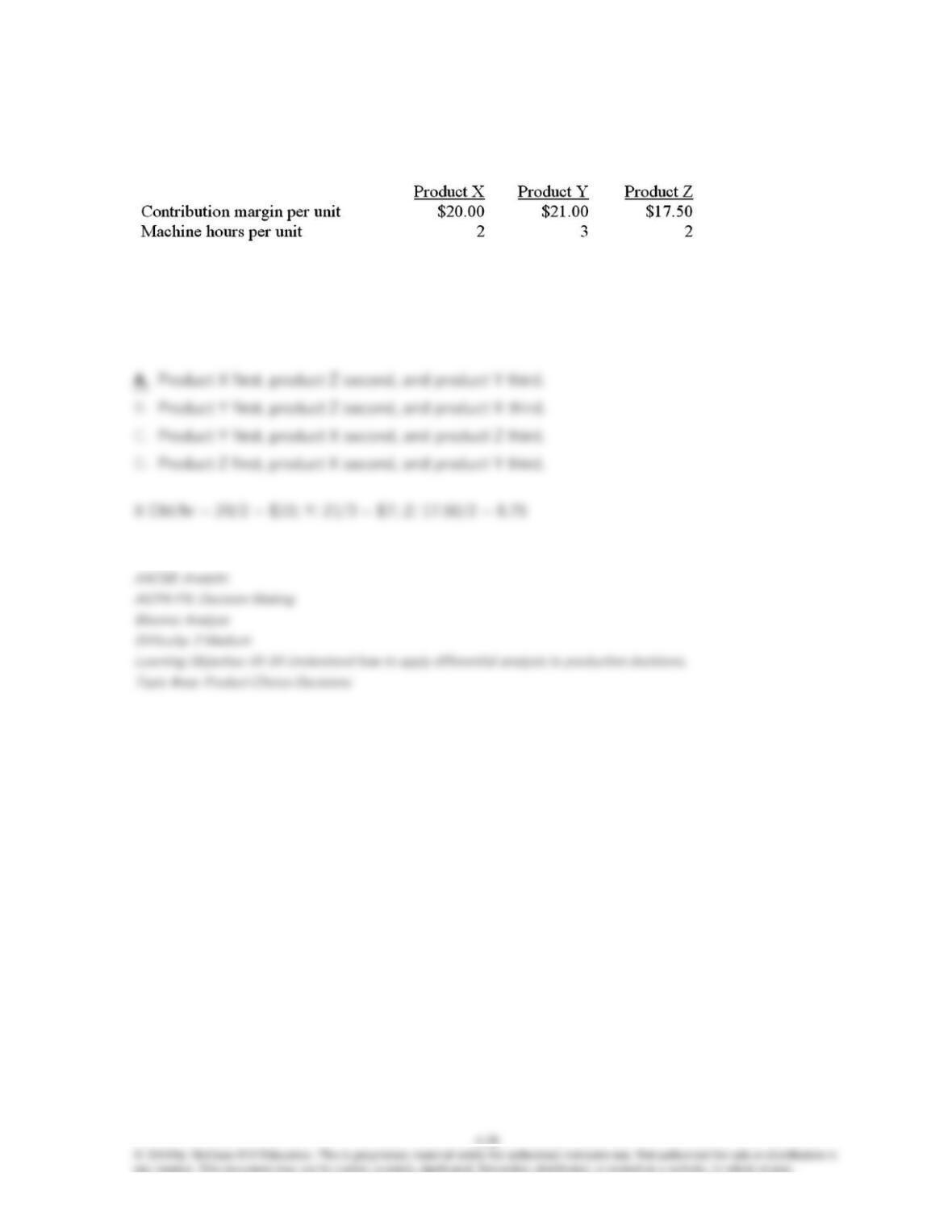
60. Lerner Inc has 6,600 machine hours available each month. The following information on
the company’s three products is available:
If market demand exceeds the available capacity, in what sequence should orders be filled to
maximize the company’s profits?
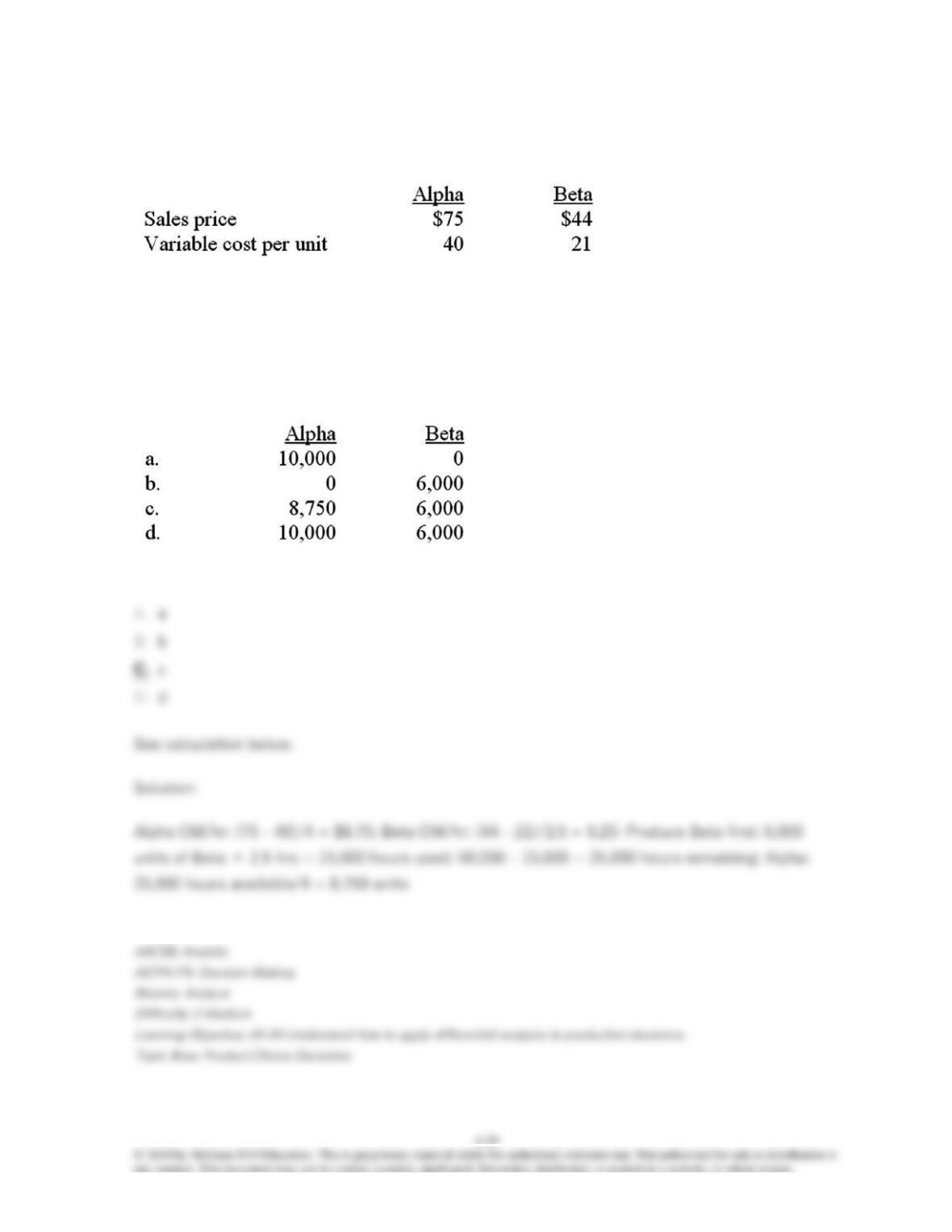
61. The Clapton Company manufactures two products: Alpha and Beta. The costs and
revenues are as follows:
Total demand for Alpha is 10,000 units and for Beta is 6,000 units. Machine hours is a scarce
resource. During the year, 50,000 machine hours are available. Alpha requires 4 machine hours
per unit, while Beta requires 2.5 machine hours per unit.
How many units of Alpha and Beta should Clapton produce?
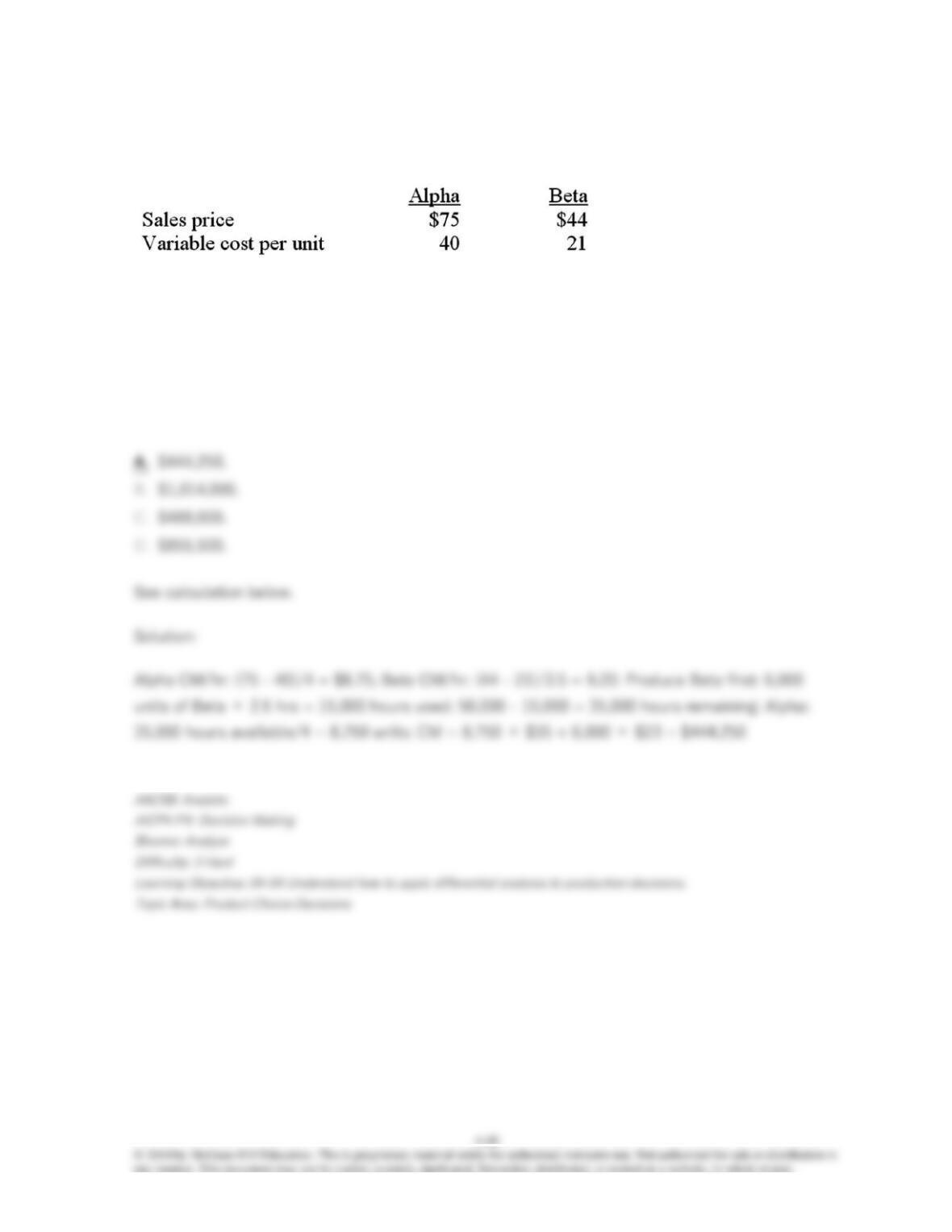
62. The Clapton Company manufactures two products: Alpha and Beta. The costs and
revenues are as follows:
Total demand for Alpha is 10,000 units and for Beta is 6,000 units. Machine time is a scarce
resource. During the year, 50,000 machine hours are available. Alpha requires 4 machine hours
per unit, while Beta requires 2.5 machine hours per unit.
What is the maximum contribution margin Clapton can achieve during a year?