Accounting Information Systems, 2e (Kay/Ovlia)
Chapter 4 Accounting Systems and Business Processes
Objective 1
1) Since a baseline accounting system is already developed, the time line for developing a system
can be accelerated.
2) Some of the benefits of using an off-the-shelf accounting system are lower cost, tighter
security, and scalability.
3) When adapting an organization’s business practices to meet a baseline system’s process
requires extensive changes, ________ may be needed to reduce stress and employee turnover.
4) An advantage of customizing a baseline accounting system is
A) The lack of standardization
B) Adapting existing business processes to meet the baseline system may require extensive
changes
C) The time line for developing a system can be accelerated, significantly reducing the time
required from start to finish
D) Change management may be needed to reduce stress and employee turnover
5) What are the advantages of configuring or customizing a baseline accounting system?
6) What are the disadvantages of configuring or customizing a baseline accounting system?
1) The vendors module in the baseline accounting system correspond to the sales transaction
cycle.
2) What IT professionals call transaction cycles, accountants refer to as business processes.
3) The customers module in the baseline accounting system corresponds to the sales transaction
cycle.
4) A well-designed chart of accounts does not use a coding system for account numbers.
5) Since most accounting systems use databases to store accounting data, the account balances
are calculated using various database tables.
6) By studying a ________, you will be able to quickly understand the business processes for
most companies.
7) What accountants refer to as transaction cycles IT professions call ________.
8) In a baseline accounting system, the pay bills business process is included in the ________
module.
9) The ________ module in a baseline accounting system consists of other activities and
transactions that do not fall into the other modules.
10) In a baseline accounting system, the business processes that involve cash received and cash
paid are included in the ________ module.
11) An event typically associated with the vendor module of a baseline accounting system is
A) Create invoices
B) Receive payments
C) Make deposits
D) Enter bills
12) An event typically associated with the customer module of a baseline accounting system is
A) Make deposits
B) Create purchase orders
C) Receive inventory
D) Pay bills
13) An event typically NOT associated with the employee module of a baseline accounting
system is
A) Pay bills
B) Pay payroll liabilities
C) Calculate payroll
D) Enter time
14) An event typically associated with the banking module of a baseline accounting system is
A) Make adjusting entries
B) Write checks
C) Make deposits
D) Receive payments
15) An event typically NOT associated with the financial module of a baseline accounting
system is
A) Closing entries
B) Adjusting entries
C) Record deposits
D) Correcting entries
16) What are the transactions typically associated with vendors? Please define each transaction.
17) What are the transactions typically associated with customers? Please define each
transaction.
18) What are the transactions typically associated with employees? Please define each
transaction.
19) What are the transactions typically associated with the banking module of a baseline
accounting system?
20) What are the transactions or events typically associated with the financial module of a
baseline accounting system?
1) When a new accounting system is developed, companies rarely streamline business processes
to improve effectiveness.
2) A ________ diagrams step-by-step the activities performed in a process.
3) ________ do not always provide the level of detail that IT professionals need to develop
accounting systems.
4) ________ provides a mapping standard for bridging the gap between IT professionals and
business users, such as accountants.
5) Which of the following business mapping standards graphically describes processes and data
flows using hundreds of symbols?
A) Flowcharts
B) Unified Modeling Language
C) Business Process Model and Notation 2.0
D) Data flow diagrams
6) Which of the following business mapping standards graphically describes processes and data
flows using only four symbols?
A) Flowcharts
B) Unified Modeling Language
C) Business Process Model and Notation 2.0
D) Data flow diagrams
7) Describe the four business mapping standards discussed in the text. What are their advantages
and disadvantages?
1) Software engineers may use flowcharts during audits to map systems they are auditing.
2) Flowcharts are well suited for programming development because of the ability to chart a
series of steps and decisions involved in a process that can be converted to programming code.
3) A flowchart can show up to five levels of detail.
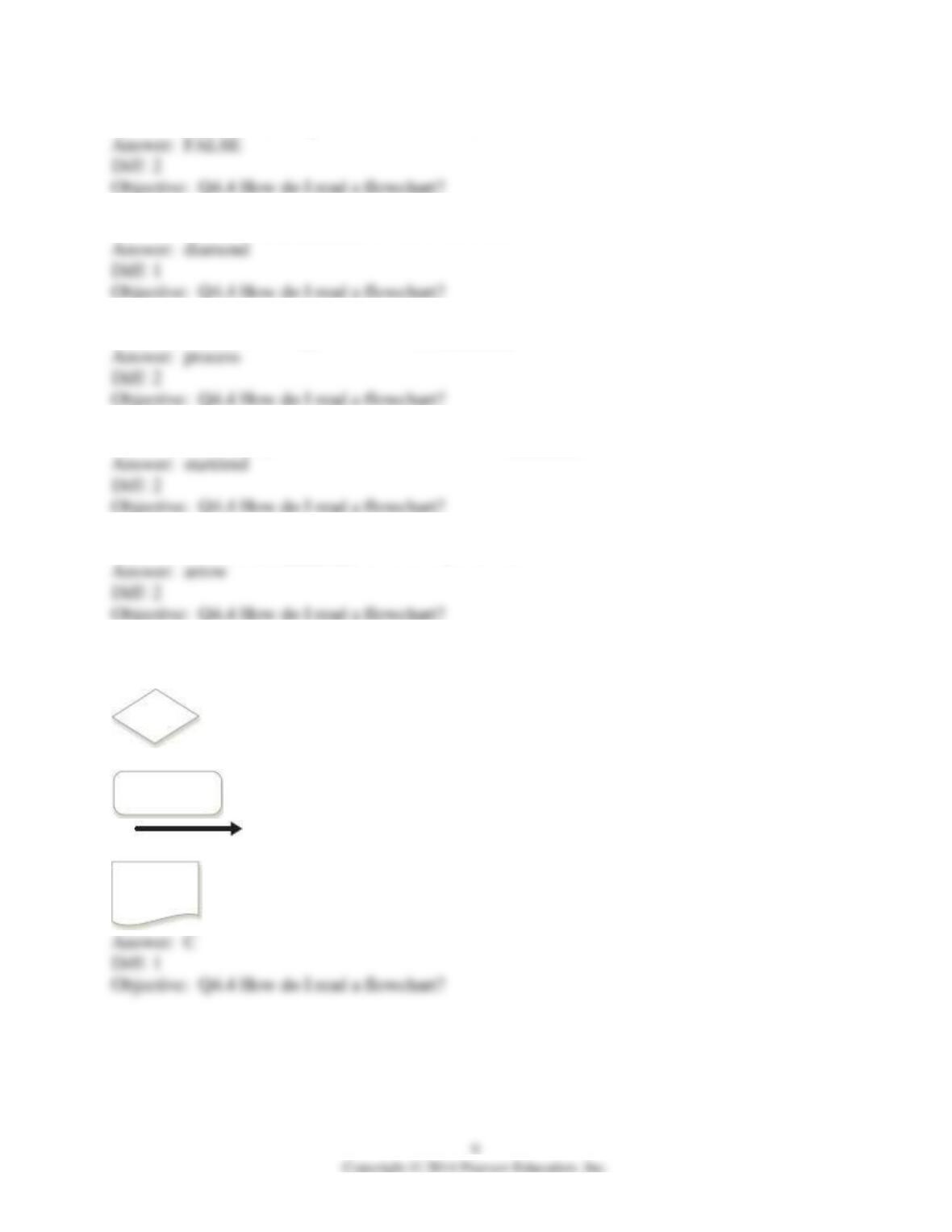
4) In a flowcharts, a(n) ________ indicates a decision.
5) In a flowchart, a rectangle indicates a(n) ________.
6) A rounded rectangle on a flowchart indicates a(n) ________.
7) In a flowchart, a(n) ________ indicates a process flow.
8) In a flowchart, which symbol represents a process flow?
A)
B)
C)
D)
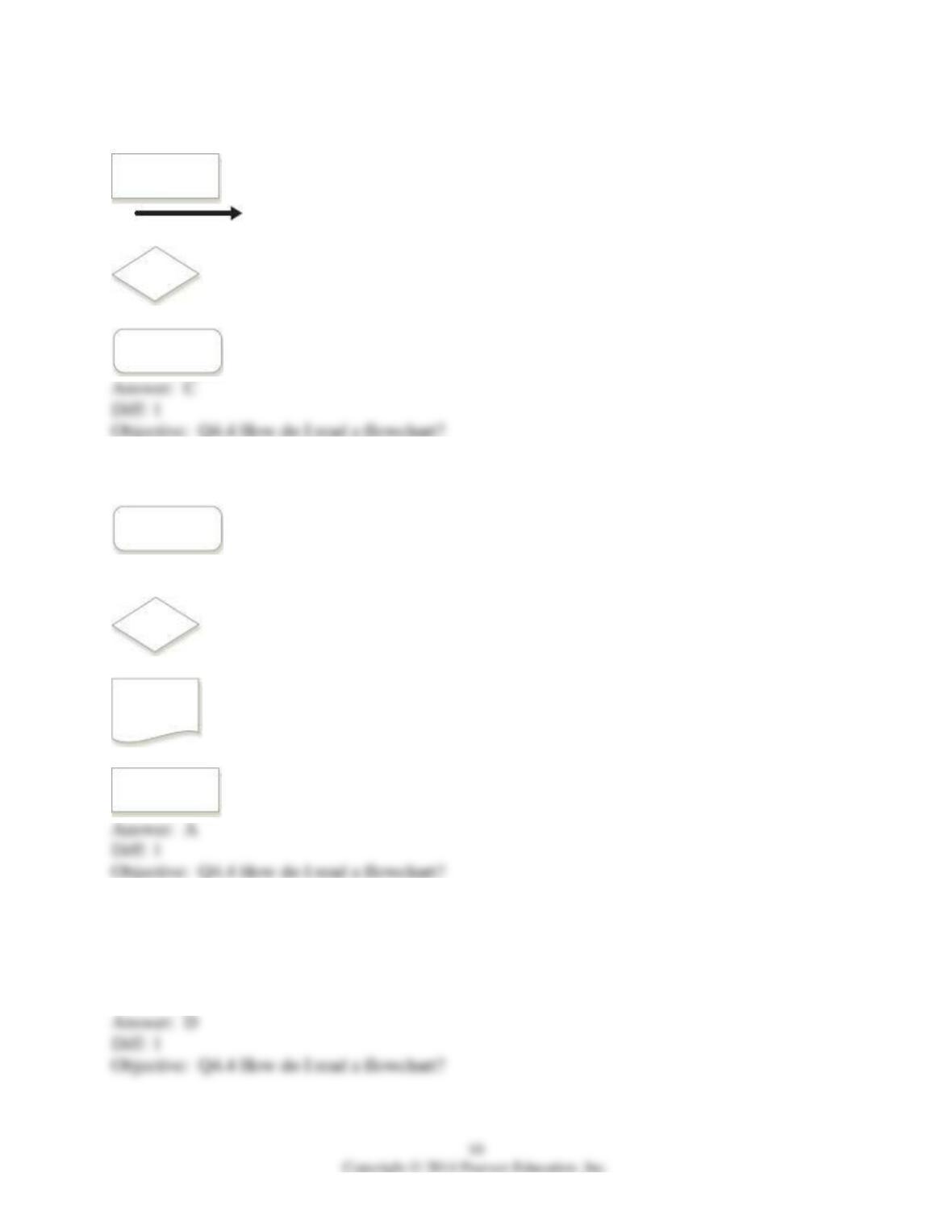
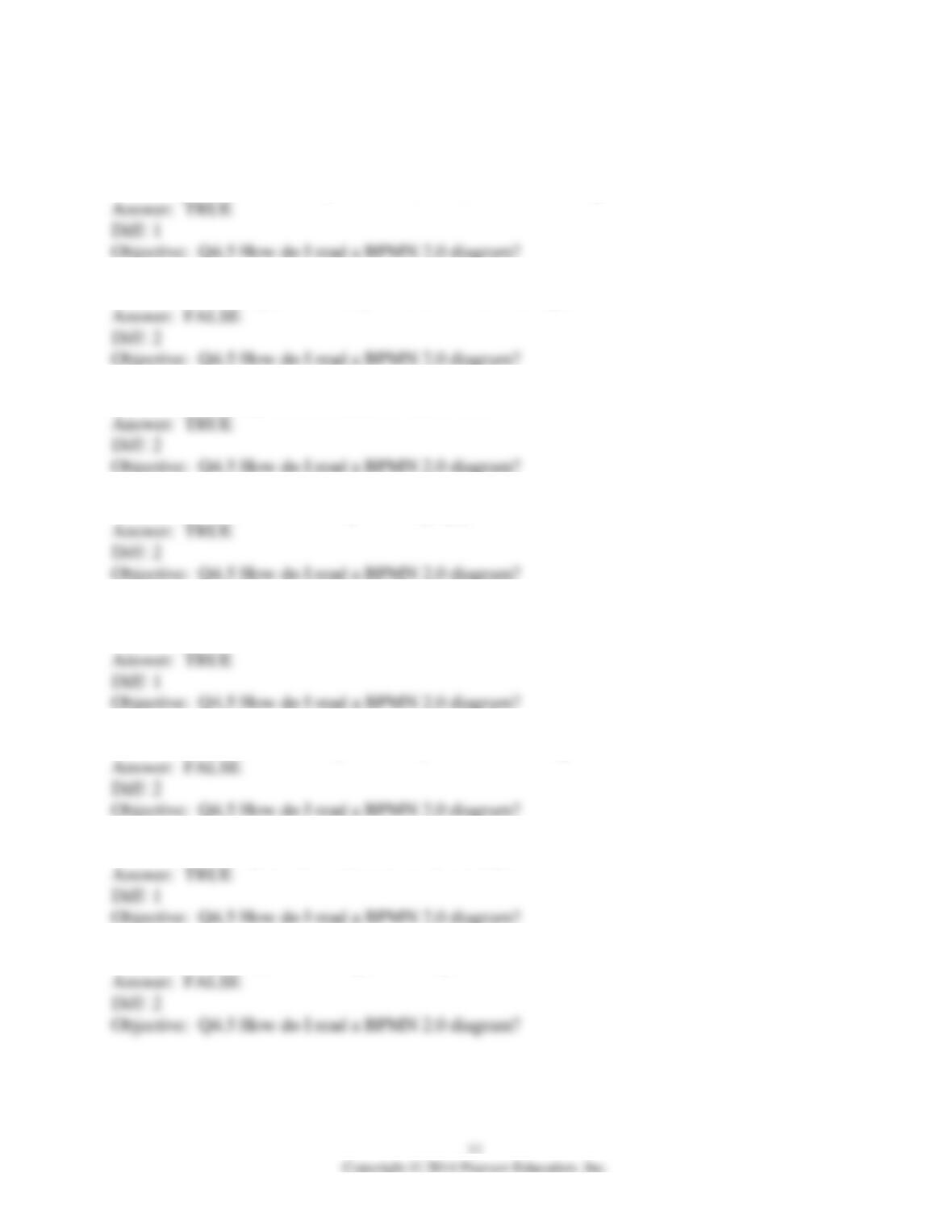
9) In a flowchart, which symbol represents a decision?
A)
B)
C)
D)
10) In a flowchart, which symbol represents a start/end?
A)
B)
C)
D)
11) How many levels of detail may be shown in a flowchart?
A) 1 level
B) 2 level
C) 3 levels
D) 4 levels
Objective 5
1) BPMN 2.0 was developed as an easily understandable, standardized language to communicate
business processes effectively between all business users and IT professionals.
2) BPMN 2.0 uses symbols to map events, activities, and agents.
3) A data object may be a document or data record.
4) Gateways are used for forking and merging process flows.
5) Pools represent major participants in the process and are often used to identify separate
organizations.
6) In BPMN 2.0 an event is represented by a rounded rectangle.
7) In BPMN 2.0 a gateway is represented by a triangle.
8) In BPMN 2.0 a data flow is represented by an arrow with a solid line.
9) Object Management Group, Inc. (OMG) is a not-for-profit industry standards consortium that
maintains specifications including UML and BPMN.
10) A BPMN diagram may be used as ________ to describe the current accounting system.
11) A BPMN diagram may be used as a(n) ________ to describe a new, proposed accounting
system.
12) A BPMN diagram may be used as a ________ for streamlining a current or proposed
accounting system.
13) ________ and ________ are rectangles used to group and organize activities in a BPMN
diagram.
14) The specifications for the BPMN is maintained by
A) AICPA
B) GAAP
C) OMG
D) Wheat Commission
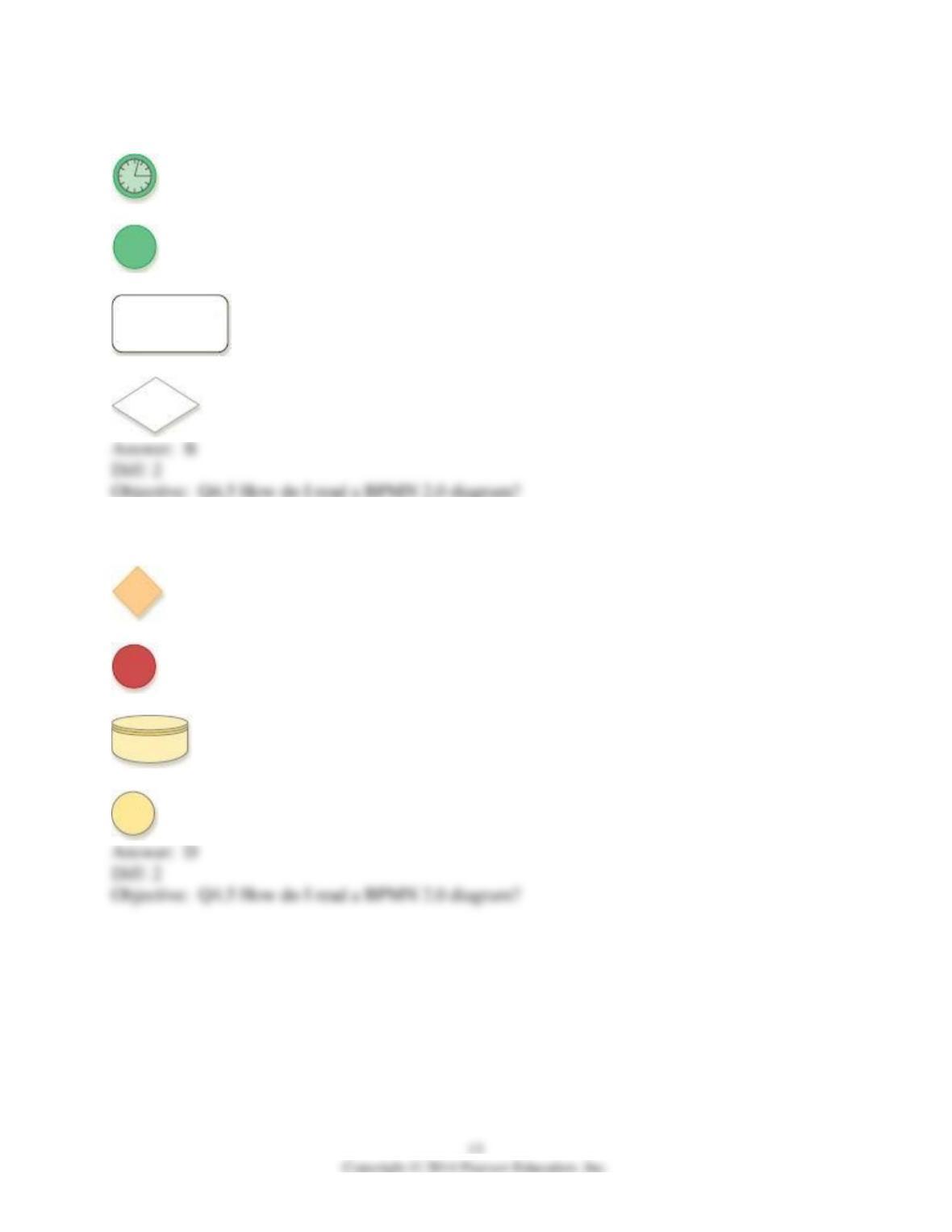
15) In a BPMN diagram, which symbol represents a start event?
A)
B)
C)
D)
16) In a BPMN diagram, which symbol represents an intermediate event?
A)
B)
C)
D)
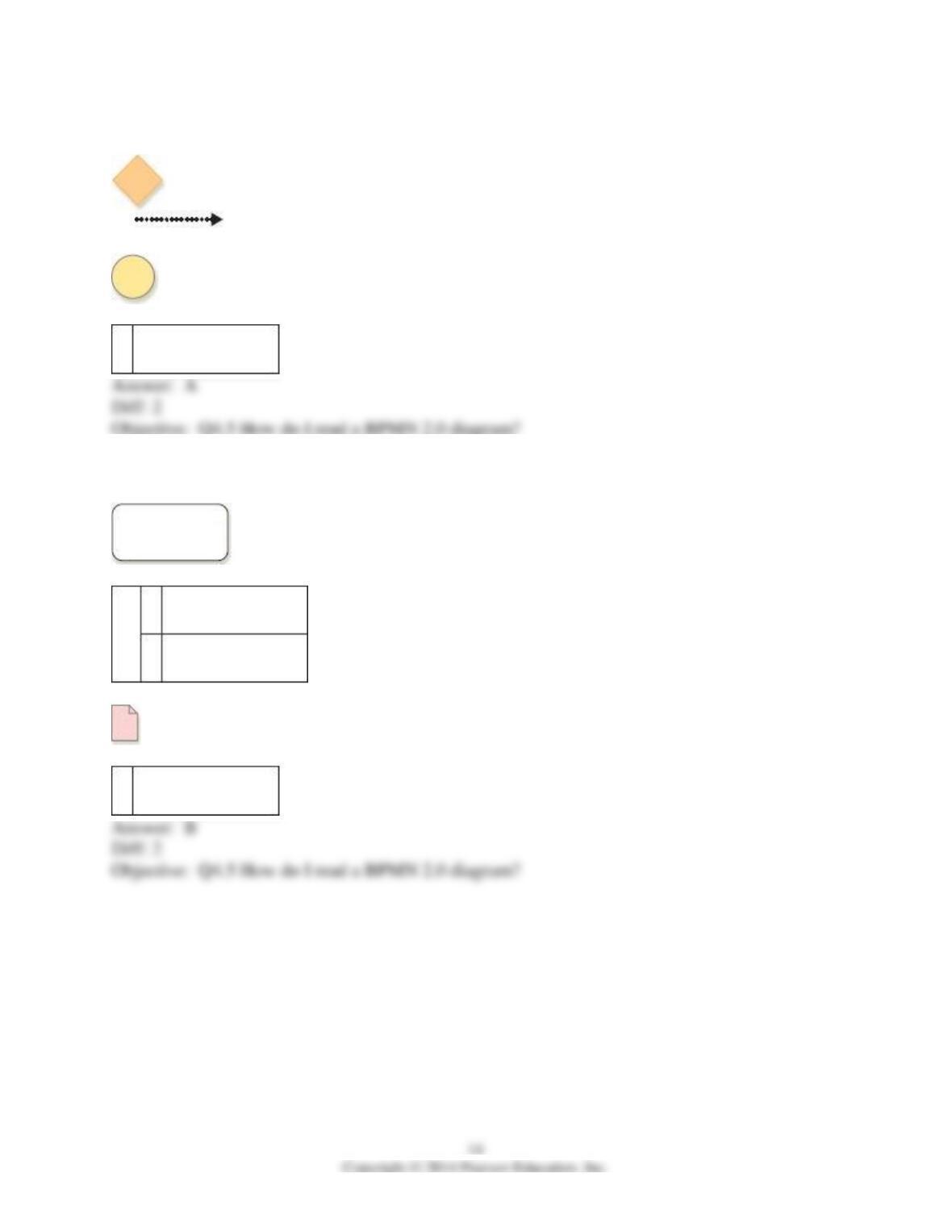
17) In a BPMN diagram, which symbol represents a gateway?
A)
B)
C)
D)
18) In a BPMN diagram, which symbol represents a pool?
A)
B)
C)
D)