4-1
Chapter 4
Process Costing and Hybrid Product-Costing Systems Answer Key
True / False Questions
1. The flow of costs through the manufacturing accounts is essentially the same in both
process costing and job-order costing.
2. Companies that use a process-cost accounting system would establish a separate Work-in–
Process Inventory account for each manufacturing department.
3. Direct labor and manufacturing overhead often are combined into a single cost category
termed conversion costs.
4-2
4. When goods are sold, their costs are transferred to Finished Goods Inventory.
5. California Corporation overstated the percentage of work completed with respect to
conversion cost on the ending work-in-process inventory. This overstatement caused
conversion-cost equivalent units to be overstated.
6. Equivalent units and physical units are the same in manufacturing inventories.
4-3
7. When calculating equivalent units using the weighted average method, the number of
equivalent units of activity is calculated without making a distinction as to whether the
activity occurred in the current accounting period or the preceding period.
8. Equivalent-unit calculations are necessary to allocate manufacturing costs between units
sold and ending work in process.
9. When the cutting process in a manufacturing firm has been finished and the goods are
transferred into the assembly department, the journal entry to record the transfer will debit
Finished Goods Inventory and credit Work in Process – Assembly.
4-4
10. Only normal costing may be used in conjunction with a process-costing system.
11. Under weighted-average process costing, unit-cost figures are weighted averages of costs
incurred over two or more accounting periods.
12. A departmental production report under weighted-average process costing would most
likely present total costs for two different processes.
13. Operation costing tends to parallel job-order costing with respect to the treatment of
conversion cost.
14. A predetermined application rate for conversion costs is based on actual conversion costs
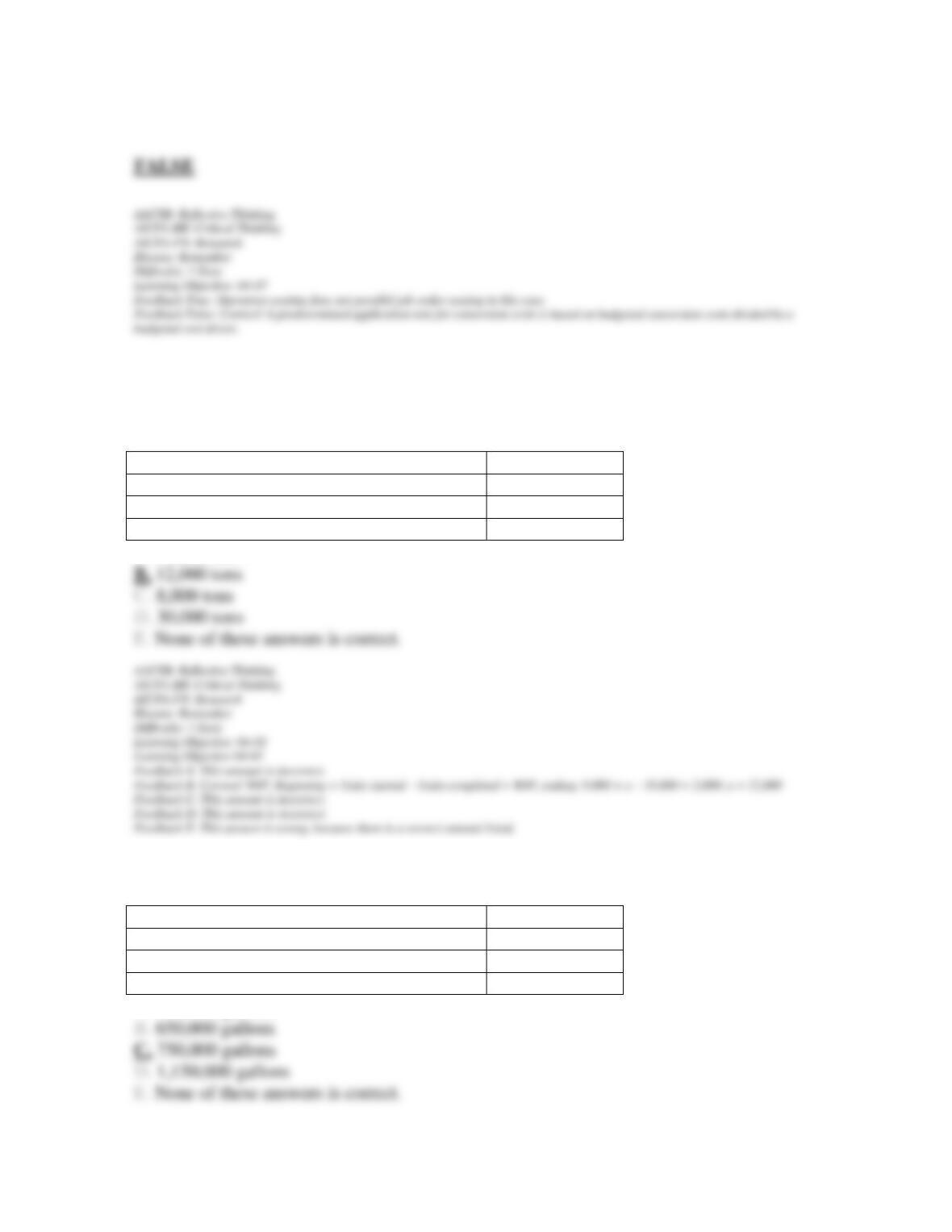
4-5
divided by a budgeted cost driver.
Multiple Choice Questions
15. What is the missing amount in this physical flow of units?
Work in process, August 1
9,000 tons
Units started in August
?
Units completed during August
19,000
Work in process, August 31
2,000 tons
A. 10,000 tons
16. What is the missing amount in this physical flow of units?
Work in process, April 1
100,000 gallons
Units started in April
850,000 gallons
Units completed during April
?
Work in process, April 30
200,000 gallons
A. 950,000 gallons
4-6
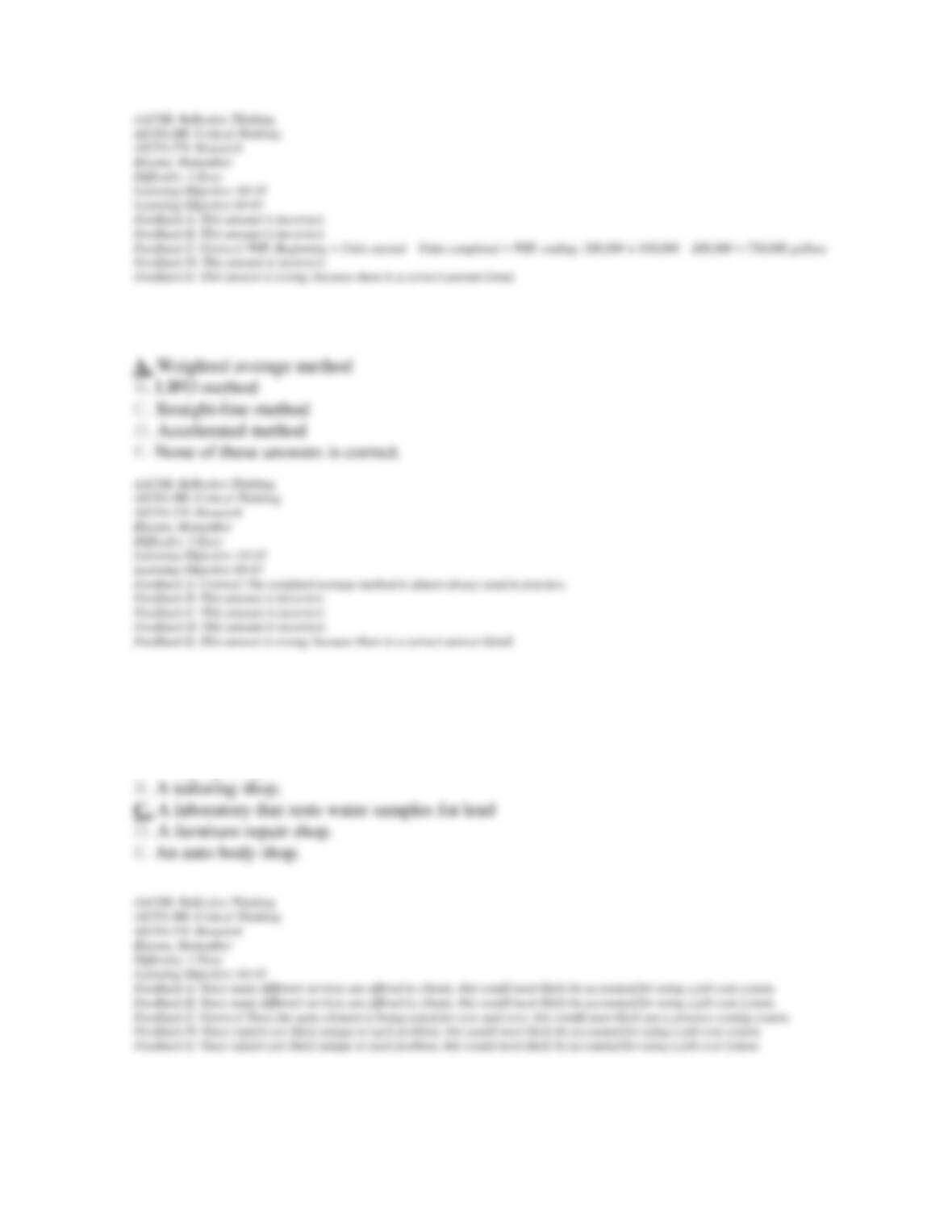
17. Which method of process costing is almost always used in practice?
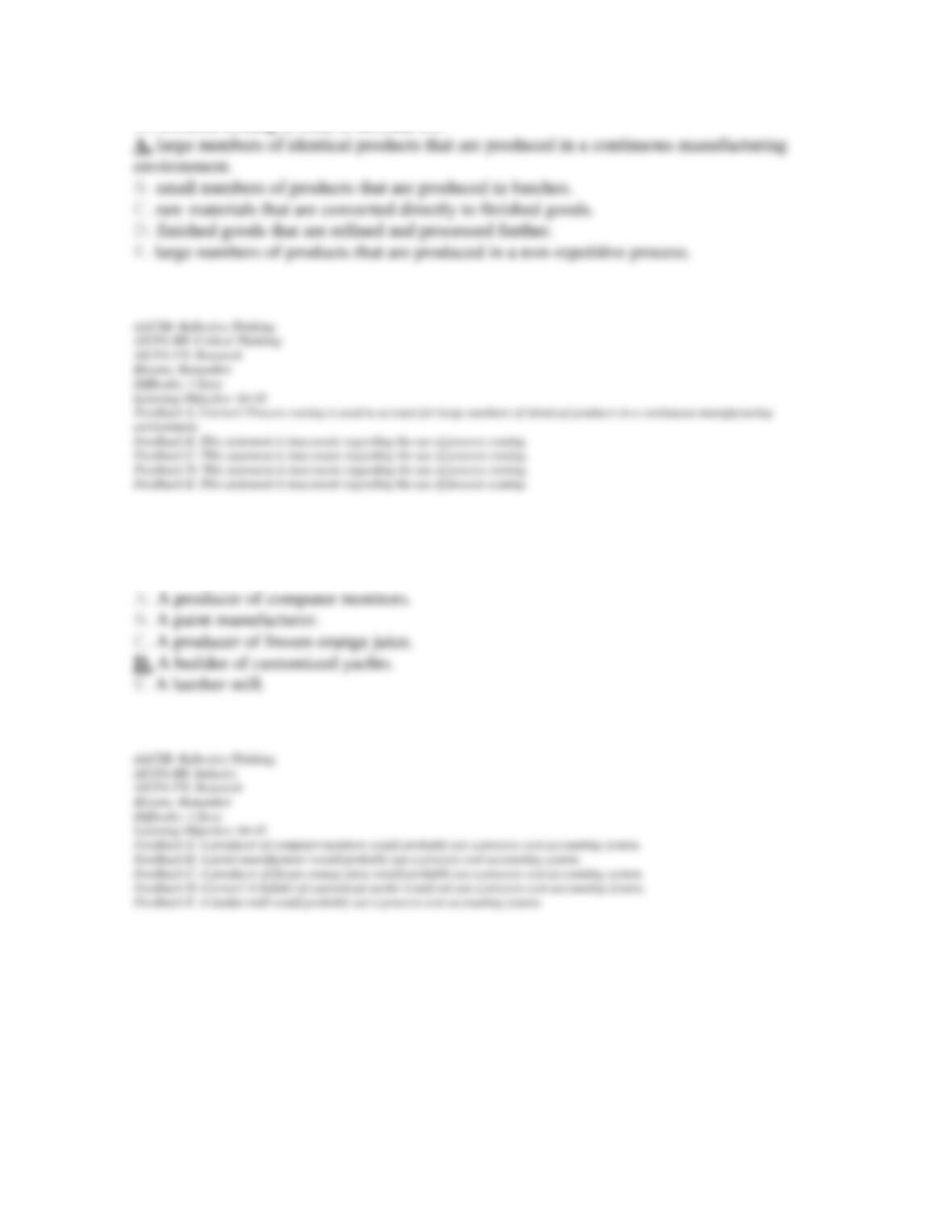
18. Which of the following is a nonmanufacturing business where process costing would most
likely be used?
A. A beauty shop.
4-7
19. Process costing is used to account for:
20. Which of the following manufacturers would most likely not use a process-cost
accounting system?
4-8
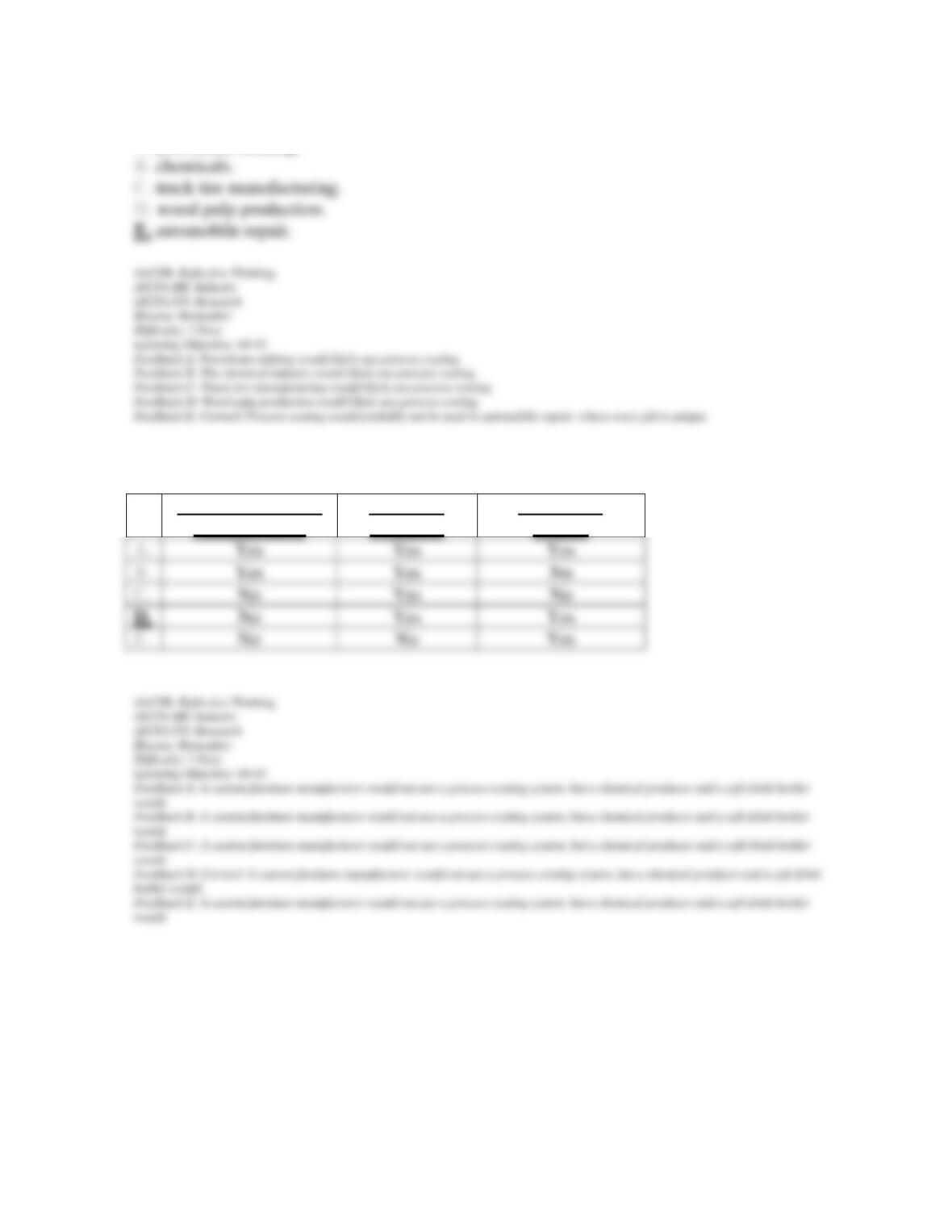
21. Process costing would likely be used in all of the following industries except:
A. petroleum refining.
22. Which of the following companies would likely use a process-costing system?
Custom Furniture
Manufacturer
Chemical
Producer
Soft Drink
Bottler
4-9
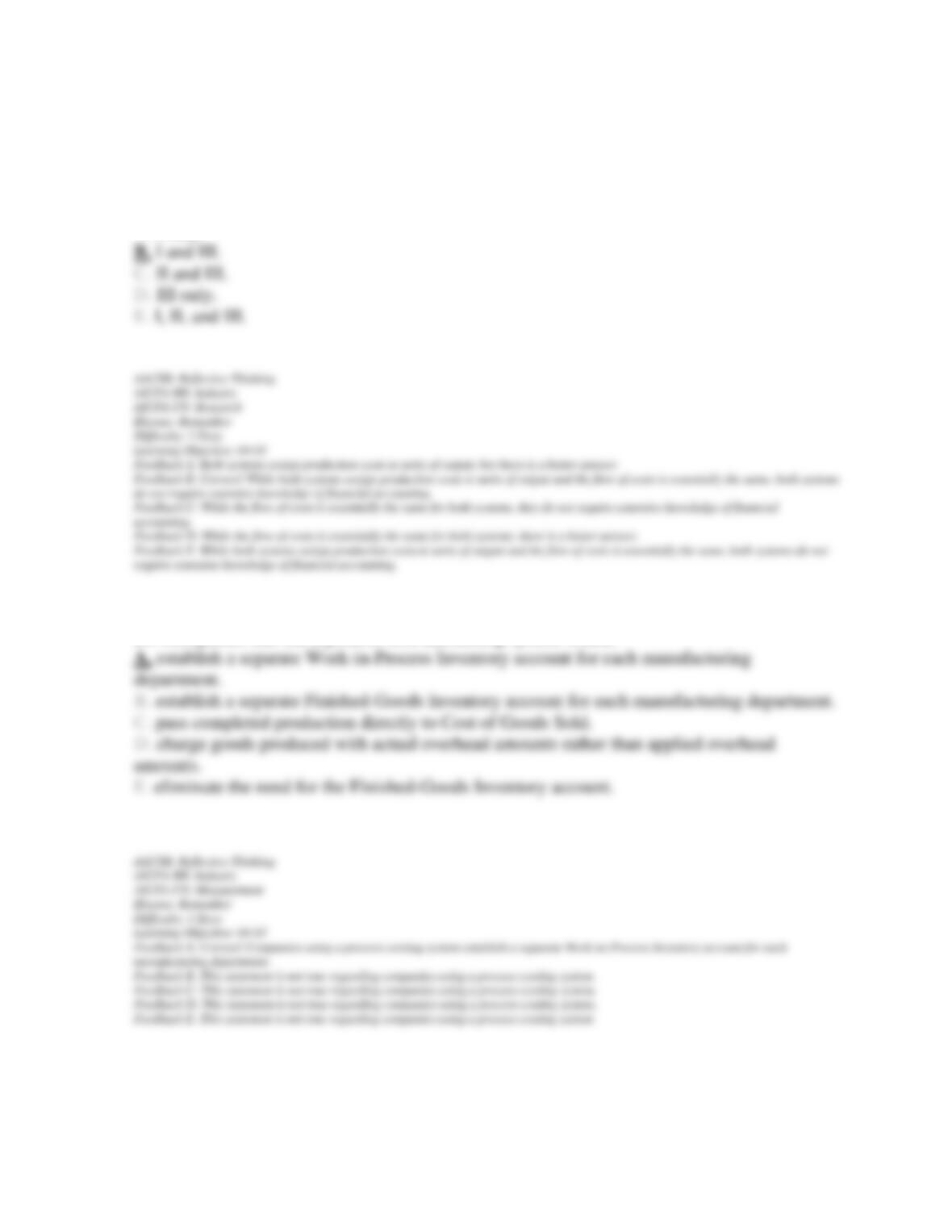
23. Which of the following statements about similarities between process costing and job-
order costing are true?
I. Both systems assign production costs to units of output.
II. Both systems require extensive knowledge of financial accounting.
III. The flow of costs through the manufacturing accounts is essentially the same.
A. I only.
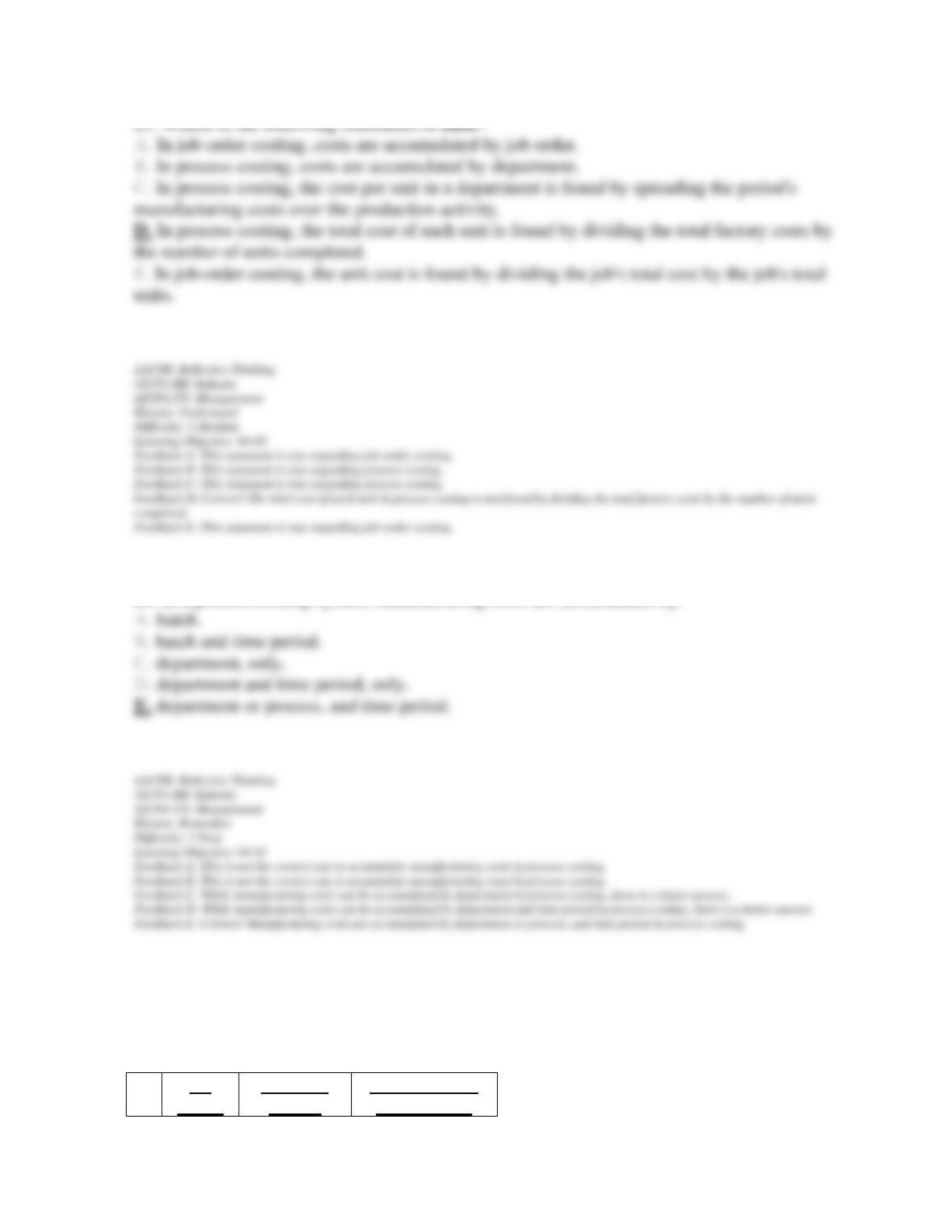
24. Companies that use a process-cost accounting system would:
4-10
26. In a process-costing system, manufacturing costs are accumulated by:
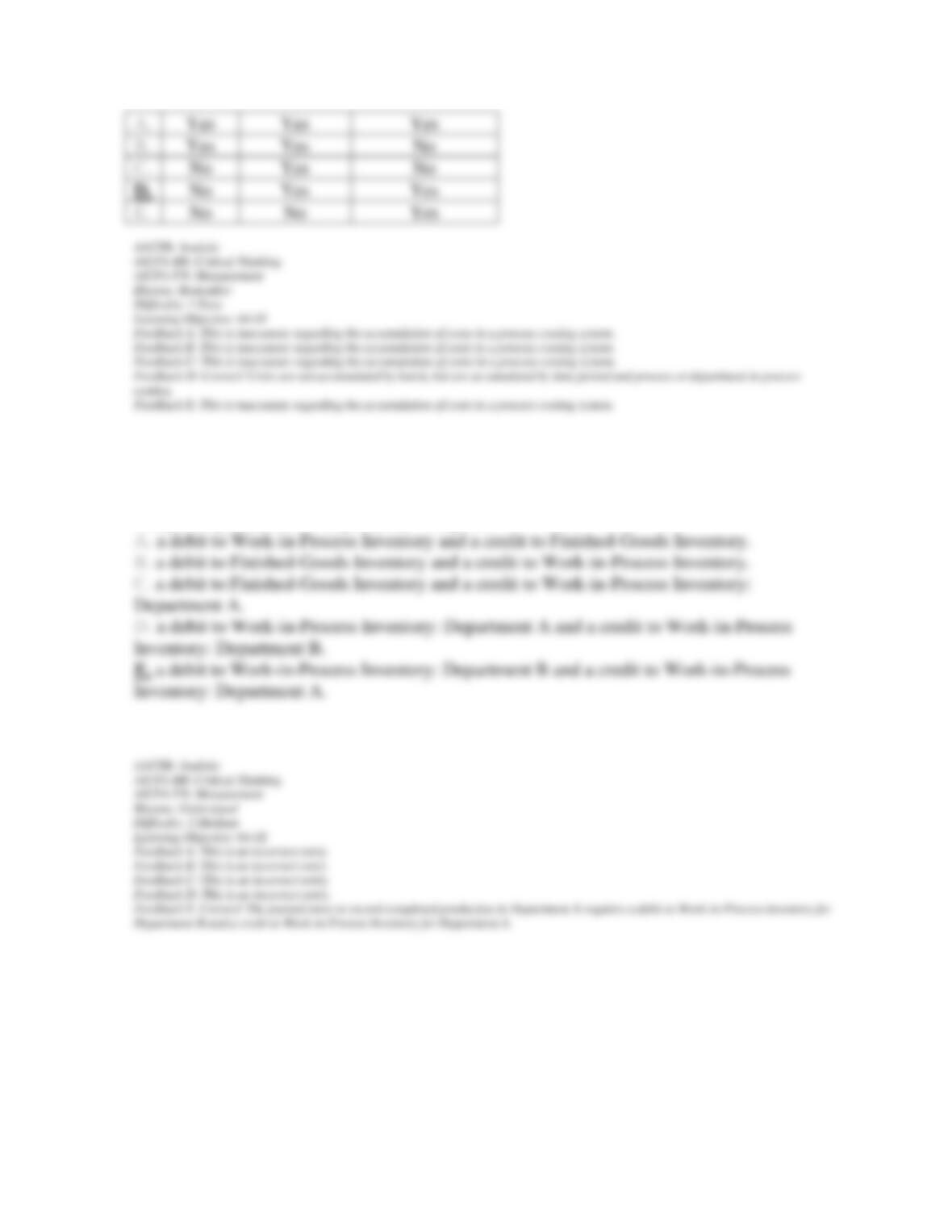
27. Which of the following choices correctly shows how costs are accumulated in a process-
costing system?
By
Batch
By Time
Period
By Process or
Department
4-11
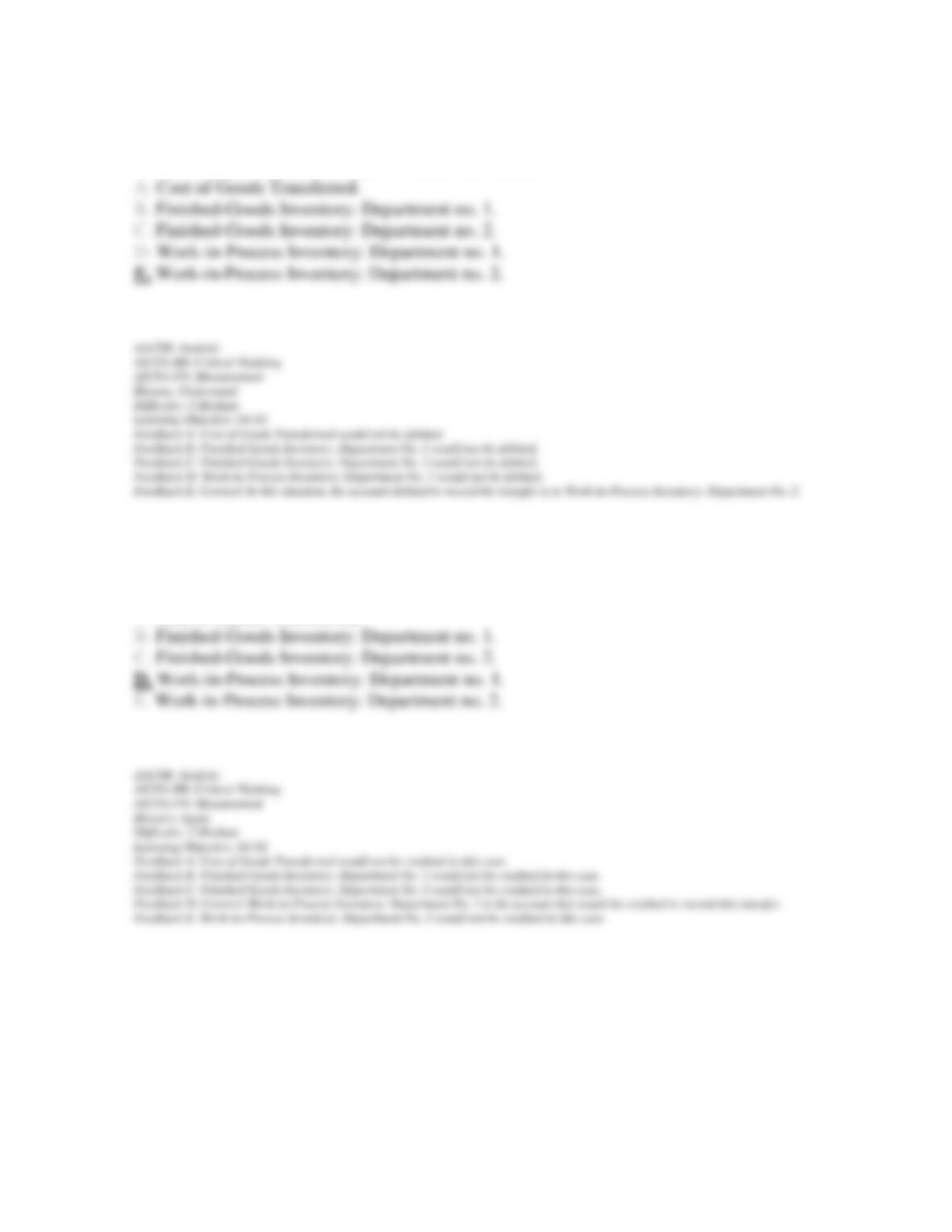
28. Mulligan, Inc., which uses a process-cost accounting system, passes completed production
from Department A to Department B for further manufacturing. The journal entry to record
completed production in Department A requires:
4-12
29. Gulliver, Inc., which uses a process-costing system, transfers completed production from
Department no. 1 to Department no. 2 for further work. Which of the following best describes
the account that would be debited to record this transfer?
30. Breight, Inc., which uses a process-costing system, transfers completed production from
Department no. 1 to Department no. 2 for further work. Which of the following best describes
the account that would be credited to record this transfer?
A. Cost of Goods Transferred.
4-13
31. Harrington Industries, which uses a process-costing system, had a balance in its Work-in–
Process account of $68,000 on January 1. The account was charged with direct materials,
direct labor, and manufacturing overhead of $450,000 throughout the year. If a review of the
accounting records determined that $86,000 of goods were still in production at year-end,
Harrington should make a journal entry on December 31 that includes:
A. a debit to Cost of Goods Sold for $432,000.
32. Hornsby has a single production department, and uses a process-costing system. The
balance in its Work-in-Process account on January 1 was $68,000. The account was charged
with direct materials, direct labor, and manufacturing overhead of $450,000 throughout the
year. If a review of the accounting records determined that $86,000 of goods were still in
production at year-end, Hornsby should make a journal entry on December 31 that includes:
A. a debit to Cost of Goods Sold for $432,000.
4-14
33. Unit costs in a process-costing system are derived by using:
34. Bratton Corporation had 6,500 units of work in process on April 1. During April, 19,100
units were completed and as of April 30, 5,100 units remained in production. How many units
were started during April?
4-15
35. Linder Corporation had 8,200 units of work in process on November 1. During
November, 26,800 units were started and as of November 30, 7,900 units remained in
production. How many units were completed during November?
36. Xin Co., had 3,000 units of work in process on April 1 that were 60% complete. During
April, 10,000 units were completed and as of April 30, 4,000 units that were 40% complete
remained in production. How many units were started during April?
4-16
37. Forte Co., had 3,000 units of work in process on April 1 that were 60% complete. During
April, 11,000 units were started and as of April 30, 4,000 units that were 40% complete
remained in production. How many units were completed during April?
38. Oxford, Inc., which uses a process-cost accounting system, began operations on January 1
of the current year. The company incurs conversion cost evenly throughout manufacturing. If
Oxford started work on 3,000 units during the period and these units were 70% of the way
through manufacturing, it would be correct to say that the company has:
4-17
39. Which of the following data are needed to calculate total equivalent units under the
weighted-average method?
40. Covington Corporation uses a process-cost accounting system. The company adds direct
materials at the start of its production process; conversion cost, on the other hand, is incurred
evenly throughout manufacturing. The firm has no beginning work-in-process inventory; its
ending work in process is 40% complete. Which of the following sets of percentages would
be used to calculate the correct number of equivalent units in the ending work-in-process
inventory?
4-18
41. Ashley Corporation uses a process-cost accounting system. The company adds direct
materials and direct labor at the start of its production process; overhead cost is incurred
evenly throughout manufacturing. The firm has no beginning work-in-process inventory; its
ending work in process is 40% complete. Which of the following sets of percentages would
be used to calculate the correct number of equivalent units in the ending work-in-process
inventory?
42. Alton Company uses a process-costing system for its single product. Material A is added
at the beginning of the process; in contrast, material B is added when the units are 75%
complete. The firm’s ending work-in-process inventory consists of 6,000 units that are 80%
complete. Which of the following correctly expresses the equivalent units of production with
respect to materials A and B in the ending work-in-process inventory?
4-19
43. Agee Company uses a process-costing system for its single product. Material A is added
at the beginning of the process; in contrast, material B is added when the units are 50%
complete. The firm’s ending work-in-process inventory consists of 4,000 units that are 75%
complete. Which of the following correctly expresses the equivalent units of production with
respect to materials A and B in the ending work-in-process inventory?
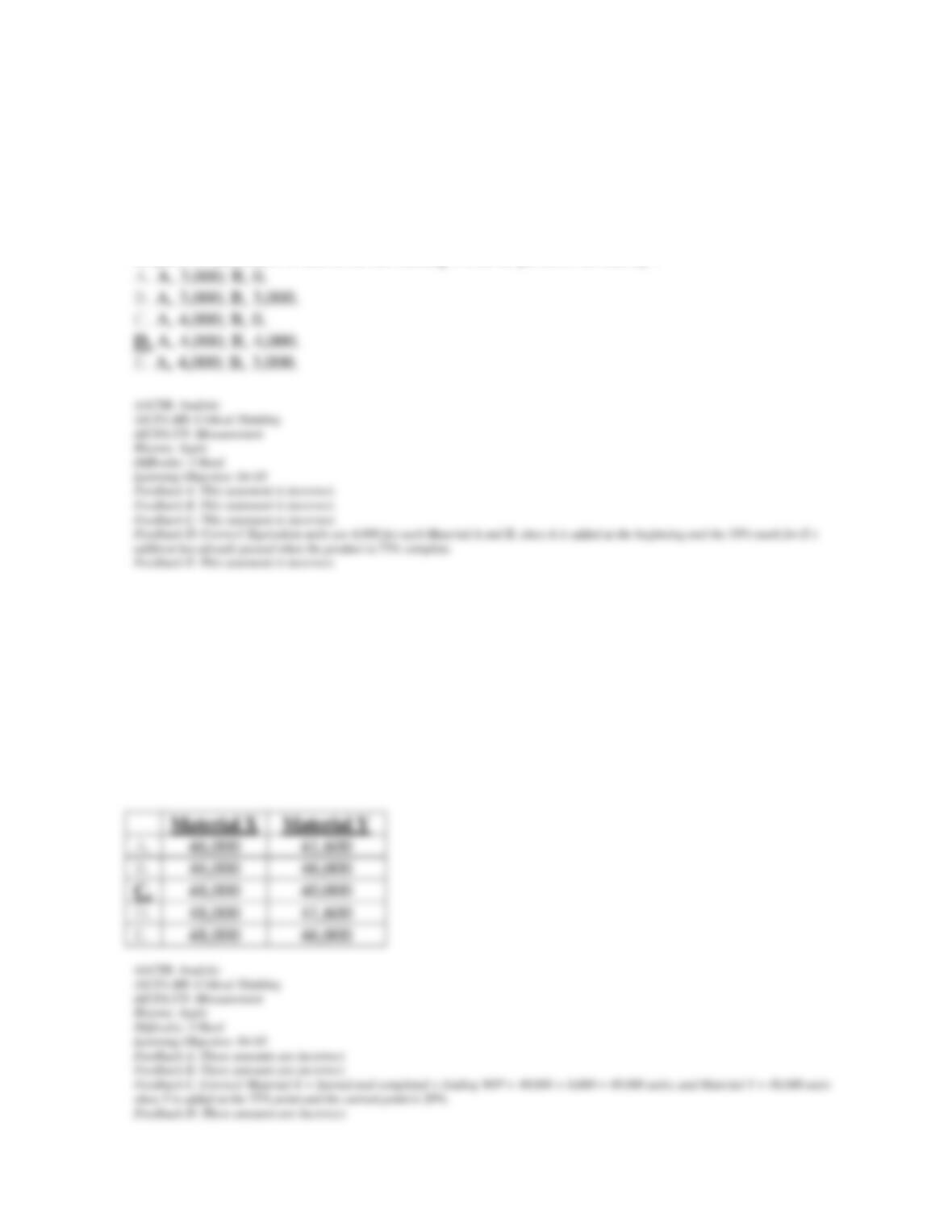
44. Warren Industries uses a process-costing system for its single product, which is
manufactured from Material X and Material Y. X and Y are introduced to the product as
follows:
Material X: Added at the beginning of manufacturing
Material Y: Added at the 75% stage of completion
The company started and completed 40,000 units during the period, and had an ending work-
in-process inventory amounting to 8,000 units, 20% complete. Which of the following choices
correctly expresses the total equivalent units of production for Material X and Material Y?