1. Differential analysis involves the comparison of one or more alternative courses of action
with the status quo.
2. If there is only one alternative course of action and the status quo is unacceptable, then
there really is no decision to make.
3. A decision must involve at least two alternative courses of action.
4. Differential analysis cannot be used for long-run decisions because it cannot incorporate
the timing of revenues and costs (i.e., the time-value of money).
5. Short-run decisions often have long-run implications.
6. Only variable costs can be differential costs.
7. Fixed costs are always classified as sunk costs in differential cost analysis.
8. The full cost fallacy occurs when a decision-maker fails to include fixed manufacturing
overhead in the product’s cost.
9. When deciding whether or not to accept a special order, a decision-maker should focus on
differential costs instead of full costs.
10. The differential analysis approach to pricing for special orders could lead to under-pricing
in the long-run because fixed costs are not included in the analysis.
11. Target costs equal the difference between the target selling price and the desired profit
margin.
12. Dumping occurs when a company exports its product to consumers in another country at
an export price that is below the domestic price.
13. Price discrimination is the practice of selling identical goods or services to different
customers at different prices.
14. Peak load pricing is the practice of setting prices lowest when the quantity demanded for
the product approaches the physical capacity to produce it.
15. The alternative courses of action in a make-or-buy decision are (a) manufacture needed
items internally or (b) purchase needed items externally.
16. The reason opportunity costs are not included in the accounting system is because they
involve estimates.
17. Financial statements prepared in accordance with generally accepted accounting
principles (GAAP) provide differential cost information.
18. In the short-run, plant capacity is fixed and product choices have to be made that optimize
the use of available capacity.
19. With constrained resources, the important measure of profitability is the contribution
margin per unit of scarce resource.
20. The theory of constraints focuses on determining the optimal product mix when one or
more resources restrict the attainment of a goal or objective.
21. The relevance of a particular cost to a decision is determined by the: (CMA adapted)
22. In a decision analysis situation, which one of the following costs is not likely to contain a
variable cost component? (CMA adapted)
23. Which of the following statements regarding differential costs is (are) false?
(A) The full cost fallacy occurs when a decision-maker fails to include fixed manufacturing
overhead in the product’s cost.
(B) When deciding whether or not to accept a special order, a decision-maker should focus on
differential costs instead of full costs.
24. Which of the following costs are irrelevant for a special order that will allow an
organization to utilize some of its present idle capacity?
25. Which of the following statements regarding special orders is (are) true?
(A) The primary decision for special orders is determining whether the differential revenue is
greater than the differential costs associated with the order.
(B) The differential analysis approach to pricing for special orders could lead to underpricing in
the long-run because fixed costs are not included in the analysis.
4-12
26. Which of the following costs are not considered in a differential analysis for a make–or–
buy decision?
27. For the past five years, the RS Company has produced and sold electronic magnets to
chemistry labs throughout the United States. Recently, a strong competitor has entered the
market and RS is considering whether it should continue to produce and sell the electronic
magnets. The following information has been gathered to assist management in its decision:
A) The machinery used to produce the magnet was purchased five-years ago for $500,000.
B) Four of the employees who produce magnets would be reassigned to the magnifying glass
division.
C) The space now used to produce the magnets would be used to eliminate the need to rent
warehouse space.
D) Sales volume (units) is estimated to drop by 50% once the competitor becomes fully
operational.
Which of the items listed above is (are) relevant to the decision to continue the production and
sale of the electronic magnets?
28. Which of the following statements about the theory of constraints is (are) true?
(A) The theory of constraints focuses on determining the optimal product mix when one or more
resources restrict the attainment of a goal or objective.
(B) The theory of constraints focuses on maximizing the rate of throughput contribution while
minimizing investment and other operating costs.
29. The theory of constraints focuses on maximizing throughput contribution margin while
minimizing all of the following except:
30. The AZ Company manufactures kitchen utensils. The company is currently producing well
below its full capacity. The BV Company has approached AZ with an offer to buy 20,000 utensils
at $0.75 each. AZ sells its utensils wholesale for $0.85 each; the average cost per unit is $0.83, of
which $0.12 is fixed costs. If AZ were to accept BV’s offer, what would be the increase in AZ’s
operating profits?
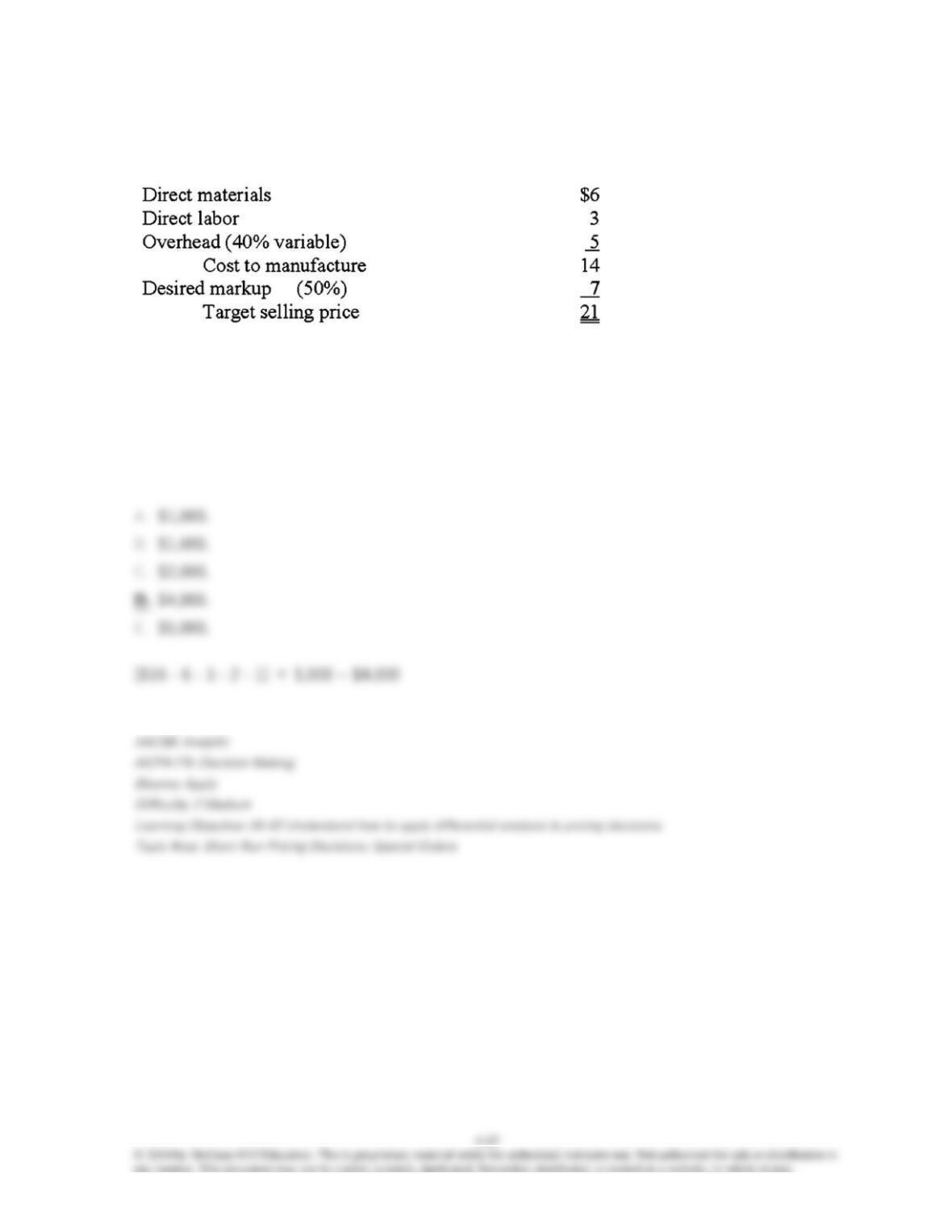
31. The MNK Company has gathered the following information for a unit of its most popular
product:
The above cost information is based on 4,000 units. A foreign distributor has offered to buy 1,000
units at a price of $16 per unit. This special order would not disturb regular sales. Variable
shipping and other selling expenses would be an additional $1 per unit for the special order. If the
special order is accepted, MNK’s operating profits will increase by:
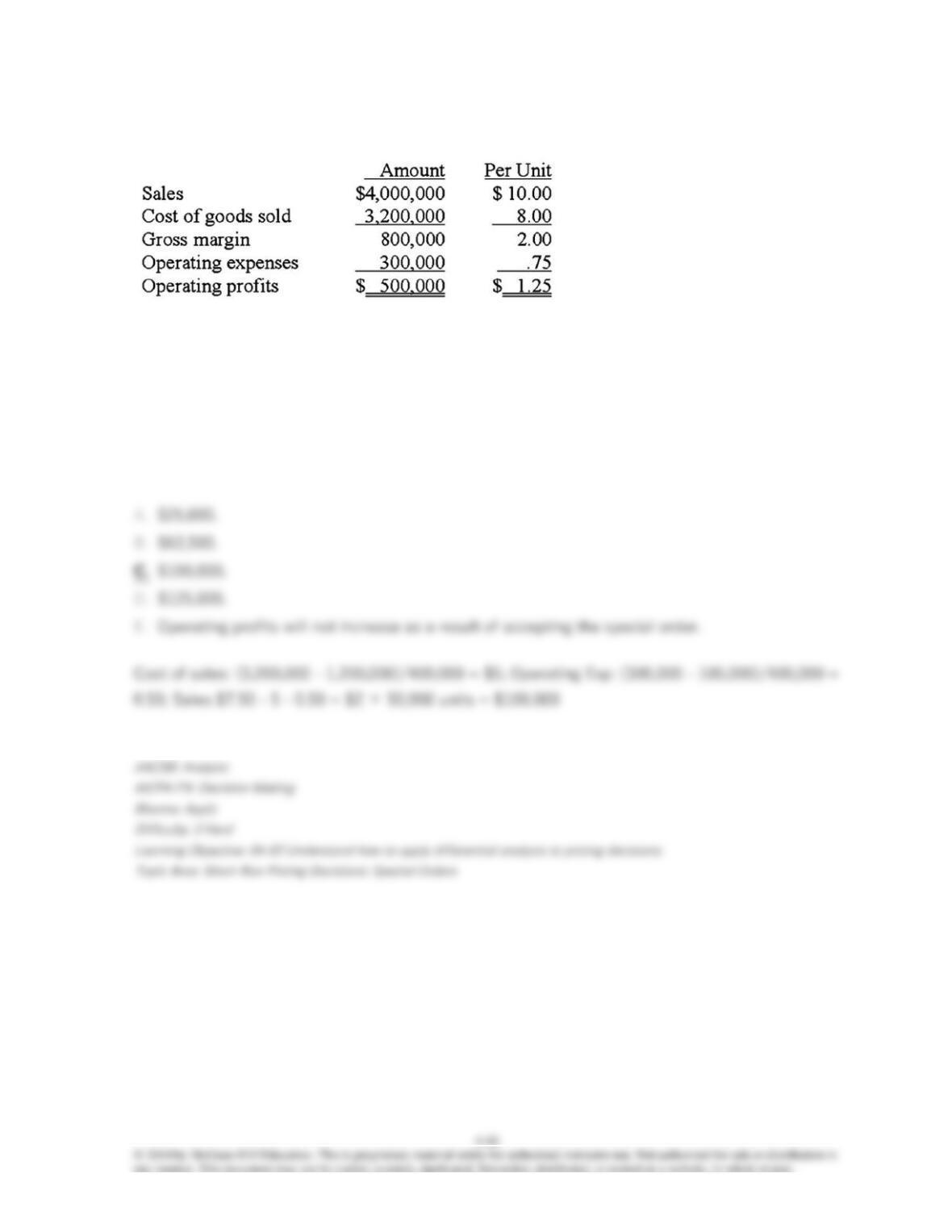
32. The following information relates to the Tram Company for the upcoming year.
The cost of goods sold includes $1,200,000 of fixed manufacturing overhead; the operating
expenses include $100,000 of fixed marketing expenses. A special order offering to buy 50,000
units for $7.50 per unit has been made to Tram. Fortunately, there will be no additional operating
expenses associated with the order and Tram has sufficient capacity to handle the order. How
much will operate profits be increased if Tram accepts the special order?
33. The Regal Baking Company is considering the expansion of its business into door–to-door
delivery service. This would require an additional $12,500 in labor costs per month. Company–
owned vehicles now used to make morning deliveries to restaurants could be used in the
afternoons to make the home deliveries. However, it is estimated that an additional $5,000 would
be required per month for gas, oil, and maintenance. It is further estimated that the home delivery
use of the trucks would be allocated 45% of the existing $6,500 fixed vehicle costs. What is the
differential delivery cost per month for expanding into the home delivery market?
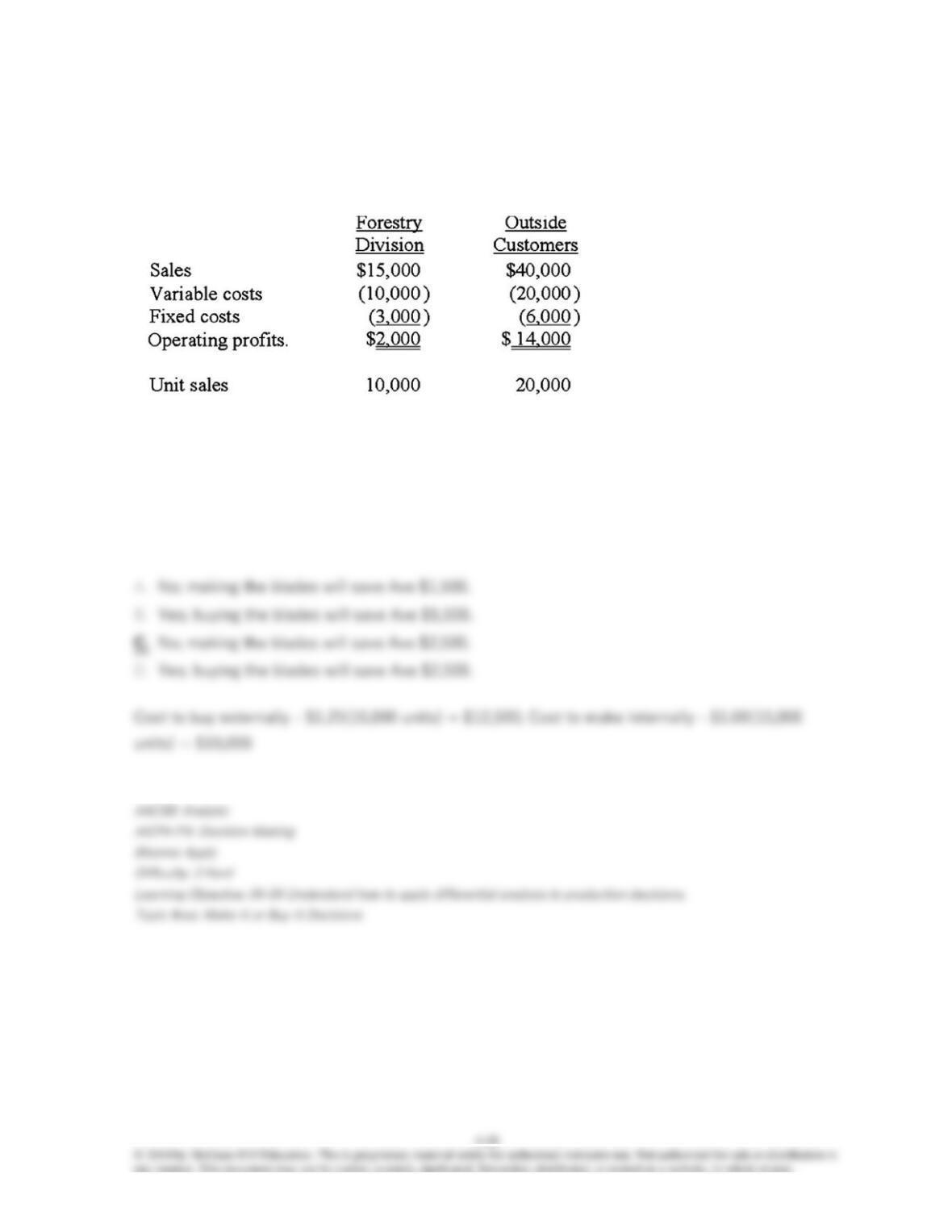
34. The Blade Division of Axe Company produces hardened steel blades. One-third of Blade’s
output is sold to the Forestry Products Division of Axe; the remainder is sold to outside
customers. Blades’ estimated operating profit for the year is:
The Forestry Division has an opportunity to purchase 10,000 blades of the same quality from an
outside supplier on a continuing basis. The Blade Division cannot sell any additional products to
outside customers. Should the Axe Company allow its Forestry Division to purchase the blades
from the outside supplier at $1.25 per unit?
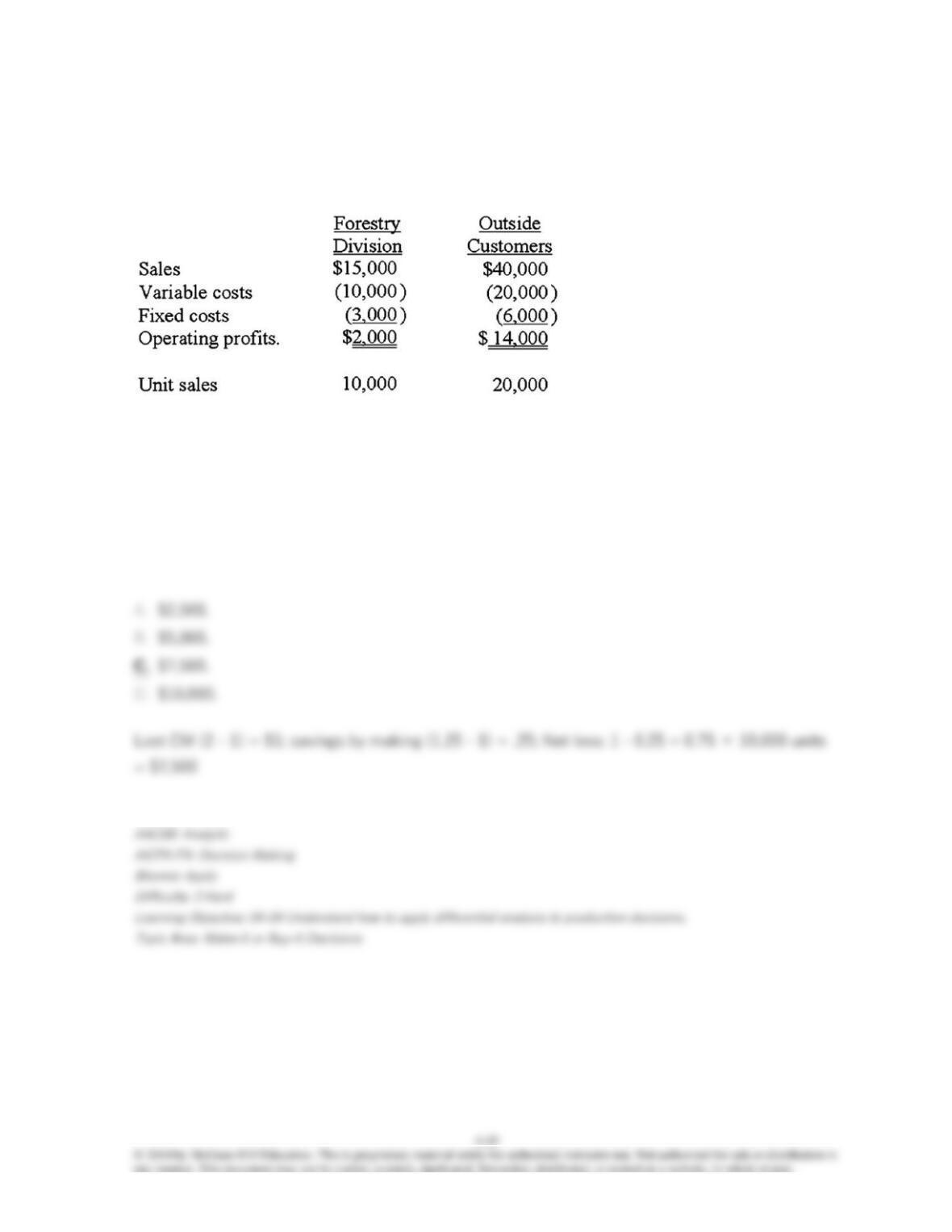
35. The Blade Division of Axe Company produces hardened steel blades. One-third of Blade’s
30,000 unit output is sold to the Forestry Products Division of Axe; the remainder is sold to
outside customers. Blades’ estimated operating profit for the year is:
The Forestry Division has an opportunity to purchase 10,000 blades of the same quality from an
outside supplier on a continuing basis. The purchase price would be $1.25. If the Blade Division is
now operating at full capacity and can sell all its units to outside customers at the present selling
price, what is the differential cost to Axe of requiring that the blades be made internally and sold
to the Forestry Division?
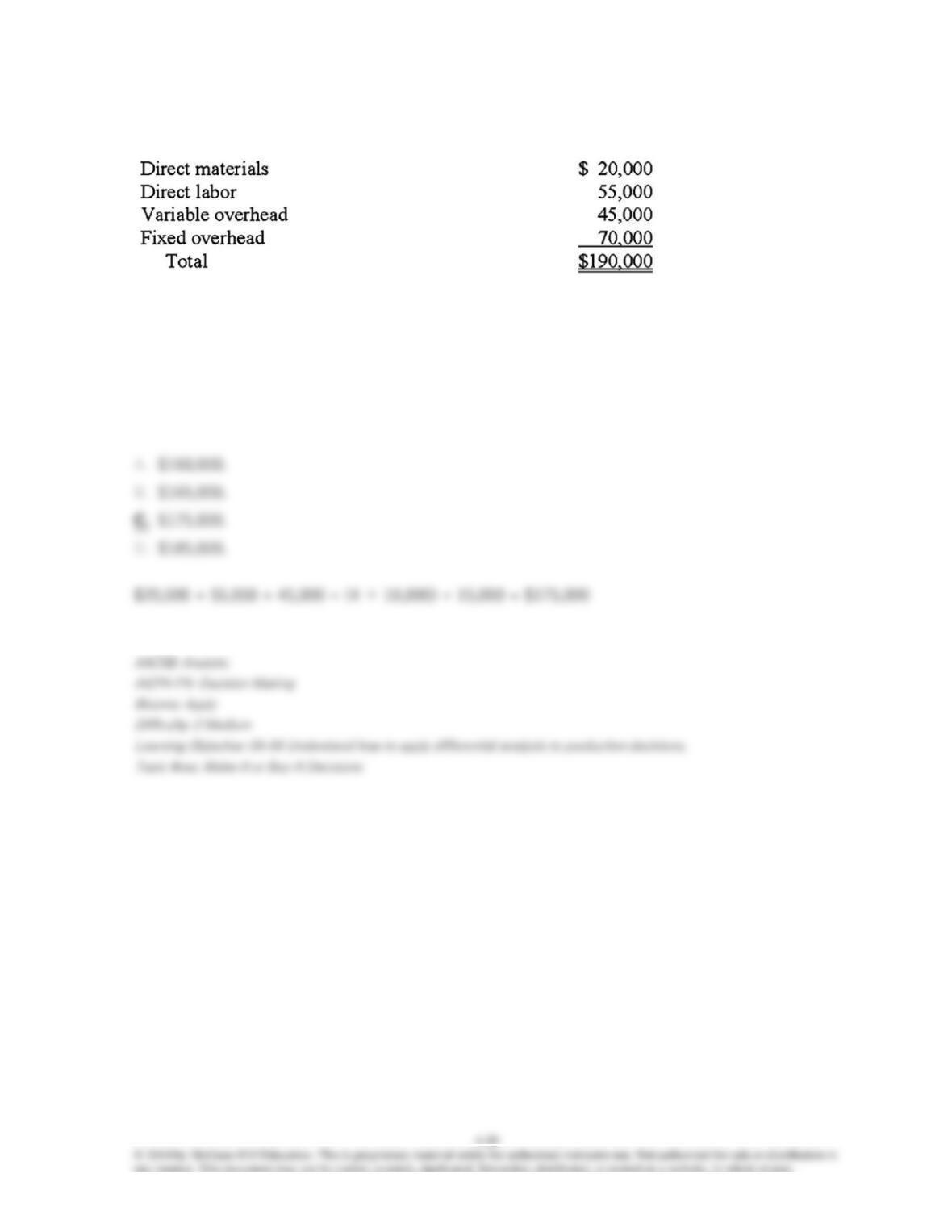
36. The CJP Company produces 10,000 units of item S10 annually at a total cost of $190,000.
The XYZ Company has offered to supply 10,000 units of S10 per year for $18 per unit. If CJP
accepts the offer, $4 per unit of the fixed overhead would be saved. In addition, some of CJP’s
facilities could be rented to a third party for $15,000 per year. What are the relevant costs for the
“make” alternative?