
Chapter 4—Documenting Information Systems Key
1. Flowcharts are commonly used for new systems implementations, business process reengineering, finance
function transformations, and assessments of internal controls.
2. Data flow diagrams (DFDs) depict a system’s components; the data flows among the components; and the
sources, destinations, and storage of data.
3. Data flow diagrams (DFDs) present a comprehensive picture of the management, operations, information
systems and process controls embodied in business processes.
4. A data flow diagram (DFD) is a graphical representation of a system, which depicts the system’s components,
5. System flowcharts use only four symbols.
6. Systems documentation is used to understand, explain, evaluate, and improve complex business processes,
information systems, and internal controls.
7. In a data flow diagram (DFD), a bubble symbol shown below depicts an entity or a process within which
incoming data flows are transformed into outgoing data flows.
8. The advantage of a physical data flow diagram (DFD) versus a logical data flow diagram (DFD) is that we
can concentrate on what activities a system is performing without having to specify how, where or by whom.
9. In a data flow diagram (DFD), a square represents an internal entity.
10. In a data flow diagram (DFD), two parallel lines represent the data store symbol.
11. The following symbol represents general purpose input-output.
12. The following symbol represents a computer process.
13. The following symbol represents a manual process
14. The following symbol represents a disk data store
15. The following symbol represents a paper file.
16. The following symbol represents a document.
17. In a data flow diagram (DFD), an external entity symbol portrays a source or a destination of data outside
18. A context diagram is a top-level diagram of a system that depicts the system and all its activities as a single
bubble.
19. Internal entities are those entities inside the system that send data to, or receive data from, the system.
20. Internal entities are those persons, places, or things that send data to, or receive data from, the system.
21. An external entity is a person, place, or thing within the system that transforms data.
22. A physical data flow diagram (DFD) uses bubbles to specify where, how, and by whom a system’s processes
are accomplished.
23. When the context diagram and the level 0 diagram have equivalent external data flows, the DFDs are said to
be balanced.
24. The successive subdivision, or exploding, of logical data flow diagrams (DFDs) is called bottom up
partitioning.
25. A systems flowchart is a graphical representation of both the physical and logical features of an information
system.
26. Processes that handle other-than-normal situations are called exception routines.
27. Information processing activities retrieve data from storage, transform data, or file data.
28. An acceptance stub is a data flow that leaves a bubble but does not go to any other bubble or file and
indicates processing that is performed in other than normal situations.
29. In an enterprise system, we would have one data store/disk symbol labeled “enterprise database” instead of
two or more data store symbols.
30. When we convert to an enterprise system, reengineered processes often result from the installation and can
cause changes throughout the systems flowcharts.
31. Systems flowcharts portray business process activities, stores of data, and flows of data among those
elements without presenting the physical details of those elements.
32. Data flow diagrams (DFDs) portray a business process’ activities, stores of data, and flows of data among
those elements.
33. In a systems flowchart, a square represents a source or destination of data outside the system.
34. In a systems flowchart, two parallel lines represent the data store symbol.
35. Internal entities are included on both data flow diagrams (DFDs) and systems flowcharts.
36. Internal entities are included on data flow diagrams (DFDs) but not on systems flowcharts.
37. External entities are persons, places, or things outside the context of the system.
38. The successive subdividing, or “exploding,” of physical data flow diagrams (DFDs) is called top-down
partitioning.
39. On a systems flowchart the start/stop symbol can also be an external entity.
40. There can be only one correct logical data flow diagram (DFD) for any system.
41. A symbol used in data flow diagrams (DFDs) to depict an entity or process within which incoming data
flows are transformed into outgoing data flows is a(n):
42. A data flow diagram (DFD) could contain each of the following symbols except:
43. Which of the following data flow diagram (DFD) symbols is represented by two parallel lines?
A. data flow symbol
44. Which data flow diagram (DFD) symbol portrays a source or destination of data outside the system?
45. Which data flow diagram (DFD) symbol is usually portrayed with a circle?
A. data flow
46. Which data flow diagram (DFD) symbol is usually portrayed with a square?
47. Which data flow diagram (DFD) symbol is usually portrayed with an arrow?
48. In the top-down partitioning of process 3.0, the next level’s process bubbles would be labeled (assuming
there are four subprocesses):
A. 1.3, 2.3, 3.3, 4.3
49. Which of the following data flow diagram (DFD) guidelines is correct?
50. Which of the following systems flowcharting guidelines is correct?
A. documents or reports printed by a central computer should first be show in that computer’s column
51. Those entities which perform no information processing activities for the system are called:
52. Which symbol can be either an entity or a process depending on the type of data flow diagram (DFD)?
53. Which of the following is the least detailed of the data flow diagrams?
54. In a physical data flow diagram (DFD), this is something within the system that transforms data.
A. data flow
55. In a physical data flow diagram (DFD), a bubble or circle could be used to specify each of the following
except:
A. where a process is performed
56. Which type of data flow diagram specifies where, how, and by whom a system’s processes are performed?
57. A person, place, or thing within a system that transforms data is called:
58. Which data flow diagram shows what activities the system is performing without having to specify how,
where, or by whom the activities are accomplished?
A. context diagram
59. Data flow labels in context diagrams usually describe:
60. In which of the following data flow diagrams does the bubble symbol represent a process and not the entire
system?
61. In a logical data flow diagram (DFD) for a cash receipts system, each of the following labels might appear
in a bubble except:
62. The data flows in a logical data flow diagram (DFD) show:
63. When two data flow diagrams (DFDs) have equivalent external data flows, we say that the two data flow
diagrams are:
64. A process in which successive layers of data flow diagrams (DFDs) are constructed by “exploding” the
bubbles on a less detailed DFD to show more detailed data flows is called:
65. Which of the following statements related to the construction of data flow diagrams (DFDs) is false?
A. The level 0 diagram is the next level down from the context diagram.
66. A systems flowchart varies from a data flow diagram (DFD) because it:
A. only represents the information system
67. Information processing activities include:
68. Why do auditors and systems analysts use systems documentation?
69. On a systems flowchart, computer processing is represented by a:
70. On a systems flowchart, a paper file is represented by a:
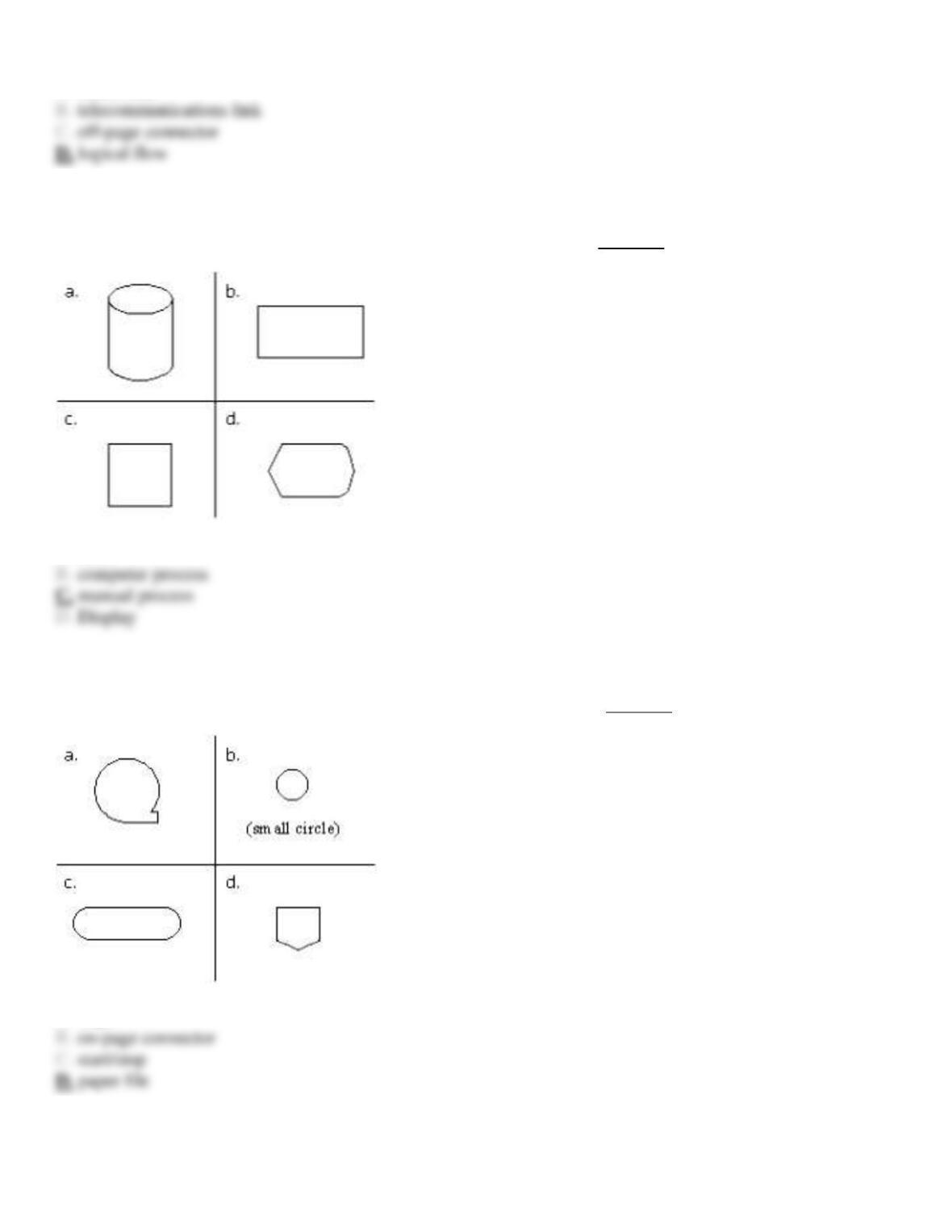
71. On a systems flowchart, a solid line with an arrow indicates a(n):
A. batch total
72. Which of the following systems flowcharting symbol descriptions is incorrect?
A. Disk
73. Which of the following systems flowcharting symbols descriptions is incorrect?
A. Tape
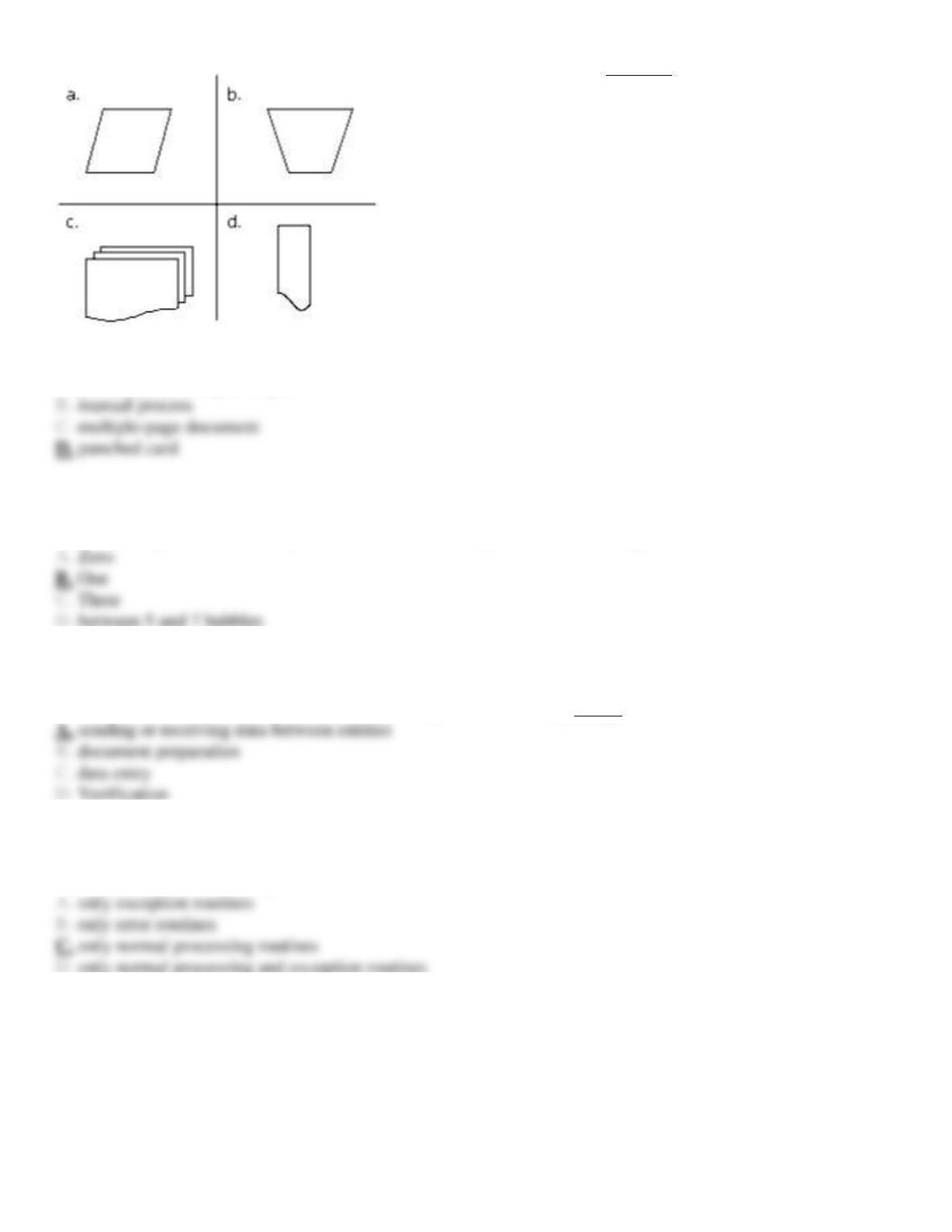
74. Which of the following systems flowcharting symbols descriptions is incorrect?
A. general purpose input-output
75. How many circles (bubbles) are included in a correctly drawn context diagram?
76. An information processing activity could be any of the following except:
77. In drawing a context diagram, we should include:
78. To make a logical data flow diagram (DFD) readable, how many bubbles should be used?
79. On a logical data flow diagram (DFD), data flows:
80. All of the following are “guidelines” for grouping activities in a level 0 DFD except:
81. When a transaction cannot be processed in a routine fashion because of an error or other processing
problems, the transaction must be handled by a(n):
A. rejection routine
82. The following is a jumbled list of the activities suggested in this text for drafting data flow diagrams (DFDs)
for an existing system:
I.
Prepare a table of entities and activities.
II.
Prepare an annotated table of entities and activities.
III.
Draw a physical data flow diagram.
IV.
Draw a logical data flow diagram.
V.
Draw a context diagram.
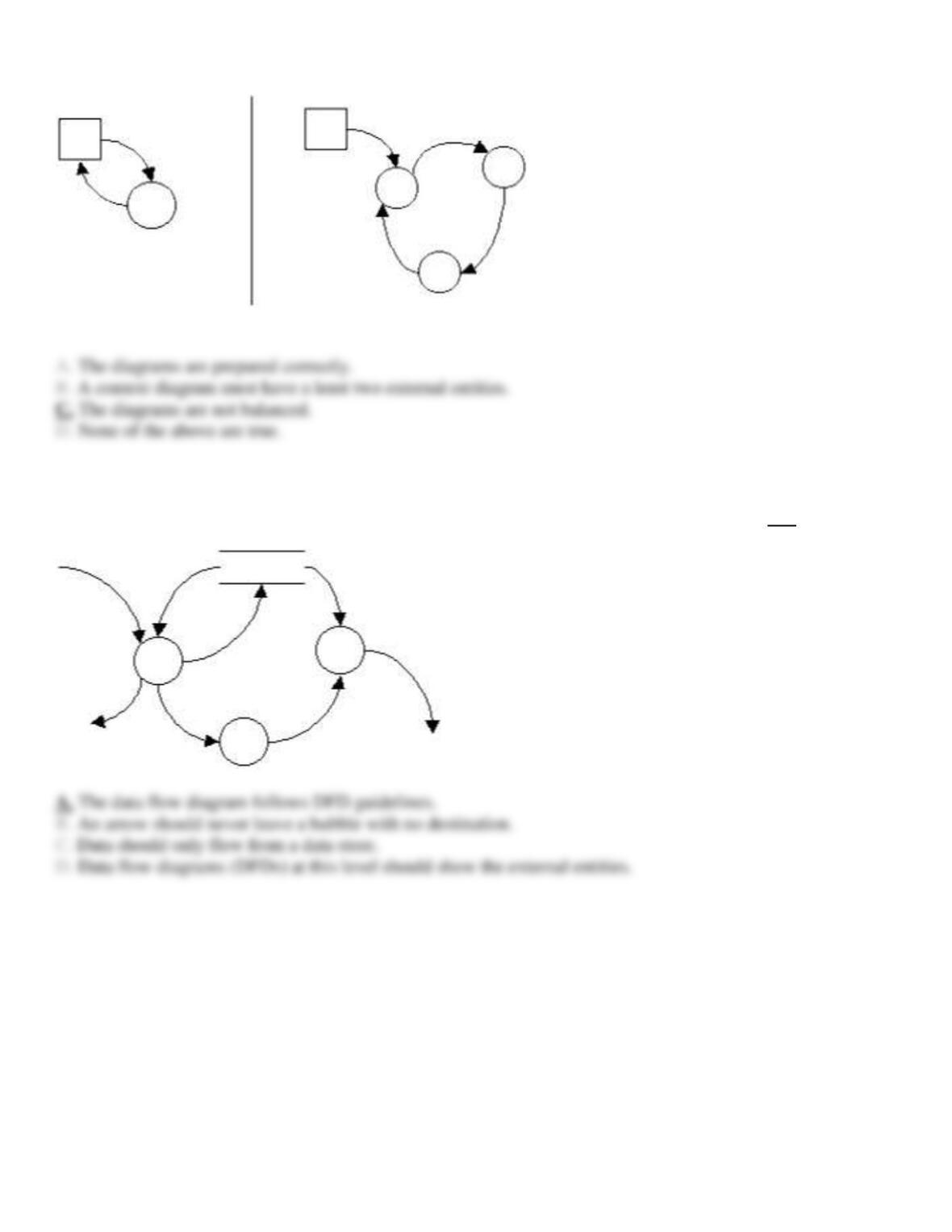
83. Examine the following context diagram and the related level 0 logical DFD. Which of the following
statements is true?
84. Which statement concerning the following diagram 1.0 logical data flow diagram (DFD) is true?
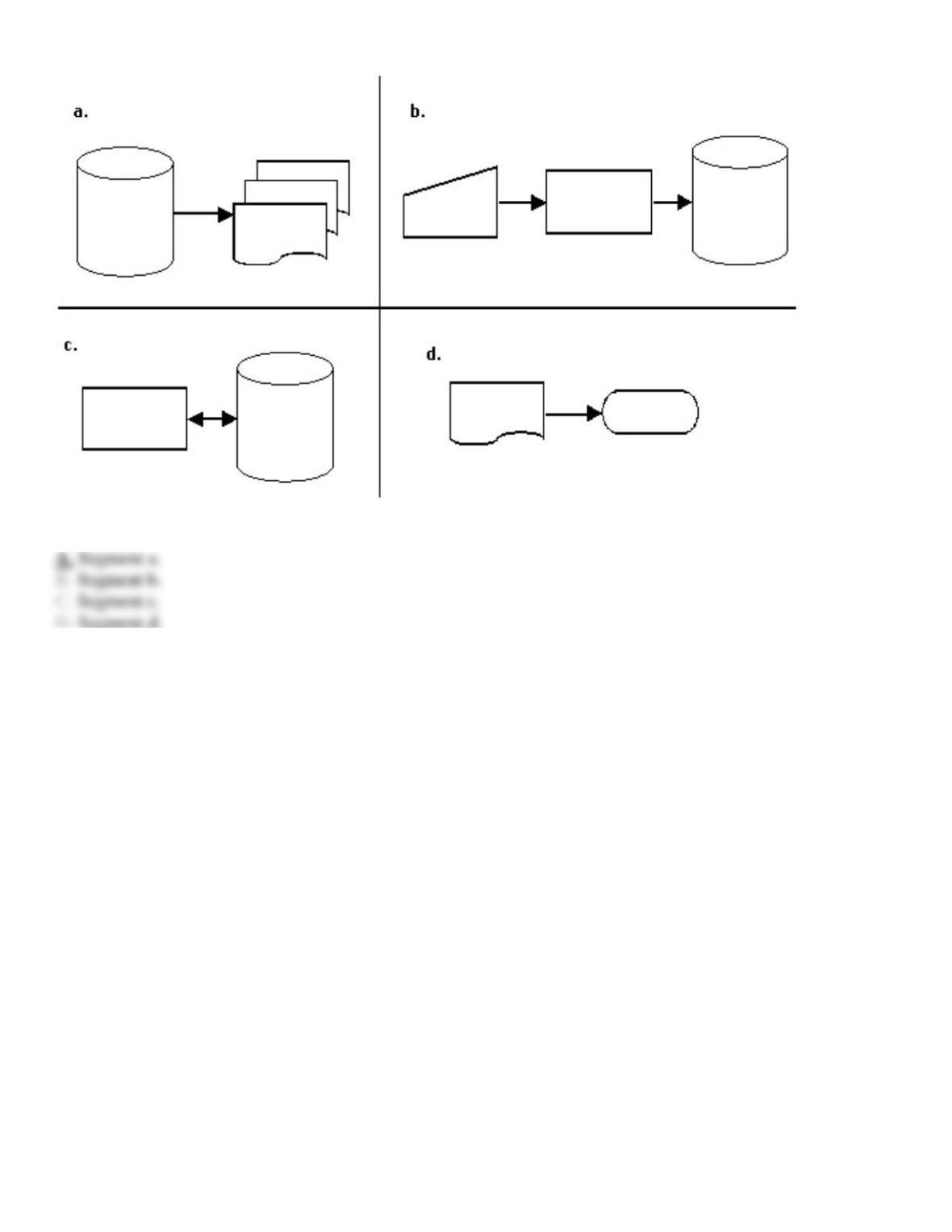
85. Which of the following segments violates guidelines for creating systems flowcharts?
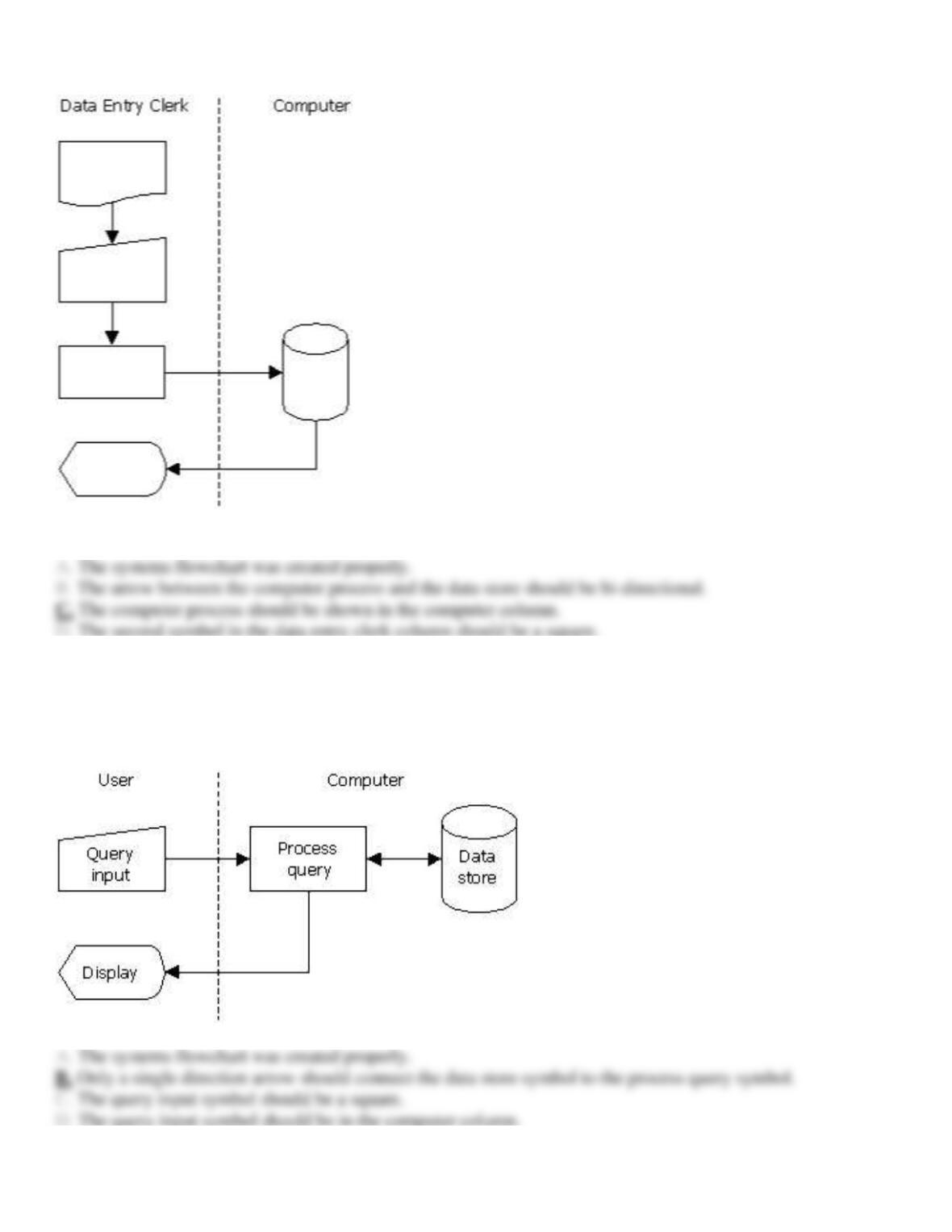
86. The following systems flowchart segment depicts a data entry clerk keying data from a source document
into a business event data store. Which statement is correct?
87. The following systems flowchart segment depicts a user’s query of a data store to view information on a
computer screen. Which statement is correct?
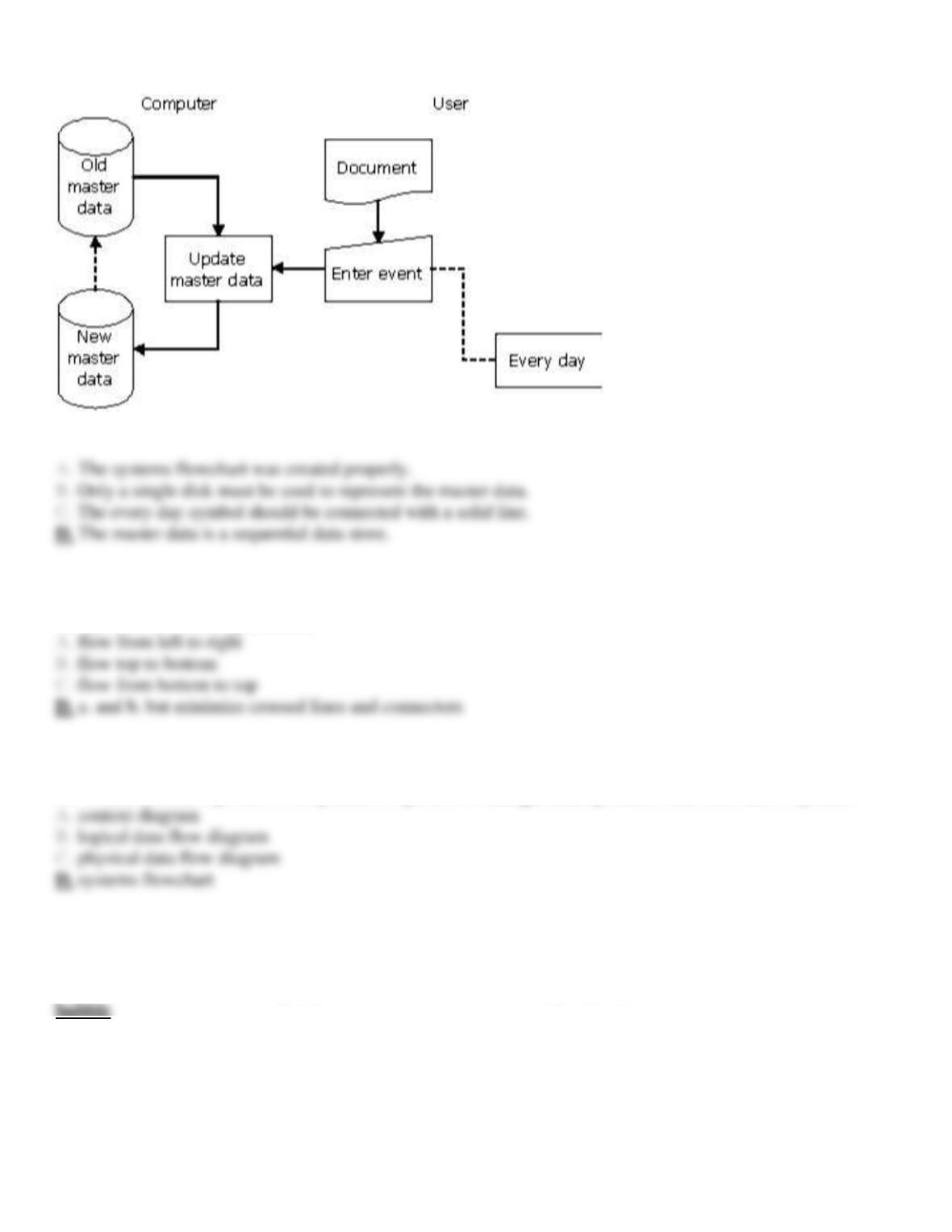
88. The following systems flowchart segment depicts a user entering business event data from a source
document to update a master file data store. Which statement is correct?
89. System flowchart logic should:
90. Which of these represent a comprehensive picture of management, operations and information systems?
91. In a data flow diagram (DFD), a(n) ______________________________ symbol depicts an entity or a
process within which incoming data flows are transformed into outgoing data flows.

92. In a data flow diagram (DFD), a(n) ______________________________ symbol represents a pathway for
data.
93. In a data flow diagram (DFD) data store symbols are represented by ______________________________.
94. In a data flow diagram (DFD), a(n) ______________________________ symbol portrays a source or a
destination of data outside the system.
95. A(n) ______________________________ is the top-level, or least detailed, diagram of a system depicting
the system and all its activities as a single bubble and showing the data flows into and out of the system and into
and out of the external entities.
96. A(n) ______________________________ is the top-level, or least detailed, diagram of a system.
97. ______________________________ are those persons, places, or things outside the system that send data
to, or receive data from, the system.
98. A(n) ______________________________ is a person, place, or thing within the system that transforms
data.
99. A(n) ______________________________ specifies where, how, and by whom a system’s activities are
accomplished.
100. A(n) ______________________________ shows what activities the system is doing without specifying
how, where or by whom the activities are accomplished.
101. A(n) ______________________________ data flow diagram (DFD) depicts what activities the system
performs rather than how, where, or by whom they are performed.
102. When the context diagram and the level 0 diagram reflect the equivalent external data flows, the two
diagrams are said to be ______________________________.
103. The successive subdividing, or exploding, of logical data flow diagrams (DFDs) is called
______________________________.
104. A(n) ______________________________ gives a complete picture of a system by combining physical and
logical aspects of the system.
105. A(n) ______________________________ is any action being performed by an internal or external entity.
106. ______________________________ activities include retrieving data from storage, transforming data, or
filing data.
107. Processes that handle other-than-normal situations are called ______________________________ routines
or ______________________________ routines.